Wednesday, June 29, 2022

IDC: Worldwide public cloud revenues grew 29.0% in 2021

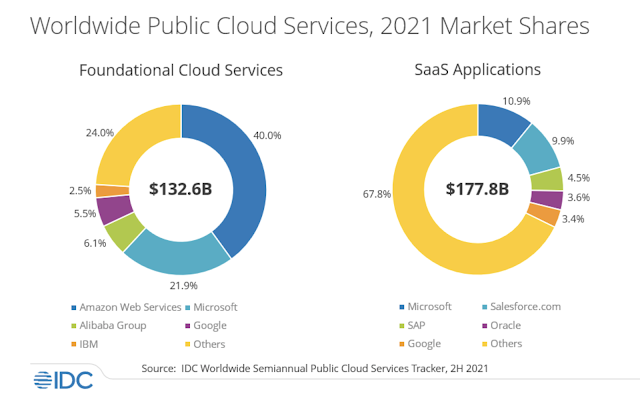
The worldwide public cloud services market, including Infrastructure as a Service (IaaS), Platform as a Service (PaaS), Software as a Service – System Infrastructure Software (SaaS – SIS), and Software as a Service – Applications, grew 29.0% year over year in 2021 with revenues totaling $408.6 billion, according to the International Data Corporation (IDC) Worldwide Semiannual Public Cloud Services Tracker.
"Organizations continued their strong adoption of shared public cloud services in 2021 to align IT investments more closely with business outcomes and ensure rapid access to the innovations required to be a digital-first business," said Rick Villars, group vice president, Worldwide Research at IDC. "For the next several years, leading cloud providers will play a critical role in helping enterprises navigate the current storms of disruption (inflation, supply chain, and geopolitical tensions), but IT teams will also focus more on bringing greater financial accountability to the variable spend models of public cloud services."

Some highlights:

  • The top 5 public cloud service providers (Microsoft, Amazon Web Services, Salesforce Inc., Google, and SAP) captured nearly 40% of the worldwide total and grew 36.6% year over year. 
  • With offerings in all four deployment categories, Microsoft captured the top position in the overall public cloud services market with 14.4% share in 2021, followed closely by Amazon Web Services with 13.7% share.
  • While the overall public cloud services market grew 29.0% in 2021, revenue for foundational cloud services* that support digital-first strategies saw revenue growth of 38.5%. 
  • IDC expects spending on foundational cloud services (especially IaaS and PaaS elements) to continue growing at a higher rate than the overall cloud market as enterprises leverage cloud to overcome the current disruptions and accelerate their shift toward digital business.

https://www.idc.com/getdoc.jsp?containerId=prUS49420022

Samsung begins chip production using 3nm process

Samsung Electronics confirmed initial production of its 3-nanometer (nm) process node applying Gate-All-Around (GAA) transistor architecture. The company is starting the first application of the nanosheet transistor with semiconductor chips for high performance, low power computing applications and plans to expand to mobile processors.

Samsung says its proprietary technology utilizes nanosheets with wider channels, which allow higher performance and greater energy efficiency compared to GAA technologies using nanowires with narrower channels. Utilizing the 3nm GAA technology, Samsung will be able to adjust the channel width of the nanosheet in order to optimize power usage and performance to meet various customer needs.

"Samsung has grown rapidly as we continue to demonstrate leadership in applying next-generation technologies to manufacturing, such as the foundry industry’s first High-K Metal Gate, FinFET, as well as EUV. We seek to continue this leadership with the world’s first 3nm process with the MBCFET™," said Dr. Siyoung Choi, President and Head of Foundry Business at Samsung Electronics. "We will continue active innovation in competitive technology development and build processes that help expedite achieving maturity of technology.”

http://news.samsung.com

SpaceX launches SES-22 C-band satellite

On June 29, SpaceX launched the SES-22 satellite to a geosynchronous transfer orbit from Space Launch Complex 40 (SLC-40) at Cape Canaveral Space Force Station in Florida. 

SES-22, which was built by Thales Alenia Space,  will operate in the 135 degrees West orbital slot and will deliver TV and radio to millions of American homes. SES-22 is expected to start operations by early August 2022.

This is the first of SES' C-band satellites.To meet the FCC’s accelerated deadline of clearing C-band spectrum across the US by December 2023 while maintaining uninterrupted services, SES will launch five satellites – SES-18, SES-19, SES-20, SES-21 and SES-22 in 2022. 

 “We are thrilled with the successful launch of SES-22, thanks to our partners at Thales Alenia Space and SpaceX,” said Steve Collar, CEO of SES. “The launch of SES-22, together with other upcoming C-band satellite launches scheduled this year, will enable us to continue providing the high-quality services that our customers have been accustomed to over the last several decades, while freeing up spectrum that will enable the US to rapidly unlock the promise of 5G.” 

The Falcon 9 first stage booster supporting this mission previously supported the launch of one Starlink mission. After stage separation, the first stage will land on the A Shortfall of Gravitas droneship, which will be stationed in the Atlantic Ocean.

https://www.ses.com/newsroom/c-band-satellites-us-delivering-tv-and-data-transmissions-services-millions-americans

Prosimo raises $30 million for its multicloud networking

Prosimo, a start-up that offers an Application eXperience Infrastructure (AXI) platform for secure application delivery in multi-cloud environments, has secured $30 million in Series B funding.  

Prosimo, which is based in San Jose, California, was co-founded by Ramesh Prabagaran (CEO), Pradeep Aragonda (Head of Engineering) and Nehal Bhau (CTO), who were part of the founding team at Viptela that was acquired by Cisco for its SD-WAN solutions. Prosimo offers an integrated "infrastructure stack" that provides secure access, app experience, real-time insights and quantified recommendations for multi-cloud. Prosimo  AXI platform is powered by machine learning and works with the platform’s Application-driven Intelligent Results engine (AIR) and AXI Edge.  The platform handles both user-to-app and app-to-app requirements, preventing multiple fragmented initiatives in the cloud. 

The latest funding round was led by Redline Capital, BlackRock, and DTCP innovation in cooperation with existing investors General Catalyst, Celesta Capital, and Nepenthe Capital.

http://www.prosimo.io

Video: Simplifying Connectivity at Cloud Scale - Prosimo

https://youtu.be/oT6fNlB1Kj4Enterprises, including major financial institutions, have been struggling to provide connectivity at cloud scale for all of their application workloads, says Faraz Siddiqui, Head of Solutions Architecture, Prosimo.Filmed at ONUG Spring 2022.https://prosimo.ioWho is Prosimo? CTO presentationTuesday, April 06, 2021  Prosimo, SD-WAN, Start-Ups  https://youtu.be/58YMebmBJwMProsimo, a start-up...

Prosimo enhances App Transit for multi-cloud environments

 Prosimo, a start-up that offers an Application eXperience Infrastructure (AXI) platform for secure application delivery in multi-cloud environments, released new advanced App Transit features that builds on the platform's four core capabilities  — Transit, Application Performance, Secure Access, and Observability.App Transit’s latest features include:Fastlane — dynamically optimizes performance for latency-sensitive and business-critical...


Everstream deploys Ekinops360 optical transport

Everstream, a communication service provider serving  north-central and eastern regions of the United States, is deploying the Ekinops360 optical transport solutions.

Specifically, Ekinops is delivering its PM 200FRS02 FlexRate module with multi- reach capability from access to ultra-long haul along with a flexgrid ROADM-based optical line system to provide the optical layer flexibility necessary to reconfigure capacity rapidly based on customer demand.  Ekinops' Celestis NMS network management system provides the monitoring and control functions and delivers rich, actionable intelligence about the state of the network that Everstream uses to manage all of its locations from its dual network operations centers.

Everstream operates an extensive 27,000 fiber-mile network stretching from Duluth, Minnesota all the way to Washington, DC.The network consists of more than 5,000 on-net locations with connectivity in 63 Tier 1 to Tier 4 data centers across its ten-state footprint, including key markets such as Milwaukee, Chicago, Indianapolis, St. Louis, Detroit and Philadelphia.

Everstream said its solution facilitates increased transport capacity for fiber to the tower (FTTT) backhaul services in addition to enterprise transport applications. 

"From wireless backhaul services for 5G to enterprise cloud applications – the demand for bandwidth continues to rise," said Chuck Girt, Everstream Chief Technology Officer. "Capacity-building technologies such the Ekinops360 platform provide the scalability called for in Everstream's technology roadmap, enabling delivery of the high-bandwidth, low-latency connectivity solutions our customers require."  

"We are very pleased to be partnering with Everstream on such a robust network," says Kevin Antill, Ekinops' group vice president of sales for North America. "That they've built so quickly speaks volumes not just about the performance of Ekinops equipment, but also our ability to execute and deliver in response to customer requirements."

https://www.ekinops.com/solutions/optical-transport 

HPE first to offer servers powered by Ampere's Altra CPUs

 Hewlett Packard Enterprise (HPE) will deliver a new ProLiant RL300 Gen11 server in Q3 2022 powered by the Ampere Altra and Ampere Altra Max cloud-native processors. 

HPE is the first major server provider to deliver a new line of cloud-native compute solutions using processors from Ampere. 

The new HPE ProLiant RL Gen 11 servers provide a single socket that delivers up to 128 cores per socket for scale-out compute. 

https://www.hpe.com/us/en/newsroom/press-release/2022/06/hewlett-packard-enterprise-expands-compute-portfolio-with-new-servers-based-on-cloud-native-silicon.html

Taiwan's Chunghwa cuts energy use with Ericsson upgrade

Taiwan's Chunghwa Telecom (CHT),CHT has begun upgrading their installed Ericsson base of mid-band Massive MIMO from AIR 6488 to AIR 6419 and from AIR 3239 to AIR 3219 as part of their network modernization. 

Ericsson's AIR 6419 weighs 60 percent less than its predecessor and has 192 antenna elements (vs 128 in previous installation). Ericsson says actual power consumption in the field was reduced by an average of 33 percent, lowering CO2 emissions, and cutting CHT’s energy bills. 

In addition, Chunghwa Telecom installed Ericsson’s Fronthaul 6000 to connect the radios and the RAN Compute in the C-RAN hub. Fronthaul 6000 reduces fiber cost while increasing throughput in existing fibers. By using the passive parts of the Fronthaul 6000 portfolio, energy consumption could also be minimized.

Chunghwa Telecom also installed Router 6000 to aggregate and connect all RAN Compute units to the backhaul network. Router 6000 providestime and frequency synchronization between radios. It also serves as a safety precaution for the existing synchronization solutions. This has reduced the overall operating costs and improved network performance.

https://www.ericsson.com/en/news/2022/6/chunghwa-telecom-cuts-energy-use-by-an-average-of-33-percent-using-ericsson-5g-solutions

France's LyRES Metropolitan Network deploys Ekinops360

The Ekinops360 optical transport system has been implemented within the LyRES Metropolitan Network (Lyon Recherche et Enseignement Supérieur) to support the delivery of high-speed, ultra-secure broadband to staff and students at 22 universities and over fifty connected sites in the Lyon area. The upgraded network delivers average speeds of 100Gbps, with peaks of several hundred Gbps in certain areas.

The Ekinops360 optical transport solution has been selected by partner SPIE ICS, a digital services subsidiary of the SPIE group, which is contracted to LyRES to seamlessly upgrade its network to meet new and existing challenges of digital development for its higher education and research institutions. As the LyRES network is connected to the RENATER national network for higher education and research, maintaining network availability, reliability and security is crucial.

“LyRES Metropolitan Network is yet another example of how Ekinops is able to quickly serve customers,” said Thierry Varona, Sales Director France at Ekinops. “We are delighted that the LyRES Network has chosen Ekinops and its partner SPIE ICS for its network and believe this signals the beginning of future investment in homegrown French technologies.”

“Ekinops’ deep understanding of how mission critical networks should be upgraded is clear in their optical transport solutions,” adds Bogdan Stefanescu, Director Competence Center for the Eastern Region, SPIE ICS. “The flexibility and scalability enabled by their technologies allowed us to deliver a seamless migration to the new network environment and provide tremendous network speeds to all users. Ekinops is also headquartered in France which gives us an operational advantage too.”

https://www.ekinops.com

Tuesday, June 28, 2022

Intel shows eight-wavelength DFB laser array in silicon

Intel Labs has demonstrated an eight-wavelength distributed feedback (DFB) laser array that is fully integrated on a silicon wafer. The laser array, which is built on Intel’s commercial 300-millimeter silicon photonics manufacturing process, delivers output power uniformity of +/- 0.25 decibel (dB) and wavelength spacing uniformity of ±6.5% that exceed industry specifications.

 Intel Labs says this advancement will enable the production of the optical source with the required performance for future high-volume applications, such as co-packaged optics and optical compute interconnect. The fabrication of the eight-wavelength DFB laser array employed the same process which is used to manufacture production optical transceivers in volume. Specifically, Intel used advanced lithography to define the waveguide gratings in silicon prior to the III-V wafer bonding process. This technique resulted in better wavelength uniformity compared to conventional semiconductor lasers manufactured in 3-inch or 4-inch III-V wafer fabs. In addition, due to the tight integration of the lasers, the array also maintains its channel spacing when the ambient temperature is changed.

In addition, many aspects of the eight-wavelength integrated laser array technology are being implemented by Intel’s Silicon Photonics Products Division as part of a future optical compute interconnect chiplet product. The forthcoming product will offer power-efficient, high-performance multi-terabits per second interconnect between compute resources including CPUs, GPUs and memory. The integrated laser array is a critical element to achieve a compact and cost-effective solution that supports high-volume manufacturing and deployment.

“This new research demonstrates that it’s possible to achieve well-matched output power with uniform and densely spaced wavelengths. Most importantly, this can be done using existing manufacturing and process controls in Intel’s fabs, thereby ensuring a clear path to volume production of the next-generation co-packaged optics and optical compute interconnect at scale,” states Haisheng Rong, senior principal engineer at Intel Labs.

https://www.intel.com/content/www/us/en/research/overview.html


Intel establishes Integrated Photonics Research Center

Intel Labs has established an academically-oriented Integrated Photonics Research Center with a mission to accelerate optical input/output (I/O) technology innovation in performance scaling and integration with a specific focus on photonics technology and devices, CMOS circuits and link architecture, and package integration and fiber coupling.The Intel Research Center for Integrated Photonics for Data Center Interconnects will bring together leading...

Intel shows micro-ring modulators, all-silicon photodetectors, multi-lambda lasers

Intel showcased a number of advancements in the field of optical interconnects, advancing its long-term ambition to bring optical I/O directly into silicon packages. During a virtual Intel Labs day presentatio, the company demonstrated advances in key technology building blocks, including with light generation, amplification, detection, modulation, complementary metal-oxide semiconductor (CMOS) interface circuits and package integration. Key...


MEF appoints AT&T and Verizon Executives to its Board

MEF announced the appointment of two new members to its board of directors: Debika Bhattacharya, Chief Product Officer, Verizon Business, and John Nolan, Vice President, Global Connection Management, AT&T.

Bhattacharya and Nolan join MEF’s world-class board of directors who guide the advancement of the MEF baseline for LSO supply chain automation, MEF 3.0 standardized services, and test, training and certification, allowing service and technology providers and the enterprise to differentiate with on-demand, cloud-like experiences for their customers. Bhattacharya leads product management across all customer segments for Verizon Business and is responsible for the company’s product portfolio and its strategy and alignment with Verizon’s Network-as-a-Service framework. Nolan leads a team of professionals in more than 30 countries responsible for AT&T’s voice, data, international roaming, IoT, and performance relationships with other telecommunications providers in support of AT&T’s wireless and wireline businesses objectives around the world.

MEF Board of Directors:

  • Debika Bhattacharya, Chief Product Officer, Verizon Business
  • Nan Chen, Head of The One Network, Ericsson
  • Frederick Chui, Chief Commercial Officer, PCCW Global
  • Andrew Dugan, Chief Technology Officer, Lumen
  • Shawn Hakl, Vice President, 5G Strategy, Microsoft
  • Daniele Mancuso, Senior Vice President Chief Product Management, Sparkle
  • Franck Morales, Vice President, Connectivity Services, Orange Business Services
  • John Nolan, Vice President, Global Connection Management, AT&T
  • Robert “Bob” Victor, Senior Vice President of Product Management, Comcast Business
  • Mirko Voltolini, Vice President, Innovation, Colt Technology Services
  • Jeremy Wubs, Senior Vice President, Product, Marketing and Professional Services for Bell Business Markets, Bell Canada

https://www.mef.net/news/att-and-verizon-executives-join-mef-board-of-directors/


Mexico's Neutral Networks deploys Infinera's ICE6

Neutral Networks has deployed Infinera’s ICE6 800G coherent technology for its new transnational, fiber network called NEXT. NEC collaborated on the project.

Neutral Networks, which provides connectivity to carriers, data centers, and enterprise customers on its existing 175-mile network, will establish a neutral, diverse, 100% underground and ultra-low latency fiber network to connect the City of Laredo in the United States with the City of Monterrey in Mexico. Leveraging Infinera’s ICE6 technology on the GX Series Compact Modular Platform, NEXT increases the capacity of the international network to meet the rapidly growing bandwidth demands in the region. The network will aggregate and transport 10G and 100G Ethernet services onto high-speed wavelengths across more than 175 miles from Mexico to the United States without regeneration.

“Our goal is for Mexico to have a modern, world-class network infrastructure which is why we found Infinera’s innovative ICE6 solution and NEC’s local engineering capabilities a reliable and ideal fit to ensure a seamless implementation at a scale of this kind,” said Noé Garza, CTO at Neutral Networks. “Our NEXT network is revolutionizing the telecoms industry in Mexico, contributing to its growth and providing the most advanced border-crossing network available with Laredo, Texas serving as a key access point to Mexico’s international clients.”

“We are delighted to collaborate with NEC to design and build NEXT, Neutral Networks’ next generation network, which will be a critical foundation for internet traffic between the U.S. and Mexico,” said Nick Walden, Senior Vice President of Worldwide Sales at Infinera. “This is one of the most important telecom investment projects in the Northeast part of Mexico in recent history, and we are proud to have Infinera’s industry-leading ICE6 technology part of this transnational upgrade. ICE6 is deployed worldwide, and this deployment continues to demonstrate the solution’s scalable and flexible services to meet growing bandwidth demands.”

https://www.infinera.com/press-release/infinera-and-nec-to-modernize-neutral-networks-mexico-to-us-network-with-ice6-800g

https://www.neutralnetworks.mx/productos/next

Taiwan's GlobalWafers to build new wafer fab in Sherman, Texas

GlobalWafers, a leading provider of semiconductor wafers based in Hsinchu, Taiwan, announced plans to build a state-of-the-art, silicon wafer factory in Sherman, Texas.

The new 300-millimeter facility represents a multi-billion dollar investment and could support as many as 1,500 jobs with production volumes ultimately reaching 1.2 million wafers per month after multiple stages of equipment installation. Production is anticipated as early as 2025.

300-millimeter silicon wafers are the starting material for all advanced semiconductor fabrication sites (or fabs), including recently announced United States (US) expansions by GlobalFoundries, Intel, Samsung, Texas Instruments and TSMC. 

GlobalWafers Chairman/CEO Doris Hsu stated, “With the global chips shortage and ongoing geopolitical concerns, GlobalWafers is taking this opportunity to address the United States semiconductor supply chain resiliency issue by building an advanced node, state-of-the-art, 300-millimeter silicon wafer factory. Instead of importing wafers from Asia, GlobalWafers USA (GWA) will produce and supply wafers locally thereby reducing significant carbon footprint benefitting both customers and GWA in the current ESG tide worldwide.”

https://www.sas-globalwafers.com/en/gwc_news_en_20220627/

Colt launches SASE Gateway based on Versa

Colt Technology Services has launched an integrated full Secure Access Service Edge (SASE) solution that brings together SD WAN and SSE features.

The new Colt SASE Gateway solution, which is designed for global enterprise companies, is based on Versa SASE. This includes Versa Secure Web Gateway, a secure web access solution that offers organisations protection from malware and threats, and instant insight for policy management, along with reducing end-user friction to access cloud-based applications securely.

The Colt SASE Gateway works in combination with Colt SD WAN Remote Access, a feature launched last year based on Versa Secure Access (VSA) and Colt SD WAN’s core integrated features.

Peter Coppens, Colt’s VP Product Portfolio, said: “Colt was one of the first to offer a true SD WAN service in Europe many years ago, and now we extend our offering further with the launch of a full SD WAN-integrated SASE solution, powered by Versa. It comes as a result of the changes in how people are working and accessing systems, combined with increasingly complex enterprise networks and rapidly changing security threats. We see our customers looking to move away from more traditional network security solutions to a SASE approach. This brings together networking and security to offer secure access for employees no matter where they are and how they’re accessing the company network.”

https://www.colt.net/product/sd-wan/

Tele2 Estonia installs ADVA ALM fiber monitoring

Tele2 Estonia has deployed the ADVA ALM fiber monitoring solution for real-time assurance across its national network. 

The ADVA ALM is a low-power, service-agnostic solution that offers total fiber infrastructure visibility. Requiring no active equipment at the user site, it’s now delivering comprehensive insight into the integrity and performance of Tele2 Estonia’s fiber infrastructure. The Ensemble Fiber Director provides a GIS-based, real-time graphical user interface that proactively notifies the CSP’s field forces of any fiber anomaly, enabling them to take countermeasures before problems develop and services are affected. With complete control, Tele2 Estonia is now significantly improving robustness and efficiency across its nationwide network, which is built on the ADVA FSP 3000.

“With the ADVA ALM, we can offer even more value to our customers. Needing no calibration, it easily plugged into our infrastructure to instantly provide detailed info on any fiber event. Having the ability to rapidly respond to network issues and take immediate targeted action helps us ensure zero downtime and uninterrupted connectivity,” said Asse Hang, head of international sales at Tele2 Estonia. “This deployment is also central to our role as a sustainability leader. As the first communication service provider (CSP) in the Baltic region to have achieved climate neutral operations, we’re dedicated to reducing environmental impact in every aspect of our business. The ADVA ALM fiber monitoring solution enables us to dramatically decrease truck rolls, helping to further cut our carbon footprint”.

http://www.adva.com

ADVA supplies fiber monitoring for Westfalen Weser Netz

Westfalen Weser Netz, a regional utility provider serving 736,000 customers in Germany, has deployed ADVA's ALM fiber monitoring technology for precise, real-time insight into its regional metro network. The solution enables the municipal utility provider to instantly detect and rapidly repair fiber breaks with minimal disruption. “The ADVA ALM is helping us ensure excellent network availability while also reducing maintenance effort and expense....


Lightbits raises $42 million for NVMe over TCP

 Lightbits Labs, a start-up based in San Jose, California focused on NVMe over TCP (NVMe/TCP) software-defined storage, raised $42 million in growth capital, bringing total raised to over $100 million in funding since its founding in 2016. 

Lightbits eliminates storage complexities, unlike other NVM Express over Fabrics (NVMe-oF) implementations that require Fibre Channel or RDMA via the RoCE protocol, with specialized network interface cards and drivers. 

The funding round was led by new investor Atreides Management, alongside J.P. Morgan, Valor Equity Partners, Eyal Ofer’s O.G. Tech, founder and chairman of Pacific Century Group (PCG) Richard Li, existing investors, and others. 

“In today’s data-driven market, enterprise and data center customers are increasingly focused on achieving superior performance, scalability, and economics. Lightbits has established itself as a clear leader in disaggregated storage solutions—poised to meet accelerated customer demand with its cloud-native data platform. We are excited to partner with the Lightbits team at a critical stage in the company’s growth trajectory,” said Gavin Baker, Manager Partner and Chief Investment Officer of Atreides Management.

“The unprecedented events of the past two years and the impact of strained supply chains, have organizations thinking differently about their data infrastructure, rapidly accelerating the adoption of cloud solutions. There is tremendous pressure on Cloud Service Providers (CSPs) and IT Organizations with private clouds to profitably keep pace with growing business demand while providing fast, resilient, and secure services,” said Avigdor Willenz, Co-Founder and Chairman of Lightbits Labs. “Lightbits invented NVMe/TCP and has led the way in defining a cloud-native storage architecture that is simple, agile, and efficient. Delivering these benefits significantly improves the competitive advantage of our enterprise customers. This investment and our continued growth are validation of our strategy, our incredible team, and our mission to lead the cloud-native data center transformation by delivering scalable and efficient software-defined storage that is easy to consume.”

http://www.lightbitslabs.com

Open RF Association streamlines its technical work

 The Open RF Association, which is dedicated to creating an open 5G ecosystem of interoperable hardware and software across member multi-mode RF (radio frequency) front-end and chipset platforms, is consolidating its existing five working groups into three – Software Interoperability, Hardware Interoperability and Compliance.

When the Open RF Association was formed, it identified five key areas essential for specification development: the RF register map, software APIs, the hardware RF Front End and RFIC, RF power management, and compliance. With the completion of the first phase of its plan to establish a standard for the RF Front-end and RFIC ecosystem, the Open RF working groups have consolidated efforts along natural lines, merging the software-focused register map and software API working groups into the Software Interoperability Working Group, and combining the hardware and power management working groups into the Hardware Interoperability Working Group.

  • The new Software Interoperability Working Group, comprised of the Register Map and SW_API working groups, will increase its efforts to develop a register map framework and common hardware abstraction layer (HAL) creating an agnostic RFIC and RFFE interface model.
  • The new Hardware Interoperability Working Group, comprised of the RF PMIC and Hardware RFFE working groups, will continue to maximize common frontend features and capabilities, and evolve the 5G user curve model.
  • The Compliance Workgroup remains unchanged, working to deliver the consortium's initial Level 1 compliance requirement end of this year.

“The next stage of the OpenRF working groups will focus on standardizing various RF front-end applications – the hardware features, capabilities, and interface requirements associated with each, while still allowing for the flexibility needed for members to differentiate their products,” said OpenRF Hardware Working Group Chair Peter Bacon of MuRata.

https://openrf.com

Monday, June 27, 2022

Cisco boosts its Routed Optical Networking solutions

Cisco is rolling out a number of enhancements to its Routed Optical Networking portfolio with new products and features, including a new Cisco NCS 1010 open optical line system, Bright ZR/ZR+ pluggable optics, and expansion of Cisco Crosswork Automation portfolio.   

"Cisco is committed to powering an inclusive future for all, where everyone has access to quality internet, and that requires fundamental changes in networking,” said Bill Gartner, Senior Vice President and General Manager, Optical Systems and Optics, Cisco. “Cisco Routed Optical Networking takes a less is more approach, offering communication service providers the critical components they need to speed transitions to a more efficient way of building and operating networks, reducing legacy technology and focusing on sustainable components that will save money and save the environment." 

Enhanced Capabilities for Cisco Routed Optical Networking include: 

  • NCS 1010 Open Optical Line System for Optimized Transport: Designed to scale for capacity at speed, the Cisco NCS 1010 leverages both C and L-band to double fiber capacity; Powered by the Cisco IOS-XR operating system, it is an open networking platform to help customers deploy Cisco Routed Optical Networking in both green and brown field deployments. 
  • New Bright 400G ZR/ZR+ Pluggable Optic: The Bright 400G ZR/ZR+ pluggable optic can be deployed in any DWDM network, regardless of vendor. 
  • Private Line Emulation: Standardized private line emulation (PLE) will support the move of legacy bit transparent services over an IP/MPLS infrastructure. 
  • Cisco Crosswork Network Automation: Cisco Crosswork Automation now provides multi-layer automation for assurance and provisioning, and optical automation for Cisco’s entire optical portfolio. 
  • Sustainability: Cisco networking analysis and modelling shows improved solution sustainability with up to 45% in power savings and up to 70% space savings. 
  • New Cisco Customer Experience (CX) Advisory Service: Cisco CX is providing advisory, planning, solution validation, and expanded support services to help customers with their architecture transitions. 

https://www.cisco.com/c/en/us/solutions/service-provider/routed-optical-networking/index.html#~what-is-routed-optical-networking

Cisco's P100 routing silicon brings 112G SerDes and 19.2 Tbps

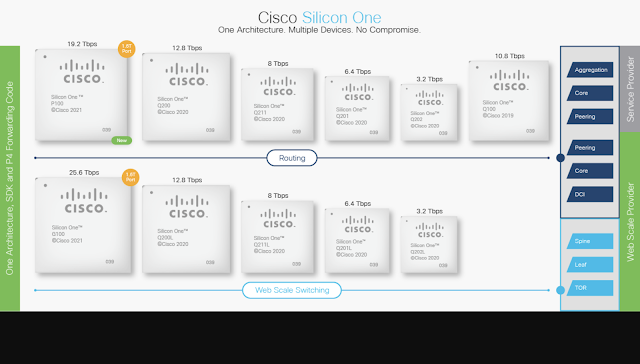
Cisco has begun sampling its latest P100 routing silicon, the 11th device in the Cisco Silicon One family which debuted in December 2019.The 7nm Cisco Silicon One P100 boasts the industry’s first 112G Serializer/Deserializer (SerDes) high bandwidth routing silicon, achieving full-duplex 19.2 Tbps of capacity. It features Cisco's second-generation P4 run-to-completion engine coupled with large table scale and deep buffers.Cisco says its P100 device...

DT runs with Cisco 8000 Series routers

One year after introducing its 8000 Series routers, Cisco confirmed that Deutsche Telekom (DT) has now deployed the new platforms, which feature Cisco Silicon One Q200 series chips, to boost its network performance and reach – now supporting 246M mobile customers, more than 27 million fixed-network lines and 22 million broadband lines. Deutsche Telekom worked closely with Cisco to move from redesign to full provisioning in under four monthsThe...

Cisco to acquire Sedona for IP/optical network automation 

Cisco announced plans to acquire Sedona Systems Ltd., a start-up offering multi-layer IP/optical network automation and control solutions. Financial terms were not disclosed.Sedona, which is based in Ramat Gan, Israel, is known for its Hierarchical Controller (HCO) that enables multi-vendor, multi-domain automation, and software-defined networking. The Sedona NetFusion platform automatically discovers, aggregates and analyzes network data from multiple...

Cisco unveils Routed Optical Networking 

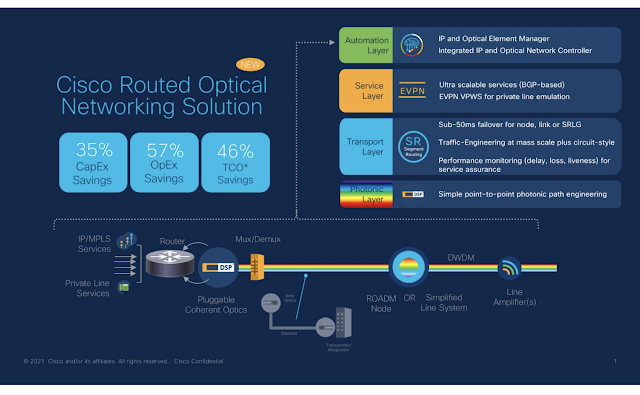
Cisco announced a number of  Internet infrastructure products and technologies including a new Routed Optical Networking solution featuring Acacia pluggable optics and Cisco’s full mass-scale routing portfolio. The company claims its integration of routing and optics will lead to savings of up to 46% over traditional, layered IP + optical product architecture.At its virtual Cisco Live! event, the company said Acacia’s pluggable coherent optics,...


Open XR Forum releases its first specification

The Open XR Forum, which aims to advance the deployment of software-configurable point-to-point and point-to-multipoint coherent optical networks utilizing XR optics pluggable transceiver technology has released its first specification. 

The first approved specification defines enhanced network management of pluggable coherent optical technology. It addresses challenges associated with managing advanced coherent optical engines and features as they are deployed in a wider variety of networking devices such as routers, servers, and mobile radios.

The Open XR Forum said this first specification paves the way for creating an architecture that seamlessly disaggregates the management of intelligent Open XR-compliant pluggable transceivers from host devices. The same management framework could be used to manage features in any advanced coherent module. By clearly delineating transport and IP management functions, this management architecture resolves the remaining obstacles to widespread deployment of IP over DWDM. At the same time, it establishes a foundation for managing emerging point-to-multipoint coherent networks based on XR-compliant pluggable transceivers. The result is a seamless and holistic management solution that will facilitate deployment of powerful coherent optical engines closer to the network edge, fueling network growth and enabling new services within existing network management frameworks.

The complete specification, "Open XR Management Architecture," can be downloaded from the Open XR Forum website under "Documents".

https://www.openxrforum.org

Argonne and Fermilab connected via quantum network over fiber

The DOE’s Fermi National Accelerator and Argonne National Laboratory have been connected over a distance of 50km via the Illinois Express Quantum Network.

The experimental quantum network is being used to test the synchronicity of two clocks — one at Argonne and one at Fermilab. Scientists transmitted a traditional clock signal (blue) and a quantum signal (orange) simultaneously between the two clocks. The signals were sent over the Illinois Express Quantum Network. Researchers found that the two clocks remained synchronized within a time window smaller than 5 picoseconds, or 5 trillionths of a second. 

The experiment marked the first time that quantum-encoded photons — the particle through which quantum information is delivered — and classical signals were simultaneously delivered across a metropolitan-scale distance with an unprecedented level of synchronization.

“To have two national labs that are 50 kilometers apart, working on quantum networks with this shared range of technical capability and expertise, is not a trivial thing,” said Panagiotis Spentzouris, head of the Quantum Science Program at Fermilab and lead researcher on the project. ​“You need a diverse team to attack this very difficult and complex problem.”

https://www.anl.gov/article/quantum-network-between-two-national-labs-achieves-record-synch

Red Hat joins HPE GreenLake ecosystem

 Red Hat is joining the HPE GreenLake ecosystem. 

The partnership combines HPE GreenLake edge-to-cloud platform with Red Hat’s enterprise open source technologies will help address IT organizations’ need for agile technology solutions that can accelerate business outcomes and help fuel their digital transformations. 

“This extended partnership makes it easy for HPE GreenLake customers to consume and work with Red Hat’s highly regarded open source solutions. This enables our joint customers to focus on accelerating their business transformations, at a lower cost, while solving their most pressing challenges around performance, risk, and speed, without worries about integration, licenses, or product updates,” said Keith White, EVP & GM, HPE GreenLake Cloud Services Commercial Business, HPE. “We’re delivering the hybrid cloud ‘your way’ by partnering with trusted open source solutions from Red Hat.”

“Red Hat and HPE are committed to enabling greater customer choice and flexibility, as many organizations look to accelerate digital transformation efforts and expand their hybrid cloud footprints,” said Stefanie Chiras, senior vice president, Partner Ecosystem Success, Red Hat. “Red Hat’s open hybrid cloud portfolio offers a more consistent and scalable foundation for customers to optimize their cloud operations, from the datacenter to the edge. We are pleased to collaborate with HPE to integrate Red Hat technologies with HPE GreenLake platform, further supporting customer choice wherever needed.”

The HPE GreenLake edge-to-cloud platform enables customers to accelerate data-first modernization and provides over 50 cloud services that can run on-premises, at the edge, in a colocation facility, and in the public cloud. In Q2 2022, HPE reported Annualized Revenue Run-Rate (ARR) of $829 million and as-a-service orders growth of 107 percent year-over-year, the third consecutive quarter of triple digit orders growth. HPE GreenLake platform has over 1600 enterprise customers consuming cloud services today, and over 120,000 users of the platform. 

https://www.hpe.com/us/en/greenlake.html