Friday, January 28, 2022

Google to invest up to $1 billion in Bharti Airtel

Google will invest up to US$1 billion in a partnership with Bharti Airtel. The agreement includes an investment of US$700 million to acquire 1.28% ownership in Airtel and up to US$300 million toward potential multi-year commercial agreements.

The companies will focus on India-specific network domain use cases for 5G and other standards. Airtel is already using Google’s 5G-ready Evolved Packet Core & Software Defined Network platforms, and plans to explore scaling up the deployment of Google’s network virtualisation solutions to deliver a superior network experience to their customers.

Sunil Bharti Mittal, Chairman of Bharti Airtel said, “Airtel and Google share the vision to grow India’s digital dividend through innovative products. With our future ready network, digital platforms, last mile distribution and payments ecosystem, we look forward to working closely with Google to increase the depth and breadth of India’s digital ecosystem.”


Apricot subsea cable to link Japan to Singapore

Google and Facebook unveiled plans for the Apricot subsea cable system, a 12,000-kilometer-long cable will connect Japan, Taiwan, Guam, the Philippines, Indonesia and Singapore.Apricot, which is expected to launch in 2024, will boast a 190 Tbps design capacity based on space division multiplexing. It will feature a submersible reconfigurable optical add-drop multiplexer employing wavelength selective switch for a gridless and flexible bandwidth configuration.https://cloud.google.com/blog/products/infrastructure/new-apricot-subsea-cable-brings-more-connectivity-to-asiaGoogle's...

Google Cloud opens in Delhi National Capital Region

Google Cloud inaugurated its new Delhi National Capital Region (NCR), its second Google Cloud region in India and 10th to open in Asia Pacific. Google Cloud region highlighted several major customer already active in the Delhi NCR, including InMobi, Groww, HDFC Bank, and Dr. Reddy's Lab.Delhi NCR joins 25 existing Google Cloud regions connected via Googles high-performance network.https://cloud.google.com/blog/products/infrastructure/google-cloud-region-in-delhi-ncr-is-now-openGoogle...

The Economic Times: Google dominates in India

Google is building a substantial lead over rivals in India. A report in The Economic Times states that Google Search has more than 90% share of the Indian market and, likewise, YouTube is regularly watched by 80% of online users, and Google's Android OS powers more than 90% of smartphones in the country. Moreover, a mobile payments service called Google Tez quickly captured 60% of transactions a month after its launch in September 2017. The Economic...

Terralpha deploys ADVA's FSP 3000 for 600G transport across France

Terralpha, the new network subsidiary of France’s state-owned railway operator Société nationale des chemins de fer français (SNCF), has deployed ADVA's FSP 3000 TeraFlex terminal to transport data at speeds up to 600 Gbps between cities across France. The new solution also features ADVA’s FSP 3000 OLS, flexgrid multi-degree ROADMs, its ALM fiber monitoring technology and its Ensemble Controller network management and control solution.

Terralpha plans to use its spare fiber capacity to offer low-latency, ultra-high-speed connectivity to enterprises, mobile network operators and government institutions. 

“With around 20,000km of fiber deployed alongside our railway infrastructure, we knew we were in a unique position to offer super-fast connectivity right across France. What we needed was a transport solution with the capacity, flexibility and scale to match our ambitions and a partner we could trust. In ADVA, we have a European technology provider with a wealth of experience and an excellent track record for success,” said Gabriel Chenevoy, CEO of Terralpha. 

“We’re helping Terralpha to unlock the full value of its fiber assets. By harnessing our technology and the expertise of our engineers, Terralpha can take advantage of its vast network architecture to bring reliable, low-latency services at unprecedented speeds to homes, businesses and service provider customers in every corner of France,” commented Hartmut Müller-Leitloff, SVP of sales, EMEA at ADVA. 

http://www.adva.com

Thursday, January 27, 2022

Ericsson targets Dynamic Network Slicing for 5G devices

Ericsson introduced a Dynamic Network Slice Selection solution that will provide communication service providers with the ability to flexibly separate services in their 5G network and enhance traffic steering to maximize quality of experience on a single device. This will allow multiple tailored slices to 5G devices. 

Ericsson said it has taken the first steps to enable enterprise services in smartphones for high-quality connectivity, and support for consumer services in smartphones will follow, as well as support in other 5G devices. Ericsson has been actively working with the device ecosystem to introduce 3GPP-standards based user equipment route selection policies (URSP) in 5G networks to enable application traffic steering with network slices.

URSP is one of the main functionalities being implemented in 5G smartphones and 5G network infrastructure and allows devices to have multiple network slices on the same device with traffic detection and steering capabilities.

For instance, a user device might attach to different network slices for personal and work profiles. They could have one slice for generic mobile broadband traffic, another slice for a service like gaming, and one or several slices for work, like a high-security slice for enterprise applications like video conferencing and collaboration. Application developers could use this technology to improve the quality of experience for their applications, for example by decreasing the latency.

Monica Zethzon, Head of Solution Area Packet Core at Ericsson says: “We are now enhancing the Ericsson 5G Core portfolio with new network slicing capabilities, by introducing Ericsson Dynamic Network Slice Selection. This enables our customers to provide differentiated 5G services to their enterprise and consumer customers, by enabling multiple tailored network slices on a single 5G device.”

https://www.ericsson.com/en/news/2022/1/dynamic-network-slice-selection

  • In November last year FarEasTone and Ericsson demonstrated the world’s first 5G end-to-end multiple network slicing on commercial Android 12 devices based on an Ericsson-powered 5G standalone system.
  • In January 2021, Ericsson launched 5G RAN Slicing that supports customized business models and growth requirements, strengthening end-to-end network slicing capabilities needed to deliver different services over a common infrastructure and ensuring end-to-end network slice management and orchestration support for fast service delivery.


Nokia to power cloud servers using 3rd Gen AMD EPYC processors

 Exapnding its choice of processors, Nokia confirmed that its Core Networks business will 3rd Gen AMD EPYC processors to power the servers that deliver Nokia Core cloud-native software products for communication service providers. Servers powered by the 3rd Gen AMD EPYC processors are expected in the first half of this year. Nokia will continue to offer existing servers with other processor choices.

Nokia said it is targeting up to a 40% reduction in server power consumption to run Core workloads using AMD EPYC processors.

Dan McNamara, SVP & GM, EPYC, Server, AMD said: “We are excited to collaborate with Nokia to provide their customers with the performance, efficiency and overall sustainability benefits of 3rd Gen AMD EPYC processors. With our unique capability to offer high core counts in an energy efficient package, we are enabling outstanding performance for telco and 5G workloads, while supporting Nokia and the ICT industry’s quest to improve energy efficiency and the overall performance of its operations.”

Fran Heeran, SVP & Head of Core Networks, Cloud and Network Services at Nokia, said: “Through the latest generation of AMD EPYC processors and Nokia’s cloud-native Core software, we are helping CSPs shrink the carbon footprint of their networks. This is critical as advanced 5G service roll-out accelerates, with the associated implications for new demands on energy consumption and our continued innovation push to minimize the impact of those demands.”

GlobalConnect carries 600G using Nokia's PSE-V

GlobalConnect, which operates more than 74.500 kilometers of fiber, 3300 access nodes, and 16 data centers in Europe, completed a trial of Nokia PSE-V fifth generation super coherent optics (PSE-Vs). The trial demonstrated 600G transmission over a live long-haul network link of GlobalConnect Group’s GO-COLOR network. 

Nokia said the trial validated a planned upgrade of GlobalConnect's long-haul backbone networks using the PSE-Vs super coherent optics productized in Nokia’s 1830 PSI-M optical transport system. 

Anders Kuhn-Saaby, CTO, GlobalConnect Group, said: “This trial validates GlobalConnect’s commitment to offering scalable and flexible high-bandwidth services across our Nordic backbone network. We are pleased to validate Nokia’s latest generation of PSE-V super coherent optics as an important enabler of these continuous network upgrades, seamlessly operating over our live network with existing coherent channels.”  

James Watt, Head of Optical Networks Division, Nokia, said: “We are delighted to work with GlobalConnect to support continued capacity evolution of its core networks. With the introduction of the PSE-Vs super coherent capabilities across our entire 1830 portfolio, Nokia enables spectrally-efficient network capacity upgrades over real-world long-haul networks.”

https://www.nokia.com/about-us/news/releases/2022/01/26/nokia-and-globalconnect-demonstrate-600g-transmission-using-pse-v-super-coherent-optics/

Nokia debuts WaveFabric Elements: photonic chips, devices, subsystems

Nokia unveiled its WaveFabric Elements portfolio of photonic chips, devices and subsystems, including its fifth generation coherent digital signal processor family, the Photonic Service Engine V (PSE-V). The company said its WaveFabric Elements address the demanding power, performance, and cost-per-bit requirements of 400G networking across data center, metro, core and subsea applications. Nokia’s WaveFabric Elements portfolio combines digital signal...


Telstra Enterprise deploys Ericsson Private 5G

Telstra Enterprise has deployed Ericsson Private 5G for AgriFood Connect, an Australian not-for-profit organisation.

Ericsson Private 5G is a private wireless connectivity platform that facilitates advanced operations through automation, flexibility and intelligent connectivity. Using a single server 5G dedicated network based on a dual mode core, Ericsson Private 5G facilitates both LTE and 5G Standalone (SA) simultaneously.

The 5G SA capability delivered from the Ericsson Private 5G product, coupled with Telstra’s advanced network capabilities, offers an industrial wireless connectivity platform for enterprise that can deliver low latency, enhanced resiliency and the capacity to meet even the most demanding business operation requirements.

Telstra Network and Infrastructure executive, Iskra Nikolova, says: “The combination of a dedicated network in partnership with Telstra’s existing Network capabilities can facilitate the implementation of a whole variety of new and emerging technologies. Challenging locations in regional Australia, where there is comparatively limited backhaul capacity, will greatly benefit from this technology. For example, a remote farming or a manufacturing business could embrace the latest advancements in video analytics and IoT connectivity, almost regardless of their location, with the data processed on site.” 

https://www.ericsson.com/en/press-releases/7/2022/telstra-deploys-industry-first-ericsson-private-5g-for-enterprise

Juniper posts revenue of $1.3 billion, up 6% YOY

Juniper Networks reported revenues of $1,299.9 million for Q4 2021, an increase of 6% year-over-year, and an increase of 9% sequentially. GAAP operating margin was 11.8%, an increase from 8.0% in the fourth quarter of 2020, and an increase from 10.1% in the third quarter of 2021. Non-GAAP net income was $184.7 million, an increase of 2% year-over-year, and an increase of 22% sequentially, resulting in non-GAAP diluted earnings per share of $0.56.

For full year 2021, Juniper reported net revenues of $4,735.4 million, an increase of 7% year-over-year.

Juniper also noted that it is still experiencing "significant supply chain related headwinds associated with rising component costs and shortages, as well as elevated freight costs, which are expected to continue at least through the first half of the year. While we have taken pricing actions to offset these headwinds, we do not expect these actions to have an impact until later in the year."

Some highlights:

Revenue by vertical:

  • Cloud grew 19% year-over year and increased 10% sequentially. 
  • Service Provider was up 8% up year-over-year and up 15% sequentially.
  • Enterprise decreased 3% year-over-year but increased 4% sequentially. 
  • Total software and related services revenue was $242 million, an increase of 41% year-over-year

“We experienced better than expected demand during the December quarter, with strong double-digit order growth across all verticals, all customer solutions and all geographies,” said Juniper’s CEO, Rami Rahim. “Our commitment to delivering products that simplify operations and deliver a superior end-user experience, what we call experience-first networking, is resonating with our customers and allowing us to capitalize on several large and growing markets. We believe this focus, along with the investments we’ve made in our go-to-market organization, will enable us to accelerate our growth in 2022.”

“Our teams executed extremely well during the December quarter, delivering better than expected sales and non-GAAP earnings per share, despite the challenging supply chain environment,” said Juniper’s CFO, Ken Miller. “Our continued order strength, record backlog and actions to further strengthen supply, provide confidence in our ability to accelerate growth and deliver improved profitability in the upcoming year.”

https://investor.juniper.net/investor-relations/events/event-details/2022/Juniper-Networks-Q4-and-Fiscal-Year-2021-Financial-Results-Conference-Call/default.aspx


FCC revokes China Unicom's license

The FCC ordered China Unicom (Americas) Operations Limited to discontinue domestic interstate and international telecommunications services within the United States within 60 days.

The FCC said today's decision rests on the following:

• First, the Order finds that China Unicom Americas, a U.S. subsidiary of a Chinese state-owned enterprise, is subject to exploitation, influence, and control by the Chinese government and is highly likely to be forced to comply with Chinese government requests without sufficient legal procedures subject to independent judicial oversight.  

• Second, given the changed national security environment with respect to China since the Commission authorized China Unicom Americas to provide telecommunications services in the United States two decades ago, the Order finds that China Unicom Americas’ ownership and control by the Chinese government raise significant national security and law enforcement risks by providing opportunities for China Unicom Americas, its parent entities, and the Chinese government to access, store, disrupt, and/or misroute U.S. communications, which in turn allow them to engage in espionage and other harmful activities against the United States.  

• Third, China Unicom Americas’ conduct and representations to the Commission and Congress demonstrate a lack of candor, trustworthiness, and reliability that erodes the baseline level of trust that the Commission and other U.S. government agencies require of telecommunications carriers given the critical nature of the provision of telecommunications service in the United States.  

• Fourth, the Order finds that mitigation would not address these significant national security and law enforcement concerns.  

https://www.fcc.gov/document/fcc-revokes-china-unicom-americas-telecom-services-authority

Biden signs Secure Equipment Act

President Biden signed into law the “Secure Equipment Act of 2021,” which requires the Federal Communications Commission to adopt rules clarifying that it will no longer review or approve any authorization application for equipment that poses an unacceptable risk to national security.The bill would prevent further integration and sales of Huawei, ZTE, Hytera, Hikvision, and Dahua – all Chinese state-backed or directed firms – in the U.S. regardless...

FCC revokes China Telecom America's license

Citing national security concerns, the Federal Communications Commission a(FCC) revoked China Telecom (Americas) Corporation’s ability to provide domestic interstate and international telecommunications services within the United States.  China Telecom Americas has been ordered to discontinue any domestic or international services that it provides pursuant to its section 214 authority within sixty days following the release of the order.  The...


NEC to acquire Blue Danube for Massive MIMO 5G beamforming

NEC agreed to acquire Blue Danube Systems, a start-up based in Santa Clara, California. Financial terms were not disclosed. 

Blue Danube has successfully demonstrated its Coherent Massive MIMO 5G beamforming technology in numerous trials around the world, delivering up to 3X capacity increases with first generation software in commercial mobile networks using existing mobile phones. The company says its Coherent Massive MIMO together with autonomous AI/ML beam optimization software will enable mobile network operators to improve overall multi-site performance in both FDD and TDD bands. 

Blue Danube has been shipping products commercially for over 5 years.

Mark Pinto, CEO of Blue Danube, said, “We are excited about joining the NEC team that is an Open RAN leader and recognized for its end-to-end Open 5G solutions and system integration capabilities. Becoming part of NEC enables Blue Danube to expand our 5G product offerings, and together we will bring ever more powerful hardware and software products based on O-RAN specifications to customers worldwide.”

http://www.bluedanube.com

  • Blue Danube Systems was backed by Sequoia Capital and Silver Lake along with other investors including AT&T. 

Blue Danube announces coherent Massive MIMO

Blue Danube Systems announced its first Coherent Massive MIMO solution for TDD networks. Blue Danube said its approach to Massive MIMO starts by assuring RF array coherency which, in conjunction with digital processing, uniquely enables the definition, placement and dynamic coordination of high precision beams. These beams can be software controlled to direct RF energy towards high user-density areas, while minimizing adjacent sector interference,...

Blue Danube demos FDD Massive MIMO in Clustered Multi-Sectors

Blue Danube Systems announced the commercial deployment of its massive MIMO solution to multiple clustered cell sites. Blue Danube has performed multi-sector beam optimization using its BeamCraft 500 Massive MIMO systems at two different sites within the FDD-LTE network at a US mobile operator. The company said that it has not been clearly proven until now that Massive MIMO is deployable beyond isolated high-demand sectors where effects such as...

Blue Danube intros 96-element, Multiband, Massive MIMO Antenna

Blue Danube Systems, a start-up based in Santa Clara, California, introduced its 96-element, second-generation 5G-ready Massive MIMO system. Blue Danube's the BeamCraft 600 series supports simultaneous beamforming over multiple frequency bands and across multiple cellular standards, allowing operators to deliver increased capacity through a single compact system. The company said its Massive MIMO can dynamically direct radio frequency (RF) beams...


McAfee Enterprise appoints Gee Rittenhouse as CEO

Symphony Technology Group, a private equity firm focused on investing in the software, data and analytics sectors, announced the appointment of Gee Rittenhouse as CEO of McAfee Enterprise.

McAfee Enterprise is focused on data-aware Security Service Edge (SSE) solutions. STG is expected to rebrand the McAfee Enterprise SSE portfolio as a separate business later this quarter. McAfee Enterprise currently has approximately 3,000 SSE customers and 700 employees.

Rittenhouse most recently led Cisco’s Security Business Group. Prior to Cisco, Rittenhouse served as President of Bell Labs. Rittenhouse received his Doctorate in Electrical Engineering and Computer Science from Massachusetts Institute of Technology.

“Business-critical data is everywhere,” said Rittenhouse. “It resides in cloud applications, cloud infrastructure, data-centers and devices. It is essential for companies to know where their data is, who has access to it, and protect it. Our unique, data-centric approach simplifies these essential functions and allows companies to accelerate their digital transformation and secure their hybrid workforce. It is a privilege to join this amazing team.”

https://www.mcafee.com/enterprise/en-us/home.html


Trellix emerges from McAfee Enterprise + FireEye, ML extended detection and response

Symphony Technology Group (STG) announced the launch of Trellix, a new business that emerges from the previously announced merger of McAfee Enterprise and FireEye in October 2021.

Trelix will deliver extended detection and response (XDR) to organizations with a focus on accelerating technology innovation through machine learning and automation. The company says its new name evokes the structure of a trellis, a strong and safe framework used to support structured growth of climbing plants and trees. 

"As today's organizations push to achieve digital transformation, a strong security foundation is required to ensure continued innovation, growth and resiliency," said Bryan Palma, chief executive officer, Trellix. "Trellix's XDR platform protects our customers as we bring security to life with automation, machine learning, extensible architecture, and threat intelligence." 

STG is expected to launch the McAfee Enterprise Secure Service Edge (SSE) portfolio as a separate business later this quarter, inclusive of Cloud Access Security Broker (CASB), Secure Web Gateway (SWG) and Zero Trust Network Access (ZTNA).

https://www.trellix.com/

Investment group acquires FireEye Products business for $1.2 billion

A consortium led by Symphony Technology Group (STG) will acquire the FireEye Products business, including the FireEye name, in an all-cash transaction for $1.2 billion.The transaction, which is expected to close by the end of the fourth quarter of 2021, will separate FireEye’s network, email, endpoint, and cloud security products, along with the related security management and orchestration platform, from Mandiant’s controls-agnostic software and...


Airspan appoints Glenn Laxdal as president and COO

Airspan Networks appointed Glenn Laxdal as President and Chief Operating Officer. 

Laxdal was most recently SVP of Products at Infinera. He has also held senior leadership positions at Ericsson, Blackberry, and Nortel. 

In addition to hiring Laxdal, long-time Airspan executive Uzi Shalev has been appointed Chief Technology Officer and will continue to lead the company’s R&D operations.

https://www.airspan.com


Wednesday, January 26, 2022

BT conducts Open RAN trial with Nokia

BT will install Nokia’s RAN Intelligent Controller (RIC) for Open RAN, across a number of sites, to optimise network performance for customers of its mobile network, EE. The Open RAN trial is taking place in the city of Hull. 

BT said it is supporting Open RAN, with its vendor partners, to ensure it becomes a viable, mature, scale option for network optimisation as soon as possible. In addition to this trial, BT will also open a dedicated Open RAN Innovation Centre at its Adastral Park facility later this year. 

Neil McRae, Chief Architect, BT, commented: “Our Open RAN trial with Nokia is one of many investments we are making to boost the performance of our market-leading 4G and 5G EE network and deliver an even better service to our customers. Our high performance, high efficiency radio access equipment, provided by the major global vendors, has enabled us to roll-out 4G and now 5G at scale, with the confidence that our customers will get the best network experience possible.”

Mark Atkinson, SVP, Radio Access Networks PLM, Nokia, commented: “We are delighted to deepen our partnership with BT with this trial. Nokia is investing in Open RAN capabilities to enable a robust telecom ecosystem with strong network performance and security. An open and programmable RAN enables many new advanced capabilities to be introduced that can automatically optimize the 5G network. I look forward to seeing how this project develops.”

So far, BT has launched 5G across hundreds of towns and cities via its EE mobile network. EE’s 5G network will cover more than half the UK population by 2023 (four years ahead of current Government ambitions), will deliver 5G connectivity solutions anywhere in the UK by 2028 and complete the country’s only fully converged network by the mid-2020s.

https://newsroom.bt.com/bt-and-nokia-trial-open-ran-solution-in-hull-uk-to-enhance-mobile-broadband-experience/


Equinix and Singapore's GIC to build 2 hyperscale data centers in Seoul

Equinix and GIC, SINGAPORE'S sovereign wealth fund, agreed to form a US$525 million joint venture to develop and operate two xScale data centers in Seoul, Korea. GIC will own an 80% equity interest in the joint venture, and Equinix will own the remaining 20% equity interest. 

The two facilities under this joint venture, to be named SL2x and SL3x, are expected to provide more than 45 megawatts (MW) of power capacity to serve the unique core workload deployment needs of hyperscale companies, including the world's largest cloud service providers. 

Equinix entered the Korean market in 2019 with its first IBX, SL1. At the facility, customers can connect their corporate IT infrastructure to global hyperscale providers, including Alibaba Cloud, Amazon Web Service, Google Cloud, Microsoft Azure and Oracle Cloud, via Equinix Fabric.

Charles Meyers, President and CEO, Equinix, commented, "More and more organizations are embracing a digital-first strategy to scale their operations, enhance the experiences of their customers, and unlock the value of technologies like 5G, IoT, artificial intelligence (AI) and machine learning (ML). Korea and the broader Asia-Pacific market are both enablers and beneficiaries as organizations prioritize digital transformation. To address demand for cloud and digital infrastructure, we have continued to invest in the region through the expansion of International Business ExchangeTM (IBX) capacity and locations, as well as the expansion of our hyperscale program, xScale, in Australia, and now Korea."

Equinix forms $1.0 billion JV with GIC for data centers in Japan

Equinix and GIC, Singapore's sovereign wealth fund, announced a US$1.0 billion initial joint venture to develop and operate xScale data centers in Japan. GIC will own an 80% equity interest in the joint venture and Equinix will own the remaining 20% equity interest. GIC is expected to have contributed cash to fund its 80% equity interest in the joint venture. Equinix is expected to have transferred its Tokyo TY12 and Osaka OS2 development assets,...

Equinix partners with Singapore's GIC on xScale Data Centers in Europe

Equinix has formed a joint venture with GIC, Singapore's sovereign wealth fund, to develop and operate xScaleTM data centers in Europe. The joint venture is initially valued at over $1 billion. Equinix said initial facilities in the joint venture will serve the unique core workload deployment needs of a targeted group of hyperscale companies, including the world's largest cloud service providers. The facilities will be located on or proximate to...


Digital Realty opens carrier-neutral data center in Seoul

Digital Realty inaugurated its first data center in South Korea. Digital Seoul 1 (ICN10) will serve as a gateway to global expansion for enterprises in Korea to scale their digital business into new markets globally, and vice versa.

ICN10 is a multi-story, 12-megawatt facility spanning 22,000 square feet and is strategically located in the northwest region of Seoul within the Sangam Digital Media City, a newly developed urban planning zone populated with technology and media companies, serving as a hub to promote South Korea's digital economy.  As a carrier-neutral data center facility, ICN10 offers enterprises superior connectivity with direct access to all local exchange carriers in the Korean market.

ICN10 is also a NVIDIA-certified colocation provider of choice in South Korea as part of the NVIDIA DGX-Ready Data Center program. The facility is designed to handle Artificial Intelligence (AI) and Machine Learning (ML) workloads from NVIDIA, serving as a key launch pad to help enterprises accelerate their AI and analytics capabilities.

"South Korea is a leading technology and digital hub in Asia Pacific and is set to be one of the fastest growing data center markets in the region. It was the first country to roll out 5G in April 2019 alongside its Smart Cities initiatives, which has led to a rise of data center deployments in South Korea. The opening of our first data center in South Korea today is set to meet the growing demand from enterprises looking to scale their digital footprint across APAC and beyond, as well as deliver greater connectivity, coverage and capacity," says Mark Smith, Managing Director of APAC, Digital Realty.

"ICN10 will be critical to our go-to market strategy in Seoul and be complementary to ICN11, our hyperscale campus. It will be uniquely equipped to help organizations reinvent IT using a data-centric approach and unlock data gravity, the effect seen when data accumulates in massive amounts. From small to large colocation footprints, to integration with public cloud and cross-connects, organizations will have access to all the elements of the digital ecosystem from one place," says Jay Weon Khym, Country Manager for Digital Realty Korea.

https://investor.digitalrealty.com/

Microsoft reports 46% increase in Azure revenue

Citing strong growth in cloud services, Microsoft reported revenue of $51.7 billion for its second quarter ended 31-December-2021, an increase of 20% yoy. Net income was $18.8 billion and increased 21%, Diluted earnings per share was $2.48 and increased 22%.

“Solid commercial execution, represented by strong bookings growth driven by long-term Azure commitments, increased Microsoft Cloud revenue to $22.1 billion, up 32% year over year” said Amy Hood, executive vice president and chief financial officer of Microsoft.

Some highlights:

Revenue in Productivity and Business Processes was $15.9 billion and increased 19%, with the following business highlights:

  • Office Commercial products and cloud services revenue increased 14% driven by Office 365 Commercial revenue growth of 19%
  • Office Consumer products and cloud services revenue increased 15% and Microsoft 365 Consumer subscribers grew to 56.4 million
  • LinkedIn revenue increased 37% (up 36% in constant currency)
  • Dynamics products and cloud services revenue increased 29% driven by Dynamics 365 revenue growth of 45% (up 44% in constant currency)

Revenue in Intelligent Cloud was $18.3 billion and increased 26%, with the following business highlights:

  • Server products and cloud services revenue increased 29% driven by Azure and other cloud services revenue growth of 46%

Revenue in More Personal Computing was $17.5 billion and increased 15%, with the following business highlights:

  • Windows OEM revenue increased 25%
  • Windows Commercial products and cloud services revenue increased 13% (up 14% in constant currency)
  • Xbox content and services revenue increased 10%
  • Search and news advertising revenue excluding traffic acquisition costs increased 32%
  • Surface revenue increased 8%

https://news.microsoft.com/2022/01/25/microsoft-cloud-strength-fuels-second-quarter-results-4/

Intel sees record quarter for its Data Center Group

Citing an all-time record quarter for its Data Center Group (DCG), with strong server recovery in enterprise and government, Intel reported Q4 2022 GAAP revenue of $20.5 billion, exceeding October guidance by $1.3 billion and up 3 percent yoy. Q4 EPS amounted to $1.13, exceeding October guidance by 35 cents.

Full-year GAAP revenue set an all-time Intel record of $79.0 billion, up 1 percent YoY.

Pat Gelsinger, Intel's CEO, states: "We had a record quarter for DCG, where we grew 20% year-over-year and where we continue to be the partner of choice for cloud and data center customers. We expect that our Xeon shipments in December alone exceeded the total server CPU shipments by any single competitor for all of 2021." 


https://www.intc.com/financial-info/financial-results

AT&T cites growth in mobile and fiber subscribers

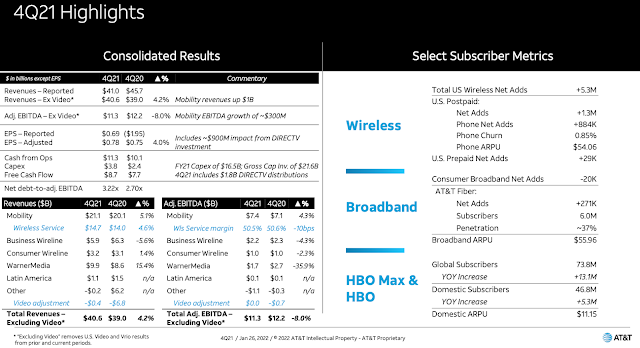
Citing customer growth in wireless, fiber and HBO Max, AT&T reported consolidated revenues for Q4 2021 of $41.0 billion versus $45.7 billion in the year-ago quarter, down 10.4% reflecting the impact of divested businesses, mainly U.S. Video in the third quarter and Vrio in the fourth quarter, and lower Business Wireline revenues.  Excluding impacts of the U.S. Video business and Vrio from both quarters, consolidated revenues totaled $40.6 billion9 compared to $39.0 billion in the year-ago quarter.

For full-year 2021 when compared with 2020 results, AT&T's consolidated revenues totaled $168.9 billion versus $171.8 billion, reflecting the separation of the U.S. Video business in the third quarter of 2021, and the impacts from other divested businesses. These decreases were partially offset by higher revenues in WarnerMedia and Communications. Excluding impacts of U.S. Video and Vrio from both years, consolidated revenues totaled $153.2 billion9 compared to $144.6 billion in 2020. 

“A year and a half ago, we began simplifying our business to reposition AT&T for growth and we’re extremely pleased with how we’ve executed on that commitment,” said John Stankey, AT&T CEO. “We ended 2021 the way we started it – by growing our customer relationships, running our operations more effectively and efficiently, and sharpening our focus. Our momentum is strong and we’re confident there is more opportunity to continue to grow our customer base and drive costs from the business.  

“We’re at the dawn of a new age of connectivity. Our focus now is to be America’s best connectivity provider and also ensure our media assets are positioned to grow and truly become a global media distribution leader. Once we do this, we’ll unlock the true value of these businesses and provide a great opportunity for shareholders.”


Some highlights for Communications:

Fourth-quarter revenues were $30.2 billion, up 2.4% year over year due to increases in Mobility and Consumer Wireline more than offsetting a decline in Business Wireline. Operating contribution was $6.5 billion, up 1.4% year over year, with operating income margin of 21.4%, compared to 21.6% in the year-ago quarter.

Mobility

  • Revenues were up 5.1% year over year to $21.1 billion due to higher service and equipment revenues. Service revenues were $14.7 billion, up 4.6% year over year due to subscriber gains and the lapping of pandemic impacts on international roaming revenues. Equipment revenues were $6.5 billion, up 6.2% year over year, driven by increased sales of higher-priced smartphones.
  • Operating expenses were $15.8 billion, up 5.1% year over year due to higher equipment costs, including 3G network shutdown costs of approximately $130 million, and higher HBO Max bundling costs, partially offset by lower marketing and support.
  • Total net adds were 5.3 million including 1,285,000 postpaid net adds and 24,000 prepaid phone net adds
  • Postpaid churn was 1.02% versus 0.94% in the year-ago quarter. Postpaid phone churn was 0.85% versus 0.76% in the year-ago quarter. Prepaid phone churn was less than 3% with Cricket substantially lower.
  • Postpaid phone-only ARPU was $54.06, down 0.7% versus the year-ago quarter, due to the impacts of promotional discount amortization.

Business Wireline

  • Revenues were $5.9 billion, down 5.6% year over year, partially due to the prior-year increase for pandemic-related connectivity, lower demand for legacy voice and data services, and a strategic decision to deemphasize non-core services.
  • More than 675,000 U.S. business buildings are lit with fiber from AT&T, enabling high-speed fiber connections to more than 2.75 million U.S. business customer locations. Nationwide, more than 9.5 million business customer locations are on or within 1,000 feet of AT&T fiber.

Consumer Wireline

  • Revenues were $3.2 billion, up 1.4% year over year due to gains in broadband more than offsetting declines in legacy voice and data services and other services. Broadband revenues increased 5.4%, which reflects fiber subscriber growth and higher ARPU resulting from increases in higher-revenue fiber customers.
  • Total broadband and DSL subscriber net losses were 20,000, reflecting growth in fiber subscribers mostly offsetting losses in slower-speed services. 
  • Full-year 2021 fiber net adds totaled about 1.0 million, the fourth consecutive year in which the company added 1 million or more fiber subscribers. AT&T Fiber is marketed to about 16 million customer locations.

https://investors.att.com/financial-reports/quarterly-earnings/2021

Verizon Business and Atos to power predictive analytics for 5G edge

Verizon Business is working with Atos to power intelligent IoT solutions with private 5G multi-access edge computing. The Verizon-Atos solution provides an end-to-end architecture that includes hardware, 5G, application and automation, field services and service desk support.

Verizon will implement Atos Computer Vision platform in their private 5G multi-access edge computing as part of the joint solution for enterprises, providing ready-to-deploy business use cases in various industries. The Atos platform plays a role in bringing key capabilities in AI-powered video analytics to mission critical environments. Verizon’s use of Atos’ BullSequana Edge servers will strengthen its 5G edge offers and will unlock new use cases, advancements of network security, connectivity and data management.

“This new, joint solution will provide enterprise customers with an unprecedented level of insight into their operations, and we’re excited about the prospect of building on our existing partnership with Atos. We know the future will be built on our leading 5G network, and today’s announcement is another example of how our products and solutions are having a genuine impact on business efficiency and revenue today,” said Tami Erwin, CEO, Verizon Business.

https://www.verizon.com/about/news/verizon-business-atos-5g-edge-solution

Rambus delivers PCIe 6.0 controller

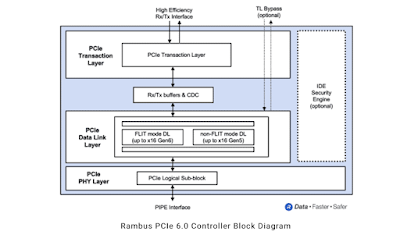
Rambus released a PCI Express 6.0 Controller, delivering data rates up to 64 Gigatransfers per second (GT/s) for high-performance applications. In addition, the controller provides an Integrity and Data Encryption (IDE) engine that monitors and protects PCIe links against physical attacks.

“The rapid advancement of AI/ML and data-intensive workloads requires that we continue to provide higher data rate solutions with best-in-class latency, power and area,” said Sean Fan, chief operating officer at Rambus. “As the latest addition to our portfolio of industry-leading interface IP, our PCIe 6.0 Controller offers customers an easy to integrate solution that delivers both performance and security for advanced SoCs and FPGAs.”

Key features of the Rambus PCIe 6.0 Controller include:

  • Supports PCIe 6.0 specification including 64 GT/s data rate and PAM4 signaling
  • Supports fixed-sized FLITs that enable high-bandwidth efficiency
  • Implements low-latency Forward Error Correction (FEC) for link robustness
  • Internal data path size automatically scales up or down (256, 512, 1024 bits) based on max. link speed and width for reduced gate count and optimal throughput
  • Backward compatible to PCIe 5.0, 4.0 and 3.0/3.1
  • Supports Endpoint, Root-Port, Dual-Mode and Switch port configurations
  • Integrated IDE optimized for performance

https://www.rambus.com/rambus-delivers-pcie6-controller-for-next-generation-data-centers/

New PCIe 6.0 spec delivers 64 GT/s raw data rate

PCI-SIG, the organization responsible for the widely adopted PCI Express standard, officially released the PCIe 6.0 specification boasting a top raw data rate of 64 GT/s (gigatransfers per second) -- double the bandwidth and power efficiency of the PCIe 5.0 specification (32 GT/s).Applications for PCIe 6.0 are expected to include data centers, AI/ML, HPC, and defense systems.PCIe 6.0 Specification Features64 GT/s raw data rate and up to 256...