Monday, March 29, 2021

Facebook and Google collaborate on U.S.-Guam-Singapore cable

Facebook and Google are lead investors in a new subsea cable from Eureka, California to Singapore, with a stop-over in Guam.

The Echo subsea cable will be the first to directly connect the U.S. to Singapore with direct fiber pairs over an express route. The cable is expected to have landings in Indonesia and possibly other locations. 

In a blog posting, Google said Echo's unique route to Southeast Asia will avoid the crowded, traditional paths to the north. The cable is expected to be ready for service in 2023.

https://cloud.google.com/blog/products/infrastructure/introducing-the-echo-subsea-cable

https://engineering.fb.com/2021/03/28/connectivity/echo-bifrost/

Facebook's new Singapore data center to use StatePoint Liquid Cooling

Construction is now underway on Facebook's first custom-built data center in Asia.  The new data center in Singapore shares some characteristics with other Facebook facilities, such as the use of 100% renewable energy, but features many unique aspects. First, it will be an 11-story building that will sit on 12 acres of land in Singapore’s Tanjong Kling Data Center Park. Second, it will be the first to incorporate the new StatePoint Liquid...

Facebook to build data center in Singapore

Facebook announced plans to build a hyperscale data center in Singapore. The 170,000 square meter facility, which will be Facebook's first wholly-owned data center in Asia-Pac, is expected to come online in 2022 at the latest. Facebook estimated the cost of the project at US$ 1 billion. Last month, Facebook set 2020 as its target to reduce greenhouse gas emissions by 75% and to power 100% of global operations with renewable energy. Three years...

MIST subsea cable to deliver 240 Tbps from Singapore to India

NTT announced "MIST", a submarine cable between Singapore, Myanmar and India (Mumbai and Chennai) that promises a record 240 Tbps capacity with support for 400 Gbps wavelengths. MIST will be part of a strategic joint venture for international submarine cables in South East Asia, with Orient Link Pte. Ltd. The cable is expected to be ready for service by June 2022. MIST will span 11,000 kilometers in length with 12 fiber pairs. Wavelength Selective...

Facebook backs Bifrost cable from U.S. to Southeast Asia

In addition to its participation in the Echo subsea cable from the U.S. to Singapore, Facebook confirmed its investment in the Bifrost Cable System from the U.S. to South East Asia.

The Bifrost Cable System will span over 15,000 km, connecting Singapore, Indonesia, the Philippines, Guam and the west coast of North America. The cable is expected to be completed in 2024.

The project is also backed by Keppel Telecommunications & Transportation Limited (Keppel T&T) and Telekomunikasi Indonesia International (Telin), which is a subsidiary of PT Telkom Indonesia.

The partners say that when fully commissioned, the multiple fibre paired Bifrost Cable System will be the largest capacity cable across the Pacific Ocean.

Keppel T&T, Facebook and Telin have appointed Alcatel Submarine Networks (ASN) for the supply and installation works of the cable system.

“Connectivity is at the heart of our mission to give people the power to build community,” said Kevin Salvadori, Vice President, Network at Facebook. “We are committed to bringing more people online to a faster internet, to support the growth of digital economies, and to do this in collaboration with local partners.”

https://engineering.fb.com/2021/03/28/connectivity/echo-bifrost/

https://www.telin.net/company/newsroom/257-keppel--facebook-and-telin-announce-bifrost-cable-system

DARE-1 subsea cable enters service to East Africa

The Djibouti Africa Regional Express (DARE) submarine cable system has entered service in East Africa and the Horn of Africa. 

The 4,900 km cable links Djibouti, Somalia and Kenya. The project was funded by Djibouti Telecom, Somtel, Hormuud Telecom and Telkom Kenya. Total investment was US$81 million.

DARE-1 has a design capacity of 36 Tbps, making it the largest in the region.

https://international.djiboutitelecom.dj/dare1/internet-le-cable-dare-1-mis-en-service/

Australia's NBN Co extends satellite coverage for businesses

Australia's nbn announced plans to expand its satellite beams for its business nbn satellite service (BSS)  to cover 100 per cent of the Australian mainland and surrounding large islands.

Scheduled for 29 July 2021, BSS beam coverage will increase from 93 per cent to 100 per cent to expand access across the east coast of the Australian mainland, the west coast of Tasmania and large surrounding islands such as Christmas Island, Lord Howe Island and Norfolk Island.


nbn also announced plans to reduce the wholesale price by approximately 40 per cent for the BSS Access Bandwidth Service (ABS) Layer 3 dedicated bandwidth product for internet retailers that engage in extended contract terms with nbn to help meet the needs of their customers over longer time periods. The ABS Layer 3 service is designed to deliver consistent wholesale speeds of up to 50/13 Mbps to provide the core connectivity for critical applications required by many medium and large businesses, enterprises and government organisations. 

NBN Co’s Chief Development Officer of Regional and Remote, Gavin Williams: “At nbn, we recognise that connectivity is vital for businesses to drive innovation, productivity and growth. With this knowledge we have dedicated ourselves to expand the availability of wholesale business-grade services across the continent. Whether to connect remote health facilities, mining operations or large-scale agriculture, these enhancements help make the business nbn™ satellite service more accessible for eligible businesses and government organisations even in the most remote parts of continent and we look forward to delivering new capabilities to further improve the service in the future.”

https://www.nbnco.com.au/corporate-information/media-centre/media-statements/coverage-increase-and-reduced-wholesale-prices-to-enhance-bss

DE-CIX brings its Internet Exchange to four QTS Mega Data Centers

DE-CIX has extended Internet Exchange platform by deploying core switches in QTS' mega-scale data centers in Chicago, Dallas/Irving, TX, Piscataway, NJ and Richmond, VA. 

The Dallas/Irving DE-CIX core switch enables QTS customers to peer with nearly 100 networks, while the New York DE-CIX core switch provides QTS' Piscataway customers access to more than 250 networks. 


All four DE-CIX IXs in North America, including DE-CIX Chicago and RVA-IX, are interconnected via a private network to DE-CIX New York and DE-CIX Dallas, creating a fully redundant, optimized low-latency route between each market. DE-CIX and QTS partnered with global consulting company InterGlobix on the new expansion across the four markets.

"QTS is clearly committed to providing access to an unrestricted Internet ecosystem as evidenced by their partnership with similar exchanges nationally," said Ivo Ivanov, CEO, DE-CIX International. "By expanding our US presence in QTS' mega scale, carrier neutral data centers and connectivity ecosystems, DE-CIX is able to provide even more customers the ability to reach the greatest number of low latency network choices, reducing risk and improving performance for their IT investments in each market."

"DE-CIX is the ideal partner to support our focus on creating optimized and resilient interconnection platforms, utilizing the most advanced technologies, and reinforcing our core values of interconnection neutrality and transparency," said Sean Baillie, Executive Vice President – Connectivity Strategy, QTS. "As technology increases in scale and complexity across multiple platforms and geographies, we are focused on building mega data centers with risk-adjusted access to a myriad of networks sought by enterprise and hyperscale organizations. This translates to a combination of mega scale infrastructure with access and connectivity to the world's largest cloud providers, the world's largest IP networks, Internet Exchanges, fiber providers, diverse transport paths and subsea cables."

http://www.qtsdatacenters.com

DC BLOX secures $187M for data centers in southeastern U.S.

DC BLOX, which operates Tier III-designed data centers located in Atlanta, Birmingham, Chattanooga, and Huntsville, secured $187 million in long-term financing led by Post Road Group and Bain Capital Credit. 

Proceeds will be used to refinance DC BLOX’s existing credit facilities, add liquidity to DC BLOX’s balance sheet, and provide additional capital to fund continued investments in existing and new data center capacity.


“This financing would have not been possible without the efforts of our team and represents a significant milestone for the company. The trust and partnership we have developed with the teams at Post Road Group and now with Bain Capital Credit are instrumental to our continued growth plans,” commented Jeff Uphues, CEO of DC BLOX. “This capital will be immediately deployed to support growth in our existing facilities and accelerate the expansion of our Tier III-designed interconnected data center platforms in other markets throughout the Southeastern United States,” said Kevin O’Donnell, Chief Financial Officer.

http://www.dcblox.com

Fujitsu supplies FTTP in rural Virginia


Fujitsu Network Communications was selected to be the prime broadband network and integration partner for a 53-mile fiber-to-the-premises (FTTP) broadband network for Craig-Botetourt Rural Electric Cooperative (CBEC) headquartered in New Castle, Virginia. Fujitsu is responsible for network design and build-out, multivendor equipment and software procurement, network integration, testing and service turn-up. 

The new fiber broadband network, which passes 700 addresses, makes it possible for CBEC to serve the essential connectivity needs of their cooperative members, delivering symmetrical, high-speed internet services up to 300 Mbps and digital voice services. Since the launch on February 1, 2021, the co-op already has 155 new subscribers.

“The response from our community is overwhelmingly positive. Improved broadband means a better quality of life for our members, attracting new residents to the area and encouraging existing residents to stay when they might have otherwise moved,” said Jeff Ahearn, CEO, Craig-Botetourt Rural Electric Cooperative. “The ability of Fujitsu to efficiently manage the overall project while accommodating a very tight turnaround means that we can deliver unmatched, next-generation fiber broadband services to our members at a time when they are most needed.”

“Being connected with reliable, affordable, high-speed broadband has become a must-do for the economic vitality of communities of all sizes,” said Greg Manganello, senior vice president and head of wireless and service solutions, Fujitsu Network Communications, Inc.

http://www.fujitsu.com

Sunday, March 28, 2021

Nokia intros integrated CBRS solution

Nokia announced a fully integrated CBRS solution that consists of Key Bridge Wireless' FCC-certified Wave 1 SAS/ESC coupled with Nokia CBRS radios, user devices and new Domain Proxy.

The CBRS solution is aimed at communications service providers (CSPs), multiple-system operators (MSOs) and enterprises.

The Nokia Domain Proxy’s capabilities are implemented as scalable edge cloud native micro-services, which aggregate multiple radio links to simplify SAS connectivity in large deployments. Simultaneously, they provide an extra level of CBRS reliability, policy control and security in the most challenging environments.

The integrated Key Bridge Environmental Sensing Capability (ESC) in the solution can be selectively densified in areas with high-value industrial sites and enterprises to enable ultra-reliable CBRS spectrum availability information. Combined with distributed, geo-redundant SAS and Domain Proxy, this enables enterprises to operate ultra-reliable radio access networks in CBRS spectrum, especially high-value PAL spectrum.

The companies said their joint offering provides the highly reliable SAS service required to operate in CBRS General Authorized Access (GAA) and Priority Access License (PAL) spectrum.

Stephan Litjens, Vice President Enterprise Solutions, Nokia Cloud & Network Services, said: “Together with Key Bridge, this new offering gives PAL and GAA users a new standard in ease of use. Its unparalleled robustness will extend and accelerate their CBRS plans, and maximize the value of their investment. CBRS presents a huge opportunity for CSPs, MSOs and enterprises for deployment of private wireless networks and to build the platform for new use cases that drive Industry 4.0 implementation.”

Jesse Caulfield, CEO of Key Bridge Wireless, said: “Our partnership with Nokia has produced an integrated CBRS solution unlike any other. Our SAS/ESC infrastructure is designed, deployed and operated to ensure carrier-grade reliability at tremendous scale. Through extensive testing, field trials and now active commercial deployments we provide a robust and easy-to-use service for CBRS network operators."

https://keybridgewireless.com/

https://www.nokia.com/networks/solutions/industrial-grade-private-wireless-solutions/

Video: IBM builds a Cloud for Telecommunications


There are several key drivers for why carriers are moving to cloud infrastructures, including the acceleration of edge & 5G services, zero touch service automations, and operational modernization.  But can carriers justify the cost of this migration. Bill Lambertson, Vice President, 5G, Edge & Cloud Business, IBM, gives an overview of the IBM Cloud for Telecommunications, and why Red Hat OpenShift is a strategic advantage.

https://www.youtube.com/watch?v=AtMVnZCO4Lk

Download the 2021 Telco Infrastructure Report here: http://ngi.how/telco-2021


IBM Cloud launches Multizone Region in Brazil

 IBM Cloud launched its first Multizone Region (MZR) in Brazil.

IBM Cloud MZRs are composed of three or more data center zones with each being an Availability Zone. This is designed so that a single failure event can affect only a single data center rather than all zones – allowing for consistent cloud services and greater resiliency. Clients hosting workloads on IBM Cloud MZRs in any country can continuously run mission-critical workloads to keep business up and running.


IBM said the new MZR is a result of its continued investment in cloud infrastructure to accelerate hybrid cloud adoption and help foster business growth in Latin America. Following the openings of Toronto and Osaka last year, the latest MZR in Brazil marks IBM's ongoing commitment to help clients across the globe deploy mission-critical workloads with high levels of security and resilience, while helping to address data sovereignty requirements and prepare for a sustainable future.

"As companies embrace digital transformation, IBM is continuing to invest in cloud infrastructure and hybrid cloud capabilities that will help businesses around the world modernize and drive sustainable growth and innovation," said Harish Grama, General Manager, IBM Cloud. "Following the openings of Toronto and Osaka MZRs just last year, IBM's expanded presence in Brazil is designed to deliver our clients high levels of security and reliability, so they can advance in their journey to cloud – all in a way that supports sustainability goals while thriving in a digital era advancing to the future."

China Telecom grew 4.7% in 2020

China Telecom has reported 2020 revenue of RMB393.6 billion, representing an increase of 4.7% over last year. EBITDA amounted to RMB118.9 billion, representing an increase of 1.4% over last year. Net profit amounted to RMB20.9 billion, representing an increase of 1.6% over last year, while basic earnings per share were RMB0.26. 

Some highlights:

  • Service revenues amounted to RMB373.8 billion, representing an increase of 4.5% over last year.
  • Mobile service revenues amounted to RMB181.7 billion, representing an increase of 3.5% over last year. 
  • Wireline service revenues amounted to RMB192.1 billion, representing an increase of 5.5% over last year. 
  • Capital expenditure was RMB84.8 billion and free cash flow was RMB14.3 billion. 
  • As of the end of 2020, the number of 5G base stations in use exceeded 380,000. China Telecom aims to have 700,000 5G base stations in use by the end of 2021.
  • China Mobile now has 351 million mobile users.
  • Overall mobile ARPU is RMB44.1, down from RMB45.8 a year earlier
  • 5G ARPU is RMB65.6
  • Broadband access revenue is RMB38.4


https://www.chinatelecom-h.com/en/global/home.php


Coherent Inc. finally picks II-VI's acquisition offer

The Board of Directors of Coherent selected the latest acquisition proposal from II-VI over the competing bid from Lumentum. In making its determination, the Coherent board of directors evaluated the comparative benefits and risks of the II-VI and Lumentum proposals, including the near-term and long-term financial opportunities and risks presented by each proposal, the potential synergies available through a combination with each company, and the complementary businesses of each company.​

Under the II-VI offer, each share of Coherent common stock will be exchanged for $220.00 in cash and 0.91 of a share of II-VI common stock at the completion of the transaction. 


Coherent confirmed that it has terminated he March 9, 2021 merger agreement between Coherent and Lumentum and paying Lumentum the $217.6 million termination fee contemplated by their merger agreement in order to enter into a new merger agreement with II-VI.

II-VI said it plans to finance the transaction with cash on hand, approximately $5.4 billion in fully committed debt financing from J.P. Morgan Securities LLC and an equity investment from Bain Capital. Bain Capital has committed $1.5 billion in the combined company at a conversion price of $85.00 per share and has confirmed it is willing to increase this commitment by at least $300 million of an additional $650 million optional amount on the same terms, for a total commitment of at least $1.8 billion. 

Dr. Vincent D. Mattera, Jr., Chief Executive Officer of II-VI, states: “We are pleased to have reached an agreement with Coherent to create a global leader in photonic solutions, compound semiconductors and laser technology and systems. Together, we will have significant opportunities to accelerate our growth through complementary technology platforms, strengthen our competitiveness by using our combined scale across the value chain, benefit from deeper market intelligence and expertise, and further diversify our businesses by end market and geography. Moreover, the combination of II-VI and Coherent will increase our collective exposure to irreversible megatrends for decades to come.

For its part, Lumentum noted Coherent's Board of Directors "chose to accept an offer that is inferior in overall value and cash consideration. Using the closing prices as of March 24, 2021, Lumentum's offer had a value of $283.12 while the value of II–VI Incorporated's (NASDAQ: IIVI) ("II-VI") offer was $281.21."

Nokia to supply XGS-PON to UG in South East Europe

United Group (UG), a leading multi-play and media provider in South East Europe, has selected Nokia to deploy a fiber network and in-home mesh Wi-Fi solution across the eight different countries it operates in. 

The rollout will be based on Nokia Lightspan series FX for GPON and XGS-PON services. Nokia will also supply its ONT customer premises equipment and WiFi Beacons.

UG will use the network to deliver new enhanced broadband services to residential and business customers, offer mobile transport services, create new business opportunities such as off-loading mobile traffic and seamlessly evolve toward a virtualized access-network.


Sandy Motley, President Nokia Fixed Networks Division, said:  “We are excited to be the preferred fiber access network equipment provider to United Group and to work with them on this new phase of growth. With our FTTH and Wi-Fi solution, we are able to provide a high-speed, reliable network infrastructure and an unmatched in-home Wi-Fi experience that will meet United Groups 

NTT builds Internet Exchange into its Bangkok2 data center

NTT Ltd., in partnership with Japan Network Access Point (JPNAP) and Bangkok Neutral Internet eXchange (BKNIX), is uplifting its the NTT Bangkok 2 Data Center to become an international network exchange. NTT has developed an “international link” with JPNAP’s data centers in Tokyo and with BKNIX Point of Presence (PoP), which was installed at NTT’s data center in Thailand.

NTT Thailand’s partnership with JPNAP, the leading Internet Exchange Point service provider in Asia, aims to create an Internet exchange linkage that will empower Internet Service Providers, Cloud Service Providers and educational institutions among others, with unlimited access to international-level content. NTT also collaborated with BKNIX, Thailand's first neutral IXP service provider, to install a new PoP at Bangkok 2 Data Center to serve as a hub for content and Internet traffic exchange.


Bangkok 2 Data Center can accommodate ultra-high-heat servers that consume 20kW or more power, such as Graphics Processing Unit servers. The center also adopted 2N Power System with Active-Active technology that guarantees a supply of electrical power, to enable a 100% service-level agreement. With these innovations, customers can easily access large-volume traffic exchange services on existing networks through Bangkok 2 Data Center.

Sutas Kongdumrongkiat, CEO for NTT Ltd. in Thailand, who is also responsible for its operations in Cambodia, Myanmar and Laos, said “We’re pleased to be a part of this initiative to help drive the efficiency of Internet connectivity on an international level. With connectivity being paramount to business success, we hope this will unlock greater value for partners and providers, as they capture emerging market demands in today’s digital economy.”

a

Safaricom launches 5G in Kenya with Huawei and Nokia

Safaricom activated trial 5G services in principal areas across Kenya, including Nairobi, Kisumu, Kisii and Kakamega.

Safaricom plans to expand the number of such 5G sites to more than 150 across nine towns over the next 12 months. Nokia and Huawei are the vendors.

“Today marks a major milestone for the country. With 5G, we aim to empower our customers with super-fast internet at work, at home and when on the move, supplementing our growing fibre network. At Safaricom, we are proud to be the first in the country and the region to bring this latest innovation to both our retail and enterprise customers empowering them to start exploring new opportunities that 5G provides,” said Peter Ndegwa, CEO, Safaricom.


“I congratulate Safaricom on this milestone, reinforcing the country’s position at being at the forefront of innovation in the region and the world. 5G technology will usher increased internet speeds and capabilities for millions across the country, laying a strong foundation for a new generation of innovators and entrepreneurs,” said Hon. Joe Mucheru, Cabinet Secretary, Ministry of Information and Technology.

Peter Ndegwa, CEO of Safaricom, said: “We are proud to be the first operator in the East Africa to launch 5G services, bringing the benefits of 5G technology to our customers. 5G capabilities will change a lot of things in unimaginable ways for people and enterprises, playing a key role towards fulfilling our vision to transform lives. Our long-term partner Nokia’s technologies and services expertise helped us achieve this milestone in our journey to provide world-class broadband services to our customers.”


Thursday, March 25, 2021

China Mobile: over 173 million 5G customers, 390,000 5G base stations

As of February 2021, China Mobile, the world's largest mobile operator, was serving 173 million customers with 5G packages and had more than 390,000 5G base stations in operation.

For 2020, China Mobile has just reported operating revenue of RMB768.1 billion, up by 3.0% compared to the year before. Of this, telecommunications services revenue amounted to RMB695.7 billion, representing growth of 3.2% year-on-year. Profit attributable to equity shareholders reached RMB107.8 billion or RMB5.27 per share, up by 1.1% year-on-year. 

Some highlights:

  • Wireline broadband revenue increased by 17.4% year-on-year and reached RMB80.8 billion. 
  • Revenue from applications and information services increased by 22.4% year-on-year and reached RMB101.0 billion. 
  • As of the end of December 2020, the number of mobile customers reached 942 million, of which, 165 million customers were on 5G packages, representing a net increase of 162 million customers. The overall subscriber count dropped from 950 million at the end of 2019.  
  • Mobile ARPU (average revenue per user per month) reached RMB47.4 where the decline rate was flattened by 4.0 percentage points compared to the previous year.
  • DOU (average handset data traffic per user per month) increased by 39.0% to 9.4GB.
  • In 2020, total 5G-related investment amounted to RMB102.5 billion out of a total CAPEX budget of RMB180.6 billion. 
  • For 2021, 5-G related investment is estimated at RMB110.0 billion out of a total CAPEX budgest of RMB183.6 billion.
  • In 2020, China Mobile put in use around 340,000 new 5G base stations, bringing the total number of 5G base stations to a cumulative 390,000, providing 5G services to all prefecture-level cities, selected counties and key areas in China. 
  • The total number of wireline broadband customers was 210 million, up from 187 million a year earlier.


Mr. Yang Jie, Chairman of the China Mobile commented, ‘We were faced with a complex operating environment in 2020. COVID-19 affected all aspects of life, while the digital transformation of our economy and society further accelerated, and coopetition within the telecommunications industry and beyond continued to evolve. Despite various difficulties and challenges, we managed to forge ahead steadily with the goal of achieving high-quality development and becoming a world-class enterprise by building a dynamic “Powerhouse”.

China Mobile is putting forward a new strategic vision: "We will open up development space toward information services and focus on technological innovation to create competitive advantages. These moves will form part of our concerted efforts to achieve our goal of joining the league of the world’s first- class information service technology companies. At the same time, we will focus on “two facilitations and two integrations”: We will fully facilitate the construction of information infrastructure and facilitate the digitalized and intelligent transformation of the whole society. We will also make endeavors to accelerate the integration and innovation of various information technologies, and speed up the deep integration of information technology and the economy, society and people’s livelihood."


Analog Devices launches ASIC for O-RAN compliant radios

Analog Devices announced an ASIC-based radio platform for O-RAN compliant 5G radio units. The solution includes all the core functionality needed in an O-RAN compliant 5G radio unit, including a baseband ASIC, software-defined transceivers, signal processing, and power. 

The company says its advanced radio platform is designed to enable significant performance and form factor improvements to address the critical power consumption and cost challenges.

The Analog Devices platform allows radio designers and manufacturers to optimize total system performance for macro and small cell solutions. The reference design will enable designers to create O-RAN compliant radios with the use of:

  • ADI’s next-generation transceiver featuring advanced digital front-end signal processing (DFE), digital pre-distortion with GaN PA support, crest factor reduction, channel digital up converters and channel digital down converters.
  • A low-PHY baseband ASIC that delivers a 7.2x compliant solution for LTE, 5G and NBIoT, including IEEE1588 Precision Time Protocol and an eCPRI interface.
  • Complete clock and power chain solution

“O-RAN looks to disrupt the traditional market by rethinking the network structure with open standards that will require new and innovative radio solutions,” said Joe Barry, Vice President of Wireless Communications at Analog Devices. “ADI’s new O-RAN compliant solution marks a major step forward for the ecosystem by providing a performance optimized radio platform for 5G applications.”

“Bringing an ASIC low PHY baseband to market is a big step forward for Open RAN. Now, there is a clear path for OEMs to build competitive systems for macro and small cell,” said Andy Dunkin, Open RAN RF and Digital Platform Development Manager at Vodafone Group. “It is initiatives like this that help build a healthy ecosystem.”

http://platform.radioverse.com

http://www.analog.com/radioverse

Marvell and Samsung collaborate on Massive MIMO chip

Samsung Electronics and Marvell have  jointly developed a new System-on-a-Chip (SoC) to power Samsung’s Massive MIMO and other advanced radios.

The new SoC supports 5G and 4G networks simultaneously, and it can also save up to 70 percent in chipset power consumption compared to previous solutions.


“We are excited to extend our collaboration with Marvell to unveil a new SoC that will combine both companies’ strengths in innovation to advance 5G network solutions,” said Junehee Lee, Executive Vice President and Head of R&D, Networks Business at Samsung Electronics. “Samsung prioritizes the development of high-impact 5G solutions that offer a competitive edge to our operators. We look forward to introducing this latest solution to the market shortly.”

Samsung and Marvell have been working closely to deliver multiple generations of leading network solutions. Last year, the companies announced a collaboration to develop new 5G products, including innovative radio architectures to address the compute power required for Massive MIMO deployments.

“Our collaboration with Samsung spans multiple generations of radio network products and demonstrates Samsung’s strong technology leadership. The joint effort includes 4G and 5G basebands and radios,” said Raj Singh, Executive Vice President of Marvell’s Processors Business Group. “We are again honored to work with Samsung for the next generation Massive MIMO radios which significantly raise the bar in terms of capacity, performance and power efficiency.”

https://news.samsung.com

Marvell partners with Samsung on RAN processing

Marvell and Samsung Electronics Co. are extending their collaboration to include additional segments of the Radio Access Network (RAN). The solutions will build on the OCTEON Fusion platform and integrating Samsung’s unique intellectual property.

To date, the companies have worked closely to deliver multiple generations of baseband and transport processing solutions for base stations based on Marvell’s OCTEON and OCTEON Fusion processors.

In addition, the companies are collaborating on innovative radio unit architectures designed to meet the dramatic increase in compute power required for the complex beamforming algorithms inherent to massive MIMO deployments. 

“Samsung is committed to helping mobile operators meet their performance targets,” said Jaeho Jeon, executive vice president and head of R&D, Networks Business at Samsung Electronics.  “Our relentless spirit to find innovative ways to address the next set of 5G market challenges will drive us to enhance our 5G technical capabilities.  Marvell is a valued collaborator in helping us achieve these goals.”

“Marvell believes that close collaboration with Samsung has allowed both companies to excel in the 5G infrastructure market,” said Raghib Hussain, chief strategy officer and executive vice president of the Networking and Processors Group at Marvell.  “It is our goal to ensure that infrastructure equipment suppliers such as Samsung can allow network operators to thrive in the fast-paced world of 5G.”

NXP debuts Microsoft Azure Sphere-certified processor for IoT

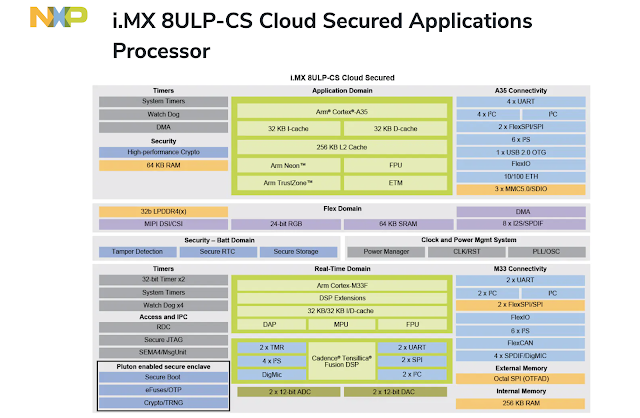
 NXP introduced its first cloud-secured crossover applications processor, the i.MX 8ULP-CS with Azure Sphere. The processor is based on the ARM Cortex A35 is aimed at IoT applications requiring continuous security updates in the field.

Together, NXP and Microsoft are delivering a new class of secured SoCs for the IoT market. Azure Sphere provides ongoing protection, responding to emerging threats and providing continual updates to help keep devices secured. 

NXP's new i.MX 8ULP-CS processor, is cloud secured by Azure Sphere, including: the Microsoft Pluton hardware root of trust enabled on NXP EdgeLock™ secure enclave, the secured Azure Sphere OS, the cloud-based Azure Sphere Security Service and ongoing on-chip OS and security improvements from Microsoft for each device, for more than ten years. 

https://www.nxp.com/company/blog/nxp-introduces-its-first-cloud-secured-microsoft-azure-sphere-certified-processor-family:BL-I-MX-8ULP-CS

OneWeb launches 36 satellites, bringing its constellation to 146

OneWeb confirmed the successful launch of all 36 satellites by Arianespace from the Vostochny Cosmodrome, bringing the company's in-orbit constellation to 146 satellites. 

OneWeb said this is the second in a five-launch programme that will enable OneWeb’s connectivity solution to reach all regions north of 50 degrees latitude by the middle of 2021, with service ready to start by year's end, giving OneWeb the ability to connect millions of consumers in the northern hemisphere. These services will cover the United Kingdom, Alaska, Northern Europe, Greenland, Iceland, the Arctic Seas and Canada, and will be switched on before the end of the year. 

OneWeb anticipates launching global services in 2022. The company plans to have a fleet of 648 LEO satellites.

Neil Masterson, OneWeb CEO commented: “This is the second of our ‘Five to 50’ launch series and represents a key moment in OneWeb’s return. The next launch in the series is scheduled for the end of April, as we continue our drive towards commercial service this year. OneWeb is rising to the challenge of our mission to provide connectivity to everyone, everywhere, all the time. Backed by exemplary shareholders, we are connecting the world.”

https://www.oneweb.world/media-center/successful-launch-marks-key-milestone-for-onewebs-five-to-50-ambition