Wednesday, March 11, 2020

Telia Carrier launches SD-WAN leveraging its cloud-scale backbone

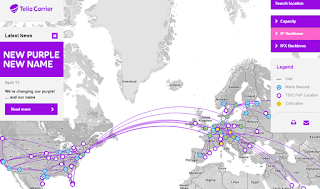
Telia Carrier has launched an advanced SD-WAN service that leverages its global and cloud-scale Internet backbone. The end-to-end networking solution, which is based on Cisco's Viptela SD-WAN technology, provides superior visibility, agility and control beyond the traditional WAN perimeter.

In 2017, Telia Carrier, via its parent company Telia Company, was the first European service provider to launch SD-WAN. The company is now strengthening its offering to meet the growing demands of global enterprises in Europe, North America, and parts of Asia. Enterprises will benefit from Telia Carrier’s unique cloud-scale internet backbone, ranked number 1 in the world (Dyn Research), as the underlay, which complements the resilient overlay it can build on Cisco’s SD-WAN platform.
“We see tremendous opportunities to help global enterprises with their digital transformation journeys through the ‘cloudification of networking’ – using a centralized, unified, cloud-based controller that covers the extended WAN environment, with the support of our backbone as the primary underlay and an award-winning customer experience,” said Staffan Göjeryd, CEO, Telia Carrier.

“SD-WAN has the capability to deliver transformative results for organizations looking to harness the power of a cloud-based consumption model,” said Erin Dunne, Director of Research, Vertical Systems Group. “Telia Carrier has a unique advantage as the operator of one of the world's largest global internet backbones to simplify the adoption of SD-WAN using their established ecosystem. By combining the latest developments in SD-WAN with proven carrier solutions, Telia Carrier is addressing current migration challenges in this market.”

“SD-WAN has emerged as the connective tissue of the digital enterprise, enabling organizations to deliver applications to users with full visibility, control, security and performance across branches, campuses and clouds,” said JL Valente, vice president of product management, managed services for Cisco’s Intent Based Networking Group. “Telia Carrier’s new global SD-WAN managed service brings together Cisco’s leadership in SD-WAN and security with Telia Carrier’s powerful internet backbone to give customers an easy to deploy managed solution that keeps remote users secure and ensures a consistent user experience.”

Telia Carrier's 400GE-ready IP backbone powered by Cisco NCS5500 routers

Telia Carrier has launched a full-scale, 400GE-ready network supported by Cisco NCS5500 series routers.

The launch follows Telia Carrier’s successful deployment of more than 10,000 new 100GE ports during 2019 using the same platform.

Telia Carrier’s customer base now exceeds 2,000 customers in more than 120 countries.

Cisco said the ongoing standardization of 400GE coherent technologies also incentivises new, simplified and partially disaggregated IP over DWDM architectures. The NCS5500 will play a key role in realizing Telia Carrier’s ambitions to spearhead that wave as they are already deploying open optical line systems across several continents.

“Conventional architectures and technologies built on decades of accumulated complexity and yesterday's truths fall short in helping us keep up with customer demands for more, consistent bandwidth and a high-quality experience. This is especially true as more value is shifting to software, hardware cycles are becoming shorter and ongoing 400G standardization is poised to finally disrupt the optical networking market,” said Staffan Göjeryd, CEO, Telia Carrier. “With Cisco leading the market in high capacity transport, they were the perfect fit to help us reach this monumental milestone to continue to perform at the highest calibre, while also reducing costs.”

“We are aligned in our mission to make connections reach further and bring the world closer through innovative technology,” said Kevin Wollenweber, Vice President of Networking, Cisco Service Provider Business. “Combining Cisco’s cloud-scale technology with the strength of the Telia Carrier network, we are helping Telia Carrier customers across more than 120 countries realize the full potential of what the Internet for the Future can do for them.”

http://thenetwork.cisco.com

QSFP-DD800 MSA releases initial 800G transceiver spec

The Quad Small Form Factor Pluggable Double Density 800 (QSFP-DD800) Multi Source Agreement (MSA) group has released a new hardware specification for the QSFP-DD800 transceiver form factor.

The new QSFP-DD800 1.0 specification is intended to be incremental to the existing QSFP-DD 5.0 specification. As signal integrity and thermal performance remain imperative, the transceiver pads have been optimized to improve signal integrity for 100 Gbps performance per lane without affecting backwards compatibility. The new specification additionally defines a novel 2x1 connector/cage, with cabled upper ports as an option to address signal loss issues associated with tradition PCBs. Looking ahead, QSFP-DD800 promoters will continue to work on new connector/cage variants, including 2x1 SMT versions that operate at 100 Gbps per lane.

The MSA group was formed to advance the development of high-speed, double-density QSFP modules which support 800 Gbps connectivity and includes the following promoters: Broadcom, Cisco, II-VI, Intel, Juniper Networks, Marvell, Molex and Samtec.

“In the short time our group has collaborated, we are thrilled to introduce this first specification for the next generation of the QSFP family of modules,” said Scott Sommers, co-chair of the QSFP-DD800 MSA. “As signal integrity and thermal management remain challenges for the optical communications industry, our MSA group is confident that its solutions will meet performance needs.”

“With their superior system integration and design flexibility, QSFP modules continue to be the cornerstone in building next generation networks and network equipment, especially as port speeds increase to 800G,” said Mark Nowell, co-chair of the QSFP-DD800 MSA. “Furthermore, their ability to increase switch and routing bandwidth density without sacrificing backwards compatibility with QSFP-DD, QSFP56 and QSFP28 modules provide network operators tremendous commercial and operational advantages.”

http://www.qsfp-dd800.com

Lumentum introduces 980nm high-power pump lasers

Lumentum introduced a series of advanced 980 nanometer (nm) single-mode pump lasers that offer significantly higher power and higher efficiency, enabling high-density erbium-doped fiber amplifier (EDFA) designs.

Lumentum said its new pump lasers employ revolutionary chips that are based on Lumentum's field-proven, proprietary, high-reliability technology, but offer operating power levels from 250 mW to 1600 mW.

Highlights

  • The new 5200 Series is designed for undersea optical applications that require ultra-high reliability when pumping EDFAs in submarine repeaters and branching units. The new uncooled laser offers increased operating power up to 800 mW. Additionally, by employing new and innovative advancements in chip technology and high-reliability packaging, the 5200 Series improves customers' overall optical performance. The 5200 Series will be available in July 2020.
  • The H11 Series, an uncooled 3-pin low-profile planar pump laser with up to 250 mW output power, significantly reduces the overall pump laser size and power consumption. This laser series employs both an innovative distributed feedback (DFB) laser chip, which integrates a high-power laser and grating into a single high-reliability laser die, and an improved package design. The H11 Series provides a noise-free, narrowband spectrum under temperature, drive current, and optical feedback changes. The H11 Series will be available in May 2020.
  • The new D2 Series dual-chip 980 nm pump laser provides up to 1.6 W total optical output in a low-profile 14-pin butterfly package. The D2 Series also incorporates an innovative next-generation chip and semi-autonomous assembly technology, which significantly improves power and density. The D2 Series will be available in July 2020.

MACOM announces 96 GBaud TIA and driver for 600Gbps and 800Gbps

MACOM released a dual channel 96 GBaud transimpedance amplifier (TIA) and quad-channel modulator driver for coherent optical networking applications.

The company said its new dual-channel TIA MATA-009806 and quad-channel driver MAOM-009408 offer customers the high bandwidth, low noise and low power consumption to enable Integrated Coherent Receivers (ICRs), High Bandwidth Coherent Driver Modulators (HB-CDMs) and Integrated Coherent Transmit-Receive Optical Sub-Assemblies (ICTROSAs) operating at up to 800Gbps in Telecom and DCI applications.


  • The MATA-009806 is a dual-channel linear TIA for coherent receivers supporting baud rates up to 96 GBaud and complex modulation formats such as 64QAM. With built-in automatic gain control (AGC) and transimpedance gain of up to 5KΩ, the TIA has 60GHz of bandwidth and ultra-low noise to support applications from long haul to DCI. The device is available to customers in bare die form.
  • The MAOM-009408 is a high-performance quad channel modulator driver also supporting 96 GBaud symbol rates. The part has up to 19 dB of gain with 15 dB of gain range and a maximum output voltage of 3 Vpp differential. The device is designed to be directly DC coupled to an optical modulator for maximum bandwidth, minimum size and minimum power dissipation. The device is available to customers in bare die form.


http://www.macom.com/applications/optical-networking

MACOM intros 25G photodiode Fabry-Perot laser

MACOM announced the availability of its 25G Avalanche Photodiode (APD) and 25G Fabry-Perot (FP) Laser optical components for 5G Wireless and Datacenter applications.

  • The APD28A is a back-illuminated 25G APD covering both O- and C-Bands with a usable wavelength range of 1250nm to 1650nm. The Photodiode features greater than 20GHz (3dB) bandwidth, with very high sensitivity of -22dBm when coupled to a low noise amplifier for transmission applications. The device performance enables customers to design optical sub-assemblies and transceivers suitable for 5G wireless mid-haul and long-haul networks, and extended reach (ER4) applications for 100Gbps, 200Gbps and 400Gbps Data Center applications. MACOM will offer the 25G APD as bare die and a chip-on-carrier format to provide maximum design flexibility to customers.
  • The MAOD-131F25 is a directly modulated high speed 25Gbps 1310nm Fabry-Perot laser diode with a wide operating temperature range of -40oC to +95oC. The device leverages MACOM’s patented and proven Etched Facet Technology (EFT) enabling scalability to high volume manufacturing. The 25G FP laser is ideally suited to enable customers’ 5G LTE fronthaul short reach applications as well as low cost 100Gpbs parallel single mode fiber (PSM4) application for datacenters.MACOM will offer the 25G Fabry-Perot laser in a TO-Can package.

http://www.macom.com/applications/optical-networking

Lumentum delivers externally modulated lasers for 100G PAM4

Lumentum introduced three new high-speed datacom laser chips to enable the growth of future hyperscale data centers and 5G wireless applications.

  • 100G PAM4 Uncooled EMLs for Next-Generation Data Centers - Lumentum PAM4-optimized 53 Gbaud EMLs enable full C-temp transceiver designs without using a TE cooler. As a long-standing leader with expertise in complex EML technology, Lumentum has developed an industry-first uncooled, self-hermetic EML. Available to sample in Q3 2020, this laser chip will lead the transition in data center infrastructure from 100G to 400G by enabling a wide-temperature range and high-performance 2 km PAM4 modules.
  • 50G PAM4 VCSELs for High-Speed Short Reach Optical Networks - Enabled by its advanced 6-inch GaAs wafer foundry and its experience producing high-reliability 3D sensing VCSELs at high-volume, the Lumentum 50G (28 Gbaud) VCSEL provides unprecedented uniformity at scale. In addition, the VCSEL is suitable for non-hermetic applications from 0ºC to 80ºC, delivers extremely high yields, and is RoHS10 and Telcordia GR-468 compliant. This solution will be available to customers in Q2 2020.
  • 50G PAM4 DMLs for 5G Mid-haul, Backhaul, and Hyperscale Data Centers - Lumentum DMLs use a sophisticated cavity design to operate over wide and demanding temperature ranges. Offering higher-bandwidth, the 50G PAM4 (28 Gbaud) DMLs provide the equivalent performance of an EML, but in a smaller and more cost-effective footprint. This product is now available for sampling.

"To sustain the expected growth in these markets, customers critically need an experienced supplier that can provide high performance, high quality, and scalability," said Senior Vice President and General Manager, Datacom, Walter Jankovic. "At Lumentum, we leverage our high-volume manufacturing capability, unmatched materials, and laser device expertise in Indium Phosphide (InP) and Gallium Arsenide (GaAs), to meet our customer expectations for chip innovation at scale."

OFC Keynote: Celebrating 50 years of Light-speed Connections

From OFC 2020 in San Diego, here is a recording of the special keynote: Celebrating 50 years of Light-speed Connections.

This 50-minute video features a tribute to the many innovators over the past 5 decades, along with commentary from David Welch, founder & chief innovation officer, Infinera.

https://events7.mediasite.com/Mediasite/Play/747ae78e651e4380989bcef3ed42146e1d


IDC: Worldwide Ethernet switch sales dipped 2% in 4Q19

The worldwide Ethernet switch market (Layer 2/3) recorded $7.6 billion in revenue in the fourth quarter of 2019 (4Q19), a decline of 2.1% year over year, according to the International Data Corporation (IDC) Worldwide Quarterly Ethernet Switch Tracker and Worldwide Quarterly Router Tracker. For the full year 2019, the market recorded $28.8 billion in revenue for a year-over-year growth rate of 2.3%. Meanwhile, the worldwide total enterprise and service provider (SP) router market recorded $4.2 billion in revenue in 4Q19, a decrease of 7.7% on a year-over-year basis. For the full year 2019, the router market finished at $15.5 billion, essentially staying flat with an increase of 0.4% over 2018. These results are according to

"The Ethernet switch and router markets showed weakness in the final quarter of 2019, driven by a variety of factors. Macro-economic issues continued to impact the global economy from the ongoing trade war between the U.S. and China to growing clarity about Brexit. While the rise and spread of the novel coronavirus, COVID-19, did not impact these 4Q19 results, it will not ease these pressures in the early part of 2020 where we expect this softness to continue," said Rohit Mehra, vice president, Network Infrastructure at IDC. "Despite these headwinds, enterprises are still prioritizing investments in digital platforms in order to transform their businesses and keep pace with competitors, which will ultimately continue to buoy spending in the networking market over the long term."

Some highlights from IDC:

  • Growth in the Ethernet switch market continues to be driven by high speed switching platforms. 
  • 100Gb Ethernet switch revenues grew 24.7% year over year in the quarter and made up 18.3% of the market, down just slightly from 19.6% in the prior quarter. 
  • 100GbE shipments reached 5.8 million ports and $1.4 billion in revenue in 4Q19. 
  • 25GbE switch ports continue to see strong growth with port shipments rising 57.1% year over year in the quarter and up 7.4% sequentially. 
  • 10GbE port shipments grew 7.0% year over year while revenues decreased 13.0%. 10GbE made up 27.3% of all 2019 Ethernet switching revenues. 
  • 1Gb remains the primary connectivity technology for enterprise campus and branch deployments, driving 1Gb port shipments to 133.6 million in 4Q19, growing 4.1% year over year, and making up 67.8% share of all ports shipped in the quarter and 40.3% of Ethernet switching revenues.
  • The combined enterprise and service provider router market had mixed results across the world, with APeJ falling 12.4% year over year in 4Q19 and down 1.1% for the full year. 


Company highlights

  • Cisco's 4Q19 Ethernet switch revenues were down 6.4% year over year giving the company a 50.9% market share. For the full year 2019, Cisco switching revenues were flat, rising 0.1% over 2018. In the hotly contested 25GbE/100GbE segment, Cisco remains the market leader with 39.7% share in 4Q19. Cisco's combined service provider and enterprise router revenue fell 18.5% year over year in 4Q19 and was off 3.4% for the full year giving the company 37.2% share in 2019.
  • Huawei's Ethernet switch revenue grew 8.9% year over year in 4Q19 and was up 7.8% in 2019 compared to 2018. This gives Huawei 9.6% market share for the full year. Huawei's enterprise and SP router revenue fell 4.1% year over year in 4Q19 but rose 4.1% for the full year, giving the company 29.8% market share in 2019.
  • Arista Networks' Ethernet switching revenue fell 11.1% year over year in 4Q19 but rose 9.8% for the full year. 100GbE revenues for Arista cooled somewhat in 4Q19 falling 19.7% compared to 3Q19. Arista's market share in the broader Ethernet switch industry stood at 7.0% at the end of 2019, up from 6.5% year over year.
  • Hewlett Packard Enterprise's (HPE) Ethernet switch revenues were off 15.9% year over year in 4Q19. This contributed to a decline of 9.1% in annual revenues in 2019, putting the company's full-year market share at 5.4% compared to 6.1% at the end of 2018.
  • Juniper's Ethernet switch revenues rose 11.7% year over year in 4Q19 but were off 7.2% for the full year. Juniper's 4Q19 router revenues declined 4.6% year over year and were off 11.7% for the full year. The company finished 2019 with 13.2% market share in the service provider routing market, down from 14.7% in 2018.

Department of Commerce extends export license to Huawei

The U.S. Department of Commerce has extended export licenses to Huawei Technologies Co. Ltd. and its non-United States affiliates (Huawei) for U.S. suppliers through May 15, 2020.

At the same time, the Bureau of Industry and Security (BIS) announced it is seeking public comments on the continuing need for, and scope of, possible future extensions of the Temporary General License (TGL) for Huawei.  The Department notes that its initial TGL from May 2019 and the three extensions that followed were intended to allow time for companies and persons to shift to alternative sources of equipment, software, and technology (e.g. those not produced by Huawei or one of its listed affiliates).

Semtech releases PAM4 CDR Platform for 200G and 400G

Semtech announced production availability of its "Tri-Edge" CDR SR solutions to enable next-generation data center multi-mode interconnectivity. There are two new devices:

  • GN2558 is a quad PAM4 CDR with an integrated VCSEL driver
  • GN2559 is a quad PAM4 CDR with an integrated linear transimpedance amplifier (TIA).

The GN2558 CDR includes proprietary VCSEL compensation to enable a wide range of VCSEL options with fully adaptive input equalization and fast startup to streamline system bring up. The GN2559 linear TIA and CDR provides superior receiver performance with fast adaptation and startup. The GN2559 includes configurable output equalization enabling robust electrical interfaces.

“Semtech has successfully demonstrated the inter-working of its chipset solution on 400G ports for commercial Ethernet switches over 70m of OM3 fiber and 100m of OM4 fiber,” said Julius Yam, Senior Product Line Manager in Semtech’s Signal Integrity Products Group. “The GN2558 and GN2559 ICs provide the highly desired low power, low latency analog solution to meet the needs of high-performance computing (HPC), artificial intelligence (AI) and Cloud data center networks. This chipset is also fully compliant to the 200G-SR4 Open Eye MSA specification.”

http://www.semtech.com/optical

Tuesday, March 10, 2020

State of NFV: Containerizing the Telco Cloud

In 2019, NFV pretty much became mainstream. This year, the term is becoming irrelevant, says  Ron Haberman, CTO of Nokia Software, thanks to the shift to containers and the expansion capabilities into public cloud. This 5-minute video offers insights into the containerization of telcos clouds.

https://youtu.be/Pfn5RnNi-ok


Aruba launches Passpoint-based Wi-Fi service for mobile operators

Aruba is launching a roaming service for mobile operators that will enable cellular subscribers to securely and automatically roam onto participating Aruba enterprise Wi-Fi networks.

Aruba Air Pass promises a seamless hand-off between cellular and Wi-Fi networks, without sacrificing security or quality of service.

For existing Aruba enterprise customers, the new Air Pass service will use existing enterprise Wi-Fi infrastructure as a cost-effective alternative to deploying indoor small cells or distributed antenna systems (DAS).

When used in conjunction with Aruba Air Slice, an Aruba technology that improves radio performance, telcos can extend their 5G footprint into the enterprise and enable seamless Wi-Fi calling and gigabit-class guaranteed performance.

Aruba believes global telcos will support the service because the enterprise Wi-Fi network effectively becomes a seamless on-ramp and offload point for 5G services.

“The combination of Aruba Air Pass with Aruba Air Slice gives telcos the ability to extend the reach of their 5G networks into the enterprise while economically improving the overall end user experience,” said Jeff Lipton, vice president of Strategy and Corporate Development at Aruba, a Hewlett Packard Enterprise company. “Devices that associate with an enterprise network using Aruba Air Pass may then use their Wi-Fi connections to access applications and services, such as making and receiving calls and text messages, based on their roles and permissions.”

http://www.arubanetworks.com

Aruba Air Slice brings to app prioritization to Wi-Fi 6

Aruba introduced a unique Wi-Fi 6 technology designed to provide application prioritization with carrier-grade quality assurance.

Aruba Air Slice leverages the same OFDMA radio technology that powers the 4G LTE and 5G NR radios to dynamically allocate radio resources, such as time, frequency and spatial streams. The company says Aruba Air Slice guarantees performance for latency-sensitive applications such as AR/VR, Zoom and Slack, mobile gaming and real-time IoT applications.

The Air Slice technology is proprietary and builds on top of the Wi-Fi 6 specification. In addition to OFDMA, it leverages MU-MIMO and TWT (Target Wake Time) to allocate resources and extend cellular-grade SLAs and QoS to Wi-Fi connections.

Aruba says Air Slice minimizes airtime contention and efficiently groups Wi-Fi 6 and non-Wi-Fi 6 client devices to guarantee bit rate, and provide bounded latency and jitter simultaneously. Air Slice is available exclusively on Aruba’s Wi-Fi 6 access points via Aruba Central for management.

https://www.arubanetworks.com/assets/tg/TB_Air-Slice.pdf

HPE extends its 5G strategy with as-a-Service portfolio

Hewlett Packard Enterprise (HPE) is advancing its edge-to-cloud, platform as-a-service offering with 5G in mind.

HPE's portfolio will include a cloud-native software stack for 5G core, optimized telco core and edge infrastructure blueprints, and Wi-Fi 6 enabled services.

The company will focus on open and interoperable platforms combined with carrier-grade infrastructure and modular software components.

  • At the telco core – a new HPE 5G Core Stack, which is a cloud-native and containerized. The HPE 5G Core Stack will be available as an integrated software and hardware platform, based on validated HPE Telco core and edge blueprints
  • At the telco edge – a dense, ruggedized general purpose platform enabling Virtual Radio Access Networks (vRAN) and Multi-access Edge Computing (MEC). 
  • Infrastructure delivered as-a-service with HPE GreenLake - available via a pay-as-you-go, managed services and elastic model, these offerings provide telcos with an attractive, fast ramp for rolling out 5G services by enabling them to reduce upfront capital investments and reduce risk by leveraging specialized and proven telco and enterprise edge hardware and software. With HPE GreenLake, telcos can grow and expand their network as new users come online and pay monthly based on measured utilization. Through HPE GreenLake, the 5G infrastructure can be operated on behalf of the customer to free up resources to focus on innovation at the network and enterprise edge.


“Openness is essential to the evolutionary nature of 5G and with HPE 5G Core Stack telcos can reduce operational costs, deploy features faster and keep themselves open to multiple networks and technologies while avoiding being locked-in to a single vendor approach,” said Phil Mottram, vice president and general manager of the Communications and Media Solutions business unit at HPE. “HPE has one of the broadest 5G portfolios in the market and is uniquely positioned to help telcos build an open multi-vendor 5G core, optimize the edge with vRAN, and deliver connectivity and new compute services to the enterprise using MEC and Wi-Fi 6.”

“5G has the potential to revolutionize our digital lives and the combination of 5G and Wi-Fi 6 presents telcos with an unlimited array of possibilities for offering subscribers new and compelling services that can transform the user experience,” said Keerti Melkote, president of Intelligent Edge at HPE and founder of Aruba Networks. “With a broad portfolio of innovations that span from the telco core to the enterprise edge, HPE is the only platform as-a-service company that can deliver the infrastructure, software solutions and the technical expertise to support global telcos in their quest to fully realize the promise of 5G.”

Cignal AI: North American optical sales rebound in 2019

Sales of optical equipment in North America rose more than 25% for 4Q19 and 10% for all of 2019, according to the most recent Transport Hardware Report from research firm Cignal AI.

The North American packet market for Access and Aggregation routing devices also grew strongly in the fourth quarter as demand for Edge and Core switching and routing dropped off dramatically. 5G and other access rollouts boosted growth in the Access and Aggregation market segment.

“After three years of North American spending declines as operators focused capex on wireless and access, optical hardware sales for the region revived and grew at a healthy pace for 2019, while packet hardware sales remained flat,” said Scott Wilkinson, Lead Analyst at Cignal AI. “Market leaders Ciena, Infinera, and Cisco all achieved optical sales growth of more than 25% in 2019.”

Some highlights:

  • Long haul optical spending reached record levels in 2019. Growth slowed in 4Q19 but the segment finished the year up over 10%.
  • Transport equipment sales in China declined slightly in 4Q19 as packet sales declined and optical sales growth cooled to single digits. When adjusted for the influence of ZTE’s shutdown in 2Q18, optical hardware sales grew less than 10% in 2019.
  • Japan ended an extraordinary year of optical sales growth up 25% in Q4 and almost 40% in 2019.


https://cignal.ai/2020/03/north-american-optical-sales-rebound-in-2019/

II-VI launches pluggable Optical Line Subsystem for 400ZR

II‐VI introduced a pluggable optical line subsystem (POLS) platform to enable the 400ZR coherent transceivesr ecosystem for next-generation datacenter interconnects (DCIs).

II-VI’s initial product from the POLS platform is the OSFP-LS, designed in the very compact OSFP form factor, that plugs directly into a datacenter interconnect (DCI) switch port and enables full-duplex multi-channel 400ZR transport, including multiplexing, demultiplexing, and variable-gain amplification. The OSFP-LS supports up to 8 DWDM wavelengths, or 3.2 Tbps per fiber pair.

“The POLS platform is a revolution in datacenter interconnects,” said Martin Hull, VP of Platform Products at Arista Networks. “Just as a 400ZR transceiver collapses the 400G transponder linecard functionality into a pluggable module, so does the OSFP-LS in relation to an optical line system linecard. The plug-and-play functionality of the OSFP-LS will enable our switch customers to deploy them quite easily and cost-efficiently as they migrate to 400ZR.”

“The POLS platform leverages significant breakthroughs in the areas of miniaturizing optical components for amplification and wavelength management, while simultaneously improving performance and reducing power consumption,” said Dr. Sanjai Parthasarathi, Chief Marketing Officer, II-VI Incorporated. “The POLS platform is enabled by II-VI’s vertically integrated portfolio of best-in-class components in the industry, including our uncooled, highly compact, 3-pin micropump, the smallest of its kind on the market.”

MACOM extends Transimpedance Amplifier line for 100G to 800G

MACOM Technology Solutions released two new transimpedance amplifiers (TIAs) optimized for use in optical networking applications ranging from 100Gbps DR1 to 800Gbps DR8 and FR8.
 The new TIAs are available today in flip chip and wire bonding packaging options for fast, flexible deployment in QSFP, QSFP-DD and OSFP optical modules.

MACOM says the rapid evolution to single lane 100G and multiple lanes 200G, 400G and 800G connectivity is increasing the demand for high-performance, power-efficient optical components needed to maximize bandwidth density in the Cloud Data Center.

  • The MATA-05817 delivers low noise performance less than 2 uA RMS typical and supports bandwidth up to 35 GHz. The TIA supports high throughput optical data links in a very low power profile, optimal for use in high density Optical Data Center interconnects. The device is intended for 50G, 100G, 200G and 400G receivers using multilevel modulation such as PAM4.
  • The MATA-38134 is a quad 26/53 GBaud linear PAM4 TIA with automatic gain and integrated AGC loop. The TIA consumes very low power and is primarily targeted for single-mode fiber applications. The TIA has 500um anode to anode spacing which allows customers to place two devices within the QSFP-DD form factor enabling 800Gbps applications.


Both devices include RSSI for photo-alignment and power monitoring and I2C control of bandwidth, output amplitude, peaking, LOS, gain and other parameters.

http://www.macom.com/applications/optical-networking

CoreSite Open Cloud Exchange offers connections to Google Cloud

CoreSite Realty is adding on-demand direct connectivity to the Google Cloud Platform on the CoreSite Open Cloud Exchange.

CoreSite continues to provide high-speed fiber connectivity to Google Dedicated Interconnect for the most demanding data needs and is now offering Partner Interconnect to Google within the CoreSite Open Cloud Exchange.

“By simplifying and automating the provisioning process, offering flexible bandwidth options, and enabling additional points of access to the Google Cloud Platform on the CoreSite Open Cloud Exchange, it enriches the value of CoreSite’s interconnection platforms to enterprises and service providers designing and implementing hybrid and multi-cloud solutions,” said Maile Kaiser, CoreSite’s SVP of Sales. “This is another important innovation of our interconnection capabilities and further enhances our value to enterprises advancing their digital business.”

Open Eye Consortium specification defines 53Gbps per lane PAM-4

The Open Eye Consortium (Open Eye MSA) published its 53 Gbps single-mode specification defining the requirements for analog PAM-4 solutions for 50G SFP, 100G DSFP, 200G QSFP, and 400G QSFP-DD and OSFP single-mode modules.

The Open Eye MSA aims to accelerate the adoption of PAM-4 optical interconnects scaling to 50Gbps, 100Gbps, 200Gbps, and 400Gbps by expanding upon existing standards to enable optical module implementations using less complex, lower cost, lower power, and optimized analog clock and data recovery (CDR) based architectures in addition to existing digital signal processing (DSP) architectures.

A whitepaper is available to view and download.

In addition, the Open Eye MSA announced the draft of its multi-mode specification available to its members for comments, with general availability targeted for release in Fall 2020.

http://www.openeye-msa.org

Innovium reports multiple customers for 400G production networks

Innovium reports that multiple cloud and data center customers are deploying its 12.8Tbps TERALYNX 7 based switches together with Innolight optics for 400G production networks. Customers were not named.

“Massive growth in Data, AI and 5G is driving the need to scale data center networks. Leading data center customers are deploying Innovium 12.8Tbps switches together with Innolight’s comprehensive portfolio of 400G optical transceivers to scale their networks,” said Osa Mok, Chief Marketing Officer of Innolight Technology. “400G PAM4 optics has achieved volume production with superior cost per bit and is expected to ramp significantly during 2020. We are excited to partner with Innovium using their 50G PAM4 TERALYNX switches, as well as future 112G solutions.”

“The 50G PAM4 ecosystem has matured over the last few years to offer a range of switch systems and 400G optics ready for production network deployments,” said Alan Weckel, founding analyst at 650 Group. “We expect a significant ramp in 400G deployments in 2020 as data center customers build next generation networks to meet their insatiable appetite for bandwidth and get better ROI. We also believe that these 400G switches will extend to data-center inter-connect (DCI) and accelerate with the availability of 400G ZR optics next.”