Wednesday, February 20, 2019

Ciena's WaveLogic 5 delivers tunable bandwidth up to 800G

Ciena unveiled its latest WaveLogic coherent optics technology for greater scale, programmability and intelligence from network edge to core.

The two solutions are being introduced:
  • WaveLogic 5 Extreme (WL5e) provides programmable capacity in 50G increments over a single-wavelength 800G.  The solution delivers 50 percent more capacity per wavelength and up to 20 percent higher spectral efficiency than competitive offerings. WL5e also enables an elegant evolution to emerging 400GbE-interface routers, with the ability to efficiently transport 400GbE client rates at any distance, from across the metro to across the ocean.
  • WaveLogic 5 Nano (WL5n) addresses the market of footprint-optimized coherent solutions for 100G-400G applications. It supports a range of solutions that meet specific space, power and operational requirements, from standalone pluggables for 400ZR single-span DCI applications, to extended-temperature, standards-based optical modules for access applications, to compact coherent optics with seamless photonic layer integration for certain metro/regional applications.
Ciena said it has focused its WaveLogic 5 investment in key foundational technologies beyond digital signal processing (DSP) to include high-speed electro-optic components based on both silicon photonics and indium phosphide. This gives Ciena full control of the design of its coherent optical solutions to accelerate innovation and deliver significant time-to-market and cost advantages for customers.

“An important part of Ciena’s success has always been our ability to anticipate market trends and strategically invest and out-innovate the competition to solve our customers business problems. WaveLogic 5 is another example of that leadership ability at work, underpinned by the financial strength, global scale and superior engineering expertise that affords us the confidence in continuing to deliver as promised on our forward roadmap commitments,” stated Scott McFeely, Senior Vice President of Global Products and Services, Ciena.

The WaveLogic 5 solutions will begin to become available in the second half of 2019. WL5e and WL5n technology will be offered across Ciena’s Converged Packet Optical and Packet Networking portfolios, and will also be made available for use in third-party equipment via Ciena’s Optical Microsystems portfolio.


https://www.ciena.com/insights/articles/Ciena-unveils-WaveLogic-5-800G-and-so-much-more.html

Ericsson and Juniper partnership exceeds 20 new customers

Ericsson and Juniper Networks cited growing momentum for their expanded partnership, which was announced in September 2018 and which has now passed 20 new customers worldwide.

The two companies also announced the following enhancements to their joint 5G transport network and security solutions:

  • With the evolution of Ericsson’s solution for network slicing, Juniper’s SDN controller, NorthStar, is interworking with Ericsson Dynamic Orchestration, providing seamless control from the cell site to the packet core network – including the data center gateway. This allows automation and integration of connectivity services in the transport domain into an end-to-end network slice. With this solution, Ericsson’s Wide Area Network Orchestrator (WANO) acts as a hierarchical SDN controller in charge of configuring connectivity services.
  • Transport orchestration added to Ericsson’s network slicing solution provides the network slice with guaranteed bandwidth and key performance indicators, such as latency. Slicing in the transport domain is also enhanced by combining soft network slicing through Ericsson Dynamic Orchestration and hard network slicing through Junos node slicing on Juniper’s MX Series portfolio. In combination with Ericsson Radio System, this joint solution will enable an end-to-end network slice on a shared infrastructure that can be secure, optimized and isolated.
  • Security solutions from Juniper are being integrated into the Ericsson RAN offerings. In addition to the newly announced 5G High Layer vRAN, Ericsson security functionality has been complemented with Juniper SRX and vSRX gateway products as the IPSec security solution to elevate and extend the security framework across the network.
  • Juniper PTX, MX and SRX will be natively integrated into Ericsson Security Manager to reduce time-to-market by automating hardening and facilitating monitoring and compliance of security policies.

Ericsson expands 5G portfolio with Juniper's edge, core and security

Juniper Networks and Ericsson are expanding their 18-year partnership with Ericsson with a focus on delivering an end-to-end 5G solution that combines Juniper’s routing and IP transport with Ericsson’s Router 6000 and MINI-LINK microwave portfolio for distributed, centralized and virtualized radio access.

The companies are now offering a 5G transport network solution with single pane of glass visibility to manage the new requirements of next-generation mobile service delivery.


For the go-to-market strategy, Ericsson will include Juniper’s solutions for edge, core and security as part of its end-to-end 5G transport portfolio.

The joint solution encompasses:

Access, fronthaul/backhaul:

  • Ericsson Router 6000 flagship mobile backhaul portfolio. 
  • Ericsson Fronthaul 6000 includes high density optical solutions that complement microwave solutions for CPRI and eCPRI transport.

Microwave radio backhaul:

  • Ericsson’s MINI-LINK is a 5G-ready microwave technology.
WAN Services and IP Transport: 
  • Juniper’s MX and PTX Series support mobile infrastructure for 10G/100G/400G optical transport, simplified operations with Juniper’s unique universal design, advanced Junos OS software functionality including Junos Node Slicing, Juniper Telemetry Interfaces and an open, standards-based hardware-accelerated 5G CUPS User Plane.
  • Juniper’s MX Series 5G Universal Routing Platform .
  • Juniper’s PTX Series Packet Transport Routers are built to optimize IP/MPLS transport for backbone, peering and converged metro core applications.
  • Juniper’s transport routers offer integrated dense wavelength-division multiplexing (DWDM) interfaces with interoperability between the MX, PTX series and Ericsson’s Router 6000
Security Gateway & Gi Firewall:

  • Ericsson Radio Base Stations are already integrated with the Juniper’s SRX Series Services Gateway, a high performance and highly scalable next-gen firewall platform, providing both Gi Firewall and security gateway solutions for end-to-end 4G/5G offerings. Juniper will continue to enhance its security solutions to work efficiently with Ericsson’s RAN solutions as they evolve to 5G.
Unified management and control:

  • Ericsson’s management and orchestration solution will be applied across Ericsson and Juniper products, which will be fully integrated, including full FCAPS support.

NEC demos adaptive network control for radio resources

NEC demonstrated adaptive network control technology in its multi-access edge computing (MEC) servers and base stations in a use case concerning automated driving. These trials successfully allocated radio resources (frequency bandwidth and time slots) to vehicles with high urgency as part of providing services that require real-time communication control for mobile networks.

NEC said the tests confirmed that base stations can support safe driving by steadily suppressing communications delay time to within 100 milliseconds by preferentially assigning radio resources to vehicles with high urgency based on the analysis results of vehicle location information, camera images of the area around the road and other data.

In the experiment, an automated driving environment was simulated in an anechoic chamber. The MEC server detected pedestrians by analyzing images of street cameras at an intersection, collected information on the location of surrounding vehicles, and shared such information with individual vehicles in real time. The commercial LTE base station was placed near the intersection, and multiple devices, such as vehicle models, cameras and smartphones, were connected to create a situation where there was a shortage of wireless resources.


ZTE intros 5G Fronthaul 200G outdoor OTN platform

ZTE unveiled a 5G fronthaul 200G outdoor OTN product, the ZXMP M721 OD62, for the metro edge. The platform supports 200G connections and employs Flex-O technology to restrict the end-to-end latency within 1 microsecond.

ZTE said its fronthaul solution supports various service access types, including SDH, Ethernet, CPRI and eCPRI to meet the requirements of diversified scenarios. In addition, it supports WiFi debugging, and can automatically implement fast service provisioning, thereby simplifying operation and maintenance. 

“The ZXMP M721 OD62 demonstrates the world-leading 5G fronthaul transport capability of ZTE OTN products, and consolidates the industry-leading position of the full ZXMP M721 series as the aggregation access layer OTN. ZTE’s ZXMP M721 series has got objective assessment from the global industry analyst firm GlobalData. In the Packet-Optical Access (POA) class, it has again been rated as ‘Very Strong’ in recognition of the largest switching capacity, the highest port density, and the smallest footprint in the industry,” said Mr. Wang Taili, General Manager of ZTE Optical Transport Product. 

Deutsche Telekom continued to grow in record year 2018

Deutsche Telekom managed to keep growing throughout 2018, with revenue up by 0.9 percent to 75.7 billion euros, representing organic growth of 3.1 percent. Adjusted EBITDA rose by 5.0 percent to 23.3 billion euros, and free cash flow increased by 13.7 percent in the full year to 6.2 billion euros. The figures exceed the carrier's financial guidance.

The DT Group’s CAPEX increased to a record level with spending before expenses for mobile spectrum reaching 12.2 billion euros. This takes the investments made by the Group worldwide in the last four years to more than 46 billion euros, around 21 billion euros of this in Germany.

Some highlights:

  • In Germany, of branded mobile contract customers, 50.7 percent now use product packages combining mobile communications and fixed network, compared with 41.7 percent a year earlier. The number of MagentaEINS customers rose to 4.3 million as of the end of the year, up 17.5 percent from the end of December 2017.
  • In Germany, the fiber-optic build-out, which has been driven forward year after year, is resulting in a steady rise in customer numbers. 12.2 million customers now use a fiber-optic line, up more than 27 percent compared with the end of 2017. About half of branded consumers in the broadband business are already benefiting from the high speeds of fiber-optic lines.
  • While revenue remained almost stable, falling just 1.1 percent to 21.7 billion euros, adjusted EBITDA in the Germany segment increased by 2.4 percent to 8.6 billion euros. The first-time application of the new accounting standard IFRS 15 had a negative impact on revenue and a positive effect on adjusted EBITDA.
  • T-Mobile US’ total revenue grew by 6.8 percent in 2018 to 43.1 billion U.S. dollars. At the same time, adjusted EBITDA rose by 13.6 percent to 11.9 billion U.S. dollars.
  • In other European markets, revenue increased by 1.5 percent on an organic bases in the full year, and adjusted EBITDA by 1.8 percent. Due to the first-time consolidation of UPC in Austria, the increases in the reported figures were even higher. Revenue increased by 2.6 percent in 2018 to 11.9 billion euros. Adjusted EBITDA rose by 3.5 percent to 3.9 billion euros.

Okinawa subsea cable to deliver 80 Tbps design capacity

The  Okinawa Cellular Telephone Company has selected NEC to design, engineer, supply, install, test and implement an optical submarine cable system connecting Okinawa Prefecture and Kagoshima Prefecture in Japan.

The subsea cable will span a total length of approximately 760 km at a maximum depth of approximately 1,200 m. The cable system employs the latest optical wavelength multiplex transmission method, and the maximum design transmission capacity is 80 Tbps. The system is expected to enter service in April 2020.

https://www.nec.com/en/press/201902/global_20190218_02.html

Vodafone rolls out 5G test in Barcelona city center

In preparation for next week's Mobile World Congress, Vodafone has rolled out a 5G network in the city centre of Barcelona. The network will be used to demonstrate peak downlink speeds of 1.5Gbps.

Vodafone confirmed that it is on track to launch 5G in a number of European cities during the second half of 2019. The carrier has already completed trials over a four-week period with three 5G smartphones that will be launched in 2019. Both the smartphones and Vodafone’s 5G network were fully compliant with the latest version of the industry standard for Non-Standalone 5G - 3GPP’s ‘Release 15’, which was only approved in December 2018.

Other notes

  • Vodafone has invested €90 million in Milan to build the first 5G network in Italy, covering over 80% of the city. It has launched 31 5G use cases to date working with 38 industrial and public sector partners. The use cases cover the fields of health and wellbeing; security and surveillance; smart energy and smart cities; mobility and transport; manufacturing and industry 4.0; education; entertainment; and the digital divide. The use cases include a 5G Connected Ambulance developed with San Raffaele hospital; Europe’s first live 5G news broadcast with Sky; and a self-driving robotic vehicle delivering books at the Polytechnic University of Milan campus. Vodafone has also allocated €10 million over four years for the ‘Action for 5G’ competition for start-ups, SMEs and social businesses.
  • Vodafone UK is trialling 5G in seven cities and successfully completed the country’s first holographic call in September 2018 when England and Manchester City Women’s Captain, Steph Houghton MBE who broadcast from Manchester to Vodafone’s headquarters in Newbury, Berkshire in order to give footballing tips to 11-year-old Manchester City and Lionesses fan, Iris.
  • Vodafone Germany won the international Paul Pietsch Award in 2019 for its work in making the 5G standard fit for connected and autonomous driving in future utilising its 5G Mobility Lab and auto test track near Dusseldorf. It is now working with German broadcaster WDR to test the distribution of TV and Video on Demand content over 5G.
  • Vodafone Spain, which completed the world’s first 5G call at Mobile World Congress in 2018, has 5G cell sites across six cities. The company is also supporting the development of 5G connected surgery in Spain working with L’Hospital Clinic in Barcelona to enable a specialist surgeon to guide an operation by another surgeon without being physically present.

Xilinx updates Zynq UltraScale+ RFSoC chip for 5G sub-6GHz

Xilinx has updated its Zynq UltraScale+ Radio Frequency (RF) System-on-Chip (SoC) portfolio for greater RF performance and scalability.

The new Zynq devices can cover the entire sub-6 gigahertz (GHz) spectrum, which is a critical need for next-generation 5G deployment. They support direct RF sampling of up to 5 giga-samples per-second (GS/S) 14-bit analog-to-digital converters (ADCs) and 10 GS/S 14-bit digital-to-analog converters (DACs), both up to 6 GHz of analog bandwidth.

The portfolio now includes:

  • Xilinx Zynq UltraScale+ RFSoC Gen 2: Sampling now with production scheduled for June 2019, this device meets regional deployment timelines in Asia and supports 5G New Radio.
  • Xilinx Zynq UltraScale+ RFSoC Gen 3: Provides full sub-6GHz direct-RF support, extended millimeter wave interface, and up to 20 percent power reduction in the RF data converter subsystem compared to the base portfolio. The product will be available in 2H 2019.

"We are committed to helping our customers accelerate innovation, and are especially excited to drive the development of adaptable, intelligent 5G infrastructure with these new, higher performing additions to the Zynq UltraScale+ RFSoC portfolio," said Liam Madden, executive vice president of hardware and systems product development, Xilinx. "Now with complete coverage of sub-6GHz spectrum bands, it will give our customers even more of a competitive advantage by allowing them to accelerate the design and development of next-gen systems today."

ADVA posts Q4 revenue of EUR 131.5 million, up 12% YoY

ADVA reported revenues of EUR 131.5 million for Q4 2018, up by 4.2% from EUR 126.2 million in Q3 2018 and up by 12.2% from EUR 117.2 million in the same year-ago period. Pro forma operating income for Q4 2018 was EUR 8.1 million (6.2% of revenues), compared to EUR 6.8 million (5.4% of revenues) in Q3 2018 and a pro forma operating income of EUR 4.5 million in the same year-ago period. Net income for Q4 2018 was EUR 3.6 million, down from EUR 3.9 million in Q3 2018 and significantly improved in comparison to the same year-ago period net loss of EUR 0.9 million.

"We have steered a steady course in these turbulent times, remaining focused on our key goals to ensure both stability and continuity,” said Uli Dopfer, CFO, ADVA. “In all four quarters of 2018, we were able to increase our revenues sequentially. Our profitability also developed in a positive direction. In addition to successfully developing existing customers, we have won important new projects in all regions. At the same time, consolidation in our industry has further reduced the number of competitors, further sharpening our profile as an innovative telecommunications supplier with a unique blend of innovation and customer focus.”

“Digitization continues to transform networks and drive the investment focus towards us,” commented Brian Protiva, CEO, ADVA. “The rapid development and rollout of artificial intelligence, edge computing solutions, IoT and 5G require a robust and scalable telecommunications infrastructure with greater optical transmission capacity, new models for providing communication services, and increasingly precise network synchronization. Our key investments address each of these issues and clearly underline the value of our acquisition strategy. From this solid base, we’re creating new growth opportunities that we will capitalize on.”

https://www.advaoptical.com/en/newsroom/press-releases/20190221-adva-posts-annual-revenues-of-eur-502-million-for-2018

Orange and NTT enter R&D pact

Orange and NTT have entered into a strategic R&D pact covering multiple technology domains including 5G, network transformation, AI, IoT, cloud services, etc.

“As Europe embarks on its own 5G journey, our collaboration with NTT will be very precious. Both parties share a commitment to continuous learning and cultural exchange, which I fundamentally believe is essential in today’s global environment. The mutualisation of our respective research learnings will enable us to identify and develop better services for customers in our respective regions, and support the development of our multinational business customers internationally,” stated Stéphane Richard, chairman & CEO, Orange Group.

Tuesday, February 19, 2019

Deutsche Telekom deploys MobiledgeX Edge-Cloud

MobiledgeX, the edge computing company founded by Deutsche Telekom AG, unveiled its architecture for connecting mobile users to application cloud containers created by aggregating existing operator network resources.

Deutsche Telekom is now using the MobiledgeX Edge-Cloud R1.0 to power the first world's first public mobile edge network deployment and is already supporting the prototyping of developer use cases such as live trials around Augmented Reality (AR), Mixed Reality (MR), and Simultaneous Localization and Mapping (SLAM).

The solution MobiledgeX Edge-Cloud R1.0 leverages application cloud containers created by aggregating existing operator network resources. At runtime, MobiledgeX Edge-Cloud R1.0 spins up the containers on-demand in edge cloud locations (also known as “cloudlets”) that optimally fulfill the needs of the desired application and user quality of experience.

“Deutsche Telekom is proud to lead a global effort toward a smart, mobile, digital society and recognizes that ubiquitous edge availability is the foundation for this vision. For operators, Edge-Cloud R1.0’s ability to quickly aggregate existing 4G and 5G resources and make them available anywhere they are needed across the network means an extremely low barrier to entry for scalable edge deployments that can be immediately monetized. When edge networks are deployed widely, developers and device makers can more easily define business and use cases for new offerings that can be rolled out across a large number of users. The milestone announced today is an important moment not just for Deutsche Telekom and MobiledgeX, but the broader mobile ecosystem eager to capitalize on the massive edge opportunity in the lead-up to 5G,” stated Walter Goldenits, CTO of Telekom Deutschland in Germany.

Key features of MobiledgeX Edge-Cloud R1.0:

  • Device and platform-independent SDKs for Android and IOS devices in Java, C++, C# or REST that support edge node discovery, built-in identity and verified location services, with the ability to connect automatically to the nearest edge location. MobiledgeX will release these SDKs as open source to speed development times and flexibility.
  • A Distributed Matching Engine (DME) that is natively borne and integrated into Telekom Deutschland’s mobile network in Germany. The DME allows developers to ensure the identity and location of application users while guaranteeing their privacy as this data remains within the boundaries of the mobile service provider and is not disclosed to MobiledgeX.
  • A fully multi-tenant control plane that supports zero-touch provisioning of edge cloud resources via a Cloudlet Resource Manager. This architecture is massively scalable based on the number of distributed edge cloud locations and enables the operator to bring any combination of compute, storage and network resource pools to add to capacity independently of a preferred Virtualization Infrastructure Management (VIM) layer. For example, while Deutsche Telekom edge cloud resource pools are virtualized using OpenStack, MobiledgeX Edge-Cloud R1.0 equally supports other industry- standard VIMs such as VMware or native Kubernetes.
  • A global edge cloud SAAS portal that allows operators to visualize application delivery performance and developers to deploy their application containers.


MobiledgeX is highlighting the following use cases :

  • Automatically deploying application backends close to users based on their Verified Location and Identity. MobiledgeX Edge-Cloud R1.0 instantiates application containers to support streaming workloads similar to lambda functions ideally suited for increasingly immersive and massively multi-user workloads like multi-player gaming, robotics and AR maintenance that must ascertain trusted identity and location. The built-in “verified location” service automatically correlates GPS-reported location from the device using telemetry extracted from the mobile service provider’s infrastructure and directs mobile client to appropriate edge location.
  • Augmented Reality and Mixed Reality Performance Support. Makes lower latency available natively in the mobile network and geographically closer to end user devices. Enables AR and MR experiences on smart glasses or wearables where these devices do not natively provide the required CPU and GPU hardware capabilities, either due to cost, weight or power consumption reasons.
  •  Video and Image Processing that meets local privacy regulations. Platform guarantees in- country containment and privacy of user data, offering country-specific control planes that ensure country-specific applications and data remain in the country to satisfy GDPR and other privacy regulations.

Deutsche Telekom's MobiledgeX venture aligns with SK Telecom


MobiledgeX, the independent mobile edge computing provider founded by Deutsche Telekom, announced an agreement with SK Telecom to enable a new generation of connected devices, content and experiences, creating new business models and revenue opportunities leading into 5G.

MobiledgeX is focused on delivering developer-facing edge cloud services and bringing mobility to those services, dynamically placing application back-end as close to mobile devices as possible and removing them when not needed. MobiledgeX, Deutsche Telekom and Intel have partnered with Telecom Infra Project (TIP) to form an Edge Application Developer project group to ensure the gained insights and supporting source code are available to all.

"Deutsche Telekom created MobiledgeX as an independent company to drive strategic collaboration across the world’s leading telecoms, public cloud providers, device makers and the surrounding ecosystem - enabling a new era of business models, operating efficiencies and mobile experiences. We are particularly excited to announce SK Telecom’s participation in this collaborative ecosystem where everybody wins. SK Telecom is a global leader in 5G which follows their rich tradition of innovation within their network, strategic partnerships and developer engagement. This new era is underway,” says Eric Braun, Chief Commercial Officer of MobiledgeX.

Qualcomm's 2nd gen 5G modem targets 7 Gbps peak downlink

Qualcomm has begun sampling its 2nd generation 5G New Radio (NR) modem chip --  a 7-nanometer device that supports 5G NR mmWave and sub-6 GHz spectrum bands with up to 7 Gbps download speeds and 3 Gbps upload speeds over 5G, and Category 22 LTE with up to 2.5 Gbps LTE download speeds.

The Snapdragon X55 5G modem is designed for global 5G rollouts and is expected to hit the market in commercial devices by late 2019. Target applications include premium smartphones, mobile hotspots, Always Connected PCs, laptops, tablets, fixed wireless access points, extended reality devices, and automotive applications.


Qualcomm highlights support for all major frequency bands, whether mmWave or sub-6 GHz, supports TDD and FDD modes of operations and is capable of both Standalone (SA) and non-standalone (NSA) network deployments – providing flexibility and enabling virtually all deployment types globally. The modem is also engineered to support dynamic spectrum sharing between 4G and 5G, enabling operators to accelerate 5G deployments by using their existing 4G spectrum holdings to deliver both 4G & 5G services dynamically. It supports 100 MHz envelope tracking technology, and adaptive antenna tuning for 5G sub-6 GHz, designed for power-efficient connectivity.


“Qualcomm Technologies is spearheading the first wave of 5G launches with our first generation 5G mobile platform. With significant evolution in capabilities and performance, our second generation commercial 5G modem is a true testament to the maturity and leadership of our 5G technology. We expect our 5G platform to accelerate 5G commercial momentum and power virtually all 5G launches in 2019 while significantly expanding the global 5G rollout footprint,” said Cristiano Amon, president, Qualcomm Incorporated.

The Snapdragon X55 5G modem pairs with the newly announced 5G mmWave antenna module (QTM525), a new single-chip 14nm RF transceiver for 5G sub-6 GHz and LTE, and sub-6 GHz RF front-end modules to deliver the next generation modem-to-antenna solution for all major spectrum bands. The new QTM525 5G mmWave antenna module builds on the innovation of Qualcomm Technologies’ first mmWave antenna module by reducing the height of the module to support 5G smartphone designs sleeker than 8 millimeters thick. The new module adds support for band n258 (24.25 – 27.5 GHz) for North America, Europe and Australia on top of bands n257 (26.5 – 29.5 GHz), n260 (37 – 40 GHz) and n261 (27.5 – 28.35 GHz) already supported by its predecessors. Qualcomm is also launching the world’s first announced 5G 100MHz envelope tracking solution, QET6100, as well as a family of integrated 5G/4G power amplifier (PA) and diversity modules, and the QAT3555 5G adaptive antenna tuning solution.

“OEMs face a range of formidable design challenges when it comes to 5G. The need to support multimode operation from 5G to 2G, along with an ever-increasing number of band combinations, brings unprecedented complexity,” added Amon. “Discrete modem or RF solutions are no longer sufficient. Qualcomm Technologies is unique in the mobile industry by offering a comprehensive modem-to-antenna solution, and we are pioneering efforts in all aspects of 5G and ready to enable our customers with these capabilities to help them commercialize the first wave of 5G devices this year.”
https://www.qualcomm.com/products/snapdragon-x55-5g-modem

Infinera outlines "Infinite" end-to-end network architecture

Infinera outlined its end-to-end architecture for instantly scalable, self-optimizing networks that dynamically adapt to the demands of users and applications.

The Infinite Network expands the power of Infinera’s unique vertically integrated Infinite Capacity Engine (ICE) and Instant Bandwidth operational model by introducing the newest generation of ICE technology, extending ICE and Instant Bandwidth to the network edge and integrating them into a comprehensive new framework of open, disaggregated, packet-optimized solutions with network automation and machine learning.

Infinera said its aim is to enable operators to scale their networks efficiently to support relentless bandwidth growth and new bandwidth-intensive and latency-sensitive applications including 5G services, Distributed Access Architectures (DAA), data center interconnection and cloud-based business services.

The Infinite Network consists of The Infinite Core, The Infinite Edge and Cognitive Networking, providing end-to-end intelligence and automation from edge to core.

  • The Infinite Core delivers leading optical performance from metro to subsea, including 600 Gbps per wavelength transmission, record-breaking capacity-reach performance and Infinera’s uniquely flexible, scalable software-defined capacity on demand with Instant Bandwidth. 
  • The Infinite Edge is designed to deliver comprehensive solutions for fiber deep architectures, including 5G and DAA. Infinite Edge solutions span Layer 0 to Layer 3 (optical, Ethernet and IP/MPLS with industry-leading technologies for operational efficiency and a disruptive disaggregated router solution that can accelerate innovation, automation and cost-efficiency.  This vision encompasses a family of pluggable coherent optics, based on Infinera’s vertically integrated ICE technology, that can be deployed deep into edge networks, and virtualized lasers, a disruptive technology innovation that promises to dramatically reduce the cost and increase the flexibility of edge networks.
  • Cognitive Networking addresses operators’ need to transform their operational models to increase efficiency and service agility. Today, Infinera provides operators with comprehensive foundational software solutions supporting multi-layer, multi-vendor network automation and optimization across The Infinite Core and The Infinite Edge, powered by Infinera’s Transcend software suite. Transcend applications today enable real-time application awareness, network performance monitoring, planning and multi-layer optimization.  The new Cognitive Networking vision will integrate these real-time applications with real-time activation of Instant Bandwidth from edge to core, and add machine learning to continuously optimize application performance and network efficiency. With this comprehensive approach, Infinera will help operators realize their vision of an instantly scalable, self-optimizing network that dynamically adapts to the demands of users and applications.

https://www.infinera.com/the-infinite-network/

Infinera's ICE6 delivers 800G waves

Infinera's sixth-generation Infinite Capacity Engine (ICE6) will deliver a new benchmark in high-capacity optical transmission with dual-channel 800 gigabits per second (800G) per wave and leading optical performance.

ICE6 combines Infinera’s sixth-generation photonic integrated circuit (PIC) with its in-house 7nm FlexCoherent digital signal processor (DSP) technology. It is packaged in a cross-platform digital coherent module.

Infinera said its leap to 800G waves is achievable thanks to its use of revolutionary Nyquist subcarriers, deep vertical integration, and mastery of indium phosphide photonics. Featuring a second-generation probabilistic constellation shaping engine, powered by 7 nm technology and a comprehensive toolkit of advanced coherent technologies, ICE6 will deliver up to 45 percent higher maximum capacity per fiber, streamlined operations and lowest total cost of ownership.

“Infinera continues to lead industry innovation with ICE6, delivering the first coherent 800G per wave solution to the market ahead of schedule,” said Dr. Dave Welch, Infinera Founder and Chief Innovation Officer. “Similar to the launch of ICE4, ICE6 will transform the market by delivering cutting-edge technology, designed in house, enabling network operators to respond to the insatiable demand for capacity quickly while optimizing costs.”

The ICE6 PIC is available today, and will be demonstrated for the first time at next month's OFC in San Diego, The FlexCoherent 6 DSP will be available in Q3-2019, with the complete ICE6 optical engine available by end of year, and platforms powered by ICE6 commercially available in the second half of 2020.

Nokia updates its Anyhaul transport portfolio for 5G

Nokia is rolling out a number of additions and enhancements to its Anyhaul transport portfolio, including 25 Gbps PON connectivity to base stations. The updates span microwave, optical, IP and broadband technologies within Nokia's Software Defined Networking (SDN) transport architecture.


Highlights:

  • A new release of the Nokia Wavence microwave portfolio supports carrier aggregation to combine frequency bands in the traditional uWave or mmWave frequencies or even with existing third-party microwaves to achieve 5G-ready microwave throughput beyond 10 Gbps. The 2+0 E-Band systems ensure 20 Gbps throughput, as a single radio can provide 10 Gbps with the new 2 GHz channel bandwidth. These E-Band ultra-broadband radios are ready to be deployed in small form factor hardware variants to provide fiber-like backhauling for small cells. The Wavence family includes a new compact 5G-ready transceiver called UBT-C for optimal last mile connections.
  • The new Nokia 1830 Versatile WDM Module (VWM) Translation Line Unit (TLU)-200 provides high density wavelength translation at 10 Gbps and 25 Gbps speeds. Purpose-built for Cloud RAN and Edge Cloud requirements, it simplifies operations and improves reliability of fronthaul connectivity for 4G Common Public Radio Interface (CPRI)/Open Base Station Architecture Initiative (OBSAI) and 5G eCPRI data. 
  • A new, compact interconnect router, the Nokia 7250 IXR-e, is purpose-built to support 5G and edge cloud requirements at or near base stations with 1/10/25/100 GE interfaces. The 7250 IXR-e features a compact architecture with efficient cooling and optimized space efficiency for minimal installation costs. It complements the previously released 7250 IXR-R6, which also supports 5G requirements and 1/10/25/100 GE interfaces.
  • A proof of concept of Nokia Broadband Anyhaul 25G Passive Optical Network (PON) demonstrates the viability of building on existing fiber infrastructure to offer 25 Gbps speeds. Co-existing with 2.5G and 10G PON technologies, 25G PON enables more radio access sites to be connected on the same fiber to reduce costs. Nokia successfully trialed 25G PON proof of concept with T-1 operators in North America and Japan in January 2019.

"Our Anyhaul portfolio is a key element of the Nokia 5G Future X architecture, which equips our customers to take advantage of the promise of this next generation of network technology. Nokia Anyhaul has been deployed globally and is now being selected in countries such as the US, Japan, China, and South Korea where we are helping the fast-movers transform to 5G," stated Phil Twist, VP of Networks Marketing and Communications, at Nokia.

O-RAN Alliance readies Open Fronthaul Specification

The O-RAN Alliance is preparing to release the first O-RAN standard Open Fronthaul Specifications comprised of control, user, synchronization and management plane protocols.

Sachin Katti, Stanford University Professor and O-RAN TSC co-chair said, “we are excited to release the first O-RAN Open Fronthaul Specification. O-RAN has leveraged significant specification work done in xRAN and will accelerate interoperability testing and product commercialization. Further, the O-RAN fronthaul workgroup has also started discussions on potential new study items to pursue for 2019.”

At next week's MWC19 in Barcelona, O-RAN Alliance members will showcase six strategic proof-of-concepts across various member booths covering four key themes: intelligent RAN control, Open Interfaces, virtualization and white box.

Highlights of the demos

  1. "O-RAN aligned implementation of Radio Intelligent Controller (RIC) Load Balancing" showcases predictive load balancing using Smart Radio Fingerprint technology that provides opportunities to interoperability using O-RAN architecture interfaces and established industry elements. The solution enables the accurate redirection of UE attachment, optimized load balancing, and improved user experience. This demo is being sponsored and hosted by China Mobile and ZTE at their respective booths. 
  2. “AI empowered User Quality of Experience (QoE)” showcases predictive user QoE enabled by machine learning micro services chained together, to autonomously recognize traffic types in real-time, predict quality and provide closed-loop network controls resulting in a consistent, high-quality 5G user experience. This demo is being sponsored by China Mobile and Nokia; and hosted in the China Mobile booth. 
  3. “Open Fronthaul Interface” showcases the use of O-RAN’s Open Front Haul specification with a variety of vendors to achieve interoperability between the O-DU and O-RU enabled by a fully specified control, user, synchronization and management plane protocols. This demo is being sponsored by Verizon, NTT DOCOMO, KT Corporation, SK telecom, Fujitsu, HFR, Intel, Keysight, Mavenir, NEC and SOLiD; and hosted by NTT DOCOMO, KT Corporation, Keysight, Mavenir and NEC at their respective booths. 
  4. “Virtualized O-CU on Akraino edge cloud orchestrated by ONAP” -- showcases the integration of virtualized CU with a community supported Akraino edge stack blueprint packaged into a “cloud appliance” enabling the flexibility of virtualization and cloud, while retaining the simplicity and low cost of an appliance. This demo is being sponsored by AT&T and Nokia; and hosted in the Nokia booth.
  5. “Programmable mmWave White-Box Radio Unit,” showcases a mmWave smart O-RU transmitting a 5G NR signal with 100MHz bandwidth using a 5G open RAN test platform and a 28 GHz ORU whitebox with a beamformed active antenna system to two UEs test emulators. This demo is being sponsored by AT&T, Anokiwave, Ball Aerospace, Xilinx and Keysight; and hosted in the Xilinx booth.
  6. “Open hardware reference design for sub 6GHz indoor coverage” showcase two live demos of white-box and general-purpose hardware supporting sub 6GHz indoor coverage deployment scenarios for both 4G and 5G. The first demo is being sponsored by China Mobile, Lenovo, Baicells; and hosted at Lenovo booth. The second demo is being sponsored by China Telecom, Intel, H3C; and hosted in the Intel booth.

https://o-ran.net

O-RAN approves architecture, sets WGs, elects AT&T's Fuetsch as chair

The O-RAN Alliance has approved its overall O-RAN architecture plan and established an initial set of seven working groups to drive the work forward. These are:

WG1: Use Cases & Overall Architecture
WG2: Radio Intelligent Controller (RIC) (non-Real Time) & A1 Interface
WG3: RIC (near-Real Time) & E2 Interface
WG4: Open Fronthaul (FH) Interface
WG5: Stack Reference Design and F1/V1/E1/X2
WG6: Cloudification and orchestration
WG7: White Box Hardware

Google to acquire Alooma to simplify cloud migration

Google agreed to acquire Alooma, a start-up specializing in cloud data migration. Financial terms were not disclosed.

Alooma, which is based in Tel Aviv with an office in Redwood City, California, helps enterprise companies streamline database migration in the cloud with an innovative data pipeline tool that enables them to move their data from multiple sources to a single data warehouse. Alooma was backed by Sequoia and Lightspeed Venture Partners. Alooma was co-founded by Yoni Broyde and Yair Weinberger.

Google said the acquisition enables it to ofer customers "a streamlined, automated migration experience to Google Cloud, and give them access to our full range of database services, from managed open source database offerings to solutions like Cloud Spanner and Cloud Bigtable."

Low latency spec for 50GbE tweaks forward error correction

The 25 Gigabit Ethernet Consortium has completed a low-latency forward error correction (FEC) specification for 50 Gbps, 100 Gbps and 200 Gbps Ethernet networks.

The new spec cuts FEC latency approximately in half by using a shortened codeword FEC variant – RS (272, 257+1, 7, 10) that replaces the IEEE 802.3cd and 802.3bs standard FEC.  The shortened codeword contains 272 x 10-bit symbols rather than the 544 x 10-bit symbols originally specified. Nothing else changes in the symbol distribution process from the output of the encoder to the FEC lanes in the new FEC, but that process is implemented more quickly due to the shortened codeword.

This will have a significant impact on overall physical layer latency, in particular for hyperscale datacenter networks comprised of a large number of nodes, with multiple hops between servers.

“Five years ago, only HPC developers cared about low latency, but today has latency sensitivity has come to many more mainstream applications,” said Rob Stone, technical working group chair of the 25G Ethernet Consortium. “With this new specification, the consortium is improving the single largest source of packet processing latency, which improves the performance that high-speed Ethernet brings to these applications.”

The specification is available at https://25gethernet.org/ll-fec-specification

Optoscribe and Sumitomo collaborate on multicore fiber components

Optoscribe, a supplier of 3D glass-based integrated photonics components, and Sumitomo Electric Industries, agreed to collaborate to provide multicore fiber (MCF) components for datacom and telecom applications.

Optoscribe’s 3D glass-based photonic integrated circuits combine embedded waveguides and high precision micromachining for applications ranging from data center optical transceiver interconnects, to fiber connectivity and consumer electronics.

The companies said their cooperation will seed the market for practical use cases of Sumitomo Electric’s MCF interconnects. This is especially true for four core (or greater) MCF with fan-in / fan-out components based on 3D glass-based photonic technology in datacom applications where ultra-high density optical interconnect is required.

Nick Psaila, CEO of Optoscribe, said: “We are delighted to embark on this strategic cooperation with Sumitomo Electric. We see this as a great opportunity to jointly address the performance challenges faced by datacom and telecom applications, while creating and fostering the supply chain for further deployment of multicore fiber and related technologies.”

http://www.optoscribe.com

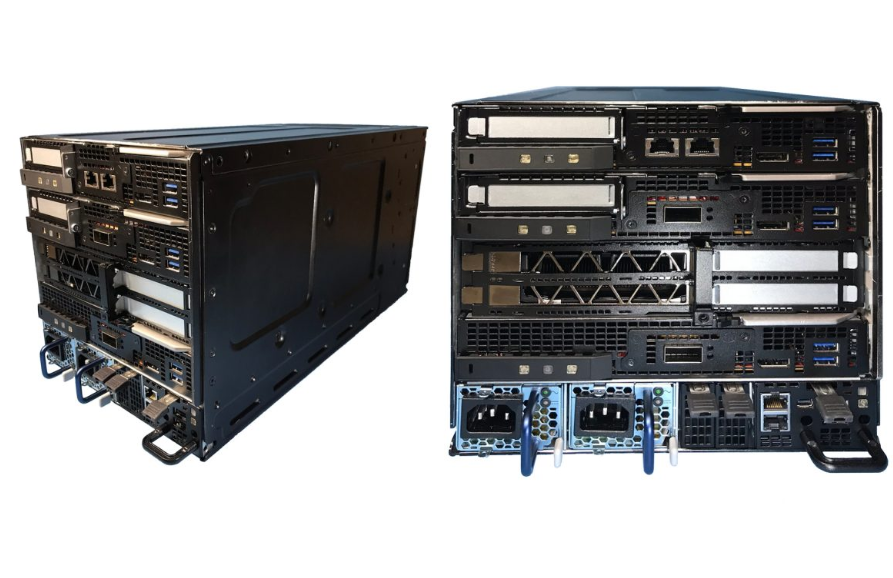
HPE launches Converged Edge System for Telcos

Hewlett Packard Enterprise (HPE) is introducing a new line of Intel-powered, environmentally hardened platforms designed for the telecommunications network edge.

The HPE Edgeline EL8000 Converged Edge System is aimed at data-intensive, low-latency services such as media delivery, connected mobility, and smart cities. The new system enables CSPs to process vast amounts of data in real time directly at the edge, based on open standards.

The platform feature a single-socket design for high-end Intel Xeon Scalable Processors. System components can be combined, scaled and hot-swapped to meet changing demands, supporting, among others, NVIDIA Tesla GPUs, FPGAs from Intel and Xilinx, NICs from Intel or Mellanox, up to 1.5TB of memory and 16TB of storage. Modular blade and chassis options allow systems to be flexibly configured and scaled to meet new or changing use-case requirements.

HPE also announced collaborations with Samsung and Tech Mahindra to accelerate CSPs 5G adoption, leveraging the HPE Edgeline EL8000 Converged Edge System to deploy the next generation of edge-centric virtual 5G applications.