Wednesday, March 26, 2014

Amazon Web Services Cuts Prices Again

Amazon Web Services announced its 42nd price reduction since launching in 2008.

The lower prices, which go into effective on April 1, apply to Amazon EC2, Amazon S3, the Amazon Relational Database Service, and Elastic MapReduce.  For storage, AWS is reducing prices for Standard and Reduced Redundancy options by an average of 51%. Pricing for Amazon RDS DB Instances are being cut by an average of 28%, while pricing for Amazon ElasticCache cache nodes is being cut by an average of 34%.

http://aws.typepad.com/

AWS Launches Virtual Private Cloud Peering

Amazon Web Services introduced a peering capability for its Virtual Provide Cloud (VPC) service, which lets users create a logically-isolated section of the AWS Cloud.

The enhancement provides the ability to create a VPC peering connection between VPCs in the same AWS Region. For instance, Amazon EC2 instances could already be connected to a Virtual Private Cloud.  Now, EC2 instances in the peered VPCs can communicate with each other across the peering connection using their private IP addresses, as if they were within the same network.  Up to 50 VPCs in the same region can be peered with each other, and they do not have to be registered to the same AWS account.

More details are online.

http://aws.typepad.com/aws/2014/03/new-vpc-peering-for-the-amazon-virtual-private-cloud.html

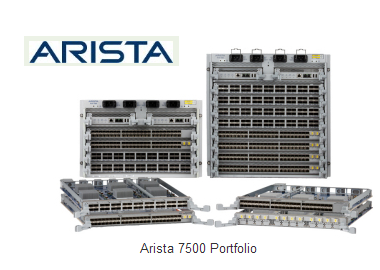
Arista Prices 100GbE CF2 Port (40km) at $6,600

Arista Networks announced two new 100GbE modules for its 7500 Series switches:

  • 7500E Series 6 port 100GbE card with support for CFP2 optics up to 40km over single mode fiber is orderable in Q2 2014 with pricing starting at $6600 per 100GbE port. 
  • 7500E Series 12 port 100GbE card is planned for availability in 2H 2014 along with a full range of QSFP-100 optics and cables.

Arista said that with 100GbE in the spine layer, customers can now achieve network virtualization using VXLAN support in the modular platforms to deploy their cloud multi-tenant networks at large scale with high bandwidth. Additionally, those deploying the Arista DANZ features within Arista EOS can now get intelligent traffic visibility on 100GbE networks by leveraging Tap Aggregation on Arista 7500E modular platforms. Arista’s Data Analysis DANZ solution is now expanded to modular chassis platforms and enables customers to connect to 100GbE spline or spine networks and to deliver tap aggregated 10GbE connections into a single 100GbE uplink to network monitoring, management and analytic tools.

“We selected the Arista 7500E platform for our data center to provide customers with true 100 Gigabit Ethernet services,” said Ihab Tarazi, Chief Technology Officer at Equinix. “Because of the open architecture and cloud interconnect protocols, including VXLAN, the programmability of Arista EOS and multi-speed mode, we are able to allocate data center resources at 10/40 or 100 gigabits in a reliable and cost-effective manner.”

Arista also noted that its 7300X Series with 10GBASE-T modules are gaining adoption among customers deploying cost-effective single tier and two tier networks.

http://www.aristanetworks.com

Apache CloudStack 4.3 Adds Support for Microsoft Hyper-V & Juniper Contrail

The Apache Software Foundation (ASF) released Apache CloudStack v4.3, its integrated Infrastructure-as-a-Service (IaaS) software platform for public, private, and hybrid cloud environments. CloudStack, which is a top-level project at the all-volunteer ASF, includes an intuitive user interface and rich APIs for managing the compute, networking, software, and storage infrastructure resources.

New features in CloudStack V4.3 include:

  • Support for Microsoft Hyper-V - Apache CloudStack can now manage Hyper-V hypervisors in addition to KVM, XenServer, VMware, LXC, and Bare Metal
  • Juniper OpenContrail integration - OpenContrail is a software defined networking controller from Juniper that CloudStack now integrates with to provide SDN services
  • SSL Termination support for guest VMs - Apache CloudStack can configure and manage SSL termination in certain load balancer devices
  • Palo Alto Firewall integration - Apache CloudStack can now manage and configure Palo Alto firewalls
  • Remote access VPN for VPC networks - CloudStack's remote access VPN is now available for Virtual Private Cloud networks
  • Site to Site VPN between VRs - CloudStack now allows site-to-site VPN connectivity to it's virtual routing devices. This permits your cloud computing environment to appear as a natural extension of your local network, or for you to easily interconnect multiple environments
  • VXLAN support expansion to include KVM - CloudStack's support for integrating VXLAN, the network virtualization technology that attempts to ameliorate scalability problems with traditional networking
  • SolidFire plugin extension to support KVM and hypervisor snapshots for XenServer and ESX - SolidFire provides guaranteed Storage Quality of Service at the Virtual Machine level
  • Dynamic Compute offering - CloudStack now has the ability to dynamically scale the resources assigned to a running virtual machine instance for those hypervisors which support it.

Apache CloudStack V4.3 is now available for download.

http://cloudstack.apache.org/

Secure Domain Foundation Tracks Registrants Security Reputation

A new Secure Domain Foundation (SDF) devoted to the identification and prevention of Internet cyber crime was launched at ICANN's 49th Public Meeting in Singapore this week.

The SDF plans to provide no-cost tools, technology, research, and security intelligence to an initial market segment of Internet domain name registrars, registries, ccTLD operators, and gTLD operators.  In the coming months, the SDF plans to expand services to hosting providers, DNS operators, CERTs, law enforcement and other Internet infrastructure operators.

The first step is a free API service that domain name registrars and registries can use to obtain an instant domain or registrant "credit score" based on security reputation and contact data validation. The API could be used during domain name transactions such as new account creation, domain registration, and record updates.

The SDF is backed by some of the industry's leading Internet and Domain Name infrastructure companies and organizations including: Facebook, Verizon, Verisign, Enom, Name.com, CIRA(.ca), CO Internet(.co), CrowdStrike, the Anti-Phishing Working Group (APWG), Emerging Threats, ESET Anti-Virus, DomainTools, Internet Identity, CoCCA, Mailshell, Blacknight Solutions, Foreground Security, and the SecDev Group.

"ICANN has recently mandated that domain registrars must validate postal addresses, phone numbers, and email addresses that are provided as contact information during the domain registration process," said Norm Ritchie, Chairman of the SDF. "And many new gTLD registries have already pledged to take a more proactive role in combating domain abuse within their TLDs. The SDF provides an entirely free service that not only validates the contact registration data provided but also lets the registrar and registry know if we have seen that data used previously in relation to cyber crime."

http://www.securedomain.org

CenturyLink Provides EMP Shielded Fiber to USAF

CenturyLink will provide a fiber optic system to the U.S. Defense Information Systems Agency (DISA) that is buried in steel pipe encased in concrete conduit to protect it from the effects of high altitude electromagnetic pulses (HEMP).

The system operates continuously among Schriever Air Force Base, Peterson Air Force Base and Cheyenne Mountain Air Force Station, thus delivering uninterrupted fiber connectivity among the three air bases in the Colorado Springs, Colo., area.

This contract, which includes telecommunications services, network systems, equipment and maintenance, follows a previous procurement for these services that was also awarded to CenturyLink. It could be worth a total of $1.7 million over the next five years.

http://news.centurylink.com/news/centurylink-wins-defense-information-systems-agency-contract


Verizon Selects Palo Alto for Data Analytics Lab

Verizon has selected Palo Alto, California as the primary site for a newly created data analytics team and lab that will provide strategic direction for data analytics, artificial intelligence and machine-learning activities.

"With the large base of big data and analytics talent in Silicon Valley, we are looking for the best and the brightest individuals who want the challenge of working on cutting-edge technologies," said Verizon Chief Data Scientist Ashok N. Srivastava. "We are working in a startup environment, but inside a large corporation, and there are very few such opportunities like this today. We have the opportunity to build intelligent systems based on recent advances in large-scale machine learning, analytics and the powerful computing technologies available today."

http://www.verizon.com

BT Selects GENBAND's Diameter Signaling Controller for LTE Roaming

BT has selected GENBAND's QUANTiX Diameter Signaling Controller (DSC) to expand its existing Global IP Exchange (GIPX), which serves as an LTE signaling and data roaming exchange for its mobile network operator (MNO) customers.

The integrated QUANTiX DSC delivers a Diameter Routing Agent (DRA), a Diameter Edge Agent (DEA), a Diameter gateway interworking function (IWF), and a Diameter load balancer – all on a common platform with centralized management. The Diameter Edge Agent (DEA) function supports interworking between the wide variety of vendor equipment that is being deployed across its customers’ LTE networks. The software provides context-aware intelligent routing, scalable handling of SIP and Diameter traffic, and secure, seamless connectivity to any IMS/LTE network resulting in a simple, cost-effective deployment of rich LTE voice and data services.

“Our strong relationship with GENBAND has helped to accelerate the growth of our wholesale network, supporting rapid expansion of our global footprint and enhancements to our GIPX services that meet customer demand for international roaming and increasingly data hungry applications,” said Steve Sherry, Head of (G)IPX Signalling, Messaging and Numbering for BT Wholesale. “The DSC solves complex Diameter signaling interworking, enabling network roaming across otherwise incompatible mobile networks. It also provides the security and routing scalability required to handle the explosion of mobile data traffic exchange for enhanced services, such as RCS, photo sharing, video and Over-the-Top (OTT) applications. GENBAND’s professional services organization has supported our ambitious plans in the marketplace – building and operating these critical solutions that drive revenue generation and customer satisfaction.”

“Although there are over 260 LTE networks in service worldwide, there are few interconnect roaming agreements in place between different mobile networks and this deployment marks a significant milestone for international mobile network operators,” said David Hiscock, Senior Vice President of Sales for Europe, the Middle East and Africa for GENBAND. “In the past, mobile service providers had to negotiate bi-lateral roaming agreements with network operators, implement point-to-point Diameter interconnects, and handle interoperability challenges between LTE and legacy 2.5G/3G networks. The enhanced BT GIPX solution addresses these challenges for BT’s international wholesale network, providing a seamless experience for roaming subscribers across 170-plus countries and varying vender equipment and host network scenarios.”

http://www.genband.com

  • In 2012, BT deployed GENBAND’s enhanced Global IP Interconnect solution to deliver SIP-based interconnect capabilities to its UK and global wholesale customers. Last year, BT leveraged the GENBAND solution to expand its GIPX services to wholesale customers across Asia and the Americas.

Cumulus Linux Selected by IXLeeds Internet Exchange Point

IXLeeds, a not-for-profit Internet Exchange Point (IXP) based in Leeds, UK, has selected the Cumulus Linux operating system.  The company said its selection followed a three-way bid over Extreme Networks and Juniper Networks. Cumulus Networks’ solution includes 1G Quanta and 10G Edge-Core Ethernet switches both of which are provided by R-Com and Hammer plc.

IXLeeds was launched in September 2010 in order to allow public peering in the north of the United Kingdom. The Cumulus upgrade replaces an existing Brocade BigIron RX-8 system, which was first installed when the project began and could no longer meet their requirements.

http://ixleeds.net/
http://cumulusnetworks.com/

ZTE's Profits Recovered in 2013 on Declining Revenue (-10.6%)

ZTE reported a net profit of RMB 1.36 billion in 2013, or RMB 0.39 per share, compared with a loss a year earlier. The company declared a cash dividend of RMB 0.3 (including taxation) for every 10 shares held, representing 75.8% of total net profit of the year available for distribution. Revenue fell 10.6% to RMB75.2 billion (US$12.1 billion).

Some highlights:

  • Operating revenue from the mainland China market reached RMB35.63 billion, accounting for 47.4% of the company’s overall operating revenue. 
  • Operating revenue from international operations reached RMB39.60 billion, accounting for 52.6% of overall operating revenue.
  • The company reported relatively fast growth in operating revenue from wireline switch and access products.
  • Operating revenue from terminal products decreased as a result of lower demand for feature phones and data cards. 
  • Smartphones and other smart terminal products now contribute a bigger percentage of total revenue, driven by the rapid development of the Mobile Internet. 

http://wwwen.zte.com.cn/en/press_center/news/201403/t20140326_421907.html

Cyan Replaces CFO

Cyan announced the appointment of Jeff Ross as its new chief financial officer (CFO), effective immediately, following the resignation of Mike Zellner for personal reasons.

Ross most recently served as chief financial officer of Velti, a provider of mobile marketing and advertising technology and solutions. Previously Ross served as senior vice president and chief financial officer of Sybase from 2007 to 2012, which was acquired by SAP in July 2010 when global revenue was above $1.1 billion. Prior to this, he was the chief accounting officer and corporate controller at Sybase.

Cyan also announced that it currently expects its first quarter 2014 revenue to be at or above the high end of its previously stated guidance. First quarter 2014 revenue guidance was provided on February 11, 2014, and included expectations that revenue would be between the range of $16 million and $18 million.

http://www.cyaninc.com

Ericsson Cites LTE Momentum with Regional Operators

Ericsson named a list of regional mobile operators that have recently selected its solutions:

  • Cellcom (Wisconsin) - LTE Enhanced Packet Core and RAN network covering central and northern Wisconsin
  • Chariton Valley (Missouri) - LTE network covering northeast Missouri
  • Dickey Rural Networks (North Dakota) - LTE network providing wireless broadband services to south central North Dakota
  • Flat Wireless, LLC. d/b/a ClearTalk (Texas) - LTE network for mobile wireless broadband covering west Texas,YumaAZ, and El CentroCA as a member of the NetAmerica Alliance
  • Glenwood Telecommunications Inc. (Nebraska) - LTE network providing wireless broadband services to south central Nebraska
  • GTA Teleguam (Guam) - Packet Core upgrade and LTE network overlay on the island of Guam
  • Infrastructure Networks, Inc. – (North Dakota) - LTE network designed to meet the needs of the Energy Industry in the Bakken Oil Formation for its M2M requirements
  • Ketchikan Public Utilities (Alaska) - LTE network covering southwest Alaska
  • Panhandle Telecommunication Systems, Inc., dba PTCI (Oklahoma) - UMTS and LTE network for mobility to cover the Oklahoma panhandle
  • Rainbow Communications (Kansas) - LTE network connected to NewCore Wireless serving northeast Kansas
  • Sully Telephone (Iowa) - LTE network providing wireless broadband services to south central Iowa
  • Ericsson also noted that 50% of the LTE connections currently in operation are in North America.

    Tuesday, March 25, 2014

    Google Advances its Cloud Platform

    Google rolled out new features and significantly lower and simpler pricing for its Cloud Platform.

    At at developer event in San Francisco, Urs Hölzle, Senior VP at Google, said the company is completely committed to making available the same infrastructure it uses for its own services at the price curves of Moore's Law. Google Cloud Platform should be "a clear path make developers incredibly more productive" by supporting multiple OSes, offering toolsets, and delivering Google scalability and predictability.

    Some highlights of the event:

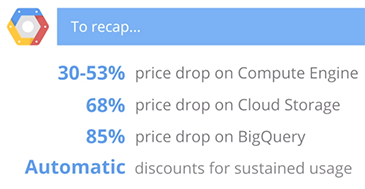
    • Compute Engine pricing was reduced by 32% across all sizes, regions, and classes.
    • App Engine pricing was simplified, with significant reductions in database operations and front-end compute instances.
    • Cloud Storage is now priced at a consistent 2.6 cents per GB -- a 68% price cut for most customers.
    • Google BigQuery on-demand prices were reduced by 85%.
    • Google demoed live VM migration of a 1080p video stream from one server to another
    • Google now support Windows Server 2008 R2 on Compute Engine in limited preview and Red Hat Enterprise Linux and SUSE Linux Enterprise Server are now available to everyone.
    • Google is now offering real time analysis of Big Data Streams with the ability to ingest 100K rows/second.  The company demoed a smart grid analysis where huge streams of data from electricity meters across Seattle are processed in real time.
    • Introduced Google Cloud DNS - a high-performance DNS with simple API and integrated in Google console
    • Google is now offering Managed Virtual Machines -- allows developers to ""break glass"" in App Engine and add a managed VM to your application. You get the flexibility of raw VMs with the auto-management capabilities of App Engine. It's one small part of our efforts to build the world's best public cloud.
    • We process 6.3 trillion Cloud Datastore operations every month. That's 30 operations per person per day for every single person on earth.
    • Google Cloud Platform supports 4.75 million active applications.
    • It's now just 2.6 cents per GB to store your data on Cloud Storage. DRA storage is just 2 cents per GB.

    https://cloud.google.com/

    Cisco Expands Nexus Data Center Switching Line

    Cisco expanded its Nexus 9000 data center switching line with the introduction of two new models: the Nexus 9504 and Nexus 9516.  The new switches leverage the centralized policy-driven automation of the Cisco Application Policy Infrastructure Controller (APIC) and application profiles to help organizations build highly secure cloud networks and hybrid clouds.

    • The Nexus 9516 boasts up to 576 wire-speed 40 Gigabit Ethernet ports and 60 Tbps throughput, making it the industry's highest density wire rate switch, according to Cisco. 

    • The Nexus 9504 provides a cost effective option to solve migration from core-aggregation-access to spine leaf architectures. With the Nexus 9504 partners now have new engagement options for customers seeking lower density aggregation and access designs.


    Cisco also announced an addition to the Nexus 3000 family: the new Nexus 3164Q switch designed for massively scalable data centers (MSDC) and big data.

    • The Nexus 3164Q supports a range of automation tools for Cloud providers including Linux Container support, XML, JSON, Puppet/Chef, Python, and OpenStack. It delivers flexible connectivity for either 40 Gigabit or 10 Gigabits ports (up to 256 10Gigabit ports) in a 2 RU and a rich NX-OS feature set. 

    "Through automation and programmability embedded within our NX-OS platforms, training, support, and certifications, we are empowering over two million networking engineers and thousands of channel partners worldwide to enable our enterprise, commercial, service provider and cloud customers to expand their skill sets while embracing on-premise private and hybrid cloud models with ACI in the data center and across the Access and WAN," said Soni Jiandani, SVP, Cisco.

    Cisco noted that its Nexus 3000 switches are being used by eight of the 10 leading cloud providers' networks for the majority of their footprint.

    du, a leading integrated telecommunications service provider in the United Arab Emirates and the fastest growing operator in the Middle East, is consolidating several data facilities into two next generation data centers designed to host new cloud services.

    http://newsroom.cisco.com/press-release-content?type=webcontent&articleId=1372860

    In January 2014, as part of its recently launched Application Centric Infrastructure (ACI) initiative, Cisco introduced an Application Policy Infrastructure Controller (APIC) Enterprise Module for extending
    high-performing applications from the data center to wide-area networks (WAN) and local access networks (LAN). The goal is to provide enterprises with complete visibility into their networks, automating network and policy configuration while managing applications across the WAN and access networks.


    The foundation for ACI is an Application Policy Infrastructure Controller (APIC), enhanced versions of the NX-OS data center switching operating system, and a new line of Nexus 9000 data center switches based on technology from Insieme Networks, the Cisco spin-in start-up that is being acquired and re-integrated into the company.

    The Cisco APIC is a centralized clustered controller that is responsible for tasks ranging from fabric activation, maintenance of switch firmware, network policy configuration and instantiation. Cisco APIC is
    completely removed from the data path.

    The Cisco APIC serves as the single point of automation and fabric element management in
    both physical and virtual environments.

    The Cisco APIC Enterprise Module is constructed of three elements: a consolidated network information database, policy infrastructure and automation.

    To address security concerns, Cisco APIC automates network-wide rapid threat detection and mitigation by integrating and automating Cisco Sourcefire  security solutions.  For compliance management across branches and headquarters, Cisco APIC also provides network-wide Quality of Service (QoS), and accelerates Intelligent WAN (IWAN) deployments. It can also be used with third-party solutions to provide an end-to-end WAN orchestration and management.

    Cisco said its APIC frees up time for IT that would otherwise be spent configuring networking equipment and updating policy changes device by device. It automates many IT functions enabling configuration and policy changes to be pushed out to the individual components of the network instead of requiring IT to update each one manually. It also enables policies to automatically adapt to network changes which would be very difficult to set otherwise.

    Cisco APIC supports both new and existing network infrastructures via a selection of network Application Programming Interfaces (APIs), including OpenFlow, Cisco onePK and Command Line Interface (CLI). The Cisco APIC Enterprise Module also supports both new SDN-ready devices as well as older Cisco network equipment, enabling the same IT automation as with Cisco ACI for a large existing installed base that eliminates the need to rip and replace existing networking equipment to take advantage of this new functionality. 

    The Cisco APIC Enterprise Module leverages the Glue Networks' "Gluware Intelligent Orchestration Engine" 

    Dell Debuts Ethernet Fabric Switch and Active Fabric Controller

    Dell made two significant networking announcements:  the introduction of a new, high-density Ethernet fabric switch for scale-out data centers; and the launch of an Active Fabric Controller for zero-touch provisioning and orchestration of virtualized networking functions and services.

    • The new Dell Networking Z9500 Fabric Switch, which is designed for 10/40 GbE aggregation in large data centers, is the highest-density fixed-form factor data center switch with a full suite of L2/L3 routing and switching protocols. It delivers up to three times the density per RU and throughput of more than 10 Tbps with one half the latency compared to Dell’s previous generation switches.  The 3RU core switch can scale up to 132 40GbE ports and up to 528 10GbE ports.  It offers "pay-as-you-go" licensing for 36, 84, or 132 port SKUs.  Dell said the new switch consumes approximately half the power per port of the Cisco Nexus 6004.
    • The new Dell Active Fabric Controller is a purpose-built SDN platform targeted for enterprise OpenStack deployments and as an optional component of Dell OpenStack-Powered cloud solutions.  It works with OpenStack applications to deliver workload and policy awareness. The Active Fabric Controller allows for insertion of service appliances including firewall, load balancing and wide area network optimization.  It delivers customized policy, enabling on-demand customized virtual fabrics that adapts whenever workloads are started, stopped or modified, enhancing the security, performance and efficiency for each application.  Dell said its Active Fabric Controller serves a fundamental building block on both enterprise control software as well as a key element of accelerating NFV deployments with its integration into OpenStack.

    “Dell is committed to changing the game in networking. As a follow on to our recent Open Networking announcement, I’m excited about demonstrating more innovation in bringing new and open solutions to our customers regardless of size,” said Tom Burns, vice president and general manager, Dell Networking. “We’re extending our leadership in SDN, NFV, and advanced new architectures that maximize customer choice and provide superior economics to the way networking has always been done.”

    http://www.dell.com/learn/us/en/uscorp1/secure/2014-03-25-dell-data-center-networking-fabric-controller

    • In February 2013, Dell advanced its strategy for cloud data centers with the introduction of a top-of-rack switch with 40G fabric uplinks and Fibre Channel over Ethernet , high performance 10/40G blade switching products, and the commercial release of OpenFlow software-defined networking in the Force10 operating system.
      Dell said these additions underline its commitment to software-defined infrastructure. The company is pursuing a "complete and unbiased approach to SDN" by embracing legacy networking environments, greenfield controller-based deployments as well as hypervisor-oriented architectures.


    • OpenStack Networking (Neutron) to enable Software-Defined Networking and Networking-as-a-Service between interface devices such as virtual network interface cards, and
    • OpenStack Telemetry (Ceilometer) to provide OpenStack resource instrumentation, which can help support service monitoring and customer billing systems.

    Embrane Raises $14 Million for Application-Centric Network Services

    Embrane, a start-up based in Santa Clara, California, raised $14 million in Series-C funding for its application-centric network services.

    The funding round was led by Cisco and included new Embrane investor Presidio Ventures, and participation from existing investors Lightspeed Venture Partners, New Enterprise Associates (NEA) and North Bridge Venture Partners.

    Also today, Embrane announced it will deliver life cycle management for third-party network services, including the Cisco Adaptive Security Virtual Appliance (ASAv) and Sourcefire virtual appliances.

    “As one of the first companies to create a software-defined networking (SDN) solution that adds agility to the network and network services, we are ready to take the next step to accelerate our growth,” said Dante Malagrinò, co-founder and CEO of Embrane. “This new financing along with the addition of Cisco as an investor and strategic partner is a significant step in the evolution of Embrane.”

    http://www.embrane.com

    CenturyLink Expands its Data Center Footprint

    Citing rising demand for secure cloud, colocation and managed services,CenturyLink opened three new data centers in North America and announced plans to expand data centers in eight markets during 2014.

    The new builds and expansions will offer more than 180,000 square feet of additional space to CenturyLink's global presence:

    • Phoenix (new data center sites, in partnership with IO, opened in January 2014)
    • Weehawken, N.J. (expansion completed in March 2014)
    • Minneapolis (new data center site opening in May 2014)
    • Sterling, Va. (expansion completing in May 2014)
    • Irvine, Calif. (expansion completing in June 2014)
    • Toronto (new data center site opening in Q3 2014)
    • Reading, England (expansion completing in Q3 2014)
    • Chicago (expansion completing in Q3 2014)


    These expansions will bring more than 20 megawatts of additional power to CenturyLink's total data center footprint, enabling businesses like the Chicago Board Options Exchange (CBOE) to add points of presence in locations most strategic for their operations.

    "CenturyLink is committed to investing in world-class infrastructure to meet growing demand for access to comprehensive and secure technology solutions that power business transformation," said Jeff Von Deylen, president, CenturyLink Technology Solutions. "By adding capacity in these key locations, we position ourselves firmly for delivering the advanced network, hosting and IT services that organizations depend on to compete in the global economy."

    http://www.centurylink.com/technology

    In January, Savvis adopted the CenturyLink Technology Solutions brand. CenturyLink acquired Savvis in 2011.

    Cisco Marks 5-Year Anniversary for UCS

    Cisco marked the 5-year anniversary of its entry into the server market.  Since launching its Unified Computing System in March 2009, morre than 30,000 customers have implemented the servers.  According to the IDC Worldwide Quarterly Server Tracker, Q4 2013, February 2014, Revenue Share:  Cisco is ranked second worldwide in x86 blade server revenue market share, with 32 percent share in the US and a top five ranking among server vendors overall. Over 80 percent of all Cisco's UCS sales come through its 3,850 channel partners.

    "Innovation and partnerships are the engines of growth for our data center business," said Ken Trombetta, VP, Worldwide Channels at Cisco.  "Our channel partners immediately embraced UCS, and today nearly 4,000 partners worldwide sell UCS. We will continue to win with our partners in the data center by delivering innovation through a highly secure and application centric infrastructure."

    http://newsroom.cisco.com/

    Dell Acquires StatSoft for Data Mining

    Dell has acquired StatSoft, a provider of advanced analytics solutions that deliver a wide range of data mining, predictive analytics and data visualization capabilities. Financial terms were not disclosed.

    StatSoft, which is based in Tulsa, Oklahoma, delivers advanced analytics tools that help organizations forecast future trends to identify new customers and sales opportunities, forecast industry shifts, explore “what-if” scenarios, and reduce the occurrence of fraud and other business risks. StatSoft’s software can be deployed on premises, in the cloud, or as software-as-a-service.

    http://www.dell.com
    https://www.statsoft.com/

    Monday, March 24, 2014

    Cisco Plans "World's Largest Global Intercloud"

    Cisco announced plans to build "the world’s largest global Intercloud" – a network of clouds – together with a set of partners.  The idea is to leverage a distributed network and security architecture designed for high-value application workloads, real-time analytics, “near infinite” scalability and full compliance with local data sovereignty laws. Cisco's open Intercloud promises APIs for rapid application development and a new enterprise-class portfolio of cloud IT services for businesses, service providers and resellers. It will support OpenStack and multiple hypervisors. It will also leverage Cisco's recently announced Application Centric Infrastructure.

    Cisco plans to invest over $1 billion to build its expanded cloud business over the next two years following a "partner-centric" business model.  The Cisco Intercloud will be hosted across a global network of Cisco data centers and partner data centers. It will offer value-added application- and network-centric cloud services to accelerate the Internet of Everything.

    The first companies either planning to deliver Cisco Cloud Services, or who have endorsed Cisco’s global Intercloud initiative, include:

    • Telstra (Australia); 
    • Allstream (Canada); 
    • Canopy, an Atos company (Europe); 
    • Ingram Micro Inc., a cloud services aggregator, provider and wholesale technology distributor; 
    • Logicalis Group, a global IT and managed services provider; 
    • MicroStrategy, global provider of enterprise software platforms for business intelligence, mobile intelligence, and network applications; 
    • OnX Managed Services, an enterprise data center IT solutions provider ; 
    • SunGard Availability Services, an information availability services provider; 
    • Wipro Ltd., a leading global IT, consulting and outsourcing company. 

    “Customers, providers and channel partners alike are turning to Cisco to create open and highly secure hybrid cloud environments, and they want to rapidly deploy valuable enterprise-class cloud experiences for key customers – all while mitigating the risk of capital investment,” said Robert Lloyd, president of development and sales, Cisco. “The timing is right for Cisco and its partners to invest in a groundbreaking, application-centric global Intercloud to provide broader reach and faster time to market. Together, we have the capability to enable a seamless world of many clouds in which our customers have the choice to enable the right, highly secure cloud for the right workload, while creating strategic advantages for rapid innovation, and ultimately, business growth.”

    Cisco noted that its Cloud Services portfolio already includes SaaS offerings, such as WebEx, Meraki and Cisco Cloud Web Security; differentiated cloud services, such as hosted collaboration and cloud DVR; and technologies and services to build public and private clouds, such as the Cisco Unified Computing System (Cisco UCS), integrated infrastructure solutions such as VCE Vblock Systems and NetApp FlexPod, and Cisco Application Centric Infrastructure (ACI).

    http://blogs.cisco.com/news/introducing-ciscos-global-intercloud/
    http://newsroom.cisco.com/press-release-content?type=webcontent&articleId=1373639


    • This week, Cisco is hosting a Partner Summit at The Venetian Resort in Las Vegas.
    • In November 2013, Cisco unveiled its Application Centric Infrastructure for data centers and clouds. In a press event in New York, John Chambers described ACI as the next big transformation of the IT industry driven by imperatives of the application economy.

      ACI is a step beyond virtualization and software-defined networks (SDN), said Chambers, because it brings agility and automation with full visibility and integrated management of both physical and virtual networked IT resources at the system, tenant, and application levels.  The architecture promises a pay-as-you-grow mode scaling to over 100,000 switch ports and capable of supporting more than one million IP end points in a data center spine with 60 Tbps capacity.  A key premise is that the network should adapt to application requirements through dynamic insertion and chaining of physical and virtual L4-7 network services including firewalls, application delivery controllers, and intrusion detection systems.  The new architecture is designed for multi-tenant cloud environments by providing real-time view of per tenant and per application health, statistics, and troubleshooting.  Real-time analytics will be used to drive intelligent application placement decisions.

      The foundation for ACI is an Application Policy Infrastructure Controller (APIC), enhanced versions of the NX-OS data center switching operating system, and a new line of Nexus 9000 data center switches based on technology from Insieme Networks, the Cisco spin-in start-up that is being acquired and re-integrated into the company.
    • In January, IBM announced plans to invest $1.2 billion to expand its cloud business and build on its acquisition of Softlayer data centers last year. The plans call for 15 new data centers worldwide, including new Softlayer facilities in Washington D.C., Mexico City, Dallas, China, Hong Kong, London, Japan, India and Canada. The expansion will bring the number of IBM cloud data centers to about 40 worldwide.

      Earlier in the year, IBM acquired SoftLayer Technologies, which operates 13 data centers in the United States, Asia and Europe.  Bloomberg valued the deal at about $2 billion.

      SoftLayer allows clients to buy enterprise-class cloud services on dedicated or shared servers, offering clients a choice of where to deploy their applications. The company is based in Dallas, Texas, and serves approximately 21,000 customers.  

      The acquisition strengthened IBM's position in cloud computing.  At the time of the deal, IBM said its expects to reach $7 billion annually in cloud revenue by the end of 2015.

      IBM also announced the formation of a new Cloud Services division. The new division will provide a broad range of choices to both IBM and SoftLayer clients, ISVs, channel partners and technology partners. SoftLayer’s services will complement the existing portfolio with its focus, simplicity and speed. The division will report to Erich Clementi, Senior Vice President, IBM Global Technology Services. IBM plans to expand SoftLayer cloud offerings to include OpenStack capabilities.