Sunday, September 18, 2022

ECOC22: Broadcom’s Silicon Photonics Chiplets in Package

What's Next at #ECOC22 for Broadcom? 

Broadcom's Silicon Photonics Chiplet in Package (SCIP). 

Rebecca Schaevitz, Product Line Manager & Principal Engineer at Broadcom, provides an introduction. 

Learn more about the Consortium for Onboard Optics and why your company should join:

https://www.onboardoptics.org

https://youtu.be/UWmcFN_y25w

ECOC22 Update: ADVA's Optical Engines

https://youtu.be/A-RdO1q1F3o

Think optical engines!

Here is an overview from Saeid Aramideh, VP of Business Development, Optical Engines Business Unit, ADVA.

Learn more about the Consortium for Onboard Optics and why your company should join:

https://www.onboardoptics.org

ECOC22: Ragile's NPO and CPO switching projects

At the 2021 OCP Summit, Ragile demonstrated a 25.6T NPO proof-of-concept switch for COBO.

At OFC 2022, Ragile showed a 51.2T NPO mechanical demo in collaboration with the OIF CPO working group.

What's next? Here is a perspective from Kevin Yao, Business Director, Ragile Networks.

https://youtu.be/ulH7JfC0ho8

ECOC22: Optiworks update on high speed transceivers


What's Next at #ECOC22 for Optiworks? 

Think high speed transceivers for data centers.

Here is an overview from Jacob Sun, VP of High Speed Transceivers, Optiworks.  

Learn more about the Consortium for Onboard Optics and why your company should join:

https://www.onboardoptics.org

https://youtu.be/Ongo5dret0Y

Saturday, September 17, 2022

ECOC22: Building a vibrant photonic ecosystem

Earlier this year, GlobalFoundries unveiled a silicon photonics platform. In this video, Vikas Gupta, Senior Director of Product Management and Marketing, provides a perspective on what it takes to build a vibrant photonic ecosystem.

Learn more about the Consortium for Onboard Optics and why your company should join:

https://www.onboardoptics.org

https://youtu.be/0cSEGbohgpU

Thursday, September 15, 2022

NEC debuts SpectralWave for disaggregated optical transport

NEC introduced its "SpectralWave WX Series" a lineup of open specifications-compliant, open optical transport products. 

The products, which were developed in collaboration with NTT, are based on standards defined by Open ROADM and Telecom Infra Project's (TIP) Phoenix initiative. 

NEC sees the push for All Optical Networks as a marked shift in transport networks, which have conventionally required both optical and electrical technologies, but will be simplified to only optical transmission technology from end-to-end in the future. Initially, four products will be released on October 1, 2022. 

The compliance with open specifications such as Open ROADM and TIP's Phoenix enable these devices to support configurations that connect to the function blocks of APN-T, APN-G and APN-I as defined by Open APN, and under examination by the IOWN Global Forum (*1). 


"NEC aims to market these products to telecommunications carriers, electric power companies and data center operators throughout the world," said Sou Satou, Senior Director, Network Solutions Business Division, NEC Corporation. "Going forward, NEC will continue to contribute to the creation and expansion of open optical networks, aiming to acquire 25% of the future optical transport market by providing products that have grown in capacity from the current 400G to 800G and equipment that supports longer distances." 

https://www.nec.com/en/press/202209/global_20220915_01.html

ETSI adopts its first O-RAN spec

ETSI has adopted the first O-RAN specification as ETSI TS 103 859, namely ‘O-RAN Fronthaul Control, User and Synchronization Plane Specification v7.02’. 

The document focuses on Open Fronthaul, one of interfaces in the O-RAN Architecture for open and intelligent Radio Access Networks. It specifies the control plane, user plane and synchronization plane protocols used over the fronthaul interface linking the O-DU (O-RAN Distributed Unit) and the O-RU (O-RAN Radio Unit) for the lower layer functional splits. The scope of TS 103 859 includes both LTE and NR (5G).

“Recognition of O-RAN specifications by ETSI is another major step in enabling broad adoption of Open RAN,” said Claire Chauvin, O-RAN Board member and Strategy Architecture and Standardization Director at Orange. “Having the O-RAN specification available as an ETSI specification adds further endorsement desired by commercial and public sector entities in a range of countries.”

“The O-RAN specification has been approved as an ETSI specification after a thorough review and requested revisions by our experts,” said Dominique Everaere, Chair of the ETSI Mobile Standards Group Technical Committee. “When specifications go through the ETSI PAS process, they need to comply with the ETSI rules, and the ETSI committee in charge of these specifications works with the organization to ensure they align with existing procedures for approval as ETSI standards.”

https://www.etsi.org

ADVA launches AccesWave25 optical transceiver

ADVA launched its AccessWave25 pluggable optical transceiver for mobile X-Haul, cable access and wholesale networks.

The SFP28 transceiver offers 25 Gbps connectivity and a reach of 40km and features G.metro auto-tuning technology to reduce provisioning efforts and simplify operations. It uses less than 3 watts and has an I-temp hardened design.

“Our AccessWave25 is the key to unlocking more bandwidth at the edge. Now network operators have an easy, low-cost way to address soaring bandwidth consumption that doesn’t require extra real estate or cause major disruption to services. And as well as boosting capacity, the AccessWave25™ offers a substantial increase in reach. While today’s solutions can’t go beyond 15km, our new pluggable device uses PAM4 modulation and direct-detection technology to support data transport up to 40km,” said Christoph Glingener, CEO of ADVA. “Simple to deploy and ideally suited for outdoor use, our AccessWave25 device will be the foundation for the next generation of optical access networks.”

“The latest addition to our pluggable technology portfolio answers the most urgent needs of our customers in a wide range of industries. From the core to the metro to access networks, our product range offers a plug for almost every situation,” commented Saeid Aramideh, VP of business development at Optical Engines, ADVA. “OurAccessWave25™ is a vital addition to our AccessWave family of pluggable devices and features our latest G.metro technology. Either with a third-party OLS or with our turnkey FSP 3000 solution for passive optical access networks, our pluggable technology provides the tools for tackling relentless growth in data consumption as well as the ever-changing demands of optical access networks.”

https://www.adva.com/en/newsroom/press-releases/20220915-adva-launches-auto-tunable-transceiver-to-help-operators-easily-scale-access-networks

OE Solutions launches DCO transceivers for access

OE Solutions is launching portfolio of digital coherent optical transceivers targeted at access network applications, including wireless mid-/back-haul as well as aggregation and backhaul in MSO networks. The portfolio supports a range of form factors with QSFP28, QSFP-DD and CPF2 and high-output power options as well as both standard and industrial temperature ranges. The first products support 100Gbps as well as 200Gbps.

The access network infrastructure is undergoing significant changes to accommodate the rapid growth in bandwidth consumption while also reducing the cost. One aspect of this trend is more capital- and space-efficient aggregation, which is increasingly deployed in unconditioned locations, such as outdoor pedestals or pole/wire-mounted enclosures. Such in-field aggregation creates a need for high- bitrate transceivers that are suitable for external deployment while also operationally easy to deploy and maintain.

Digital coherent optical (DCO) transceivers have been deployed for about a decade now but have mostly been used in long-haul core network and more recently in high-capacity metro networks. Many DCO transceivers features are attractive to access networks as well but the particular requirements of such applications, in particular price, form factor and environmental hardiness, have been a challenge. This is now changing with the next generation of DCO transceivers and access networks are poised to adopt them much more broadly.

OE Solutions is launching its portfolio of DCO transceivers, which are targeting access network applications. The first 100G QSFP28 and QSFP-DD transceivers are already shipping while additional features including CFP2, 200G multi-rate operation and industrial temperature (IT) operation are nearing release.

“We are excited to introduce OE Solutions’ digital coherent transceiver module to our customers,” said W.H. Lee, Director of Development for Coweaver Co., and added “This will significantly increase the value of our network solutions for our customers allowing them to scale with the increasing bandwidth demands in a widening application space.”

Walter Lee, GM and VP of the Optical Transceiver BU at OE Solutions stated “The launch of our coherent transceiver portfolio is an important milestone for OE Solutions as we build on our legacy as a leading supplier to the cable and wireless optical network market. We look forward to supporting the burgeoning application of coherent technology in access networks.”

https://www.oesolutions.com

Juniper advances its data center NetOps with Apstra Freeform

Juniper Networks expanded its multivendor data center automation and assurance platform with the introduction of Apstra Freeform, a tool to help manage and automate  data center operations regardless of topology and protocols used.

Freeform builds upon Apstra’s intent-based networking capabilities for full lifecycle data center management across a range of data center topologies and vendors, enabling a reliable user experience that encompasses the following key features:

  • New reference design covering any topology. With this new software release, Apstra simplifies IT operations by extending its intent-based networking capability to any protocol, any topology and any network domain. Customers can now choose the architecture that fits their business needs while taking advantage of Apstra capabilities.
  • Reliable operations. Apstra’s role as the single source of truth enables data center designs to be applied consistently, every time. Closed-loop feedback provides IT professionals with reliable operations across disparate infrastructure.
  • Value now accessible to more customers. As part of this new release, Juniper is introducing a new Apstra licensing model. Freeform extends Apstra capabilities to significantly more use cases. Customers can now choose from three licensing tiers with the option to seamlessly upgrade at any time as needed.

“Apstra continues to emphasize the importance of reliable and consistent multivendor data center operations,” said Mike Bushong, Group VP of Data Center Product Management at Juniper Networks. “With the introduction of Freeform, we are expanding operational efficiency further into the market. Freeform brings full control of the network design into the hands of data center operators, giving them complete flexibility and versatility. Without topology constraints, we are truly democratizing intent-based networking and allowing everyone to benefit from the best operational practices in the cloud era.”

https://newsroom.juniper.net/news/news-details/2022/Juniper-Networks-Announces-Additional-Versatility-and-Flexibility-for-Data-Center-Operations-with-Expansion-to-Apstra-Software/default.aspx

Juniper extends Apstra software to the edge

Juniper Networks is extending its Apstra software platform to edge data centers with collapsed fabric topologies. The latest release of Apstra software also enables tighter Zero Trust security with new policy assurance and Role-Based Access Control (RBAC) capabilities, as well as simplified migration from legacy data centers with new Apstra professional services.Specifically, the latest version of Apstra provides policy assurance to enable granular...

Juniper's new 25.6 Tbps switch matched with Apstra automation

Juniper Networks unveiled its QFX5700 Series Switch, a midsize, 25.6 Tbps chassis-based system on Broadcom Trident 4 programmable merchant silicon.The 5RU platform supports a mix of 10G/25G/40G/50G, 100G, 200G and 400G line cards supporting a variety of interfaces, all available with inline MACsec/IPsec. The QFX5700 is aimed at a variety of data center use cases, including those migrating to 100G/400G.Michael Bushong, VP of Data Center Product Management...


SD-WAN and SASE Summit 2022, 08/9-Nov-2022

The 7th edition of the Summit will take place next 8th and 9th November 2022 as an hybrid event (in-person in Paris and live streaming online) at the Hotel Pullman Paris Centre.

A special focus of the event will be SSE, as analysts, service providers and leading enterprises will discuss why it is no longer enough to offer a managed SD-WAN solution. To stay ahead, service providers must offer an integrated SASE or SSE solution on a global scale.

Other sessions cover Deployments, uCPE, Orchestration, ZTNA, AI and 5G architecture issues, especially SD-WAN network slicing.

Registration information is posted here: https://www.uppersideconferences.com/sd-wan/


Dell'Oro: Overall RAN market to top $45 B by 2030

 The high-level technology trends that have shaped the radio access network (RAN) capex cycles over the past 30-plus years are expected to play a significant role in determining the nature of RAN investments over the coming decade, according to a new report from Dell'Oro Group. In addition, the availability of more spectrum, in combination with the evolving scope of the RAN  forms the basis for the higher-than-historical growth rate projections – Fixed Wireless Access is already boosting the RAN market and enterprises are next. Following the 1 percent CAGR between 2000 and 2020, global RAN is projected to grow at a 2 percent CAGR between 2020 and 2030.  

“While we can with fairly high confidence level assume that 6G will be ready by the end of the decade, it is still early days to identify the underlying impetus that will characterize the initial 6G deployment phase,” said Stefan Pongratz, Vice President at Dell’Oro Group. “In this long-term forecast, the base case scenario is that the 5G cycle will be longer than the LTE investment phase, while 6G will start accelerating in the outer part of the forecast period to support the consumer MBB usage scenarios, closely emulating the 5G ramp ten years prior with wide-band sub-7 GHz macros delivering the most compelling RAN economics,” continued Pongratz.

Additional highlights from the new RAN 2030 Advanced Research Report:

  • Sub-7 GHz 6G Revenues to reach $10 B to $20 B by 2030.
  • Operators and enterprises will continue to embrace the movement towards virtualization, openness, and automation. At the same time, the RAN is not the core and the transition will be gradual. Even with 6G, we foresee that a significant portion of the RAN market will be based on custom silicon and proprietary interfaces – Open RAN is projected to account for more than 20 percent of total RAN by the end of the forecast period.
  • Although private LTE/5G adoption has to date been underwhelming, we still envision a world in which enterprises utilize both the unlicensed and licensed spectrums to solve their connectivity needs. Global private wireless RAN revenues are projected to approach $2 B by 2030.

 https://www.delloro.com

Wednesday, September 14, 2022

Video: Private 5G gets real in Germany

Is private 5G reaching an adoption inflection point in Germany? Is so, what are the drivers? Why would enterprises bother with building their own 5G infrastructure instead of relying on Wi-Fi or the public cellular network?  What spectrum is available in Germany? Is it easy to attain? What value can a network integrator such as NTT provider for the enterprise customer.

Kai Grunwitz, CEO of NTT Germany, answers our questions.

https://youtu.be/kutgXILAT3w

Nile targets AI-enabled campus LAN simplicity

Nile, a start-up based in San Jose, California, emerged from stealth to announced its intention to offer AI-enabled campus networking solutions based on Zero Trust Network principles. 

Although product specifics have yet been disclosed, Nile said it has taken a clean sheet approach a relentless focus on disruptive simplicity. The mission is defined by "an audacious vision to remove human dependence from management of the network." Nile’s cloud-native design includes deep physical and virtual instrumentation that provides continuous monitoring, extensive analytics, and AI/ML-driven automation.

Nile was founded by Pankaj Patel, formerly former EVP and Chief Development Officer at Cisco, and John Chambers, the former Executive Chairman and CEO at Cisco. The company is backed by  $125 million in funding from March Capital, 8VC, JC2 Ventures, and ICONIQ, among others.  It already has 170 employees and says it will have 50+ partners in place at time of launch, including network ecosystem leaders like Presidio and CBTS.

“This journey is all about a once in a decade opportunity to create something disruptive — not just for the sake of disruption — but to create something that can resolve the complexity of networking and deliver simple access to a very reliable, extremely high-performance network – and we’ve done it,” said Pankaj Patel, CEO, and co-founder of Nile. “Why is that important? Because while the world has changed, networking largely hasn’t. Of the $25 billion in hardware spent each year in wired and wireless access technology, we estimate another $75 billion is spent in operations. This simply isn’t sustainable, yet the entrenched incumbents have not responded, with business models, ecosystems, and an installed base to protect and they’d have to completely re-engineer their own existing platforms. Nile changes that – now watch us grow.”

“Our currency is very simple: We have the track record, we have the relationships, and we have the trust that almost nobody else has in the network industry,” said John Chambers, co-founder of Nile, and founder and CEO of JC2 Ventures. “This is a market that is ripe for disruption because the traditional players have lost track of where they are, slowly evolving their products, adding immense complexity, and they kept doing the same things for far too long. The incumbents have missed what the real customer desire is: simplicity. Nile enters the market with the license and the experience to disrupt the status quo.”

https://www.nilesecure.com

Arista delivers its next-gen Cloud Routing

Arista Networks is releasing the next iteration of its cloud-grade routing platform, which was first introduced six years ago. It is based on cloud principles of scale-out architectures, standards-based protocols, and software-driven control.

Highlights of the announcement:

For enterprises, Arista advances the enterprise edge by securing data-in-transit over high speed links with "TunnelSec" technology, providing in-line encryption at wire rate from 10G to 400G in its R3 Series platforms. Further, enterprise Data Center Interconnect (DCI) deployments are simplified with a unified solution connecting Ethernet VPN (EVPN) based data centers or across MPLS domains and leveraging 400GZR optics and integrated line systems.

In the cloud provider space, the expanded R3 series portfolio delivers increased route scale by 30% and provides a seamless transition to 100G and 400G and simplified connectivity options.

In mobile 5G networks, the R3 series also delivers precision timing solutions, achieved via Synchronous Ethernet (SyncE) and Precision Time Protocol (PTP), at the highest level of accuracy, to provide the best experience.

The R3 Series portfolio doubles by adding 26 new systems, including:

  • Expanded choice of 800G ready 7800R3 with 12 and 16 slot modular systems - 460Tbps and 576 ports of 400G
  • Flexible and efficient 7280R3A compact modular for metro, mobile, and DCI applications
  • 7280R3A Series with 50% performance increase scaling up to 54 ports of 400G with integrated Line System ports and SyncE for timing solutions
  • New R3A Series available with choice of route/policy scale and integrated TunnelSec.

https://www.arista.com/en/


Arrcus intros FlexMCN stack for delivering multicloud services

Arrcus released a multi-cloud networking stack for helping CSPs, co-location providers and telcos to deliver multi-cloud connectivity as a managed service to enterprises. 

The Arrcus FlexMCN solution consists of ArcEdge as a secure data plane software, coupled with ArcOrchestrator, now available on premises and off premises. By leveraging ArcOS for robust routing, FlexMCN enables the deployment of multi-cloud and hybrid cloud networking across cloud domains, and secure connectivity for workloads across cloud instances.

Arrcus said its FlexMCN provides multi-tenancy support that delivers the tenant isolation and network segmentation that large enterprises need. FlexMCN’s orchestration provides role-based access control, allowing granular access to network infrastructure, and preventing malicious access. Multi-tenancy also enables managed service providers to share the FlexMCN ArcOrchestrator with multiple tenants and allows each tenant to have its own view of its network infrastructure.

“CSPs, co-location providers and telcos have an opportunity to create new monetization streams with the delivery of secure multi-cloud connectivity as-a-service to enterprises,” said Shekar Ayyar, CEO and chairman at Arrcus. “The Arrcus FlexMCN solution uniquely provides them with a flexible, programmable, automated platform that accelerates time to revenue.”

https://arrcus.com/solutions/multi-cloud/

CoreSite deploys Arrcus to build out its Open Cloud Exchange

CoreSite has deployed the Arrcus Multi-Cloud Networking (MCN) solution to help enable the CoreSite’s Open Cloud Exchange (OCX). CoreSite is leveraging the ACE MCN solution to extend its software-defined networking platform through automating additional provisioning functionality within AWS and Microsoft Azure Cloud and direct cloud-to-cloud communication capabilities on CoreSite’s fully managed virtual routers.Arrcus’ ACE MCN solution in CoreSite’s...

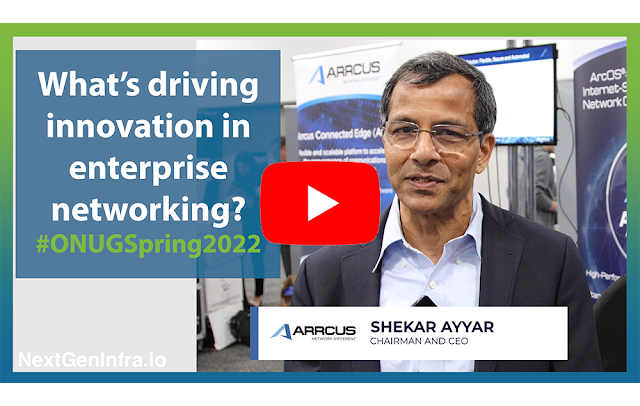
3 forces driving innovation in enterprise Networks

https://youtu.be/SKLKD3wdAfAWhat are the 3 biggest forces driving innovation in enterprise networks today? Cost, Cloud, and Connectivity, answered Shekar Ayar, CEO of Arrcus. Here’s a perspective from ONUG Spring 2022 on how a modernized routing stacking can drive transformation across all three of these forces.Arrcus cites 80% growth in bookings in Q1Thursday, April 07, 2022  Arrcus  Arrcus, a privately-held company that...


Dell’Oro: 400G drives North American SP router market


Driven by the ramping of 400 Gbps interfaces, North America led the worldwide Service Provider (SP) Router and Aggregation Switch market with double-digit revenue growth, according to a new report from Dell'Oro Group. Despite North America’s performance, the worldwide SP Router and Aggregation Switch market was flat year-over-year (Y/Y) in 2Q 2022, although revenues were in line with average revenues of the last five years.

“In 2Q 2022, we observed continuing strong demand for SP Routers in North America, driven by the ramping adoption of 400 Gbps technologies across Telecom- and  Cloud SPs and an ongoing capacity expansions by the SPs,” said Ivaylo Peev, Senior Analyst at Dell’Oro Group. “We see the flat 2Q22 Y/Y global market performance as a positive signal, as market conditions remained difficult in the second quarter. Economic uncertainty, raising inflation, China’s zero-COVID-19 policy, and the war in Ukraine are depressing markets in 2022. Adverse foreign exchange rates and the comparison to a strong 1Q 2021 are adding to the factors negatively impacting the performance of the SP Router and Aggregation Switch market,” added Peev.

Additional highlights from Dell’Oro Group’s 2Q 2022 Service Provider Router and Switch Report:

  • Double-digit market growth in North America and moderate growth in the Caribbean and Latin America (CALA) regions were offset by steeply decreasing revenues in Europe, Middle East and Africa (EMEA) and a market decline in Asia Pacific (APAC) and China.
  • Positive growth in the SP Core Router and the Aggregation Switch segments was offset by negative performance in the SP Edge Router segment.
  • The Enterprise High-End Router segment grew strongly in 2Q 2022, recording double-digit growth across all regions except APAC. APAC’s total growth was limited due to a decline in China.
  • Adverse foreign exchange rates driven by a strengthened US dollar (USD) suppressed market results in large parts of EMEA and APAC regions, as business transactions were negatively impacted by the conversion between local currencies and the USD.

https://www.delloro.com/news/400g-drove-north-americas-service-provider-router-market-to-double-digit-growth-in-1h22/

Adtran supplies 10G fibre access platform for ITS

ITS Technology Group (ITS), which designs, builds and operates wholesale fibre networks for business services in the UK, has selected the Adtran 10G fibre access platform.

Adtran said its 10G fibre access platform was selected because it uses an open and disaggregated architecture that eliminates vendor lock-in while providing the flexibility needed to sell services through a diverse set of partners and channels. 

With its flexible, scalable, programmable network, ITS works exclusively to build fibre networks across UK towns and cities, including London. Faster Britain is on track to pass 25% of the country’s business premises by the end of this year. Among its flagship projects is LCR Connect, a 212km full-fibre, ultrafast network for the Liverpool City Region Combined Authority (LCRCA) that will serve as a gateway for businesses, investors, universities, schools, hospitals, residents and students to access cloud-enabled technologies and connect to new economic and growth opportunities.


Dell'Oro: PON equipment revenue up 19% YoY

 Total global revenue for the Broadband Access equipment market increased to $4.5 B in 2Q 2022, up 12 percent year-over-year (Y/Y), according to a new report from Dell'Oro Group. Spending on PON equipment continues to fuel the overall market, with revenue for PON OLTs reaching a record $1.3 B in the quarter.

"Operators in Europe, China, and Southeast Asia increased their spending on PON equipment, offsetting some seasonal slowness in North America," noted Jeff Heynen, Vice President, Broadband Access and Home Networking at Dell'Oro Group. "The transition to fiber is clearly a worldwide phenomenon, no longer isolated to just a handful of countries," explained Heynen.

Additional highlights from the 2Q 2022 Broadband Access and Home Networking quarterly report:

  • Total XGS-PON ONT unit shipments exceeded 1 M for the first quarter on record, reaching 1.2 M worldwide.
  • Total cable access concentrator revenue decreased 4 percent Y/Y to just over $236 M. Record quarterly revenue for remote PHY devices and remote OLTs couldn't offset weakness in CCAP channel licenses.
  • Total cable CPE units increased 3 percent Y/Y, as vendors were able to fulfill orders that had been backlogged for multiple quarters. Total revenue was up 11 percent Y/Y as higher-end DOCSIS 3.1 gateways are as a percentage of total unit shipments.

Tuesday, September 13, 2022

Nokia unifies OSS, BSS, and security software under its AVA brand

Nokia’s OSS, BSS, and security software applications will be unified under Nokia’s brand, AVA (Automation, Visualization, Analytics). AVA provides “Intelligence Everywhere” through AI, machine learning, no code configuration, open APIs, multi-cloud orchestration, and digital ecosystems.

Nokia is introducing AVA Open Analytics framework to help CSPs accelerate AI projects, in part by simplifying how data is stored and used. The idea is to move from centralized data “lakes” to a hybrid data mesh architecture that abstracts technical complexity. Nokia expects the framework to be fully commercially available in 2023.

Nokia is also introducing the IGNITE Digital Ecosystem to bring together customers and application partners to accelerate and commercialize innovation of security, automation, and monetization solutions.

Hamdy Farid, Senior Vice President, Business Applications at Nokia, said: “By strengthening our analytics framework and unifying our portfolio under the AVA brand, we are reinforcing our commitment to provide deep intelligence across our security, automation and monetization solutions. We look forward to partnering with our CSP and enterprise customers along with application developers to drive further innovation and create 5G value.”