Monday, July 25, 2022

Nanosys raises over $50M for its quantum dot and MicroLED tech

Nanosys, a start-up based in Milpitas, California, raised more than $50 million in Series B equity and debt financing for its quantum dot and microLED technologies for advanced displays. 

The initial close of this round includes as new investors funds managed by affiliates of Fortress Investment Group, Centerbridge Partners and Kilonova Capital.

“This is a major milestone for Nanosys, adding capital and resources needed to enable us to expand our development of industry-leading innovative technologies, including quantum dots, microLEDs and nanoLEDs, which will be rapid growth drivers for 2023 and beyond,” said Jason Hartlove, President and Chief Executive Officer of Nanosys. “We are pleased to partner with Fortress, Centerbridge and Kilonova. The commitment from these respected institutions provides strong validation of our business model, team, intellectual property and market opportunity.”

http://www.nanosys.com

Sunday, July 24, 2022

Google announces cloud region for Mexico

Google announced plans to open a new cloud region in Mexico, its first in the country and third in Latin America, joining Santiago, Chile, and São Paulo, Brazil.

This will bring the total to 34 regions and 103 zones currently in operation around the world.

In the last year, Google has opened a support center in Mexico to boost local companies, as well as global companies with operations in Mexico. Google also opened a delivery center and grew its team in Monterrey to support the local ecosystem.

"We are very excited about the announcement of a new cloud region in Mexico. It shows the commitment that Google Cloud has with its customers," said Antonio Guichard Gonzalez, Liverpool’s Digital Executive Director. "In Liverpool, we will continue to work with Google Cloud to find solutions to our biggest challenges and accelerate our digital capabilities."

https://cloud.google.com/blog/products/infrastructure/announcing-a-new-google-cloud-region-in-mexico

Google Cloud Region opens in Milan with TIM

A new Google Cloud region has opened in Milan, in partnership with TIM. The new Milan region (europe-west8) is now part of the Google Cloud global network of 34 regions and 103 zones, bringing Google Cloud services to users in over 200 countries and territories worldwide. It is the first of two regions that are opening in Italy,  the second will launch in Turin in the coming months.“The partnership between TIM and Google Cloud will accelerate...

Google Cloud launches Private 5G for enterprises

Google Cloud launched a private 5G solution for enterprises looking to expand wireless performance and security across their campuses.The service leverages Google Distributed Cloud Edge and technology from a number of partners, including Betacom, Boingo, Celona, Crown Castle, and Kajeet.Google Distributed Cloud Edge provides a centralized control and management plane for secure networks, scaling from one to thousands of locations.  GDC Edge...

Google Cloud region opens in Madrid in partnership with Telefónica

Google opened a new cloud region in Madrid, Spain. The new Madrid region (europe-southwest1) provides low-latency, highly available cloud services with high international security and data protection standards. The Madrid region is launching with three cloud zones to prevent service interruptions, and our standard set of products, including Compute Engine, Google Kubernetes Engine, Cloud Storage, Persistent Disk, CloudSQL, and Cloud Identity.The...


Gogo Business Aviation hits midpoint on 5G air-to-ground rollout

Gogo Business Aviation activated the 75th site on its nationwide 5G network, marking the halfway point in the construction of its air-to-ground infrastructure.  The company said it remains on budget and on schedule to launch in the second half of 2022.

Gogo 5G is expected to deliver ~25 Mbps on average with peak speeds in the 75-80 Mbps range with coverage over the entire continental United States. The service is designed to deliver high throughput with very low latency. It will use both licensed and unlicensed spectrum. The base station communicates with aircraft passing overhead using 16-antenna digital port beamforming antennas using massive MIMO technology.

Gogo says its AVANCE platform, with its multi-bearer capability and software-centric design, allows customers to future-proof their inflight connectivity investments, with  upgrade paths to both Gogo 5G and to Gogo's global Low-Earth Orbit (LEO) satellite-based product in the future.

Gogo is working with Duncan Aviation to complete the first-article Supplemental Type Certification (STC) for the onboard 5G system hardware along with STCs that will cover more than 30 aircraft models. Additional STCs are being developed by several other Gogo authorized dealers, and at the factory by business aviation aircraft manufacturers.

"Getting to the 50% mark for our 150-tower 5G nationwide network in a matter of months is an incredible accomplishment by our team," said Mike Rupert, vice president of network operations for Gogo Business Aviation. "We have a team of network experts that has been working hard to bring the 5G network to life, building sites across the country, and that work will continue into the fall."

"We've been testing our network and we're pleased with the results we're seeing," said Dave Glenn, senior vice president of customer operations. "Gogo 5G is going to deliver on everything we've promised to the market."

https://business.gogoair.com/gogo-5g/


Verizon to deliver Private 5G for Virginia shipping terminal

Virginia International Terminals, which is a privately held terminal operating company that is owned by the Virginia Port Authority,  has selected Verizon to build a private 5G Ultra Wideband network at one of The Port Of Virginia’s main container terminals.

VIT is one of the most technologically advanced container terminal operators in the world, and will use the network to explore the use of autonomous over-the-road trucks for accessing the terminal to drop-off and pick-up shipping containers. 

Verizon's On Site 5G private network provides the ability to replace WiFi with secure, private 5G connectivity across its Virginia International Gateway facility, a 275 acre marine terminal.

The deal is Verizon Business’ second with a major international port and its first with a U.S.-based terminal.

“Seaports provide some of the best possible examples of the power of private 5G, with uses spanning autonomous vehicles, connected heavy equipment, and secure, real-time tracking and logistics, among many others,” said Sowmyanarayan Sampath, CEO of Verizon Business. “That’s why On Site 5G is ideal for innovative partners like Virginia International Terminals. It puts a wide range of 5G capabilities on offer, from data-intensive, high-bandwidth industrial needs to secure, reliable broadband for everyday business.”

https://www.verizon.com/about/news/verizon-business-vit-reach-agreement-private-5g-network

Singtel deploy 5G campus + edge core for Hyundai's Innovation Centre

Singtel will deploy its 5G infrastructure network solutions at the Hyundai Motor Group Innovation Centre in Singapore (HMGICS), which includes an electric vehicle production facility. Singtel’s 5G campus network with mobile edge core solution  will provide uninterrupted high-speed connectivity and massive bandwidth to enhance HMGICS’s high-precision quality control in manufacturing operations.HMGICS is the HMG’s open innovation hub for...

Dell’Oro: Private wireless market tracking below expectations

Private wireless radio access network (RAN) shipments and revenues are again coming in below expectations, resulting in another markdown, according to a newly published forecast report from Dell'Oro Group.“We have not made any changes to the potential market calculations and still estimate private wireless is a massive opportunity,” said Stefan Pongratz, Vice President at Dell’Oro Group.  “At the same time, the message we have communicated for...

Telefónica and NTT DATA demo private 5G for logistics management

Telefónica and NTT DATA are executing a private 5G proof of concept (PoC) with CIE Automotive, a global automotive supplier. At its facilities in Itziar (Guipúzcoa), a 5G intralogistics management platform has been developed and is being implemented as an integrating and enabling solution for the automation of the transport of finished products from the end of the production line to the warehouse.The objective of the solution is to increase...


SpaceX launches 53 more Starlinks from Florida

On Sunday, July 24 SpaceX launched 53 Starlink satellites from Launch Complex 39A (LC-39A) at Kennedy Space Center in Florida. 

This was the eighth flight for the Falcon 9 first stage booster supporting this mission, which previously launched GPS III Space Vehicle 04, GPS III Space Vehicle 05, Inspiration4, Ax-1, Nilesat 301, and now three Starlink missions.

The mission was SpaceX’s 54th Starlink mission to date. It was SpaceX's 6th mission during July.

http://www.spacex.com

Friday, July 22, 2022

SpaceX completes 2nd Starlink mission this month from California

On Friday, July 22, SpaceX launched 46 Starlink satellites to low-Earth orbit from Space Launch Complex 4 East (SLC-4E) at Vandenberg Space Force Base in California. 

The first stage booster supporting this mission previously launched NROL-87, NROL-85 and SARah-1. Following stage separation, Falcon 9’s first stage landed on the Of Course I Still Love You droneship stationed in the Pacific Ocean.

The launch came 12 days after the last SpaceX launch from the same SLC-4E pad at Vandenberg, marking its fastest turnaround time to date at Vandenberg.

The mission was SpaceX’s 53rd Starlink mission to date.

https://www.spacex.com

MIT: The best semiconductor of them all?

Researchers at MIT, the University of Houston, and other institutions demonstrated that cubic boron arsenide offers the best thermal conductivity of any known semiconductor material, and may be the best possible material based on theoretical predictions.

Only a small amount of cubic boron arsenide has only been made, however the researchers were able to test small regions within the material. 

More work will be needed to determine whether cubic boron arsenide can be made in a practical, economical form, much less replace the ubiquitous silicon.

The team published its findings in the journal Science, in a paper by MIT postdoc Jungwoo Shin and MIT professor of mechanical engineering Gang Chen; Zhifeng Ren at the University of Houston; and 14 others at MIT, the University of Houston, the University of Texas at Austin, and Boston College.

https://news.mit.edu/2022/best-semiconductor-them-all-0721

Verizon posts flat revenue for Q2, missing expectations

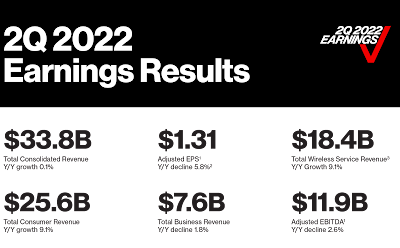
Verizon reported total revenue of $33.8 billion for Q2 2022, relatively flat from second-quarter 2021. EPS amounted to $1.24, compared with $1.40 in second-quarter 2021.

"As the market leader, in a very competitive industry, we are determined to improve our operational and financial performance for the second half of the year,” said Verizon Chairman and CEO Hans Vestberg. "With our network-as-a-service foundation, our new consumer mobility plans, and recent pricing actions, we are being deliberate in our decisions to improve our profitable growth opportunities today and into the future."

"Although recent performance did not meet our expectations, we remain confident in our long-term strategy,” said Verizon Chief Financial Officer Matt Ellis. “We believe that our assets position us well to generate long-term shareholder value."

Some highlights:

Verizon Consumer 

  • Total Verizon Consumer revenue was $25.6 billion, an increase of 9.1 percent year over year, driven by the inclusion of TracFone, higher equipment revenue and core wireless service revenue growth.
  • 47% of the consumer postpaid phone customer base is now on 5G
  • Wireless service revenue increased 10.5 percent year over year, driven by the inclusion of TracFone and growth in postpaid Average Revenue Per Account (ARPA).
  • Consumer wireless retail postpaid churn was 0.93 percent in second-quarter 2022, and wireless retail postpaid phone churn was 0.75 percent. 
  • Consumer reported 168,000 fixed wireless net additions and 30,000 Fios Internet net additions in second-quarter 2022. Consumer Fios revenue was $2.9 billion in second-quarter 2022, flat year over year. 
  • In second-quarter 2022, Consumer reported 215,000 wireless retail postpaid phone net losses, due to a year over year increase in churn and a year over year decline in phone gross additions. Consumer ended second-quarter 2022 with nearly half of its wireless phone customers having 5G-capable devices.
  • In second-quarter 2022, Consumer operating income was $7.2 billion, a decrease of 4.6 percent year over year, and segment operating income margin was 27.9 percent, a decrease from 31.9 percent in second-quarter 2021. Segment EBITDA1 in second-quarter 2022 was $10.4 billion, a decrease of 0.3 percent year over year. A higher contribution from TracFone was more than offset primarily by higher promotional activity. Segment EBITDA margin1 was 40.5 percent, a decrease from 44.3 percent in second-quarter 2021.

Verizon Business results

  • Total Verizon Business revenue was $7.6 billion in second-quarter 2022, down 1.8 percent year over year.  
  • Business wireless service revenue was $3.2 billion, an increase of 3.0 percent year over year. This increase was driven by momentum in Small and Medium Business, and the best performance in Global Enterprise since first-quarter 2020. 
  • Business reported 430,000 wireless retail postpaid net additions in second-quarter 2022, including 227,000 postpaid phone net additions. This was the third consecutive quarter that Business reported more than 200,000 postpaid phone net additions. Phone gross additions in Business increased nearly 30 percent year over year.
  • Wireless retail postpaid churn was 1.37 percent in second-quarter 2022, and wireless retail postpaid phone churn was 1.07 percent.
  • Business reported 88,000 fixed wireless net additions in second-quarter 2022. 
  • In second-quarter 2022, Verizon Business operating income was $675 million, a decrease of 21.1 percent year over year, and segment operating income margin was 8.9 percent, a decrease from 11.0 percent in second-quarter 2021. Segment EBITDA1 was $1.7 billion in second-quarter 2022, a decrease of 6.5 percent year over year. In addition to Wireline revenue declines, Business experienced elevated device subsidies related to wireless activations in the quarter. Segment EBITDA margin1 was 22.9 percent, a decrease from 24.1 percent in second-quarter 2021. 

https://www.verizon.com/about/news/verizon-reports-2q-and-first-half-2022-results

Telefónica validates its net-zero ambitions

Telefónica claims to be the first telco in the world to obtain validation from the Science Based Targets (SBTi) initiative, according to the new ‘Net-Zero Standard’, of its net zero environmental targets, both in the short, medium and long term. 

Telefónica's Net-Zero targets include:

  • a committment to achieving net zero Greenhouse Gas (GHG) emissions across the value chain by 2040, which means an effective reduction of at least 90% of all its emissions (direct and indirect) and neutralising the remaining emissions (less than 10%) through high quality carbon credits.
  • an intermediate target of reducing absolute GHG emissions in Scope 1 and 2 by 80% and 56% in Scope 3 (value chain) by 2030.

The company says it has already decreased all its emissions by more than 40% (70% for Scope 1+2 since 2015 and 27% for Scope 3 since 2016).

“Protecting the environment is a top priority for Telefónica, which is why we are working to curb climate change and reverse biodiversity loss. The fact that our emissions reduction targets are validated by SBTi according to the new ‘Net-Zero Standard’ demonstrates the company’s commitment to leading the energy and digital transition as they go hand in hand to build a greener future for all,” said Elena Valderrábano, Global Chief Sustainability (ESG) Officer.

https://www.telefonica.com/en/communication-room/telefonicafirst-telco-in-the-world-with-net-zero-targets-validated-by-sbti/

IQM raises €128m for quantum computing

IQM Quantum Computers, a start-up based in Espoo, Finland, raised €128 million ($128m) in Series A2 funding for its development of superconducting quantum computers.

IQM delivers a quantum advantage through a unique application-specific, co-design approach. IQM is building Finland’s first 54-qubit quantum computer with VTT and an IQM-led consortium (Q-Exa) is also building a quantum computer in Germany. This computer will be integrated into an HPC supercomputer to create a quantum accelerator for future scientific research. IQM has over 180+ employees with offices in Paris, Madrid, Munich and Espoo. The company was founded in 2018.

The funding was led by World Fund and included participation from Bayern Kapital, EIC Fund, OurCrowd, QCI SPV, Tofino and Varma, as well as existing investors Maki.vc, Matadero QED, MIG Fonds, OpenOcean, Salvia GmbH, Santo Venture Capital GmbH, Tencent, Tesi, and Vsquared. The funding round follows a €39m ($39m) Series A1 announcement in 2020 and includes part of a €35m ($35m) venture loan from the European Investment Bank (EIB) announced earlier this year, 

Dr. Jan Goetz, CEO and Co-founder of IQM Quantum Computers, said: “This funding underscores the importance of our mission: building quantum computers for the well-being of humankind. It also demonstrates the confidence in our business model and the continued trust in our team's ability to build the future of quantum technologies. I am confident that we will continue to achieve all our product and business milestones and deliver world-class quantum computers to our customers.”

https://www.meetiqm.com

Rakuten Symphony opens lab in Bengaluru

Rakuten Symphony will open a new lab in Bengaluru, India, to focus on the automation of Open RAN-based, cloud native mobile networks. The Global Innovation Lab is expected to open in early 2023 and will be housed inside new engineering development facilities opening simultaneously to bring together Rakuten Symphony’s Bengaluru employee base.

Tareq Amin, Chief Executive Officer of Rakuten Symphony, said, “Our operations around the world are powered by incredible Indian talent and creative innovation, so I am very proud to announce this additional investment with the establishment of our Global Innovation Lab and new engineering development facilities in Bengaluru. I am very confident that as we continue to grow here in India, our ability to provide telco solutions to the world will also grow exponentially.”

Rakuten says its Global Innovation Lab will be a state-of-the art facility that recreates the entire network architecture in a simulated environment, from RAN to Core to transport, enabling function and performance testing. The lab will also act as a showcase for Symworld platform, allowing Rakuten Symphony to demonstrate the capabilities and performance of the platform to customers. It will complement and expand upon Rakuten Symphony’s existing RAN lab in Bengaluru and the Rakuten Cloud Innovation Lab in Tokyo, allowing for global end-to-end testing of apps across the Symworld portfolio. Going forward, there are plans to set up facilities for 6G infrastructure R&D in the lab.

Narendra Narayana, Managing Director of Rakuten Symphony India said, “Rakuten Symphony India represents a key driver of innovation in the telecom space, and we are very excited to further expand our presence. We look forward to fostering local talent and working with local Indian and global partners to promote the adoption of Open RAN technologies and empower global telecom operators to build and operate secure mobile networks.”

Including locations in Bengaluru and Indore, Rakuten Symphony’s employee base in India has grown to over 3,300 in less than one year through acquisitions and organic growth.

https://symphony.rakuten.com/newsroom/rakuten-symphony-to-expand-in-india-with-the-establishment-of-global-innovation-lab-and-new-engineering-development-facilities-in-bengaluru


Xunison secures €3.35 million

Xunison, a start-up based in Dublin, Ireland,  raised seed capital of €3.35 million for its development of software/hardware solutions for telcos and ISPs. 

The funding was secured through Focus Capital Partners.

Xunison cited a business’s partnership rollout with STC, Saudi Arabia.  

Speaking of the super round secured, CEO of Xunison, Ryan O’Donovan commented, “We were humbled by the level of interest that was expressed in this round. It exceeded our expectations and capacity when it closed out on Christmas week. As a result of this funding, 2022 will see Xunison cement our brand presence and effectively communicate the incredible capabilities of the organisation to a global audience.”

https://www.xunison.com

Thursday, July 21, 2022

Ericsson aims for 5G monetization with $6 billion acquisition of Vonage

Ericsson completed its previously-announced acquisition of Vonage Holdings Corp.  

The deal provides Ericsson with a platform for offering a full suite of communications solutions including, Communications Platform as a Service (CPaaS), UCaaS and CCaaS.

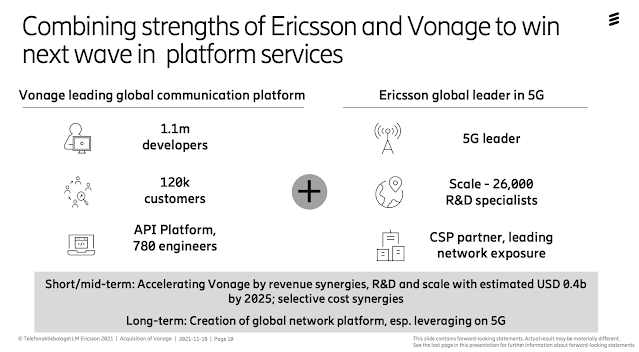
Ericsson said it aims to transform the way advanced 5G network capabilities are exposed, consumed and paid for. This will provide the global developer community, including Vonage’s more than one million registered developers, with easy access to 4G and 5G network capabilities via open Application Program Interfaces (APIs).

For communications service providers (CSPs), global network APIs - such as location and quality of service APIs - provide new opportunities to expand their profit pools to monetize 5G network capabilities. For Ericsson, global APIs provide a new material growth opportunity. The existing market for communications APIs – such as video, voice and SMS – is currently growing at 30 percent annually and projected to reach USD 22 billion by 2025.

Ericsson intends to increase R&D investments and offer these solutions to CSPs.

Börje Ekholm, President and CEO, says: “We are excited to welcome Vonage as part of Ericsson. With Vonage’s suite of communications solutions – UCaaS, CCaaS and Communications APIs – Ericsson will further expand its offerings into the enterprise space. In the future, network capabilities will be consumed and paid for through open network APIs, creating the opportunity for unparalleled innovation. We have already launched the first network API, Dynamic End-user Boost, based on existing 4G infrastructure. With Vonage, we will now develop and commercialize these new APIs.  We are already seeing great progress with frontrunner CSPs, and we aim to launch the first 5G network APIs in the coming year. We will continue to create new, enhanced applications and services for enterprises, while driving continued innovation on Vonage’s UCaaS and CCaaS applications, helping businesses create new digital experiences for better communications, connections and engagement.

Rory Read, Vonage CEO, says: “Vonage was born out of innovation and is today a global leader in business cloud communications. This partnership will strengthen our offerings to businesses across the globe by leveraging Ericsson’s leadership in 5G, global market presence and strong R&D capabilities. With the demand for UCaaS, CCaaS and Communications APIs growing rapidly, the combined expertise, talent and innovation is good news for our customers and partners.”

Some additional notes:

  • Ericsson paid for the acquisition with cash on hand.
  • The transaction is expected to be accretive to Ericsson’s EPS (excluding non-cash amortization impacts) and free cash flow before Mergers & Acquisitions (M&As) from 2024 onwards.
  • Vonage will become a separate business area within the Ericsson Group - called Business Area Global Communications Platform (BGCP). Rory Read, current CEO of Vonage, is appointed Senior Vice President and Head of Business Area Global Communications Platform and a member of Ericsson’s Executive Team.
  • Vonage will continue to operate under its existing name and brand being part of the Ericsson Group. 

https://www.ericsson.com/en/press-releases/2022/7/ericsson-completes-acquisition-of-vonage


Ericsson to acquire Vonage for its cloud communications platform

Ericsson agreed to acquire Vonage, one of the earliest developers of a commercial VoIP service, for US$6.2 billion in cash.

Vonage traces its roots to 1998 when Jeff Pulver established Min-X.com as a VoIP exchange. In 2001, the company changed its name to Vonage and launched a commercial VoIP services aimed at consumers. Vonage went public in 2006. Vonage is headquartered in Holmdel, New Jersey and has 2,200 employees throughout the United States, EMEA and APAC.

Currently, the cloud-based Vonage Communications Platform (VCP) serves over 120,000 customers and more than one million registered developers globally. The API platform within VCP allows developers to embed high quality communications - including messaging, voice and video - into applications and products, without back-end infrastructure or interfaces. Vonage also provides Unified Communications as a Service (UCaaS) and Contact Center as a Service (CCaaS) solutions as part of the Vonage Communications Platform.

Sales were US$1.4 billion in the 12-month period to 30 September 2021, and over the same period, Vonage delivered an adjusted EBITDA margin of 14% and free cash flow of US$109 million.

VCP accounts for approximately 80% of Vonage’s current revenues and delivered revenue growth in excess of 20% in the three-year period to 2020, with adjusted EBITDA margins moving from -19% in 2018 to break-even in the 12-month period to 30 September 2021. Vonage’s management team projects annual growth of over 20% for VCP in the coming years.


Ericsson completes Cradlepoint acquisition

Ericsson completed its previously-announced acquisition of Cradlepoint for approximately US$1 billion.Cradlepoint will operate as a stand-alone subsidiary within Ericsson and continue to build on the current market momentum as 5G is speeding up digital transformation and increasing the need for advanced connectivity services for enterprises. Cradlepoint will be part of Ericsson’s Business Area Technologies & New Businesses.Ericsson acquires Cradlepoint...


Cisco intros Webex Wholesale for Service Providers

Cisco launched a new Webex Wholesale Route-to-Market (RTM) for Service Provider. 

The new sales model includes a single commercial agreement with each partner and a self-service platform for Service Providers to deliver managed services for Webex, as well as the agility, scalability and flexibility to create their own co-branded offers.

The Wholesale partner program features consumption-based billing with fixed, predictable per-user/per-month package pricing and equips Service Providers with several invoicing options. The partner onboarding experience includes dedicated Cisco experts, paired with comprehensive online training and a robust set of migration and marketing toolkits to drive market demand and serve SMB customers.

Initial managed services packages for Webex that are available through the Wholesale RTM include:

  • Webex Calling: Enterprise-grade calling and advanced collaboration with features for 1:1 and group messaging, file-sharing, and secure basic video conferencing for up to 100 users, for a complete PBX replacement, including multi-device support, visual voicemail, intelligent call routing and more.
  • Common Area Calling: Calling built for shared use and common area locations and phones.
  • Webex Meetings: A premium meeting and messaging experience with meetings allowing up to 1000 users. Also includes AI-driven intelligence with Webex Assistant, Slido, remote desktop control, moderator controls and more.
  • Webex Suite: Encompasses all the above with premium calling, messaging and meetings, plus advanced features that are engaging and inclusive.

"By tapping into the brand power of respected Service Providers and combining it with our inclusive Webex technology, rapid innovation, and complete collaboration portfolio, we are creating winning partnerships that address the communication needs of small and medium-sized businesses and help them thrive in a hybrid work world," said Jeetu Patel, Cisco EVP and GM, Security & Collaboration.

https://newsroom.cisco.com/c/r/newsroom/en/us/a/y2022/m07/cisco-equips-service-provider-partners-with-new-managed-services-offering-for-webex.html

Nokia's Q2 net sales increased 3% yoy in constant currency

Nokia reported Q2 net sales of EUR 5,873 billion, up 11% year over year in absolute terms and up 3% yoy when accounting for constant currency. Gross margin was 40.2%. EPS was 0.08.

Some highlights:

  • Network Infrastructure net sales grew 12% in constant currency, with growth across all four businesses.
  • Mobile Networks returned to growth despite ongoing supply chain constraints.
  • Cloud and Network Services net sales were flat in constant currency. 
  • Nokia Technologies declined 25% as it continued to be impacted by expired licenses that are in the process of being renewed.

Pekka Lundmark, Nokia's president and CEO, states: "While we recognize the increased global macroeconomic uncertainty and currency fluctuations impacting some emerging markets, I am confident we have the right strategy in place to navigate these challenges along with support from structural technology adoption trends in 5G and fiber. However, we will not become complacent; we remain focused on building technology leadership and improving cost-efficiency to deliver on our strategic goals for the years ahead."

"We have had a strong first half and with our renewed competitiveness, we are well placed to deliver our full year 2022 guidance. There remain risks around timing of Nokia Technologies’ contract renewals, potential COVID-19 lockdowns and the supply chain which remains challenging but is showing signs of improvement. We are currently tracking towards the higher-end of our net sales guidance and towards the mid-point of our operating margin guidance as we manage ongoing inflation and currency headwinds."

https://www.nokia.com/about-us/news/releases/2022/07/21/nokia-corporation-financial-report-for-q2-and-half-year-2022/

AT&T chases growth in 5G and fiber

AT&T reported Q2 revenues from continuing operations of $29.6 billion versus $35.7 billion in the year-ago quarter, down 17.1% reflecting the impact of the U.S. Video separation in Q3 2021 and certain other divested businesses. Excluding the impact of these divestitures, operating revenues for standalone AT&T were up 2.2%, from $29.0 billion in the year-ago quarter.

AT&T said its results were driven by higher Mobility revenues and, to a lesser extent, higher Mexico and Consumer Wireline revenues, partially offset by lower Business Wireline revenues.  

“We’re expanding our customer base at an accelerated pace across our twin engines of growth – 5G and fiber,” said John Stankey, AT&T CEO. “We’re rapidly building out our best-in-class networks on the heels of record-level connectivity investment. We’ve already added nearly 2 million AT&T Fiber locations this year and just reached our target of covering 70 million people with mid-band 5G spectrum two quarters early, with expectations to now approach the 100 million mark by the end of year.”

On the investor conference call, AT&T also disclosed that more customers are falling behind in monthly payments.


Some additional highlights:

Mobility

  • Revenues were up 5.2% year over year, to $19.9 billion due to higher service and equipment revenues. Service revenues were $15.0 billion, up 4.6% year over year, primarily driven by subscriber growth. Equipment revenues were $4.9 billion, up 7.2% year over year, driven by increased sales of higher priced smartphones.
  • Operating expenses were $13.7 billion, up 6.1% year over year due to higher equipment costs, network costs, bad debt expense, amortization of customer acquisition costs, HBO Max content costs, FirstNet 
  • Total net adds were 6.6 million
  • Postpaid churn was 0.93% versus 0.87% in the year-ago quarter.
  • Postpaid phone churn was 0.75% versus 0.69% in the year-ago quarter.
  • Postpaid phone-only ARPU was $54.81, up 1.1% versus the year-ago quarter, due to improved international roaming and a mix shift to higher-priced unlimited plans.
  • FirstNet connections reached approximately 3.7 million across more than 21,800 agencies. 

Business Wireline

  • Revenues were $5.6 billion, down 7.6% year over year due to lower demand for legacy voice and data services, a strategic decision to deemphasize non-core services and lower revenues from the government sector. 
  • Operating expenses were $4.9 billion, down 2.0% year over year due to ongoing operational cost efficiencies and lower amortization of deferred fulfillment costs, partially offset by higher wholesale network access costs and higher depreciation expense. 

Consumer Wireline

  • Revenues were $3.2 billion, up 1.1% year over year due to gains in broadband more than offsetting declines in legacy voice and data services and other services. Broadband revenues increased 5.6% due to fiber growth of nearly 28%, partially offset by non-fiber revenue declines of 9.8%.
  • Total broadband losses, excluding DSL, were 25,000, reflecting AT&T Fiber net adds of 316,000, more than offset by losses in non-fiber services. AT&T Fiber now has the ability to serve 18 million customer locations, and offers symmetrical speeds up to 5-Gigs across parts of its entire footprint of more than 100 metro areas. 

https://about.att.com/story/2022/q2-earnings.html

SK Telecom activates bare-metal 5G Core with Ericsson

SK Telecom has activated a bare-metal cloud-native 5G core network, using Ericsson 5G Core and Cloud Native Infrastructure (CNIS).

SKT's cloud-native 5G core is expected to improve traffic processing significantly compared to existing physical-based cores by applying packet acceleration processing, route optimization, and multi-flow control for ultra-high-speed and large-capacity 5G services.

The companies have been developing and verifying the cloud-native solution in stages since 2019, and since November of last year, they have been testing a full-scale 5G network for commercial service, where the Ericsson’s dual-mode 5G Core is deployed on the Kubernetes over bare metal infrastructure solution Ericsson Cloud Native Infrastructure (CNIS).

Park Jong-kwan, VP, Head of  Infra Tech, says, "Based on the commercialization of the cloud-native-based 5G core, we have laid the foundation to provide cutting-edge ICT services more efficiently and stably. We will continue to develop and apply the next-generation network technology that will become this”.

Monica Zethzon, Head of Solution Area Packet Core at Ericsson says, “With the bare-metal cloud-native 5G Core solution, SKT is reconfirming its ambitions to lead the way in creating a future-focused, versatile 5G network. The efficiency and performance gains to the 5G Core network that comes from this new Cloud Native Infrastructure will be a strong foundation for innovative use cases and new services for enterprises and consumers.  We are proud to continue our long-standing partnership with SKT, together supporting the innovative ecosystem of technology-driven businesses.” 

https://www.ericsson.com/en/press-releases/2/2022/7/skt-live-5g-core


Samsung's 2nd gen SmartSSD computational drive offloads CPU

Samsung Electronics introduced a second generation of its pioneering SmartSSD computational storage drive that uses a Xilinx Versal Adaptive chip to offload certain data processing functionality from the host CPU.

Unlike existing SSDs, Samsung’s SmartSSD can process data directly, thereby minimizing data transfers between the CPU, GPU and RAM. This technology can avoid the bottlenecks that often occur when moving data between storage devices and CPUs, resulting in markedly improved system performance and much higher energy efficiency.

 Samsung says that compared to conventional data center solid-state drives, processing time for scan-heavy database queries can be slashed by over 50%, energy consumption by up to 70% and CPU utilization by up to 97%.

Since its development in 2020 through the joint efforts of Samsung and AMD, the first-generation SmartSSD is being supplied to global IT companies including video communications platform providers. The first-generation SmartSSD was recognized as an Innovation Awards Honoree at CES 2021 for its outstanding performance and energy efficiency.

 “Commercialization of the first-generation SmartSSD, in collaboration with AMD, established that the computational storage market has great potential,” said Jin-Hyeok Choi, Executive Vice President and Head of Memory Solution Product & Development at Samsung Electronics. “With the upgraded processing functionality of the second-generation SmartSSD, Samsung will be able to easily address increasing customer needs in the database and video transcoding sectors, as we expand the boundaries of the next-generation storage market.”

 “Powered by Xilinx Versal Adaptive SoCs from AMD, second-generation Samsung SmartSSDs enable improved CPU efficiency and greatly reduced energy consumption by efficiently integrating the computing and storage functions in data centers,” said Sina Soltani, Corporate Vice President of Sales, AECG, Data Center and Communication Group at AMD. “As data-intensive applications continue to grow, second-generation Samsung SmartSSDs will deliver the superior performance and efficiency required for this expanding market.”

 https://news.samsung.com/global/samsung-electronics-develops-second-generation-smartssd-computational-storage-drive-with-upgraded-processing-functionality

ZEDEDA raises $26 million for edge orchestration

ZEDEDA, a start-up based in San Jose, California, raised $26 million in Series B funding for its edge orchestration solution.

ZEDEDA provides a unified orchestration experience across hardware, software, networks and cloud that delivers visibility, control and security. The company says revenue is up 7x year-over-year, while at the same time, its number of nodes under management has risen by 4x. 

The funding round attracted a range of new and existing investors — including Coast Range Capital, Lux Capital, Energize Ventures, Almaz Capital, Porsche Ventures, Chevron Technology Ventures, Juniper Networks, Rockwell Automation, Samsung Next and EDF North America Ventures. ZEDEDA has now raised more than $55 million since its inception in 2016.

“All aspects of our business — from a growing base of Global 500 customers to major strategic partnerships and growth in deployed edge nodes — are on a terrific path,” said Said Ouissal, founder and CEO of ZEDEDA. “This latest round of investment validates that our open framework and ecosystem approach to the distributed edge is the ideal choice for the future of connected operations.”

http://www.ZEDEDA.com

Quantifi Photonics raises $15M for optical test systems

Quantifi Photonics, a start-up based in Auckland, New Zealand, announced US$15 million in Series C funding for its solutions for the high-density photonic test market.

Quantifi Photonics plans to offer fully integrated test systems for optical transceivers, silicon photonics and co-packaged optical devices that are emerging from R&D labs onto high-volume production lines. At this year's OFC, the company released a 288-channel optical power meter. Quantifi Photonics plans to grow its R&D and manufacturing teams and expand its sales and customer support capabilities in the USA and Europe to capitalize on the significant growth in optical communication networks around the world.

Intel Capital, the venture capital arm of Intel Corporation, led the round which was fully supported by existing investors.

"Intel Capital's investment will help us carry out our strategy and seize the market for the high-value test instruments required to support the rapidly growing transceiver market, which is projected to exceed US $14B by the year 2026," said Dr. Andy Stevens, CEO and co-founder of Quantifi Photonics.

"Silicon photonics is a key technique in the future of the semiconductor and telecommunications industries, especially with the increasing bandwidth requirements for data center and 5G/6G applications," said Sean Doyle, Managing Director at Intel Capital. "The Quantifi Photonics team has the potential to supply critical test and measurement solutions to the market at large."

"By working extremely closely with customers such as Intel, we understand their challenges and can begin to anticipate what they might need in 6, 12 or 24 months' time. As a result, we're rapidly developing a new generation of high-density test solutions that are critical to unlocking the potential of 800G technologies," says Dr. Stevens.

https://www.quantifiphotonics.com