Tuesday, June 28, 2022

Taiwan's GlobalWafers to build new wafer fab in Sherman, Texas

GlobalWafers, a leading provider of semiconductor wafers based in Hsinchu, Taiwan, announced plans to build a state-of-the-art, silicon wafer factory in Sherman, Texas.

The new 300-millimeter facility represents a multi-billion dollar investment and could support as many as 1,500 jobs with production volumes ultimately reaching 1.2 million wafers per month after multiple stages of equipment installation. Production is anticipated as early as 2025.

300-millimeter silicon wafers are the starting material for all advanced semiconductor fabrication sites (or fabs), including recently announced United States (US) expansions by GlobalFoundries, Intel, Samsung, Texas Instruments and TSMC. 

GlobalWafers Chairman/CEO Doris Hsu stated, “With the global chips shortage and ongoing geopolitical concerns, GlobalWafers is taking this opportunity to address the United States semiconductor supply chain resiliency issue by building an advanced node, state-of-the-art, 300-millimeter silicon wafer factory. Instead of importing wafers from Asia, GlobalWafers USA (GWA) will produce and supply wafers locally thereby reducing significant carbon footprint benefitting both customers and GWA in the current ESG tide worldwide.”

https://www.sas-globalwafers.com/en/gwc_news_en_20220627/

Colt launches SASE Gateway based on Versa

Colt Technology Services has launched an integrated full Secure Access Service Edge (SASE) solution that brings together SD WAN and SSE features.

The new Colt SASE Gateway solution, which is designed for global enterprise companies, is based on Versa SASE. This includes Versa Secure Web Gateway, a secure web access solution that offers organisations protection from malware and threats, and instant insight for policy management, along with reducing end-user friction to access cloud-based applications securely.

The Colt SASE Gateway works in combination with Colt SD WAN Remote Access, a feature launched last year based on Versa Secure Access (VSA) and Colt SD WAN’s core integrated features.

Peter Coppens, Colt’s VP Product Portfolio, said: “Colt was one of the first to offer a true SD WAN service in Europe many years ago, and now we extend our offering further with the launch of a full SD WAN-integrated SASE solution, powered by Versa. It comes as a result of the changes in how people are working and accessing systems, combined with increasingly complex enterprise networks and rapidly changing security threats. We see our customers looking to move away from more traditional network security solutions to a SASE approach. This brings together networking and security to offer secure access for employees no matter where they are and how they’re accessing the company network.”

https://www.colt.net/product/sd-wan/

Tele2 Estonia installs ADVA ALM fiber monitoring

Tele2 Estonia has deployed the ADVA ALM fiber monitoring solution for real-time assurance across its national network. 

The ADVA ALM is a low-power, service-agnostic solution that offers total fiber infrastructure visibility. Requiring no active equipment at the user site, it’s now delivering comprehensive insight into the integrity and performance of Tele2 Estonia’s fiber infrastructure. The Ensemble Fiber Director provides a GIS-based, real-time graphical user interface that proactively notifies the CSP’s field forces of any fiber anomaly, enabling them to take countermeasures before problems develop and services are affected. With complete control, Tele2 Estonia is now significantly improving robustness and efficiency across its nationwide network, which is built on the ADVA FSP 3000.

“With the ADVA ALM, we can offer even more value to our customers. Needing no calibration, it easily plugged into our infrastructure to instantly provide detailed info on any fiber event. Having the ability to rapidly respond to network issues and take immediate targeted action helps us ensure zero downtime and uninterrupted connectivity,” said Asse Hang, head of international sales at Tele2 Estonia. “This deployment is also central to our role as a sustainability leader. As the first communication service provider (CSP) in the Baltic region to have achieved climate neutral operations, we’re dedicated to reducing environmental impact in every aspect of our business. The ADVA ALM fiber monitoring solution enables us to dramatically decrease truck rolls, helping to further cut our carbon footprint”.

http://www.adva.com

ADVA supplies fiber monitoring for Westfalen Weser Netz

Westfalen Weser Netz, a regional utility provider serving 736,000 customers in Germany, has deployed ADVA's ALM fiber monitoring technology for precise, real-time insight into its regional metro network. The solution enables the municipal utility provider to instantly detect and rapidly repair fiber breaks with minimal disruption. “The ADVA ALM is helping us ensure excellent network availability while also reducing maintenance effort and expense....


Lightbits raises $42 million for NVMe over TCP

 Lightbits Labs, a start-up based in San Jose, California focused on NVMe over TCP (NVMe/TCP) software-defined storage, raised $42 million in growth capital, bringing total raised to over $100 million in funding since its founding in 2016. 

Lightbits eliminates storage complexities, unlike other NVM Express over Fabrics (NVMe-oF) implementations that require Fibre Channel or RDMA via the RoCE protocol, with specialized network interface cards and drivers. 

The funding round was led by new investor Atreides Management, alongside J.P. Morgan, Valor Equity Partners, Eyal Ofer’s O.G. Tech, founder and chairman of Pacific Century Group (PCG) Richard Li, existing investors, and others. 

“In today’s data-driven market, enterprise and data center customers are increasingly focused on achieving superior performance, scalability, and economics. Lightbits has established itself as a clear leader in disaggregated storage solutions—poised to meet accelerated customer demand with its cloud-native data platform. We are excited to partner with the Lightbits team at a critical stage in the company’s growth trajectory,” said Gavin Baker, Manager Partner and Chief Investment Officer of Atreides Management.

“The unprecedented events of the past two years and the impact of strained supply chains, have organizations thinking differently about their data infrastructure, rapidly accelerating the adoption of cloud solutions. There is tremendous pressure on Cloud Service Providers (CSPs) and IT Organizations with private clouds to profitably keep pace with growing business demand while providing fast, resilient, and secure services,” said Avigdor Willenz, Co-Founder and Chairman of Lightbits Labs. “Lightbits invented NVMe/TCP and has led the way in defining a cloud-native storage architecture that is simple, agile, and efficient. Delivering these benefits significantly improves the competitive advantage of our enterprise customers. This investment and our continued growth are validation of our strategy, our incredible team, and our mission to lead the cloud-native data center transformation by delivering scalable and efficient software-defined storage that is easy to consume.”

http://www.lightbitslabs.com

Open RF Association streamlines its technical work

 The Open RF Association, which is dedicated to creating an open 5G ecosystem of interoperable hardware and software across member multi-mode RF (radio frequency) front-end and chipset platforms, is consolidating its existing five working groups into three – Software Interoperability, Hardware Interoperability and Compliance.

When the Open RF Association was formed, it identified five key areas essential for specification development: the RF register map, software APIs, the hardware RF Front End and RFIC, RF power management, and compliance. With the completion of the first phase of its plan to establish a standard for the RF Front-end and RFIC ecosystem, the Open RF working groups have consolidated efforts along natural lines, merging the software-focused register map and software API working groups into the Software Interoperability Working Group, and combining the hardware and power management working groups into the Hardware Interoperability Working Group.

  • The new Software Interoperability Working Group, comprised of the Register Map and SW_API working groups, will increase its efforts to develop a register map framework and common hardware abstraction layer (HAL) creating an agnostic RFIC and RFFE interface model.
  • The new Hardware Interoperability Working Group, comprised of the RF PMIC and Hardware RFFE working groups, will continue to maximize common frontend features and capabilities, and evolve the 5G user curve model.
  • The Compliance Workgroup remains unchanged, working to deliver the consortium's initial Level 1 compliance requirement end of this year.

“The next stage of the OpenRF working groups will focus on standardizing various RF front-end applications – the hardware features, capabilities, and interface requirements associated with each, while still allowing for the flexibility needed for members to differentiate their products,” said OpenRF Hardware Working Group Chair Peter Bacon of MuRata.

https://openrf.com

Monday, June 27, 2022

Cisco boosts its Routed Optical Networking solutions

Cisco is rolling out a number of enhancements to its Routed Optical Networking portfolio with new products and features, including a new Cisco NCS 1010 open optical line system, Bright ZR/ZR+ pluggable optics, and expansion of Cisco Crosswork Automation portfolio.   

"Cisco is committed to powering an inclusive future for all, where everyone has access to quality internet, and that requires fundamental changes in networking,” said Bill Gartner, Senior Vice President and General Manager, Optical Systems and Optics, Cisco. “Cisco Routed Optical Networking takes a less is more approach, offering communication service providers the critical components they need to speed transitions to a more efficient way of building and operating networks, reducing legacy technology and focusing on sustainable components that will save money and save the environment." 

Enhanced Capabilities for Cisco Routed Optical Networking include: 

  • NCS 1010 Open Optical Line System for Optimized Transport: Designed to scale for capacity at speed, the Cisco NCS 1010 leverages both C and L-band to double fiber capacity; Powered by the Cisco IOS-XR operating system, it is an open networking platform to help customers deploy Cisco Routed Optical Networking in both green and brown field deployments. 
  • New Bright 400G ZR/ZR+ Pluggable Optic: The Bright 400G ZR/ZR+ pluggable optic can be deployed in any DWDM network, regardless of vendor. 
  • Private Line Emulation: Standardized private line emulation (PLE) will support the move of legacy bit transparent services over an IP/MPLS infrastructure. 
  • Cisco Crosswork Network Automation: Cisco Crosswork Automation now provides multi-layer automation for assurance and provisioning, and optical automation for Cisco’s entire optical portfolio. 
  • Sustainability: Cisco networking analysis and modelling shows improved solution sustainability with up to 45% in power savings and up to 70% space savings. 
  • New Cisco Customer Experience (CX) Advisory Service: Cisco CX is providing advisory, planning, solution validation, and expanded support services to help customers with their architecture transitions. 

https://www.cisco.com/c/en/us/solutions/service-provider/routed-optical-networking/index.html#~what-is-routed-optical-networking

Cisco's P100 routing silicon brings 112G SerDes and 19.2 Tbps

Cisco has begun sampling its latest P100 routing silicon, the 11th device in the Cisco Silicon One family which debuted in December 2019.The 7nm Cisco Silicon One P100 boasts the industry’s first 112G Serializer/Deserializer (SerDes) high bandwidth routing silicon, achieving full-duplex 19.2 Tbps of capacity. It features Cisco's second-generation P4 run-to-completion engine coupled with large table scale and deep buffers.Cisco says its P100 device...

DT runs with Cisco 8000 Series routers

One year after introducing its 8000 Series routers, Cisco confirmed that Deutsche Telekom (DT) has now deployed the new platforms, which feature Cisco Silicon One Q200 series chips, to boost its network performance and reach – now supporting 246M mobile customers, more than 27 million fixed-network lines and 22 million broadband lines. Deutsche Telekom worked closely with Cisco to move from redesign to full provisioning in under four monthsThe...

Cisco to acquire Sedona for IP/optical network automation 

Cisco announced plans to acquire Sedona Systems Ltd., a start-up offering multi-layer IP/optical network automation and control solutions. Financial terms were not disclosed.Sedona, which is based in Ramat Gan, Israel, is known for its Hierarchical Controller (HCO) that enables multi-vendor, multi-domain automation, and software-defined networking. The Sedona NetFusion platform automatically discovers, aggregates and analyzes network data from multiple...

Cisco unveils Routed Optical Networking 

Cisco announced a number of  Internet infrastructure products and technologies including a new Routed Optical Networking solution featuring Acacia pluggable optics and Cisco’s full mass-scale routing portfolio. The company claims its integration of routing and optics will lead to savings of up to 46% over traditional, layered IP + optical product architecture.At its virtual Cisco Live! event, the company said Acacia’s pluggable coherent optics,...


Open XR Forum releases its first specification

The Open XR Forum, which aims to advance the deployment of software-configurable point-to-point and point-to-multipoint coherent optical networks utilizing XR optics pluggable transceiver technology has released its first specification. 

The first approved specification defines enhanced network management of pluggable coherent optical technology. It addresses challenges associated with managing advanced coherent optical engines and features as they are deployed in a wider variety of networking devices such as routers, servers, and mobile radios.

The Open XR Forum said this first specification paves the way for creating an architecture that seamlessly disaggregates the management of intelligent Open XR-compliant pluggable transceivers from host devices. The same management framework could be used to manage features in any advanced coherent module. By clearly delineating transport and IP management functions, this management architecture resolves the remaining obstacles to widespread deployment of IP over DWDM. At the same time, it establishes a foundation for managing emerging point-to-multipoint coherent networks based on XR-compliant pluggable transceivers. The result is a seamless and holistic management solution that will facilitate deployment of powerful coherent optical engines closer to the network edge, fueling network growth and enabling new services within existing network management frameworks.

The complete specification, "Open XR Management Architecture," can be downloaded from the Open XR Forum website under "Documents".

https://www.openxrforum.org

Argonne and Fermilab connected via quantum network over fiber

The DOE’s Fermi National Accelerator and Argonne National Laboratory have been connected over a distance of 50km via the Illinois Express Quantum Network.

The experimental quantum network is being used to test the synchronicity of two clocks — one at Argonne and one at Fermilab. Scientists transmitted a traditional clock signal (blue) and a quantum signal (orange) simultaneously between the two clocks. The signals were sent over the Illinois Express Quantum Network. Researchers found that the two clocks remained synchronized within a time window smaller than 5 picoseconds, or 5 trillionths of a second. 

The experiment marked the first time that quantum-encoded photons — the particle through which quantum information is delivered — and classical signals were simultaneously delivered across a metropolitan-scale distance with an unprecedented level of synchronization.

“To have two national labs that are 50 kilometers apart, working on quantum networks with this shared range of technical capability and expertise, is not a trivial thing,” said Panagiotis Spentzouris, head of the Quantum Science Program at Fermilab and lead researcher on the project. ​“You need a diverse team to attack this very difficult and complex problem.”

https://www.anl.gov/article/quantum-network-between-two-national-labs-achieves-record-synch

Red Hat joins HPE GreenLake ecosystem

 Red Hat is joining the HPE GreenLake ecosystem. 

The partnership combines HPE GreenLake edge-to-cloud platform with Red Hat’s enterprise open source technologies will help address IT organizations’ need for agile technology solutions that can accelerate business outcomes and help fuel their digital transformations. 

“This extended partnership makes it easy for HPE GreenLake customers to consume and work with Red Hat’s highly regarded open source solutions. This enables our joint customers to focus on accelerating their business transformations, at a lower cost, while solving their most pressing challenges around performance, risk, and speed, without worries about integration, licenses, or product updates,” said Keith White, EVP & GM, HPE GreenLake Cloud Services Commercial Business, HPE. “We’re delivering the hybrid cloud ‘your way’ by partnering with trusted open source solutions from Red Hat.”

“Red Hat and HPE are committed to enabling greater customer choice and flexibility, as many organizations look to accelerate digital transformation efforts and expand their hybrid cloud footprints,” said Stefanie Chiras, senior vice president, Partner Ecosystem Success, Red Hat. “Red Hat’s open hybrid cloud portfolio offers a more consistent and scalable foundation for customers to optimize their cloud operations, from the datacenter to the edge. We are pleased to collaborate with HPE to integrate Red Hat technologies with HPE GreenLake platform, further supporting customer choice wherever needed.”

The HPE GreenLake edge-to-cloud platform enables customers to accelerate data-first modernization and provides over 50 cloud services that can run on-premises, at the edge, in a colocation facility, and in the public cloud. In Q2 2022, HPE reported Annualized Revenue Run-Rate (ARR) of $829 million and as-a-service orders growth of 107 percent year-over-year, the third consecutive quarter of triple digit orders growth. HPE GreenLake platform has over 1600 enterprise customers consuming cloud services today, and over 120,000 users of the platform. 

https://www.hpe.com/us/en/greenlake.html


Sabey Data Centers commits to Net Zero carbon emissions

Sabey Data Centers has committed to reach net-zero carbon emissions by or before 2029 across its Scope 1 and Scope 2 emissions. 

The Science-Based Target Initiative (SBTi), a global body that aligns enterprise emission reduction efforts with climate science, last year validated Sabey’s target and methods to achieve a 50% reduction in greenhouse gas emissions by 2030. Significantly, the company is now increasing and accelerating its commitment to a 100% reduction one year earlier.

Scope 1 focuses on direct emissions from operations, and Scope 2 includes indirect emissions from purchased electricity that powers its resilient data center infrastructure. Sabey will adopt industry-leading technology and techniques that align with its business objectives to meet its ambitious, portfolio-wide carbon emissions target.

“Sabey is an industry leader in energy-efficient solutions and low-cost, renewable power,” says John Sasser, Chief Technology Officer at Sabey Data Centers. “Unveiling our ambitious goal of net-zero emissions by or before 2029 aligns with our consistent, recognized record of sustainability.”

http://www.sabeydatacenters.com

Rural Independent Network Alliance deploys Mavenir

The Rural Independent Network Alliance (RINA Wireless), a leading provider of technology services across rural wireless carriers in the United States, is deploying Mavenir’s cloud-native, small footprint containerized Evolved Packet Core (EPC), with a remote redundant User Plane Function (UPF). 

Mavenir’s EPC, part of the Converged Packet Core solution, enables the separation of the control and user plane allowing RINA Wireless to deploy remote gateways for managing local traffic breakouts, thereby reducing the costs of transport and latency. RINA Wireless now can expand Mobile and Fixed Wireless Access (FWA) services to new regions and remote locations such as Alaska.

Ashok Khuntia, Mavenir’s GM and EVP Packet Compute, said, “We are extremely pleased to be working with RINA Wireless on this network upgrade project. Our focus here is to enable RINA Wireless to deploy future-proof cloud-enabled technology bringing reliable, cost-effective service and new connectivity to underserved rural America.”

Allen Bennion, RINA Wireless, Chief Operating Officer, said, “It is a great experience to work with the Mavenir team, they are committed to deliver an EPC that allows us to use open interfaces we can leverage to expand the number of regional carriers connected to our core”.

MaxLinear unveils modem chipset developed with Aviat

MaxLinear introduced its next-generation MODEM System on Chip (SoC), developed in partnership with Aviat Networks. 

The MxL852xx will integrate MaxLinear’s highest performance capabilities to provide a compact and complete MODEM solution, including:

  • Multicore MODEM implementation supporting millimeter and microwave transmission
  • Multi-band operation support enabling more extended reach, higher throughput greater link availability
  • Enhanced IP traffic management
  • Leading-edge spectral efficiency, latency and network synchronization
  • Embedded processors supporting hosted and hostless applications

“The MxL852xx combines MODEM, quality of Service (QoS), and other functionality into a single chip for all products across all frequency bands,” said Gary Croke, Vice President of Marketing for Aviat Networks. “This will allow Aviat to create more integrated microwave, millimeter-wave, and multi-band solutions that increase capacity and lower TCO for wireless transport while simplifying the supply chain and operational complexities. As an industry leader and innovator, we are excited about the complete solution we will be able to offer customers by combining Aviat’s software leadership with this next-generation chip.”

"The challenge we face is to balance the need to preserve all existing legacy requirements with the new, dramatic shift towards higher capacity and multi-band transport for wireless backhaul and fronthaul applications,” said Brendan Walsh, Vice President of MaxLinear’s Wireless Infrastructure Group. “We achieved this balance through an innovative architecture well-suited to support Aviat’s next-generation product features and TCO goals.”


GSMA confirms Barcelona will host MWC at least until 2030

GSMA confirmed its intention to host the annual MWC event in Barcelona until at least 2030.

Since a change in location from Cannes to Barcelona sixteen years ago the GSMA has grown MWC to a show where more than 109,000 global visitors attended in 2019.

In a statement, GSMA Ltd CEO John Hoffman pointed to Barcelona’s role as more than just the host city of MWC. “We’ve not just grown the event since our move to Barcelona but evolved it to include an entire ecosystem,” he noted.


https://www.mobileworldlive.com/featured-content/home-banner/mwc-to-stay-in-barcelona-through-2030

Sunday, June 26, 2022

LF Edge: Major trends and taxonomy for edge computing

LF Edge, an umbrella organization under the Linux Foundation that aims to establish an open, interoperable framework for edge computing independent of hardware, silicon, cloud, or operating system, released a 39-page whitepaper that provides a detailed taxonomy of the emerging edge networking segment.

“With the growing edge computing infrastructure market set to be worth up to $800B by 2028, our LF Edge project communities are evolving,” said Jason Shepherd, VP Ecosystem, ZEDEDA  and former LF Edge Governing Board Chair. “This paper outlines industry direction through an LF Edge community lens. With such a diverse set of knowledgeable stakeholders, the report is an accurate reflection of a unified approach to defining open edge computing.” 

The white paper, “Sharpening the Edge II: Diving Deeper into the LF Edge Taxonomy & Projects,” covers macro-trends as well as major paradigms for edge management and orchestration, security, connectivity, and analytics.

Download here: https://www.lfedge.org/wp-content/uploads/2022/06/LFEdgeTaxonomyWhitepaper_062322.pdf

Google claims cleanest cloud in the industry

In 2021, Google signed agreements to buy power from new renewable energy projects with a combined capacity of nearly 1300 MW – expanding its global portfolio by almost 25% and re-affirming Google Cloud's position as the cleanest cloud in the industry.

Google has now set a "moonshot goal" of operating on 24/7 carbon-free energy (CFE) by 2030.

This week, Google released the 2021 carbon-free energy percentages (CFE%) for each of its data centers. Globally, Google operated at 66%1 CFE in 2021 – 5% higher than 2019, but 1% lower than 2020. 


https://cloud.google.com/blog/topics/sustainability/5-years-of-100-percent-renewable-energy

Saturday, June 25, 2022

FCC reviews Next Gen TV (ATSC 3.0)

The FCC is seeking public comment on Next Generation Television (“Next Gen TV” or “ATSC 3.0”)  and on the scheduled sunsets of two rules concerning broadcast TV.

Next Gen TV is the newest broadcast TV transmission standard, developed by the Advanced Television Systems Committee (ATSC), which promises to enable broadcasters to deliver an array of new video and non-video services and enhanced content features to consumers. ATSC 3.0 merges the capabilities of over-the-air (OTA) broadcasting with the broadband viewing and information delivery methods of the Internet, using the same 6 MHz channels presently allocated for DTV service. 

The greater spectral capacity of ATSC 3.0, along with it IP delivery, will allow broadcasters to provide consumers with a higher quality television viewing experience, such as ultra-high-definition (UHD) picture resolutions and immersive audio. It also has the potential to enable broadcasters to reach viewers on both home and mobile screens. In addition, ATSC 3.0 will allow broadcasters to offer enhanced public safety capabilities, such as geo-targeting of emergency alerts to tailor information to particular communities and emergency alerting capable of waking up sleeping devices to warn consumers of imminent emergencies, as well as greater accessibility options, localized content, and interactive educational children’s content.

https://www.fcc.gov/document/fcc-seeks-comment-deployment-next-generation-tv-technology

WSJ: AT&T, Verizon Raise Prices and Test Consumer Budgets

The Wall Street Journal comments on recent price hikes from AT&T and Verizon, mostly concerning mid-range, monthly plans.  Both carriers increased the price of certain older wireless plans by up to $6 for single lines and $12 for family plans.  Meanwhile, T-Mobile is constrained in its ability to raise prices by the regulatory agreement related to its acquisition of Sprint.

Company officials expressed confidence that consumers will accept the price increases and/or move to unlimited data plans, however they declined to comment on how much additional revenenue will be generated.

https://www.wsj.com/articles/at-t-verizon-raise-prices-and-test-consumer-budgets-11656156781?mod=hp_lead_pos3


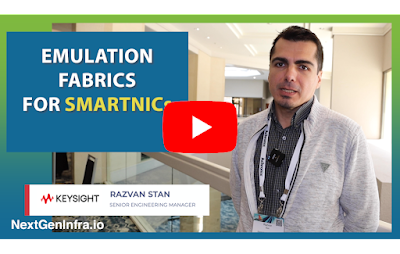
Video: Emulation fabrics for SmartNICs


https://youtu.be/feIX3PpgbbQ

Builders of advanced data center networks powered by SmartNICs will be interested in understanding traffic patterns and measuring performance of their systems. 

Rezvan Stan, Senior Engineering Manager, Keysight, talks about the emulation of complex data center topologies.

Get up to speed on SmartNICs by downloading our complimentary 2022 SmartNICs and Infrastructure Acceleration Report https://ngi.how/ia-2022

ITRI cites advancements in magnetic memory technology

Taiwan's government-backed Industrial Technology Research Institute (ITRI), in collaboration with TSMC and academic partners, announced the development of Spin Orbit Torque Magnetoresistive Random Access Memory (SOT-MRAM) array chips.

Dr. Shih-Chieh Chang, General Director of ITRI's Electronic and Optoelectronic System Research Laboratories, pointed out that the use of lower voltage and current in the memory can lead to higher efficiency. Therefore, ITRI and TSMC developed SOT-MRAM technology that incorporates high write efficiency and low write voltage, achieving a writing speed of 0.4 nanoseconds and a high endurance of 7 trillion reads and writes. The memory also offers a data storage lifespan of over 10 years. In the future, it can potentially be integrated into the advanced processes of embedded memory, which has outstanding prospects in applications such as AI, automotive electronics, and high-performance computing chips.

ITRI has also collaborated with National Yang Ming Chiao Tung University (NYCU) to develop magnetic memory technology that can perform across a wide operating temperature range of nearly 400°C. Both developments are pivotal for industries to move towards next-generation memory technology.

In the ITRI-NYCU collaboration, both parties have worked to develop high-efficiency operating technology for MRAM and jointly presented the R&D results at this year's IEEE Symposium on VLSI Technology and Circuits, one of the leading events in the global semiconductor industry. The newly developed Spin-Transfer-Torque MRAM (STT-MRAM) adopts ultrathin composite films and magnesium spacers to boost writing speed, reduce latency, minimize writing current, and improve endurance. The multi-functional magnetic memory has optimal data access performance and stability across a wide operating temperature range between 127°C and -269°C. This is the first of its kind to pass verification tests and will offer enormous potential for applications such as quantum computers and aerospace.

https://www.itri.org.tw/english/ListStyle.aspx?DisplayStyle=01_content&SiteID=1&MmmID=617731531241750114&MGID=111062708280270049


Telefónica and NTT DATA demo private 5G for logistics management

Telefónica and NTT DATA are executing a private 5G proof of concept (PoC) with CIE Automotive, a global automotive supplier. 

At its facilities in Itziar (Guipúzcoa), a 5G intralogistics management platform has been developed and is being implemented as an integrating and enabling solution for the automation of the transport of finished products from the end of the production line to the warehouse.

The objective of the solution is to increase the flexibility, efficiency and traceability of internal logistics processes through the intelligent management of multiple sensors and mobile devices, such as AGVs (automated guided vehicles) and AMRs (autonomous mobile robots).

Jon Ezkerra, R&D project coordinator of the CIE Automotive group, highlights that “The proof of concept being developed in collaboration with Telefónica and NTT Data will be validated in one of the automated welding cells for the manufacture of fuel rails at the CIE Norma plant located in Itziar (Gipuzkoa) and will connect through the use of 5G technology with the plant’s management system to perform intra-logistics movement via AGVs, will allow connection through the use of 5G technology, with the plant’s management system to carry out intra-logistical movement by means of AGVs, establishing the continuous flow of supply and collection of finished product packaging for stacking at height in the warehouse.”

Andrés Escribano, director of New Business and Industry 4.0 at Telefónica Tech, said: “This initiative will allow us to bring logistics automation solutions to many of our customers in a simple and flexible way. The application of 5G connectivity will help to solve the challenges faced in this field of Industry 4.0.”

https://www.telefonica.com/en/communication-room/telefonica-and-ntt-data-integrate-5g-in-cie-automotives-internal-logistics/