Wednesday, January 27, 2021

Deutsche Telekom tests Samsung 5G SA in Czech Republic

Deutsche Telekom completed a trial of Samsung's 5G Standalone (SA) solution in the Czech Republic.

The trial, which was held in the city of Pilsen, 5G SA Multi-User, Multiple-Input, Multiple-Output (MU-MIMO) technologies using Samsung’s 3.5GHz Massive MIMO radio. The spectrum efficiency was tripled in comparison to that of LTE under realistic conditions and the throughput was increased by about 2.5 times of SU-MIMO (Single-User MIMO).


“We are pleased to collaborate with Samsung to verify the performance of its 5G SA solution,” said Alex Choi, SVP Strategy & Technology Innovation, Deutsche Telekom. “Together with strong partners we are consistently introducing advanced technical capabilities into our network, and we are very excited about the potential of 5G SA networks to further accelerate the 5G evolution.”

“Samsung is glad to successfully conduct the first Massive MIMO call on an end-to-end 5G architecture within the DT Group in Europe. This is an important milestone in both companies’ efforts to bring 5G to the next phase,” said WooJune Kim, Executive Vice President, Head of Global Sales & Marketing, Networks Business at Samsung Electronics. “Leveraging Samsung’s technical capabilities, DT will provide the ability of 5G to deliver unprecedented values to users.

Intel re-hires Sunil Shenoy to lead Design Engineering Group

Intel announced the appointment of Sunil Shenoy as senior vice president and general manager of the Design Engineering Group.

Shenoy, a 33-year Intel veteran who departed in 2014, will lead design, development, validation and manufacturing of intellectual properties and system-on-chips (SOC) for client and data center applications. 

Most recently, Shenoy was senior vice president and general manager of RISC-V at SiFive, an Intel Capital portfolio company working to commercialize the RISC-V open architecture. At SiFive, Shenoy helped build the engineering team. In his prior years at Intel, Shenoy was corporate vice president in charge of Intel’s Platform Engineering Group, responsible for microprocessor and SoC design across Intel’s product groups. He also led Intel’s Visual and Parallel Computing Group and server and PC silicon development R&D and engineering, among other responsibilities.


Tuesday, January 26, 2021

Ericsson's 5G RAN slicing allocates resources with 1ms scheduling

 Ericsson announced commercial availability of its 5G network slicing solution for radio access networks.

The Ericsson 5G RAN Slicing allocates radio resources at 1 millisecond scheduling and supports multi-dimensional service differentiation handling across slices, ensuring high-quality end-user experience for diverse use cases. This allows for the effective use of dynamic radio resource partitioning, slice-aware quality of service (QoS) enforcement, and slice orchestration functionality for service-level agreement (SLA) fulfilment. 


Per Narvinger, Head of Product Area Networks, Ericsson says: “Ericsson 5G RAN Slicing dynamically optimizes radio resources to deliver significantly more spectrum-efficient radio access network slicing. What makes our solution distinct is that it boosts end-to-end management and orchestration support for fast and efficient service delivery. This gives service providers the differentiation and guaranteed performance needed to monetize 5G investments with diverse use cases. With 5G as innovation platform, we continue to drive value for our customers.”

Ericsson said it now has ongoing 5G network slicing engagements for RAN, transport, core network and orchestration across the globe involving use cases for the consumer segment and enterprises/industry verticals such as video-assisted remote operations, AR/VR, TV/Media for sports event streaming, cloud gaming, smart city, and applications for Industry 4.0 and public safety. 

An Ericsson report estimates USD 712 billion in an addressable consumer market for service providers by 2030. The addressable market for network slicing alone in the enterprise segment is projected at USD 300 billion by 2025 (GSMA data). As 5G scales up, service providers are looking to maximize returns on their investments by targeting innovative and high revenue-generating use cases such as cloud gaming, smart factories, and smart healthcare.

https://www.ericsson.com/4addb2/assets/local/networks/documents/ericsson-5g-ran-slicing.pdf

RTI and OneQode offer Layer 2 connectivity from Queensland

 RTI Connectivity Pte. Ltd. (RTI) and the OneQode Group (OneQode)  are now offering international layer-2 carrier connectivity from the Sunshine Coast, Queensland via RTI's JGA-S, JGA-N and SEA-US cables, which use a high-capacity fibre branch terminating in Maroochydore, Queensland.

“The Sunshine Coast and wider Queensland area is home to many companies doing amazing things. RTI is passionate about unlocking latent potential in regions we connect our cables to, and we believe there’s an incredible amount of potential here. Connecting Queensland to the world will remove the region’s dependency on other capital cities and allow people to do business like never before.”


https://www.oneqode.com/media/oneqode-fastest-path-to-asia/

Department of Homeland Security opens $3.4B data center contract

The U.S. Dept. of Homeland Security has opened a Request for Proposal for a single award contract value at $3.355 billion for Data Center and Cloud Optimization (DCCO) Support Services.

The contractor is to provide the Department of Homeland Security and its Components with management of its enterprise data center and to implement and manage its future state enterprise information technology (IT) hosting environment.

The main source of enterprise computing resource for DHS has been Data Center 1 (DC1), a Government Owned Contractor Operated data center located at the NASA Stennis Space Center in Mississippi. NASA owns and manages the data center facility and DHS leases approximately 36,000 square feet of raised floor space in the data center. 

https://beta.sam.gov/opp/17d9f5185e3b42ad89a5d559e578e974/view

Verizon reports flat trends, continue buildout of 5G Ultra Wideband

Verizon reported total 4Q 2020 revenue of $23.9 billion, a decrease of 1.2 percent year over year. Earnings per share (EPS) amounted to $1.11, compared with $1.23 in 4Q 2019. Net income was $4.7 billion, a decline of 9.6 percent from fourth-quarter 2019, and adjusted EBITDA (non-GAAP) of  $11.7 billion, an increase of 5.3 percent from fourth-quarter 2019.

"Verizon finished the fourth quarter with strong financial performance," said Verizon Chairman and CEO Hans Vestberg. "2020 was marked by transformational change, including the launch of our 5G nationwide network. We witnessed a mass shift toward virtual collaboration, touchless retail and delivery, remote work, distance learning, and telemedicine. We continued to execute our multi-use network strategy; we were recognized by RootMetrics as the best overall wireless provider, undefeated in all categories; and we continue to be the partner of choice for the world’s most innovative brands. 

Some highlights

  • Full-year 2020 capital expenditures were $18.2 billion. Capital expenditures continue to support the growth in traffic on the company's 4G LTE network and the continued build-out of the company's 5G Ultra Wideband and nationwide networks. 
  • For 2021, capital spending is expected to be in the range of $17.5 billion to $18.5 billion, including the further expansion of 5G Ultra Wideband in new and existing markets, the densification of the wireless network to manage future traffic demands, and the continued deployment of the company's fiber infrastructure. 

Consumer

  • Total Verizon Consumer revenues were $23.9 billion, a decrease of 1.2 percent year over year, primarily driven by a decline in wireless equipment revenue due to softer volumes in the quarter. For full-year 2020, total Consumer revenues were $88.5 billion, a decrease of 2.8 percent from full-year 2019, driven by a decline in wireless equipment revenue.
  • In fourth-quarter 2020, Consumer reported 357,000 wireless retail postpaid net additions.This consisted of 163,000 phone net additions and 81,000 tablet net losses, offset by 275,000 other connected device net additions. Postpaid smartphone net additions were 284,000.
  • Consumer wireless service revenues were $13.6 billion in fourth-quarter 2020, a 1.2 percent increase year over year. Full-year 2020 Consumer wireless service revenues were $53.6 billion, a 0.3 percent decrease from full-year 2019.
  • Total retail postpaid churn was 0.96 percent in fourth-quarter 2020, and retail postpaid phone churn was 0.76 percent. 
  • Consumer reported 92,000 Fios Internet net additions in fourth-quarter 2020, an increase from 35,000 Fios Internet net additions in fourth-quarter 2019. Consumer and Business reported 95,000 total Fios Internet net additions in fourth-quarter 2020, the most fourth-quarter total Fios Internet net additions since 2014. Consumer reported 72,000 Fios Video net losses in fourth-quarter 2020, reflecting the ongoing shift from traditional linear video to over-the-top offerings. 

Business results

  • Total Verizon Business revenues were $8.1 billion, down 0.3 percent year over year. Wireless service revenue growth was offset by reductions in wireless equipment volumes and secular pressure on legacy wireline products. For full-year 2020, total Verizon Business revenues were $31.0 billion, a decrease of 1.5 percent from full-year 2019. 
  • Business reported 346,000 wireless retail postpaid net additions in fourth-quarter 2020. This consisted of 116,000 phone net additions, 116,000 tablet net additions, and 114,000 other connected device additions.
  • Business wireless service revenues were $3.1 billion in fourth-quarter 2020, a 7.1 percent increase year over year. Full-year 2020 Business wireless service revenues were $11.8 billion, a 5.5 percent increase from full-year 2019.
  • Total retail postpaid churn was 1.19 percent in fourth-quarter 2020, and retail postpaid phone churn was 0.98 percent.  


FCC moves to 5G auction assignment, Rosenworcel appoints staff

The FCC released final guidance on the upcoming assignment phase of the 5G auction of C-band spectrum which has already generated gross proceeds exceeding $80.9 billion.  Bidders that won generic spectrum blocks in the recently concluded clock phase will have the opportunity to bid for their preferred combinations of frequency-specific license assignments, consistent with their clock phase winnings.

Acting FCC Chairwoman Jessica Rosenworcel stated “This auction has exceeded expectations, and, at this point, we are pushing forward to get this critical piece of mid-band spectrum to market quickly, where it will help American consumers tap into next generation wireless services,” said Rosenworcel.  “I thank the FCC staff who work so hard to ensure the success of our spectrum auctions.  Few things we do have as great an impact on the day-to-day lives of the American people as our work to ensure spectrum is available for wireless connectivity.”

Rosenworcel also announced the following appointments:

  • P. Michele Ellison, Acting General Counsel
  • Joel Taubenblatt, Acting Chief of the Wireless Telecommunications Bureau  
  • Travis Litman, Acting Chief of Staff
  • Kate Black, Acting Chief Policy Advisor
  • Umair Javed, Acting Chief Counsel
  • D’wana Terry, Acting Special Advisor to the Chairwoman and Acting Director of the Office of Workplace Diversity
  • Sanford Williams, Acting Special Advisor to the Chairwoman and Director, Office of Business Communications Opportunities
  • Trent Harkrader, Acting Special Advisor to the Chairwoman and Deputy Bureau Chief, Wireline Competition Bureau
  • Holly Saurer, Acting Legal Advisor, Media:  Holly joins the office from the Media Bureau
  • David Strickland, Acting Legal Advisor, Consumer, Enforcement, and International
  • Ethan Lucarelli, Acting Legal Advisor, Wireless and Public Safety
  • Aurelle Porter, Acting Staff Assistant
  • Andi Roane, Acting Confidential Assistant
http://www.fcc.gov

Verizon suffers fiber cut in Brooklyn

 Following widespread outages on the East Coast, Verizon confirmed a fiber cut in Brooklyn.


Microsoft Azure clocks revenue growth of 50% YOY

Microsoft reported strong financial performance for the quarter ended 31-December-2020, with overall revenue of $43.1 billion, up 17%; operating income of $17.9 billion, up 29% YOY; net income of $15.5 billion, up 33% YOY; and diluted earnings per share of $2.03, up 34% YOY.

Highlights


Revenue in Productivity and Business Processes was $13.4 billion and increased 13% (up 11% in constant currency), with the following business highlights:

  • Office Commercial products and cloud services revenue increased 11% (up 9% in constant currency) driven by Office 365 Commercial revenue growth of 21% (up 20% in constant currency)
  • Office Consumer products and cloud services revenue increased 7% (up 6% in constant currency) and Microsoft 365 Consumer subscribers increased to 47.5 million
  • LinkedIn revenue increased 23% (up 22% in constant currency)
  • Dynamics products and cloud services revenue increased 21% (up 18% in constant currency) driven by Dynamics 365 revenue growth of 39% (up 37% in constant currency)

Revenue in Intelligent Cloud was $14.6 billion and increased 23% (up 22% in constant currency), with the following business highlights:

  • Server products and cloud services revenue increased 26% (up 24% in constant currency) driven by Azure revenue growth of 50% (up 48% in constant currency)

Revenue in More Personal Computing was $15.1 billion and increased 14% (up 13% in constant currency), with the following business highlights:

  • Windows OEM revenue increased 1%
  • Windows Commercial products and cloud services revenue increased 10% (up 8% in constant currency)
  • Xbox content and services revenue increased 40% (up 38% in constant currency)
  • Surface revenue increased 3% (up 1% in constant currency)
  • Search advertising revenue excluding traffic acquisition costs increased 2% (up 1% in constant currency)


ExteNet integrates with Evoque's U.S. data centers

ExteNet Systems, a provider of mobility and fiber connectivity solutions, will integrate its line of cloud and network connectivity services into Evoque’s infrastructure at 14 key data centers throughout the United States.

Evoque Data Center Solutions, headquartered in Dallas, Texas, is one of the world’s 20 largest data center firms. It is a colocation services company that owns and operates 31 data centers across four continents, 11 countries and 25 markets.

Working with ExteNet, the Evoque Connectivity Suite now delivers point-to-point connections over an extensive footprint throughout North America. 

https://www.evoquedcs.com/

Telefónica's Cloud Garden integrates IBM Cloud Pak, Red Hat

Telefonica introduced its Cloud Garden 2.0, the next phase of Telefonica’s cloud services platform designed to accelerate application modernization. 

Cloud Garden 2.0 is built on IBM Cloud Pak and Red Hat OpenShift. The platform lets Telefónica clients to run their applications based on  containers on premises or in the cloud environment of their choosing, as well as simplify and speed how they bring new solutions to market.

"We are very pleased to have been able to count on the right partners to accelerate our hybrid cloud strategy and offer our clients the speed, flexibility and decision-making power they need to modernize and quickly launch innovative digital services to their users and customers," said Andrés López Hedoire, de Enterprise Product Marketing Director, Telefónica España.

Cloud Garden 2.0 is hosted via Telefonica’s Virtual Data Center in Spain.

https://www.telefonica.com/en/web/press-office/-/telefonica-ibm-and-red-hat-join-forces-to-accelerate-digital-transformation-with-open-hybrid-cloud

Monday, January 25, 2021

ONF releases SD-RAN v1.0 for Open RAN

The ONF released SD-RAN v1.0, the first software release for its cloud-native exemplar platform for software-defined RAN that is consistent with the O-RAN architecture.  

The ONF’s first release of the SD-RAN project implements a minimal O-RAN consistent end-to-end mobile RAN stack intended as a development environment for building xApps for the emerging Open RAN ecosystem. It includes µONOS-RIC (ONF’s nRT-RIC based on µONOS) which interacts with RAN hardware (RU/DU/CU) via O-RAN consistent interfaces (E2AP), encodings (ASN.1), transport-protocols (SCTP) and Service Models (SMs). The release also includes a white-box based RU/DU/CU solution, leveraging OAI software, that has been enhanced to expose O-RAN consistent interfaces and protocols. To integrate with µONOS-RIC, the CU-CP RAN component has been enhanced with an E2 Agent that exposes the KPM-SM information-elements to xApps that connect to the nRT-RIC and subscribe to the KPM service. image png

Secondly, an end-to-end solution is provided. The RAN components interact with Samsung Android handsets as well as OAI User Element (UE) emulation software. For mobile core (EPC) integration, the RAN components interact with ONF’s OMEC mobile core. 

This release also includes the beginnings of an app-SDK which can ease the process of creating xApps that are portable across different nRT-RIC platforms.  As part of ONF’s commitment to supporting the O-RAN Alliance, this SDK is being shared with the O-RAN Software Community to support and promote availability of interoperable xApps and rApps that can work with a selection of nRT-RIC implementations. 

Finally, the solution can be instantiated in two distinct forms to create nimble development environments.  SD-RAN can run on reference white-box hardware, and it can also be instantiated entirely in a virtualized form (in a VM or server) in a distribution package called RiaB (sdRan-in-a-Box). The entire distribution including xApp, µONOS-RIC components, CU/DU, UE and OMEC can be instantiated within RiaB with just a few simple commands.

https://opennetworking.org/news-and-events/press-releases/onf-announces-first-release-of-sd-ran-v1-0-software-platform-for-open-ran/

ONF launches 5G SD-RAN Project

The Open Networking Foundation (ONF) has launched an SD-RAN project with the aim of building an open source Near Real-Time RAN Intelligent Controller (nRT-RIC) compatible with the O-RAN architecture as well ONF’s existing base cloud-native solutions leveraging disaggregation and whitebox hardware.

ONF said its goal is to foster open source software platforms and multi-vendor solutions for mobile 4G and 5G RAN deployments.

Central to the project is the development of an open source near-real time RIC called µONOS-RIC (pronounced “micro-ONOS-RIC”).

µONOS is a microservices-based SDN controller created by the refactoring and enhancement of ONOS, the leading SDN controller for operators in production tier-1 networks worldwide.  µONOS-RIC is built on µONOS, and hence features a cloud-native design supporting active-active clustering for scalability, performance and high availability along with the real-time capabilities needed for intelligent RAN control. The O-RAN ALLIANCE E2 interface is used to interface between µONOS-RIC and vendor supplied RAN RU/DU/CU RAN components.

Carriers would be able to run new "xApps" on top of the µONOS-RIC.  These open xApps could provide functionality that traditionally has been implemented in vendor-proprietary implementations, including providing visibility and control over the RAN.

Significantly, the ONF's SD-RAN project is backed by AT&T, China Mobile, China Unicom, Deutsche Telekom, Facebook, Google, Intel, NTT, Radisys and Sercomm.

A working skeleton prototype of the µONOS-RIC controller is already running above a RAN emulation platform through the E2 interface.  ONF has demonstrated handover and load balancing at scale, supporting over 100 base stations and 100,000 user devices with less than 50ms handover latency (less than 10ms latency for 99% of all handovers). Field trials are expected by early 2021.

South Korea's LG U+ deploys 600G on a single wavelength with Ciena


LG U+ has deployed a newly constructed and dedicated nationwide ROADM backbone network leveraging Ciena’s WaveLogic 5 Extreme and WaveLogic Ai coherent optical solutions and becoming the first carrier in Korea to deploy 600G on a single wavelength for long haul distances.

LG U+ is applying OTDR (Optical Time Domain Reflectometer) technology to all sections of the backbone network for real-time line condition monitoring. In addition, Ciena’s 6500 ROADM equipment will provide disaster recovery line services to public government, financial institutions and compute centers of large enterprises through third party interworking certification. LG U+ can also provide a dedicated line service with enhanced security through optical transport encryption.

LGU+ will be using Ciena’s Manage, Control and Plan (MCP) SDN controller to be able to automate service delivery via next-generation OPEN APIs to improve customer experience and increase operational efficiencies.

Sung-cheol Koo who’s in charge of LG U+’s wired business said, “Amid the expansion of cloud services such as telecommuting, video conferencing and remote classes, we are building a new backbone network that can accommodate the needs of various corporate customers. With a flexible and stable transmission network, we expect that companies can provide a higher level of service."


NEC delivers submarine cable seismic and tsunami observation system

NEC has delivered a submarine cable seismic and tsunami observation system to Taiwan's Central Weather Bureau (CWB) under the Ministry of Transportation and Communications. The new system is mainly intended for observation of earthquakes and tsunami in the area ranging from the offshore coast of Yilan in eastern Taiwan to Fangshan in Pingtung County. 

The submarine cable measures 620 kilometers and reaches a depth of 5,800 meters. All products, including optical submarine cables, submarine observation units, and optical submarine repeaters, which constitute the system, were manufactured and assembled at NEC factories in Japan.

According to the CWB, when an earthquake occurs in the eastern sea area of Taiwan this new system can provide an emergency warning more than 10 seconds before the actual tremor is felt on land. Moreover, a warning can be issued 20 to 30 minutes before a tsunami reaches the coastal area. As a result, this system will contribute to the enhancement of disaster prevention and mitigation capabilities. For example, public transportation systems, including MRTs (Mass Rapid Transit) and HSRs (High Speed Rail) can quickly decelerate in the event of an earthquake.

Atsushi Kuwahara, General Manager, Submarine Network Division, NEC Corporation, said, "It is a great honor that the NEC Group can use its many years of experience in optical submarine cable communication technology and submarine observation technology to help prevent disasters and ensure safety for the residents and government of Taiwan. Going forward, we will continue to provide technology and solutions that contribute to the well-being of our communities."

https://www.nec.com/en/press/202101/global_20210126_01.html

NASA's Psyche spacecraft to test Deep Space laser communications

 NASA's upcoming Psyche mission, which will explore the origin of planetary cores by studying the metallic asteroid 16 Psyche, will use a Deep Space Optical Communications (DSOC) package that is designed to transmit data in photon packets from the asteroid belt back to earth, a distance of nearly 200 million miles. The Psyche mission is scheduled to launch in August 2022.

The laser communications will be able to transmit data over long distances at rates up to 100 times faster than traditional radio frequency systems. 

In November 2020, CACI delivered an engineering model of the laser communication transmitter to JPL, having passed space qualification testing. To pass space qualification testing, CACI engineers demonstrated the transmitter could withstand both space launch and flight.

CACI said is currently designing laser communications systems for five space hardware programs, including NASA’s Orion EM-2 Optical Communications (O2O) project, which will enable broadband data communications to and from the Orion Multi-Purpose Crew Vehicle designed to take humans into lunar orbit, and the NASA Integrated LCRD Low-Earth Orbit User Modem and Amplifier Terminal (ILLUMA-T) program, which will deploy laser communications technology on the International Space Station.

John Mengucci, CACI President and Chief Executive Officer, said, “The successful operation by NASA of a CACI-developed laser communications transmitter demonstrates the advanced mission technology this company designs for our country. CACI is excited to support this NASA deep space mission with fast and reliable communications, and is ready to deliver advanced laser-based technologies to other space, aerial and terrestrial missions to come.”

www.caci.com

NTT Research and Caltech to develop coherent ising machine


NTT Research has signed a collaboration agreement with Caltech to develop a high-speed Coherent Ising Machine (CIM). 

A CIM is a network of optical parametric oscillators (OPOs) programmed to solve problems that have been mapped to an Ising model, which is a mathematical abstraction of magnetic systems composed of competitively interacting spins, or angular momentums of fundamental particles. The CIM is particularly suited to combinatorial optimization problems that are beyond the capabilities of current computer processors to solve. NTT Research and Caltech will jointly develop a high-speed, miniature CIM, consisting of an on-chip 100 GHz pulsed pump laser source and on-chip parametric oscillator device.

The principal investigator at Caltech for this four-and-a-half-year joint project is Kerry Vahala, the Jenkins Professor of Information Science and Technology and Applied Physics and Executive Officer for the department of Applied Physics and Materials Science. Professor Vahala has pioneered the use of nonlinear optics in high-Q optical micro-resonators. Leading this effort at NTT Research is PHI Lab Research Scientist, Dr. Myoung-Gyun Suh, an expert in on-chip optical sources and their application to precision measurements.

“We are delighted at the prospect of working with Professor Vahala to develop an extremely small and high-speed CIM,” said NTT Research PHI Lab Director, Yoshihisa Yamamoto. “This work will advance our understanding of the CIM’s capabilities, map well with ongoing and related work with other institutions, provide new demonstrations of this awesomely powerful new information system and, we hope, set standards for the CIM’s speed and size.”

To date, the NTT Research PHI Lab has established ten joint research projects as part of its long-range goal to radically redesign artificial computers, both classical and quantum. To advance that goal, the PHI Lab has established joint research agreements with seven universities, one government agency and quantum computing software company. This is the second joint research agreement with Caltech. The other institutions of higher education are Cornell University, Massachusetts Institute of Technology (MIT), Stanford University, Swinburne University of Technology, the University of Michigan and the University of Notre Dame. 

NTT Tackles Artificial Spin for Photonic Computation

Researchers at NTT and and Osaka University announced an important step toward photonic computation by developing a large-scale artificial spin network based on photonics technologies. The development targets a fundamental component for the coherent Ising machine (CIM), which utilizes interacting artificial spins realized with optical parametric oscillators (OPO) for computation of combinatorial optimization problems.

The researchers generated more than 10,000 time-multiplexed OPOs using an optical fiber cavity as long as 1 km.

The OPOs can be used as artificial spins for a large-scale CIM to solve combinatorial optimization problems in the real world. The research was published in the UK science journal “Nature Photonics” on April 18, 2006.

http://www.ntt.co.jp/news2016/1604e/160418a.html

Oranges brings in investors to back rural fiber rollout

Orange will establish a new ownership structure and funding vehicle supporting its rollout of fiber connection in rural France.

Orange has entered into an exclusivity agreement with La Banque des Territoires (Caisse des Dépôts), CNP Assurances, and EDF Invest for the sale of a 50% equity interest and co-control of Orange Concessions, which will be France’s leading fibre-to-the-home (FTTH) operator of networks rolled out and operated on behalf of 23, local public authorities representing over 4.5 million built or to-be-built plugs.

This transaction values Orange Concessions at 2.675 billion euros, which highlights the value and the relevance of Orange’s investments in fibre.


The networks operated by Orange Concessions on behalf of local public authorities are open to all operators. Fibre roll-out and maintenance will continue to be performed by Orange who holds an efficient and proven industrial tool. On a local level, the teams working in partnership with local authorities with maintain the same level of mobilisation and commitment.

Commenting on this partnership, Stéphane Richard, Chairman & CEO of Orange stated: “I am delighted that Orange, Europe’s leader in fibre roll-out, is now set to establish this partnership in its domestic market with recognized investors who share our vision of digital communication infrastructure development.

Through this partnership, Orange holds the means to pursue the development of fibre in rural areas, by winning new public initiative networks or by participating in market consolidation. This is a key milestone in the delivery of our Engage 2025 strategic plan.

As to its financial merits, the achieved valuation reveals the value of Orange’s investments in fibre as well as the relevance of such strategic move.”

MACOM inks GaN-on-SiC pact with U.S. Air Force Research Lab


MACOM signed a Cooperative Research and Development Agreement with the United States Air Force Research Laboratory (“AFRL”) regarding Gallium Nitride-on-Silicon Carbide (GaN-on-SiC) technology. Specifically, AFRL and MACOM will work together to transfer AFRL’s production ready 0.14 micron GaN-on-SiC semiconductor process to MACOM’s Massachusetts-based U.S. Trusted Foundry. Semiconductor experts from both parties will collaborate to support a rapid process transfer to MACOM.

MACOM said the AFRL GaN-on-SiC process is suitable for monolithic microwave integrated circuit (“MMIC”) products and is capable of achieving industry leading frequency and power density performance. Once the process is transferred, MACOM anticipates that it will expand its standard and custom MMIC product offerings.

“This semiconductor process will enable us to enter the microwave and millimeter wave GaN MMIC market with high-performance products,” said Stephen G. Daly, MACOM’s President and Chief Executive Officer. “Our wafer fabrication facility is already well equipped to support GaN, including installed electron beam lithography capability, so we can bring the process online with minimal capital investment. We intend to service a wide range of commercial and U.S. defense opportunities, including satellite communication systems, as well as land-, air- and sea-based radar systems.”

“We look forward to MACOM supporting critical U.S. Air Force and Department of Defense requirements with an industrialized and best in class GaN semiconductor process,” said Dr. Robert Fitch of AFRL Sensors Directorate. “Expanding domestic advanced semiconductor manufacturing is a national priority.”

F5 completes acquisition of Volterra

 F5 Networks completed its previously announced acquisition of Volterra, which offers a universal edge-as-a-service platform. 

“I am incredibly excited to welcome Volterra to the F5 family and get to work bringing Edge 2.0—a key part of our Adaptive Applications vision—to customers,” said François Locoh-Donou, F5 President and CEO. “Joining forces, we will deliver the enterprise-grade features, including world-class security and scale, that have been missing from the edge until now.”

“Current edge approaches were not designed with enterprises in mind,” said Ankur Singla, founder of Volterra. “When Harshad and I started Volterra, we knew the edge would need to be delivered with the scale of public clouds, but with management and security integrated with the data centers where so many enterprise apps still live. Given F5’s leadership in Adaptive Applications and their vast enterprise customer base, I could not imagine a better partner to empower customers’ business transformation through modern apps.”

F5 to acquire Volterra for its open edge platform

 F5 Networks agreed to acquire Volterra, a start-up developing a universal edge-as-a-service platform, for approximately $440 million in cash and approximately $60 million in deferred consideration and assumed unvested incentive compensation to founders and employees. 

F5 said the addition of Volterra will give it an edge platform built for enterprises and service providers that will be security-first and app-driven with unlimited scale.

Volterra, which is based in Santa Clara, California, offers a distributed cloud service for deploying and managing applications at the edge. The cloud-native environment can be deployed across multiple public clouds and edge sites.


  • Volterra is headed by Ankur Singla, Founder & CEO, who previously was the founder and CEO of Contrail Systems, a pioneer in telco NFV and SDN technologies that was acquired by Juniper Networks in 2012. Prior to Contrail, Ankur was the CTO and VP Engineering at Aruba Networks, a global leader in wireless solutions. 

Volterra unveils distributed cloud platform for apps

Volterra​, a start-up based in Santa Clara, California, emerged from stealth to unveil its distributed cloud platform for deploying and managing applications. The SaaS-based offering integrates a broad range of services that have normally been siloed across many point products and network or cloud providers.

Volterra has raised over $50 million in funding to date from Khosla Ventures, Mayfield and M12 (Microsoft’s venture fund), as well as a growing set of strategic investors/partners including Itochu Technology Ventures and Samsung NEXT. Volterra said it now has 100+ engineers and 30+ global customers.

The cloud-native environment can be deployed across multiple public clouds and edge sites. Key capabilities include:

  • Fleet-wide management of distributed applications and data across heterogeneous infrastructure
  • Globally distributed control plane with Kubernetes APIs for application orchestration and multi-layer security for workloads and data
  • Comprehensive compute, storage, networking and security for distributed edge locations
  • Secure, high-performance global connectivity across edge sites, private clouds and multi-cloud
Key elements of the offering are:
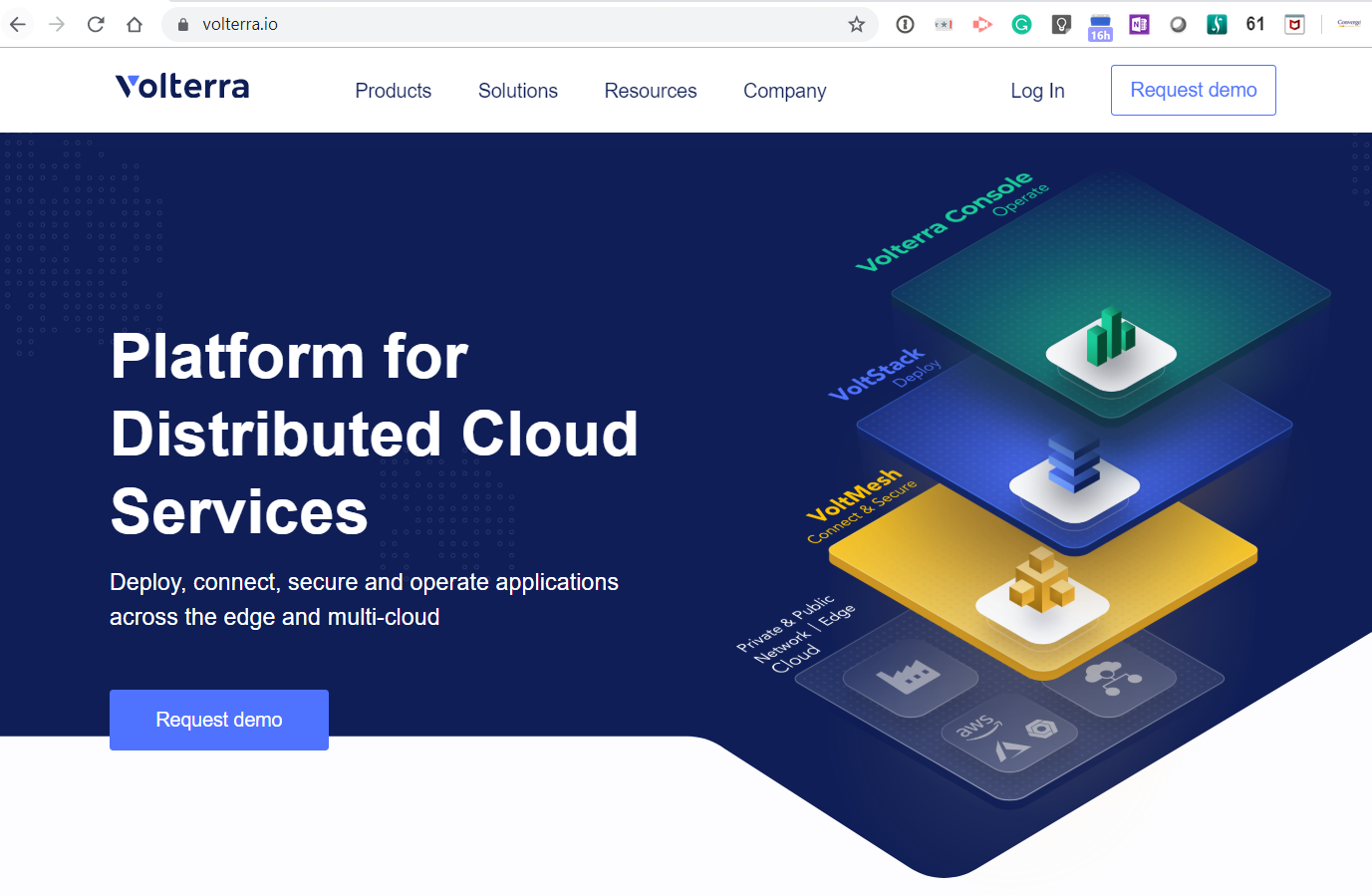
  • VoltStack deploys and manages distributed applications across multiple clouds or edge sites using industry standard Kubernetes APIs
  • VoltMesh delivers high performance networking and zero-trust security between multiple clouds and edge sites
  • Volterra Console​ is a management console for deploying and operating distributed applications at a global scale with centralized control and observability
http://www.volterra.io​

Sunday, January 24, 2021

NEC triples number of connections in distributed-MIMO

NEC demonstrated multiple highly stable simultaneous terminal connections and transmission capacity through distributed-MIMO in the 28 GHz millimeter-wave frequency band. 

The company says its demonstration, which was conducted in a real world office environment, achieved approximately 3 times the number of simultaneous connections and transmission

capacity compared to cases without distributed-MIMO in the 28 GHzfrequency band. Moreover, transmission deterioration from obstacles was also reduced.

Earlier this year, Japan began to commercially deploy 5G in the sub 6 frequency band and millimeter-wave frequency band, with the expectation of enhancing network performance to support 10 times more capacity than 4G, as well as higher throughput, lower latency, and multiple connections.

NEC has been a pioneer in digital beamforming technology and has commercialized Massive-MIMO in the sub 6 frequency band. Moreover, NEC has developed digital coordination technology among antenna elements distributed in the millimeter-wave frequency band and conducted verification activities to solve the problems of indoor mobile communications, such as shadowing and diffraction of propagation paths.

https://www.nec.com/en/press/202101/global_20210125_01.html