Monday, December 16, 2019

SpaceX launches JCSAT-18 and Kacific1 satellites

SpaceX successfully completed its JCSAT-18/Kacific1 satellite launch mission from Cape Canaveral.

The JCSAT-18/Kacific1 payload was equipped with two unique payloads.

The JCSAT-18 satellite was built by Boeing for SKY Perfect JSAT, one of the largest providers of multichannel pay TV broadcast services in Japan, which operates the largest satellite communications business in Asia. The JCSAT-18 satellite will provide Ku-band coverage and improve mobile and broadband services for SKY Perfect JSAT Corporation customers in the Asia-Pacific region,  including the far eastern part of Russia. Boeing has built 13 satellites, including two high-throughput satellites, for SKY Perfect JSAT Corporation and its predecessors since the 1980s.

Kacific1 is a next-generation geostationary satellite operating in the Ka-band frequency spectrum. Its 56 high-throughput spot beams will place capacity over selected regions in South East Asia and the Pacific Islands. Deployed to a geostationary orbital position above Asia Pacific, Kacific1 will transmit to state-of-the-art gateways, designed and built by Kratos.

Falcon 9’s first stage was successfully recovered on the “Of Course I Still Love You” droneship stationed in the Atlantic Ocean.

Telenor sticks with Ericsson, Nokia and Huawei for 5G

Telenor completed its vendor selection process for the future network in Norway. Ericsson will modernize and build the Telenor’s 5G radio access network (RAN). The core network is being upgraded by Nokia and Ericsson, as previously announced. Huawei, which is an existing RAN vendor for Telenor, was selected to maintain the 4G network and also upgrade to 5G coverage in selected areas of Norway.

Telenor is currently deploying 5G in the city of Trondheim.

Currently, the Telenor Group is testing 5G in ten locations in Norway as well as selected areas in Denmark, Sweden, Finland, Thailand and Malaysia.

https://www.telenor.com/media/press-release/telenor-completes-5g-vendor-selection-for-norway

China Mobile tests 5G with Spirent

China Mobile is using Spirent’s radio frequency (RF) channel emulation technology to help compare the performance of new 5G chipsets and consumer smartphones from leading global manufacturers.

The new YuHeng system allows operators and device manufacturers to test their RF solutions in the lab with the latest 5G base stations (gNodeB) that employ sophisticated new radio technologies such as massive MIMO beamforming. Devices under test are positioned within an RF anechoic chamber and are driven by a commercial base station, allowing the system to evaluate the performance of the device’s antenna configuration, baseband algorithms, hardware and software design.

Spirent’s Vertex RF Channel Emulator is used to replicate real-world indoor and outdoor effects that can influence radio efficiency, such as multi-path loss, reflections, absorption, delay, doppler frequency shift and antenna polarization. Both downlink and uplink propagation channels are modeled by the system, and multiple types of device-in-motion simulations can be created to replicate real-world scenarios such as walking in an urban environment or traveling in a vehicle on a highway.

“We are delighted to have had the opportunity to collaborate with the China Mobile Group Device Company team on the YuHeng project,” said Peter Tan, Spirent’s VP for Greater China & East Asia. “This innovative solution is the first of its kind and enables China Mobile to thoroughly assess and benchmark the growing number of new 5G smartphones, devices and chipsets for performance in test environments that realistically replicate a wide variety of authentic radio and motion conditions.”

Sunday, December 15, 2019

MIST subsea cable to deliver 240 Tbps from Singapore to India

NTT announced "MIST", a submarine cable between Singapore, Myanmar and India (Mumbai and Chennai) that promises a record 240 Tbps capacity with support for 400 Gbps wavelengths.

MIST will be part of a strategic joint venture for international submarine cables in South East Asia, with Orient Link Pte. Ltd. The cable is expected to be ready for service by June 2022.

MIST will span 11,000 kilometers in length with 12 fiber pairs. Wavelength Selective Switching ROADMs will be used for flexible remote switching of transmission routes to branch units.

NTT Ltd. said it plans to connect the MIST cable landing stations directly to its data centers in Singapore, Myanmar and India using large-capacity fiber which will be owned, built and operated by NTT Ltd. In addition, NTT Ltd. will centrally maintain and operate all the landing stations, aiming to further improve the service quality.


NTT also notes that MIST will connect to other cables in which it holds an interest, including Asia Submarine cable Express (ASE), Asia Pacific Gateway (APG), Pacific Crossing -1(PC-1) and JUPITER cables (under construction).
“Businesses and individuals from all over the world are experiencing the accelerated growth of digital connectivity - and this is especially true within Asia. Globally, India and South East Asia are some of the world’s fastest-growing economies. As digital investment and demand for data capacity continues to increase, providing access to reliable connectivity will remain critical to accelerate economic and social growth. The implementation of MIST will ultimately allow us to work with our clients around the world to build a truly connected future,” states NTT Ltd. Chief Executive Officer, Jason Goodall.

https://hello.global.ntt/en-us/newsroom/ntt-ltd-to-commence-construction-of-the-optical-submarine-cable-mist


JUPITER transpacific cable to carry 400G wavelengths

JUPITER, a new large-capacity, low-latency subsea cable between Japan and the United States has received the backing of SoftBank, Facebook, Amazon, PLDT and PCCW Global.

The JUPITER cable system. which will have a total length of 14,000 km, will have two landing points in Japan — the Shima Landing Station in Mie Prefecture and the Maruyama Landing Station in Chiba Prefecture — as well as a U.S. landing station in Los Angeles, California, as well as a landing station at Daet in the Philippines.

JUPITER will feature a state-of-the-art submersible ROADM employing WSS (wavelength selective switch) for a gridless and flexible bandwidth configuration. The cable system will also be designed to support 400 Gbps wavelengths. The initial design capacity is 60 Tbps.

NTT Com said its Asia Submarine-cable Express (ASE), Asia Pacific Gateway (APG) and Pacific Crossing-1 (PC-1) cables will connect with JUPITER to provide a redundant three-route structure linking major cities in Asia, Japan and United States. NTT Com is also planning direct connections from the cable landing stations in Japan to data centers in Tokyo and Osaka.

JUPITER is expected to come online in early 2020.

NTT Com launches network services, builds 2 data centres in India


NTT Communications (NTT Com), the ICT solutions and international communications business within the NTT Group, announced the launch of international data network services in India through its affiliate NTT Communications India Network Services (NTTCINS).

NTT Com stated that the acquisition of its licence in India follows the launch of construction of two new Indian data centres in Mumbai and Bangalore, through subsidiary Netmagic, a provider of managed hosting and cloud services in India. As a result, NTTCINS will be able to offer infrastructure services and management and security services designed to meet companies ICT outsourcing needs.

NTT Com plans to invest $160 million in building the two data centres, which are scheduled to become operational by April 2018. The new data centres will add nearly 500,000 sq feet of gross floor space at full build out, increasing NTT Com's total gross footprint in India to 1,100,000 sq feet. The new data centres in Mumbai and Bangalore will accommodate 2,750 racks with 22 MW of power and 1,500 racks with 15 MW of power, respectively.

NTT Com noted that it became the first Japanese service provider to be awarded a Virtual Network Operator - International Long Distance (VNO-ILD) network licence for India in March. In addition, NTT Com provides Arcstar Universal One international network services in partnership with local carriers. The company also implements value-added services such as network virtualisation functions (NVF) utilising the infrastructure of its partner carriers in India.

Commenting on the launch, NTT Com president and CEO Tetsuya Shoji said, "India has been a key strategic market for NTT Com with the accelerating shift of IT services from traditional enterprise data centres into the cloud-based services… for the past few years the business in India has consistently grown over 35% annually… with the expansion of the data centre foot print and new international data network services NTT Com aims to meet the growing market needs for mobility, e-commerce, IoT, cloud and big data".


Google intros Storage Transfer Service for on-premise data

Google Cloud Platform introduced a managed Transfer Service for large-scale on-premises data.

The Transfer Service helps customers complete large-scale data transfers online, which scale to high-speed network connections—up to billions of files, multiple PB of data, and tens of Gbps. Customers do not need to custom software or off-the-shelf software for managing the large operation. Google's Transfer Service for on-premises data validates data integrity. It also includes performance optimizations from the application to the transport layer.

https://cloud.google.com/blog/products/storage-data-transfer/introducing-storage-transfer-service-for-on-premises-data

Google, Siemens and VMware back Automated Compliance Tooling

Google, Siemens and VMware have thrown their support behind The Linux Foundation's Automated Compliance Tooling (ACT), as well as key advancements for tools that increase ease and adoption of open source software.

ACT aims to ensure compliance with the terms of open source's licensing.

ACT is composed of five primary projects:

  • FOSSology: An open source license compliance software system and toolkit allowing users to run license, copyright and export control scans from a REST API. As a system, a database and web UI are provided to provide a compliance workflow. License, copyright and export scanners are tools available to help with compliance activities. FOSSology is an existing Linux Foundation project that will move under ACT.
  • OSS Review Toolkit (ORT) enables highly automated and customizable Open Source compliance checks the source code and dependencies of a project by scanning it, downloading its sources, reporting any errors and violations against user-defined rules, and by creating third-party attribution documentation. ORT is designed for the CI/CD world and supports a wide variety of package managers including Gradle, Go modules, Maven, npm and SBT. The project is being contributed to ACT by HERE Technologies.
  • Quartermaster (QMSTR), originally contributed by Encode, integrates into the build systems to learn about the software products, their sources and dependencies. Developers can run QMSTR locally to verify outcomes, review problems and produce compliance reports. By integrating into DevOps CI/CD cycles, license compliance can become a quality metric for software development. The project is being contributed to ACT by Endocode.
  • SPDX Tools: Software Package Data Exchange (SPDX) is an open standard for communicating software bill of material information including components, licenses, copyrights and security references. The main SPDX specification will remain separate from, yet complementary to, ACT, while the SPDX tools that meet the spec and help users and producers of SPDX documents will become part of ACT. SPDX is an existing Linux Foundation project.
  • Tern: Tern is an inspection tool to find the metadata of the packages installed in a container image. It provides a deeper understanding of a container’s bill of materials so better decisions can be made about container-based infrastructure, integration and deployment strategies. Tern was created by VMware, who are contributing the project to ACT, to help developers meet open source compliance requirements for containers. Tern 1.0 has just been released.

“One of the most exciting parts of the ACT Project is its integration with pre-existing activities around the Linux Foundation Open Compliance Project,” says Shane Coughlan, OpenChain General Manager. “This includes the OpenChain Reference Tooling Work Group, with its focus on addressing real world challenges as efficiently as possible, an area where targeted investment is critical. The end result of these activities will ensure that open source tooling for open source compliance is more mature, more effective and easier to adopt for entities of all sizes.”

“To do open source compliance well, at scale, we need to ensure the community has easy access to advanced automation and tooling,” said Will Norris, Open Source Engineering Manager at Google. “Google has invested heavily in our own compliance tooling, and we are proud to be a part of the Automated Compliance Tooling project to share our experience and expertise with the broader community. We look forward to helping make it easier for everyone using open source code to do so respectfully and in accordance with open source licenses.”

https://www.linuxfoundation.org/press-release/2019/12/the-linux-foundations-automated-compliance-work-garners-new-funding-advances-tools-development/

AT&T ahead of schedule on asset monetization program

AT&T said it is ahead of schedule with its asset monetization program - part of its effort to reduce its debt-to-adjusted EBITDA ratio target.

Specifically, AT&T had a 2019 target to sell $6 billion to $8 billion of non-core assets. With the completion of the recent $4.5 billion sale of a preferred equity interest in a subsidiary that holds cell tower assets, AT&T now has completed a net $15 billion in asset monetization initiatives this year. It has also announced nearly $4 billion in monetization initiatives that are expected to close by mid-2020.

Some additional updates:

  • AT&T’s board of directors approved a 2% increase in the company’s quarterly dividend from $0.51 per share to $0.52 per share. On an annualized basis, this equates to a full-year dividend of $2.08, up from $2.04. The increase is consistent with AT&T’s capital allocation strategy announced in October calling for continued modest annual increases in the dividend.
  • The company began retiring shares in the fourth quarter and has entered into a $4 billion accelerated share repurchase (ASR) agreement. Through purchases under the ASR, AT&T plans to retire about 100 million shares in the first quarter of 2020.
  • AT&T’s board of directors also declared a dividend of $170.1388889 per share on the company’s 5.000% Perpetual Preferred Stock, Series A (representing $0.1701388889 per Depositary Share, each representing a 1/1000th interest in the 5.000% Perpetual Preferred Stock, Series A). 

Videotron picks Samsung for 4G/5G in Quebec

Videotron has selected Samsung Electronics to provide 4G LTE-Advanced (LTE-A) and 5G radio access networks solutions.

Starting in early 2020, Samsung will deliver 4G LTE-A solutions across Quebec and Ottawa in which the solutions from Samsung include Massive MIMO and Dual-band base stations, supporting the operator’s 4G LTE frequencies, and 5G solutions for both 3.5GHz and 28GHz spectrum.

Videotron anticipates commercial launch in late 2020.

“We have been all over the world to find the best supplier suited to meet the evolving needs of our customers. This partnership will allow us to deliver the most advanced telecommunications solutions to Quebecers. While 4G technology has profoundly transformed telecommunications in the world, LTE Advanced and 5G will undoubtedly revolutionize the way we interact with our loved ones and the environment around us,” said Jean François Pruneau, President and Chief Executive Officer of Videotron.

Thursday, December 12, 2019

FCC advances C-V2X in 5.9 GHz proposal

The FCC is proposing rule changes for the 5.9 GHz (5.850-5.925 GHz) band, which has been reserved for use by Dedicated Short-Range Communications (DSRC), a radio service designed to enable vehicle-related communications.  However, after 20 years, DSRC still has not been widely deployed, and this spectrum therefore generally remains unused.

The FCC is proposing to designate the lower 45 megahertz of the band for unlicensed uses like Wi-Fi.  This 45 megahertz sub-band can be combined with existing unlicensed spectrum to provide cutting-edge high-throughput broadband applications on channels up to 160 megahertz wide. 

The FCC is proposing to dedicate the remaining 30 megahertz of the band for use by transportation and vehicle safety-related communication services.  Specifically, in the NPRM, the Commission proposes to revise its rules to provide Cellular Vehicle to Everything (C-V2X), an emerging standard for transportation applications, with exclusive access to the upper 20 megahertz of the band.  Under the Commission’s current rules, no spectrum is allocated for C-V2X.  The NPRM seeks comment on whether to retain the remaining 10 megahertz for use by DSRC systems or to dedicate it for C-V2X use. 

"One promising new technology that is gaining momentum in the automotive industry is Cellular Vehicle to Everything, or C-V2X.  C-V2X would use standard cellular protocols to provide direct communications between vehicles, and, as the name suggests, everything—including other vehicles on the road, infrastructure (like light poles), cyclists (like me), pedestrians, and road workers.  C-V2X also is expected to support new, advanced applications as we transition to faster, more responsive 5G networks.  And it’s backed by automakers like Ford, Audi, BMW, Daimler, and Tesla.  So we’re proposing to designate the upper 20 MHz for this exciting, new automotive communications technology," states Ajit Pai, FCC Chairman.

FCC looks to open 3.1-3.55 GHz band for 5G

The FCC is considering opening the 3.1-3.55 GHz band for advanced commercial services, including 5G. Specifically, the FCC is proposing to remove and relocate the non-federal users in the 3.3-3.55 GHz portion of the band, which currently is allocated for non-federal secondary radiolocation services and amateur use.  The item also seeks comment on the relocation options and transition mechanisms for these incumbent non-federal users to the 3.1-3.3 GHz band or to other frequencies.

FCC Chairman Ajit Pai states: "Our action today is just another example of our comprehensive strategy to free up spectrum for commercial use across the country and advance American leadership in the next generation of wireless connectivity.  We have been aggressive in freeing up mid-band spectrum in particular.  For instance, an auction of the 3.5 GHz band will commence on June 25, 2020.  The Commission is also focused on commencing an auction of 280 MHz of spectrum in the C-band late next year.  And we recently voted to put the 2.5 GHz band—the largest swath of contiguous spectrum in the country below 3 GHz—to use for the American people.

In addition to these mid-band efforts, we’ve also been hard at work when it comes to high-band spectrum.  In January, we finished an auction of spectrum in the 28 GHz band.  In May, we concluded an auction of spectrum in the 24 GHz band.  And earlier this week, we launched an auction of 3,400 MHz of spectrum in the upper 37, 39, and 47 GHz bands, which is the largest spectrum auction in American history." 

https://www.fcc.gov/document/fcc-considers-facilitating-shared-use-31-355-ghz-band

Facebook expands Eagle Mountain Data Center in Utah

Facebook is expanding plans for its Eagle Mountain Data Center, which is currently under construction. The new plan adds more than 500,0000 square feet to form a nearly 1.5 million square foot campus.

Construction of the data center began in May 2018.

Facebook said the expansion means that this data center will represent an investment of more than $1 billion. Once completed, the Eagle Mountain Data Center will support over 200 jobs.

The Eagle Mountain facility will be LEED Certified Gold once it’s operational. Facebook has contracted for more than 450 MWs of new solar energy in Utah which will support otsoperations in the region and will provide the Eagle Mountain Data Center with 100% renewable energy.

AT&T 5G now live in 10 markets

AT&T's 5G network is now live for consumers in 10 markets: Birmingham (AL),Indianapolis, Los Angeles, Milwaukee, Pittsburgh, Providence, R.I., Rochester, N.Y., San Diego, San Francisco and San Jose.

AT&T is offering two flavors of 5G.

  • 5G initially offers broad coverage areas for both consumers and businesses over low-band 5G. 
  • 5G+ offers extra speed and capacity over high-band 5G to serve high-traffic areas and places like arenas, campuses and more. It is currently available for businesses and collaborators who are exploring new ways to unlock the significant performance capabilities of 5G+. Service is now offered in parts of 23 cities, including recent entries into parts of King of Prussia and West Hollywood.

“We believe 5G technology will be game-changing, and we continue to help drive this next wave of innovation,” said Scott Mair, President of AT&T Technology Operations. “We were the first in the U.S. to offer commercial mobile 5G, and this is the next step as we build to nationwide service in the first half of 2020.”

Ciena hits Q4 revenue of $968 million, up 7.6% yoy

Ciena reported revenue of $968.0 million for the fourth quarter of its fiscal year, ending October 31, 2019, up 7.6% year over year. For fiscal year 2019, Ciena reported revenue of $3.57 billion, as compared to $3.09 billion for fiscal year 2018.

Ciena's GAAP net income for the fiscal fourth quarter 2019 was $80.3 million or $0.51 per diluted common share, which compares to a GAAP net income of $64.0 million, or $0.34 per diluted common share, for the fiscal fourth quarter 2018. For fiscal year 2019, Ciena's GAAP net income was $253.4 million, or $1.61 per diluted common share, as compared to a GAAP net loss of $(344.7) million, or $(2.49) per diluted common share for fiscal year 2018.

"Our outstanding Q4 financial performance rounded out an extraordinary year of industry-leading growth and profitability," said Gary Smith, President and CEO, Ciena. "Our innovation, diversification and scale uniquely position us to continue taking share while delivering improved operating margin and driving sustained EPS growth in 2020."

Some notes from Ciena:

  • One 10%-plus customer represented a total of 15.1% of revenue for the fiscal quarter
  • Three 10%-plus customers represented a total of 34.1% of revenue for the fiscal year
  • Cash and investments totaled $1,024.0 million
  • Non-telco revenue grew 25% year-over-year, led by web-scale customers
  • On track to have WaveLogic 5 in customers' hands during the company's fiscal Q1
  • On an annual basis, Packet Networking revenue grew 23% in fiscal 2019
  • Revenue from our Blue Planet business doubled in fiscal 2019
  • Headcount totaled 6,383


https://investor.ciena.com/news/press-release-details/2019/Ciena-Reports-Fiscal-Fourth-Quarter-2019-and-Year-End-Financial-Results/default.aspx

Broadcom posts revenue of $5.78 billion, up 6% yoy

Broadcom reported quarterly net revenue of $5,776 million, 4.7 percent higher than $5,515 million in the previous quarter and 6.1 percent higher than $5,444 million in the same quarter last year.

Gross margin 54.6 percent of net revenue. Operating income was $1,054 million, or 18.2 percent of net revenue. This compares with operating income of $865 million, or 15.7 percent of net revenue, in the prior quarter, and operating income of $1,652 million, or 30.3 percent of net revenue, in the same quarter last year. Net income was $847 million, or $1.97 per diluted share. This compares with net income of $715 million, or $1.71 per diluted share, in the prior quarter, and net income of $1,115 million, or $2.64 per diluted share, in the same quarter last year.

The results do not include the Symantec Enterprise Security business, which Broadcom acquired on November 4, 2019.

On an annual basis, the semiconductor business declined 8% yoy, offset by gains in the infrastructure software business. All silicon categories declined for the year, with the exception of networking.

"Fiscal year 2019 concluded as expected. Our semiconductor solutions segment continued to work its way through a cyclical correction. This was more than offset by our infrastructure software segment, which delivered healthy results benefitting from the integration and performance of our CA business," said Hock Tan, President and CEO of Broadcom Inc. "Looking to fiscal 2020, we remain well-positioned across our technology franchises. We continue to believe that our core semiconductor business is bottoming and will return to year over year growth in the second half of our fiscal year. In addition, we expect to benefit from the integration of the Symantec Enterprise Security business into what is otherwise expected to be a stable infrastructure software segment in fiscal 2020."

CenturyLink debuts home gateway with Wi-Fi 6

CenturyLink announced its next-generation home gateway featuring Intel's Wi-Fi 6 Gig+ technology to deliver gigabit speeds.

"Every year connected homes face the challenge of powering more devices and keeping up with emerging technology, so it's important for consumers to have a powerful gateway enhanced with the latest Wi-Fi capabilities," said Andrew Dugan, CenturyLink chief technology officer. "

"Wi-Fi 6 is designed for our ultra-connected lifestyles and is one of the biggest achievements in connectivity during the last decade," said Weng Kuan Tan, vice president and general manager of Intel's Connected Home Division.

The CenturyLink Wi-Fi 6 gateway will be available to consumers in early 2020.

Wednesday, December 11, 2019

Cisco presents Silicon One engine of "Internet for the Future"

by James E. Carroll

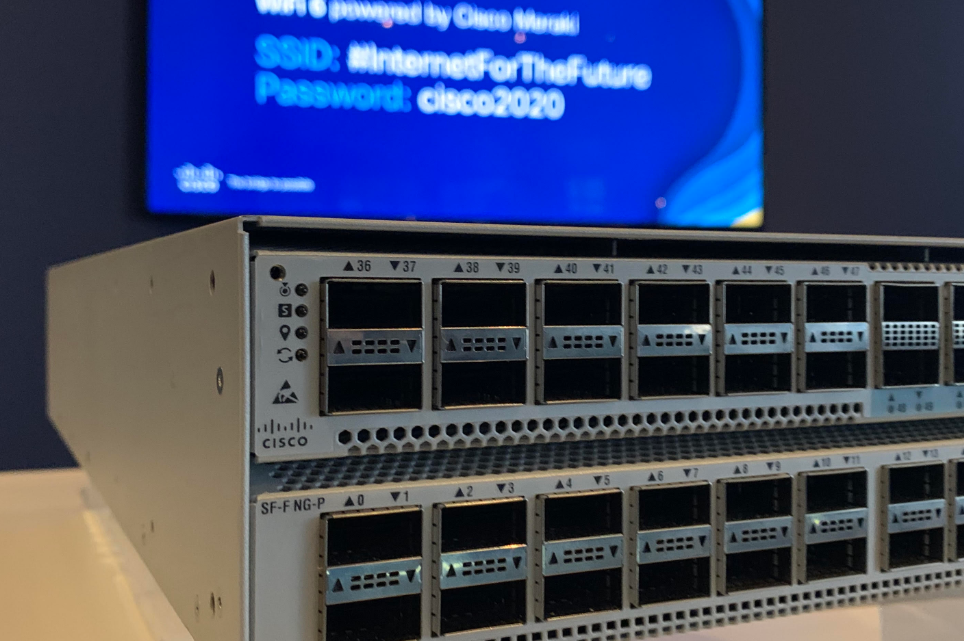
Cisco unveiled its next generation architecture - its foundation for building a new Internet, by combining silicon, optics, and software. At its "Internet for the Future" event in San Francisco, the company also unveiled new carrier-class routers and discussed an expanded sales strategy that will allow hyperscale web companies and other customers to purchase silicon and optical components directly.

Cisco Silicon One is the new unified, programmable silicon architecture that will be the foundation of Cisco’s routing portfolio going forward, including fixed and modular platforms.  It offers programmability, buffering, power efficiency, scale, and feature flexibility.


The first Cisco Silicon One device - dubbed Q100 - surpasses the 10 Tbps routing performance, although in the near term the company expects to deliver up to 25 Tbps. Q100 actually began sampling 2 years ago and is now shipping. It offers global route scale, deep buffering, and P4 programmability with switching efficiency. It delivers 2x bandwidth and 3x packets-per-second over current routing silicon.

The new Cisco 8000 series carrier-class router is the first platform built with Cisco Silicon One, specifically the Q100. Key features include:
  • Optimized for 400 Gbps and beyond, starting at 10.8 Tbps in just a single rack unit
  • Powered by the new, cloud-enhanced Cisco IOS XR7 networking operating system software,
  • designed to simplify operations and lower operational costs
  • Offers enhanced cybersecurity with integrated trust technology for real-time insights into the trustworthiness of critical infrastructure
  • Service providers gain more bandwidth scale and programmability to deliver Tbps capacity
Saudi Arabia's STC will be the first carrier to deploy the Cisco 8000 series. Comcast and NTT Communications are also testing the platform.

The new Cisco IOS XRT promises:
  • 50% less memory footprint
  • 50% faster boot time
  • 40% smaller image sizes
  • 40% faster download
  • Root-of-trust in the hardware and a cloud-based method for verifying trust in the NOS
Silicon + Optics

Over the past few years, Cisco has been investing in silicon photonics, including its acquisitions of CoreOptics, LightWire and Luxtera.  Its acquisition of Acacia is pending -- all of which reflect the company's desire to improve the availability, capacity, density and power-efficiency, especially at 400G and above.  The strategy has 3 major themes:

  • Optical  innovations will drive architectural transitions, including coherent pluggables and co-packaging.
  • Different optical consumption model, including fully integrated systems, pluggables, and components
  • Cisco Optics on non-Cisco hosts.

In terms of the new sales model, Cisco CEO Chuck Robbins said the key idea is to provide greater flexibility in how customers consume the technology. Cisco cited Google and Facebook as partners who are interested in disaggregated solutions.

Microsoft is testing the use of its SoNIC technology in conjunction with the Cisco 8000 platform.

“Innovation requires focused investment, the right team and a culture that values imagination," said Chuck Robbins, chairman and CEO of Cisco. "We are dedicated to transforming the industry to build a new internet for the 5G era. Our latest solutions in silicon, optics and software represent the continued innovation we're driving that helps our customers stay ahead of the curve and create new, groundbreaking experiences for their customers and end users for decades to come.”


About 5 years ago, Cisco set out to design a new silicon architecture, one which could serve multiple markets and scale over time.

Eyal Dagan, SVP Silicon, Cisco, shares his views on the design philosophy of Cisco Silicon One. It was a clean sheet approach. A key question -- is it possible to create a routing chip with the efficiency of switching silicon?

https://youtu.be/P5QwOKaxRtI


Unpacking Cisco's Internet for the Future


Jonathan Davidson gives his take on Cisco's Internet for the Future event. Headlining the announcements is a Cisco Silicon One, its foundation for a new portfolio of carrier-class routers as well as future products.


https://youtu.be/FTF8RjvUTL0


Hyperscalers and Service Providers on Cisco's Future of the Internet


Cisco's Future of the Internet event in San Francisco featured a panel discussion with Comcast's Noam Raffaeli, AT&T's Chris Rice, Facebook's Dan Raniovitsj, and Microsoft's Yousef Kalidi.

Jonathan Davidson, SVP and General Manager of Cisco's Service Provider group, provides some key takeaways.

https://youtu.be/trYofSMFPaY

The design philosophy of Cisco Silicon One


About 5 years ago, Cisco set out to design a new silicon architecture, one which could serve multiple markets and scale over time.

Eyal Dagan, SVP Silicon, Cisco, shares his views on the design philosophy of Cisco Silicon One. It was a clean sheet approach. A key question -- is it possible to create a routing chip with the efficiency of switching silicon?

https://youtu.be/P5QwOKaxRtI


The 400G-ZR Transition


400G-ZR is going to shift network architectures, says Bill Gartner, SVP/GM of Cisco's Optical Systems and Optics Group. Many customers will continue to deploy chassis solutions, but others will choose pluggables in a router for coherent transmission.

Cisco is also discussing the changing consumption models for network silicon and optics as some customers seek fully disaggregated solutions.

https://youtu.be/RrKqRv8-7po