Monday, February 12, 2024

Video: Advancing the Open Chiplet Economy

Chiplets offer significant promise in light of the slowing down of Moore's Law. But what will it take to establish an open chiplet economy? 

Cliff Grossner, VP Market Intelligence and Innovation from Open Compute Project (OCP) explains: 

- The progress made in the open chiplet economy over the past 12 months, including the development of a new supply chain and the need for standardization.

- The advancements in creating a standard way for companies to build a chiplet and create an electronic data sheet for other companies to use in their design tools.

- The future plans for the open chiplet economy, including further standardization, the creation of a marketplace for chiplets, and the introduction of commercially viable chiplets. 

https://youtu.be/ZS3KpEIi_Gc

Want to be involved our video series? Contact info@nextgeninfra.io

Check out AI and Cloud Data Center Networking videos here: https://ngi.fyi/aidcnet23yt


Video: Scaling High-Speed I/O Jitter and Eye Diagram testing

How significant is jitter in high-speed communication interfaces? Kees Propstra, VP of Marketing from Quantifi Photonics, explains:

  • The importance of jitter in maintaining signal quality in high throughput, multi-channel signaling, and low latency interfaces.
  • Quantifi Photonic's new QCA Series High-Speed Communication Analyzer for testing high speed ICs.
  • Testing strategies for scaling Photonic ICs as part of the larger ecosystem. The inflection point to high volume manufacturing is near and the ecosystem is preparing for this transition. 


https://youtu.be/1O-mnnSygiY

 Check out other Tech Updates on our YouTube Channel (subscribe today): https://www.youtube.com/@NextGenInfra and check out our latest reports at: https://nextgeninfra.io/


Have a tech update that you want to brief us on? Contact info@nextgeninfra.io!

NTIA awards $42M for ACCoRD Open RAN

 The National Telecommunications and Information Administration (NTIA) awarded $42 million to fund the Acceleration of Compatibility and Commercialization for Open RAN Deployments (ACCoRD) project.

ACCoRD is a project by a consortium of U.S. carriers, foreign carriers, universities and equipment suppliers that will operate a testing, evaluation and R&D center in the Dallas Technology Corridor and a satellite facility in the Washington, D.C area. The new center will focus testing on network performance, interoperability, security, and facilitate research into new testing methods.

  • Leadership of ACCoRD Project:
    • AT&T and Verizon.
  • Unfunded Founding Members:
    • NTT DOCOMO (Japan)
    • Reliance Jio (India).
  • Support for Dallas-area Center:
    • The University of Texas at Dallas.
  • Neutral Laboratory Support:
    • Virginia Tech
    • Northeastern University
    • Iowa State University
    • Rutgers University.
  • Suppliers for ACCoRD:
    • Microsoft, Nokia, Radisys, Airspan, Ericsson, Fujitsu, Rakuten, Samsung, Mavenir, VMWare, RedHat, Wind River, Ciena, Cisco, Dell, Intel, Amdocs, Keysight, VIAVI.

“Spurring innovation and competition in wireless technologies is vital to U.S. economic and national security,” said U.S. Secretary of Commerce Gina Raimondo. “This $42 million award marks $140 million in investments through the Wireless Innovation Fund, underscoring the impact of President Biden’s Investing in America Agenda in action. These grants are supporting facilities and advancing research that will unlock new opportunities for America to lead in the global telecommunications market, strengthen our supply chains and drive down costs.”

https://www.ntia.gov/press-release/2024/biden-harris-administration-awards-42m-wireless-innovation

https://about.att.com/blogs/2024/open-ran.html

Cisco transmits 800Gbps wavelength across Amitié transatlantic cable

Cisco transmitted 800Gbps on the Amitié transatlantic communications cable, which runs 6,234 kilometers from Boston, Massachusetts to Bordeaux, France, and which now supportsMicrosoft’s global network.  

The Amitié submarine cable incorporates Space Division Multiplexing (SDM) technology, utilizing 16 fiber pairs, which is higher than what is typically found in underwater cables. This design allows for the distribution of repeater power among the fiber pairs, resulting in the maximum capacity for the cable.
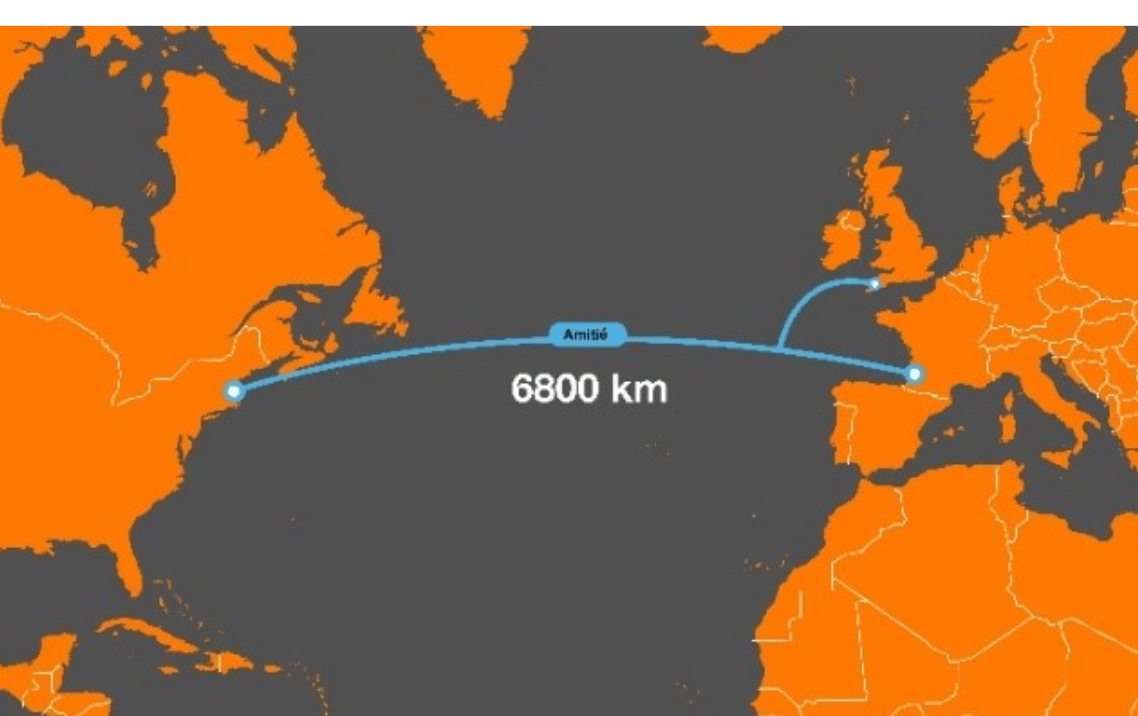
Cisco said the field trial carried an 800G wavelength in a 150GHz channel spacing, equivalent to a spectrum efficiency of 5.33bit/s/Hz and a maximum spectral efficiency of 5.6bit/s/Hz. In addition, 600G was transmitted over 12,469 kilometers for a trans-Atlantic loopback configuration. This is the first time a 140Gbaud single carrier signal was demonstrated live, and is the longest distance ever reported at single carrier 600G DWDM transmission on an SDM cable. The trial was performed with the Cisco NCS 1014 platform enabled by Acacia’s Coherent Interconnect Module 8 (CIM 8), which is powered by its Jannu digital signal processor and advanced silicon photonics.  Both products are available today and actively deployed in multiple networks. 

“In the era of AI, reliable and fast network connections are more important than ever,” said Bill Gartner, SVP Optical Systems and Optics, Cisco. “Working with Microsoft on the Amitié cable to demonstrate the potential for improved overall network capacity with 800G at these distances is a significant milestone for an SDM cable, and we’re proud to drive the innovations that pave the way for ever increasing network capacity needs.”   

“The transmission of 800G over 6,234 kilometers is a milestone that demonstrates SDM cables can deliver increased capacity over traditional subsea cables,” said Jamie Gaudette, GM of Cloud Network Engineering, Microsoft. “This field trial demonstrates what is now a commercial technology for subsea routes, and we can improve the network capacity to help drive digital transformation for people, organizations, and industries around the world.” 

https://newsroom.cisco.com/c/r/newsroom/en/us/a/y2024/m02/cisco-delivers-800gbps-on-amitie-transatlantic-cable-in-collaboration-with-microsoft-to-support-exponential-growth-of-cloud-and-ai-services.html

  • In July 2023, Aqua Comms, Meta, Microsoft, and Vodafone announced the commissioning of the Amitié subsea cable system, a 6,783 km (4,215 miles) trans-Atlantic system connecting North America and Europe and boasting 16 fiber pairs and up to 400 Tbps capacity -- the highest to date.
  • The Amitié cable, which was built by Alcatel Submarine Networks, has landings in Lynn, Massachusetts; Widemouth Bay, England; and Le Porge, France. 
  • The design of the system brings all users additional connectivity options in the United States, the UK, and in France. Boston will have direct connection all the way to London and a new Carrier Neutral Data Center constructed in Bordeaux. This delivers improved reliability in terms of protected capacity on multiple diverse routes.

  • The system includes an innovative branching unit 860 km from France and 650 km from the UK. This device allows the owners to switch either individual optical wavelengths between different landings or the full fiber capacity via two different types of switching technologies.
  • Space Division Multiplexing (SDM) is a technology used in optical fiber communication to increase the amount of data that can be transmitted over a single fiber. It involves the use of multiple spatial channels within a single fiber optic cable to carry separate data streams. This is achieved by either using multiple cores within a single fiber (multi-core fiber) or by exploiting different modes in a single core fiber (few-mode fiber).
  • In traditional fiber optic communication, the capacity of a fiber is mainly increased by using techniques like Wavelength Division Multiplexing (WDM), where different wavelengths (colors) of light carry different data streams. However, as the demand for data capacity grows, WDM alone may not suffice due to physical and technical limitations.
    SDM offers a way to further expand the data-carrying capacity by multiplying the number of available channels. This is done by creating physical or modal separations within the fiber, allowing for parallel data transmission paths that can significantly increase overall throughput.
    The application of SDM in submarine cables, like the Amitié mentioned previously, represents a significant advancement in undersea communication infrastructure. By using SDM, these cables can handle more data simultaneously, making them more efficient and capable of supporting the growing demand for internet bandwidth and connectivity across continents.

Arista posts strong Q4 as sales rise 21% yoy

 For its fourth quarter ended December 31, 2023, Arista Networks reported revenue of $1,540.4 million, an increase of 2.1% compared to the third quarter of 2023, and an increase of 20.8% from the fourth quarter of 2022. GAAP gross margin was 64.9%, compared to GAAP gross margin of 62.4% in the third quarter of 2023 and 60.3% in the fourth quarter of 2022. Non-GAAP net income amounted to $664.3 million, or $2.08 per diluted share, compared to non-GAAP net income of $445.1 million, or $1.41 per diluted share, in the fourth quarter of 2022.

The results were ahead of market expectations.

For full fiscal year 2023, Arista reported revenue of $5,860.2 million, an increase of 33.8% compared to fiscal year 2022. GAAP gross margin was 61.9%, compared to GAAP gross margin of 61.1% in fiscal year 2022. Non-GAAP net income amounted to $2,199.4 million or $6.94 per diluted share, compared to non-GAAP net income of $1,448.3 million or $4.58 per diluted share, in fiscal year 2022.

Commenting on the company's financial results, Ita Brennan, Arista’s outgoing CFO said, "Our outstanding performance for 2023 epitomizes our focus on profitable revenue growth, expanding our enterprise and campus footprint while leveraging R&D and go-to-market investments across the business."

Rwgarding its expectations for the first quarter of 2024, Arista expects:

  • Revenue between $1.52 billion to $1.56 billion;
  • Non-GAAP gross margin of approximately 62%; and
  • Non-GAAP operating margin of approximately 42%.


https://investors.arista.com/Events/Events/Event-Details/2024/Arista-Networks-Q4-2023-Earnings-Conference-Call--Webcast/default.aspx

Telia Lithuania deploys 800G wavelength service with Ciena

Telia Lithuania is upgrading its national telecom network with Ciena's WaveLogic 5 Extreme (WL5e) technology. 

This upgrade enables the introduction of Lithuania's first 800G wavelength service between major cities, supporting 400G services and up.

The network's capabilities are further extended through additional Ciena solutions, including the 6500 packet-optical platform with WL5e and WaveLogic Ai optics for increased capacity and power efficiency, faster wavelength restoration, and improved service deployment and network operations facilitated by Ciena's Navigator Network Control Suite.

Andrius Šemeškevičius, Head of Technology at Telia Lithuania, emphasized the company's commitment to innovation, particularly in data transmission, choosing Ciena for their leading optical technology. Virginie Hollebecque, Ciena's Vice President of EMEA, highlighted the network's resilience as crucial for the digitally dependent Baltic region, ensuring quick recovery from disruptions and continuous service.

https://www.ciena.com/about/newsroom/press-releases/telia-lithuania-deploys-cienas-wavelogic-5-extreme-for-country-wide-800gbs-wavelength-service

Telstra begins LEO Backhaul in Australia via Eutelsat OneWeb

 Telstra has begun largest rollout of Eutelsat OneWeb Low Earth Orbit (LEO) backhaul. More than 300 remote mobile base station sites currently using satellite backhaul will be connected to Eutelsat OneWeb’s LEO solution over the next 18 months. The capability will allow Telstra to expand mobile coverage as it supports new site deployments.

The launch follows the signing of a strategic multi-year agreement last year that will enable LEO capacity delivered to Telstra’s most remote mobile customers across Australia to enhance their experience when using real-time applications such as voice and video calling.

It follows a successful voice call on-air using Eutelsat OneWeb’s LEO solution, the first time a satellite backhaul call has been conducted on a commercial mobile network with a guaranteed quality level of services in Australia.

“We are delighted to support Telstra in delivering consistent, leading-edge connectivity to its customers in Australia, regardless of location. We are honoured to count Telstra among our most trusted partners, with whom we will continue to collaborate to test and deploy current and future technology.”

Cyril Dujardin, Co-General Manager of Eutelsat Group’s Connectivity Business Unit said: “We are delighted to support Telstra in delivering consistent, leading-edge connectivity to its customers in Australia, regardless of location. We are honoured to count Telstra among our most trusted partners, with whom we will continue to collaborate to test and deploy current and future technology.”

www.eutelsat.com

Alphawave Semi hires Charlie Roach as Chief Revenue Officer

Alphawave IP Group appointed Charlie Roach as Chief Revenue Officer (CRO).

Previously, Roach was Senior VP of Worldwide Sales and Corporate Marketing at Inphi, leading the company’s expansion into new markets such as hyperscaler data centers and networking, and achieving more than 10X growth in revenue and stock price when Inphi was acquired by Marvell. Before Inphi, Charlie was at IDT (acquired by Renesas) and AMCC/Applied Micro (acquired by MACOM).

Tony Pialis, Co-Founder, President, and Chief Executive Officer of Alphawave Semi said: “I am thrilled to welcome Charlie, a highly accomplished sales and technology executive to our executive leadership team. Charlie comes with an impressive track record at Inphi, building strong partnerships and driving strategic wins with more than 10X revenue growth among its hyperscaler customers. His expertise is invaluable as we continue to lead in delivering connectivity and compute silicon solutions, shaping the future of next-generation AI infrastructure.”

https://awavesemi.com

Sunday, February 11, 2024

Video: What's Next for Chiplets

Is the future more about chiplets rather than monolithic chips? Yervant Zorian, Fellow & Chief Architect from Synopsys, explains:

  • The limitations of monolithic chips: As technology advances, we're reaching the limit of how much knowledge we can squeeze into a single chip. Chiplets, on the other hand, are smaller, more cost-effective, and yield better results.
  • The evolution of the chiplet industry: The real breakthrough will come when different vendors start offering their chiplets to the market, much like IPs. This will lead to a new ecosystem of chiplet providers and users, with 'supermarkets' of chiplets available for innovative designs.
  • The importance of interoperability: For this new chiplet industry to thrive, there needs to be interoperability not just functionally, but also in terms of the health of the overall system. This includes the reliability and availability of individual chiplets, as well as their communication with each other over their lifecycle.

https://youtu.be/4mOTXfjPDX0

Want to be involved our video series? Contact info@nextgeninfra.io

U.S. forms National Semiconductor Technology Center Consortium

A new National Semiconductor Technology Center will convene government, industry, customers, suppliers, educational institutions, entrepreneurs, and investors as a public-private consortium to innovate, connect, and solve problems.

The Department of Commerce expects to invest over $5 billion in the program. Deirdre Hanford, a semiconductor industry leader with 30 years of experience at Synopsys, has been selected as the first Chief Executive Officer of Natcast.org, the organization that will operate the NSTC consortium. 

The NSTC will also prioritize launching a Workforce Center of Excellence, which will be a hub for workforce development for semiconductor companies doing business in America. 

“Semiconductors are at the heart of the economy, impacting every aspect of our lives,” said Deirdre Hanford. “My amazing years at Synopsys have given me a broad and deep view of the semiconductor landscape. I am honored and humbled to take on the role of Natcast CEO. I look forward to fulfilling the CHIPS NSTC mission of fostering semiconductor innovation and growing a talented workforce.”

https://natcast.org/about

https://www.youtube.com/live/sE6hxDNJQqg?feature=shared

BT, Ericsson and Qualcomm advance network slicing

 BT, Ericsson and Qualcomm demonstrated advanced 5G slicing for differentiated consumer and enterprise connectivity.

The trial, which took place at BT's Adastral Park research facilities, established network slices for Gaming, Enterprise and Enhanced Mobile Broadband (eMBB), and showed how, by allocating a portion of the 5G SA network to provide dynamic partitions for specific use-cases, optimal performance can be maintained for bandwidth-heavy activities including mobile gaming and video conferencing even during peak times.

The tests featured Ericsson’s 5G Core and Radio Access Network technology with devices powered by the Snapdragon 8 Gen 2 for Galaxy Mobile Platform.

Some key points:

  • Mobile gaming traffic on EE, the UK's leading network, has nearly doubled since early 2023, exceeding two petabytes per month.
  • Network slicing is anticipated to significantly enhance performance and growth in the 5G SA era by providing low-latency, jitter-free, and immersive gaming experiences.
  • BT Group, Ericsson, and Qualcomm Technologies showcased superior mobile cloud gaming on Nvidia’s GeForce Now, achieving over 25 Mbps throughput at 1080p, even under additional network load, using network slicing.
  • A gaming session on Fortnite with the Samsung S23 Ultra, powered by Snapdragon 8 Gen 2, demonstrated smooth performance through Ericsson’s network slicing and Radio Resource Partitioning, compared to a congested non-optimized eMBB RAN partition.
  • The trial also highlighted network slicing's benefits for enterprise applications, showing stable 4K video streaming and efficient enterprise communications on the Samsung S23 Ultra device.
  • Ericsson's 5G RAN Slicing and Radio Resource Partitioning ensured optimal experiences for both gaming and enterprise use-cases by allowing devices to connect to multiple network slices based on the application's needs.

Greg McCall, Chief Networks Officer, BT Group, said: “Network slicing will enable us to deliver new and improved capabilities for customers in the 5G SA era. As we work diligently towards the launch of our own 5G SA network, today’s successful demonstration of how slicing enables us to differentiate Quality of Service to guarantee performance for different segments is a significant milestone, and illustrative of the new services that will be enabled by 5G SA.”

https://newsroom.bt.com/bt-group-ericsson-and-qualcomm-technologies-inc-network-slicing-trial-promises-new-consumer-and-enterprise-capabilities-in-5g-sa-era-including-enhanced-mobile-gaming/

2Africa subsea cable lands in Ghana and Nigeria

 The 2Africa project marked another significant milestone with the landing the subsea cable in Ghana and Nigeria.

At 45,000km, 2Africa is expected to be the longest subsea cable ever deployed. A total of 46 cable landing locations are envisioned for the project.

Frédéric Schepens, CEO of Bayobab said, “Following two milestone landings in South Africa, we are pleased to announce 2Africa cable landing further up the continent, in Accra, Ghana and Lagos, Nigeria. The 2Africa initiative is at the core of the work we do as Bayobab, with the ultimate goal of connecting Africa to the world and the world to Africa. We are eager to continue offering services that will expand the rapidly growing African digital economy and positively impact growth across the continent.”

The 2Africa consortium includes Bayobab (formerly MTN GlobalConnect), Center3 (stc), China Mobile International, Meta, Orange, Telecom Egypt, Vodafone Group, and WIOCC.


https://bayobab.africa/bayobab-lands-2africa-subsea-cable-in-ghana-and-nigeria-to-strengthen-internet-connectivity-across-west-africa/

Corning intros its latest indoor cellular solution


 Corning introduced its latest indoor cellular solution, the Evero® 5G Enterprise Radio Access Network (ERAN), designed for hospitals, hotels, airports, and other high-density environments regardless of their mobile provider. The solution combines the benefits of small cell radio access networks (RAN), which accommodate multiple frequencies, with the advantages of distributed antenna system (DAS) technologies, which provide reliable signals throughout high-density environments.

In a major departure from legacy solutions, the newest addition to Corning’s Everon portfolio supports multiple mobile operators over a common network, si,mplifying installation and reducing cost of ownership, as conventional architectures typically  provide cellular connectivity for only one operator at a time.

Corning says its solution leverages Open RAN architecture and works with components from multiple vendors, enabling software upgradability. It also uses Virtualized RAN technology, offering hardware flexibility through cloud-based data processing.

“Everon 5G ERAN sets a new industry standard by offering a streamlined solution for coverage-challenged places that are part of our daily lives, like hospitals, hotels, and office buildings,” said Shirish Nagaraj, Corning Optical Communications’ chief technology officer, Wireless.

“Our newest Everon solution offers flexibility in design, predictability in deployment, and scalability for future needs,” said Nagaraj. “It highlights Corning’s dedication to solving the world’s toughest technology challenges alongside our customers – and improving the world with every innovation.” 

https://www.corning.com/worldwide/en/about-us/news-events/news-releases/2024/02/cornings-new-everon-cellular-solution-delivers-robust-reliable-cellular-coverage-in-high-density-environments.html

Telstra implements Azure OpenAI for frontline customer service

Telstra is expanding two in-house developed generative AI solutions following promising pilots with frontline team members. 

The applications, One Sentence Summary and Ask Telstra, leverage Microsoft Cloud and its Azure OpenAI.

  • One Sentence Summary ,condenses recent customer notes, interactions, and transactions into a brief overview of a customer’s current situation. This reduces the need for customers to reiterate their information. During trials in 2023, it was found that 90% of employees who used the tool experienced time savings and enhanced productivity, with a 20% reduction in the need for follow-up contact. The tool also facilitated employees' ability to comprehend and  handle complex or delicate issues, such as prioritizing or providing financial assistance to customers. Telstra plans to expand the availability of One Sentence Summary to all its contact center and store teams throughout 2024.
  • Ask Telstra is another GenAI app deployed by Telstra to allow employees swift and easy access to the company’s vast internal knowledge bases. Leveraging Microsoft Azure OpenAI Service and Azure AI Search, Ask Telstra delivers AI-generated answers to employee inquiries through a straightforward search interface, ensuring responses are based on Telstra’s reliable and secure corporate information. This tool streamlines the process of finding information within the company, making it quicker and more efficient for employees to get the answers they need.

Kim Krogh Andersen, Telstra's Group Executive Product & Technology, states “We’re at a profound juncture in a new era of transformation, and it's one that we're navigating in lockstep with our partners. Our deep, strategic relationship with Microsoft is positioning us well to unlock value and growth as technologies like generative AI proliferate at speed. We’ve been on a journey of simplification and modernisation over a number of years. We've simplified our technology architecture and shifted to a 100% API-first approach to product development. We’re also migrating workloads to the public cloud and building reusable AI capabilities. Our collaboration with Accenture is now helping to accelerate the work we have ahead. It's a massive undertaking, but it has put us in a position to now rapidly scale bespoke generative AI tools, like Ask Telstra and One Sentence Summary, that can really shift the dial when it comes to helping our teams provide quicker, more effective, and more personalised customer interactions.”

https://www.telstra.com.au/aboutus/media/media-releases/telstra-scales-up-ai-adoption

Oracle Cloud broadens FedRAMP Approval

 Over 16 new services and features within Oracle Cloud Infrastructure (OCI) have received FedRAMP certification, offering advanced AI, DevOps, and security functions to federal agencies and their partners. As a result, there are now 93 FedRAMP approved services accessible in Oracle's U.S. government regions for customer use.

Highlights of the new capabilities available at FedRAMP High in the U.S. Government Cloud include:

  • Network Firewall is an integrated, cloud native, managed firewall service built using next-generation technology from Palo Alto Networks.
  • DevOps service is a complete continuous integration/continuous delivery (CI/CD) platform for developers to simplify and automate their software development lifecycle.
  • AI Vision is an AI service for performing deep-learning–based image analysis at scale.
  • AI Forecasting delivers univariate and multivariate time-series forecasts through statistical, machine learning, and deep learning algorithms.
  • Data Safe empowers organizations to understand data sensitivity, evaluate data risks, mask sensitive data, implement and monitor security controls, assess user security, and monitor user activity—all in a single, unified console.
  • Big Data Service is a fully managed, automated cloud service that provides enterprises with a cost-effective Hadoop environment.

Oracle has also introduced nine new features to existing FedRAMP High approved cloud services.

“Adding these new services to our U.S. government cloud underscores our commitment to providing our government customers with comprehensive cloud services, and we will continue to use feedback from our customers to build new innovative solutions,” said Rand Waldron, vice president, Global Government Sector, Oracle. “Moreover, government agencies and the companies that support them can always use our government cloud regions at the same globally consistent price as our public cloud, enabling them to spend more of their resources on core mission needs.”

https://www.oracle.com/news/announcement/oracle-cloud-infrastructure-attains-expanded-fedramp-authorization-2024-02-07/

Kyndryl and Google Cloud partner on Enterprise-ready GenAI

Kyndryl expanded its partnership with Google Cloud to targetn enterprise-ready GenAI. 

Kyndryl and Google Cloud have worked together since 2021 to help global businesses transform with Google Cloud’s advanced AI capabilities and trusted infrastructure. 

The next phase of the partnership will focus on coupling Google Cloud’s in-house AI capabilities, including Gemini, Google’s most advanced Large Language Model (LLM), with Kyndryl’s expertise and managed services to develop and deploy generative AI solutions for customers. Key focus areas include: 

  • Kyndryl will offer advisory and implementation services through Kyndryl Consult to help clients identify and implement the best generative AI use cases and data strategies for their business goals, leveraging its experience with Google Cloud's technologies, including Gemini, for AI-driven business transformation.
  • Kyndryl will use Google Cloud's Cortex Framework to enhance customer value from ERP data on Google Cloud, aiming to increase productivity, foster innovation, and deliver better insights for improved business outcomes.
  • Kyndryl plans to introduce its custom LLM Operations Framework to Google Cloud customers, facilitating the adoption of generative AI solutions that address common issues efficiently and responsibly, while continuing to provide data modernization services for optimizing generative AI implementations.
  • Kyndryl aims to expand its AI and data analytics expertise through more training and bootcamps via Google Cloud Academy, enhancing its ability to deliver Google Cloud-powered generative AI solutions to clients, supported by its involvement in Google’s Generative AI Initiative for Service Partners.

“Given Kyndryl’s data services expertise, along with our more than 30 years of experience managing large enterprise environments, Kyndryl understands the complexities in moving a generative AI solution from an idea into production,” said Nicolas Sekkaki, Kyndryl’s Global Applications, Data and AI Practice Leader. “By combining this unique perspective and the Kyndryl Responsible AI Principles with Google’s AI history and in-house generative AI capabilities, we can quickly and responsibly bring this new generation of AI to customers and drive their business value.” 

https://www.kyndryl.com/us/en/about-us/news/2024/02/google-cloud-enterprise-generative-ai-solutions

Thursday, February 8, 2024

Tech Update: Highlights of Chiplet Summit 2024

The Second Annual Chiplet Summit, held February 6-8, 2024 at the Santa Clara Convention Center, more than doubled in size compared with the previous year's event, demonstrating growing interest from chip designers in this emerging field. Chuck Sobey, Conference Chair of Chiplet Summit, provides some highlights:

- The industry's shift towards chiplet technology as a way to move beyond Moore's law, utilizing older process geometries and combining them with the latest cutting-edge process technologies.

- The potential of chiplets in accelerating AI in various domains such as automotive, medical, telecommunications, and more, with the help of universal standards like UCI for seamless chip communication.

- The promising future of chiplets, with projections of significant improvements in performance and power, enabling advancements we've only dreamed of or haven't yet imagined.


https://youtu.be/ICM62IBv6bU

Have a tech update that you want to brief us on? Contact info@nextgeninfra.io!

Check out other Tech Updates on our YouTube Channel (subscribe today): https://www.youtube.com/@NextGenInfra and check out our latest reports at: https://nextgeninfra.io/


Tech Update: Calculating the Costs/Benefits of Chiplets

Should you consider a chiplet for your next semiconductor project or stick with a conventional, monolithic design? 

Marek Hempel, Staff Process Development Engineer from Analog Devices, discuss a white paper by the Open Compute Project that delves into this topic.

  • - He discusses the financial trade-offs between monolithic, chiplet, and SIP designs, helping you understand which route is best for your specific needs.
  • - Marek dives into the interplay between technology choices and business decisions, such as the costs of designing a chiplet system and whether it's the right choice for your project.
  • - He also shares exciting updates about the development of a chiplet marketplace and an upcoming workshop on chiplet business challenges, both aimed at fostering an open chiplet economy.

https://youtu.be/SUq7DBHeoqU

Check out other Tech Updates on our YouTube Channel (subscribe today): https://www.youtube.com/@NextGenInfra and check out our latest reports at: https://nextgeninfra.io/

Have a tech update that you want to brief us on? Contact info@nextgeninfra.io!


Filmed at Chiplet Summit 2024 in Santa Clara, California.

#OFC24: Upcoming Panel on Heterogeneous Integration

Heterogeneous Integration opens new capabilities for technologies, use cases, and market participants. Integrating devices developed separately and often on different substrates (as, for example, III-V semiconductors and Silicon Photonics) into a single composite device enables miniaturization, simplifies interconnection, saves materials, and reduces energy consumption. 

Dan Pitt, President of Palo Alto Innovation Advisors, previews a panel discussion on Sunday, March 24, 16:00 - 18:30, featuring:

Alex Chikhaoui, X-Celeprint, Ireland

Ivan Huang, Avicena Tech, United States

Michael Lebby, Lightwave Logic, United States

Sylvie Menezo, Scintil, France

Edward Preisler, Tower Semiconductor, United States

Jing Zhang, IMEC AND Ghent University, Belgium

Mian Zhang, Hyperlight, United States

https://youtu.be/ye0HUYIaLH8

https://www.ofcconference.org/en-us/home/program-speakers/workshops/will-heterogeneous-integration-meet-the-needs/

Have a tech update that you want to brief us on? Contact info@nextgeninfra.io!


FCC rules against AI-driven Robocalls and Robotexts

The FCC issued a declatory ruling that prohibs the use of AI-generated voices for robocalls, under the protections afforded under the Telephone Consumer Protection Act (TCPA).  The ruling also  encompasses current uses of AI in robotexting,  e.g., interacting with consumers as though they were live human callers.

The FCC also finds “that certain AI technologies such as ‘voice cloning’ appear to fall within the TCPA’s existing prohibition on artificial or prerecorded voice messages because this technology artificially simulates a human voice”.

FCC Chairwoman Jessica Rosenworcel states "The Telephone Consumer Protection Act is the primary law we have to help limit unwanted robocalls.  It means that AI technologies like voice cloning fall within this law’s existing prohibitions and that calls that use this technology to simulate a human voice are illegal, unless callers have obtained prior express consent.  It also means that when these calls happen, State Attorneys General across the country can go after the bad actors behind these robocalls and seek damages under the law."

https://www.fcc.gov/document/fcc-confirms-tcpa-applies-ai-technologies-generate-human-voices