Saturday, March 5, 2022

Marvell posts revenue of $1.343 billion

 Marvell Technology reported revenue of $1.343 billion for its fourth fiscal quarter, ended January 29, 2022, exceeding the midpoint of the company's guidance provided on December 2, 2021. The figure was up 11% sequentially and 68% year over year, including the acquisitions of Inphi and Innovium.

GAAP net income for the fourth quarter of fiscal 2022 was $6 million, or $0.01 per diluted share. Non-GAAP net income for the fourth quarter of fiscal 2022 was $429 million, or $0.50 per diluted share. Cash flow from operations for the fourth quarter was $346 million.

Net revenue for fiscal 2022 was $4.462 billion. GAAP net loss for fiscal 2022 was $(421) million, or $(0.53) per diluted share. Non-GAAP net income for fiscal 2022 was $1.279 billion, or $1.57 per diluted share.

On a conference call, company executives said growth in demand continues to outstrip increases in supply.

"Marvell delivered record revenue of $1.34 billion in the fourth quarter of fiscal 2022, growing 11 percent sequentially and 68 percent year over year, exceeding the midpoint of guidance. The Marvell team continued to rack up design wins, securing additional sockets at key customers leveraging our advanced technology platforms," said Matt Murphy, Marvell's President and CEO. "Revenue grew in all five of our end markets in the fourth quarter, with strong contributions from cloud, 5G and auto, which together represented 40% of total revenue. In addition, our enterprise networking end market has become another growth pillar, with revenue increasing 64% year over year, driven by our content gains and share increases, as enterprises continue to transform their infrastructure to address the needs of a more flexible, hybrid workforce."




Friday, March 4, 2022

Attendance at #MWC22 tops 60,000

GSMA confirmed that attendance at MWC Barcelona last week topped 61,000 from almost 200 countries.

  • Over 61,000 unique people attended in person
  • Around 500,000 unique virtual and daily viewers on MWC22 and partner platforms
  • Representation from almost 200 countries and territories
  • Over 1,900 exhibitors, sponsors, and partners
  • Over 1,000 speakers, 97% in person and 36% women
  • More than 50% of attendees were Directors and C-Suite executives, 20% were CEOs and founders, 25% were women
  • Millions tuned into MWC22 Barcelona content via Mobile World Live global syndication and official national and international broadcasters.
  • More than 1,600 international journalists were onsite

"Nothing beats MWC in person, and it was exciting to bring our community – which is so passionate about connectivity – back together to discuss the opportunities that lie ahead." John Hoffman, CEO GSMA Ltd. said. "On behalf of the GSMA, I would like to thank all of our attendees, exhibitors, sponsors, and partners who came together to make MWC22 so productive, safe, and successful. I also want to thank Barcelona City Council, Generalitat de Catalunya, the Ministry of Economy and Digital Transformation, Fira de Barcelona, Tourism de Barcelona (the Host City Parties), the L’Hospitalet de Llobregat, Mobile World Capital, and the people of Catalonia and Spain. Your support is unwavering, and your creativity, hospitality, and perseverance continually inspire us.”


OneWeb suspends all launches from Baikonur.

The Board of OneWeb has voted to suspend all launches from Baikonur. This follows a standoff with the Russian space agency Roscosmos.

OneWeb's next launch had been expected this week from Kazakhstan aboard a Russian Soyuz rocket. 

OneWeb launches 34 satellites, bringing constellation to 428


OneWeb confirmed the successful deployment of 34 satellites by Arianespace from the Guiana Space Centre in Kourou, French Guiana. 

The launch marks OneWeb's first in 2022 and 13th overall, bringing its total in-orbit constellation to 428 satellites. It represents 66 percent of OneWeb’s planned 648 LEO satellite fleet that will deliver high-speed, low-latency global connectivity.

OneWeb notes that it has signed new distribution partnership agreements with several companies in the last month – including Hughes Network Systems, Marlink, and Field Solutions Holding. 

Neil Masterson, OneWeb CEO, commented: “Our first launch of the year marks our significant progress in completing a truly global LEO network later in 2022. We continue to see growing demand for OneWeb’s industry-leading services as we look forward to delivering on our ambition to build robust, secure, and global access to broadband services.”

BT to offer OneWeb's LEO satellite service

BT Group will offer OneWeb's Low Earth Orbit (LEO) satellite connectivity services to its customers.The landmark Distribution Partner Agreement supports the UK Government’s National Space Strategy and spans BT’s global footprint.BT, which is currently testing how LEO satellite technology integrates with its existing terrestrial capabilities, expects to commence the first live trials with customers from early next year. The partnership will span a...

Hughes and OneWeb alliance targets enterprise services

Hughes Network Systems and OneWeb have signed a distribution agreement in the U.S. focused on enterprise services. In India, the parties have entered into an MOU for a strategic agreement to distribute services to large enterprises, small and medium businesses, government, telcos and ISPs, including in the rural and remote parts of the country. Hughes and OneWeb also stated that thy intend to work together to broaden distribution globally,...

AT&T inks deal with OneWeb for coverage in remote locations

AT&T signed a strategic agreement with OneWeb to provide LEO satellite coverage for AT&T business customers into remote and challenging geographic locations. The new connectivity will complement existing AT&T access technologies.The AT&T service will be supported by OneWeb’s network of satellites. OneWeb has launched 288 satellites and expects to attain global coverage with a total fleet of 648 satellites by the end of 2022. AT&T...


Thursday, March 3, 2022

Windstream Wholesale and Infinera develop Node-on-a-Blade

Windstream Wholesale will transform its optical network infrastructure using an innovative Node-on-a-Blade jointly pioneered by Infinera and Windstream.

The companies describe Node-on-a-Blade as the next evolution of ROADM-based solutions that will provide a more advanced and cost-effective approach to optical networking enabling deployment across a wider variety of network locations. Advanced capabilities include a coherent optical channel monitor and a coherent probe.

“Node-on-a-Blade technology will be a powerful tool in the evolution and transformation of optical networks,” said Ron Johnson, general manager, optical systems and network solutions group at Infinera. “Infinera is excited to work with Windstream to usher in a new era of optical networking capabilities and the services this new architecture will enable.”

“Networks and service offerings need to transform to provide better support for hyperscale customers as initiatives like distributed computing evolve,” said Art Nichols, vice president of architecture and technology at Windstream. “Key technologies such as Node-on-a-Blade and innovative partners like Infinera will be instrumental in enabling Windstream’s ICON vision to better support continued edge traffic growth and introduce a new class of hyperscale optimized network services that will provide unique value to our customers.”

https://www.infinera.com/press-release/windstream-wholesale-partners-with-infinera-to-build-next-generation-optical-infrastructure

NeoPhotonics demos 120Gbaud InP-based coherent receiver/modulator

NeoPhotonics has used its Indium Phosphide-based Coherent Receiver and Coherent Modulators, coupled with its Ultra-Narrow Linewidth Tunable Lasers or Distributed Feedback Lasers, to demonstrate 120Gbaud operation in applications ranging from 800G LR transmission to 400G long haul transmission.

The next-generation DSP baud rate will be based on 120+ Gbaud, and potential applications include 800LR (≤10km), 800ZR for DCI (≤100km), 800ZR+ for metro-core (≤1000km), and 400Gb/s ultra-long-haul transmission. 

Demonstrations of this level of performance are reported and listed below, showing that corresponding high-speed optoelectronic components are available today to match the DSP baud rate and to enable pluggable or embedded modules at these data rates.

Using its indium phosphide (InP)-based coherent driver modulator (CDM) and intradyne coherent receiver (ICR) with more than 60GHz-bandwidth, NeoPhotonics has experimentally demonstrated the feasibility of the following transmission systems at 120+ Gbaud:

  • Long-haul: 400Gb/s over 1500km standard single-mode fiber EDFA-only transmission system with a superior required OSNR of 16.7dB at OFEC threshold;
  • Regional/Metro-core: 800Gb/s (with probabilistic shaping) over 1000km standard single-mode fiber EDFA-only transmission system with a superior required OSNR of 24.3dB at OFEC threshold;
  • ZR DCI: 800ZR over a single-span EDFA-based 100km standard single-mode fiber with a superior required OSNR of 25dB at OFEC threshold and a transmitter output power of -6dBm; and
  • Unamplified LR: 800LR over an unamplified 10km link with a 9dB link budget, and 800Gb/s “coherent lite” over an unamplified 1km link with a budget of 5.2dB, both using a low-latency FEC with a BER threshold at 4 x 10⁻³. The latter used self-homodyne coherent detection so as to significantly simplify the DSP and remove wavelength locking between transmitter and local oscillator.

“We are pleased to take this opportunity to highlight the progress we have made in pushing our high-performance indium phosphide integration technologies to even higher speeds and over longer distances to enable new potential applications in cloud and data center applications,” said Tim Jenks, Chairman and CEO of NeoPhotonics. “These 120Gbaud components, coupled with our ultra-narrow linewidth external cavity “nano” tunable laser or our distributed feedback lasers, along with concurrent DSP advances, could enable pluggable modules to operate at 800G for applications within and between datacenters, as well as to extend the speed and reach of embedded telecom systems,” concluded Mr. Jenks.

https://www.neophotonics.com/press-releases/?newsId=13151

Verizon teams with Celona on Private 5G

Verizon Business will integrate Celona's wireless private networking solution.

The strategic partnership will focus on leveraging the power of Verizon’s On Site LTE and 5G network with Celona’s c5G LAN products. The joint offer will deliver an enterprise-friendly approach to private networks that is designed to meet growing demand for the reliable wireless performance, coverage and connectivity required by a new era of network-dependent business applications and IoT systems. In addition, the solution will also lower the cost barrier for developers, opening new pathways for them to test innovative and transformative applications.

“Today, every organization around the world faces its own unique set of digital transformation challenges, and for businesses to remain competitive, they require new, cutting-edge solutions designed specifically to meet their needs. The partnership we’ve announced today does exactly that. No one is better positioned to leverage the power of private networks than Verizon, and we can’t wait to see our partnership with Celona deliver powerful results for our customers,” said Tami Erwin, CEO, Verizon Business.

“Celona and Verizon have a shared architectural approach and vision for the power that 5G technology has in transforming business operations,” said Rajeev Shah, Co-Founder and CEO of Celona. “We believe that 5G as a network software service, operating within common mobile edge compute environments, will give enterprises the agility they need to truly support their latest digital initiatives.”

https://www.verizon.com/about/news/verizon-business-launches-turn-key-private-networking-solution-celona


Terabit BiDi MSA gets underway

A new Terabit Bidirectional (BiDi) Multi-Source Agreement (MSA) group has been established to develop interoperable 800 Gb/s and 1.6 Tb/s optical interface specifications for parallel multimode fiber (MMF).

The goal is to provide an upgrade path for the parallel MMF based 400 Gb/s BiDi to 800 Gb/s and 1.6 Tb/s. BiDi technology has already proven successful as a way of providing an upgrade path for installed duplex MMF links from 40 Gb/s to 100 Gb/s. 

The Terabit BiDi MSA specifications will address applications for critical high-volume links in modern data centers between switches, and server-switch interconnects.

Founding members of the Terabit BiDi MSA include II-VI, Alibaba, Arista Networks, Broadcom, Cisco, CommScope, Dell Technologies, HGGenuine, Lumentum, MACOM and Marvell Technology.

"As the industry transitions to 100 Gb/s per lane signaling on high density 25.6 Tb/s and future 51.2 Tb/s switches, there is a market need to increase interface speeds using VCSEL based technology to achieve cost-optimal and faster interfaces," said Tzu Hao Chow, MSA co-chair.

https://terabit-bidi-msa.com

SpaceX completes 9th launch of 2022

SpaceX launched 47 Starlink satellites from Launch Complex 39A (LC-39A) at Kennedy Space Center in Florida. This was the ninth SpaceX launch of 2022. 

It was also the 11th flight for the Falcon 9 first stage booster supporting this mission, which previously launched GPS III-3, Turksat-5A, Transporter 2, and now eight Starlink missions.

The booster was recovered on a drone ship.


Micron samples 176-layer NAND SSD for data centers

Micron Technology is sampling the  first vertically-integrated 176-layer NAND data center solid-state drive.

The Micron 7450 SSD with NVMe achieves latency at or below 2 ms for 99.9999% QoS in common, mixed, random workloads— driving up performance in databases such as Microsoft SQL Server, Oracle, MySQL, RocksDB, Cassandra and Aerospike, among others. Compared to SATA SSDs, latency is reduced by nearly 50%, and read bandwidth is improved by up to 12 times.

"We're launching the Micron 7450 SSD at the same time PCIe Gen4 is becoming the most widely adopted SSD interface in servers,” said Jeremy Werner, corporate vice president and general manager of Micron’s Storage Business Unit. “This product delivers the world’s most advanced NAND in a data center SSD well ahead of the industry and, importantly, brings consistent, reliable latencies below 2 milliseconds, critical to enabling quality of service in scale-out data center workloads.”

The 7450 SSD offers e capacity range from 400GB to 15.36TB.


Wednesday, March 2, 2022

Marvell intros 400G/800G PAM4 DSPs for Active Electrical Cables

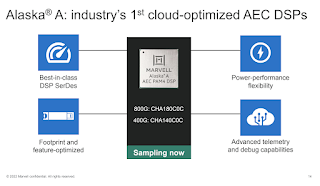
Marvell introduced its Alaska A PAM4 DSP family for Active Electrical Cables (AECs) designed for data center interconnects by hyperscale customers.

The new Alaska 400G/800G DSPs, fabricated in 6nm process, leverages Marvell’s PAM4 DSP technology to improve signal integrity in copper, short reach AECs to address emerging 100G/lane adoption in cloud data center interconnect architectures. 

The new Alaska 400G/800G DSPs add to Marvell’s comprehensive portfolio of high speed transceivers, including line card retimers, gearboxes and MACsec PHYs supporting rates up to 800G, and active optical cable (AOC) interconnect solutions. 

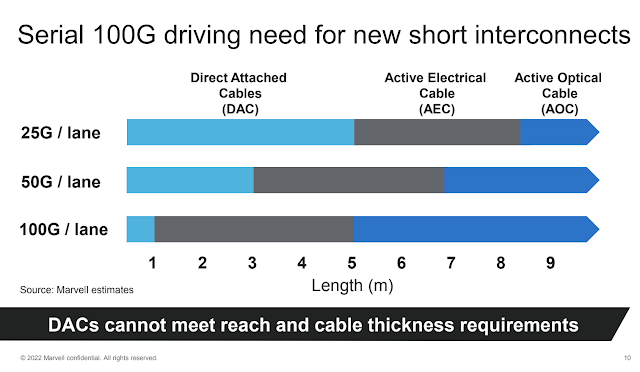
Marvell said its Alaska A DSPs for AECs can compensate for >40db of loss, which enables longer reach and thinner cables, both of which are key requirements for high density data center deployments. The Marvell AEC platform includes a complete cable reference design for 400G and 800G AECs and software stack with CMIS5.0 support as well as proven interoperability with leading switch and NIC platforms. Marvell’s Alaska A platform brings Marvell’s PAM4 DSP leadership coupled with the state-of-the-art cable manufacturing and assembly expertise of leading cable manufacturers. This combination delivers best-in-class AECs as well as the scalability and supply assurance to meet the critical requirements of cloud customers.

“100G/lane-enabled products are the next inflection point for data centers, as artificial intelligence, machine learning and other data-intensive workloads grow,” said Achyut Shah, senior vice president and general manager of Marvell’s PHY business unit. “Achieving the reach needed for AI accelerators and server to top-of-rack links and switch-to-switch interconnects requires an active electrical cable (AEC) solution because of the reach limitations and cable thickness challenges of passive direct attach offerings at 100G/lane. We are working with all major cable vendors and cloud operators on end-to-end AEC solutions based on our  Alaska A DSPs to enable 100G serial-based next-generation data center deployments.”

Marvell also confirmed that it is working with leading data center cable manufacturers, including Amphenol, Celestica, Luxshare-tech, Molex, TE Connectivity, and Volex.

Marvell samples first 1.6T Ethernet PHY with 100G PAM4 I/Os in 5nm

Marvell has begun sampling the industry's first 1.6T Ethernet PHY with 100G PAM4 electrical input/outputs (I/Os) in 5nm, enabling next-generation 100G serial-based 400G and 800G Ethernet links for high-density switches. The doubling of the signaling rate creates signal integrity challenges, driving the need for retimer devices for high port count switch designs. It's critical that retimer and gearboxes used for these applications are extremely power...

Marvell samples 50G PAM4 DSP chipset for 5G optical fronthaul

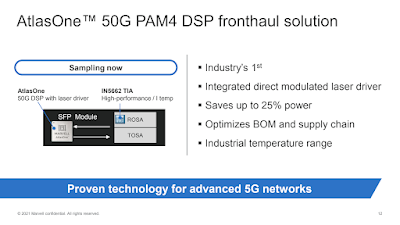
Marvell has begun sampling the industry’s first 50Gbps PAM4 DSP and TIA chipset solution for 5G fronthaul.Key features of the new Marvell AtlasOne chipset:PAM4 digital core for optimal performance across a range of applications.Marvell’s companion IN5662 TIA for linearity while maintaining ultra-low noise and power.The industry’s first PAM4 DSP integrated Direct Modulated Laser driver in mainstream CMOS technology.Industrial temperature range support...


Marvell samples 800G Multimode Electro-Optics Platform

Marvell is now sampling a 800Gbps or 8 x 100Gbps multimode platform for short-reach optical modules and Active Optical Cable (AOC) applications. 

The new 800G platform, which includes Marvell's PAM4 DSP with a multimode transimpedance amplifier (TIA) and Driver, enables faster data center speeds scaling to 800Gbps, using conventional cost-effective vertical-cavity surface-emitting laser (VCSEL) technology over multimode fiber. 

"As a pioneer in PAM4 DSP technology for data centers, Marvell is the first in the industry to offer a cost-effective, plug-and-play platform solution that supports 800G speeds using VCSEL technology and multimode fiber," said Lian Qin, associate vice president, Optical and Copper Connectivity Group, Marvell. "With this industry-first 800G multimode platform solution, we are transforming today's data centers to deliver the required bandwidth to support the data centers of tomorrow."


PAM4 DSPs

The Marvell Spica PAM4 DSP is the industry's first 800Gbps or 8x100Gbps PAM4 DSP to support 800G optical modules in QSFP-DD800 and OSFP form factors. Spica is a field-proven, low-power, high-performance PAM4 DSP, optimized for optical transceiver modules applications, with various package options for all major module form factors. Spica DSPs are optimized for both multimode and single-mode applications.

Multimode Driver

The Marvell IN5614DV is a 56GBaud low power VCSEL linear driver for PAM4 optical modules or Active Optical Cables. The TIA is optimized for routing with a channel pitch aligned to the VCSEL optics driving over multimode fiber.

Multimode TIA

The Marvell IN5669TA is a 56GBaud low power VCSEL TIA for PAM4 optical modules. It features a wide dynamic range to meet the different performance and link requirements for optical applications and excellent signal integrity necessary for PAM4 modulation schemes.

https://www.marvell.com/company/newsroom/marvell-introduces-industrys-first-800g-multimode-electro-optics-platform-for-cloud-data-centers.html

Molex ramps 400G ZR QSFP-DD coherent optical transceivers

Molex is ramping production of its commercially available 400G ZR QSFP-DD pluggable coherent optical transceivers.

Molex’s 400G ZR is among the first standards-based, pluggable coherent optical modules to be commercially available in volume. In addition, the 400G OpenZR+, which is slated for availability in Q2, extends reach from 120km to about 600km at low power consumption to enable 12.8T in 1RU switch or router chassis.

Molex also completed experimental verification of 400 Gb/s data transmission over DCI ZR distances in a 75 GHz spaced DWDM link with amplification in an Open Line System (OLS). Using the compact, cost-effective Molex 400G ZR QSFP-DD transceiver modules in conjunction with 75 GHz OLS increases bandwidth capacity of optical fibers in a DCI application and can decrease the cost per bit significantly.

Molex is collaborating with Marvell on a 400G QSFP-DD optical module based on the Marvell® Deneb™ Coherent DSP (CDSP) while fully supporting the OpenZR+ Multi-Source Agreement (MSA).


Qualcomm debuts Wi-Fi 7

Qualcomm unveiled its FastConnect 7800 chipset offering Wi-Fi 7, Bluetooth connectivity and High Band Simultaneous Multi-link technology that leverages two Wi-Fi radios for four streams of high band connectivity in 5GHz and/or 6GHz bands. FastConnect 7800 supports all multi-link modes and with HBS Multi-Link, consumers can experience minimized latency and interference, jitter-free connections, and blazing fast speeds using 320MHz channels in increasingly available 6GHz spectrum, or 240MHz channels of globally available 5GHz spectrum.

"With FastConnect 7800, Qualcomm Technologies reasserts its leadership by defining the future of wireless connectivity. Introducing the first Wi-Fi 7 solution to the industry might be enough for some, but with the introduction of HBS Multi-Link we take performance to the next level, shattering expectations for speed and latency," said Dino Bekis, vice president and general manager, Mobile Compute and Connectivity, Qualcomm Technologies, Inc. "Coupled with up to 50% lower power consumption** and Intelligent Dual Bluetooth with advanced Snapdragon Sound capabilities, FastConnect 7800 is simply the best client connectivity offering in the industry.”

Key Wi-Fi features include:

  • Peak speed: 5.8Gbps (via single 320MHz or paired 160MHz channels) or 4.3Gbps where 6GHz spectrum may not be available.
  • Sustained low latency: less than 2ms
  • Key Wi-Fi Features:
  • HBS Multi-Link
  • 4-Stream DBS extended into the high bands
  • Full Wi-Fi 7 feature support, expected to be the first Wi-Fi 7 solution to ship in commercial products
  • Spectrum support: 5GHz, 6GHz, as well as 2.4GHz
  • Battery life: system enhancements drive 30-50% power savings** for the most demanding sustained Wi-Fi use cases
  • Modulation: 4K QAM
  • Standards: 802.11be (Wi-Fi 7 – certification expected upon program launch), 802.11ax (Wi-Fi 6E, Wi-Fi 6), 802.11ac Wave 2, 802.11a/b/g/n), 802.11ax (Wi-Fi 6E, Wi-Fi 6), 802.11ac Wave 2, 802.11a/b/g/n.

Key Bluetooth features include:

  • Bluetooth 5.3, LE Audio and ANT+ support
  • Dual Bluetooth support
  • Snapdragon Sound technology to deliver:
  • 16-bit 44.1khz CD Lossless Bluetooth audio quality
  • 24-bit 96kHz high resolution Bluetooth audio quality 
  • 32kHz super wideband voice support for crystal clear calls
  • Gaming mode, with 68ms low latency audio for lag-free gaming and a voice channel for in game chat
  • Stereo recording for creators, enabling recorded content with stereo sound
  • Robust connectivity even in very busy RF environments
  • LE Audio for personal audio sharing and broadcast for listeners to share streams or join others


Vertical Systems Group: U.S. Wavelength Services LEADERBOARD

Vertical Systems Group announces that eight companies achieved a position on the year-end 2021 U.S. Wavelength Services LEADERBOARD (in rank order based on circuit share): Lumen, Zayo, Verizon, AT&T, Arelion (formerly Telia Carrier), Windstream, Crown Castle and Cox. 

This new benchmark measures U.S. market presence for wavelength providers selling retail and wholesale services. LEADERBOARD companies each have a one percent (1%) or higher share of U.S. wavelength circuits. A wavelength circuit provides a Layer 1 dedicated bidirectional gigabit-speed optical fiber connection between two sites.

“U.S. demand for wavelength services is rising to support mission-critical applications that require assured performance, deterministic latency and gigabit speed connectivity,” said Rick Malone, principal of Vertical Systems Group. “Our forecasts show double digit growth this year, driven by high demand for 100 Gbps wavelength circuits.”

U.S. Wavelength LEADERBOARD Research Highlights

  • Customer demand for retail wavelength circuits exceeded wholesale deployments in 2021.
  • Revenue for U.S. Wavelength Services is projected to grow at a 13% CAGR between 2021 and 2026. This projection incorporates the effects of the COVID pandemic, including installation disruptions and chip shortages.
  • Six providers on the U.S. Wavelength Services LEADERBOARD also hold a rank position on the latest U.S. Fiber Lit Buildings LEADERBOARD – Lumen, Zayo, Verizon, AT&T, Crown Castle and Cox. Additionally, Windstream achieved a Challenge Tier citation.
  • Five U.S. Wavelength Services LEADERBOARD providers are also top ranked on the Mid-2021 U.S. Ethernet LEADERBOARD – Lumen, Verizon, AT&T, Windstream and Cox. Zayo has a Challenge Tier citation.

https://www.verticalsystems.com/2022/02/23/2021-us-wavelength-leaderboard/

IP Infusion supplies white box OS for NTT's 8K120p video

IP Infusion provided its OcNOS white box network operating system (OS) to NTT for its development of uncompressed 8K120p video transmission technologies using the IOWN All-Photonics Network (APN). 

NTT recently announced its development of the world’s first-ever ultra-low latency video-transmission technology that supports uncompressed 8K120p video. Using a disaggregation configuration, it has succeeded in sending and receiving 8K120p video as SMPTE ST 2110 streams, which is the equivalent of doubling the current standard frame rate of 8K video. This achieves ultra-low latency video transmission with a delay of less than 1 ms between the video input at the transmitting end and video output at the receiving end. 

“IP Infusion supports the IOWN concept proposed by NTT,” said Atsushi Ogata, President and CEO of IP Infusion. “As a technology partner in research, development and implementation, we are helping NTT to realize this IOWN concept. We are very proud to have collaborated on the development of NTT’s world-first ultra-low latency video-transmission technology, which supports uncompressed 8K120p video, by providing our OcNOS white box network OS, which enables flexible setting of network configurations, and eliminates vendor lock-in to reduce costs. Going forward, we will continue working with NTT to develop and commercialize this technology.”

OcNOS is the industry’s first full-featured modular extensible network OS for white box open networking solutions offering advanced L2/L3 features and L1 DWDM/OTN functions that include extensive switching and routing support ranging from MPLS to PTP (Precision Timing Protocol) and APIs/protocols for SDN (Software Defined Networking). OcNOS features hybrid, centralized or distributed network support; scalable, modular high-performance network; and a robust data plane built on merchant silicon.

https://group.ntt/en/newsrelease/2022/02/22/220222a.html

Mitsubishi Electric samples 50Gbps DFB laser diode for 5G base stations

Mitsubishi Electric will begin sampling its 50Gbps distributed-feedback (DFB) laser diode for 5G base stations.

Key features

  • Frequency-response characteristics are compatible with 4-level pulse-amplitude modulation (PAM4) for multilevel signal modulation, supporting transmission rates up to 50Gbps. Also, its industry-leading operating temperature range of -40°C to 90°C eliminates the need for any temperature-control unit, helping to reduce power consumption by mobile base stations.
  • The new diode’s package is compliant with the TO-56 CAN industry standard and is compatible with the SFP56 compact-transceiver standard adopted for Mitsubishi Electric’s 25Gbps DFB laser diode (model ML764AA58T; production discontinued).

http://www.MitsubishiElectric.com/news/

Tuesday, March 1, 2022

Ericsson demos 5G Dynamic Radio Resource Partitioning

Ericsson demonstrated Dynamic Radio Resource Partitioning, a 5G Radio Access Network (RAN) Slicing solution that will enable six mobile network operators (MNOs) to deliver customized 5G services with guaranteed performance.

Each MNO sharing DNB’s network has access to the full spectrum asset to achieve the best possible speed, while simultaneously ensuring the pooled spectrum is efficiently used and maximized among all other MNOs. The Ericsson solution optimally provisions each MNO in order to ensure a good end-user experience. This allows each MNO to offer services that meet the Service Level Agreements (SLA) and provides guaranteed resources as configured.

Dynamic Radio Resource Partitioning is one of the features of Ericsson 5G RAN Slicing, a software solution that dynamically allocates spectrum resources at millisecond scheduling and supports multi-dimensional service differentiation handling across slices. In short, RAN Slicing optimizes radio resources, strengthening end-to-end slicing capabilities for dynamic resource management and orchestration. This ensures fast and efficient delivery of services as well as high-quality user experience required by diverse use cases.

Malaysia’s Digital Nasional Berhad (DNB) will be the first commercial network in the world to deploy the solution.

David Hägerbro, Head of Ericsson Malaysia, Sri Lanka and Bangladesh, says, “Ericsson’s first-in-the-world application of our Dynamic Radio Resource Partitioning technology catering for six MNOs on one 5G network is an example of our commitment to providing a world-class 5G network to Malaysia. This technology solution enables all six MNOs to deliver customized 5G services with guaranteed performance. This innovation also allows each MNO to differentiate its offering to consumers on the shared 5G network.”

https://www.ericsson.com/en/press-releases/2/2022/3/ericsson-demonstrates-worlds-first-5g-dynamic-radio-resource

EVG and Teramount target wafer-level silicon photonics packaging

EV Group (EVG), a leading supplier of wafer bonding and lithography equipment for the MEMS, nanotechnology and semiconductor markets, announced a collaboration with Teramount on implementing wafer-level optics.

The collaboration will leverage EVG's nanoimprint lithography (NIL) technology, expertise and services with Teramount's PhotonicPlug technology.

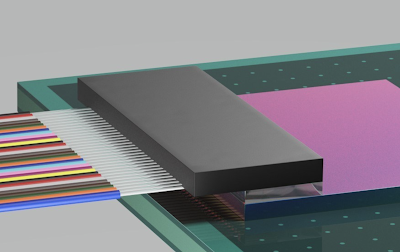
Under this collaboration, standard CMOS wafers that implement silicon photonics chips will be post processed using EVG's NIL technology to implement optical elements such as mirrors and lenses for Teramount's unique "self-aligning optics". This enables flexible beam extraction from the chips and easy connection to a large number of optical fibers. Furthermore, it enables wafer-level optical inspection capabilities for enhancing silicon photonics wafer manufacturing.

The collaboration is being carried out within EVG's NILPhotonics Competence Center at its headquarters in St. Florian, Austria. The NILPhotonics Competence Center provides an open access innovation incubator for customers and partners across the NIL supply chain to collaborate to shorten development cycles and time to market for innovative photonic devices and applications. Through the collaboration with Teramount, EVG provides process development and production services, as well as expertise in both CMOS and photonics manufacturing, thus accelerating the commercialization of Teramount's PhotonicPlug technology.

"Our joint work with EVG has been very successful in producing this innovative synergy between wafer-level optics and silicon photonics wafer manufacturing," said Hesham Taha, CEO of Teramount. "By offering this capability to the industry, Teramount solves one of the major hurdles to further adoption of optical connectivity, which is critical for so many applications that require high-speed data transfers and low power consumption."

"Teramount's PhotonicPlug silicon photonics packaging technology is a truly novel approach to improving optical performance, and we are excited to be a partner in helping to bring it to the market," stated Markus Wimplinger, Corporate Technology Development and IP Director at EV Group. "This is just the latest example of innovative technology developed with the support of EVG's process and equipment know-how through our NILPhotonics Competence Center, where we help our partners and customers turn new ideas into innovative products."

http://www.EVGroup.com

http://www.teramount.com

Nokia and AT&T target 5G uplink with distributed massive MIMO

AT&T is working with Nokia Bell Labs in testing distributed massive MIMO (DmMIMO) to significantly increases uplink capacity and speeds in 5G networks without requiring an overly complex solution. Specifically, Nokia is collaborating with AT&T on the validation of DmMIMO and testing the proof-of-concept technology in the AT&T labs. Bell Labs’s DmMIMO simulations have demonstrated increases in 5G uplink capacity between 60% and 90% compared to similarly configured systems with a single panel. While other techniques come at the expense of downlink capacity, DmMIMO would produce sizable increases in uplink capacity without sacrificing performance.

DmMIMO allows devices to leverage signal propagation to multiple cells or antenna panels in a network when establishing a link, thereby turning noise into a useful signal and increasing the uplink throughput. The data transmission is pieced together from multiple antenna panels and cell sites through distributed baseband processing. The processing load between the cell site radio units and the central processing unit is split in a novel way, reducing the fronthaul capacity to cell sites and hence lowering the cost.

Nishant Batra, Chief Strategy and Technology Officer, Nokia, said: “Addressing uplink speeds is becoming critical as consumers are increasingly becoming content creators as well as content consumers, video conferencing has become a cornerstone of the teleworking era, and many of the applications in the industrial internet of things require higher uplink speeds. When 5G-Advanced networks come online, we will see the network enhanced in multiple dimensions, expanding and extending its capabilities. Even today, with the focus on 5G mid-band spectrum rollouts in the U.S., there are opportunities for technologies like this that can maximize available resources. We feel distributed massive MIMO will be a critical element of networking in the 5G-Advanced era to help meet these demands with significant gains in uplink without a hit to downlink performance. Three decades ago, Bell Labs and AT&T invented MIMO, so it is only fitting that we continue this groundbreaking work together for the next generation of MIMO.”

Andre Fuetsch, Executive Vice President & CTO Network Services, AT&T, said: “AT&T and Nokia have a long history of working together on new network technologies, and I welcome this strategic collaboration for the development of distributed massive MIMO technology. Newer applications in the 5G-Advanced timeframe, such as eXtended Reality (XR), are expected to be more demanding on the uplink compared to regular broadband traffic. Technologies such as distributed massive MIMO show potential to improve uplink capacity in the right scenarios. DmMIMO is also a technology that shows potential for the next generation of wireless networks. Therefore, this strategic technology collaboration with Nokia may help provide learnings with long-term benefits to both companies.”


Nokia adds liquid cooling to AirScale base stations

Nokia has added a Liquid Cooling option to its AirScale base station portfolio. 

The company calculates that liquid cooling can significantly reduce the energy required to cool a base station. Cooling system energy consumption can be reduced up to 90 percent and base station CO2 emissions up to 80 percent compared to traditional active air-cooling systems. 

Commercial products will be available from Q3 2022. Nokia also announced that AT&T is piloting the solution in a live network trial in Philadelphia, U.S.

Joe Taylor, VP Implementation, Provisioning & Optimization at AT&T, said: “AT&T is committed to tackling climate change, enhancing the efficiency of our network, and reducing our operational carbon footprint. We’re pleased to work with Nokia as we take a more sustainable path and to trial its liquid-cooled base station in our network. We firmly believe that sustainability is one of the biggest factors impacting the world right now and is a key differentiator in business. We’re eager to continue aligning with like-minded, innovative companies like Nokia that are developing ground-breaking solutions to combat climate change.”

Tommi Uitto, President of Mobile Networks at Nokia, said: “There is no green without digital and the commercial availability of Nokia’s liquid cooling technology across our AirScale portfolio highlights our commitment to leading the industry to become more sustainable through digitalization. Our innovative, game-changing solution reduces energy consumption, costs, and carbon emissions and helps mobile operators become more environmentally responsible. 5G networks and technologies will play a critical role in making other industries more sustainable and we must all play our part to minimize our footprint and accelerate the use of green electricity.”