Tuesday, February 22, 2022

Infinera's ICE6 Turbo enables 4 x 400 GbE long-haul services

Infinera is rolling out a performance-optimized configuration of its 1.6T (2 x 800G) ICE6 coherent optical engine.

Infinera's ICE6 Turbo, which is produced in Infinera’s in-house, U.S.-based fabrication center, is the industry’s first coherent optical solution that can operate above 100 Gbaud.  This enables network operators to support 4 x 400 GbE services using a single optical engine across long-haul distances and 3 x 400 GbE services across ultra-long-haul distances, driving down the cost per bit of delivering high-speed optical services. ICE6 Turbo will be available in both C- and L-band variants.

Infinera said its ICE6 Turbo solution leverages the capabilities of the company’s unique monolithic indium phosphide-based photonic integrated circuit (PIC) technology. The new benchmark for optical performance set by ICE6 Turbo is enabled by the holistic co-design of the various optical engine components and pioneering optical networking features including second-generation Nyquist subcarriers, long-codeword probabilistic constellation shaping (LC-PCS), dynamic bandwidth allocation, and soft-decision forward error correction (SD-FEC) gain sharing.

“ICE6 Turbo builds on Infinera’s heritage of delivering innovative optical solutions that provide meaningful value for our customers,” said Ron Johnson, General Manager of Infinera’s Optical Systems & Network Solutions Group. “ICE6 Turbo further pushes the boundaries of optical performance, enabling our customers to rapidly scale their networks with industry-leading economics.”

https://www.infinera.com/press-release/infinera-ice6-gets-a-turbo-charge

Fastweb carries 600 Gbps wavelength across 1,372km with Infinera

Fastweb, one of the main telecom providers in Italy, completed a single-wavelength service connectivity speed trial of 600 Gb/s across its network, including the Milan-Bari optical route spanning 1,372 kilometers. The trial used Infinera’s fifth-generation ICE6 800G technology on the GX Series Compact Modular Platform. Infinera said its ICE6 solution enabled Fastweb to increase network capacity by up to two times. The ICE6 solution features...

Telia Carrier picks Infinera’s ICE6 800G solution for global network

Telia Carrier has selected Infinera’s ICE6 800G solution for Telia Carrier’s global network after completing a successful trial of the technology on Telia Carrier’s live number-one-ranked global network, AS1299. The decision to deploy Infinera’s ICE6 comes after a field validation trial on the 2,396-km link in the U.S. between Denver and Chicago. The trial was performed using Infinera’s innovative ICE6 technology over an existing third-party...

Open Eye Consortium releases 400Gbps and 800Gbps LR and SR spec

The Open Eye Consortium (Open Eye MSA) released two specifications:

  • 100 Gbps per lane, long reach, single-mode specification -  targeted for 4x100 Gbps WDM modules for three kilometers reach applications (400G-FR4-3). The specification enables the use of analog-based and DSP technologies to deliver lower cost, lower power and lower latency optical modules to address growing hyperscale data centers and AI-clusters requirements.
  • 100 Gbps per lane, short reach, multi-mode specification -  targeted for 400 Gbps SR4-Lite and 800 Gbps SR8-Lite applications. Optimized for lower power and lower cost solutions for high volume hyperscale data centers, the new specification defines 50 meter reach at 850 nm VCSEL wavelength over OM4 fiber, as well as 30 meter reach at 940 nm VCSEL wavelength over OM4 and OM5 fiber.

The specifications are optimized for low-power, low-cost solutions enabling hyper scale 400 Gbps and 800 Gbps data center connectivity. These new specifications complement the Open Eye MSA’s previously released single and multi-mode specifications.

In addition to these released specifications, the MSA has commenced work on multilane, 100 Gbps per lane, three-kilometer parallel single mode (PSM) fiber specifications optimized for hyperscale cloud data center connectivity. The MSA welcomes input from the end user community on these new specifications.

http://www.openeye-msa.org

MEF opens LSO Marketplace

MEF announced the launch of the LSO Marketplace, a set of resources designed to accelerate the evaluation and implementation of MEF Lifecycle Service Orchestration (LSO) APIs for automating service provider and enterprise business transactions. 

MEF also announced availability of the Celine LSO API Framework release, which adds a new service provisioning developer guide and features such as incident management and security profiles.

The LSO Marketplace includes:

  • LSO API Catalog – Includes API definitions, release information, developer guides, and test requirements
  • LSO Payloads – Schemas for MEF standardized products and services that can be managed with the APIs
  • Evaluation resources – Tools to help evaluate MEF APIs and build a business case for implementation
  • Implementation support – Tools, programs, groups, and resources to help accelerate API implementation

MEF also announced Celine, the third in the series of LSO API Framework releases. Celine provides new trouble ticketing uses cases and adds service provisioning and API security profiles. MEF also released new developer guides, including the LSO API Security Profile, LSO Payload Handbook, and an example implementation of dynamic binding.

“Leading global service providers are implementing MEF LSO APIs because they offer an automated, standardized way for service providers to buy and sell services while maximizing return on their investment in interface development,” said Daniel Bar-Lev, Vice President Strategic Programs, MEF. “With the availability of the LSO Marketplace, along with ongoing enhancements to MEF’s LSO SDKs, implementation is simplified and deployment is accelerated. Service providers can connect with partners faster to quickly bring new services to market that offer competitive differentiation to customers, and ultimately lead to faster time to revenue.”

https://www.mef.net/news/mef-lso-marketplace-accelerates-service-provider-automation/


Dell advances its open telecom solutions

Dell Technologies is introducing new telecommunications solutions and services to bolster the open telecom ecosystem and help communications service providers (CSPs) migrate to open, cloud-native networks. The announcement centers on its Dell Telecom Cloud Foundation, Dell Open RAN Accelerator and new telecom solutions and lab capabilities.

  • Dell Telecom Multi-Cloud Foundation is a turnkey, end-to-end network infrastructure solution that includes Dell hardware, Dell Bare Metal Orchestrator management software and choice of integrated telecom cloud software platforms, including Red Hat, VMware and Wind River. Dell is adding new Dell Bare Metal Orchestrator Modules to its software, giving CSPs the ability to deploy and lifecycle manage the entire cloud foundation stack. This provides a scalable cloud foundation spanning core, edge and RAN for their open hardware and software environment.
  • Dell Open RAN Accelerator Card  - this solution, which was developed in partnership with Marvell, is a new in-line 5G Layer 1 processing card for vRAN and Open RAN solutions. Designed for Dell PowerEdge and other x86-based servers, the PCIe accelerator card brings the same Marvell OCTEON Fusion technology and performance of today’s leading 5G radio networks to the Open RAN ecosystem. 

“Marvell is delighted to partner with Dell Technologies to enable an open, virtualized 5G RAN architecture that delivers advanced features and performance built on our proven OCTEON® Fusion platform,” said Raj Singh, executive vice president, Processors Business Unit at Marvell. “The new Dell Open RAN Accelerator Card is an innovative no-compromise, cloud-native, inline, Open RAN Layer 1 acceleration solution that addresses the shortcomings of existing vRAN alternatives.”

Dell also highlighted new telecom solutions for edge and core.

  • Dell Validated Design for Services Edge 1.2 brings together edge compute resources with private wireless connectivity, enabling the ease of deployment, scalable operations and security capabilities required for large numbers of edge locations. The open standards-based design now supports Airspan 5G RAN for a fast deployment of enterprise private 5G networks.
  • Dell Validated Design for the 5G Core with Oracle and VMware gives CSPs the choice to build a robust, scalable 5G core on industry standard infrastructure, in a more secure and reliable way. The solution can help reduce the time needed to design, test and integrate network components from multiple partners.
  • Dell ProDeploy for NFVI - a service that combines Dell factory integration and field deployment options to flexibly build the optimal NFV infrastructure specific to each customer’s network. The service integrates compute, networking and telecom cloud software platforms, helping CSPs deploy workloads faster and at scale, saving them time and cost. 


Deutsche Telekom and Ericsson demo 5G network slicing + SD-WAN

Deutsche Telekom and Ericsson demonstrated 5G end-to-end network slicing for latency-critical enterprise applications with guaranteed Quality of Service. 

The 5G slicing trial includes SD-WAN and end-to-end service orchestration afor latency-critical applications in different countries. This approach will be especially beneficial for global enterprises who run latency-critical applications in different international subsidiaries. 

In this trial, the QoS connectivity was extended from Germany to Poland using a 5G slicing setup that is based on commercial grade Ericsson 5G Standalone (SA) radio and core network infrastructure and a Deutsche Telekom commercial SD-WAN solution. The home operator-controlled User Plane Function (UPF) is placed in Poland as the visited country and the entire setup is managed by an Ericsson orchestrator integrated with a Deutsche Telekom business support system via open TM Forum APIs. Combining 5G slicing and SD-WAN technology allows flexible connectivity establishment and control, while traffic breakout close to the application server in visited countries enables low latency.

Deutsche Telekom said the trial also verified the radio resource partitioning (RRP) for enhanced RAN slicing. The trial achieved an efficient isolation and sharing of radio resources among network slices by isolating the radio resources into partitions that can be associated per network slice in a dynamic way. Each network slice can rely on the availability of a certain minimum allocation of radio resources, while unused capacity is dynamically made available to other network slices, thus maximizing the overall capacity of the system. For an operator, this enables delivery of high-value services with SLA assurance, while at the same time using valuable spectrum efficiently.

Alex Choi, SVP Technology Strategy & Innovation, Deutsche Telekom, says: “Network slicing is a key 5G enabler to deliver tailored connectivity services to enterprise customers. By flexibly combining 5G slicing with SD-WAN in an international setup, we can address the emerging need among enterprises for uniform global connectivity with guaranteed quality of service.”

Erik Ekudden, Senior Vice President, CTO and Head of Group Function Technology, Ericsson says: “Combining different technologies in an intelligent and flexible way across borders to address the emerging needs of globally operating enterprises is another proof point of the promise that a global 5G ecosystem can offer.” 

Vantage to build 16MW data center in Frankfurt

Vantage Data Centers disclosed plans to build the second of three facilities on its flagship 55MW EU campus (FRA1) located in Offenbach, Germany, just one kilometer from the main data centers and peering points in Frankfurt. This facility will include 16MW of critical IT capacity and 13,000 square meters (140,000 square feet) once fully developed and will open to customers in the first half of 2024.

In addition, Vantage has acquired full ownership of the first data center on this campus, buying out its joint venture partners Energieversorgung Offenbach (EVO) and DataCenter-Group (DCG). Vantage will continue in a new partnership with EVO as the energy provider and landowner of the campus. Terms of the deal are not being disclosed.

“Vantage continues to accelerate our growth in Frankfurt and Offenbach, the most sought-after data center markets in Europe, to meet demand from our hyperscale and cloud customers,” said Antoine Boniface, president of EMEA for Vantage Data Centers. “Our partnership with EVO and DCG was instrumental in opening this 

Furthering its commitment to be a responsible corporate citizen, Vantage, alongside EVO, will repurpose the waste heat from the new data center and make it available to the local community for heating purposes. This unique initiative supports Vantage’s sustainable construction goals and enables the company to make a positive impact in the region.

Vantage recently announced that it has also begun construction on a second campus in Frankfurt to meet increased customer demand. The two campuses combined will have 95MW of critical IT capacity in the Frankfurt region once fully developed. 

https://vantage-dc.com/data-center-locations/emea


KDDI implements Wind River Studio for O-RAN virtualized base station

KDDI implemented Wind River Studio for its O-RAN–compliant 5G stand-alone virtualized base station technology, which has recently launched on its commercial network.

Wind River Studio provides a cloud-native platform for the development, deployment, operations, and servicing of mission-critical intelligent systems. Its cloud infrastructure capabilities include a fully cloud-native, Kubernetes- and container-based architecture, based on the StarlingX open source project, for distributed edge networks at scale. Addressing the complexities of deploying and managing cloud-native vRAN infrastructure, Studio delivers a foundation for a geographically distributed, managed solution able to simplify Day 1 and Day 2 operations by providing single-pane-of-glass, zero touch automated management of thousands of nodes, no matter their physical location.

“5G opens up new opportunities, with greater intelligence and compute moving toward the edges of the network. Much of our future will be run on a virtualized, distributed cloud with low-latency, far edge cloud architecture to support new use cases in the new intelligent machine economy,” said Paul Miller, Chief Technology Officer, Wind River. “We are able to provide solutions to help prepare for a cloud-native future and deliver on high-reliability, ultra-low-latency, and highly efficient solutions for next-generation networks.”

http://www.windriver.com/studio

KDDI activates 5G Standalone Open RAN site powered by vRAN

KDDI activated the world's first commercial 5G Standalone Open Radio Access Network site powered by virtualized Radio Access Network in Kawasaki, Kanagawa and is now carrying live 5G traffic.KDDI is using Samsung's 5G virtualized CU (vCU) and virtualized DU (vDU) as well as Fujitsu's Massive MIMO radio units,Beginning with this site, in 2022, KDDI, along with Samsung and Fujitsu, will deploy this Open RAN in some parts of Japan and continue its deployment...


Aptiv to acquire Windriver for $4.3 billion

Aptiv, a leading supplier of automotive parts, agreed to acquire Wind River from TPG Capital, the private equity platform of global alternative asset management firm TPG, for $4.3 billion in cash.Wind River is a global leader in delivering software for the intelligent edge. Used on over two billion edge devices across more than 1,700 customers globally, Wind River’s software enables the secure development, deployment, operations and servicing of...

O-RAN Global PlugFest 2021attracts 144 corporate participants

The O-RAN ALLIANCE conducted its worldwide O-RAN Global PlugFest 2021 to demonstrate the functionality and multi-vendor interoperability of O-RAN based network equipment. The event was conducted in 7 global venues, with 94 participating companies. Many of the companies contributed to multiple venues, bringing PlugFest to a total of 144 active corporate participants compared to 70 at the 2020 PlugFest.“The expanded and diverse participation of...

Frontier offers 2 Gig Fiber Service to customers network-wide

Frontier, which operates in 25 states, is launching network-wide 2 Gig fiber internet service.

The residential offer includes symmetrical 2 Gig fiber speeds @ $149.99/mo + free next-gen total home Wi-Fi + free Amazon Fire TV + free webcam + free voice line + free activation + free premium tech support + free multi-device security.

The service is available across Frontier’s entire fiber footprint.

“We’re thrilled to become the first and only major ISP to deliver network-wide 2 Gig internet service, as we unleash the power of our fiber network,” said Nick Jeffery, President and CEO of Frontier. “Today is proof that Frontier is doing what customers want and cable can’t – bringing faster speeds and greater value to consumers as we Build Gigabit America.”

Sierra Wireless hits Q4 revenue of $149.9 million, up 24%

Sierra Wireless reported Q4 2021 revenue was $149.9 million, an increase of 24.4% year-over-year. 

Sierra Wireless said the improved performance was due to (i) strong demand; (ii) realization of previous investments in inventory in a supply constrained environment; and (iii) improved manufacturing flexibility with multi-factory production.

  • Gross margin was 32.5% as compared to 36.0% in the fourth quarter of 2020. The decrease was mainly driven by higher component costs as a result of the continued supply chain constraints as well as product mix. Operating expenses were $58.6 million, a decrease of 10.8% resulting from improved expense control measures.
  • Connectivity, software, and services revenue was $36.3 million, an increase of 11.3%. Monthly recurring revenue was $11.6 million in December, a year-over-year increase of 10.5%.


“We worked closely with our customers, partners and suppliers to deliver strong sequential and year-over-year revenue growth in the Fourth Quarter,” said Phil Brace, President and CEO of Sierra Wireless. "We continue to see strong demand for our solutions and we are working hard in a challenging environment to secure raw materials and deliver to our customers."


Monday, February 21, 2022

SEA-ME-WE 6 undersea cable system plans launch in 2025

The Southeast Asia-Middle East- Western Europe 6 consortium (SEA-ME-WE 6) selected Subcom for the supply and installation of a new 19,200 km undersea cable system connecting South East Asia, the Middle East, and Western Europe at 12 locations from Singapore to France. The system is expected to be ready for service by the first quarter of 2025.

SubCom will utilize SL17-SDM cable, supporting up to 24 fiber pairs (FP). Production of the cable and equipment will take place at SubCom’s manufacturing campus in Newington, NH, USA.

The system consists of three segments: an undersea segment from Tuas (Singapore) to Ras Ghareb (Egypt), a terrestrial segment from Ras Ghareb (Egypt) to Port Said (Egypt), and another undersea segment from Port Said (Egypt) to Marseilles (France). The fiber pair capacities for each network segment have been individually designed, together with the segment fiber pair counts, resulting in multi-Terabits end-to-end capacity whilst optimizing the overall system price.

SEA-ME-WE 6 will use Subcom's 18kV power source technology and is designed to maintain operations with single-end feed power in the event there is a far-end fault. Single-end power source capability is critical for the reliability and overall resilience of a system, particularly of extended length. SubCom’s system powering expertise and continued investment in research and development enables the company to support complex deployments requiring additional cable lengths.

To reliably support as much as 24FP on a trunk or branch port, SubCom will utilize its Enhanced Branching Unit (eBU), which provides flexible electrical power and optical fiber routing with shore-based telemetry control. The eBU latching power switching provides advanced internal management features for unit and user protection that include repair states, configurable restricted states, and a configurable power-down state that is selected for optimum system re- activation.

“SubCom is honored to drive the design, manufacture, and deployment of SEA-ME-WE 6, a system that will reach more than 11 countries and benefit hundreds of communities beyond,” said David Coughlan, CEO of SubCom. “We maintain the industry’s most advanced technology portfolio and marine installation capabilities, all of which will contribute to a successful project on behalf of the SEA-ME-WE 6 Consortium.

“With this new cable system, our partners will be able to meet and exceed capacity demands across multiple regions,” said Mr. Yue Meng Fai, Chairperson of the SEA-ME-WE 6 Management Committee and Senior Director, Consortium Cable Engineering, Singtel. “This new, reliable and resilient system encompasses some of the most advanced transmission technologies in the world and will improve access to services for everyone along this route.”

https://www.subcom.com/documents/2022/SEA-ME-WE_6_SubCom_CIF_21FEB2022.pdf


KDDI activates 5G Standalone Open RAN site powered by vRAN

KDDI activated the world's first commercial 5G Standalone Open Radio Access Network site powered by virtualized Radio Access Network in Kawasaki, Kanagawa and is now carrying live 5G traffic.

KDDI is using Samsung's 5G virtualized CU (vCU) and virtualized DU (vDU) as well as Fujitsu's Massive MIMO radio units,

Beginning with this site, in 2022, KDDI, along with Samsung and Fujitsu, will deploy this Open RAN in some parts of Japan and continue its deployment and development, embracing openness and virtualization in KDDI's commercial network.

While traditional RAN uses hardware-based equipment, this Open RAN site leverages fully-virtualized RAN software, provided by Samsung, that runs on commercial off-the-shelf (COTS) servers. Furthermore, by pursuing an open network approach between radio units and baseband unit, KDDI used Samsung's baseband and Fujitsu's Massive MIMO Units, which are connected with an open interface.

The virtualized network allows the use of general-purpose hardware (COTS servers) across the country, which will greatly increase deployment efficiencies. Additionally, by leveraging system automation, fully-virtualized RAN software can reduce deployment time, enabling swift nationwide expansion, including rural areas.

"Together with Samsung and Fujitsu, we are excited to successfully develop and turn on the world's first commercial 5G SA Open RAN site powered by vRAN. Taking a big step, we look forward to continue leading network innovation and advancing our network capabilities, towards our vision of delivering cutting-edge 5G services to our customers," stated Kazuyuki Yoshimura, Chief Technology Officer, KDDI Corporation.

TPG Telecom and Telstra reach network sharing deal in Australia

Telstra and TPG Telecom announced a ten-year regional network sharing agreement covering Telstra's Radio Access Network in defined territory.

The deal provides TPG Telecom with access to around 3,700 of Telstra’s mobile network assets, increasing TPG Telecom’s current 4G coverage from around 96 per cent to 98.8 per cent of the population.

Both carriers will continue to operate their own core network. Telstra will also obtain access to and deploy infrastructure on up to 169 TPG Telecom existing mobile sites, improving coverage for TPG and Telstra customers in the zone. TPG Telecom will decommission the 725 mobile sites it currently operates within the agreed area, reducing environmental impact, energy consumption, operating costs and future capex. The non-exclusive agreement includes the option for TPG Telecom to request two contract extensions of five years each.

TPG Telecom CEO Iñaki Berroeta said the landmark network sharing agreement would significantly expand TPG Telecom’s mobile network footprint in regional Australia and enable growth of its customer base in regional and metropolitan areas.

“It represents a material uplift in the capability of our network and will provide significant value for TPG Telecom shareholders over the medium and long term.

“We will be open for business in regional and rural Australia like never before, offering a 4G network that provides 98.8% population coverage and rapidly growing 5G coverage across the nation."

TPG Telecom notes that it will continue to operate its own 3G, 4G and 5G networks in metropolitan areas reaching around 80 per cent of the population, which includes its network infrastructure sharing arrangement with Optus in those areas.

https://www.tpgtelecom.com.au

T-Mobile and Deutsche Telekom launch T-IoT enterprise service

T-Mobile US and Deutsche Telekom introduced T-IoT, a comprehensive enterprise solution for global IoT connectivity, platform management and support. The service will be available across 188 destinations, on 383 networks worldwide.

Key features:

  • Worldwide network connectivity spanning NB-IoT, LTE-M, LTE, and 5G.
  • A single pane of glass to easily view, and eventually manage global IoT connections across several platforms, including T-Mobile Control Center and Deutsche Telekom M2M Service Portal, with T-IoT Hub.
  • A simplified procurement process that includes streamlined contract and billing, consistent global service level agreements, and customer support.
  • Flexible pricing with a pay-per-data model OR a choice of three flat-rate unlimited connectivity packages (T-IoT Unlimited Base, T-IoT Unlimited Premium, and T-IoT Unlimited Pro) across the U.S. and Europe, as well as value added services to serve connectivity needs for the lifetime of the device.

"One provider. One solution. That's 'making it simple' taken at its word," says Hagen Rickmann, Managing Director Business Customers, Telekom Deutschland. "Many industries, such as healthcare or automotive, depend on international supply chains. And their customers today rely on receiving service and assistance anywhere in the world. We're able to do that with this transatlantic collaboration, with our networks, for the best customer experience worldwide."

“With millions of connected Mercedes-Benz vehicles in nearly every corner of the world today, and up to 20 million connected cars in our fleet by 2025, we need be able to rely on telecommunications partners like T-IoT, that offer us global network coverage and an ecosystem for IoT leadership,” said Ola Källenius, Chairman of the Board of Management, Mercedes-Benz Group AG. “Real-time, high-bandwidth data transmission is key to digital innovation. 5G technology in IoT scenarios will allow our vehicles to communicate with the speed and reliability needed to offer our customers greater efficiency through improved routing and improved safety.”

SpaceX completes 38th Starlink mission

On February 21, SpaceX launched 46 Starlink satellites from Space Launch Complex 40 (SLC-40) at Cape Canaveral Space Force Station in Florida. The launch was southbound.

This was the 38th Starlink launch mission and the 11th flight for this Falcon 9 first stage booster, which previously launched Crew Demo-2, ANASIS-II, CRS-21, Transporter-1, Transporter-3, and now six Starlink missions.

The Falcon 9 was recovered on a drone ship.

ADVA FSP 3000 carries 400G over 10,000 km for FUNET and SUNET

CSC – IT Center for Science, which operates the Finnish University and Research Network (FUNET) and the Swedish University Computer Network (SUNET), transmitted data at 400 Gbit/s over more than 10,000km using the ADVA FSP 3000 TeraFlex CoreChannel.

The industry-first long-distance demo was conducted over a live flexgrid network, including both ROADMs and RAMAN amplifiers. Covering FUNET in Finland and Sweden’s SUNET network, the trial crossed international borders and achieved a reach of more than 10,000km. The trial solution used two 200Gbit/s streams to achieve 400Gbit/s data transport in a 200GHz window while delivering the highest levels of performance. It was built on ADVA FSP 3000 optical transport technology, which provides a truly open line system fully ready for open spectrum services. Other recent field trials conducted by FUNET using ADVA FSP 3000 TeraFlex technology include an industry-first demo of 800Gbit/s over a 2280km network and a successful trial of two 200Gbit/s streams in the 150GHz band able to transmit 400GbE services over more than 7,000km.

“Our multi-domain field trial with the ADVA FSP 3000 TeraFlex CoreChannel terminal evaluated flexibility and the terminal’s capabilities to adapt to use cases where ultra-long-haul 400GbE services are needed. The results that were achieved – trans-oceanic reach over terrestrial systems – were far beyond our expectations and typical real-life service requirements,” said Jani Myyry, senior network specialist at FUNET. “Nordic research and education networks are shifting towards a federated next-generation model where optical spectrum resources are shared within the region. We have already built multiple programmable cross-border interconnection links between the FUNET and SUNET ADVA open line systems to exchange spectrum transparently. The trial utilized these interconnection links and the FUNET and SUNET network footprint to create the extremely transparent optical routes used during the tests.”

http:/www.adva.com


Thailand's Nipa Cloud upgrades with Juniper

Nipa Cloud, a leading cloud services provider in Thailand, has selected Juniper Networks' EVPN-VXLAN solutions from Juniper Networks, including the QFX5120 Series Switches and MX10003/MX204 Series Universal Routing Platforms, to upgrade its campus and data center networks and better differentiate its offerings.

These upgrades allow Nipa to now deploy a common set of policies and services across campuses with support for Layer 2 and Layer 3 VPNs. In addition, Nipa is now able to better deliver enhanced throughput, scalability, capacity, performance and security – enabling Nipa to continue development of its ground-up cloud solutions, uniquely built for Thailand’s fast- developing enterprises and its rapidly transforming digital ecosystem.

“Thailand is amid a massive digital transformation, with consumers and enterprises alike accelerating their transition to the cloud. As our nation drives toward Thailand 4.0, it is key that infrastructure providers like Nipa Cloud adapt and transform to stay ahead of the pack. Through our partnership with Juniper Networks, we can introduce new infrastructure-as-a-service capabilities with multiple locations and lower cost of cloud. This will offer our customers and partners access to agile, cost-effective and secure services that will help drive sustainable growth in Thailand’s digital economy," states Dr. Abhisak Chulya, Founder and CEO, Nipa Cloud.

Thursday, February 17, 2022

HPE offers 5G RAN virtualized DU powered by Qualcomm accelerator

Hewlett Packard Enterprise (HPE) will deliver 5G distributed units powered by Qualcomm Technologies X100 5G RAN inline accelerator card and its HPE ProLiant DL110 Gen10 Plus Telco Server.

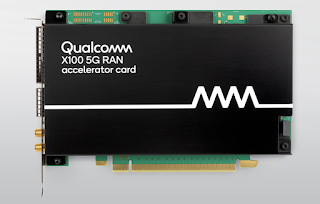
The Qualcomm X100 5G RAN accelerator card, which leverages a combination of DSPs and ARM CPUs, offloads Layer 1 and Layer 2 MAC functionality, including compute-intensive 5G baseband processing. 

HPE's 5G RAN virtualized distributed unit (vDU) solution is designed to support up to four high-performance accelerator cards in a small footprint 1U server, which lowers power consumption, even while supporting dense 5G mid-band and massive MIMO use cases. 

“HPE is looking forward to collaborating with Qualcomm Technologies to help address the rigorous and ever-changing demands of 5G,” said Tom Craig, general manager and vice president, communications technology group, Hewlett Packard Enterprise. “Our industry-leading HPE carrier-grade infrastructure integrated with Qualcomm Technologies’ innovative technology will further benefit our customers as they expand the deployment of their 5G networks.”

“We are excited for the opportunity to work with HPE to further the capabilities and efficiencies of 5G virtualized networks,” said Durga Malladi, senior vice president and general manager, 5G, mobile broadband and infrastructure, Qualcomm Technologies, Inc. “Through our collaboration with HPE, we are able to deliver enhanced, powerful and reliable 5G experiences to consumers.”

http://www.qualcomm.com/products/5g

Qualcomm intros 5G DU accelerator card

Qualcomm introduced its 5G DU X100 PCIe inline accelerator card with concurrent Sub-6 GHz and mmWave baseband support.

The accelerator card is designed to ease of deployment with O-RAN fronthaul and 5G NR layer 1 High (L1 High) processing. It plugs into standard Commercial-Off-The-Shelf (COTS) servers to offload CPUs from latency-sensitive and compute-intensive 5G baseband functions such as demodulation, beamforming, channel coding, and Massive MIMO computation needed for high-capacity deployments. For use in public or private networks, this accelerator card aims to give carriers the ability to increase overall network capacity and fully realize the transformative potential of 5G.


Qualcomm targets 5G RAN platforms

Qualcomm introduced a new family of chipsets targetting 5G infrastructure, ranging from macro base stations with massive MIMO to micro base stations with compact designs. There are new three new 5G RAN platform offerings: Qualcomm Radio Unit Platform, Qualcomm Distributed Unit Platform, and Qualcomm Distributed Radio Unit Platform. Qualcomm said it took a ground up approach is designing these chipsets to support leading mobile operators in the...


Vodafone and Qualcomm collaborate on O-RAN blueprint

Vodafone and Qualcomm are collaborating on a technical blueprint for more equipment suppliers to adopt Open Radio Access Network (Open RAN) technology. The goal is lower the entry barrier for many companies and drive diversification of network equipment vendors. The reference design will combine Vodafone’s engineering expertise at building high capacity, large-scale networks with Qualcomm Technologies’ leadership in developing high performance...


II-VI unveils pluggable OLS in QSFP for 400ZR/ZR+

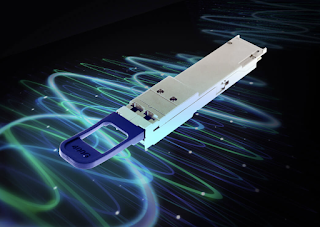
II‐VI introduced a pluggable optical line subsystem (POLS) in the small QSFP form factor for eight-channel 400ZR/ZR+ transport in datacenter interconnects.

II-VI’s new POLS product, the QSFP-LS, is designed in the very compact QSFP form factor that plugs directly into a switch or router QSFP port, transparent to the port speed, and enables full-duplex multichannel 400ZR/ZR+ transport, including multiplexing, demultiplexing, and variable-gain amplification. The QSFP-LS supports up to eight DWDM wavelengths at 400 Gbps, or 3.2 Tbps per fiber pair.

“In the last several years, we’ve led the industry in offering breakthrough solutions at scale of our miniature optical amplifier components, including our flagship 3-pin uncooled micropump. These components are now the building blocks that differentiate our POLS platform,” said Dr. Sanjai Parthasarathi, Chief Marketing Officer, II-VI Incorporated. “The QSFP-LS is one of our most advanced integrated products and the tiniest open line system on the market. It’s about one-fifth the size of similar amplifier module technology ten years ago and consumes one-third the power, enabling it to remain within the maximum power-dissipation requirements for any QSFP socket. Compared to similar functionality in a dedicated rack-mounted line system, the QSFP-LS consumes about half the amount of power, is about a fifth of the cost, and occupies orders of magnitude less space.”

II-VI expanded its industry-leading POLS platform by adding the QSFP-LS to the OSFP-LS, which was introduced in March 2020. The availability of POLS in both the QSFP and OSFP form factors provides a universal optical amplifier building block that is compatible with some of the most widely available plug-in sockets in switches and routers.

“With the original OSFP-LS and now the QSFP-LS available, we have a greatly simplified transport solution that eliminates the need for dedicated rack-mounted line systems, which will significantly reduce the number of network elements to be installed, powered up, configured,

and monitored,” said Martin Hull, VP of Platform Products at Arista Networks. “POLS technology represents a paradigm shift in datacenter interconnects that is complementary to and on par with the advent of 400ZR/ZR+ pluggable transceivers, in terms of greater equipment density, lower power consumption, and pay-as-you-grow flexibility that now extends to QSFP ports.”

https://ii-vi.com/news/ii-vi-incorporated-unveils-pluggable-optical-line-subsystem-in-qsfp-form-factor-for-400zr-zr-transport-in-datacenter-interconnects/

Ericsson refreshes its RAN portfolio

Ericsson announced a number of additions and enhancements o its radio access network (RAN) portfolioo, bringing sizable energy savings and up to ten-fold capacity increases – with minimal or no added footprint.  The new products are powered by next-generation Ericsson silicon.

Leading the portfolio enhancements is Radio 4490, a dual-band radio that delivers 25 percent lower power consumption and lesser weight compared to the current product. This radio type is compatible with most of the radio sites globally as it supports the main FDD (Frequency Division Duplex) bands being used by many service providers for their 5G deployment.

Ericsson is also launching a high-power version of the new dual-band radio, 4490 HP, which enables up to 50 percent more output power compared to current radios. The two new radios apply passive cooling – reducing power consumption further, as fans are not needed. They are also Cloud RAN-ready.

The portfolio additions also include:

  • Easy-to-install 64T/R Massive MIMO AIR 6428 for mid-band, with 400MHz bandwidth for efficient RAN sharing, in a single-person-carry 25kg radio
  • Highly integrated, multi-band Antenna 4602 – only 398mm wide, designed for best wind load durability and for maintained site build requirements
  • Next-generation Interleaved AIR 3218 with industry-leading low height and weight, enabling Massive MIMO rollouts without growing visual antenna footprint
  • Expanded Deep Sleep mode software for new radios and Massive MIMO portfolios. Consumes up to 70 percent less power per radio during low traffic hours
  • Coverage Boost is a versatile 5G carrier aggregation software that delivers 60 percent wider reach for mid-band TDD (Time Division Duplex) compared to dual connectivity. It supports RAN Compute and Cloud RAN platforms

Per Narvinger, Head of Product Area Networks, Ericsson, says: “We continue to evolve our RAN portfolio with more solutions for smart, slim and sustainable 5G networks. Our latest innovations will further optimize 5G sites for both purpose-built and Cloud RAN deployments.“

https://www.ericsson.com/en/press-releases/2022/2/ericsson-5g-portfolio-update-puts-energy-efficiency-center-stage

Kyndryl and Nokia form network and edge computing alliance

Nokia and Kyndryl (formerly IBM's managed infrastructure services business) formed  a global network and edge computing alliance aimed at helping enterprise customers accelerate their digital transformations with LTE and 5G private wireless networking.

The partnership, which has already resulted in private LTE and 5G real world deployments, combines Nokia Digital Automation Cloud (DAC) application platform with Kyndryl’s consulting, design, implementation and managed services. The solution is designed to support the move to Industry 4.0, which is transforming how companies manufacture and distribute their products by interacting with IoT, cloud computing, artificial intelligence (AI) and other advances to their environments and operations.

“As enterprises across every industry are seeking new ways to digitally transform their operations, 5G and edge computing are growing so they can harness the promise of these emerging technologies,” said Paul Savill, global practice leader of Network and Edge computing for Kyndryl. “By collaborating with Nokia, we’re taking another step forward in helping our customers unlock the power of LTE and 5G through a secure, private environment that helps them deliver tailored enterprise-grade edge solutions that drive new value for their bottom lines and next gen customer experiences.”

Chris Johnson, head of the Global Enterprise Business at Nokia, said: “By combining Kyndryl’s world-class services expertise and global reach with Nokia’s mission-critical, industry-leading private wireless and industrial edge computing solutions, we will enable even more organizations to transform their operations, accelerate their digitalization journey and reap the benefits of Industry 4.0.”

Kyndryl and Nokia also plan to explore and develop new, integrated solutions and services for Edge Cloud, IP networking, Optics, Fixed Access, 4G and 5G Core and Network Operations software technologies.


Kyndryl is IBM's managed infrastructure services business

IBM's board of directors approved the previously announced separation of the company’s managed infrastructure services business into a new company called Kyndryl.

Kyndryl's mission is to design, run and manage the most modern, efficient and reliable technology infrastructure for the world's most important businesses and organizations. The company will have 90,000 employees worldwide upon spin out from IBM.

To effect the separation the IBM board of directors declared a pro rata distribution to IBM stockholders of 80.1 percent of the outstanding shares of Kyndryl.  Once distributed, each holder of IBM common stock will receive one share of Kyndryl common stock for every five shares of IBM common stock held on October 25, 2021, the record date for the distribution.   The distribution is expected to occur after close of market on November 3, 2021. IBM will retain 19.9 percent of the shares of Kyndryl common stock, with the intention of exchanging those shares for IBM debt during the 12-month period following the distribution, subject to market considerations.