Thursday, November 11, 2021

Blueprint: Reimagining Metro Networks for Edge Computing and Beyond

by Julius Francis, Sr. Director, Product Marketing, Juniper Networks

As new advancements are made in 5G, Internet of Things (IoT) and edge computing, doors are opening for network operators to play a more prominent role in the delivery of next generation consumer and enterprise services. However, these opportunities come paired with new challenges. Specifically, these new services and requirements drive increased traffic and diverse traffic patterns throughout networks, demands that will have the most significant impact on metro networks. 

Metro networks will play an increasingly critical role in service delivery innovations; where all services accessing the network converge (e.g., mobile devices, laptops, gaming consoles, IoT devices and sensors, etc.). Traditionally, metro networks were built to funnel traffic into centralized edge and core resources – a characteristic that is rapidly evolving as edge service technologies are increasingly virtualized and instantiated across new cloud resources. The result is more efficient use of metro facilities as more and more workloads remain in the metro reducing latency and improving user experiences. As a result, metro traffic is projected to grow four times faster than anywhere else in the network by 2025.  

To leverage this opportunity, network operators must rethink how metro networks are architected to unleash new digital experiences – from how they’re designed, to how they’re used, to how their resources are allocated. And operators must fully embrace automation to make this new level of orchestration possible. Focusing on this transformation will help operators deliver better user experiences, helping them play a more prominent and profitable role in the digital ecosystem.

Drivers of Change

Over the next five years network traffic growth will continue, driven largely by the increased adoption, virtualization and prominence of edge applications. Cloud computing resources are increasingly being deployed across cloud resources in parallel with the metro, moving the execution of edge services from regional data centers to the cloud – a trend that is expected to increase over the next decade. Many next-generation edge applications and services require low latency and customized SLAs, which legacy networks based on regional data centers may struggle to provide. 

Further, the proliferation of high-quality and mobile video content will increase demands on metro networks. Video content will increasingly be cached within the metro and distributed to users locally rather than from central cache locations within the core. 

As new distributed 5G and edge services push more workloads out to distributed cloud resources, existing metro networks built for conventional networking will no longer be sufficient to leverage the benefits associated with cloud-based edge computing. All of these issues are driving the need for change in network architecture, infrastructure and operation. 

Reimaging Metro Network Design

Many legacy metro networks are designed using ring topologies, which enable metro networks to carry traffic from access nodes, across an aggregation network, to regional data centers. While there are many instances where the ring design can solely provide adequate performance, operators are turning to a new industry trend to achieve the flexibility and agility needed to handle increasing network traffic and fully leverage the advantages of edge computing – the ring topology paired with spine-leaf. In a spine-leaf topology, each network element has a dedicated connection point, which reduces the transit traffic and throughput requirements on each device. Therefore, this combination provides more scalable, flexible and resilient bandwidth and allows metro networks to handle higher rates of traffic and bandwidth needs while leveraging the power of two topologies. 

By reimagining their metro network design, operators can future proof their organizations for the challenges of the 5G, IoT and cloud era. To attain a next-generation metro network, network operators must stay laser focused on achieving the following:

  • New network architectures. To keep pace with shifts in metro network requirements and support the dramatic growth in traffic, metro topologies can leverage ring topologies, spine-leaf topologies, or a hybrid of both networking architectures.
  • Scalability and flexibility. To achieve elastic scalability, new routers and network architectures with scalable bandwidth, real-time service monitoring and control, and end-to-end automation must be implemented.
  • Service and application intelligence. Next-generation metro networks leverage network slicing to intelligently steer traffic to the right physical and virtualized resource by identifying the most efficient path across the network to optimize user experience. Future-proofed metro networks must have cloud computing levels of orchestration and automation to keep pace with evolving services, applications and user expectations.
  • End-to-end automation. Network automation is necessary to reduce complexity and help engineers manage the increased traffic load and simplify operations. Manual operations are no longer capable of keeping pace with the dynamics of a next-generation metro network.
  • Converged multiservice metro networks. To manage the increasing scope, scale and complexity onto one common network, next-generation metro networks will need to eliminate siloes from legacy networks to focus less on process and more on end-user outcomes.

Metro Networks for Next-Gen 5G, Edge and IoT Services 

The 5G, IoT and cloud era brings incredible opportunity in every market vertical, but there will be growing pains along the way. The key to addressing new bandwidth, latency and orchestration challenges will be for operators to advance and modernize their network architecture. A metro network designed for yesterday’s static transport and aggregation needs simply won’t be capable of supporting the service delivery needs of 2021 and beyond.

By incorporating architectures built for automation and scale, metro networks that offer flexible network slicing, service-aware technologies and cloud-scale capabilities, will exceed user expectations for every service they deliver—while reducing the complexity of operations.

ADVA positions FSP 3000 OpenFabric1200 for 400G metro aggregation

ADVA introduced its FSP 3000 OpenFabric1200 for 400G metro aggregation.

The FSP 3000 OpenFabric Series combines open 400 Gbps pluggable coherent technology with OTN switching on a blade, enabling client services to be groomed into 400 Gbps wavelengths. The platform features 1200 Gbps interface capacity and supports Ethernet and OTN services from 10 Gbps to 400 Gbps.

ADVA says the open switchponder card can be added to any network without requiring additional adaptors. In addition, the FSP 3000 OpenFabric1200 can work in multiple operation modes: ADM on a blade, DWDM muxponders, or OTN cross-connect. 

“The strain on today’s transport infrastructure is growing like never before. Today’s operators need new solutions that can meet rapidly rising data demand while also driving down costs. That’s why we’ve developed our FSP 3000 OpenFabric1200. It offers a simple way to dramatically increase fiber efficiency by supporting lower-speed service grooming at the network edge. By deploying OpenFabric1200 in ring or hub-and-spoke topologies, operators can significantly reduce switching and cross-connect requirements in the core,” said Christoph Glingener, CTO, ADVA. “What’s more, our open Terabit-scale switchponder solution can be easily added to any network.”

https://www.adva.com/en/newsroom/press-releases/20211111-adva-launches-new-traffic-grooming-solution-to-reduce-metro-costs

Marvell shipping SONiC-enabled switch silicon to tier-1 clouds

Marvell confirmed that it is shipping SONiC-enabled production switch silicon of its Teralynx 9K and Prestera 8K devices in high-volume to tier-1 cloud customers. 

Marvell's Teralynx and Prestera devices support Switch Abstraction Interface (SAI) and Software for Open Networking in the Cloud (SONiC), which is an open-source network operating system (NOS) based on Linux. 

Marvell says SONiC running on its Teralynx and Prestera switch silicon brings greater flexibility and choice to cloud data centers grappling with the demand for greater bandwidth as data growth continues to surge.

"Marvell remains deeply committed to open systems and will continue to invest in and support SONiC solutions for our customers," said Guy Azrad, senior vice president and general manager, Switch Business Unit at Marvell. "Marvell's high-volume shipping of SONiC-enabled production switch silicon to tier-1 cloud providers showcases our technology leadership in combining our advanced packet processing architecture with the power of an agile, open network operating system."

"We have deployed Teralynx based switches in production across multiple data centers with the SONiC network OS. These switches deliver high performance, low-latency and rich telemetry required to run modern applications in our infrastructure," said Shawn Zandi, head of Network Engineering at LinkedIn. "With Innovium's acquisition by Marvell, we look forward to benefiting from greater investment into the Teralynx roadmap and Marvell's continued commitment to SONiC."

"Celestica delivers open disaggregated solutions that offer customers flexibility and compelling total cost of ownership," said Gavin Cato, VP, Celestica Hardware Platform Solutions. "We have been collaborating with Marvell to build high performance switch systems that are now deployed at scale by top cloud service providers, addressing the ever increasing need for bandwidth."

"Edgecore looks forward to the continued collaboration with Marvell to bring leading networking solutions for our service provider, data center, and enterprise customers," said Heimdall Siao, president of Edgecore Networks. "With Marvell's technology and Marvell's proactive support of the open SONiC software ecosystem, Edgecore is able to provide high performance and cost-effective solutions using community based open networking solutions which allows our customers and partners to achieve more."

https://www.marvell.com/company/newsroom/marvell-shipping-high-volume-sonic-enabled-production-switch-silicon-into-tier-1-clouds.html

Credo pushes LP SWITCH Active Electrical Cable to 200G

Credo announced the 200G HiWire LP SWITCH Active Electrical Cable (AEC) for connecting servers to to two Top-of-Rack (TOR) switches for hitless failover. The solution architecture was jointly announced in July 2021 by Credo and Microsoft, whose SONIC Dual TOR Management Container controls the SWITCH AEC.

The HiWire LP SWITCH AEC 200 has QSFP56 (Quad Small Form Factor Pluggable) connectors with integrated Credo PCS termination. The cables support 50G, 100G, and 200G with optional speed-shifting between 56G PAM4 and 28G NRZ lanes on both the NIC and TOR ends. The new 200G AECs join Credo’s diverse HiWire family for 100G, 200G, 400G, and 800G systems.

“Thanks to Credo’s advanced purpose-built SerDes architecture, our 200G LP SWITCH AEC has doubled its speed in the last six months while staying inside the same power envelope.”

Data processing and storage power can be monetized but not the power consumed for data transport. Credo’s low-power LP SWITCH AECs help minimize data transport power and enable data center architectures that eliminate redundant failover server racks.

“Power is the most important and most difficult parameter to control in hyperscale networking,” said Don Barnetson, Vice President of Product, AECs at Credo. “Thanks to Credo’s advanced purpose-built SerDes architecture, our 200G LP SWITCH AEC has doubled its speed in the last six months while staying inside the same power envelope.”

“As NIC speeds increase rapidly in the hyperscale datacenter, reliability must not be compromised,” said Lihua Yuan, Partner Development Manager at Microsoft. “Credo’s 50G and 100G HiWire LP SWITCH AECs are already proven and up-streamed in SONiC with the 200G LP SWITCH AEC creating a path for next-generation NIC speeds in 2022.”

“Emerging trends such as AI and 5G are driving exponential growth in the performance demands of the modern data center,” said David Iles, Senior Director of Ethernet Switches at NVIDIA. “The NVIDIA Networking platform equips innovators as Credo with the network bandwidth and low latency required to supercharge the modern data center with breakthroughs such as the HiWire LP SWITCH AECs.”

"Reliability is more critical for telecommunication service providers than for hyperscalers," said Keyur Patel, Founder and CTO, Arrcus. “Credo’s HiWire LP SWITCH AECs provide 5x9s (99.999%) rack reliability and enable us to ensure autonomous high availability (HA) from the Arrcus Connected Edge (ACE) platform with a sub-microsecond failover."

https://www.credosemi.com/credo-hiwire-lp-switch-aec-active-electrical-cable

SFP-DD MSA issues two specs

The Small Form Factor Pluggable Double Density (SFP-DD) Multi-Source Agreement (MSA) Group has released updated 5.0 hardware specifications and drawings for the SFP-DD, SFP-DD112, and SFP112 pluggable modules. 

This revision enables SFP112 operating at 112 Gbps and SFP-DD112 operating at an aggregate rate of 224 Gbps; aligning with next generation higher speed networking, storage and access equipment. This new revision also includes an SFP112 module specification to ensure the industry roadmap from SFP28/SFP56 to SFP112 and SFP-DD to SFP-DD112 maintain overall compatibility.

SFP-DD MSA revision 5.0 hardware specification includes significant signal integrity enhancements to address 112 Gbps differential signaling. Three new clauses have been added as follows: Chapter 5 for SFP112 electrical and management interface requirements, Chapter 8 for SFP-DD 112G mechanical and board definition, and Chapter 9 for SFP112 mechanical and board definition. In addition, the new revision includes an ePPS/Clock signal definition for SFP-DD/SFP-DD112. Lastly, TS-1000 Normative Module and Connector performance requirements for SFP112 were added into Appendix A.

SFP-DD MSA promoters include Alibaba Group, Broadcom, Cisco, Dell Technologies, Hewlett Packard Enterprises, Huawei, II-VI Incorporated, Intel, Juniper Networks, Lumentum, Molex, Nvidia and TE Connectivity. Contributors include Accelink, Amphenol, AOI, Eoptolink, Foxconn Interconnect Technology, Fourte International, Genesis Connected Solutions, Hisense Broadband, Infinera, InnoLight, Maxim Integrated, Multilane, Nokia, Senko, Source Photonics, US Conec, Yamaichi Electronics, and ZTE.

http://www.sfp-dd.com

FCC announces over $700M in RDOF funding in 26 States

The FCC is ready to authorize $709,060,159 in its fourth round of funding for new broadband deployments through the Rural Digital Opportunity Fund.  

The 26 states slated for funding include Alabama, Arizona, California, Florida, Georgia, Illinois, Indiana, Iowa, Kentucky, Louisiana, Michigan, Minnesota, Mississippi, Missouri, Montana, New Hampshire, New York, North Carolina, North Dakota, Oregon, South Dakota, Tennessee, Texas, Virginia, West Virginia, and Wisconsin.  The bulk of today’s funding will go to nonprofit rural electric cooperatives to deploy broadband throughout their service areas.   

“This latest announcement highlights the agency’s commitment to supporting even more opportunities to connect hundreds of thousands of Americans to high-speed, reliable broadband service while doing our due diligence to ensure the applicants can deliver to these unserved communities as promised,” said Chairwoman Jessica Rosenworcel.  “This program can do great things to help expand broadband in our country.” 

Together with three prior funding wave announcements, the Commission has now announced over $1.7 billion in funding to winning bidders for new deployments.  In this funding wave, 50 broadband providers will bring broadband service to over 400,000 locations in 26 states.

https://www.fcc.gov/auction/904


Biden signs Secure Equipment Act

President Biden signed into law the “Secure Equipment Act of 2021,” which requires the Federal Communications Commission to adopt rules clarifying that it will no longer review or approve any authorization application for equipment that poses an unacceptable risk to national security.

The bill would prevent further integration and sales of Huawei, ZTE, Hytera, Hikvision, and Dahua – all Chinese state-backed or directed firms – in the U.S. regardless of whether federal funds are involved.

In 2020, the FCC adopted new rules to require U.S. telecommunications carriers to rip and replace equipment provided by Huawei, ZTE, and other covered companies that pose a risk to U.S. national security. 

In October, when the bill passed the House of Representatives, the following statements were released.

Rep. Anna Eshoo (D, California): "I’ve fought for over a decade to address vulnerabilities in our telecommunications infrastructure that directly impact our national security. Equipment made by Huawei and ZTE, companies linked to the Chinese government, increase the vulnerabilities of our telecommunication systems and put the U.S. at risk. I'm so pleased that the House passed bipartisan, bicameral legislation that Rep. Scalise and I co-authored to prohibit the FCC from issuing licenses for any telecommunications equipment made by Huawei or ZTE.”

Rep. Steve Scalise (R-La.): "It was good to see both parties come together to strengthen America’s security against Chinese cyber attacks when the House overwhelmingly passed the Secure Equipment Act that I wrote with Rep. Anna Eshoo. The Secure Equipment Act, H.R. 3919, will prevent China from infiltrating America’s telecommunications networks and threatening the safety and national security of the American people when sending data across the internet. By prohibiting the FCC from issuing any equipment licenses to companies identified as a threat to our national security, this bill prevents compromised Chinese equipment from threatening America’s networks. The Secure Equipment Act sends a strong signal to the Chinese Communist Party that America is committed to securing our networks and protecting the privacy and safety of our citizens."

KIOXIA ships native Ethernet Flash-Based SSDs

KIOXIA America is now shipping its new EM6 Series Enterprise NVMe-oF™ solid state drives (SSDs) for Ethernet Bunch of Flash (EBOF) systems. 

The drives use the Marvell 88SN2400 NVMe-oF SSD converter controller that converts an NVMe SSD into a dual-ported 25Gb NVMe-oF SSD

KIOXIA says the platform exposes the entire SSD bandwidth to the network.

EM6 Series Key Features

  • Single or dual 25Gb Ethernet and RoCEv2 network connectivity
  • NVMe-oF 1.1 and NVMe 1.4 specification compliant
  • 2.5-inch 15mm Z-height form factor
  • 1 DWPD endurance with 3,840 GB, 7,680 GB capacity options

www.kioxia.com

Wednesday, November 10, 2021

2021 OCP Global Summit - the next 10 years

This year is the tenth anniversary of the Open Compute Project, an organization that has advanced the cause of "vanity free" infrastructure for cloud providers. The mission is broadening and the next 10 years will see advances in additional domains. Here is a 2-minute perspective from Rebecca Weekly, Board Chair, Open Compute Project.

https://youtu.be/xeU8WsVscAs

For more video interviews with industry experts, visit: https://nextgeninfra.io/

Meta’s Minipack2 is powered by Broadcom's Tomahawk 4 silicon

Broadcom confirmed that Meta is now deploying the 25.6 Tbps StrataXGS Tomahawk 4 switch in its data center network fabric.

The Tomahawk4 is now shipping in high volume in Meta’s Minipack2 platform.

“Broadcom is pleased to support Meta and its ecosystem partners on the transition to a leading-edge 25.6Tbps networking fabric,” said Ram Velaga, senior vice president and general manager, Core Switching Group, Broadcom. “Our multi-year collaborative effort has resulted in the successful integration of multiple generations of the marketplace’s highest bandwidth Tomahawk switch chip into Meta’s industry- leading Wedge400 and Minipack2 networking platforms.”

The Tomahawk4 family has been shipping in volume for over one year. Members of the Tomahawk4 family, currently in production, include the Tomahawk4-50G, Tomahawk4-100G and Tomahawk4-12.8T.

The Broadcom Tomahawk3, the Tomahawk4’s predecessor, has been shipping in production since 2018. It has been deployed in Meta’s previous and current generation platforms. 

In addition to Tomahawk4, Minipack2 uses Broadcom’s 7nm Barchetta2, a 16×56-Gb/s full-duplex PHY, featuring demonstrated interoperability with Broadcom merchant switches and ASICs. This 400G/200G/100G retimer is designed with industry-leading 56-Gbps PAM4 Serdes architecture that supports greater than 30dB of insertion loss on both host and line interfaces. 

https://www.broadcom.com

Broadcom samples 100G/lane Optical PAM-4 DSP PHYs

Broadcom announced its 100G/lane optical PAM-4 DSP PHY families with integrated transimpedance amplifier (TIA) and laser driver, the Jesko BCM8741x and Gemera BCM8781x, optimized for 400G DR4/FR4 and 800G DR8/2xFR4 module applications, respectively. 

The new, highly integrated PHYs, which are built on Broadcom’s proven 112G PAM-4 DSP platforms, can be used to power 7W 400G DR4/FR4 and sub 14W 800G DR8/2xFR4 optical modules.

Highlights

  • 400G and 800G DSP PHYs with integrated TIA and high-swing laser driver deliver best-in-class module performance in BER and power consumption
  • Enables industry’s lowest power 400G and 800G pluggable optical modules
  • Compliant to all applicable IEEE and OIF standards, capable of supporting MR links on the chip to module interface
  • Powers Silicon Photonics (SiPh) as well as discrete EML/PD based modules
  • Drives higher density and bandwidth with hyperscale cloud networking data centers

“Ever increasing compute density and networking bandwidths demand unrelenting quest for lower power, cost and form factor reduction,” said Vijay Janapaty, vice president and general manager of the Physical Layer Products Division at Broadcom. “Broadcom’s innovative and highly integrated optical DSPs drive industry leading optical module solutions that meet the roadmap needs of our hyperscale cloud customers.”

“Networking and compute advances continue to push the boundaries of the power, performance and cost of optical modules,” said Adit Narasimha, vice president and general manager of Optoelectronics at Molex. “Molex’s PAM-4 optical modules pair the advantages of Broadcom’s highly integrated DSPs with the high performance of Molex’s SiPh ICs to deliver extremely low power, high performance and cost-effective solutions that will serve the industry’s multi-generational needs.”

https://www.broadcom.com/company/news/product-releases/59716

Inspur and Samsung build open storage solution for OCP

Inspur Information, which ranks among the world’s top 3 server manufacturers, and Samsung announced a Poseidon V2 E3.x reference system for the Open Compute Project community.

This product adopted composable architecture to maximize the benefits of EDSFF E3.x form factor.  Poseidon V2 system can accommodate not only the PCIe Gen5 SSDs but also various devices like AI/ML accelerators or CXL Memory Expanders.  Data center users can configure the system according to application's needs.


“Following the development of the E1.S reference system, we expect that this type of storage solution will become one of the most sought-after and cost-effective storage solutions on the market for leading cloud data center servers and hyperscale companies that operate large data centers,” according to Jongyoul Lee, Executive Vice President of Samsung’s Memory Software Development Team. “We are eager to continue our collaborative work on the E3.S reference system with Inspur to drive further advancements in future server and storage systems.”

“Through our combined vision with Inspur's general purpose server design and Samsung's Poseidon, we believe E1.S and E3.x will bring a revolutionary use case that fulfills the need for an efficient high-performance and high-density storage system,” stated Alan Chang, VP of Technical Operation at Inspur Information. “Customers who use general purpose severs as their compute can smoothly transition to Poseidon whose modularized design will reduce redundant engineering and validation across the board. We anticipate even broader usage models and applications with the new Poseidon v2 specification.”

https://www.inspursystems.com

Windstream Wholesale cites progress with 400G

Windstream Wholesale  is expanding its 400 Gigabit wave offerings to meet rapidly growing customer demand for high-bandwidth solutions. The carrier cited several milestones:

Windstream and Infinera were the first to successfully demonstrate 400 Gig client-side services in April 2020 with commercially available ultra-efficient 400GbE-LR8 QSFP-DD compact pluggable interfaces.

In February 2021, Windstream announced that it had deployed 400 Gbps single-wavelength transmission across its long-haul network using Acacia Communications’ pluggable modules. These modules will drive high-capacity optical connections to the network edge to deliver ultra-fast speeds to more end-users than ever before.

In October 2021, Windstream announced that it had partnered with II-VI to co-develop next-generation transceivers that will streamline deployment of 400 gigabit services while significantly reducing costs, power consumption and network complexity.

“Windstream Wholesale has a robust nationwide network with 400 Gigabit waves available to more than 30 sites already in service and more coming online by year’s end,” said Joe Scattareggia, executive vice president of Windstream Wholesale. “Large wholesale and hyperscale customers are looking to deploy high-bandwidth solutions at a lower cost per bit, and our multi-layer open network architecture enables us to deliver these solutions in a way that is fast and flexible and meets their needs.”


LINX installs Nokia's 7750s routers with 400GE around London

LINX, the UK’s leading interconnection and peering community, will install Nokia's 400GE IP edge routing platforms to connect its 950+ membership. 

The installation includes Nokia's 7750 SR-7s edge routers deployed by LINX in three locations around London, providing greater bandwidth and higher density than its existing solution.

The platforms will allow LINX to support services at speeds of up to 400GE initially with the ability to seamlessly grow capacity and scale to higher speeds in the future. LINX will benefit from Nokia FP silicon that ensures network performance and capabilities such as traffic engineering do not degrade as network traffic levels increase.

Richard Petrie, CTO and Executive Director at LINX, said: “Our partnership with Nokia highlights LINX’s commitment to delivering high-speed IP interconnection and peering for its members. The scalability and capabilities of Nokia’s IP routing platforms and the integration with our automation platform will enable us to respond to our members’ needs more quickly, offering them better connectivity, improved network performance and more control.”

Manuel Ortiz Fernandez, Senior Vice President of EMEA Webscale business at Nokia, said: “LINX is experiencing greater demand for its market-leading interconnection services than ever before. We are pleased LINX has chosen Nokia’s market-leading 400GE IP routing technology to help ensure its infrastructure is as up to date as possible and that it remains at the forefront of the IXP industry.”


Rockley Photonics is working with Caltech on health monitoring

Rockley Photonics has kicked off a research collaboration with Caltech’s Sensing to Intelligence (S2I) Center that will focus on the development of next-generation solutions that combine advanced sensors with artificial intelligence. 

The S2I Center seeks to bring together two typically isolated disciplines — the field of sensing and imaging and the field of computation and algorithms — by adopting a holistic, interdisciplinary approach. The goal of bringing these two fields together is to develop more powerful and intelligent sensing systems and is wholly aligned with Rockley’s approach to health and wellness monitoring, which combines photonics-based sensor technologies with state-of-the-art artificial intelligence (AI) and data analytics.

Through its investment in S2I, Rockley plans to support a range of projects, including the development of new integrated spectrometer technologies using advanced photonics sensors. Researchers in the S2I center will explore and further analyze the relationship between spectral data and individual biomarkers to broaden and enhance the health monitoring capabilities and will utilize Rockley’s platform in the process.

Rockley Photonics and Caltech have collaborated previously on research projects including co-packaged optics and the co-design and integration of advanced photonics and electronics. This new agreement deepens an already strong association.

“Over the years, we have had a wonderful relationship with our Pasadena neighbors at Caltech, and it is an honor to continue our research agreement with them through the S2I Center,” said Dr. Andrew Rickman, chief executive officer and founder of Rockley Photonics. “Caltech has a strong history of supporting the development of health-related technologies, including Professor Arnold Beckman’s invention of the DU spectrophotometer, which was hailed as perhaps the most important instrument ever developed toward the advancement of bioscience. This new partnership will combine our experience building Rockley’s unique biomarker sensing platform, which incorporates a spectrophotometer-on-a-chip, with Caltech’s extensive research capabilities. We are happy to be working with Caltech once again to push the boundaries of bioscience even further.”

https://rockleyphotonics.com/

Rockley Photonics unveils spectrophotometer-on-a-chip module

Rockley Photonics revealed its complete full-stack, “clinic-on-the-wrist” digital health sensor system based on its own spectroscopy technology. Rockley’s sensor module generates a large number of discrete laser outputs from a single silicon chip covering a broad optical band. The sensor non-invasively probes beneath the skin to analyze blood, interstitial fluids, and various layers of the dermis for constituents and physical phenomena of interest. The company says its device delivers several milliwatts of optical output power per wavelength channel, which is key to achieving the high signal-to-noise ratio required for signal analysis from a small wearable.

Rockley’s full-stack sensing solution features a wristband that contains the sensor module and communicates with custom cloud-based analytical engines via a Rockley smartphone app. The wristband will be used in a sequence of in-house human studies in the coming months.

“Our full-stack sensor solution, which brings together optical and electronic hardware, firmware, algorithms, and cloud-based analytics, is an exciting milestone on our roadmap. Our reference designs will significantly aid our customers and partners with the deployment of our technology and accelerate their own scalable, high-volume product delivery,” said Dr. Andrew Rickman, chief executive officer and founder of Rockley Photonics. “We believe that combining machine learning algorithms with continuous monitoring of an extended set of biomarkers from accessible wearable devices will provide new actionable insights to enhance and transform digital healthcare.”

https://rockleyphotonics.com/

Samsung announces 2.5F Hybrid-Substrate Cube packaging

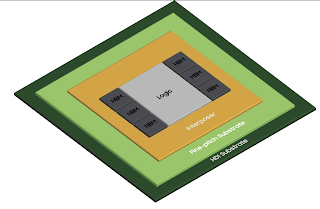
Samsung Electronics introduced Hybrid-Substrate Cube (H-Cube) technology, its latest 2.5D packaging solution specialized for semiconductors for HPC, AI, data center, and networking chips that require high-performance and large-area packaging technology.

2.5D packaging enables logic chips or high-bandwidth memory (HBM) to be placed on top of a silicon interposer in a small form factor. 

Samsung said its H-Cube technology features a hybrid substrate combined with a fine-pitch substrate which is capable of fine bump connection, and a High-Density Interconnection (HDI) substrate, to implement large sizes into 2.5D packaging.

“H-Cube solution, which is jointly developed with Samsung Electro-mechanics (SEMCO) and Amkor Technology, is suited to high-performance semiconductors that need to integrate a large number of silicon dies,” said Moonsoo Kang, senior vice president and Head of Foundry Market Strategy Team at Samsung Electronics. “By expanding and enriching the foundry ecosystem, we will provide various package solutions to find a breakthrough in the challenges our customers are facing.”

“In today’s environment where system integration is increasingly required and substrate supplies are constrained, Samsung Foundry and Amkor Technology have successfully co-developed H-Cube to overcome these challenges,” said JinYoung Kim, senior vice president of Global R&D Center at Amkor Technology. “This development lowers barriers to entry in the HPC/AI market and demonstrates successful collaboration and partnership between the foundry and outsourced semiconductor assembly and test (OSAT) company.”


https://www.samsungfoundry.com


Telia deploys Nokia's 5G SA core first in Finland

Telia has deployed Nokia's 5G Standalone (SA) Core network in Finland enabling advanced 5G services like slicing.

Nokia is also in the process of rolling out its 5G SA Core for Telia in Denmark, Estonia, Lithuania, Norway and Sweden.

The rollout in Finland includes Nokia’s cloud packet core and registers, which allows subscriber data to be consolidated into a common repository using a distributed and flexible architecture. Telia is also using Nokia’s Radio Access Network.

Nokia is leading the 5G SA Core market, with over 80 CSP and enterprise customers around the world; that includes nearly 30 CSPs in Europe. In addition, 25 of the top 40 service providers by revenue rely on Nokia core network products.

Jari Collin, Telia Finland CTO, said: "We are now taking the most significant step forward since the launch of 5G, as SA enables all the revolutionary features of 5G. Thanks to our cooperation with our trusted partner Nokia, Finland will keep its position as a leading mobile country in the world.”

Fran Heeran, SVP & Head of Core Networks, Cloud and Network Services, Nokia, said: “We are delighted that Nokia’s 5G SA Core is now live for Telia in Finland. This provides Telia with the industry’s leading Core Network technology, enabling the rapid rollout of advanced 5G services to its customers. Our work continues with this longstanding Nokia partner and we look forward to the additional Nokia 5G Core rollouts in other Telia Nordic and Baltic countries.”


Lockheed Martin and Keysight test 5G.MIL for aerospace/defense

Lockheed Martin and Keysight Technologies are actively collaborating on a 5G.MIL testbed that Lockheed Martin teams will use to advance 5G capabilities for multiple aerospace and defense applications. 

The testbed, which reached initial operational capability in July, will help Lockheed Martin’s 5G.MIL teams quickly verify interoperability and performance with a wide range of 5G assets and simulate reliable and secure communications. Since that time, both companies have worked together to emulate, test and validate 5G Open Radio Access Network and Non-Terrestrial Network communications. 

“Lockheed Martin is leveraging expertise in the commercial sector to scale, adapt and integrate 5G technology rapidly and affordably across mission-critical operations across land, sea, air, space and cyber domains,” said Dan Rice, vice president for 5G.MIL Programs at Lockheed Martin. “Keysight’s end-to-end 5G test platforms, widely used commercially, provide an opportunity to develop customized solutions that meet the stringent requirements of the defense industry.”

“Deployment of future-proof, seamless and secure communication links serving operations across ground, sea and air depends on the successful integration of 5G, satellite, unmanned aerial vehicle, artificial intelligence and cloud technologies,” said Vince Nguyen, general manager for Aerospace Defense Government Solutions at Keysight Technologies. “Leveraging Keysight’s portfolio of flexible, scalable, and fully automated test, measurement, verification and optimization tools, Lockheed Martin has implemented the most advanced testbed for 5G and hybrid networks that we have seen in the aerospace and defense industry.”

www.keysight.com


Backblaze prices IPO

Backblaze, which offers a storage cloud platform, announced the pricing of its initial public offering of 6,250,000 shares of its Class A common stock at a price to the public of $16.00 per share, for gross proceeds to Backblaze of $100,000,000, before underwriting discounts, commissions, and offering expenses payable by Backblaze. In addition, the underwriters of the initial public offering have a 30-day option to purchase up to an additional 937,500 shares of Class A common stock from the Company at the initial public offering price, less underwriting discounts and commissions.

Backblaze’s Class A common stock is expected to begin trading on the Nasdaq Global Market on November 11, 2021 under the ticker symbol "BLZE." The offering is expected to close on November 15, 2021, subject to the satisfaction of customary closing conditions.

https://www.backblaze.com


Tuesday, November 9, 2021

NVIDIA unveils Quantum-2 networking platform - a 400Gbps InfiniBand Switch

NVIDIA announced the next generation of its InfiniBand networking platform for cloud computing providers and supercomputing centers.

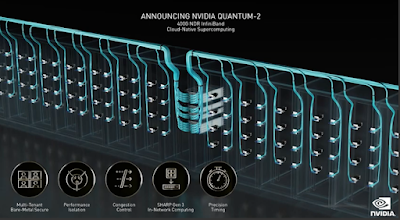
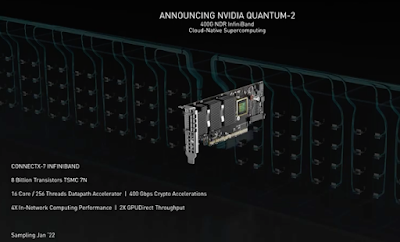
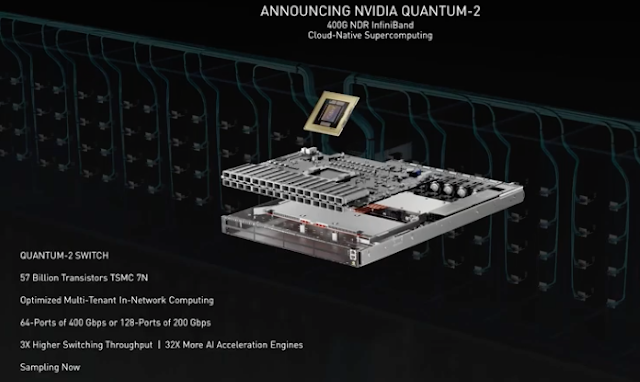
NVIDIA Quantum-2 is a 400Gbps InfiniBand networking platform that consists of the NVIDIA Quantum-2 switch, the ConnectX-7 network adapter, the BlueField-3 data processing unit (DPU) and all the software that supports the new architecture.

NVIDIA Quantum-2 includes key features required for demanding workloads running in either cloud enviroments or superomputing clusters. The multi-tenant performance isolation of NVIDIA Quantum-2 keeps the activity of one tenant from disturbing others, utilizing an advanced telemetry-based congestion control system with cloud-native capabilities that ensure reliable throughput, regardless of spikes in users or workload demands.

NVIDIA Quantum-2 SHARPv3 In-Network Computing technology provides 32x more acceleration engines for AI applications compared with the previous generation. Advanced InfiniBand fabric management for data centers, including predictive maintenance, is enabled with the NVIDIA UFM® Cyber-AI platform.

A nanosecond-precision timing system integrated into NVIDIA Quantum-2 can synchronize distributed applications, like database processing, helping to reduce the overhead of wait and idle times. This new capability allows cloud data centers to become part of the telecommunications network and host software-defined 5G radio services.

The Quantum-2 platform is powered by new Quantum-2 InfiniBand switching ASIC with 57 billion transistors implemented in 7-nanometer silicon. It features 64 ports at 400Gbps or 128 ports at 200Gbps and will be offered in a variety of switch systems up to 2,048 ports at 400Gbps or 4,096 ports at 200Gbps — more than 5x the switching capability over the previous generation, Quantum-1.

The NVIDIA Quantum-2 switch is now available from a wide range of leading infrastructure and system vendors around the world, including Atos, DataDirect Networks (DDN), Dell Technologies, Excelero, GIGABYTE, HPE, IBM, Inspur, Lenovo, NEC, Penguin Computing, QCT, Supermicro, VAST Data and WekaIO.

“The requirements of today’s supercomputing centers and public clouds are converging,” said Gilad Shainer, senior vice president of Networking at NVIDIA. “They must provide the greatest performance possible for next-generation HPC, AI and data analytics challenges, while also securely isolating workloads and responding to varying demands of user traffic. This vision of the modern data center is now real with NVIDIA Quantum-2 InfiniBand.”

https://nvidianews.nvidia.com/news/nvidia-quantum-2-takes-supercomputing-to-new-heights-into-the-cloud