Tuesday, August 17, 2021

Xanadu and imec target photonic qubits in silicon nitride waveguides

Xanadu, a start-up based in Toronto, announced a partnership with imec to develop photonic qubits based on ultra-low loss silicon nitride (SiN) waveguides.

imec is a leading research and innovation center in nanoelectronics and digital technologies based in Belgium. 

Xanadu is developing a unique type of quantum computer powered by photonic qubits based on squeezed states - a special type of light generated by chip-integrated silicon photonic devices. Such an approach uses particles of light to carry information through photonic chips, rather than electrons or ions used by other approaches. 

Xanadu said its photonic approach offers the benefits of scalability to one million qubits via optical networking, room temperature computation, and the natural ability to leverage fabrication R&D centers such as imec. Xanadu is using silicon nitride to enable the generation of squeezed states, which replace single photons as the basic resource for synthesizing qubits. Squeezed states are deterministically generated, and can be used to distill error-resistant qubits called 'GKP states'. When multiplexed and implemented in Xanadu's architecture, these offer a more promising path to fault-tolerant quantum computing. 

Amin Abbasi, business development manager at imec: "We are pleased to see that imec's wafer-scale low loss SiN photonics platform, initially developed for communication, is finding its way towards other advanced applications, like quantum computing. We look forward to working with Xanadu to drive further development of this platform for their particular needs."

"We are pleased to partner with Xanadu, one of the most exciting companies working in the quantum computing space." said Philippe Helin, specialty components program manager at imec. "Xanadu's mission to build photonic quantum computers matches perfectly with imec's track record of and commitment to pushing the leading edge of integrated technologies," adds Haris Osman, VP R&D and head of department.

"One of the most critical challenges in building a photonic quantum computer is finding the right fabrication partner that can simultaneously deliver cutting-edge process development and volume production of high performing photonic chips," said Zachary Vernon, who heads up Xanadu's Hardware team. "Imec is one of the few semiconductor R&D centers that does advanced technology R&D on advanced 200mm and 300mm lines, as well as volume manufacturing on their 200mm line, capable of delivering up to a thousand wafers per year per customer on a few platforms including ultralow-loss photonic platforms. The seamless transfer offered by imec of new processes to production is especially critical for rapid scaling of our technology."

http://www.xanadu.ai 

Vocus to launch 200G optical network in Australia with Nokia

Vocus has deployed Nokia’s optical transport solution to enable 200G links covering more than 4,100 km between Brisbane and Darwin. 

Nokia’s 1830 Photonic Service Switch (PSS) is used to upgrade Vocus’ optical network between Adelaide, Brisbane and Darwin to deliver 200G with the capability to easily provide 300G and 400G in the near future. With this initiative, the Vocus capacity upgrade covers more than 7,100 km of fibre. Nokia’s solution uses Colorless, Directionless, Contentionless Flex-grid (CDC-F) architecture at the terminal sites at Adelaide, Brisbane and Darwin, and a simpler Colorless-Flexgrid (C-F) solution at regional drop sites providing a total warranted capacity of 10.8Tb (54x200G) between Adelaide-Darwin and Brisbane-Darwin. The solution is powered by Nokia’s Photonic Service Engine (PSE) super coherent digital signal processors. 


Nokia said the deployment of 2 x 200G based wavelength unregenerated optical transport networks covers 70 sites, over a distance of 3,000 and 4,100 km respectively, and will help Vocus to optimize CapEx and reduce OpEx.The upgraded, higher capacity optical network allows Vocus to provide the latest generation of quality optical services, in connecting Darwin to Hypercloud Data Centres, regional locations and international submarine cables. 

Rob McCabe, Head of Enterprise, Australia and New Zealand at Nokia, said: “Nokia and Vocus have partnered for many years, and we’re delighted to have helped them build a 200G optical network of this capability over such a significant distance. This upgrade improves both the current and future capacity of the Adelaide, Brisbane and Darwin links to ensure Vocus can address growing data consumption demands while also delivering ultra-high speed and reliable experiences for their customers.”

Alaska Comm provides subsea fiber for earthquake monitoring

Alaska Communications is collaborating with the University of Michigan’s Department of Earth and Environmental Sciences to allow earthquake monitoring data to be collected from the ocean floor via the company’s subsea fiber optic cable.

University of Michigan Assistant Professor Ƶack Spica and a graduate student traveled to Alaska Communications’ landing station in Florence, Oregon last week to attach a DAS interrogator (distributed acoustic sensing) to the company’s fiber. The instrument uses a beam of light inside the fiber to analyze seismic activity and report data back to the research team.

“With the Cascadia subduction zone stretching along the pacific northwest coastline along Canada, this is in an ideal location for our team to gather seismic data,” said Spica. “This research project will support continued learning about utilizing fiber for earthquake research, as well as learn how we can use this technology to provide early warning for tsunamis, which are often prompted by earthquakes.”

“With two subsea cables connecting Alaska to the Lower 48, we have substantial infrastructure to aid in research that can help our communities,” said Rick Benken, vice president, network strategy, engineering and operations at Alaska Communications. “We’re excited to support University of Michigan in gaining important insights about earthquakes and tsunamis.”

http://www.AlaskaCommunications.com

NEC's Optical Sensing measures vibrations in fiber cables

NEC has begun commercial sales of a new AI-driven technology that analyzes small vibrations detected with optical fibers.The "NEC Intelligent Optical Fiber Sensing Solution" enables the operator of fiber cables to utilize optical fiber as a sensor. The detected vibrations can be indicative of fiber damage or environmental shaking. In addition to a sensing device attached to one end of the optical fiber, this solution consists of software with a function...

NEC has delivered a submarine cable seismic and tsunami observation system to Taiwan's Central Weather Bureau (CWB) under the Ministry of Transportation and Communications. The new system is mainly intended for observation of earthquakes and tsunami in the area ranging from the offshore coast of Yilan in eastern Taiwan to Fangshan in Pingtung County. The submarine cable measures 620 kilometers and reaches a depth of 5,800 meters. All products,...

Orange and members of the FLY-LION3 consortium (Lower Indian Ocean Network) - the Société Réunionnaise du Radiotéléphone and Comores Câbles - will provide connectivity for the Mayotte volcano and earthquake monitoring network, which is administered by the Institut de Physique du Globe de Paris (IPGP). Using a pair of optical fibres, IPG will experiment with a new technique to listen to the region’s seismic activity. The scientists involved hope...

Spectra7 and MultiLane demo 112Gbps PAM4 Active Copper Cable

Spectra7 Microsystems and MultiLane Technologies demonstrated 112Gbps PAM4 Active Copper Cable (ACC) technology at this week's DesignCon event in San Jose, California.

Spectra7 said ACCs enabled by its new 112G PAM4 GaugeChanger chip will extend copper cable reach 2.5 times, up to 4 meters at a fraction of the cost of optics. Critically, at a time when Hyperscale operators are struggling with power consumption and carbon emissions, ACCs using the Spectra7 technology will consume only 200mW of power per channel, which is up to 12 times lower power than optical solutions.

Spectra7's GC1122 solution is the latest addition to the company's GaugeChanger product line and extends the data rate from 56Gbps PAM4 to 112Gbps PAM4 per lane. Since the GC1122 is analog and highly linear, dynamics such as line rate adjustment, multi-level signaling, intermittent line silence, transmit pre-emphasis or amplitude adjustment and receiver adaptivity are fully preserved. The GC1122 is packaged in an ultra-small 2.7mm x 4.2mm chip scale package making it easily embeddable in even the smallest of connectors.

The DesignCon demonstration highlights Spectra7's new GC1122 device as well as MultiLane's latest high speed test equipment including the ML4015D DSO and the ML4039E BERT.

"Spectra7's new GC1122 is set to fill a big need in the data center interconnect market," said MultiLane CEO Fadi Daou. "We are delighted to be working with Spectra7 and their cable partners as they anticipate bringing their 112Gbps products to mass production in 2022."

"We are seeing tremendous interest from every Hyperscaler to get sample 800Gbps cables that are enabled by our new GC1122 solution", said Spectra7 CEO Raouf Halim. "Both we and our cable partners believe that 800Gbps will represent a significant acceleration in the growth and adoption of our ACC data center interconnect technology."

https://www.spectra7.com/spectra7andmultilane-2021

Microsoft invests in Rubrik for Zero Trust data protection

Microsoft will make an equity investment in Rubrik, a start-up based in Palo Alto, California, that offers  Cloud Data Management platform with data protection, search and analytics, archiving and compliance, and copy data management capabilities for hybrid cloud enterprises.  

The companies also agreed to co-engineer projects to deliver integrated Zero Trust data protection solutions built on Microsoft Azure to address rising customer needs to protect against surging ransomware attacks, which are growing 150% annually. Together, Rubrik and Microsoft will provide Microsoft 365 and hybrid cloud data protection and integrated cloud services on Microsoft Azure.

Rubrik said its data management was designed for the cloud from day one. As part of this collaboration, customers and partners gain additional data protection, so that critical Microsoft 365 data is secure, easily discoverable, and always accessible in the case of a malicious attack, ransomware attack, accidental deletion, or corruption. Rubrik also offers additional support and protection for Microsoft 365 including instant search and restore and policy-based management at scale. Additionally, Rubrik and Microsoft provide long-term archival of Microsoft 365 data for the purposes of regulatory compliance. 

Rubrik takes a Zero Trust approach to data management, which follows the NIST principles of Zero Trust for everyone interacting with data. This means operating with the assumption that no person, application, or device is trustworthy. To meet this standard, data must be natively immutable so that it’s not modified, encrypted, or deleted by ransomware. 

“As the pioneer of Zero Trust Data Management, Rubrik is helping the world’s leading organizations manage their data and recover from ransomware,” said Bipul Sinha, Co-founder and CEO of Rubrik. “Together with Microsoft, we are delivering tightly integrated data protection while accelerating and simplifying our customer’s journey to the cloud.”

“Customers, across industries, are migrating to the cloud to drive business transformation and realize growth,” said Nick Parker, Corporate Vice President, Global Partner Solutions, Microsoft. “End-to-end application and data management is critical to business success, and we believe that integrating Rubrik's Zero Trust Data Management solutions with Microsoft Azure and Microsoft 365 will make it easy for customers to advance their Zero Trust journey and increase their digital resilience.”    


Infinera announces four executive appointments

Infinera announced four executive appointments in newly created positions:

  • Ron Johnson, General Manager of Optical Systems & Network Solutions Group – responsible for driving Infinera’s growth in open optical systems and software as networks move to 800G in the core, 400G in the metro, and 100G coherent to the edge. Most recently, Ron served as head of Product Management at Cisco’s Optical Transport Business Unit.
  • Tom Burns, General Manager of Optical Modules & Coherent Solutions Group – responsible for Infinera’s optical modules and coherent solutions, including the company’s ICE optical engines and its recently announced suite of ICE-XR optical pluggables. Tom previously served at Dell Technologies, where he managed a multi-billion-dollar networking and solutions business. He will partner with co-founder and Chief Innovation Officer Dave Welch to capitalize on the growth opportunity of game-changing XR optics point-to-multipoint optical connectivity.
  • Azmina Somani, Senior Vice President of Engineering, Optical Modules & Coherent Solutions Group – responsible for optical modules and coherent solutions engineering. Azmina brings to her role over 30 years of experience and expertise in the optical components industry, with executive leadership positions at industry leaders that include Jabil, Lumentum, JDSU, and Nortel. In addition to her deep technical knowledge and exceptional leadership skills, Azmina has a proven track record of developing and delivering state-of-the-art subsystems and modules to the market at high volume, critical to Infinera’s pluggables strategy.
  • Russ Esmacher, Senior Vice President of Strategy – responsible for strategy, marketing, and corporate development in leading the company’s strategic planning processes and executing plans to achieve market share gains and the company’s target business model. Russ brings to his role over 20 years of experience in go-to-market programs, sales leadership, business development, and technical marketing, including prior executive positions at Nokia and Cisco.


“The shift to open optical networks represents an unprecedented opportunity for Infinera with our differentiated, high-performance solutions and vertically integrated capabilities,” said David Heard, Infinera CEO. “I’m thrilled to welcome these talented industry veterans to our team as we strategically align the organization to scale and accelerate toward the next phase of Infinera’s growth and innovation.”

https://www.infinera.com/press-release/infinera-strengthens-executive-leadership-team


Adam Crozier appointed as Chairman of BT

Adam Crozier will succeed Jan du Plessis as Chairman of BT Group plc with effect from 1 December 2021 when Jan will retire from the BT Board.

Crozier is currently Chairman of Whitbread plc, ASOS plc, Kantar Group Limited, as well as a non-executive director of Sony Corporation. Earlier in his career and for over 20 years he was a CEO across four different sectors, most recently as the CEO of ITV plc and before that as CEO of Royal Mail Holdings plc, where he led its modernisation and transformation.


Iain Conn, BT's Senior Independent Director, said: “After a thorough and comprehensive process to ensure we identified the very best candidate to lead BT, Adam is the unanimous choice of the Board. He has significant experience in leading public company boards, developing teams and managing stakeholders and brings a strong transformational and operational track record in large-scale executive roles.”


Monday, August 16, 2021

Apricot subsea cable to link Japan to Singapore

Google and Facebook unveiled plans for the Apricot subsea cable system, a 12,000-kilometer-long cable will connect Japan, Taiwan, Guam, the Philippines, Indonesia and Singapore.

Apricot, which is expected to launch in 2024, will boast a 190 Tbps design capacity based on space division multiplexing. It will feature a submersible reconfigurable optical add-drop multiplexer employing wavelength selective switch for a gridless and flexible bandwidth configuration.


https://cloud.google.com/blog/products/infrastructure/new-apricot-subsea-cable-brings-more-connectivity-to-asia


Google's Dunant subsea cable ready for service with up to 250 Tbps

Google's new Dunant transatlantic submarine cable system has been declared ready for service. Dunant is the first long-haul subsea cable to feature a 12 fiber pair space-division multiplexing (SDM) design, which will enable it to deliver record-breaking capacity of 250 terabits per second (Tbps) across the Atlantic Ocean. Subcom was the prime contractor for the project.SubCom is the first to market using SDM technology to increase cable capacity...

Google teams with Sparkle on 2 subsea cables

Google is collaborating with Sparkle and others to build and operate two submarine cable systems linking the Middle East with southern Europe and Asia: the Blue Submarine Cable System connecting Italy, France, Greece, and Israel; the Raman Submarine Cable System connecting Jordan, Saudi Arabia, Djibouti, Oman and India. Both cables will be equipped with 16 fiber optic pairs and are expected to be ready for service in 2024. They will...

Google's Firmina cable to link North and South America

Google announced plans to build a 12-fiber pair subsea cable linking North and South America via the Atlantic.The Firmina cable system, which will be designed, manufactured and installed by SubCom, will run from the East coast of the United States to Las Toninas, Argentina, with additional landings in Praia Grande, Brazil and Punta del Este, Uruguay. The Firmina system will use SubCom's 18kV power technology, which will enable Firmina to be...


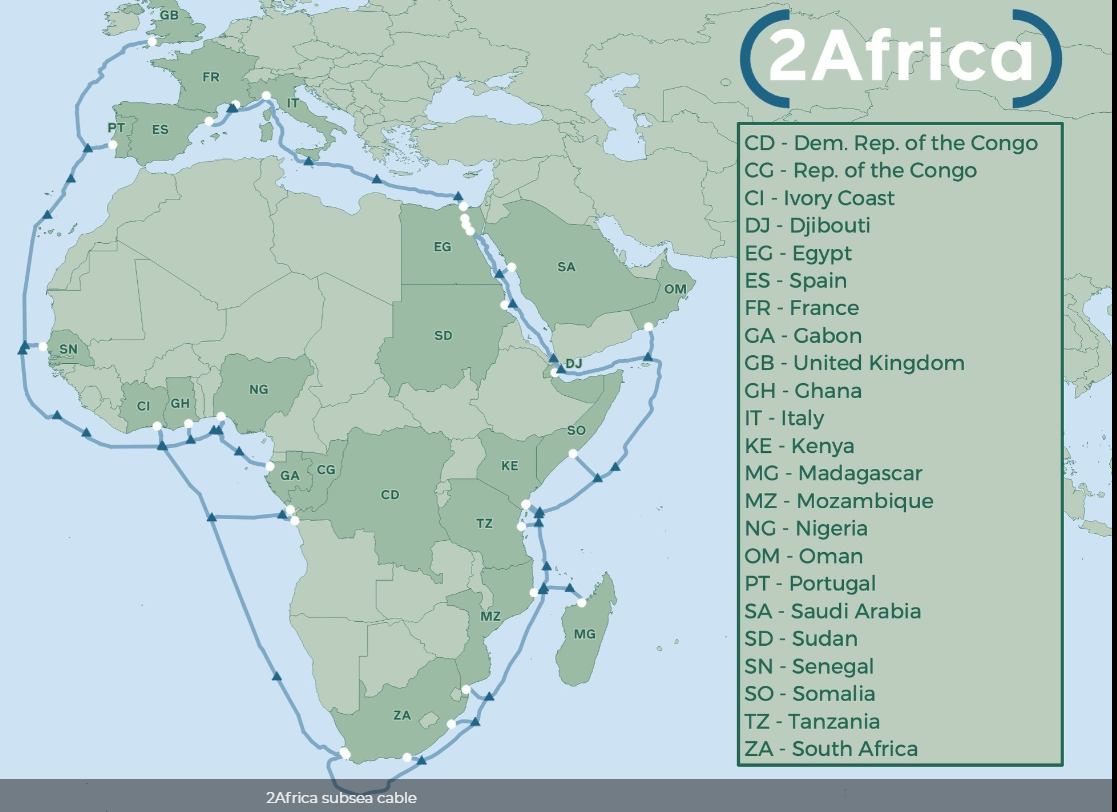
2Africa cable takes shape as world's largest subsea project

The 2Africa consortium, comprised of China Mobile International, Facebook, MTN GlobalConnect, Orange, stc, Telecom Egypt, Vodafone and WIOCC, announced four new branches: the Seychelles, the Comoros Islands, and Angola, and bring a new landing to south-east Nigeria. The new branches join the recently announced extension to the Canary Islands.

Alcatel Submarine Networks (ASN) has been selected to deploy the new branches, which will increase the number of 2Africa landings to 35 in 26 countries. ASN has started manufacturing the cable and building repeater units in its factories in Calais and Greenwich to deploy the first segments in 2022. The system is expected to be ready-fo-service in 2023.

Marine surveys have been completed for most of the 2Africa system, which is expected to become the world's largest subsea cable project.

https://www.orange.com/en/newsroom/press-releases/2021/new-branches-2africa-subsea-cable-system

2Africa subsea cable boasts design capacity up to 180 Tbps

2Africa, a new subsea cable to serve the African continent and Middle East region, promises to deliver more than the total combined capacity of all subsea cables serving Africa today, with a design capacity of up to 180Tbps on key parts of the system.

Consortium partners include China Mobile International, Facebook, MTN GlobalConnect, Orange, stc, Telecom Egypt, Vodafone and WIOCC.

Alcatel Submarine Networks (ASN) has been selected to build the fully-funded cable. The project will leverage SDM1 (space division multiplexing) technology from ASN, allowing deployment of up to 16 fiber pairs instead of the eight fiber pairs supported by older technologies. The cable will incorporate optical switching technology to enable flexible management of bandwidth. Cable burial depth has also been increased by 50% compared to older systems, and cable routing will avoid locations of known subsea disturbance, all helping to ensure the highest levels of availability.

The 2Africa subsea cable will span 37,000km long, interconnect Europe (eastward via Egypt), the Middle East (via Saudi Arabia), and 21 landings in 16 countries in Africa. The system is expected to go live in 2023/4. Each of the cable landing sites will offer carrier-neutral data centers or open-access cable landing stations on a fair and equitable basis.

In addition, the 2Africa parties and Airtel have signed an agreement with Telecom Egypt to provide a completely new crossing linking the Red Sea and the Mediterranean, the first in over a decade. This includes new cable landing stations and deployment of next-generation fiber on two new, diverse terrestrial routes parallel to the Suez Canal from Ras Ghareb to Port Said, and a new subsea link that will provide a third path between Ras Ghareb and Suez. 


"The launch of 2Africa enables us to offer our customers seamless connection between Africa and Europe, together with our SEA-ME-WE 5 and AAE-1 subsea cable resources to further extend to Asia, which is an important milestone of our global development strategy," said Jessica Gu, Director & Chief Technology Officer of China Mobile International. "The utmost capacity and faster transmission allows us to satisfy the needs of African nations today and in the future, reflecting our firm commitment to building a global digital life."

O-RAN Alliance enters 4th release of Open Software

The O-RAN Alliance announced the fourth release of its open software featuring support for closed-loop processing use cases, continued evolution of Non-Real-Time RAN Intelligent Control (Non-RT RIC) platform, new and enhanced xApps for the Near-Real-Time Radio Intelligent Controller (Near-RT RIC), as well as new performance monitoring and alarm support.

"With the joint efforts from the mobile carriers, traditional vendors, and more technology partners onboard, the 4th release is the first try to get the full O-RAN software stack working, and in addition we can now declare it is a smart RAN," said Chih-Lin I, the Co-chair of O-RAN Technical Steering Committee. "We are glad to see major accomplishments in the D release, and that our lab now delivers a reliable environment for the software community to continue new feature implementation and integration test verification."

Some further developments at the O-RAN Alliance:

  • On May 27, 2021, the O-RAN ALLIANCE signed a cooperation agreement with the European Telecommunications Standards Institute (ETSI). O-RAN ALLIANCE shares with ETSI a common objective to perform and promote regional and international standardization for 3GPP based technologies.
  • The O-RAN ALLIANCE also signed a Memorandum of Understanding with the Telecommunications Standards Development Society, India (TSDSI). It expresses mutual interest in cooperation to grow open interfaces and the open RAN ecosystem in the India subcontinent region.
  • On June 28, 2021, the O-RAN ALLIANCE approved three new Open Test and Integration Centers (OTICs):
    • European OTIC in Madrid hosted by Telefonica
    • European OTIC in Paris hosted by Orange
    • Auray OTIC and Security Lab (Taiwan) hosted by Auray Technology

”Making the RAN intelligent and context-aware is critically important for network optimization and automation. The focus of Samsung's O-RAN SC contribution has been towards enhancing the A1-Enrichment Information (A1-EI) & xAPP Framework. Overall, we believe that strengthening the O-RAN AI/ML Framework will play a big role in making operators achieve proactive closed-loop optimization and automation of RAN operations," said Dr. Sunghyun Choi, Corporate SVP and Head of Advanced Communications Research Center of Samsung Research, Samsung Electronics.


T-Mobile US confirms major cyber breach

T-Mobile confirmed that unauthorized access to its IT systems had occurred, however, the company said it has not yet determined how much, if any, customer data had been stolen.

"We are confident that the entry point used to gain access has been closed, and we are continuing our deep technical review of the situation across our systems to identify the nature of any data that was illegally accessed. This investigation will take some time but we are working with the highest degree of urgency. Until we have completed this assessment we cannot confirm the reported number of records affected or the validity of statements made by others."


https://investor.t-mobile.com/news-and-events/t-mobile-us-press-releases/press-release-details/2021/TMobile-Cybersecurity-Incident-Update/default.aspx

Boingo integrates AWS edge and cloud services

Boingo Wireless has expanded its collaboration with Amazon Web Services by integrating AWS edge and cloud services within Boingo’s converged network offering in DAS, Wi-Fi and private network deployments.

One example is Chicago O’Hare International Airport (ORD), where Boingo launched a new private network over CBRS. The private cellular solution securely connects IoT devices at ORD and powers essential airport services. ORD activated a virtual customer service center at its Traveler’s Aid Station that required a dedicated wireless network to facilitate communications between on-site passengers and remote support staff via a live video kiosk. Because Boingo manages the converged DAS and Wi-Fi network at ORD, the company had the flexibility to quickly design and deploy a cloud-based private network for the kiosk in just days, supplying necessary bandwidth and speed for reliable, high quality video calls. The end-to-end network was engineered with AWS to securely host video distribution data.


“The Boingo Private Network gives Chicago O’Hare a connectivity platform that delivers crisp, clear video calls while avoiding congestion with our public wireless networks,” said Diego Ferrer, managing deputy commissioner and chief information officer at Chicago Department of Aviation. “Boingo seamlessly integrated the private network into our existing infrastructure and keeps our airport operations cutting-edge with AWS cloud services.”

www.boingo.com

AT&T teams with Boingo to expand 5G mmWave in U.S. airports

AT&T 5G+ is set to light up seven major U.S. airports in 2021, and reach 25 by the end of 2022. 5G+ is AT&T's term for mmWave coverage.AT&T confirmed that it is working with Boingo Wireless to expand this connectivity in major U.S. airports.“AT&T is always working to offer services and solutions that enhance our customers’ experiences, no matter where they are or what they’re doing,” said Mo Katibeh, who leads AT&T’s Network Infrastructure...

Boingo launches Private Networks Service

Boingo Wireless has launched an enterprise private networks offering that provides dedicated, secure wireless connectivity with enhanced capacity, control and coverage. It is currently being trialed at leading airports, sports and entertainment venues nationwide.Boingo is offering a network as a service (NaaS) model. It can be implemented with 5G, LTE, CBRS, Wi-Fi 6, multi-access edge computing (MEC) and work seamlessly alongside neutral host DAS...

Boingo: Wi-Fi 6 vs. CBRS? Competing or Complementary?

https://youtu.be/XUPIUe_3R5sDigital Transformation is driving the deployment of a new class of Private Mobile Networks. But which technology should enterprises choose? Wi-Fi 6 or private 5G based on CBRS? In this video, Derek Peterson, CTO of Boingo, offers his perspective.Download the 2021 Private Mobile Networks Report here: http://ngi.how/private-networks-2021&nb...

Padtec's Q2 revenues rise 39% on strong DWDM growth

Padtec reported Q2 2021 operating revenue totaled R$ 119.6 million – an increase of 38.8% compared to the first quarter of 2021, and an increase of 86.3% compared to the same period last year. It was the company’s best quarterly result in the last five years.

For the first half of 2021, the company reported gross operating revenue of R$ 205.7 million, an amount that represents a growth of 63.7% compared to the same period last year. 

Padtec said its DWDM sales recorded a growth of 75.6% in the first six months, compared to the same period in 2020. 


In the first half of the year, Padtec also recorded an improvement in EBITDA, with earnings before interest, taxes, depreciation and amortization of R$ 36 million – triple the amount recorded in the same period in 2020. Adjusted EBTIDA (that disregards non-recurring events) reached R$ 21.1 million, with a margin of 13.6% – an increase of 9 percentage points. Gross margin was 35.5% (an increase of 3 percentage points), maintaining the same level as in recent quarters and reinforcing the profitability of the company’s businesses despite the exchange rate fluctuation between the periods.

Carlos Raimar, Padtec’s CEO, states: “The change in the dynamics of the Brazilian telecommunications market, with the accelerated adoption of fiber optic networks for residential and corporate applications, is now being replicated in other countries in Latin America. It is, without a doubt, an opportunity to expand our business in these regions. In addition, the prospect of activating 5G mobile networks in Brazil should generate a strong push to build communication networks across the country, both by operators – already active in the mobile segment – and by regional providers. To support 5G, investment in high-capacity optical networks should significantly increase the demand for DWDM equipment, benefiting our direct customers and their users and paving the way for a society with more connectivity and quality in data services.” 

https://www.padtec.com.br/en/

Brazil's Mercantil bank connects data centers with Padtec DWDM

Banco Mercantil do Brasil is increasing the transmission capacity of its DWDM networks in Belo Horizonte using a solution provided by Padtec.Padtec supplied transponders and route protection systems to connect the bank's data centers in Belo Horizonte. The project’s technical highlight is the use of the family of 200 Gbps transponders developed by the company for the transport of multiple 16 Gb/s data channels, in a network protocol called Fiber...

HE-NET deploys Padtec's 200G in Bahia, Brazil

HE-NET, the largest telecom operator in the state of Bahia, Brazil, has deployed Padtec's 200 Gbps transponders, optical amplifiers, and route protection systems to upgrade its optical network.The upgrade will light up the provider’s new routes in Bahia – two optical rings that connect the main municipalities in the south and southwest of the state. Padtec has also supplied the OTDR (Optical Time-Domain Reflectometer) solution, which allows operators...

Altarede, a fiber-based network operator in Brazil, has made a record investment in Padtec’s 200 Gbps and 800 Gbps family of transponders to ensure high capacity connections to its customers - such as operators, internet service providers (ISPs), governments and enterprises.To light up the operator's new routes, installed between the capitals of Rio de Janeiro and Espírito Santo, Padtec provided state-of-the-art DWDM systems with ROADM (Reconfigurable...


Nokia hires Oracle exec to head its SaaS business

Nokia has appointed Mark Bunn as Vice President, SaaS Business Operations, Cloud and Network Services. He is responsible for the business model, and operational and commercial strategy to drive Nokia’s shift to an ‘as a Service’ provider.

Bunn joins Nokia from Oracle, where he was Vice President of Monetization and Orchestration Applications in its Communications Business Unit; he is based in Dallas. 


Sunday, August 15, 2021

Blueprint column: Wavelength routing in the 400GE era

by Arnold Jansen, Senior Product Marketing Manager, Nokia

The introduction of 400 Gigabit Ethernet (GE) pluggable digital coherent optics (DCOs) has stirred up considerable debate about innovative approaches to metro access and metro/regional network design that blend IP and optical networking technologies in more optimal ways. The key question is how this technology can be leveraged to more cost-efficiently meet service-level requirements without adding more complexity to network operations. 


Routers, ROADMs and rings

Due to their lower cost, power and space requirements, pluggable 400GE DCOs are generally more economical for shorter reaches than connecting routers to dense wavelength division multiplexing (DWDM) transponders in optical line systems. With in-line amplification, 400ZR+ coherent optics can interconnect 400GE router ports over hundreds of kilometers of fiber, and up to 1,000 km at lower bit rates. 

This capability is certainly adequate for most point-to-point fiber applications, but dedicated fiber may not be readily available where it is needed because laying new fiber is costly and time consuming. At least initially, new 400GE router-to-router connections will be implemented over existing fiber plant in metro/regional access and aggregation networks. This fiber is typically laid as interconnected and overlapping rings that aggregate traffic from multiple central offices. 

An IP-centric way to look at metro/regional access and aggregation rings is as a distributed leaf-spine fabric with access routers on the ring (the leaves) connecting into a centralized aggregation router at the ring head-end (the spine). Ideally, each access leaf directly connects with the spine in a logical hub-and-spoke IP topology, especially since the volume and growth of ingress traffic on individual access leaves can differ greatly in urban and regional settings. This allows transport efficiency and latency to remain low and deterministic, as access traffic on the ring is passed to the hub router in a single hop. 

The first option to implement this target architecture leverages 2-degree ROADMs and optical transponders (OTs) to connect access routers to the centralized hub router over protected, point-to-point wavelengths. This is the present mode of operation (PMO) for most communication service provider networks, and is depicted at the left side of Figure 1. Routers connect using 400GE gray optics to performance-optimized OTs that can operate over long fiber spans with many ROADM hops, allowing single-hop connections from each access router to the hub node at full 400G rates.  

Figure 1. IP aggregation over metro/regional fiber rings

In the center, future mode of operation 1 (FMO1) leverages 400ZR+ pluggable router optics instead of WDM transponders to save space, power and cost through IP-optical integration. Through 2-degree ROADMs, all access routers connect to the hub router in a single hop over dedicated wavelengths. For large rings with many nodes, it may be necessary to reduce the line rate of 400ZR+ pluggable DCOs for an increased reach when and where it’s needed. 

On the right side of Figure 1, FMO2 bypasses ROADMs altogether and interconnects routers in a daisy chain over point-to-point WDM line systems between each node on the ring. Each router aggregates local ingress traffic with transit traffic from other nodes, and passes it hop-by-hop along the ring until it reaches the hub router at the ring head-end. With wavelengths having to travel only one hop to the adjacent routers, 400ZR/ZR+ DCOs can connect at the full 400 Gb/s line rate for most router-to-router distances. 

Figure 2. Comparing scaling properties of PMO, FMO1 and FMO2 in aggregation rings 

Figure 2 compares the scaling properties of the PMO with FMO1 and FMO2 for a single aggregation ring with varying numbers of access nodes and amounts of ingress traffic. Although this is a simple modeling exercise, it illustrates several points:  

  1. The PMO scales the best with increasing traffic and ring sizes and makes the most efficient use of available 400GE router ports. Although DWDM transponders cost more than pluggable DCOs, fewer of them are required on each ring and current investments in ROADMs and fiber can be fully leveraged. Also note that pluggable 400G Multihaul DCOs will become available for  routers to enable higher capacity-reach over 400ZR+, and as a lower-cost alternative to DWDM transponders. 
  2. The FMO1 can be deployed as an overlay to offload the PMO over an additional fiber pair. While FMO1 consumes slightly more 400GE router ports for larger rings and traffic volumes, this upfront cost is offset by incremental savings created by using router pluggable 400ZR+ DCOs instead of WDM transponders. 
  3. FMO2 has a marginally lower upfront cost than FMO1 due to minor savings on ROADM capabilities, but its incremental scaling costs are much higher. There is a sweet spot for small rings and low initial ingress traffic volumes where access routers can aggregate all ring traffic over one or two wavelengths, but the number of 400G DCOs required will quickly surpass the 4–6 QSFP-DD network ports that are typically available on a 1 RU leaf aggregation router.

Key Takeaways 

From an end-to-end cost perspective, a critical objective of any network architect is to minimize the number of hops required to transport traffic between source and destination. Each router hop adds cost, latency and power consumption that must be offset by statistical multiplexing gains of packet aggregation, and these gains have diminishing returns with each hop. 

400GE pluggable coherent optics are a new and powerful technology that can be used to cost-optimize IP networks, provided that the number of router hops in the end-to-end data path does not increase significantly as a result. There are two ways to achieve this:

  1. Deploy dedicated point-to-point fiber routes where available and feasible. 
  2. Provision dedicated point-to-point wavelengths over shared fiber using ROADMs.

When point-to-point wavelengths must traverse several ROADMs, it is generally more economical to either de-rate the capacity of 400ZR+ optics or deploy higher-performance optics such as 400G Multihaul DCOs or 400GE OTs than to bridge the distance with additional router hops or back-to-back DCOs. Importantly, this new generation of compact and modular line systems with ROADM capabilities can ensure that the capacity-reach and cost benefits of 400GE pluggable coherent optics can be maximized for all applications. 

About the author - Arnold Jansen, Senior Product Manager, Nokia

Arnold is responsible for promoting products and solutions for the IP/optical networks group at Nokia. Arnold has held a number of roles in research and innovation, sales, product management, and marketing during his 30 years in the telecommunications industry. Arnold is based in Ottawa, Canada and holds a Bachelor degree in Computer Science from the Rotterdam University of Applied Sciences