Thursday, March 3, 2016

Blueprint: Monitoring as a Discipline and the Network Administrator

by Leon Adato, Head Geek, SolarWinds

As IT professionals, we know our way around data centers like the backs of our hands. But what consistently surprises me when I speak with other admins is the general lack of knowledge about and resources put towards what we at SolarWinds call monitoring as a discipline, especially as it pertains to monitoring networks.

Evolution of the network

The network is a complex thing, and it has evolved considerably over the past decade.

For example, the network used to be defined by a mostly wired, physical entity controlled by routers and switches. Business connections were based on T1 and ISDN, and Internet connectivity was always backhauled through the data center. Each network device was a piece of company-owned hardware, and applications operated on well-defined ports and protocols. VoIP was used infrequently, and anywhere connectivity—if even a thing—was provided by the low-quality bandwidth of cell-based Internet access.

Today, however, wireless is becoming ubiquitous—it’s even overtaking wired networks in many instances—and the number of devices wirelessly connecting to the network is exploding (think Internet of Things). It doesn’t end there, though—networks are growing in all directions. Some network devices are even virtualized, resulting in a complex amalgam of the physical, the virtual and the Internet. Business connections are DSL/cable and Ethernet services. BYOD, BYOA, tablets and smartphones are prevalent and are creating bandwidth capacity and security issues. Application visibility based on port and protocol is largely impossible due to applications tunneling via HTTP/HTTPS. VOIP is common, also imposing higher demands on network bandwidth, and LTE provides high-quality anywhere connectivity.  

And the future isn’t looking any simpler. The Internet of Things (IoT); software defined networking (SDN); and hybrid IT, with its accompanying challenge of ensuring acceptable quality of service to meet the business performance needs for any given service delivered via a cloud provider, are all cresting the horizon.

What’s my point? These trends, challenges and complexities underscore a new set of monitoring and management essentials.

Enter monitoring as a discipline

What is monitoring as a discipline?

Monitoring as a discipline varies from simply monitoring in that it is an actual role, the defined job of one or more individuals within an organization, not just something “everyone kind of does when it’s needed.” The most important benefit of such a dedicated role is the ability to turn data points from various monitoring tools and utilities into more actionable insights for the business by looking at all of them from a holistic vantage point, rather than each disparately.

Although such a monitoring-dedicated individual or team is in reality probably only likely at larger organizations at this point in time, small- and medium-sized businesses may want to take note, as their infrastructures, all of which rely on the backbone known as the network, are only going to get more complex, bringing the need for even them to create such a role into sharp focus. Don’t believe me? Think about how common hiring a dedicated information security professional was ten years ago—nearly unheard of. But today, many organizations of almost every size consider this to be a necessity given the constant specter of security breaches.

Now reflect on how IT environments, not just the network, have grown, both in size and complexity, being distributed across geographies more than ever. In turn, monitoring them has equally grown in complexity. In fact, due to hybrid IT, it has become extremely difficult to pinpoint the root cause of issues—whether they lie with the cloud services provider or the organization’s internal network itself.

Thus, the “old way” of monitoring, where network admins, server admins and storage admins, etc. each operate in silos, monitoring only within their specific realm without much if any cross-silo oversight, is no longer really a viable option. By employing an expert who monitors as a specific discipline across all of the traditional silos can provide a cohesive view across an organization’s IT spectrum, making root cause analysis much more efficient and accurate, reducing costs in the process.

Expanding monitoring skillsets

All that said, given budget constraints, the reality for IT departments at many small- and medium-sized businesses will be one without such a dedicated monitoring expert for at least the near future. If having a dedicated monitoring expert is not in the cards for now, the next step is to expand your current IT team’s monitoring skillset. At minimum, your team should at least be able to effectively monitor:
  • Hardware
  • Networks (i.e. NetFlow and syslog)
  • Applications
  • Virtualization
  • Configurations
Configuration monitoring is especially important because when it comes to configs—what changed as well as the exact moment the change was made is critical to both the security and stability of entire environments. In fact, 80 percent of all corporate outages are caused by unexpected or uncontrolled config changes. And, in all honesty, in the absence of a dedicated monitoring expert, we generalist network admins are perhaps best positioned to step in and corral all this monitoring data into one cohesive set of actionable insights.

In conclusion

As the network becomes more complex and expands in nearly every direction, monitoring as a discipline will become more critical to business success. In summary, companies of all sizes should consider:
  • Adding a dedicated monitoring expert or experts who can provide a holistic view of the organization’s infrastructure performance, turning seemingly disparate data points gathered by monitoring tools into valuable, actionable insights.
  • If a dedicated expert is not possible, ensure the current IT team understands the nuances of monitoring hardware, networks, applications, virtualization and configurations and has a comprehensive, but not necessarily expensive, suite of monitoring tools available.
  • Putting network admins in charge of corralling all this monitoring data.
About the Author


Leon Adato is a Head Geek and technical evangelist at SolarWinds, and is a Cisco Certified Network Associate (CCNA), MCSE and SolarWinds Certified Professional (he was once a customer, after all). Before he was a SolarWinds Head Geek, Adato was a SolarWinds® user for over a decade. His expertise in IT began in 1989 and has led him through roles as a classroom instructor, courseware designer, desktop support tech, server support engineer, and software distribution expert. His career includes key roles at Rockwell Automation®, Nestle, PNC, and CardinalHealth providing server standardization, support, and network management and monitoring.


About SolarWinds 
SolarWinds (NYSE: SWI) provides powerful and affordable hybrid IT infrastructure management software to customers worldwide from Fortune 500® enterprises to small businesses, government agencies and educational institutions. We are committed to focusing exclusively on IT Pros, and strive to eliminate the complexity that they have been forced to accept from traditional enterprise software vendors. Regardless of where the IT asset or user sits, SolarWinds delivers products that are easy to find, buy, use, maintain and scale while providing the power to address all key areas of the infrastructure from on premises to the cloud. Our solutions are rooted in our deep connection to our user base, which interacts in our thwack online community to solve problems, share technology and best practices, and directly participate in our product development process. Learn more today at www.solarwinds.com. 

Got an idea for a Blueprint column?  We welcome your ideas on next gen network architecture.
See our guidelines.

Verizon Digital Media Enable Direct Link to Google Cloud

Verizon Digital Media Services is now allowing customers to use Google Cloud CDN Interconnect to more safely and securely transfer content between the Verizon Digital Media Services content delivery network (CDN) and Google Cloud Platform.

The high-performance interconnections provide a direct link between Google Cloud Platform and Verizon Digital Media Services' CDN, allowing content to move between the two directly without traversing other networks, providing increased availability and reduced latency for important content.

"Our commitment to open collaborations with companies like Google ultimately expands the choices our customers have to move their data and content efficiently, securely and affordably," said Verizon Digital Media Services Chief Technology Officer Rob Peters. "The combined power of Verizon Digital Media Services and Google Cloud Platform gives our customers the edge they need in today's digital media environment that demands constant innovation."

Verizon Digital Media Services customers that use Google Cloud Platform can save more than 65 percent on their cloud egress costs for an easier, more cost-effective delivery path that is optimized to move and scale content between Google Cloud Platform and Verizon's CDN. This provides an exceptional content experience that leverages Verizon's world-class CDN to reach any screen, anywhere.

http://www.verizon.com

BT to Offer Palo Alto Networks's Next Gen Security

BT will integrate the Palo Alto Networks Next-Generation Security Platform into its global portfolio of security services.

Specifically, BT's Assure Managed Firewall service will now integrate WildFire cloud-based malware prevention, which is a key component of the Palo Alto Networks Next-Generation Security Platform. It will be used to further secure the access to cloud-based applications, enabling enterprise customers to reap increased benefits from BT's Cloud of Clouds.

"Security is now a top concern for every business, and with continued growth in both the volume and sophistication of attacks, a breach prevention-focused strategy is essential to ensure a safe digital future for organisations and individuals alike. We are delighted to join forces with BT to help organisations safely enable business operations and protect their most valuable assets, managing both their risk and their security budgets," stated Mark McLaughlin, president and chief executive officer at Palo Alto Networks.

http://www.btplc.com

Hibernia Employs Accedian on Transatlantic Cable

Hibernia Networks is using Accedian to provide tiered termination aggregation services on its new transatlantic cable, Hibernia Express, which offers round-trip speeds of under 58.95 milliseconds between New York and London.

The Accedian platform enables Hibernia Networks to provide flexible Ethernet speeds for its portfolio of low latency connectivity solutions, ensuring a more precisely scaled service that meets the individual requirements of its customers.

Accedian said its network solution is capable of providing monitoring and measurement functions on a one-way transatlantic transmission with sub-microsecond accuracy—enabling Hibernia Networks to provide more proactive performance assurance support for low latency services, from its network operations center. The performance monitoring metrics include latency, packet loss, and
jitter.

“We’re delighted to be part of Hibernia Networks state-of-the-art transatlantic cable system,” said Patrick Ostiguy, CEO, Accedian. “Our ability to guarantee lowest possible latency through technology innovation and best-practice continues to provide the hallmark for our ongoing expansion as we serve an increasing number of service providers spanning wholesale, mobile, and
cable networks.”

http://www.accedian.com

Telefónica Awards 10-year Contract to IBM to Modernize Financial and HR Processes

Telefónica awarded a 10-year contract for IBM to modernize and manage different Telefonica Human Resources and Finance Management processes of the telecommunications giant over the next 10 years.

As part of the agreement, IBM is acquiring three companies of Tgestiona -- a Telefónica company specialized in finance and human resources processes management for Communications Sector -- in Spain, Argentina and Peru.

"IBM was chosen as our strategic partner based on its ability to demonstrate market-leading best practices in finance and HR, deliver a superior user experience to Telefónica, and demonstrate automation and digital innovation while respecting the cultural diversity of our clients," said Javier Delgado, Director Planning, Projects and Global Services of Telefónica.

http://www.ibm.com

HPE Posts Quarterly Results, Networking Revenue up 54% YoY

Hewlett Packard Enterprise reported first quarter net revenue of $12.7 billion, down 3% from the prior-year period and up 4% on a constant currency basis. First quarter GAAP diluted net earnings per share (EPS) was $0.15, down from $0.30 in the prior-year period, and above its previously provided outlook of $0.09 to $0.13.

By segment:

  • Enterprise Group revenue was $7.1 billion, up 1% year over year, up 7% in constant currency, with a 13.4% operating margin. Servers revenue was down 1%, up 5% in constant currency, Storage revenue was down 3%, up 3% in constant currency, Networking revenue was up 54%, up 62% in constant currency, and Technology Services revenue was down 9%, down 3% in constant currency.  
  • Enterprise Services revenue was $4.7 billion, down 6% year over year, flat in constant currency, with a 5.1% operating margin. Infrastructure Technology Outsourcing revenue was down 8%, down 2% in constant currency, and Application and Business Services revenue was down 3%, up 3% in constant currency.
  • Software revenue was $780 million, down 10% year over year, down 6% in constant currency, with a 17.4% operating margin. License revenue was down 6%, down 2% in constant currency, support revenue was down 13%, down 9% in constant currency, professional services revenue was down 7%, down 2% in constant currency, and software-as-a-service (SaaS) revenue was down 9%, down 7% in constant currency. 
  • Financial Services revenue was $776 million, down 3% year over year, up 3% in constant currency, net portfolio assets were up 4%, up 9% in constant currency, and financing volume was down 4%, up 3% in constant currency. The business delivered an operating margin of 12.9%. 

"During our first quarter as an independent company, we saw the progress that comes from being more focused and nimble," said Meg Whitman, president and chief executive officer, Hewlett Packard Enterprise. "We delivered a third consecutive quarter of year-over-year constant currency revenue growth, and excluding the impact of recent M&A activity, we saw revenue growth in constant currency across every business segment for the first time since 2010."

http://www.hpe.com

Ciena Posts Revenue of $573 Million

Ciena reported revenue of $573.1 million as compared to $529.2 million for the fiscal first quarter 2015. Net loss (GAAP) for the fiscal first quarter 2016 was $(11.5) million, or $(0.08) per diluted common share, which compares to a GAAP net loss of $(18.8) million, or $(0.17) per diluted common share, for the fiscal first quarter 2015.

"We delivered strong first quarter business and financial performance, including 8% adjusted operating margin, highlighted by engagement with a more diverse set of customers," said Gary B. Smith, president and CEO, Ciena. “Despite some recent volatility in the broader macroeconomic environment, the demand drivers for our business remain firmly in place and we are well positioned to translate our market leadership into continued growth and profitability this fiscal year.”

Some highlights:

  • U.S. customers contributed 63.7% of total revenue
  • One customer accounted for greater than 10% of revenue and represented 22% of total revenue
  • Cash and investments totaled $995.4 million

http://www.ciena.com

Nimble Storage Posts Revenue of $90 Million, up 32%

Nimble Storage reported revenue of $90.1 million for its fourth quarter of fiscal 2016, up from $68.3 million in the fourth quarter of fiscal 2015. Excluding fluctuations in foreign currency over the past year, revenue would have been $92.6 million representing a 36% increase over the fourth quarter of fiscal 2015. GAAP net loss for the fourth quarter of fiscal 2016 was $32.4 million, or $0.40 per basic and diluted share, compared with a net loss of $24.7 million, or $0.33 per basic and diluted share in the fourth quarter of fiscal 2015.

Total revenue for fiscal 2016 was $322.2 million, compared to $227.7 million in fiscal 2015, representing growth of 42% year-over-year.

http://www.nimblestorage.com

Wednesday, March 2, 2016

Cisco Sets Digital Network Architecture as its Platform of the Future

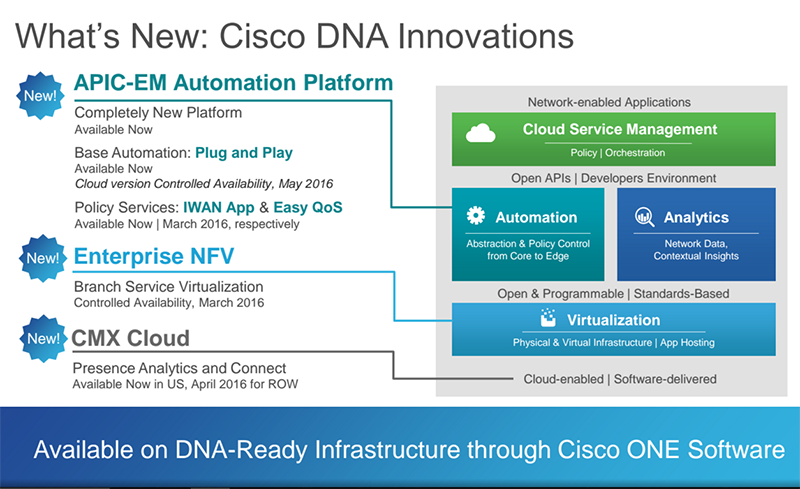
Cisco unveiled its Digital Network Architecture (DNA) for transforming business with the power of analytics driven by programmable networks, cloud applications, open APIs, and virtualization.  The Cisco DNA aims to extend the company's data center-based, policy-driven Application Centric Infrastructure (ACI) technology throughout the entire network: from campus to branch, wired to wireless, core to edge.  

Cisco DNA is built on five guiding principles:

  • Virtualize everything to give organizations freedom of choice to run any service anywhere, independent of the underlying platform – physical or virtual, on premise or in the cloud.
  • Designed for automation to make networks and services on those networks easy to deploy, manage and maintain – fundamentally changing the approach to network management.
  • Pervasive analytics to provide insights on the operation of the network, IT infrastructure and the business – information that only the network can provide.
  • Service management delivered from the cloud to unify policy and orchestration across the network - enabling the agility of cloud with the security and control of on premises solutions.
  • Open, extensible and programmable at every layer – Integrating Cisco and 3rd party technology, open API’s and a developer platform, to support a rich ecosystem of network-enabled applications.

“The digital network is the platform for digital business,” said Rob Soderbery, SVP for Enterprise Products and Solutions, Cisco.  “Cisco DNA brings together virtualization, automation, analytics, cloud and programmability to build that platform.  The acronym for the Digital Networking Architecture – DNA – isn’t an accident. We’re fundamentally changing the DNA of networking technology.”

The first deliverables of Cisco DNA include:

DNA Automation:  APIC-Enterprise Module (APIC EM) Platform


  • APIC-EM Platform:  A new version of Cisco’s enterprise controller has been released. Cisco claims 100+ customer deployments running up to 4000 devices from a single instance.  The company is adding automation software that removes the need for staging for pre-configuration or truck roll-outs to remote locations. The Plug and Play agent sits on Cisco routers and switches and talks directly to the network controller. A new EasyQoS service enables the network to dynamically update network wide QoS settings based on application policy.
  • Cisco Intelligent WAN Automation Services: This service automates IWAN deployment and management, providing greater WAN deployment flexibility and allowing IT to quickly configure and deploy a full-service branch office with just 10 clicks.  IWAN automation eliminates configuration tasks for advanced networking features, and automatically enables Cisco best practices, application prioritization, path selection and caching to improve the user experience.
  • DNA Virtualization:  Evolved IOS-XE is a network operating system optimized for programmability, controller-based automation, and serviceability. The new OS provides open model-driven APIs for third party application development, software-defined management, application hosting, edge computing and abstraction from the physical infrastructure to enable virtualization.   It supports the Cisco Catalyst 3850/3650, ASR 1000 and ISR 4000 today, and will continue to be expanded across the Enterprise Network portfolio.

    Evolved Cisco IOS XE includes Enterprise Network Function Virtualization (Enterprise NFV) that decouples hardware from software and gives enterprises the freedom of choice to run any feature anywhere. This solution includes the full software stack - virtualization infrastructure software; virtualized network functions (VNFs) like routing, firewall, WAN Optimization, and WLAN Controller; and orchestration services - to enable branch office service virtualization.
  • DNA Cloud Service Management:  CMX Cloud provides business insights and personalized engagement using location and presence information from Cisco wireless infrastructure.  With CMX Cloud enterprises can provide easy Wi-Fi onboarding, gain access to aggregate customer behavior data, and improve customer engagement. 

Cisco to Acquire Leaba Semiconductor for $320M

Cisco agreed to acquire Leaba Semiconductor, a venture-backed fabless semiconductor company, for $320 million in cash and assumed equity awards, plus additional retention based incentives.

Leaba, which is based in Israel, specializes in networking semiconductors.  The company is in stealth mode and has not announced any products.

The Leaba team will report into Cisco’s Core Hardware Group, led by Senior Vice President, Ravi Cherukuri.

https://blogs.cisco.com/news/networking-semiconductors-news
http://www.leabasemiconductor.com/


  • Leaba Semiconductor is headed by Eyal Dagan, who previously was CEO and co-founder of Dune Networks, a privately-held developer of switch fabric solutions for data center networking equipment that was acquired by Broadcom for approximately $178 million in cash in 2009.

OPNFV Brahmaputra Adds IPv6, VPN Config, Fault Detection

The OPNFV Project, which is the community based effort sponsored by the Linux Foundation to develop an open source platform to accelerate the introduction of Network Functions Virtualization (NFV), announced its OPNFV Brahmaputra release.

Key enhancements in OPNFV Brahmaputra include:

Hardened feature enhancements.
  • Layer 3 VPN instantiation and configuration
  • Initial support for IPv6 deployment and testing in IPv6 environments,
  • Improved fault detection and recovery capabilities via work in OpenStack Neutron and Ceilometer as well as collaborative development work with DPDK
  •  Initial Service Function Chaining capabilities via OpenDaylight Beryllium
  • Basic resource reservation via a shim layer on top of OpenStack
  •  Enhancements in performance and throughput via data plane acceleration and NFV-focused enhancements in OVS and KVM
Enhanced testing capabilities. 


  • Extending the suite of functional tests developed in Arno, Brahmaputra adds system-level testing and multiple performance testing frameworks and methodologies. The Yardstick Project implements system-level validation with baseline testing requirements as outlined in the ETSI TST 001 spec. Additional improvements include detailed vSwitch performance characterization, bottoms-up system performance benchmarking, and the implementation of a performance bottleneck-focused testing framework.

Infrastructure and testing environment advancements.

  • In addition to the bare metal lab hosted by the Linux Foundation, community Pharos labs were used to release validation for Brahmaputra. Additionally, OPNFV’s Jenkins-based continuous integration and continuous deployment toolchain has made great strides in automating all integration and deployment scenarios and associated testing frameworks.


Deployment and integration enhancements. 

  • Brahmaputra contains an increased number of components and scenarios, including support for additional SDN controllers and installers, such as OpenStack Liberty and OpenDaylight Beryllium, which can be used to build the platform.

“Building on the foundation of Arno, the OPNFV community worked tirelessly to integrate and combine components from multiple communities to deliver Brahmaputra, which brings end-to-end feature realization,” said Chris Price, technical steering committee chair, OPNFV and Open Source Manager for SDN, Cloud & NFV, Ericsson. “The impact is substantial; we’ve now established methodologies and mechanisms for further cross-project and feature development.”

“The strength of any open source project depends on the community developing it,” said Heather Kirksey, director, OPNFV. “With an entire industry involved in the development of NFV, we’re seeing more collaboration among key stakeholders across the ecosystem. The strides we made in Brahmaputra create a framework for even more developers to come together and make progress in the journey to NFV.”

https://www.opnfv.org/news-faq/press-release/2016/03/opnfv-delivers-second-release-open-source-network-functions

Samsung Ships its 15.36TB SSD

Samsung Electronics began shipping the industry’s largest solid state drive (SSD) – the “PM1633a,” a 15.36 terabyte (TB) drive.

The new 15.36TB SSD is based on a 12Gb/s Serial Attached SCSI (SAS) interface, for use in enterprise storage systems. Samsung said the unprecedented 15.36TB of data storage on a single SSD is enabled by combining 512 of its 256Gb V-NAND memory chips. The 256Gb dies are stacked in 16 layers to form a single 512GB package, with a total of 32 NAND flash packages in the 15.36TB drive. Samsung’s 3rd generation, 256-gigabit (Gb) V-NAND technology which stacks cell-arrays in 48 layers.

Because the PM1633a comes in a 2.5-inch form factor, enterprise storage managers can fit twice as many of the drives in a standard 19-inch, 2U rack, compared to an equivalent 3.5-inch storage drive.

http://www.samsung.com

Mellanox Samples its High-end Network Processor

Mellanox Technologies has begun sampling its next generation, NPS-400 network processor, which is capable of performing advanced deep packet processing for security and telecommunications applications at over 800 Gbps.


The NPS features programmable CPU cores that are highly optimized for packet processing and leverage deep packet processing and applications experience, a traffic manager, hardware accelerators for security and DPI (Deep Packet Inspection) tailored for efficiency and performance, on-chip search engines including TCAM with scaling through algorithmic extension to external low-cost low-power DRAM memory and a multitude of network interfaces providing an aggregated bandwidth of 800-Gigabits per second including 10-, 40- and 100-Gigabit Ethernet, Interlaken and PCI Express interfaces. It offers C‑based programming, a standard toolset, support of the Linux operating system, large code space, and a run-to-completion or pipeline programming style. Mellanox supplies a library of source code for a variety of applications.

ZTE plans to use the NPS-400 for its new line cards design for carrier-grade router platforms.

“We are pleased that the NPS network processing unit is now available and shipping to communication technology leaders such as ZTE,” said Marc Sultzbaugh, senior vice president, Mellanox Technologies. “Through the acquisition of EZchip we’ve gained tremendous expertise and advanced network processing capabilities. The NPS is a sixth generation network processor and has evolved to provide unmatched performance and flexibility that meets the needs of the most advanced data center and communications customers.”

http://www.mellanox.com


  • Last month, Mellanox completed its acquisition of EZchip at a total purchase price of approximately $811 million (approximately $606 million net of cash).

TeliaSonera IC Pumps 100G to 365 Data Centers

TeliaSonera International Carrier (TSIC) is now delivering its Tier 1 Internet backbone network service at 100G to 365 Data Centers’ Detroit facility and its customers.

TSIC currently provides 100Gbps IP Transit services to customers in the region and worked with 365 Data Centers last year to provide 100Gbps services in six other cities including Buffalo, N.Y.; Tampa, Fla.; Nashville, Tenn.; St Louis, Mo.; Cleveland, Ohio; and Indianapolis, Ind.

“By partnering with 365 Data Centers, we are able to increase TSIC’s footprint in the Midwest region and enable faster delivery of data and video to local mobile operators, Internet service providers and education networks,” said Art Kazmierczak, Director of Business Development, Americas at TeliaSonera International Carrier Inc. “Detroit continues to grow and diversify in the new digital economy as the Internet of Things meshes with automotive technology and with the concentration of talent, provides the perfect location to service customers throughout the region.”

http://www.teliasoneraic.com

Equinix Plans 4 More Data Centers on 4 Continents

Equinix plans to launch four new data centers on four continents this year, adding nearly 200,000 square feet of new data center space at full build. This brings Equinix’s total global footprint to 14 million square feet, increasing the scale of Platform Equinix by more than 27 percent year-over-year.

The new facilities will be located in Dallas, São Paulo (doubling the company's capacity in Brazil, Sydney (more than doubling colocation space at the existing campus), and Tokyo (its fifth data center in the city).

https://blog.equinix.com/2016/03/equinix-expansion-continues-with-4-new-data-centers-on-4-continents/

Tuesday, March 1, 2016

Cisco Ups its Nexus Data Center Game

Cisco is rolling out its next generation of Nexus data center switches, including a new Nexus 9000 model based on its custom ASIC and a Nexus 3000 model based on Broadcom's Tomahawk silicon.

The refreshed portfolio aims to transition the market from 10G and 40G ports to 25/50/100 Gbps at the same density of interfaces as existing systems. Cisco said it will now be able to deliver 25G at the previous price of 10G, and 100G at the previous price of 40G -- effectively 2.5x bandwidth at the same price.

In terms of network architecture and software programmability, Cisco is supporting three choices: its own, full-bore Application Centric Infrastructure (ACI) architecture, running on the APIC controller in its Nexus 7K and flagship 9K switches, a programmable fabric vision that could also be supported on the new Nexus 3000 switches with Broadcom silicon, and a lighter Programmable Network architecture running on any of the Nexus switches and featuring NX-OS enhancements for DevOps, automation and segment routing.

With the new Nexus 9000 switches, Cisco said it will achieve industry-leading performance for 100Gbps, with 25 percent more non-blocking performance, at 50 percent the cost of comparable solutions, plus greater reliability and lower power. The new Nexus 9K switches will support real time network telemetry at 100Gbps wire rate, enabling network security with pervasive NetFlow and fabric wide troubleshooting.  The switches will also scale up to 10 times in IP addresses and end points at cloud scale, and support over a million containers per rack. The new Nexus 9K is also designed to drive unique cloud services with adaptive capacity and congestion control, allowing customers to support lossless traffic for IP storage, hyperconverged and converged infrastructure on a single unified fabric that enables application completion times 50 percent faster than traditional competitive platforms.

In addition, Cisco is announcing a new Cisco Nexus Fabric Manager that automates the complete fabric lifecycle management with a point-and-click web interface, and offers automated configuration snapshots and rollbacks. Nexus Fabric Manager builds and self-manages a VXLAN-based fabric, dynamically configuring switches based on simplified user-based actions. An IT manager can fully deploy a VXLAN-based fabric in just three steps, complete with zero touch provisioning, and can upgrade all fabric switches to a new software release in "only four mouse clicks."

Cisco also announced several new ACI ecosystem pioneers: Infoblox, which automates network configuration and change; N3N, which extends ACI visibility beyond the network to the entire data center; Tufin, which provides visibility, control and security change orchestration across heterogeneous environments; vArmour, which provides application-aware micro-segmentation with advanced security analytics; and Veritas, which collects, protects, analyzes and optimizes customers’ global data.

http://www.cisco.com

Cisco's New HyperFlex Systems Take Aim at Hyperconvergence

Cisco is renewing its focus on hyperconverged infrastructure with the introduction of new HyperFlex Systems built on its UCS compute platform.

Compared with existing hyperconverged platforms, the new Cisco HyperFlex Systems aim to simplify policy-based automation across network, compute and storage for a wide set of enterprise applications. The systems promise plug-n-play setup within minutes, not days, with flexible, adaptive and independent scaling of compute, network as well as storage capacity. Cisco is offering data management capabilities, such as rapid clones and non-intrusive snapshots with always-on inline deduplication and inline compression, yielding up to 80% reduction in the data footprint.  The rollout includes:

  • Cisco HyperFlex HX220c M4 Node, 1 rack unit, up to 7 TB of storage, up to 2 processors per node
  • Cisco HyperFlex HX240c M4 Node, 2 rack units, up to 29 TB of storage, up to 2 processors per node
  • Cisco HyperFlex HX240c M4 Node with Cisco UCS B200 M4 Blade-Series Servers, max capacity and up to twice the compute, 2 rack units + 6 rack units, up to 29 TB of storage, and up to 4 processors per node


http://www.cisco.com

AT&T Selected by Defense Information Systems Agency

AT&T confirmed that it has been awarded a position on the Defense Information Systems Agency’s (DISA) Global Networking Services (GNS) contract. AT&T will provide services like global and regional transport services, software-defined networking, Ethernet and network integration services. DISA provides enterprise network and IT infrastructure to support the requirements of the Department of Defense’s more than 40 military services, combatant commands and support organizations worldwide.

DISA plans to spend $4.3 billion over 10 years to build a single global network that will work 10x faster than today’s.

“This award lets us do our part to help defend the nation,” said Kay Kapoor, president, AT&T Global Business - Public Sector Solutions. “It aligns with our long-standing commitment to use our innovative technology solutions to support our troops, national safety and freedom.”

http://about.att.com/story/defense_information_systems_agency_awards_contract.html


IBM Cloud Receives DISA Impact Level 5 Authorization


The U.S. Defense Information Systems Agency (DISA) has authorized IBM Cloud services at the highest security levels – known as Impact Level 5 – for Controlled Unclassified Information as defined by the Department of Defense (DoD). This pavesthe way for DoD agencies seeking to take advantage of the innovations cloud can offer and manage sensitive data. DISA has granted the company a Conditional Authority to Operate IBM Cloud services hosted at the...

Level 3 Wins for DISA's Global Network Services Contract


The Defense Information Systems Agency (DISA) selected Level 3 Communications for a multiple-year competitive contract known as Global Network Services (GNS). The contract allows Level 3 to bid on and provide communications services to support DISA's goal of providing a single global network including both wired and wireless technologies by 2020. The contract has a five-year base period and five one-year option periods. Level 3 is Authorized to...

NTT Com Rolls Out Enhanced Enterprise Cloud Services

NTT Communications is rolling out a number of enhancements to its Enterprise Cloud portfolio, first in Japan and followed in the UK, Singapore, US, Australia, Hong Kong and Germany this year.

Some highlights of the new capabilities:

  1. Hosted Private Cloud for Traditional ICT - dedicated bare-metal servers with the automation, pay-as-you-go flexibility and options of a multi-hypervisor environment, including VMware vSphere and Microsoft Hyper-V. It also provides a highly flexible internal network, which facilitates the re-use of on-premises network architecture in the cloud. 
  2. Enterprise-class Multi-tenant Cloud for Cloud-Native ICT - a secure and highly reliable, enterprise-class multi-tenant cloud based on the OpenStack architecture, which therefore gives customers an industry-standard open API to control the Enterprise Cloud in an automated manner. In addition, by incorporating Cloud Foundry, an open source Platform-as-a-Service (PaaS) software, the Enterprise Cloud provides PaaS for agile application development and operational efficiency. 
  3. Seamless Hybrid Cloud Environment - the enhanced Enterprise Cloud's multi-tenant cloud and hosted private cloud are connected at Layer 2 with SDN, which gives customers the power to flexibly and seamlessly configure the network components (virtual server, bare-metal server, firewall, load balancer) running on a complex on-premises environment in the same network segment. As a result, customers can reduce approximately 30% of the workload required for the network and server re-configuration that usually comes with cloud migration.
  4. Free and Seamless Connection between Cloud Platforms - the enhanced Enterprise Cloud platform is connected with a 10Gbps best-effort closed network, which is free of charge. In addition, connectivity between Enterprise Cloud platforms and data centers is provided at competitive prices globally, utilizing NTT Com's infrastructure as a telecom carrier. 
  5. Cloud Management Platform (CMP) for Full Visibility and IT Governance - providing efficient management and unified control of both Enterprise Cloud and third-party providers' clouds, including Amazon Web Services (AWS) and Microsoft Azure. CMP also enables customer management and operation of hybrid clouds and meets the IT governance, cost control, security management and automated ICT operational requirements needed to successfully execute a cloud-first digital transformation strategy companywide.

NTT Com said it will continue to enhance its capabilities in areas such as SDx-enabled unification of cloud, world-class data centers and global network assets. The OpenStack-based micro service architecture of Enterprise Cloud enables NTT Com to incorporate the latest technology advancements coming from both open source communities and its technology partners. Some of the new functions NTT Com plans to launch for enterprises include SAP HANA, virtual private PaaS and enhanced cloud management capabilities, to further support the digital transformation journeys of its enterprise customers.

"As enterprise businesses move towards digitalization, globalization and cloud, NTT Com will continue to help customers innovate business processes and create new business models with Enterprise Cloud, which has been enhanced to meet requirements of both secure and reliable ICT and flexible and agile ICT," said Motoo Tanaka, Senior Vice President of Cloud Services at NTT Com.

http://www.ntt.co.jp

Cisco to Acquire CliQr for Cloud Orchestration

Cisco agreed to acquire CliQr Technologies, a start-up offering an application-defined cloud orchestration platform to model, deploy and manage applications across bare metal, virtualized and container environments. Cisco will pay $260 million in cash and assumed equity awards, plus retention based incentives.

The CliQr platform provides a broad variety of application profile templates and an integrated service library to make it easier to model new or existing, simple or complex applications in a way that is cloud agnostic. CliQr already integrates with Cisco ACI to enable application portability for on-premise and cloud environments. The company cites several key benefits:

  • Profile once, deploy anywhere: CliQr’s solution allows customers to create a single application profile that is simple and secure to deploy across any data center, public or private cloud.
  • Ensure consistent policies: CliQr automatically applies a customer’s access control and security policies to an application, and then ensures that those policies move with the application.
  • Optimize applications across hybrid cloud environments: CliQr will measure both price and performance of applications on any cloud environment, helping users to make informed decisions about the best place for their application on any data center or cloud.
  • Manage with one-click: CliQr provides a single management interface to give customers complete visibility and control across applications, cloud environments and users. 
Cisco said it will integrate CliQr across its data center portfolio. 1The CliQr team will join Cisco’s Insieme Business Unit reporting to Prem Jain, senior vice president and general manager. The goal is to make it simpler for customers to automate and manage application policies across the entire data center stack.

“Customers today have to manage a massive number of complex and different applications across many clouds,” said Rob Salvagno, vice president, Cisco Corporate Development. “With CliQr, Cisco will be able to help our customers realize the promise of the cloud and easily manage the lifecycle of their applications on any hybrid cloud environment.”

http://www.cisco.com
http://www.cliqr.com


  • CliQr was founded by Gaurav Manglik and Tenry Fu, both previously from VMware. 
  •  Investors in CliQr included Foundation Capital, Google Ventures, Translink Capital, and Polaris Partners.