Sunday, November 6, 2022

FCC Chairwoman Rosenworcel proposes Space Bureau

FCC Chairwoman Jessica Rosenworcel announced a plan to reorganize the FCC’s International Bureau into a new Space Bureau and a standalone Office of International Affairs. 

"The satellite industry is growing at a record pace, but here on the ground our regulatory frameworks for licensing them have not kept up. Over the past two years the agency has received applications for 64,000 new satellites. In addition, we are seeing new commercial models, new players, and new technologies coming together to pioneer a wide-range of new satellite services and space-based activities that need access to wireless airwaves,” said Chairwoman Rosenworcel. “Today, I announced a plan to build on this success and prepare for what comes next. A new Space Bureau at the FCC will ensure that the agency's resources are appropriately aligned to fulfill its statutory obligations, improve its coordination across the federal government, and support the 21st century satellite industry."

The Commission licenses radio frequency uses by satellites and ensures that space systems reviewed by the agency have sufficient plans to mitigate orbital debris under the authority of the Communications Act of 1934, as amended. By establishing a stand-alone Space Bureau the agency aims to better fulfill its statutory obligations and elevate the significance of satellite programs and policy within the agency to a level that reflects the importance of the emerging space economy. By separating satellite policy from the “International Bureau,” the agency acknowledges the role of satellite communications in advancing domestic communications policy and achieving U.S. broadband goals.

https://www.fcc.gov/document/chairwoman-rosenworcel-proposes-space-bureau

Thursday, November 3, 2022

Airtel surpasses first 1 million 5G customers in 30 days

Just one month since launching its 5G service,  Bharti Airtel crossed the 1 million unique 5G user mark on its network. 

Earlier this month, Airtel announced the advent of its 5G services in Delhi, Mumbai, Chennai, Bengaluru, Hyderabad, Siliguri, Nagpur and Varanasi. The services in these cities are getting rolled out in a phased manner as the company continues to construct its network and complete the roll out.

Randeep Sekhon, CTO, Bharti Airtel, said “These are early days but the response from customers have been very encouraging. Our network is being built every day even as all 5G devices are now capable of working on the Airtel 5G Plus network barring a few exceptions which should also be done in the coming weeks. We will continue to advance our network with a vision to connect the entire country.”

Google to invest up to $1 billion in Bharti Airtel

Google will invest up to US$1 billion in a partnership with Bharti Airtel. The agreement includes an investment of US$700 million to acquire 1.28% ownership in Airtel and up to US$300 million toward potential multi-year commercial agreements.The companies will focus on India-specific network domain use cases for 5G and other standards. Airtel is already using Google’s 5G-ready Evolved Packet Core & Software Defined Network platforms, and plans...


Dell’Oro: Edge Data Center Forecast

The telecom server market opportunity is projected to reach $14 B by 2026 according to a new “Telecom Server” report from Dell’Oro Group. Edge data centers will account for most of the telecom server market growth.

“Data center IT and telecom network infrastructure have been converging in recent years. Service providers have been replacing dedicated devices with unique hardware architectures in the mobile core network with commercial off-the-shelf (COTS) hardware to virtualize various network functions,” said Baron Fung, Research Director at Dell’Oro Group. “Network function virtualization has the potential to reduce capex through the use of less expensive and commoditized COTS hardware, instead of dedicated or proprietary hardware for network services. Furthermore, a new class of latency-sensitive applications in the form of multi-access edge computing (MEC), and virtualization of the baseband functions in the radio access networks in the form of Open RAN, will pave the way for the explosive growth of a new class of servers located at the network edge,” explained Fung.

Additional highlights from the new Telecom Server market Advanced Research Report:

  • Edge use cases for Broadband Access, MEC, and RAN— still in the nascent stage, are expected to exceed 50 percent CAGR in server revenue over our forecast horizon.
  • Server form factors and vendor ecosystem will require further development prior to mainstream adoption.
  • Select telecom workloads are likely to migrate to the public cloud.

https://www.delloro.com/news/edge-data-center-growth-will-push-telecom-server-market-to-14-b-by-2026/

Equinix: major data center builds underway in 31 markets

Equinix's quarterly revenues increased 10% over the same quarter last year to $1.8 billion, or 11% on a normalized and constant currency basis, representing the company's 79th consecutive quarter of revenue growth—the longest streak of any S&P 500 company. Net income amounted to $212 million, a 2% decrease from the previous quarter, primarily due to lower non-recurring xScale® fees, a Q2 favorable tax settlement, partially offset by higher income from operations from strong operating performance and lower net interest expenses.

Charles Meyers, President and CEO, Equinix: "We had another record quarter as global demand for digital infrastructure continues to grow and customer preferences trend convincingly toward architectures that are highly distributed, persistently hybrid, deeply cloud-connected, and increasingly on-demand — all factors fueling our position as a trusted partner in digital transformation. Even in a complex and challenging macro environment, our expansive global reach and robust interconnected ecosystems continue to attract a wide and diverse customer set, as businesses prioritize digital investments and embrace Platform Equinix as a point of nexus to support hybrid and multicloud."

  • Equinix continued to expand its Data Center Services with 46 major builds underway in 31 markets, across 21 countries. Recent activity includes:
  • A $74 million expansion to Indonesia with plans for an International Business Exchange™ (IBX) data center in the heart of Jakarta, scheduled to open by the second half of 2024.
  • A $45 million investment in Colombia for the construction of BG2, Equinix's second IBX data center in Bogotá, scheduled to open in the first half of 2023.
  • The addition of six recently approved projects in Q3 in Barcelona, Milan, Montreal, Jakarta, Silicon Valley and Tokyo.
  • Equinix continues to extend its leadership as the most interconnected platform with four cloud on-ramp wins this quarter bringing Equinix's portfolio to more than 200 on-ramps across 44 markets. Equinix now has 11 metros enabled with five or more on-ramps to the largest cloud players.
  • ~55% of expansion cabinets are in metros that generate >$100M of annual revenues, leveraging established ecosystem density and installed customer base


https://www.equinix.com/newsroom/press-releases/2022/11/equinix-reports-third-quarter-2022-results

Arista debuts network automation based on CI/CD

Arista Networks announced a network automation solution built on a network data lake

The Arista Continuous Integration (CI) Pipeline is based on cloud networking principles, including repeatable design patterns, automated operations via software control, and an open, flexible architecture. 

This new Arista CI Pipeline addresses these challenges, enabling enterprises to achieve a modern network operating model, consisting of:

  • Continuous design
  • Continuous integration
  • Continuous testing
  • Continuous Design
  • Continuous Integration provides an advanced DevOps environment for managing network operations and change control workflows. Leveraging the CloudVision platform, CI is a packaged solution that simplifies and streamlines the execution of a Continuous Integration/Continuous Delivery (CI/CD) workflow for network automation by providing:
  • An easy-to-deploy, packaged solution to operate a CI pipeline for network operations
  • Enhancements to CloudVision’s change control to facilitate a complete CI/CD operations workflow to facilitate pre/post validation testing
  • The ability to push and pull test results and AVD models into EOS NetDL
  • Enhanced integration for external DevOps and CI tools

By using CloudVision and NetDL, a data lake extending the EOS state database to a broad aperture and data set of configuration and telemetry data, users can easily customize their workflows while taking advantage of having access to all the information stored in NetDL for data-driven automation.

The Arista CI suite is in trials and will be available in 2023. Arista Professional Services are available to deploy these solutions. Additionally, all the above software offerings are fully supported by Arista TAC globally.

https://blogs.arista.com/blog/ci-based-cloud-networking-automation

Orange Marine inaugurates cable laying ship - C/S Sophie Germain

Orange Marine has launched the C/S Sophie Germain, a new cable laying and repair ship.

The 100m vessel, which is named for a French mathmatician and philosopher, was built at the Colombo Dockyard in Sri Lanka.


https://twitter.com/OrangeMarine_/status/1588157297162948610

Padtec enters partnership with Angola's Zanecom

Padtec announced a partnership with Zanecom, an Angolan consultancy that acts as an integrator of information and communication technology solutions. 

Under the agreement, the DWDM solutions developed by Padtec become part of Zanecom’s product line, contributing to the expansion of the Brazilian company’s operations in Sub-Saharan Africa.

Mandela Barros, Zanecom’s CEO, points out that Padtec’s product line is particularly innovative and allows the company to add to its portfolio solutions designed to meet the exponential demand for high-capacity data transmission. “We are very pleased to be able to work with Padtec and offer state-of-the-art optical transmission equipment to the market. The company is already recognized in Brazil and Latin America and, with this partnership, it will consolidate itself as a new supplier also in the African market”, he concludes.

Headquartered in Campinas, in the interior of São Paulo, Padtec has four commercial offices abroad, located in Argentina, Chile, Colombia and the United States. Through a partnership with the multinational Televes, it also offers its DWDM solutions in Europe, the Middle East and Africa (EMEA). As a result of this international expansion strategy, Padtec recorded a 53% growth in revenue from foreign markets in the first half of 2022, compared to the same period last year.

https://www.padtec.com.br/en/padtec-announces-partnership-with-zanecom-to-offer-dwdm-solutions-in-africa/

Arelion adds Boston-Secaucus route

Arelion has added a new diverse, high-capacity transmission route connecting Boston to Secaucus, providing its customers with resilient connectivity and fast delivery that bypasses common routes going direct through Long Island and Manhattan. 

By providing backhaul to the Amitié sea cable system through its fifth trans-Atlantic cable route, Arelion establishes Boston as a DWDM service market and empowers companies, including financial services organizations, with diverse connection options and seamless terabit scale capability across multiple cables connecting into landing stations in the US and Europe.

The new route will offer connectivity in the US to Arelion's 150+ Points-of-Presence (PoPs) and EU terrestrial extensions to customer end points. The Amitié cable system is expected to go live in Q2 2023 and has a trans-Atlantic capacity of over 320Tbps, connecting Boston in the US to Slough (UK) and Bordeaux (FR) in Europe.

"Our new high-capacity DWDM transmission route will provide the diverse, trans-Atlantic connectivity into Europe that is needed by the financial services sectors and other companies densely concentrated in the Northeastern US," said Art Kazmierczak, Director Business and Network Development, Arelion. "Through this organic network expansion, Arelion further establishes itself as one of the few operators to own end-to-end network solutions and customer experiences in both the US and Europe. This new route furthers our vision of diverse, high-capacity global connectivity that boosts business growth in markets that rely on uninterrupted, long-haul transport of high traffic volumes."


MACOM posts revenue of $178.1 million, up 14.8% yoy

MACOM Technology Solutions Holdings reported revenue of $178.1 million for its fourth fiscal quarter, an increase of 14.8% compared to $155.2 million in the previous year fiscal fourth quarter and an increase of 3.4% compared to $172.3 million in the prior fiscal quarter.

Gross margin was 60.9%, compared to 58.1% in the previous year fiscal fourth quarter and 60.7% in the prior fiscal quarter. Net income was $239.3 million, or $3.36 per diluted share, compared to net income of $17.1 million, or $0.24 per diluted share, in the previous year fiscal fourth quarter and net income of $32.2 million, or $0.45 per diluted share, in the prior fiscal quarter.

“We are pleased with our Q4 and fiscal 2022 results,” said Stephen G. Daly, President and Chief Executive Officer. “More importantly, we have many new and compelling products to support market share gains in fiscal 2023.”

Rivada Space Networks issues RFP for 600 LEO satellites

Rivada Space Networks issued a request for proposals for 600 low earth orbit (LEO) satellites.

The company anticipates selecting a prime contractor for the space segment, parts of the ground segment and system integration for the LEO constellation by the end of 2022 in parallel to the selection of the launch service provider.

Clemens Kaiser, Rivada Space Networks Chief Program Officer, said: "Following a rigorous process with a number of leading satellite manufacturers, we are delighted that today we have completed another major milestone in the specification and development of our unique constellation to enable secure, global connectivity for governments and enterprises. The key attributes of RSN's laser-linked LEO constellation architecture include global reach, low latency, ultra-security, resilience and optional quantum key encryption." He added: "We have worked tirelessly to ensure that our system comprises the best the satellite industry has to offer. We are really looking forward to moving to the next phase of our program to manufacture and deploy our LEO constellation."

Severin Meister, Rivada Space Networks CEO, further added: "RSN is a German 'NewSpace' innovator and disruptor. I am incredibly proud of what our team has achieved in such a short time frame. Over the course of the past eight months we have completed the design of our satellite system and grown our teams in Munich and Berlin to further develop the technical, commercial and regulatory competencies of the company. With over 60 people today, we anticipate expanding further to over 100 people by the end of Q1 2023 and are on track to execute our vision of providing the first truly global point-to-point low latency connectivity network." Meister added: "Initial customers are showing great interest, which confirms that 

www.rivadaspace.com

Cloudflare posts sales of $253.9 million, up 47% year-over-year

Cloudflare announced financial results for its third quarter ended September 30, 2022. Non-GAAP net income per diluted share was $0.06, compared to non-GAAP net income per diluted share of $0.00 in the third quarter of 2021.

“We achieved an important milestone in the third quarter, surpassing $1 billion in annualized revenue for the first time. The opportunity we have in front of us is enormous. Even with this achievement, we’ve penetrated less than 1 percent of our identified market for the products we have available today,” said Matthew Prince, co-founder & CEO of Cloudflare. “This milestone is a testament to our enormous market opportunity, our ability to land and expand our largest enterprise customers, and the durability of our subscription-based revenue model. Now, we’re focused on the path to organically achieve $5 billion in annualized revenue in 5 years, and we're confident we have the products already in-market to get us there.”


Wednesday, November 2, 2022

Co-Packaged Optics (CPO) and Pluggable Summit debate

The future of data center network architecture was the key theme at last week's Co-Packaged and Pluggable Optics Industry Summit, an invite-only event presented by Optica and the Consortium for On-Board Optics (COBO) will host the  at the DuPont Silicon Valley Technology and Innovation Center.

Debate centered on the pros/cons of scaling today switching architecture based on pluggable optical transceivers versus future designs designs with co-packaged optics alongside the switching silicon.

Google: The pluggable design factor for hyperscale data center switches is working well and there is a roadmap to scale for several more generations, said Hong Liu, Google Fellow. Her presentation cited the potential of pluggable interfaces as high as 3.2T OSFP-XD and future 102.4T switch designs. Rather than CPO interfaces on switching silicon, future data center networks could scale using Optical Circuit Switching using MEMS mirror arrays. CPO inside pluggable optical transceiver is beneficial, such as integrating DSPs with TIAs.


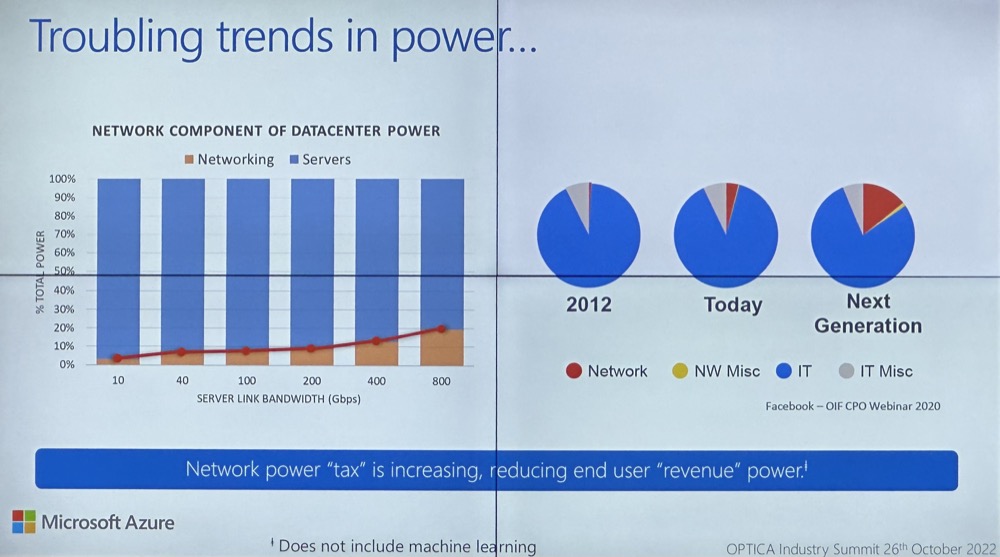
Speaking on behalf of Microsoft, Moray McLauren made the case that package-level optical integration (CPO) is needed to (1) address the rising power requirements in data centers ("network power tax is increasing, reducing end user revenue power"), (2) extend radix reach (3) lower component costs (4) drive AI/ML and HPC applications


Meta's Katharine Schmidtke, Director of ASIC and Custom Silicon Sourcing, also presented the case for optical interconnects in AI/ML hardware. As compute fabrics adopt a cluster architecture, the network fabric has to scale. Compared with existing optical modules, CPO promises to significantly reduce the power demands of the new computing clusters.

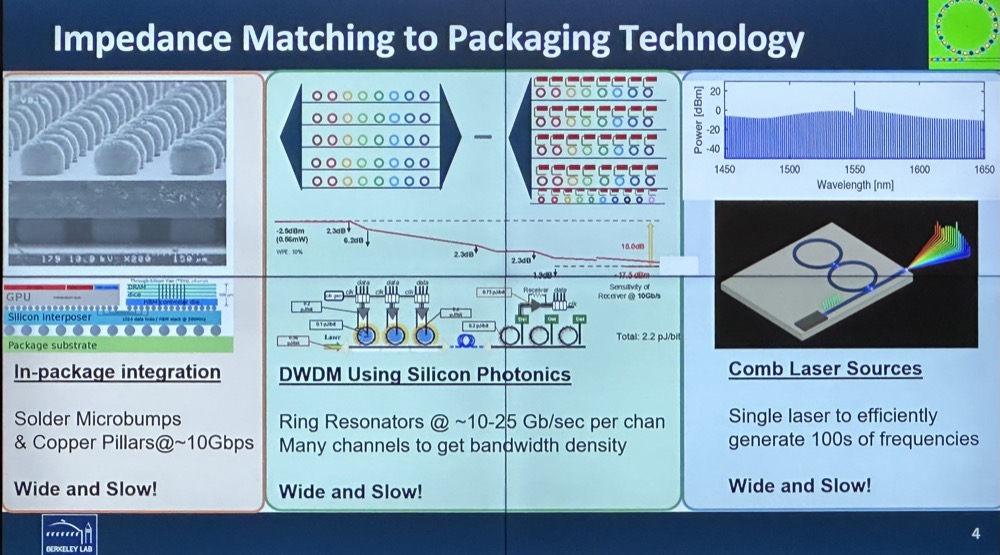
Power savings in the network can be achieved in other ways, said John Shalf, Lawrence Berkeley National Laboratory.  Think wide and slow! This applies to innovations in (1) in-package integration, (2) DWDM using Silicon Photonics (ring resonators) (3) new comb laser sources capable of generating 100s of frequencies

NVIDIA is moving forward with its own NVLink over optics approach to solve the scaling problem, said Craig Thomson. 


Jeff Maki, Distinguished Engineer at Juniper Networks and Board Member of COBO, presented a taxonomy of 400G and 800G interfaces. 

Arista's Andy Bechtolscheim presented the strongest case that pluggables are the best solution for Ethernet data center switching and that CPO switches fall short in time-to-market, standardization, break out connectors and a host of other issues.  Potential applications for CPO might include copackaging with DSPs inside pluggable modules at 224G and non-Ethernet uses cases such as AI chips.


Pluggable optics remains a feasible and dominant use case for the next generation of switching said Cisco's Anthony Torza.

It is all about system level power, said Infinera's Dave Welch. Through its vertical integration, Infinera already offers a 400G ZR+ pluggable module with a 1600km range. For intra data center range, innovations such as the microLED technology developed by Avicena promise very significant power improvements with integration in CMOS.


Marvell's Radha Nagarajan offered some thoughts on heterogeneous integration including improved modulation that puts us on the path to 3.2T. 


Video perspective on the Pluggables and CPO Debate

https://youtu.be/wVAKhSgQX8k

Here is an overview of the first Co-Packaged Optics (CPO) and Pluggables Summit presented by Optica and the Consortium for On-board Optics (COBO). The event was help 26-26-October-2022 at the DuPont Silicon Valley Innovation Center.

Perspectives from:

0:00 Jose Pozo, CTO, Optica

2:00 Jake Joo, Site Leader & Sr. Technology Manager, DuPont Silicon Valley Innovation Center

2:58 Tiger Ninomiya, Sr. Technologist, SENKO Advanced Components

3:46 John Wasserbauer, CEO, MicroGlass

4:50 Jimena Garcia-Romeu, CEO, Alcyon Photonics

5:18 Sanjay Gangadhara, Senior Technologist, Ansys

6:00 Patrick Heissler, Director of Business Development, SUSS Microoptics


Kyocera's on-board optics module offers 16x32Gbps

Kyocera has developed an On-Board Optics Module that achieves an overall bandwidth of 512 Gbps (16 channels of 32 Gbps/channel). 

Kyocera’s prototype module is miniaturized for installation on a printed circuit board near the processor. The company says its module achieves unprecedented improvements in signal-to-noise ratio, virtually eliminating the signal loss caused by conventional electrical conductors. 

Kyocera’s module  uses a Low-Temperature Co-fired Ceramic (LTCC) mounting substrate developed by Kyocera, which offers exceptional material characteristics, such as fine wiring, low dielectric constant, multilayering, and thermal conductivity.

https://global.kyocera.com/newsroom/news/2022/000650.html


Kyocera develops GaN laser chip on silicon substrate

Kyocera has developed a new thin-film process technology for making  silicon (Si) substrates for gallium nitride (GaN)-based micro-light sources, including short-cavity lasers and micro-LEDs.

GaN-based light-source devices, both micro-LED and laser, have typically been fabricated on sapphire and GaN substrates. Conventional processes involve forming a thin GaN device layer for the light source directly onto the sapphire substrate by heating it to a high temperature (1,000 degrees C or more) in a controlled gas atmosphere. The device layer has to be then removed, or "peeled," from the substrate to create a GaN-based micro-light-source device. 

Kyocera plans to offer a range of platform, substrate, and process technologies to bring high-quality, low-cost micro-light sources to market in the near future. 

https://global.kyocera.com/newsroom/news/2022/000652.html

Lumen to sell its EMEA business to Colt for $1.8B

Colt Technology Services (Colt) agreed to acquire Lumen's Europe, Middle East and Africa (EMEA) business for $1.8 billion.  The deal extends Colt's network into additional countries, European cities, and data centers.

The transaction represents a multiple of ~11x for Lumen's EMEA business. Lumen will continue to serve multinational enterprise customers through a strategic partnership with Colt.

"We are continuing to execute on portfolio optimization at Lumen, creating additional value for our shareholders by monetizing non-strategic assets at accretive multiples," said Lumen President and CEO Jeff Storey. "This transaction would enhance our focus so we can invest more efficiently in our most strategic opportunities – our key Enterprise and Quantum Fiber initiatives – and partner with regional leaders like Colt in Europe and Cirion in Latin America to continue serving our multinational enterprise customers."

"This transaction would mark the next chapter in Colt's exciting story of global growth and world-class innovation," said Keri Gilder, CEO, Colt Technology Services. "We're deeply committed to building extraordinary connections for our people, customers and partners across our digital infrastructure. This acquisition would strengthen and extend these connections across existing and new geographies, helping us to accelerate growth and bring the power of the digital universe closer to our customers."

https://www.colt.net/resources/lumen-enters-into-agreement-regarding-divestiture-of-emea-business-to-colt-technology-services-for-1-8b/

Lightpath builds high-fiber-count Miami network

Lightpath disclosed plans to build a high-fiber0count fiber network in Miami. 

Lightpath's entry into Miami will kick off with a 55-mile subterranean network of new, high-count fiber in early 2023. All together, the company is planning 135 route miles.

The Miami Central Business District (CBD) network will be customer-ready in January 2023, while two rings to the north and west of the CBD will come online in April 2023. 

During the initial rollout of the Miami network, customers will have access to area data centers at 15 NE 9th Street and 36 NE 2nd Street, with six additional area data centers coming online throughout the year. These initial data centers will also provide direct connect services to Cloud providers, connections for Lightpath long haul services, as well as connectivity options for Southern Florida cable landing stations. 

https://lightpathfiber.com/

Lightpath activates diverse route between Ashburn and NY Metro

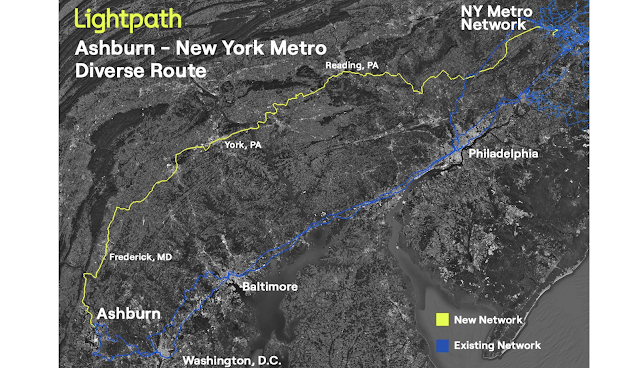
Lightpath announced a new regional long-haul route cbetween the data center epicenter of Ashburn, Virginia, and the New York Metro area. This 300-mile route is geographically diverse from existing Lightpath routes between New York and Ashburn. Lightpath will offer flexible bandwidth options along the route up to 800 Gbps optical transport. In addition, customers can directly connect to major cloud providers in the Ashburn area, as well as critical...

Lightpath expands fiber footprint west of Boston

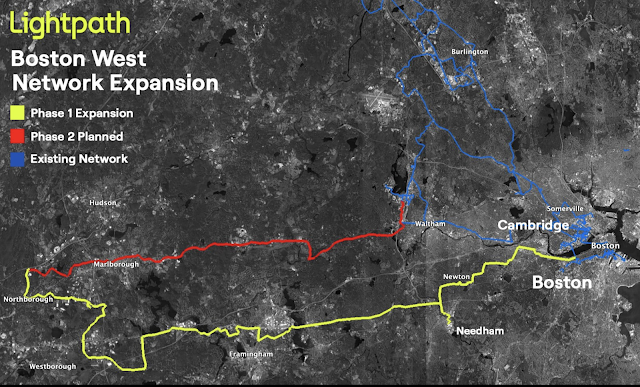
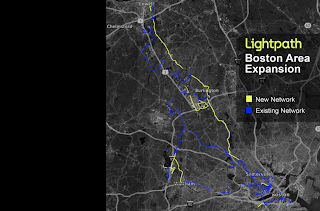
 Lightpath announced a 75-mile expansion of its all-fiber network west of its Boston metro footprint, bringing the total size of the Lightpath network in the Boston metropolitan area to more than 200 route miles.The Boston West expansion includes over 75 miles of new, high-count fiber along the I-90 corridor between Boston and Marlborough, planned in two phases. Phase 1 of the build (in yellow on map) will be completed later in 2022, while the...

Lightpath expands its fiber footprint across Boston region

Lightpath announced a 50-mile expansion of its all-fiber network in the Boston region, following the company's entrance into the market via multiple acquisitions in June. The additional 50 route miles of network brings the total route miles in the Boston metropolitan area to over 130.The network expansion is focused on the five key areas of Boston, Waltham, Bedford, Burlington, and Lowell, MA, and is designed to enable access to additional, strategic...

Infinera reports Q3 revenue of $390 million, up 9% yoy

Infinera reported Q3 GAAP revenue of $390.4 million compared to $358.0 million in the second quarter of 2022 and $355.8 million in the third quarter of 2021. GAAP gross margin for the quarter was 34.4% compared to 30.5% in the second quarter of 2022 and 33.2% in the third quarter of 2021. Non-GAAP net income for the quarter was $9.9 million, or $0.05 per share, compared to net loss of $(10.1) million, or $(0.05) per share, in the second quarter of 2022, and net loss of $(3.0) million, or $(0.01) per share, in the third quarter of 2021.

Infinera CEO David Heard said, “The third quarter was a strong quarter for us. We once again exceeded consensus expectations for both revenue and non-GAAP operating margin. On a year-over-year basis, we grew product revenue by 17% and total company revenue by 9%, and more than doubled operating profit, while generating free cash flow and strengthening our balance sheet. Further, we set another record in the quarter for ICE6 revenue and achieved additional key milestones with the field performance of our new pluggable products. Our results and progress were made against the backdrop of ongoing supply chain challenges, including the impact of elevated costs on our financial results.”

“Our investment thesis is sound, and we remain focused on the things we can control to grow market share and drive results to our target business model. We look forward to closing out 2022 on a strong note and building on our momentum in 2023 as we continue to deliver on our long-term growth and profitability objectives.”

https://investors.infinera.com/events-and-presentations/default.aspx

Kyndryl's revenues dip to $4.2 billion, focus is on alliances

Kyndryl reported revenues of $4.2 billion, a year-over-year decline of 9%, or growth of 1% in constant currency. Compared to prior-year pro forma revenues, revenues declined 8%, but increased 2% in constant currency. The company reported a pretax loss of $219 million and a net loss of $281 million, or $1.24 per diluted share, in the quarter, compared to a net loss of $690 million in the prior-year period. 

“Our solid execution and enhanced customer engagement drove strong revenue results in the September quarter. Excluding external factors such as currency headwinds and higher energy costs, our adjusted earnings were consistent with our June quarter earnings,” said Kyndryl Chief Financial Officer David Wyshner. “We’re confident we have the right strategy in place, and we’re on track to achieve our medium-term goals, including top-line growth in calendar 2025 and meaningful margin expansion.”

Kyndryl noted that in the first six months of fiscal 2023 itsigned contracts tied to cloud hyperscaler alliances with an aggregate value of more than $425 million, progressing toward its $1 billion hyperscaler signings target for the year. Kyndryl further increased its cloud-related capabilities, with more than 26,000 hyperscaler certifications among its employees at the end of the quarter, a 63% increase since the beginning of the calendar year.

https://investors.kyndryl.com/events-and-presentations/events/

Tuesday, November 1, 2022

FCC considers opening 12.7 GHz band for next-gen wireless

The FCC will launch a proceeding to explore repurposing up to 550 megahertz in the 12.7 to 13.25 GHz band (12.7 GHz band) for next-generation wireless services.  

The FCC expects that this inquiry is the first step in providing for more intensive use of the 12.7 GHz band, unlocking a significant expanse of valuable mid-band frequencies that may play a key role in delivering on the promise of next-generation wireless services, including 5G, 6G, and beyond.  

The 12.7 GHz band is believed to be ideally suited for mobile broadband use as it is already allocated for terrestrial mobile services on a primary basis domestically.

The Notice of Inquiry seeks information on how the Commission could encourage more efficient and intensive use of the 12.7 GHz band.  

Given existing incumbent operations in the band, the FCC is also seeking comment on whether and how to provide opportunities for new uses while protecting the investments made by incumbents and avoiding disruption to their operations.  

FCC adds $791 million in RDOF funding for broadband

The FCC is ready to authorize $791,604,299 through the Rural Digital Opportunity Fund to six providers to fund new broadband deployments to over 350,000 estimated locations in 19 states.  The top three states receiving funding include Illinois, $212 million, Arizona, $140 million, and Iowa, $113 million. “This funding will connect more households throughout the country with high-speed broadband as part of our ongoing work to close the digital...

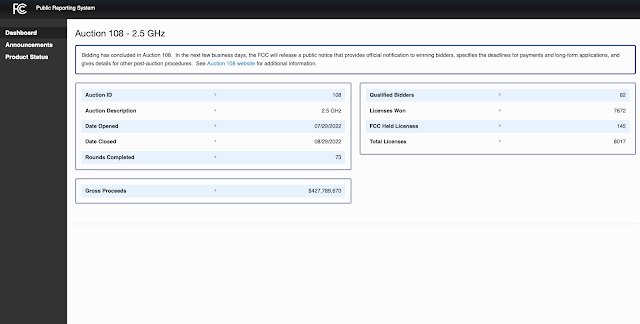
FCC Auction 108 concludes - 2.5 GHz Spectrum

Bidding has concluded in the FCC Auction 108.  Gross proceeds from the bid are expected to amount to $427,789,670.The FCC said it will post full results in the next few days. https://auctiondata.fcc.gov/public/projects/auction108FCC commences 5G mid-band spectrum auctionSunday, July 31, 2022  Auctions, FCC  The FCC opened bidding in its latest mid-band spectrum auction at 10am on Friday, July 29.Auction 108 makes...