Tuesday, November 1, 2022

Lumen wins $1.5 billion Defense Network contract

The  Defense Information Systems Agency (DISA) awarded a $1.5 billion contract to Lumen to provide essential network transport and communications services in the U.S. Indo-Pacific Command Area of Responsibility.

Lumen will supply the Defense Information Systems Network with high capacity, end-to-end communications services that enable the U.S. Department of Defense to achieve U.S. national security objectives in the 36-nation Asia Pacific region. These crucial services—which include Ethernet, Internet and wavelengths—will help protect America's interests in a diverse, strategically complex region that also includes Alaska. The contract extends over a 10 year period.

"Lumen is extremely proud to serve the U.S. Indo-Pacific Command with essential mission services that help protect and defend U.S. territory, our people and America's national interests," said Zain Ahmed, senior vice president, Lumen public sector. "We're delivering the always-on network infrastructure so the U.S. Department of Defense can focus on its mission to enhance the stability of the Asia Pacific region, promote security cooperation with our allies and partners, respond to emerging situations, deter aggression and if necessary, fight to win."

Dubai looks to Nokia 5G network slicing for smart city use

Nedaa, the security network provider of the Dubai government, will upgrade its telecommunications network across Radio Access Networks (RAN) and core by leveraging 5G technology with Nokia’s technologies. 5G network with end-to-end slicing functionality will help Nedaa deliver improved public safety and smart city services to concerned organizations and citizens, as well as lay the foundations for more advanced services such as metaverse. 

Nedaa’s network already utilizes Nokia’s infrastructure and can support many of the requirements for mission-critical networks. 

The MoU sets a framework for upgrading the existing network capabilities and introducing agile and advanced services to government organizations based on secure and reliable networks. One of the key elements is 5G network slicing which will help Nedaa provide segment-related solutions for different industries, including oil and gas, transport and other government organizations. The MoU also lays the foundation for identifying the most appropriate 5G use cases for capturing new opportunities and monetization. 

Nokia will also carry out a technology competence development program covering training and knowledge transfer to Nedaa employees. Nokia will expand its state-of-the-art Integrated Operations Center (IOC) as the integration and enablement layer for all 5G use cases, including Industry 4.0, smart city and public safety applications with a path to future services such as metaverse and more.

A10 Networks sees Q3 revenue rise 10% yoy, margins at 80%

A10 Networks reported Q3 revenue of $72.1 million, up 10.2% year-over-year. GAAP gross margin was 79.5%; non-GAAP gross margin of 80.2% as a result of better product mix and continued successful navigation of short-term input cost pressures. Non-GAAP net income of $15.9 million, or $0.20 per diluted share, compared with non-GAAP net income of $13.7 million, or $0.17 per diluted share in the third quarter of 2021.

A10 said revenue growth was broad-based, with increases in North America, APJ, EMEA and Latin America, and from both Enterprise and Service Provider customers. Enterprise sales grew 17%, and Service Provider sales grew 6%, demonstrating strong revenue diversification.

“A10 is consistently achieving revenue and EPS targets despite a variety of macro headwinds in all regions,” said Dhrupad Trivedi, President and Chief Executive Officer of A10 Networks. “This demonstrates robust demand for our proprietary security-led solutions, disciplined execution, and a focus on diversification that drives sustainability. We have positioned our business to avoid concentration in any single geography, any specific customer type, or any isolated product offering, and this diversification enables consistent execution despite economic, supply chain, and geopolitical challenges. Customer-centric technical innovation, global commercial execution and focus on driving the business model are bolstering our sustainability and driving continued success.”

https://investors.a10networks.com/overview/default.aspx

A new Internet Exchange opens in Bangkok

HGC Global Communications, AMS-IX (Amsterdam Internet Exchange), and International Gateway Company Limited (IGC), a neutral regional telecommunication and network service provider, collaborated to launch a new IX, AMS-IX Bangkok, in Thailand as part of AMS-IX strategy to implement IX's in various key locations in Asia.

The new Internet Exchange located at Bangkok, which is the hub and gateway of the Greater Mekong Subregion (GMS), will improve the quality of Internet connections of companies such as content providers, gaming, OTTs, cloud service providers and internet service providers and aims to build a thriving digital community.

HGC also partners with AMS-IX in Singapore, Hong Kong, Bay Area and Chicago. HGC will continue to serve as a commercial partner and marketing arm for AMS-IX Bangkok, while IGC provides IX infrastructure, network, and operation in Bangkok. AMS-IX, with their expertise on peering and network monitoring, will give technical support and has operational management of the exchange.

"Being an early entrant into the Thailand market, we feel honored to gain penetration into the Greater Mekong Subregion with our renowned partner - AMS-IX. This is a rite of passage for the enhancement of the HGC edgeX brand to be positioned as a premium leader in engaging the internet exchange business to contribute to a better interconnection ecosystem which is dependent on the fast development of digital transformation. We hope to have promoted access to a digitalized world by localizing traffic in this growing market.", said, Mr. Chirawat Mahawat, Vice President Greater Mekong Subregion of HGC.


New Semiconductor Climate Consortium gets underway

More that 60 companies have come together to form a new Semiconductor Climate Consortium (SCC) to accelerate the ecosystem’s reduction of greenhouse gas emissions.

The consortium’s members are committed to working toward the following pillars and objectives:

  • Collaboration – Align on common approaches, technology innovations and communications channels to continuously reduce greenhouse gas emissions.
  • Transparency – Publicly report progress and Scope 1, 2 and 3 emissions annually.
  • Ambition – Set near- and long-term decarbonization targets with the aim of reaching net zero emissions by 2050.

Founding members have affirmed their support of the Paris Agreement and related accords driving the 1.5⁰C pathway and are aligned on the need to drive climate progress within the semiconductor value chain. The SCC was conceptualized by companies meeting under the SEMI Sustainability Initiative, which will continue to focus on non-climate related Environment, Social and Governance (ESG) issues. 

“I applaud all Semiconductor Climate Consortium founding members for their leadership in this critical initiative and for their continued support of global sustainability efforts,” said Ajit Manocha, SEMI president and CEO. “While individual companies have taken significant steps to decarbonize, the industry must band together to develop green solutions and drive toward net zero. I encourage every company across the value chain to join the SCC and contribute to this crucial mission.”

https://www.semi.org/en/news-media-press-releases/semi-press-releases/semi-announces-semiconductor-climate-consortium-founding-members

Auvik appoints Douglas Murray as CEO

Auvik, a start-up offering cloud-based network management software, has appointed Douglas Murray as Chief Executive Officer. Murray succeeds Marc Morin, who founded Auvik alongside Alex Hoff and David Yach in 2011 and has served as the company’s CEO since inception. Morin will continue to be an active member of Auvik’s Board of Directors.

Murray most recently served as CEO of Valtix, a leading platform for multi-cloud network security.  Murray also brings experience from his seven years as CEO of SDN pioneer Big Switch Networks, which was acquired by Arista Networks in 2020. Additionally, as senior vice president and general manager at Juniper Networks, Murray led its USD $1 billion business across the APJC region — driving customer engagement, sales development, strategic planning and revenue growth.

“I am thrilled to join Auvik during a time with so much opportunity. It is clear that the team is aligned with its 3,500 customers to provide unrivaled, easy to use solutions,” said Murray. “The company has already seen success following its growth investment from Great Hill Partners and, with its most recent acquisitions, Auvik is poised to take the company to the next level. My thanks to Marc for leading Auvik from incubation to scale over the last decade.”

“As a co-founder, I will always be Auvik’s biggest champion and I could not think of a better person than Doug to lead the company through its next phase of explosive growth,” said Morin. “His extensive industry experience, specifically in the multi-cloud Software Defined Networking and network observability space, is exactly what Auvik needs to push forward into its next chapter and become the ultimate network management platform. I have no doubt that Auvik will experience tremendous growth and accelerated innovation with Doug at the helm.”

https://www.auvik.com/

Monday, October 31, 2022

Malaysia's mobile operators agree to share national 5G infrastructure

Four mobile operators – Celcom Axiata Bhd, Digi Telecommunications Sdn Bhd, YTL Communications Sdn Bhd (YES), and Telekom Malaysia Bhd (TM – agreed to take up equity stakes in Malaysials Digital Nasional Berhad (DNB). 

The deal paves the way for DNB to accelerate deployment of the 5G network and infrastructure, with a target of 80% coverage of populated areas by 2024.

Together, the four operators will hold 65% equity in DNB, with their respective stakes as follows: Celcom Axiata (12.5%), Digi Telecommunications (12.5%), YTL Communications (20%), TM (20%). The Government of Malaysia will retain the other 35% and hold a Golden Share, which carries various rights and privileges and covers areas such as ownership, sale, or transfer of shares on the part of the Government. 

The 12.5% shareholding each for Celcom Axiata and Digi Telecommunications is in recognition of their imminent merger. Under the terms of the SSA and the agreed governance structure between the parties, no single MNO can hold more than a 20% shareholding in DNB, and in the event of a merger between the MNOs, the merged entity cannot hold more than a 25% shareholding in DNB.

This marks a positive development following extensive discussions between the MNOs and DNB. It is anticipated that the MNOs will make 5G services available to their end users from October 2022 onwards. 

“I am pleased that the MNOs have taken up the equity offered by the Government and have executed their SSAs with DNB. All parties will now work towards completing the conditions precedent in the SSAs, including executing the Access Agreements as soon as possible. I expect that all parties will make every effort to deliver 5G availability to all their Malaysian and global ‘roaming’ customers. The MNOs, in particular, have a crucial role to play in ensuring the accelerated adoption of 5G among end users. Over the longer term, they will be responsible for bringing to market a host of new 5G-enabled products and services which will have a positive impact on many businesses, be it small, medium or large, as well as Government,” said DNB Chairman, Yang Berbahagia Datuk Seri Asri Hamidon.

"As of today, the 5G network has achieved 33% coverage of populated areas as against a target of approximately 40% by end-2022. The testing and integration of 5G sites by the MNOs have progressed well and I believe they are ready to provide 5G services to end-users located in areas where 5G infrastructure is currently available. In addition, the local 5G ecosystem has grown rapidly, with 12 device brands now offering more than 100 5G-compatible models for use in Malaysia. As such, we are encouraged by the establishment of the infrastructure to facilitate the rapid adoption of 5G by the Rakyat, businesses, and Government,” Datuk Seri Asri added. 

https://www.digital-nasional.com.my/mobile-network-operators-execute-share-subscription-agreements-digital-nasional-berhad-0

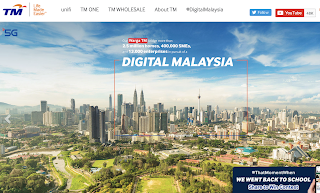
Telekom Malaysia to provide fiber to DNB for nationwide 5G

Telekom Malaysia Berhad (TM) signed a Fibre Leasing Service agreement with Digital Nasional Berhad (DNB) to speed up the deployment of the government-owned 5G network nationwide.

DNB will be able to leverage on TM’s extensive fibre and network infrastructure, and subscribe to TM’s 5G RAN-to-Edge Fronthaul and Backhaul solution for the provision of fibre connectivity, enabling DNB to provide 5G network services nationwide.

Under the agreement, TM will provide DNB with 5G fibre leasing services for connectivity between DNB’s 5G mobile sites and nodes, leveraging on TM’s domestic fibre cable network spanning over 640,000 km across Malaysia. Prior to this, TM along with other fibre providers in Malaysia had participated in the 5G Fiber Leasing Request for Quotation (RFQ) exercise conducted by DNB in June 2021.

The term sheet agreement with a total contract value of RM2 billion over 10 years was duly signed by Imri Mokhtar, Group Chief Executive Officer of TM and Amar Huzaimi Md Deris, Executive Vice President, TM Wholesale while DNB was represented by Augustus Ralph Marshall, Chief Executive Officer and Dushyanthan Vaithiyanathan, Chief Operating Officer.

https://www.tm.com.my/Newsroom/Pages/TM-INKS-AGREEMENT-WITH-DNB-TO-PROVIDE-FIBRE-CONNECTIVITY-IN-ACCELERATING-ROLLOUT-OF-5G-NETWORK-SERVICES-NATIONWIDE.aspx

Arista posts record revenue of $1.2 billion, up 57% yoy

Arista Networks reported Q3 revenue of $1.177 billion, an increase of 11.9% compared to the second quarter of 2022, and an increase of 57.2% from the third quarter of 2021. GAAP gross margin was 60.3%, compared to GAAP gross margin of 61.2% in the second quarter of 2022 and 63.9% in the third quarter of 2021. Non-GAAP net income was $391.9 million, or $1.25 per diluted share, compared to non-GAAP net income of $236.9 million, or $0.74 per diluted share in the third quarter of 2021.

“Arista continues to outpace our networking peers with record revenue in Q3 2022,” said Jayshree Ullal, President and CEO of Arista Networks. “Clearly, we are entering the next phase of Arista’s evolution in products, customer intimacy and new market expansion.”

  • Supply chain issues remained a factor.
  • International sales represented of 17% revenue, with Americas at 83%
  • Cloud titans was the largest vertical, followed enterprises.
  • Cloud titan partnerships grew stronger. Microsoft and Meta are continuing with their 400G journeys.


https://investors.arista.com/Events/Events/Event-Details/2022/Arista-Networks-Q3-2022-Earnings-Conference-Call--Webcast/default.aspx

Arista delivers its next-gen Cloud Routing

Arista Networks is releasing the next iteration of its cloud-grade routing platform, which was first introduced six years ago. It is based on cloud principles of scale-out architectures, standards-based protocols, and software-driven control. Highlights of the announcement:For enterprises, Arista advances the enterprise edge by securing data-in-transit over high speed links with "TunnelSec" technology, providing in-line encryption at wire rate from...


Far North Fiber advances plans for arctic cable from Europe to Asia

Far North Fiber, an international consortium consisting of  Finland’s Cinia Oy, Alaska’s Far North Digital and Japan’s ARTERIA Networks Corporation, is moving ahead with plans for a 17,000 km Trans-Arctic Fiber cable connecting Japan, North America, and Ireland and Scandinavia.

Far North Fiber estimates the system will be ready for service by the end of 2026. 

Alcatel Submarine Networks (ASN) has been selected to build and install the submarine cable and equipment required for this project.

“Far North Fiber will be the first multicontinental cable system through the Arctic. It provides a backbone that offers enhanced opportunities for economic development, international security, and a greener footprint for the buildout of global digital infrastructure,” says Ari-Jussi Knaapila, CEO of Cinia.

Koji Kabumoto, Representative Director, President & CEO of ARTERIA, commented: " The FNF is to build a network that directly connects Europe and Asia with low latency through the Northwest Passage, and Japan will serve as the gateway to Asia. It is our pleasure to be involved in this journey, as the project is expected to contribute the development of digital societies in Japan and Asia in a wide range of fields, including industry, academia, and culture."

https://www.cinia.fi/en/news/development-corporation-formed-for-trans-artic-fiber-cable-connecting-europe-to-asia

Cinia and Far North Digital plan subsea cable across Arctic

Finland-based Cinia announced a joint effor with Far North Digital, a start-up based in Anchorage, to build a fiber optic cable system linking Europe and Asia through the Arctic. Alcatel Submarine Networks will take the lead on project design and installation.The planned, 14,000km cable system will run from Japan, via the Northwest Passage, to Europe with landings in Alaska and the Canadian Arctic. European landings are planned in Norway, Finland...

Cinia Plans Terabit-class Cable from Finland to Germany with ALU

Cinia Group (previously Corenet), a Finnish Government-owned venture, has selected Alcatel-Lucent to deploy a terabit-class undersea cable system linking Finland and Germany. The project, named Sea Lion, calls for the deployment of a new 100G system that will span more than 1,100 km from Helsinki in Finland, to the Rostock-Ribnitz area in Germany. It will have a design capacity of 15 Terabits per second (Tbps) and is expected to enter service in...

Arctic Connect cable to link Norway and Japan

A new Arctic Connect Submarine Cable (ACSC) project is being planned to connect Kirkenes, Norway and Tokyo, Japan, through the Arctic Ocean and Northern Pacific Ocean.  The system will have its European cable landing stations in Northern Norway and Finland, with connections further southwards through Finland, Norway, Sweden, and Denmark extending to the rest of Europe. The cable system has options for additional landings in Japan and in North...


Egypt inaugurates Red2Med cable along west bank of Suez

 Last week, Telecom Egypt's CEO and Managing Director, Adel Hamed, along with Egyptian government officials officially inaugurated “Red2Med,” a new submarine and terrestrial cable running from the Ras Ghareb landing point in the Red Sea to the landing station in Port Said in the Mediterranean Sea through Internet Corridor of Egypt (ICE).

Red2Med is composed of three segments which are detached from the conventional public roads: from the south the Red Sea subsea festoon cable linking Ras Ghareb, Zaafarana and Suez, then extending to the ICE terrestrial from Suez to Port said, and finally connecting to the planned Mediterranean Sea subsea festoon cable.

ICE is a 200 km, one-of-a-kind crossing route connecting the new Suez 2 and Port Said 2 landing stations. This new terrestrial fiber optic route runs through Morshedeen route on the west bank of the highly-secured Suez Canal campus.  

Telecom Egypt says the Red2Med system will encourage and support better international connectivity between East and West, connecting Europe, Africa and Asia.

Hamed stated that launching Red2Med is a remarkable achievement and a breakthrough in the submarine cables industry, as it cements Egypt’s position as a regional data hub. He added that Telecom Egypt is pleased to offer the new cable system, a brand-new optical path that will encourage and support better international connectivity.  

https://mcit.gov.eg/en/Media_Center/Press_Room/Photo_Gallery/26972


TAWAL to provide infrastructure for King Abdullah Economic City

TAWAL, the leading Saudi ICT Infrastructure company, will provide ICT infrastructure for King Abdullah Economic City.

These solutions will improve the efficiency of KAEC’s telecommunications network through the application of best practices and international standards.

Under the stipulations of the strategic agreement, TAWAL will acquire all the towers owned by the city, as well as the In-Building Solutions (IBS). TAWAL will manage and operate these assets to telecom service providers.

The agreement was signed during the “Future Investment Initiative” summit — which was held in Riyadh from 25 to 27 October — in the presence of TAWAL CEO, Eng. Mohammed Alhakbani, and KAEC CEO, Mr. Cyril Piaia.

https://www.stc.com.sa/content/stc/sa/en/about-stc/media-center/press-release/press-release-detail.html?id=tawal-acquires-king-abdullah-economic-city-telecommunication-towers

Saudi Arabia's TAWAL picks Nokia for 5G expansion

TAWAL, the leading Saudi ICT Infrastructure company, has selected Nokia to provide full turnkey services towards expanding and deploying 5G for TAWAL’s infrastructure in the western and southern parts of Saudi Arabia. This project is part of TAWAL’s plan for 5G expansion in the western and southern parts of Saudi Arabia, where Nokia will be adding 5G capabilities to 670 4G sites over the course of six months. In addition, Nokia will be replacing...


Rogers + Shaw deal hits further regulatory snag

Quebecor, Rogers Communications, and Shaw Communications issued the following statement late last week after a mediation session as part of Canada's Competition Tribunal process failed to reach an agreement that would allow the Rogers + Shaw merger to proceed:

"“The mediation did not yield a negotiated settlement.  We are disappointed with this outcome and believe that litigation is both unnecessary and harmful to competition. The Bureau’s unwillingness to meaningfully engage unduly delays lower wireless prices for Canadian consumers.

We remain committed to completing this pro-competitive series of transactions and are confident in the strength and merits of our case in front of the Competition Tribunal, including the many benefits of these transactions to Canadians.

Once completed, our proposed series of transactions will positively transform the Canadian telecommunications industry in both the wireline and wireless segments. The combined Videotron-Freedom business will have everything it needs to compete as a stronger fourth carrier for the long term, including critical 5G spectrum. Quebecor’s commitment to lower wireless prices for Canadians across the country is one of the many benefits that the proposed transactions will create.

At the same time, the combined Shaw-Rogers wireline business will have a national network positioned to compete against the telcos for the long-term."

https://about.rogers.com/news-ideas/quebecor-rogers-shaw-provide-statement-regarding-mediation-with-the-commissioner-of-competition/

Rogers + Shaw merger to reshape Canadian market

Rogers Communications agreed to acquire Shaw Communications in a $26 billion deal that could reshape the Canadian communications market. Under the transaction, Rogers will acquire all of Shaw’s Class A and Class B shares for $40.50 per share, reflecting a ~70% premium to Shaw’s Class B share price.

The merger will create Canada’s most robust wholly-owned national network and accelerate the deployment of 5G. Once the transaction is complete, the companies plan to invest $2.5 billion in 5G networks across Western Canada, which is expected to create up to 3,000 net new jobs. The deal brings together Shaw’s fibre-to-home, WiFi and wireless networks with Roger's national wireless network and 5G capabilities.

Both Rogers and Shaw began as family operated businesses.

Rogers will also commit to establishing a new $1 billion Rogers Rural and Indigenous Connectivity Fund to connect rural, remote and Indigenous communities across Western Canada to high-speed Internet and closing critical connectivity gaps faster for underserved areas. 


Rambus posts strong Q3, exceeding guidance

Rambus posted Q3 GAAP revenue of $112.2 million, with licensing billings at $62.2 million, product at was $58.6 million, and contract and other revenue of $23.7 million. The company also generated $80 million in cash provided by operating activities in the third quarter.

“Rambus had an excellent performance in the third quarter, exceeding guidance and delivering record cash and product revenue,” said Luc Seraphin, chief executive officer of Rambus. “Our strategic focus and strong execution in data center, combined with a diverse portfolio of offerings, drive the company’s long-term profitable growth and enable consistent capital returns to our stockholders.”

Separately, Rambus extended its patent license agreement with Samsung Electronics. This substantially maintains the existing financial terms and provides Samsung with broad access to the full Rambus patent portfolio through late 2033. Other terms and details are confidential.

https://investor.rambus.com/press-releases/press-release-details/2022/Rambus-Reports-Third-Quarter-2022-Financial-Results/default.aspx

Cinchy raises $14.5m for enterprise data management

Cinchy, a start-up based in Toronto,  raised US$14.5 million in Series B financing, for its data fabric and data mesh solutions for enterprises.

“Our mission is to liberate and harness the power of data, giving it back to teams and organizations to accelerate digital transformation and growth,” said Dan DeMers, CEO and co-founder of Cinchy. “We’re thrilled to partner with the team at Forgepoint Capital, which uniquely appreciates the importance of data layer controls and the enablement of data autonomy. This latest round of funding helps us expand our team and release new offerings that include pre-built dataware solutions designed to help organizations instantly liberate both trapped data and siloed SaaS applications.”

The funding round was led by Forgepoint Capital. 

https://cinchy.com/solutions


Sunday, October 30, 2022

Orange selects Edgecore for access disaggregation via SONiC

Edgecore Networks and Orange delivered the first disaggregated switch composed of Edgecore hardware and Orange network operating system based on SONiC (Software for Open Networking in the Cloud) open source community.

Orange selected Edgecore switches to deliver connectivity for its hundreds of access Points of Presence (PoP). These locations provide 1G, 10G, and 100G access services to enterprise customers.

The disaggregated Edgecore hardware platform comes pre-loaded with the ONIE (Open Network Install Environment) software installer for the automated loading of compatible open source or commercial network operating system offerings. 

Orange is installing its own SONiC distribution to run on the switches. Orange relies on its developers’ expertise working in conjunction with Edgecore and the SONiC community, to which Orange actively contributes, to develop their own networking software solutions.

Heimdall Siao, President of Edgecore said, “As the leader in disaggregated open networking solutions, Edgecore is excited to be involved in this disaggregated and community SONiC networking project with Orange in a telecom use case. Edgecore’s switches running SONiC software provide the high-capacity throughput required for access networks. And, by utilizing Edgecore’s carrier grade and proven robust designs, Orange is able to deploy solutions in the most demanding of carrier networks. This successful experience in Orange’s network proves that disaggregated open networking solutions are robust and capable of handling the most demanding of network environments.”

Jean Luc Vuillemin, Executive Vice President of Orange International Networks, said, “We are pleased to team up with Edgecore to launch our network disaggregation transformation. This joint work enables us to drastically transform the way we build and upgrade our networks. It allows us to move away from off the shelf and locked-in solutions to in-house developed solutions relying on our network developers’ expertise. Upskilling our teams to master our software allows us to regain full control of our networks and therefore manage upgrades in a fast, cost-effective and sovereign way, while providing an improved and reliable service to our customers.”

https://www.edge-core.com/sonic.php

Ericsson Network Slicing runs during Singapore F1 Grand Prix

During the recent Grand Prix Season Singapore 2022 (GPSS 2022) in October, Singtel employed Ericsson’s Dynamic Radio Resource Partitioning feature to deliver end-to-end network slicing in a live 5G Standalone network to power 5G experiences and festivities along the Marina Bay Street Circuit.

Network slicing creates a logically separated, self-contained slice of the network, offering differentiated service performance with prioritised assurance on speed, latency and reliability. Dynamic Radio Resource Partitioning is a software solution that allocates spectrum resources at millisecond level scheduling.

Ericsson’s end-to-end network slicing solution also included cloud-native capabilities to create a dedicated slice of its network that was reserved for subscribers of Sports Plus on Singtel’s app marketplace, CAST. This meant subscribers could enjoy seamless video streaming of the action of the high-velocity race from wherever they were. The network delivered the live content even in congested areas along the Marina Bay Street Circuit due to the dedicated capacity being allocated to the service.

Singtel announced in July that it had achieved over 95 percent 5G Standalone nationwide coverage – three years ahead of the regulator’s deadline.

Mark Chong, Group Chief Technology Officer, Singtel, said, ”We’re proud to have been the official network partner of the GPSS, providing race spectators and attendees of the various GPSS related events with the superior features of Singapore’s most powerful 5G network. With the world’s first application of end-to-end network slicing technology to our CAST app, we were able to provide F1 fans a superior viewing experience of the action on the track and enhance the experience of 5G race-related activations held across the island.”

Martin Wiktorin, Head of Ericsson Singapore states:” The fast and efficient delivery of services as well as high-quality user experience provided by Singtel CAST was enabled by a range of Ericsson technologies working together to deliver a full end-to-end network slice on 5G sites surrounding the F1 race. With Singtel CAST subscribers being assigned the premium slice, they were able to enjoy the full race via seamless video streaming even in congested areas along the F1 race.” Around 302,000 fans turned up for the Singapore Grand Prix this year.

Video: Prospects for Telco Cloud and Edge


Join us on a 1-mile walk around central San Jose, California to discuss some of the big trends around Telco Cloud and Edge while enjoying the scenery.

Our topics:

01:31 Are you seeing real deployments at the edge? 2:07 Who are the main players that we are talking about? 2:53 The Sustainability imperative 4:09 Is there a killer application or killer network function? 5:17 Who has the early advantage in terms of edge deployments and strategy? 6:07 What can you tell us about Kaboom? 8:54 There are really just a handful of significant suppliers for 5G infrastructure. Are they sincere about openness 9:10 Let's talk about OCP for the service provider world 12:00 How many edge locations do telcos really need? 13:21 Will the Metaverse, AR, and VR become big drivers for the edge? 17:47 Ecosystem partners including Red Hat 18:53 How is the P4 programming language being used? 20:42 The Start-up Life


EE deploys Ericsson’s Massive MIMO radios at key UK sites

EE, part of the BT Group, has begun deployment of Ericsson’s ultra-lightweight radios  to deliver improved 5G energy efficiency and network performance across the UK.

EE’s first deployments of the equipment are in London, with sites in Manchester, Leeds, Edinburgh, and Belfast to follow this year. The improved technology will be expanded to more urban and suburban areas in the future, where Ericsson is a key partner for EE. Operating within EE’s 3.4GHz and upper 3.6GHz spectrum bands, the new radio will initially be deployed over 1,000 sites, not only offering substantial energy efficiencies but also improving capacity, coverage, speed and mobile experience for customers.

Ericsson’s AIR 3268 is the lightest and smallest Massive MIMO radio with up to 40 percent less weight (14kg) and volume (25 litres) than Ericsson's previous generation of radio.

Greg McCall, Chief Networks Officer, BT Group, said: “We’ve already made significant progress in making EE a more efficient network, delivering vast quantities of additional data without equivalent energy increases. Our partnership with Ericsson is a further milestone in this journey, enabling us not only to accelerate our 5G roll-out in city centres, but to do so in a more sustainable way. That’s good for us, but also incredibly important to our customers and the planet.”

Björn Odenhammar, CTO, Networks and Managed Services, Ericsson UK and Ireland, said: “It is incredibly exciting to see our partnership with BT Group succeed with such fantastic results. This is a great step forward for the deployment of 5G in the UK and gives a much-needed boost in both 5G coverage and mid-band performance. Together we are not only leading the delivery of next-generation connectivity across the country, but also reducing energy consumption to build a more sustainable mobile network of the future.”

https://www.ericsson.com/en/press-releases/3/2022/ericsson-and-ee-deliver-more-sustainable-5g-network-with-european-first

Germany opens ground station for optical satellite links

Earlier this month, the Institute of Communications and Navigation of the German Aerospace Center (Deutsches Zentrum für Luft- und Raumfahrt; DLR) inaugurated a ground station at its Oberpfaffenhofen site to test optical satellite links.

"In the future, it will become increasingly important to efficiently network satellites with each other and to exchange data securely and efficiently with the ground," says Anke Kaysser-Pyzalla, Chair of the DLR Executive Board. "This is driven by the ever-increasing data volumes involved in communications, navigation and Earth observation activities, as well as by the increasingly scarcity of radiocommunications licences."

The newly expanded ground station in Oberpfaffenhofen will make it possible to test and further develop its numerous applications, including satellite-based quantum communication solutions.

The centrepiece of the new optical ground station is a new telescope with a diameter of 80 centimetres. The telescope is a Coudé focus telescope, in which the light collected by the telescope is guided via mirrors directly into a laboratory.

AWS intros Amazon Neptune Serverless for graph databases

AWS introduced a serverless option for Amazon Neptune, which is itsfully managed graph database service for apps based on highly-connected datasets. Neptune supports open and popular graph query languages for powering use cases such as recommendation engines, fraud detection, knowledge graphs, drug discovery, and network security.

Neptune has always been fully managed and handles time-consuming tasks such as provisioning, patching, backup, recovery, failure detection and repair. However, managing database capacity for optimal cost and performance requires you to monitor and reconfigure capacity as workload characteristics change. 

The new Amazon Neptune Serverless option scales automatically as queries and workloads change, adjusting capacity in fine-grained increments to provide just the right amount of database resources that an application needs. 

https://aws.amazon.com/blogs/aws/introducing-amazon-neptune-serverless-a-fully-managed-graph-database-that-adjusts-capacity-for-your-workloads/