Tuesday, February 1, 2022

Blueprint: An insider’s view on the do’s, don’ts and deal breakers of SaaS

Mark Bunn, Senior Vice President, SaaS Business Operations, Cloud and Network Services, Nokia

Launching a new business model isn’t for the faint of heart, particularly when the change disrupts the status quo. Software-as-a-Service for communication service providers promises to change the very foundation of how our industry does business today. Moving from a legacy of customized, on-premise technology to a cloud native environment where everything is managed by the software vendor, is not only a change in mindset, it also changes the way CSPs have managed their businesses since the industry began in the 1800s.

The tipping point where only the strong survive 

Are CSPs ready to step into another chapter of telecommunications history? It’s only a matter of time before we reach a tipping point. SaaS will transform the way CSPs consume software. 

What’s to gain? Faster time to market, faster deployment of systems and new capabilities. Done right, SaaS eliminates risky, cumbersome upgrades, delivers significant savings on total cost of ownership (TCO) and reduces worry. Adopting SaaS will vastly improve the time-to-value that CSPs can realize by having on-demand access to services. 

Software-as-a-Service for CSPs can usher in a new era, reducing business friction to a level that makes mass adoption and value creation possible. Of course, any major shift brings cultural, operational and technology changes and it’s important to pay attention to lessons we can learn along the way.

Five critical assertions

1. Security and compliance are non-negotiable. 

As security breaches can be devastating. it is critical to take every reasonable action while providing a fully functional and highly available service. Security compliance is table stakes and takes significant time, effort and cost to achieve.

2. Architecture drives profitability.

In a cloud native environment, consider scalability at both ends of the spectrum where cost control becomes most challenging. Keep a rein on technical debt incurred as a byproduct of time-to-market priority decisions. Automate, automate and automate again, relying on infrastructure-as-code instead of manually applying production changes. It keeps the costs of SaaS operations flat while growing the SaaS subscriber base. Finally, and most important, diligently manage the reliability associated related to the deployment architecture with software.  

A key difference between SaaS and other forms of hosted services is that the software, not human beings, is responsible for managing the SaaS services.  For example, if we had production SaaS customers on our SaaS Delivery Framework today, we would have expected little measurable service impact for the AWS outage that occurred the week of December 6. The combination of our SaaS Delivery Framework architecture and Site Reliability Engineering early detection system provides a shield against this type of service disruption. In our future end-state, the SaaS Delivery Framework will enable us to move workloads between hyperscaler platforms to mitigate cloud outages like this one.

3. Embrace the fact that we are the IT department.

The buck stops with the SaaS delivery team, as the responsibility for operations, administration and management moves to the SaaS service provider. The SaaS delivery team provides the equivalent of a public utility service with responsibility for infrastructure, security, patching, updates, and data management including backup, archival and recovery. 

4. The commercial risk is distributed. 

For a mature SaaS service, there is no upfront cost for the buyer and no upfront revenue for the seller. On and off-boarding is expected to be easy. An exceptional offering and ongoing engagement with the customer are critical for retention. 

The SaaS business model is cost-effective. The customer can reduce IT expenses related to the management of personnel, hardware, and software. With a pay-as-you-go, pay-as-you grow subscription, costs for the buyer and recurring revenue for the seller are better managed by providing commercial scaling based on actual need. 

Updates to customers are provided automatically and new features can be accessed immediately. In short, buyer and seller alike reap efficiency and financial benefits from SaaS. 

5. The customer can no longer “always be right”.

With SaaS offerings, we manage customers as a group, not as individuals. SaaS at commercial scale requires the SaaS service provider to maintain full control of the lifecycle of the service. As a result, customers don’t dictate release and upgrade schedules.

Are we there yet?

Now that we’ve laid the foundation with lessons learned, let’s look at clues for SaaS buyers that the service offering has yet to reach a mature state. 

Hosted private cloud versus SaaS

A SaaS buyer would expect that the installation process is fully automated. If professional services with fees are essential to get started or the time between confirming an order and deployment is measured in weeks, it’s likely a hosted private cloud and not SaaS. A SaaS offering includes standard support with the subscription price. Support (or “CARE”) isn’t sold as a separate add-on to the SaaS service. 

Extensibility is measured by the ability to tailor a system and the level of effort needed to implement and maintain the extension. High extensibility leading to extreme customization and, subsequently, increased security vulnerability risk, is inconsistent with a SaaS model. These characteristics are commonplace in hosted private cloud offerings.

Signs it might not be cloud native 

Forced downtime and long, scheduled maintenance windows indicate software that isn’t cloud native. Applications that don’t auto-recover are not mature cloud native applications even though they may have incorporated cloud native elements.

It’s closer to an on-premises model

More than a handful of product codes per service and/or overly complex pricing, indicates an on-premise commercial model. The absence of proactive security penetration testing is also a tell-tale sign. Simplified pricing models and sophisticated security validation are fundamental characteristics of SaaS.

Walk this way to full maturity

Delivering SaaS successfully depends on building a strong foundation for entering the marketplace. While a true SaaS offering needs many ingredients before it’s considered fully mature, that doesn’t mean not being in position and being ready to sell. 

You can offer direction on standard industry security compliances and increasingly provide self-service capabilities to tenants, including ordering, billing care, pay-as-you-go pricing, and service health dashboards. 

There’s a lot more than meets the eye to a true SaaS offering. Getting from where we are today to maturity promises to be the journey of a lifetime. 



O-RAN will be a hot topic at #MWC22

by Benedict Chua


O-RAN is a hot topic on the #MWC22 agenda, says Stephanie Lynch-Habib, CMO of GSMA, speaking at MWC Los Angeles 2021. Stay tuned for more videos with top technology influencers.


Dell'Oro: Hyperscale data center CAPEX to double over next 5 years

Global data center CAPEX is on track to reach $350 billion by 2026. We forecast hyperscale cloud service providers to double their data center spending over the next five years, fueling the market growth, according to a new report from Dell'Oro Group.

“Our outlook for spending on data center infrastructure CAPEX is optimistic, with a five-year projected growth of 10 percent,” said Baron Fung, Research Director at Dell’Oro Group. “The hyperscale cloud service providers will account for an increasing portion of the total market, as they invest to expand their network of data centers, increase cloud capacity, and deploy AI infrastructure to enable new applications such as the metaverse. We also anticipate incremental growth as data center infrastructure become more distributed, as the cloud and telecom service providers and enterprises launch new services at the edge of the network,” explained Fung.

Additional highlights from the January 2022 Data Center IT CAPEX 5-Year Forecast Report:

  • Worldwide data center CAPEX is forecast to grow 10 percent by 2026.
  • CAPEX on servers is expected to outgrow other areas, driven by adoption in new server CPU platforms and accelerated computing.
  • Edge computing is forecast to comprise 8 percent of total data center infrastructure spending by 2026.

https://www.delloro.com/news/global-data-center-capex-to-reach-350-billion-by-2026/

Dell'Oro: Access equipment sales from 2021 to 2026

Sales of PON equipment for fiber to the home deployments, cable broadband access equipment, and fixed wireless CPE will all increase from 2021 to 2026, as service providers look to expand both the reach and rate of their fixed broadband services, according to a newly published report from Dell'Oro Group.

"Between national broadband plans, public subsidization, and private equity, spending on broadband infrastructure will see sustained growth through 2024, and will remain strong through 2026," said Jeff Heynen, Vice President at Dell'Oro Group. "Competition for broadband subscribers is heating up everywhere, fueling the need for operators to invest heavily in their access networks," added Heynen.

Additional highlights from the Broadband Access 5-Year Forecast Report:

  • PON equipment revenue is expected to grow from $8.3 B in 2021 to $9.8 B in 2026, driven largely by XGS-PON deployments in North America, EMEA, and CALA.
  • Revenue for Fixed Wireless CPE is expected to reach $2.8 B by 2026, led by shipments of 5G sub-6GHz and 5G Millimeter Wave units.
  • Revenue for Cable Distributed Access Equipment (Virtual CCAP, Remote PHY Devices, and Remote MACPHY Devices) is expected to reach nearly $900 M by 2024, as operators ramp their DOCSIS 4.0 deployments.

https://www.delloro.com/news/cumulative-spending-on-pon-cable-broadband-equipment-and-fixed-wireless-cpe-to-reach-95-b-between-2021-and-2026/

Starlink Premium promises 150-500 Mbps downlink, latency of 20-40ms

Starlink announced a Premium tier broadband service that promises  download speeds of 150-500 Mbps and latency of 20-40ms, enabling high throughput connectivity for small offices, storefronts, and super users across the globe.

Starlink Premium uses a bigger antenna that is twice the area of Starlink's standard phased array with broader scan angle. There are no long-term contracts, no data caps, and no exclusivity requirements.

Commercial availability for Starlink Premium is expected in Q2.

https://www.starlink.com/premium


Nautilus Floating Data Center connected via fiber

A floating data center deployed on a barge in the San Joaquin River of Central California will use an innovative water cooling system to increase its power efficiency.

Located at the Port of Stockton, the barge-mounted 10,000 square foot carrier-neutral data center is connected to an 18 mile, redundant, high count fiber ring that Utility Telecom built to link the unique facility to a local carrier hotel. 

Clearfield supplied its portfolio of  Clearview cassettes, FieldShield Drop Assemblies, terminals, cabinets, frames and enclosures for connecting the tightly packed spaces of the barge.

The companies said that installing high-speed fiber connectivity from land onto a water-based data center represented the latest, unique fiber deployment challenge for Clearfield’s products to solve. Limited access into the data center and a lack of traditional telecommunication demarc connection points required a creative approach, working with Utility Telecom to deliver and connect the fiber that brought the data center online.

Nautilus Data Technologies’ patented zero-impact water cooling system enables the highest density compute at 1.15 PUE or less with a 30 percent reduction in energy-related CO2 and air pollution. The  system operates without consuming water, producing wastewater, or using refrigerants and chemicals, making it harmless to water and wildlife.

“We are changing the dynamics of the data center industry by factoring sustainability and impact as equal value to the compute environment, resiliency, and scale,” said Ashley Sturm, Vice President of Marketing, Nautilus Data Technologies. “The team at Clearfield and Utility Telecom helped design a network to meet specific needs so we can maximize the opportunity for our company and clients.”

“Providing the right connection options is fundamental to how we approach the market, especially for companies like Nautilus Data Technologies that deliver a unique solution that can change the game for their respective industry,” said Michael Wood, National Market Manager – Utilities, Clearfield. “We believe we can help our operator partners overcome any challenge or obstacle their deployment environment presents as they roll out fiber networks to help take their network and customers further.”

https://ir.seeclearfield.com/news-events/press-releases/detail/270/clearfield-and-utility-telecom-connect-nautilus-floating

Aeva debuts 4D LiDAR on silicon photonics chip

Aeva, a start-up based in Mountain View, California, introduced a "4D LiDAR" sensor based on a unique Frequency Modulated Continuous Wave (FMCW) technology and a LiDAR-on-chip module design. The sensor uniquely detects the fourth dimension of instantaneous velocity for each point in addition to 3D position. 

Aeva’s LiDAR-on-Chip design eliminates all fiber optics and places all key components including transmitters, receivers and optics onto a silicon photonics chip in a compact module.

Aeva's 4D Perception software powers features like 4D Localization and Ultra Resolution, a camera-level image with up to 20 times the resolution of legacy LiDAR sensors. 

Key features :

  • Camera-Level Ultra Resolution: Leverages Aeva’s proprietary raw 4D data to deliver a real-time camera-level image with up to 1000 lines per frame with no motion blur for the static scene
  • Instant Velocity with Ultra Long Range: Aeva’s next-generation 4D LiDAR uniquely measures instantaneous velocity for each pixel in addition to 3D position, allowing automated vehicles and machines to perceive where things are and know precisely how fast they are moving, at distances up to 500 meters
  • LiDAR-on-Chip Technology: A groundbreaking design eliminates all fiber optics and incorporates all key LiDAR elements onto silicon photonics in a single compact module for reliable and scalable production
  • Automotive Grade Reliability: With automotive-grade ratings for ingress, impact, thermal, and shock and vibration to ensure peak performance across a variety of road and environmental conditions
  • Designed for Versatility: At a quarter of the size of the previous generation, the compact design allows for a wide range of integration options, with real-time configurable maximum ranges, field of views and scan patterns to enable a broad range of autonomous applications

“Aeries II is a leap forward for the industry, and we believe it will play a critical role in unlocking the next wave of automation across a variety of applications from automotive, to industrial and beyond,” said Mina Rezk, Co-Founder and CTO at Aeva. “Aeva's unique FMCW technology has inherent advantages like instant velocity detection for each point that allow us to deliver several crucial breakthroughs for our customers such as Ultra Resolution and 4D Localization, which have not been possible until today. Aeries II provides our customers with a new level of perception to help automated vehicles and machines make safer, more intelligent decisions with higher confidence.”

https://www.aeva.com/aeries-ii/

NeoPhotonics shareholders approve acquisition by Lumentum

NeoPhotonics stockholders approved the merger agreement under which Lumentum Holdings will acquire NeoPhotonics. Stockholders also approved other proposals relating to the transaction.

Approximately 99.5% of NeoPhotonics stockholders who voted cast their votes in favor of the proposal to approve the merger agreement. This represented approximately 76.3% of NeoPhotonics’ outstanding common stock as of the record date for the Special Meeting of Stockholders.

The company said the transaction is now expected to close in the second half of calendar year 2022.

http://www.neophotonics.com

Lumentum to acquire NeoPhotonics for $918M amidst strong demand

Lumentum agreed to acquire NeoPhotonics for $16.00 per share in cash, representing a total equity value of approximately $918 million and a premium of approximately 39% to NeoPhotonics' closing stock price on November 3, 2021.

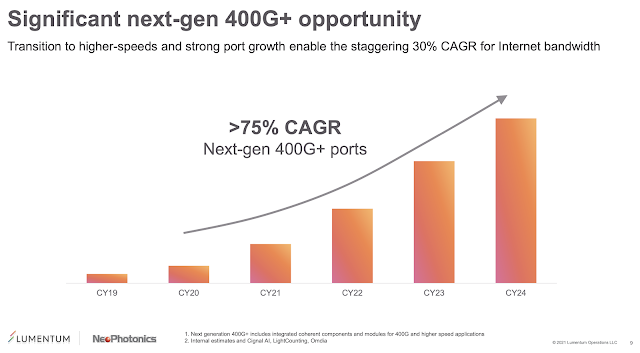
The companies cited significant next-gen 400G+ opportunities as a leading driver for the merger.

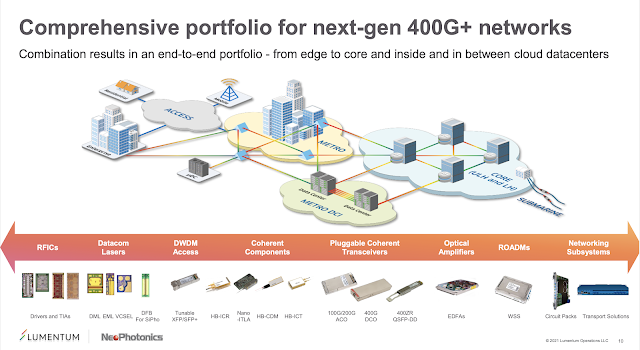
NeoPhotonics, which was founded in 1996 and is based in San Jose, is a leading supplier of tunable lasers and optoelectronic components, including devices manufactured in its own Indium Phosphide fabs and combined with electronics using using Advanced Hybrid Photonic Integration techniques. The product portfolio includes coherent components and tunable lasers, coherent transceivers, wavelength management products, as well as fixed wavelength lasers and high speed driver ICs. The company has engineering and manufacturing facilities in Silicon Valley (USA), Japan and Shenzhen, China.

Lumentum said the acquisition strengthens its position in the more than $10 billion market for optical components used in cloud and telecom network infrastructure. 

"With NeoPhotonics, we're making another important investment in better serving our customers and expanding our photonics capabilities at a time when photonics are at the forefront of favorable long-term market trends," said Alan Lowe, Lumentum President and CEO. "At the center of our strategy is a relentless focus on developing a differentiated portfolio with the most innovative products and technology in our industry so that we can help our customers compete and win in their respective markets. Adding NeoPhotonics' differentiated products and technology and innovative R&D team is consistent with this strategy and together, we will better meet the growing need for next generation optical networking solutions."

"Today's announcement is an exciting milestone for NeoPhotonics," said Tim Jenks, NeoPhotonics President, CEO, and Chairman. "The increasing global demand for our ultra-pure light tunable lasers and photonics technologies for speed over distance applications is more apparent than ever, and Lumentum is the ideal partner to serve our customers on a larger scale. Lumentum recognizes the importance of NeoPhotonics' differentiated photonic technology and products, which are well positioned for accelerated growth in the coming years. "


Lumentum intends to finance the transaction through cash from the combined company's balance sheet. Lumentum also noted that it will provide up to $50 million in term loans to NeoPhotonics to fund anticipated growth, which may require increased working capital and manufacturing capacity.

T–Mobile US extends BSS contract with Netcracker

 T–Mobile US has extended its BSS and managed services partnership for its wholesale business, which includes the MVNO and IoT markets, with Netcracker Technology, a wholly owned subsidiary of NEC. Financial terms were not disclosed.

Netcracker Digital BSS, including Netcracker Partner Management, and Netcracker Managed Services will help T-Mobile continue leveraging best-in-class capabilities for revenue management while optimizing a range of operations, such as reduced bill run times and improved billing accuracy. Netcracker Digital BSS serves as T-Mobile’s billing platform for its wholesale line of business and is used to deliver the best possible offerings and customer experience across its growing subscriber base.


Telefónica’s CEO elected chair of GSMA

José María Álvarez-Pallete, chairman and CEO of Telefónica, has been elected Board Chair of GSMA. He will serve through December 2022. Orange Group’s Stéphane Richard vacates the role after three years’ service.

As Board Chair, Mr Álvarez-Pallete will oversee the strategic direction of the GSMA, with the support of Board Deputy Chair, Rima Qureshi, Executive Vice President and Chief Strategy Officer of Verizon. The GSMA Board comprises the world’s largest operator groups and smaller independent operators with global reach.

“We very much appreciate the support and guidance that Stéphane provided during his term. His leadership was steady and supportive throughout a challenging period,” said Mats Granryd, Director General, GSMA. “As we look forward, we remain committed to our vision to unlock the power of connectivity so that people, industry, and society thrive. It is with great pleasure that we welcome José María as he joins us to support that vision for the coming year.”

“I’m very proud to join the GSMA as Chairman of the Board, representing the global mobile ecosystem. Technologies like 5G, edge computing, cloud, cybersecurity, AI and IoT, have redefined the way society operates and interacts online, paving the way towards metaverse, web3 and a new digital era”, said Telefónica’s Chairman and CEO, José María Álvarez-Pallete. “However, increased digitisation must include responsible leadership to drive growth, job creation, sustainability, and accelerate digital inclusion. I look forward to supporting the GSMA drive these critical issues, and many others, with the GSMA Board.”

https://www.gsma.com/newsroom/press-release/gsma-board-elects-new-chair/

Monday, January 31, 2022

IOWN advances All-Photonics Data and Communications Architecture

 The Innovative Optical and Wireless Network Global Forum (IOWN Global Forum) has released six technology reference documents in support of its goal to provide reliable, high-speed, low-latency data and communications paths using an all-optical data transport architecture.

The reference documents focus on methodologies for the provisioning of data and communications paths along with computing improvements which are designed to deliver more energy-efficient ways of routing network traffic than what is available today.

“Today’s world is experiencing faster than ever data growth, thanks to advancements in communication and computing technologies,” said Katsuhiko Kawazoe, Ph.D., President and Chairperson of the board, IOWN Global Forum. “However, the evolution of sensing/capture technologies suggests that their critical requirements will be much higher than is achievable with existing technologies. Moving forward, another quantum leap in computing and communication capabilities is needed to move the world into a new era of growth.”

The newly released “starter packs” cover the following areas:

Open All-Photonic Network (APN) Functional Architecture. The Open APN expands existing network communications paths such as local area networks (LANs), access networks, and inter-data-center networks, with a direct optical communication path that spans multiple segments and allows end-to-end communication with deterministic performance.

Data-Centric Infrastructure (DCI) Functional Architecture. The DCI subsystem provides applications with a distributed, heterogeneous, end-to-end computing and networking environment across clouds, edges and customer premises. The DCI is designed to enable service providers with the tools needed to build and flexibly place data pipelines, including data processing and storage functions, while dynamically selecting data transfer and network protocols on a pipe-by-pipe basis.

Data Hub Functional Architecture. This data management and sharing infrastructure enables fast and trusted data processing, usage and exchange among multiple parties or locations. This architecture sits on top of the DCI architecture and supports APIs that are functionally compatible with those of well-adopted services, such as Apache Kafka/Pulsar, AWS S3 and SQL. The Data Hub Functional Architecture provides unified secure access to its internal storage as well as the data that each organization keeps on-premises or in the cloud.

Fiber Sensing for Open APN. Fiber-optic sensing has many advantages over conventional sensors, including the ability to extend sensing range to hundreds of kilometers; reduced latency, size and weight; the ability to operate outside of line-of-site and immunity to electromagnetic interference. Distributed Fiber Optics Sending (DFOS) technology performs multi-point, real-time and continuous measurement of changing environmental conditions, such as temperature, strain and vibration (including acoustic) along the entire fiber optic cable.

Technical Outlook for Mobile Networks Using IOWN Technology. Emerging mobile technologies such as massive MIMO, dynamic spectrum sharing and mmWave wide spectrum deliver high data rates to enable video-centric, latency-sensitive applications such as remote surgery, AR/VR and industrial automation. To render these use cases possible, the reference documents for the IOWN Global Forum APN architecture allow implementers of the reference designs to address new requirements for handling capacity, reliability and availability in next generation networks.

Reference Implementation Model (RIM) for the Area Management Security Use Case. The RIM-TF oversees the Cyber-Physical System (CPS) Use Case and Artificial Intelligence-Integrated Communications (AIC) Use Case defined in 3.2.4 of the IOWN Global Forum System and Technology Outlook Report issued April 14, 2021. The RIM-TF produced reference document describes an IOWN Global Forum end-to-end system that will meet the requirements of a target use case. The reference design also aims to demonstrate many of the benefits of the IOWN Global Forum architecture and technology over today’s cloud-based implementations.

The reference documents will be introduced in detail at the next IOWN Global Forum Member Meeting, a virtual event scheduled for Feb. 15-17, 2022. Membership in IOWN Global Forum is required for attendance.

https://www.iowngf.org

IOWN Global Forum adds 23 new members

The Innovative Optical and Wireless Network Global Forum announced 23 new member companies supporting its ambition to developn an all-photonics network and data-centric infrastructure. The organization now includes over 70 companies, academic and research institutes from Asia, North America and Europe that are committed to developing an all-optical approach to data sensing, collection, storage, processing and distribution.

“We were delighted to greet members old and new and share how far IOWN Global Forum has come in such a short time,” said Dr. Kawazoe, President and Chairperson of the forum. “The robust turnout reaffirmed our commitment to define an all-photonics network and a next-generation distributed computing architecture by 2030.”


New IOWN members include:

Sponsor Members: KIOXIA Corp., PwC Japan and Samsung Electronics

General Members: Advantest Corp., AIOCORE, DIC Corp., Hitachi Ltd., Honda Tsushin Kogyo Co., Ltd., IBIDEN Co., Ltd., I-PEX Inc., MIRISE Technologies Corp., OKI Electric Industry, Peers Co., Ltd., Sumitomo Corp. Kyushu Co., Ltd., Toyo Ink SC Holdings Co., Ltd. and UNIADEX Ltd.

Academic/Research Members: The National Institute of Advanced Industrial Science and Technology, the National Research Institute for Earth Science and Disaster Resilience, the Photonics Electronics Technology Research Association, the Photonics Industry & Technology Development Association and Tohoku University.

https://www.iowngf.org

NTT establishes IOWN Integrated Innovation Center

NTT Corporation will establish an "IOWN Integrated Innovation Center" to advance R&D for optical and 6G wireless networks. Hidehiro Tsukano, Corporate Adviser of NTT Advanced Technology Corporation, will be appointed as the Head of the IOWN Integrated Innovation Center.The IOWN concept announced in May 2019 aims to develop an innovative network and information processing platform using photonics-electronics convergence technologies in 2030. NTT...

NTT and Fujitsu focus on silicon photonics manufacturing

 NTT Corporation (NTT) and Fujitsu Limited announced a strategic alliance focused on innovations for the “Realization of a Sustainable Digital Society,” including the Innovative Optical and Wireless Network (IOWN) initiative.A key focus is on establishing photonics-electronics convergence manufacturing technology. Key points:NTT Electronics Corporation (NEL), which develops hardware products utilizing NTT R&D’ s advanced device technologies,...


T-Mobile US achieves 100% renewable energy

T-Mobile US announced that it now source 100% of its total electricity usage with renewable energy.  The 100% threshold was achieved by the end of 2021. 

The 100% renewable energy target was first announced in 2018. T-Mobile met its RE100 goal through a combination of renewable energy investments, including eight virtual power agreements, 19 retail agreements, one Green Direct program, and unbundled Renewable Energy Certificates that support projects across the country. As a result, the company has invested in enough wind and solar power annually to account for every unit of electricity consumed. The nine large wind and solar farm projects alone (which include the virtual power agreements and Green Direct program) are contracted to provide T-Mobile with approximately 3.4 million MWh of clean energy annually—enough to provide electricity to over 313,000 homes per year.

T-Mobile also supports 37 community solar projects, which represent greening local energy grids with more than 2.1 million MWh over 25 years for Maine, Massachusetts, Minnesota, New York and Oregon.

“T-Mobile put a stake in the ground as the first telecom to commit to going all in on renewable energy by the end of 2021, and now we’re the first to hit this milestone years ahead of others,” said Mike Sievert, T-Mobile CEO. “This was no easy task, but we set a goal and we achieved it. Today, thanks to amazing efforts from a team who was unwavering in our commitment to reduce our impact on the planet, the Un-carrier is powering America’s largest, fastest and most reliable 5G network with 100% clean electricity.”


DT and Google expand partnership for RCS messaging, cloud and TV

Deutsche Telekom and Google are expanding their partnership in three key areas: enhanced mobile messaging services for businesses through Telekom RCS Business Messaging powered by Google and Jibe Cloud; the new Sovereign Cloud for Germany will be available to German cloud customers ahead of schedule; and Telekom’s premium TV experience, MagentaTV One, powered by Android TV OS available now in Germany and expanding to additional European markets. 

CEO Tim Höttges and Google CEO Sundar Pichai discussed this expanded partnership as part of Telekom's internal digital kick-off event attended by around 1,000 top managers. 

"Deutsche Telekom is a longstanding and important partner for us, going back to the launch of the G1, the first smartphone powered by Android, in 2008,” says Sundar Pichai, CEO of Google and Alphabet. “Today’s announcements will expand the range of helpful and trusted products and services that we can provide to businesses and consumers across business messaging, cloud computing, and TV experiences.”

Some highlights:

RCS messaging: Telekom and Google currently offer enhanced mobile messaging services for millions of Android users across Austria, Croatia, Czech Republic, Greece, Hungary, Netherlands, North Macedonia, Poland, Romania and Slovakia. This new expanded partnership extends Rich Communication Service (RCS) to customers of Telekom in Germany. In addition, Telekom announces for its entire European footprint the availability of Telekom RCS Business Messaging, provided by Google. The service enables secure, efficient and highly engaging exchanges between customers and companies via messaging. Consumers can order products, make reservations, purchase tickets and more through a seamless digital experience within their messaging app, while companies can create and manage messages to reach target groups more effectively and increase brand loyalty. 

German Sovereign Cloud: the launch of the new Sovereign Cloud for Germany will take place ahead of schedule. Telekom's business customer arm T-Systems and Google Cloud are launching their new sovereign cloud service in spring 2022. It will be available for all clients, initially out of the Frankfurt Google Cloud Region. Telekom and Google confirmed that they will jointly drive innovation for the cloud, closely aligned with the new German government's digital plans which aims to build a public administration cloud based on a multi-cloud strategy and open interfaces, as well as meeting strict sovereignty and transparency requirements. To this end, the partners are setting up a Co-Innovation Center in Munich as announced in November 2021. In addition, executive briefing facilities in Munich and one in Berlin will be established for close collaboration with customers. 

T-Systems will manage a set of sovereignty controls and measures, including encryption and identity management. In addition, T-Systems will exercise a control function over relevant parts of the German Google Cloud infrastructure. Any physical or virtual access to facilities in Germany (such as routine maintenance and upgrades) will be under the supervision of T-Systems and Google Cloud.

MagentaTV One launches in Germany: the new service is powered by Android TV OS.  MagentaTV One combines classic TV with a wide variety of streaming services, media libraries, and numerous apps via the Google Play Store. MagentaTV One is Deutsche Telekom’s second device powered by Android TV OS in Germany, following the successful launch of the MagentaTV Stick in 2020.

https://telekom.com/en/media/media-information/archive/telekom-and-google-expand-partnership-645356

T-Systems teams with Google Cloud on sovereign cloud for Germany

T-Systems announced a strategic, long-term partnership with Google Cloud to provide a sovereign cloud for German enterprises, the public sector, and healthcare organizations. 

The companies agreed to develop a large spectrum of next-generation sovereign cloud solutions and infrastructure where customers can host their sensitive workloads whilst continuing to leverage the scalability, elasticity and reliability of public cloud services. Service management and operation of the sovereign cloud will be supervised by T-Systems.

The new joint offering that will be available as of mid 2022 and then upgraded over the following months. In addition, T Systems will exercise a control function over relevant parts of the German Google Cloud infrastructure. 

"Our joint strategic goal is to support the digitalization of European companies and the public sector as they move operations to the cloud," explained Adel Al-Saleh, member of the Telekom Board of Management and CEO of T-Systems. "Together with Google Cloud, we will build a sovereign cloud services portfolio that provides clients with full control over their data, software and operations whilst leveraging the full power of Google Cloud. Even stricter compliance requirements for public sector institutions will be addressed. We are happy that we’ll be able to offer customers a cloud solution that is secure and sovereign, but also gives access to the innovation and scalability of Google Cloud in Germany. We are also considering Austria and Switzerland as a next step," he added.

"We’re committed to helping enable Germany’s digital transformation,” said Thomas Kurian, CEO of Google Cloud. “Data privacy, security and control are vital to European and German organizations as they digitize their operations. The sovereign cloud solution we are partnering with T-Systems to create will provide public and private-sector organizations with an additional layer of technical and operational measures and controls that ensure German customers can meet their data, operational, and software sovereignty requirements." 

https://www.telekom.com/en/media/media-information/archive/sovereign-cloud-from-t-systems-and-google-cloud-635314

T-Systems enters strategic collaboration agreement with AWS

T-Systems and Amazon Web Services (AWS) announced a multi-year Strategic Collaboration Agreement to manage the digital transformation of companies more quickly, efficiently and securely. 

T-Systems said the agreement will spur it to build out capacity in both solutions and people through a strong training and enablement program. The ICT service provider intends to train 3,000 additional AWS experts as part of the new collaboration.

Regarding security, AWS and T-Systems agreed to closely collaborate to achieve the targets recently set by the European regulation.

“Since the beginning of our relationship with AWS, we have built up expertise in AWS technology and combined it with our extensive experience from major transformation projects. Our customers appreciate this,” explained Adel Al-Saleh, member of the Deutsche Telekom Board of Management and CEO T-Systems.

https://www.t-systems.com/us/en/about-t-systems/news/t-systems-and-aws-expand-collaboration-365120

Deutsche Telekom aligns with Microsoft Azure

Deutsche Telekom and Microsoft announced a seven-year strategic agreement to help customers of all sizes accelerate their cloud transformation initiatives. 

"We have agreed on the framework for joint strategic growth with our long-term partner Microsoft. We are delighted," said Adel Al-Saleh, member of the Deutsche Telekom Board of Management and CEO of T-Systems. "This partnership will enable us to enhance services for our customers. We will also be supporting each other with digitalization and network build-out." 

Highlights

  • Telekom plans to migrate the majority of its internal IT workloads to the public cloud by 2025 and Azure is a central part of that strategy. Through a companywide training program, thousands of Telekom employees will learn how to maximize the benefits of Azure. 
  • Telekom will also offer its customers direct access to the Microsoft cloud through Azure ExpressRoute. 
  • Telekom will offer Microsoft 365, including Microsoft Teams. As part of this, the companies have started a project for German schools to reimagine traditional approaches to education, enabling remote learning through cloud-based IT infrastructure, modern devices and the cloud productivity and collaboration applications within Microsoft 365. 
  • Telekom will help its customers with moving their SAP environments to Azure. SAP solutions on Azure offer enterprise-grade security, and business continuity and reduce hardware expenses, making it easier for start-ups and smaller organizations to get started. 

Citrix confirms $16.5B deal to go private and merge with TIBCO

Citrix will be acquired by private equity firms in an all-cash deal valued at $16.5 billion, including assumption of debt. Citrix shareholders will receive $104.00 in cash per share, representing a premium of 30% over the company’s unaffected 5-day VWAP as of December 7, 2021, the last trading day before market speculation regarding a potential transaction.

The buyers include affiliates of Vista Equity Partners, a leading global investment firm focused exclusively on enterprise software, data and technology-enabled businesses, and Evergreen Coast Capital, an affiliate of Elliott Investment Management.

Vista and Evergreen intend to combine Citrix and TIBCO Software, one of Vista’s portfolio companies, creating one of the world's largest software providers. The combination brings together Citrix’s secure digital workspace and application delivery suite with TIBCO’s real-time intelligent data and analytics capabilities. Together, the combined company will serve 400,000 customers, including 98 percent of the Fortune 500, with 100 million users in 100 countries.

“Over the past three decades, Citrix has established itself as the clear leader in secure hybrid work. Our market-leading platform provides secure and reliable access to all of the applications and information employees need to get work done, wherever it needs to get done. By combining with TIBCO, we will expand this platform and the outcomes our customers achieve,” said Bob Calderoni, Chair of the Citrix Board of Directors and Interim Chief Executive Officer and President. “Together with TIBCO, we will be able to operate with greater scale and provide a larger customer base with a broader range of solutions to accelerate their digital transformations and enable them to deliver the future of hybrid work. As a private company, we will have increased financial and strategic flexibility to invest in high-growth opportunities, such as DaaS, and accelerate its ongoing cloud transition.”

“Today’s announcement is the culmination of a strategic review process conducted over five months, including extensive outreach to both potential financial and strategic buyers,” continued Calderoni. “This transaction provides our shareholders with significant immediate cash value. Moreover, this investment by Vista and Evergreen is a testament to the value Citrix has created and the reputation our team has built.”

Added Dan Streetman, CEO of TIBCO, “There has never been a better time to be in the business of connected intelligent analytics, and we’re thrilled to bring our industry-leading solutions to Citrix’s global customers. The workplace has changed forever, and companies everywhere will require real-time access to faster, smarter insights from the increasingly large volumes of data available to them, their employees, and their ecosystems. I couldn’t be more excited about our combined vision and look forward to a strong partnership.”

Separately, Citrix posted Q4 2022 revenue of $851 million, compared to $810 million in the fourth quarter of fiscal year 2020, representing 5 percent revenue growth. GAAP net income for the fourth quarter of fiscal year 2021 was $103 million, or $0.81 per diluted share, compared to $112 million, or $0.89 per diluted share, for the fourth quarter of fiscal year 2020. For fiscal year 2021, Citrix reported annual revenue of $3.22 billion, compared to $3.24 billion for fiscal year 2020, a 1 percent decrease. 


eir to establish wholesale fibre network for Ireland with InfraVia

eir, Ireland’s incumbent telecommunications provider, and InfraVia, is a leading independent private equity firm specialising in infrastructure and technology investments, agreed to establish a joint venture to accelerate the roll-out of high-speed internet across Ireland. 

InfraVia will take a 49% stake in a new subsidiary of eir, Fibre Networks Ireland Limited. The companies estimate that 200,000 homes will be passed in 2022, increasing to 250,000 homes in 2023. This acceleration in network roll-out will allow around 50,000 more families and businesses to gain access to high-speed internet per year than previously anticipated by eir.

Stephen Tighe, CFO of eir, states “The establishment of Fibre Networks Ireland provides a vehicle for further investment in our already extensive network. eir’s mission has always been to connect people through great quality services. Through this exciting partnership with InfraVia we can improve our ability to connect customers faster than ever before and ensure that more homes in Ireland can access the high-speed internet that has become an increasingly important part of how we live our lives.”

Bruno Candès, Partner at InfraVia Capital Partners, said, “We are very pleased to partner with eir and its shareholders in building out a high quality, national FTTH network that will provide next generation connectivity across Ireland. Fibre internet access is a critical service that enables an inclusive digital transformation, and we are proud to support this transition in the Republic of Ireland. This investment builds on our existing track record in Ireland and our deep communications infrastructure experience across Europe. We look forward to working with eir in this partnership in the years ahead.”

https://www.eir.ie/pressroom/eir-and-InfraVia-Form-Partnership-to-Accelerate-eirs-Fibre-Broadband-Roll-Out/

Ireland's eir names Oliver Loomes as next CEO

eir announced the appointment of Oliver Loomes as its Chief Executive Officer-designate, replacing Carolan Lennon, who has served as CEO since 2018.Loomes, an experienced corporate leader, has spent 30 years working in consumer-focused industries, his most recent position was Chairman and Managing Director at Diageo Ireland. Lennon departs eir having led four consecutive financial years of growth in profits, as well as the significant expansion...


Deutsche Telekom launches 5G SA Campus powered by Ericsson

Deutsche Telekom launched a 5G Campus Network offer powered by the Ericsson Private 5G portfolio. The new “Campus-Netz Private” operates completely separated from the public mobile network: all components of the infrastructure from the antennas to the standalone core network to the network server are located on the customer's premises. 

Deutsche Telekom has been offering private network solutions since 2019 and has delivered more than ten of such local networks based on 5G non-standalone technology or LTE across Germany. The new fully private 5G SA Campus network solution  operates on frequencies in the 3.7 to 3.8 GHz range that are specifically allocated to the enterprise. Thus, up to 100 MHz bandwidth is available for the exclusive use within the private campus network. 

https://telekom.com/en/media/media-information/archive/new-5g-standalone-campus-networks-645348

ZTE reports record profit for 2021

 ZTE expects its 2021 net profit attributable to holders of ordinary shares will be in range of RMB 6.5 billion to RMB 7.2 billion (US$1.02 billion to US$1.13 billion), an increase of 52.6% to 69.0% year on year. Net profit after extraordinary items for 2021 amounted to RMB 3.0 billion to RMB 3.5 billion, representing a year-on-year rise of 189.7% to 238.0%. Both of them were the highest in the history of the company. Basic earnings per share was RMB 1.40 to RMB 1.55.

ZTE said that despite complex external environment, it continued to solidify its position in 2021 with innovative initiatives while maintaining steady operations and optimizing its market structure. The company achieved double-digit year-on-year growth in operating revenue, with both domestic and international markets and all its three major businesses (operator networks, government and enterprise services and consumer services) seeing year-on-year growth in terms of operating revenue.

In domestic market, ZTE's key products of 5G, core network, transport network, and server & storage products have witnessed continued growth in terms of market share. 

In the overseas market, ZTE benefited from 4G modernization projects, 5G infrastructure deployments, fiber-based transformation of fixed networks, transport network upgrades and home broadband product upgrades. 

In the IT field, ZTE reported operating revenue of RMB10 billion (US$1.57 billion). 

https://www.zte.com.cn/global/about/news/20220128e2.html


Vodafone opens European R&D center in Málaga

Vodafone inaugurated an R&D centre and digital skills hub in Málaga, Spain.

The Vodafone European R&D Centre will develop technology solutions and digital services based on unified communications, the Internet of Things (IoT), Edge Computing, Mobile Private Networks (MPN) and Open RAN. It is equipped with the latest Vodafone 5G and ultrafast fibre connectivity, as well as laboratory infrastructure and office space.

Vodafone said the facility will grow to include 50 people dedicated to developing Open RAN, including optimized silicon designs. Plans call for 650 software engineers, architects and technicians at the hub. In total, Vodafone plans to invest EUR 225 million over 5 years in the Málaga R&D hub.

Francisco Martin, Head of Open RAN, Vodafone, explained: “As a pioneer of Open RAN, Vodafone is joining forces with specialist technology companies to expand the ecosystem. Silicon innovation will strengthen Europe’s position in the global market and speed up the roll out of new digital services.”

https://www.vodafone.com/news/technology/advance-open-ran-chip-design

Intel cites continued momentum in 5G vRAN and edge

In a virtual event ahead of Mobile World Congress, Intel showcased a number of foundational technologies and products that position the company for continued leadership in 5G virtual radio access network (vRAN) and edge deployments. This includes the following product announcements:Intel Agilex FPGA family is expanding, with a new FPGA with integrated cryptography acceleration that can support MACSec in 5G applications. This adds another layer of...

Vodafone tests multi-vendor RAN intelligent controller

Vodafone, in conjunction with Cohere Technologies, VMware, Capgemini Engineering, Intel and Telecom Infra Project (TIP), demonstrated an Open Radio Access Network (RAN) platform capable of increasing the capacity of a 5G cell site by two-fold using a programmable, Artificial Intelligence (AI)-based RAN Intelligent Controller (RIC).Specifically, he companies showed the first demonstration of 5G Multi-User MIMO (MU-MIMO) – providing more capacity at...


Sunday, January 30, 2022

Mediatek demos pre-standard Wi-Fi 7

MediaTek announced the world’s first live demo of pre-standard Wi-Fi 7 technology. The company is currently showcasing two Wi-Fi 7 demos to key customers and industry collaborators.

Wi-Fi 7, which will utilize 2.4GHz, 5GHz and 6GHz spectrum, promises 2.4X faster speeds than Wi-Fi 6 – even with the same number of antennas – since Wi-Fi 7 can utilize 320Mhz channels and support 4K quadrature amplitude modulation (QAM) technology. Other notable features of Wi-Fi 7 include MLO to reduce latency by transmitting Wi-Fi on multiple bands, in addition to multi-user resource unit (MRU) features for enhanced interference avoidances and mitigation. Products with Wi-Fi 7 are expected to hit the market starting in 2023.

MediaTek said its Wi-Fi 7 demo achieves the maximum speed defined by IEEE 802.11be and demonstrates multi-link operation (MLO) technology. MLO technology aggregates multiple channels on different frequencies bands at the same time to highlight how network traffic can still flow seamlessly even if there is interference or congestion on the bands. MLO technology will be critical for delivering faster and more reliable video streaming, gaming and anything else that requires constant, sustained and real-time throughput.

“The rollout of Wi-Fi 7 will mark the first time that Wi-Fi can be a true wireline/Ethernet replacement for super high-bandwidth applications,” said Alan Hsu, corporate vice president and general manager of the Intelligent Connectivity business at MediaTek. “MediaTek’s Wi-Fi 7 technology will be the backbone of home, office and industrial networks and provide seamless connectivity for everything from multi-player AR/VR applications to cloud gaming and 4K calls to 8K streaming and beyond.”

“Faster broadband Internet access and more demanding applications such as higher resolution video streaming and VR gaming are driving demand for Wi-Fi 6, Wi-Fi 6E, and soon Wi-Fi 7,” said Mario Morales, group vice president, Semiconductors at IDC. “Wi-Fi 7’s advances in channel width, QAM, and new features such as multi-link operation (MLO) will make Wi-Fi 7 very attractive for devices including flagship smartphones, PCs, consumer devices and vertical industries like retail and industrial; as service providers begin to deploy a wider spectrum of hotspots across these market segments.”

https://www.mediatek.com/


Saturday, January 29, 2022

FCC to open $1.2 billion through the Rural Digital Opportunity Fund

The FCC announced e more than $1.2 billion through the Rural Digital Opportunity Fund to fund new broadband deployments in 32 states.  

In the largest funding round to date, 23 broadband providers will bring broadband service to over 1 million locations.  With this sixth funding wave, the FCC has now announced over $4 billion in funding to winning bidders for new deployments. 

“Today’s announcement means more connectivity is coming to consumers, while we continue our commitment to make sure that funding goes to areas that truly need it,” said Chairwoman Rosenworcel.  “The new Rural Broadband Accountability Plan will speed up our audit and verification processes and for the first time make public the results of verifications, audits, and speed and latency testing.  These new measures will help ensure that the providers we fund in this program will do the job.”

In addition, the FCC has created a Rural Broadband Accountability Plan, a new effort to monitor and ensure compliance for universal service high-cost programs including the Rural Digital Opportunity Fund.

A fact sheet on the Rural Broadband Accountability Plan is available here: https://www.fcc.gov/document/fcc-creates-rural-broadband-accountability-plan

The list of RDOF providers and funding amounts by state, is here: https://www.fcc.gov/auction/904