Tuesday, January 18, 2022

MIPI Alliance's A-PHY v1.1 spec doubles data rate to 32 Gbps

The MIPI Alliance released the next version of its automotive serializer-deserializer (SerDes) physical-layer interface for mobile and mobile-influenced applications.

MIPI A-PHY v1.1 doubles the maximum available downlink data rate from 16 Gbps to 32 Gbps and includes other enhancements to help automotive OEMs and their suppliers implement high-performance image sensors and displays in next-generation vehicles. The higher performance is enabled by Star Quad (STQ) cables that provide dual differential pairs of conductors within a single shielded jacket. This enables two A-PHY ports over a single cable, saving cost, weight and complexity compared with using two separate coaxial or shielded twisted pair cables.

A-PHY offers a reach of up to 15 meters, unprecedented reliability with an ultra-low packet error rate of 10-19 over a vehicle's lifetime, high noise immunity and ultra-low latency. It also forms the foundation of MIPI's Automotive SerDes Solutions (MASS), an end-to-end framework for connecting cameras, sensors and displays with built-in functional safety, security and data protection.

Version 1.1 also adds optional PAM4 encoding for A-PHY downlink gears G1 and G2, with data rates of 2 Gbps and 4 Gbps, respectively. PAM4 encoding features lower modulation bandwidth for sub-1 GHz operation, allowing manufacturers to migrate to A-PHY while using either legacy cables on current platforms or lower-cost cables on new platforms.

The new version also adds a faster uplink gear with an available data rate of up to 200 Mbps, twice the rate of the existing uplink gear, providing more bandwidth for command and control of automotive peripherals. A-PHY v1.1 is fully interoperable with A-PHY v1.0, and devices using both specifications can coexist on the same network.

The MIPI alliance said these enhancements enable automotive manufacturers to design next-generation applications that use the latest camera and display technologies, including higher-performance instrument clusters and infotainment displays, interior driver and passenger monitoring systems, virtual side mirrors and other ADAS, IVI and ADS applications.

"The MIPI Alliance's adoption of A-PHY v1.1 unleashes unprecedented bandwidth and increased implementation flexibility to enable the development of safer, more connected and autonomous vehicles," said Joel Huloux, chairman of MIPI Alliance. "A-PHY continues to evolve to meet the automotive industry's ever-increasing need for high-performance, end-to-end connectivity solutions with high reliability, resiliency and interoperability."

  • MIPI A-PHY, originally released in September 2020, is the first industry-standard, long-reach, asymmetric SerDes interface to provide high-performance links between automotive image sensors and displays and their associated electronic control units (ECUs). It was developed to simplify the integration of greater numbers of onboard sensors and displays for applications such as advanced driver-assistance systems (ADAS), digital cockpits, in-vehicle infotainment (IVI) and autonomous driving systems (ADS).

https://www.mipi.org/MIPI-A-PHY-v1-1-doubles-maximum-data-rate-and-adds-new-implementation-options


5G global connections now exceed 438 million

5G global connections now exceed 438 million, according to the 5G Americas trade group.

Chris Pearson, President of 5G Americas, states: "After three years of 5G network deployments, the industry is moving toward the enhancement phase of this generation of wireless cellular. These networks are beginning to change the technology landscape for new applications with their high data speeds and very low latencies."

Cellular Communications in a 5G Era” is an annual update to previous versions, which provides a complete overview and reference source for 5G and 4G LTE networks to date, which had been created by Rysavy Research. Topics in this white paper include:


  • Overview of 5G’s impact and intensifying role on networks and industries
  • Statistics demonstrating how 5G is the fastest growing generation of cellular wireless technology ever deployed
  • Factors impacting 5G network rollout, including architecture, spectrum, standards, and technologies
  • Updates on 5G and 4G LTE enhancement timelines
  • Discussion of 5G use cases across different vertical industries, including smart cities, manufacturing, automotive, and many more
  • Further details on improvements in voice, industrial IoT, and public safety services
  • Additionally, the white paper covers updated developments on spectrum use and availability, cellular V2X communications, key supporting technologies like fixed wireless access, virtualization, cloud-native, open RAN, and edge networking, as well as AI and machine learning.

https://www.5gamericas.org/cellular-communications-in-a-5g-era/

SpaceX completes 2nd Starlink mission of 2022

SpaceX successfully launched 49 Starlink satellites to low Earth orbit  Launch Complex 39A (LC-39A) at Kennedy Space Center in Florida. 

The Falcon 9 booster supporting this mission previously launched GPS III-3, Turksat 5A, Transporter-2, and six Starlink missions. The booster was recovered on the A Shortfall of Gravitas droneship in the Atlantic. Each of Falcon 9’s fairing halves previously supported one Starlink mission.


Keysight supplies 5G device test solution to KT

KT Corporation, formerly Korea Telecom, selected Keysight’s 5G device test solution to verify advanced 5G new radio (NR) features critical in delivering 5G services.

Specifically, KT has selected Keysight’s Protocol Research & Development (R&D) Toolset to accelerate the launch of 5G mobile devices that support the latest 5G NR specifications defined by 3GPP, the global standards organization. This includes 3GPP Release 16 specifications, which device makers use to support advanced 5G features.

“Keysight is pleased to strengthen our collaboration with KT, a company currently supporting more than five million 5G subscribers in Korea,” said Cao Peng, vice president and general manager for Keysight’s wireless test group. “Keysight’s early availability of 3GPP Rel-16 test and conformance verification capabilities enables KT to deliver advanced wireless connectivity services, benefitting both consumers and enterprises.”

Keysight’s Protocol R&D Toolset uses a flexible user interface that enables KT to create and execute test cases that verify 5G NR signaling protocols. The toolset also enables KT to debug errors and fully analyze results in frequency range 1 (FR1) spectrum for both 5G NR non-standalone (NSA) and SA mode.


Monday, January 17, 2022

2022 Predictions


The following media comprises interviews and other content related to 2022 industry predictions. 

Views expressed are those of the presenting individuals and companies and may not necessarily represent views of Converge! Network Digest or AvidThink.


FAA speeds up approvals of Boeing and Airbus aircraft

Just days ahead of the planned activation of mid-band 5G spectrum by AT&T and Verizon, the FAA cleared some Boeing 737, 747, 757, 767, MD-10/-11 and Airbus A310, A319, A320, A321, A330 and A350 models to perform low-visibility landings at many of the airports where 5G interference is possible during certain weather conditions. This covers an estimated 45 percent of the U.S. commercial fleet where 5G C-band will be deployed on Jan. 19. 

The FAA approved two radio altimeter models that are installed in a wide variety of Boeing and Airbus planes. This combination of aircraft and altimeter approval opens up runways at as many as 48 of the 88 airports most directly affected by 5G C-band interference. 

As of Jan. 5, none of the 88 airports would have been available for landing during low-visibility conditions. The wireless companies agreed to create buffer zones for six months around airports where transmitters are in close proximity. They also agreed to delay deployment until Jan. 19 while the FAA reviewed new data detailing the location and power of wireless transmitters in all 46 U.S. markets where this service will be deployed.

The FAA notes that even with these new approvals, flights at some airports may still be affected. Additional aircraft and equipment clearances are expected from the FAA in coming days.

https://www.faa.gov/newsroom/faa-statements-5g

FAA issues directives concerning altimeters and 5G

 The U.S. Federal Aviation Administration (FAA) issued two airworthiness directives concerning the expansion of 5G and aviation:AD 2021-23-12 for all transport and commuter category airplanes equipped with a radio (also known as radar) altimeter. This AD was prompted by a determination that radio altimeters cannot be relied upon to perform their intended function if they experience interference from wireless broadband operations in the 3.7-3.98...


United Airlines statement on 5G

 On Monday, January 17, United Airlines released the following statement:

"The federal government’s current 5G rollout plan will have a devastating impact on aviation, negatively affecting an estimated 1.25 million United passengers, at least 15,000 flights and much-needed goods and tons of cargo traveling through more than 40 of the largest airports in the country annually. When deployed next to runways, the 5G signals could interfere with the key safety equipment that pilots rely on to take off and land in inclement weather."

"We won’t compromise on safety – full stop. But, governments in other countries have successfully designed policies to ensure the safe deployment of 5G technology and we’re simply asking the US government to do the same. Otherwise, the radio altimeters on certain aircraft, which provide information to other safety systems like autopilot, heads-up displays, terrain warning and pitch control, will be compromised and will result in significant restrictions on 787s, 777s, 737s and regional aircraft in major cities like Houston, Newark, Los Angeles, San Francisco and Chicago. Unfortunately, this will result in not only hundreds of thousands of flight cancellations and disruptions for customers across the industry in 2022, but also the suspension of cargo flights into these locations, causing a negative ripple-effect on an already fragile supply chain. We implore the Biden administration to act quickly and apply the same common sense solutions here that have clearly worked so well around the world."

https://www.united.com/en/us/newsroom/announcements/united-airlines-statement-on-5g-implementation

Vecima demos > 8.5 Gbps down and > 6 Gbps up with DOCSIS 4.0

Vecima Networks and Charter Communications havedemonstrated greater than 8.5 Gbps downstream and 6 Gbps upstream on hybrid fiber-coaxial (HFC) cable plant. 

The demo used DOCSIS 4.0 System-on-a-Chip (SoC) for Remote MACPHY Device (RMD) and cable modem solutions, which conforms to CableLabs DOCSIS 4.0 frequency division duplexing (FDD) specifications.

"This provides proof that our network is capable of offering multi-gig speeds bi-directionally,” said Joe Godas, Senior Vice President, Network Engineering & Technology, Charter Communications. “Having this technology offers an option for future improvements and continuing to evolve our leading service for years to come."

“Vecima is excited to help lead the industry in bringing DOCSIS 4.0 to the market,” added Sumit Kumar, President and Chief Executive Officer at Vecima. “The HFC plant remains a huge asset for cable operators, and our recent testing validates the performance and viability of DOCSIS 4.0 and the inherent multi-gig symmetrical capacity of the cable plant. Vecima is proud to play such an integral role in powering the world’s movement to the limitless broadband connectivity of the future.”

https://vecima.com/2022/01/05/charter-and-vecima-demonstrate-long-term-hfc-network-future-with-multi-gigabit-docsis-4-0/

Italy's WINDTRE picks Nokia for new optical backbone.

Nokia has been selected by WINDTRE to deploy a new, high performance optical backbone across Italy.

The DWDM deployment will leverage Nokia’s fifth generation PSE-V super-coherent (PSE-Vs) chipset to support programmable line rates up to 600G. The Nokia PSE-V Super Coherent DSP implements second generation probabilistic constellation shaping (PCS) with continuous baud rate adjustment, and supports higher wavelength capacities over longer distances – including support for 400G over any distance – over spectrally efficient 100GHz WDM channels while further reducing network costs and power consumption per bit.  

The new backbone with deploy redundant nodes in a wave router mesh configuration with GMPLS-based restoration, enabling the ability to instantly re-route traffic as needed.

Benoit Hanssen, Chief Technology Officer at WINDTRE, said: “Nokia’s solution based on industry-leading coherent technology will help us provide next generation broadband services to both consumer and business customers in the most efficient way. It will also enable us to grow our subscriber base and provide best-in-class experience to WINDTRE’s existing customers."

Sergio Solivera Vela, Vice President Mediterranean Region, at Nokia: “We have a long standing and successful relationship with WINDTRE and are very happy to expand this by deplolying its new optical backbone. Our latest coherent technology solutions will provide WINDTRE with massive capacity that grows as subscriber demand increases, without sacrificing reliability.”


Equinix announces its 10th data center in Paris

Equinix unveiled plans for its 10th data center in Paris.  

The new site, named PA10, will be part of the Equinix Saint-Denis campus. Phase 1 of PA10 is due to provide 3,775 m2 of colocation space and 1,525 cabinets of capacity. Upon completion of all planned phases, the full site is expected to generate 5,775  m2 of colocation space with ~2,250 cabinets.

PA10 is targeted to utilize 100% renewable energy. New sustainability technology employed at the data cente will recover heat from customer equipment and transfer it to the urban heating network, and in turn, heat the local community swimming pool. The rooftop of the new site will be home to a greenhouse of 430 m² in which fruit and vegetables will be grown. A hydroponic system aims to reduce water consumption by using a water recovery system and only irrigating the cultivated areas. The greenhouse will also utilize the heat recovery technology in place at PA10. The rooftop garden will help retain rainwater and reduce the amount of water directed to the sewer, in addition to reducing waste heat emissions.

Régis Castagné, Managing Director for France at Equinix, explains: "For a long time, the digital revolution has been seen as the cause of change in society. Its importance during the pandemic is an illustration of this: not only did it allow us to continue to work, learn, or be entertained, but it was also essential for economic recovery. At Equinix, we're working to support this shift, spearheading innovations to address the environmental impact of digital. Indeed, it has become a societal issue that requires, among other things, increased dialogue between industry and local authorities to hasten progress in this area."

"In support of the Choose France initiative, today's investment and expansion serves to bolster the country's digital infrastructure capabilities, providing local and multi-national corporations with a foundational source of differentiation and the global platform needed to thrive in today's digital economy," notes Charles Meyers, President and CEO at Equinix. "Equinix is connecting digital leaders, enabling them to simplify operations, improve customer experience and accelerate the launch of new products and services."


Digicel Tonga confirms two separate undersea cable breaks

Digicel reported that its preliminary technical fault investigation has established that there are two separate undersea cable breaks. The first between TCL cable landing station Sopu, Tongatapu and FINTEL cable landing station in Suva, Fiji. The international cable break is approximately 37km offshore from Tonga. The second cable break is on the domestic cable which is near the area of the recent volcanic activity. The company has engaged the cable repair ship CS Reliance to undertake a full fault assessment as well as determine the safety of a possible cable repair. 

Digicel also confirmed that its domestic network in Tongatapu is active. 

Digicel Regional CEO, Shally Jannif, said; “We know how vital it is at times like this that we keep people connected. We are focused on doing everything we can to ensure that we are able to establish international connectivity with Tonga.”

https://www.digicelgroup.com/to/en/news/2022/jan/18th/network-update-volcanic-eruption.html

Samsung debuts flagship Exynos 2200 mobile processor

Samsung Electronics Co. announced mass production of its flagship Exynos 2200 premium mobile processor produced using 4-nanometer (nm) EUV (extreme ultraviolet lithography) technology. 

The Exynos 2200 mobile processor leverages AMD RDNA 2 architecture based Samsung Xclipse graphics processing unit (GPU) with hardware-accelerated Ray Tracing on Mobile for gaming. 

“Built on the most advanced 4-nanometer (nm) EUV (extreme ultraviolet lithography) process, and combined with cutting-edge mobile, GPU, and NPU technology, Samsung has crafted the Exynos 2200 to provide the finest experience for smartphone users. With the Xclipse, our new mobile GPU built with RDNA 2 graphics technology from the industry leader AMD, the Exynos 2200 will redefine mobile gaming experience, aided by enhanced graphics and AI performance,” said Yongin Park, President of System LSI Business at Samsung Electronics. “As well as bringing the best mobile experience to the users, Samsung will continue its efforts to lead the journey in logic chip innovation.”

“AMD RDNA 2 graphics architecture extends power-efficient, advanced graphics solutions to PCs, laptops, consoles, automobiles and now to mobile phones. Samsung’s Xclipse GPU is the first result of multiple planned generations of AMD RDNA graphics in Exynos SoCs,” said David Wang, Senior Vice President of Radeon Technologies Group at AMD. 

The Exynos 2200 is one of the first in the market to integrate Arm’s latest Armv9 CPU cores which offer a substantial improvement over Armv8 in terms of security and performance. The octa-core CPU of Exynos 2200 is designed in a tri-cluster structure made up of a single powerful Arm Cortex®-X2 flagship-core, three performance and efficiency balanced Cortex-A710 big-cores and four power-efficient Cortex-A510 little-cores.

The Exynos 2200 NPU’s performance has doubled compared to its predecessor, allowing more calculations in parallel and enhancing the AI performance. The NPU now offers much higher precision with FP16 (16bit floating point) support in addition to power efficient INT8 (8bit integer) and INT16.

Also, the Exynos 2200 integrates a fast 3GPP Release 16 5G modem supporting both sub-6GHz and mmWave (millimeter Wave) spectrum bands. With E-UTRAN New Radio – Dual Connectivity (EN-DC), which utilizes both 4G LTE and 5G NR signals, the modem can boost the speed up to 10Gbps.

The Exynos 2200’s image signal processor (ISP) architecture has been redesigned to support the latest image sensors for ultra-high resolution of up to 200 megapixel (MP). At 30 frames-per- second (fps), the ISP supports up to 108 MP in single camera mode, and 64+36Mp in dual camera mode. It can also connect up to seven individual image sensors and drive four concurrently for advanced multi-camera setups. For video recording, the ISP supports up to 4K HDR (or 8K) resolution.

The Exynos 2200 can decode videos up to 4K at 240fps or 8K at 60fps and encodes up to 4K at 120fps or 8K at 30fps. In addition, the MFC integrates power efficient AV1 decoder enabling longer playback time. 

http://www.samsung.com/exynos

Johnson Controls acquires FogHorn for industrial IoT

Johnson Controls, which supplies builiding technology for healthcare, schools, data centers, airports, stadiums and industrial usage, has acquired FogHorn, a Silicon Valley start-up offering Edge AI software for the industrial and commercial Internet of Things (IoT). Financial terms were not disclosed.

"Value is increasingly being created by applying intelligence at the edge-device level to create real-time, secure, actionable insights," said Johnson Controls CTO Vijay Sankaran. "By pervasively integrating Foghorn's world class Edge AI throughout our OpenBlue solution portfolio, we are accelerating the pace towards our vision of smart, autonomous buildings that continuously learn, adapt and automatically respond to the needs of the environment and people."

As the number of sensors and amount of data in buildings continues to grow exponentially, the value of processing data and applying intelligence at the edge, without having to send data to the cloud, becomes increasingly pronounced.

Sastry Malladi, who served as Chief Technology Officer at Foghorn, will join Johnson Controls, reporting to Sankaran as Vice President, OpenBlue Artificial Intelligence.

"We are thrilled to bring the Foghorn team and edge AI capabilities to Johnson Controls and OpenBlue," said Sastry Malladi, Foghorn's Chief Technology Officer. "By combining our respective strengths, Johnson Controls can make an even bigger impact on continuing to address some of the world's most pressing challenges of decarbonization, sustainability and energy efficiency, indoor air quality and smart, secure buildings."

https://www.foghorn.io

Telenor to sell its stake in Myanmar's Wave Money

Telenor will sell its 51 percent share of Digital Money Myanmar Limited (“Wave Money”) for US$53 million to Yoma MFS Holdings Pte. Ltd, a subsidiary of Yoma Strategic.

Wave Money is a leading provider of money transfer and digital payment solutions in Myanmar. The company was launched in November 2016 as a joint venture between Yoma Bank and Telenor Group, after the fintech pioneer was awarded a license to become the first non-bank institution to work under Myanmar’s new Mobile Financial Services Regulation. In 2020, Wave Money processed a total of US$8.7 billion in remittance and payments, which represented around 12 percent of Myanmar’s GDP. The company runs a network of more than 45,000 active agents or “Wave Shops” in urban and rural areas across 295 out of the 330 townships nationwide. The business has seen a significant recovery in volumes since June 2021 with the trend expected to continue.

“Telenor is proud to have been part of Wave Money’s journey to empower the people of Myanmar with country-wide access to financial services. We have worked in partnership with Yoma Strategic to ensure that anyone from anywhere can digitally send and receive money, make contactless and secure payments in-stores or online using the market leading mobile Wallet App of Wave Money. We are confident that Yoma have the commitment and vision to take Wave Money forward to the next level of driving financial inclusion”, says Lars Erik Tellmann, Head of Financial Services in Telenor Group.

https://www.telenor.com/media/press-release/telenor-group-agrees-to-sell-its-stake-in-wave-money-to-yoma-strategic

Sunday, January 16, 2022

2022 Predictions from Thought Leaders

The following media comprises interviews and other content related to 2022 industry predictions. 

Views expressed are those of the presenting individuals and companies and may not necessarily represent views of Converge! Network Digest or AvidThink.


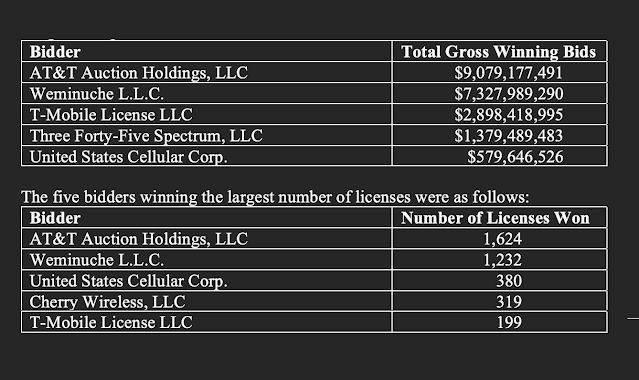
Winning bidders in FCC's midband 5G spectrum auction

AT&T was the top winner in the FCC's "Andromeda" auction of flexible-use licenses in the 3.45 GHz band. Gross proceeds for the auction exceeded $22.5 billion. The list of winning bidders was published on Friday.

Auction 110 makes available 100 megahertz of mid-band spectrum for commercial use across the contiguous United States.  The spectrum licenses are divided into ten 10-megahertz blocks licensed by geographic areas known as Partial Economic Areas (PEAs).  License winners will operate within a cooperative sharing framework that will enable commercial use by an array of service providers, while also ensuring coexistence with federal incumbents where and when they require continued access to the band.  

“Today’s 3.45 GHz auction results demonstrate that the Commission’s pivot to mid-band spectrum for 5G was the right move,” said FCC Chairwoman Jessica Rosenworcel.  “I am pleased to see that this auction also is creating opportunities for a wider variety of competitors, including small businesses and rural service providers.  This is a direct result of the Commission’s efforts to structure this auction with diversity and competition front of mind.  Enabling commercial use of this spectrum is important to America’s continuing economic recovery and 5G leadership, and I look forward to the continued collaboration between the FCC, NTIA, and other federal agencies to find innovative ways to make spectrum available for next generation commercial and government services.”  

Additional notes:

  • Thirteen of the twenty-three companies with winning bids in Auction 110 qualified as small businesses or as entities serving rural communities.  
  • Compared to the prior 5G auction, this auction saw a substantial increase in the number of winning bidders per market: over one-third of the top 100 markets have at least four winning bidders, compared with 10% of the top 100 markets for Auction 107. 
  • Notably, the 3.45 GHz auction closed as one of highest grossing auctions in the FCC’s history. 
  • Collectively, the 3.45 GHz band and the neighboring 3.5 GHz and 3.7 GHz bands represent 530 megahertz of mid-band spectrum for 5G, the next generation of wireless services.  Wider 5G deployment means that more people in more places will be more connected.  

http://www.fcc.gov/auction/110

Tonga loses subsea cable connectivity following eruption

Subsea cable connectivity to the Kingdom of Tonga was lost following the eruption of the Hunga-Tonga-Hunga-Ha’apai volcano on Saturday.

Digicel reported that all communication to the outside world in Tonga is affected due to damage on the Tonga Cable Limited submarine cable, which runs 827 kilometers and connects the Tongan capital of Nuku'alofa to Southern Cross’ trans-Pacific cable in Suva, Fiji.


https://www.digicelgroup.com/to/en/news/2022/jan/16th/network-restoration-volcanic-eruption.html

Telstra and Australian government to acquire Digicel Pacific

Telstra, in partnership with the Australian government, reached a deal to acquire the Digicel business in the South Pacific region for US$1.6 billion, plus up to an additional US$250 million subject to business performance over the next three years.The Digicel business will be owned and operated by Telstra. Telstra is contributing US$270 million of equity to the US$1.6 billion purchase price and the Australian Government, through Export Finance Australia,...


SubCom completes repair of Tonga Cable System

The cable ship SubCom Reliance successfully completed the repair of two Tongan submarine cables within eight days of arrival on repair ground. The Tonga Cable and the Tonga Domestic Cable were damaged on January 20, 2019. The ship was on standby in the South Pacific at a port in Apia, Samoa.

The Tonga Cable System is an international cable in the Pacific Ocean that spans 827 kilometers with landing points in Nuku’alofa, Tonga and Suva, Fiji. The Tonga Domestic Cable Extension is a 406-kilometer cable with three landing points in Tonga: Neiafu, Nukualofa and Pangai.

SubCom maintains these two cables in addition to 31 other systems as part of the South Pacific Marine Maintenance Agreement (SPMMA), which was signed in 2017 and covers the area from Singapore in the west to Tahiti in the east and from the southernmost point of New Zealand to Hawaii. This covers over 69,000 km of cable consisting of 33 data and power cable systems in the Pacific Ocean.

Megaport expands to Mexico via KIO Networks

Megaport plans to expand services to Mexico via a partnership with KIO Networks, the country’s largest data centre provider. Cloud connectivity services to Microsoft Azure and Google Cloud are expected to be available in March 2022 to local enterprises via on-ramps from KIO Networks’ data centres in Mexico City and Queretaro, subject to approvals.

KIO Networks has 40 state-of-the-art data centres across Mexico, Guatemala, Panama, Dominican Republic, and Spain, as well as 11 edge facilities in Mexico. The company has over 20 megawatts of installed operational capacity.

“KIO Networks is excited to offer our customers Megaport’s leading global Network as a Service platform as a quick and easy way to connect their businesses to cloud services for hybrid cloud and multicloud environments inside our data centres in Mexico,” said Santiago Suinaga, Managing Director of KIO Networks. “We believe the partnership gives our customers the agility, flexibility, and scalability they need for their digital transformation initiatives to be successful.”

“Mexico has proven to be one of the leading cloud markets in Latin America and has been growing at a rapid rate over the last several years,” said Vincent English, CEO at Megaport. “Megaport is very excited to partner with KIO Networks to launch our services in Mexico, which will provide the opportunity for our existing customers to grow with Megaport and create new opportunities for Megaport to service businesses in Mexico. We look forward to working with KIO Networks and our cloud partners to meet the growing demand for cloud-based services in Mexico.”

http://www.kionetworks.com

https://www.megaport.com

Keysight submits 5G protocol test cases to 3GPP

Keysight Technologies is first to submit 5G new radio (NR) protocol test cases to 3GPP, enabling device makers to verify enhanced network slicing and power saving features as specified in Release 16 (Rel-16).

“This is another achievement made by Keysight in the past year to accelerate the verification of devices in 5G NR standalone (SA) mode and speed the adoption of Rel-16,” said Muthu Kumaran, general manager of Keysight's device validation solutions business. “Access to verified test cases that support advanced 5G features enable chipset and device makers to capture early market opportunities focused on private 5G, industrial IoT, smart city and transportation applications.”

The 3GPP submission was made using Keysight’s S8704A Protocol Conformance Toolset. It leverages the company’s UXM 5G Wireless Test Platform, which supports multiple form factors, spans any 3GPP frequency band and covers both 5G non-standalone (NSA) and SA modes.


Saturday, January 15, 2022

CommScope hires Markus Ogurek, former Cisco VP of Enterprise

CommScope has appointed Markus Ogurek as senior vice president and segment leader of Venue and Campus Networks. 

Ogurek previously was vice president of Enterprise at Cisco. Before that, he served at Hewlett Packard Enterprise and iov42.  In his new role, Ogurek will lead a global organization of more than 2,000 professionals that include sales, product development, and supply chain operations.  He will be responsible for the development and growth of CommScope’s networking, indoor cellular and security products and applications that align to the company’s strategic transformation program, CommScope NEXT.

Chuck Treadway, president and chief executive officer, stated, “Markus brings a wealth of enterprise technology and networking expertise to CommScope’s largest and fastest-growing segment with an addressable market of $23 billion.  In his previous roles at Cisco and Hewlett Packard, Markus was responsible for accelerating revenue and developing cloud, software, and services strategies across vertical markets.  His international experience and proven track record make him well positioned to lead a business focused on the accelerated adoption of faster, secure Networks and ubiquitous connectivity.”

http://www.commscope.com