Wednesday, October 14, 2020

Spark New Zealand launches 5G with Nokia

Spark New Zealand launched 5G services in the Auckland Viaduct area using Nokia’s AirScale radio portfolio. 

Spark New Zealand and Nokia have a long-established relationship, crossing multiple domains, including IP, optical and wireless. Nokia and Spark have collaborated extensively on 5G technology, with Nokia supporting Spark’s 5G networks across New Zealand. The service rollout in Auckland adds to Nokia’s solid 5G momentum in the region, while it allows Spark to offer additional services in high traffic areas.

New Zealand blocks Huawei from 5G Infrastructure

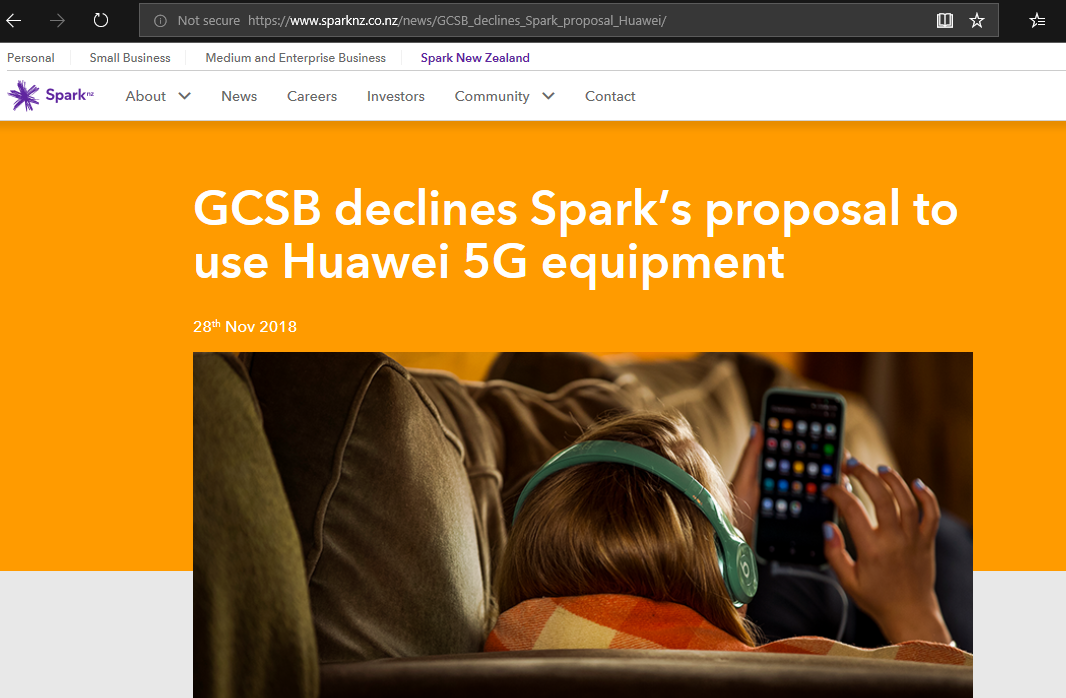
The government of New Zealand will block Huawei from participating in 5G infrastructure.

Spark New Zealand disclosed that the Director-General of the Government Communications Security Bureau (GCSB) has notified the company of the decision based on national security concerns.

Spark was planning on deploying Huawei equipment in its 5G RAN rollout. Spark said is disappointed by the decision but remains on track to launch 5G services by mid-2020.

Adamo picks Ekinops for optical transport in Spain

Adamo has selected Ekinops' FlexRate optical transport solution as part of a €250 million infrastructure investment which will deliver fiber optic services to homes and businesses in less densely populated areas across Spain. 

Adamo is currently deploying the Ekinops 200G FlexRate, a high-capacity optical transport platform which provides native 100 Gbps services. In combination with the aggregation of multiple 10GbE clients together on a single high-speed 200 Gbps link, it significantly lowers the cost-per-bit and operational expenditure, in addition to providing  400G and 600G compliance to accommodate future network growth. Ekinops' Celestis NMS (Network Management System) is also installed to monitor the network infrastructure to prevent outages and minimize service disruption.

"Adamo's mission is to provide greater internet connectivity to Spain's rural areas and smaller cities which are not well served by other operators," says Martin Czermin, CEO, Adamo. "Central to this mission is extending our backbone network and this cannot happen without a trusted supplier. Working with Ekinops is helping us to provide competitive and future-proofed high-speed optical fiber services to the market at the lowest cost per bit, with better than the required reliability."   

"Adamo's aim to provide high-quality internet and telecom services outside of key cities is admirable, and especially poignant in today's world where connectivity to work and loved ones is crucial," says Frank Dedobbeleer, Group Vice President Sales EMEA & APAC at Ekinops. "This seven figure implementation demonstrates how Ekinops can work with service providers to strengthen their optical fiber network with a robust, efficient solution which is able to overcome complex requirements such as Adamo's. We look forward to providing continued support as the company works towards its business goals."


China Telecom completes 5G SA call with Ericsson Spectrum Sharing

China Telecom (Sichuan) completed China’s first 5G Standalone (SA 5G) Ericsson Spectrum Sharing data call on a commercial network. The milestone was achieved recently on China Telecom’s 2.1GHz commercial 5G network in Deyang City, Sichuan Province.

Ericsson said the demo  shows that Ericsson Spectrum Sharing can be deployed on a dual mode 5G Core-enabling Standalone 5G network. It provides another option for communications service providers such as China Telecom to speed up the roll-out of 5G services. This means China Telecom can roll out FDD New Radio 5G SA networks as part of its wider 5G commercial deployment in the country.

Per Narvinger, Head of Product Area Networks, Ericsson, says: “This achievement shows how communications service providers can use the advantages of the fast and cost-efficient 5G coverage enabled by Ericsson Spectrum Sharing to deploy 5G Standalone. This will create business opportunities for our customers and deliver superior user experiences for 5G subscribers. This is a key milestone for bringing 5G to everyone.”


Tuesday, October 13, 2020

Padtec debuts 800 Gbps and 1.2 Tbps transponders

Padtec introduced its TM800G and TM1200G transponders for short, medium and long distances in a compact, rack mountable form for both telecom and data center applications. The muxponders enable service providers to combine multiple 100Gbps client signals into a single network signal.

Padtec said its new LightPad i6400G platform’s transponders combine a high data transmission rate with a lower cost per transmitted bit and are suited for alien wavelength applications. 

“The development of this product is in line with the company’s commitment to constantly invest in the evolution of its product line, providing the market with innovative solutions and state-of-the-art technology in optical systems”, says Manuel Andrade, Padtec North America’s CEO.

“Another of the technical innovations of this generation of transponders is the more flexible network interfaces that allow better adaptation of optical channels to meet the increasing demands for network performance and expansion”, says Manuel.

The new unit measures 1RU high and 300 mm deep, enabling rack mounting in both datacenters and telecom locations. 

https://www.padtec.com.br/en/padtec-introduces-its-new-generation-of-800-gbs-and-1-2-tbps-transponders/


Next G Alliance looks to 6G

 A new Next G Alliance, organized by ATIS, has been formed to advance North American mobile technology leadership in 6G and beyond over the next decade. 

Founding members include AT&T, Bell Canada, Ciena, Ericsson, Facebook, InterDigital, JMA Wireless, Microsoft, Nokia, Qualcomm Technologies, Samsung, TELUS, Telnyx, T-Mobile, UScellular and Verizon.  

The Next G Alliance seeks "to encompass the full lifecycle of research and development, manufacturing, standardization and market readiness." 

The group says it will initially focus on three strategic actions:

  • Develop a 6G national roadmap that addresses the changing competitive landscape and positions North America as the global leader in R&D, standardization, manufacturing and adoption of Next G technologies.
  • Align the North American technology industry on a core set of priorities that will steer leadership for 6G and beyond to influence government policies and funding.
  • Identify and define the early steps and strategies that will facilitate and lead to rapid commercialization of Next G technologies across new markets and business sectors and promote widescale adoption, both domestically and globally.

“As countries around the globe progress ambitious 6G research and development initiatives, it is critical that North American industry steps forward to develop a collaborative roadmap to advance its position as a global leader over the next decade,” said ATIS President and CEO Susan Miller. “The work of the Next G Alliance delivers just that – from research to commercialization – and it is setting the foundation for a vibrant marketplace for North American innovation in future generations of mobile technology.”

https://nextgalliance.org

Samsung’s 6G White Paper

Samsung published a whitepaper outlining its vision for 6G, including technical and societal megatrends, new services, requirements, candidate technologies and an expected timeline of standardization. Samsung is predicting that the completion of the 6G standard and its earliest commercialization date could be as early as 2028, while mass commercialization may occur around 2030. Both humans and machines will be the main users of 6G, and 6G will be...

NTT DOCOMO aims for 6G in 2030

NTT DOCOMO published a white paper outlining its ambition to launch 6G commercial services by 2030. The white paper summarizes the related technical concepts and the expected diverse use cases of evolving 5G and new 6G communication technologies, as well as the technology components and performance targets. DOCOMO has 6G research and development programs underway. In 2018, the company conducted successful radio wave propagation experiments at...

Keysight joins 6G Flagship Program

Keysight Technologies has joined the multi-party 6G Flagship Program, an initiative supported by the Academy of Finland and led by the University of Oulu, Finland. The parties envision that next generation beyond 5G  will leverage spectrum above millimeter waves called terahertz waves, from 300 GHz to 3 THz, enabling data rates of up to one terabit per second and ultra-low latencies. Keysight said its technical expertise and solutions across...

German researchers investigate THz frequencies for 6G

Researchers at Rohde & Schwarz, the Fraunhofer Institute for Telecommunications, Heinrich Hertz Institute, HHI and the Fraunhofer Institute for Applied Solid State Physics IAF are testing the terahertz (THz) frequency band for possible use in the 6th generation wireless mobile communication (6G). The collaboration has resulted in a wireless transmit and receive system operating between 270 and 320 GHz, with further frequency extensions for potential...


Apple: 5G just got real

Apple unveiled its new line-up of iPhones, which add 5G connectivity, along with a faster A14 Bionic chip with 11.8 billion transistors built on 5nm silicon, tougher screen glass, better cameras, and a new design.  

Apple has conducted 5G testing with 100 carriers in 30 regions, with peak download speeds of up to 3.5 Gbps in ideal conditions.

Apple claims the new iPhones will cover more 5G bands than any other smartphone on the market. These include:

  • 5G NR (Bands n1, n2, n3, n5, n7, n8, n12, n20, n25, n28, n38, n40, n41, n66, n71, n77, n78, n79)
  • 5G NR mmWave (Bands n260, n261)

The new iPhones can access Verizon's mmWave and have achieved over 4.0 Gbps peak download speeds in ideal conditions and with uploads rated at up to 200 Mbps in ideal conditions. 

Apple is also supporting a new Smart Data Mode. When the iPhone does not need 5G, it automatically drops back to LTE.

Connectivity also includes: 

  • Gigabit LTE with 4x4 MIMO and LAA4
  • Wi‑Fi 6 (802.11ax) with 2x2 MIMO
  • Bluetooth 5.0 wireless technology
  • Ultra Wideband chip for spatial awareness5
  • NFC with reader mode

Verizon launches 5G using Dynamic Spectrum Sharing

 Verizon also announced its launch of 5G Nationwide service using Dynamic Spectrum Sharing (DSS), which allows 5G service to run simultaneously with 4G LTE on the same spectrum band. covering more than 200 million customers. The Verizon 5G Nationwide service, which runs on lower spectrum bands than its 5G Ultra Wideband service, now boasts 200 million population coverage footprint. 

"We were first in the world to 5G and we are continuing to drive 5G forward. Our job, our passion, is to push the boundaries of what’s possible, to bring the ecosystem together and to create experiences consumers and enterprises never even knew they needed or wanted," stated Hans Vestberg, Verizon CEO.

The Verizon 5G Ultra Wideband service is now available in 55 cities, 43 stadiums and arenas, and seven airports. On its mmWave spectrum Verizon is achieving download speeds of up to 4 Gbps by using carrier aggregation to combine eight separate channels of mmWave spectrum.


Comcast expands 5G coverage nationwide

Comcast announced nationwide Xfinity Mobile 5G coverage at no additional charge.

Pricing starts at $15 for 1GB with a By-the-Gig plan, or $45 for one line of Unlimited service.

“Xfinity Mobile customers already have access to the fastest Internet at home with Xfinity Internet, and now they can access a fast nationwide 5G network when they are on the go,” said Billy Stephens, Senior Vice President of Wireless Devices for Xfinity Mobile. “Not only is Xfinity Mobile the only provider to give its customers the flexibility to seamlessly switch between 5G Unlimited or By-the-Gig data options to save money, but we also deliver the newest, most innovative 5G devices.”


Alkira secures $54M for Cloud Services Exchange

 Alkira, a start-up based in San Jose, California, announced $54 million in Series B funding for its global network cloud delivered as-a-service.

Alkira's  Cloud Services Exchange (CSX) offers a simplified networking experience for on-premises, cloud, and multi-cloud environments with integrated network and security services, and full operational visibility and governance. The company was founded in 2018 by Amir and Atif Khan, who previously founded Viptela, an SD-WAN pioneer that was acquired by Cisco in 2017 for $610 million. 


The new funding was led by Koch Disruptive Technologies (KDT) with participation from Sequoia Capital, Kleiner Perkins, GV (formerly Google Ventures), and others. The company has now raised $76 million. to date. 

“Koch Industries is a significant customer to cloud providers, and we have seen first-hand how Alkira’s powerful and intuitive network simplifies a company’s transition to the cloud,” said Chase Koch, president of Koch Disruptive Technologies. “At Koch’s scale an agile, global, end-to end network is critical to our competitiveness and growth and we are excited to lead Alkira’s Series B investment.”

“Alkira has seen a tremendous response from customers and technology and GTM partners to deploy and deliver the Alkira Network Cloud. We are honored to have our Series B led by Koch, an early customer who deployed Alkira Cloud Services Exchange™ (CSX) and shares our vision to transform networking,” said Amir Khan, President, CEO and founder of Alkira. “Koch has entrusted Alkira to rebuild their cloud network backbone and expand their network infrastructure to multi-cloud. We are delighted to welcome Jason Illian to our Board, and to receive the ongoing support from Sequoia, Kleiner Perkins, and GV on this exciting journey.”

See video with Alkira founders: https://youtu.be/njxM65N0hjg


NEC picks NXP chips for Massive MIMO 5G radios

NEC selected NXP to supply RF Airfast multi-chip modules to be used in a Massive MIMO 5G antenna Radio Unit (RU), which are being deployed by Rakuten Mobile in Japan.

NEC’s Massive MIMO 5G antenna RU features a 5G open virtual radio access network (vRAN) interface and has been adopted by Rakuten Mobile for its fully virtualized cloud-native mobile network. The RU utilizes extremely accurate digital beam forming for efficient high-capacity transmission and is easy to install as a result of miniaturization achieved through an increased level of circuit integration.

NXP’s new AFSC5G40E38 RF Airfast multi-chip module offera a common footprint across frequency and power for different regions, enabling faster time to market for network mobile operators.

NEC teamed up with Rakuten Mobile to develop and manufacture the 5G infrastructure that leverages NXP’s RF Airfast multi-chip modules.


ProLabs intros 1G DWDM tunable transceiver

ProLabs introduced its new 1G DWDM tunable transceiver line for data centers and enterprise networks.

The solution contains five tunables with the capability to tune to channels 20-27, 28-35, 36-43, 44-51, or 52-59 respectively by using the ProTune Coding & Tuning System.

"The flexibility to deploy and tune a 1G DWDM transceiver addresses a variety of operational challenges for network operators," said Jon Eikel, Chief Strategy Officer at ProLabs. "Having a 1G tunable transceiver in the access network helps operators reduce sparing and inventory complexity. This drives better performance in mean-time-to-repair by simplifying to a single part that fix agents can fit into any network segment on any wavelength."


Monday, October 12, 2020

OSA Laser Congress underway this week

The all-virtual, web conference format OSA Laser Congress takes place this week,  13 – 16 October 2020. Key topics will be the next generation of laser-based manufacturing technologies and the history and future of solid state lasers

Plenary speaker Jan Kleinert, Research Director at Electro-Scientific Industries (ESI), a division of MKS Instruments, Inc., USA, will share latest innovations in laser based manufacturing technologies in his talk titled “From µs to fs, kHz to GHz: laser micromachining in the microelectronics industry.” Understanding the underlying highly nonlinear laser material interaction dynamics is key to keeping pace with faster, better and cheaper technologies.

“A Journey through 60 Years of Solid State Lasers” is the featured topic of the plenary talk by Peter F. Moulton, senior staff, Laser Applications and Applications Group at the MIT Lincoln Laboratory, Lexington, MA, USA. Solid state lasers have achieved a dominant role in both scientific and industrial applications. Moulton will review 60 years of laser development and future applications.

The OSA Laser Congress plenary program is scheduled for Tuesday, 13 October, 08:00 – 10:00 EDT.

CommScope pushes its vision for 10G cable services

 At this year's virtual SCTE event, CommScope plans to demonstrate its vision for 10G, virtualization, the access network and the connected home. 

Specifically, CommScope will be demonstrating its Virtual Headend Portfolio, which includes solutions for virtualizing the four primary planes of modern operator networks: data, video, control, and management. CommScope is adding a new range of Distributed Access Architecture (DAA) solutions to its portfolio, pushing physical processing to the fiber node. New products include more powerful node-based Remote PHY and Remote MACPHY devices. In addition, CommScope’s Fixed Wireless Access (FWA) demonstrations will show the technology’s ability to unlock the potential of 5G to compete with fixed-line services in urban and sub-urban areas.

CommScope said its vision for 10G extends throughout the connected home of the future. Ziply Fiber recently selected CommScope X5 Wi-Fi 6 extenders to enhance its wireless presence in their subscribers’ homes. The company also announced several recent additions to its extensive portfolio of DOCSIS 3.1 and Wi-Fi 6 modems and gateways.  CommScope experts will also be supporting the recently announced Wi-Fi 6E standard for delivering the next-generation of low-latency, deterministic wireless experiences for video, gaming, augmented and virtual reality, and more.

“SCTE is very different this year, but the theme of improving network capacity and speed in both the downlink and uplink is familiar and one that we’re building into important advances throughout our portfolio and in operator networks around the world,” said Morgan Kurk, CTO, CommScope. “At this year’s show, we’re demonstrating our vision for tomorrow’s cable networks—both wired and wireless, throughout the home and beyond. Our updated end-to-end portfolio is a testament to our focus on providing customers with unmatched choice as they make some of the biggest evolutionary leaps in their access and home networks.”

U.S. Department of Defense award $600m for 5G testbeds

The U.S. Department of Defense awarded $600 million in contracts to 15 prime contractors to perform testing and evaluation of 5G technologies at five military installations across the United States. 

Five installations, including Hill Air Force Base, Utah; Joint Base Lewis-McChord, Washington; Marine Corps Logistics Base Albany, Georgia; Naval Base San Diego; and Nellis Air Force Base, Nevada, will serve as locations for the application and evaluation of a variety of 5G technologies.

"5G networks — and the technologies that will be built upon them — are an integral component of the National Defense Strategy," said Michael Kratsios, during a teleconference from the Pentagon. "We at the DOD are committed to the advancement of this critical emerging technology to improve the lethality and modernization of our force."

"Outside of the department, in order for private sector companies to test the capabilities and functionality of 5G communications, they face an onerous process — negotiating agreements with state and local officials, attaining pole permits, funding the construction of antennas, and the list goes on," Kratsios said. "At the DOD, we already have the personnel, operational capacity, facilities, scale and regulatory green light to get the job done."

The five Tranche 1 test sites were selected for their ability to provide streamlined access to site spectrum bands, mature fiber and wireless infrastructure, access to key facilities, support for new or improved infrastructure requirements, and the ability to conduct controlled experimentation with dynamic spectrum sharing.  For the Tranche 1 locations, prime contractors include AT&T, Booz Allen Hamilton, Deloitte Consulting LLP, Ericsson, Federated Wireless, GBL System Corp., General Dynamics Mission Systems, Inc., GE Research, Key Bridge Wireless LLC, KPMG LLP, Nokia, Oceus Networks, Scientific Research Corporation, Shared Spectrum Company and Vectrus Mission Solutions Corporation.

  • In June, the department also announced seven new locations to serve as Tranche 2 test beds for additional 5G capability testing. The Tranche 2 locations include Naval Station Norfolk, Virginia; Joint Base Pearl Harbor-Hickam, Hawaii; Joint Base San Antonio; the National Training Center at Fort Irwin, California; Fort Hood, Texas; Marine Corps Base Camp Pendleton, California; and Tinker Air Force Base, Oklahoma.

https://www.defense.gov/Explore/News/Article/Article/2378047/dod-kicks-off-worlds-largest-dual-use-5g-testing-effort/

U.S. Army signs FirstNet for base first responders

The U.S. Army has selected FirstNet to support firefighters, law enforcement and security personnel at 72 Army installations across the U.S. and Puerto Rico. 

FirstNet is built with AT&T in public-private partnership with the First Responder Network Authority – an independent agency within the federal government.  

Under the Task Order, AT&T is delivering nearly 3,200 lines of FirstNet services, more than 3,000 FirstNet-capable devices and 700+ signal boosters to help improve indoor connectivity. 

“FirstNet is helping us improve vital communications on our installations, depots and arsenals, including during catastrophic disasters or emergencies when communications capabilities are strained. We’re adopting FirstNet because it is designed for public safety professionals with priority, preemption and highly reliable data communications that will improve our overall response and our interoperability with our civilian partners,” stated Colonel Kevin Comfort, Command Provost Marshal at Headquarters, Installation Management Command located in Joint Base San Antonio at Fort Sam Houston, Texas.

Rockley Photonics secures $50 million in funding

 Rockley Photonics, a start-up specializing in integrated optical chips and modules, has closed an additional $50 million of growth funding from leading deep-tech VCs, strategic investors, and institutional funds including Credit Suisse backed SIG-i Capital and Applied Ventures, the venture capital arm of Applied Materials, as well as existing shareholders. To date, Rockley has raised over $225 million of financing to develop its unique silicon photonics platform.

“It is testament to the strength of our technology and emerging market opportunities that we have attracted such a preeminent list of new investors to join many of our existing shareholders in this funding round,” said Andrew Rickman, chief executive officer, Rockley Photonics. “This round provides the funding for Rockley as it moves into the next exciting growth phase and develops next generation disruptive silicon photonics powered healthcare and wellness sensors and communications products for its Tier-1 customers.”

Rockley Photonics was founded by Dr. Andrew Rickman in 2013. The company has offices in Pasadena, San Jose, Oxford, Cardiff, Cork, and Helsinki.

Telefónica UK picks Nokia's cloud-native Subscriber Data Management


Telefónica UK has selected Nokia's cloud-native Subscriber Data Management (SDM) software. Nokia will also deploy Shared Data Layer, a cloud-native database accessible via industry standard protocols to enable an open ecosystem and the integration of third party applications.

As the heart of Telefónica UK’s converged mobile core, Nokia’s SDM will securely oversee pivotal functionality for all Telefónica UK networks and services, including 5G. By controlling network data in a centralized hub and utilizing containerized micro services that have only what is required by an application to efficiently and autonomously manage all subscriber data and services, SDM increases both reliability and operational efficiencies. 

Nokia’s SDM solution serves approximately 4.8 billion subscribers and devices around the world.

Bhaskar Gorti, President of Nokia Software and Nokia Chief Digital Officer, said: “As we drive cloud-native 5G innovation together, Nokia is pleased to be building on our existing relationship with Telefónica UK by further optimizing and securing the company’s networks with Nokia’s software portfolio, and enriching the customer experience.”


Nokia boosts its Altiplano cloud SDN platform

 Nokia is now offering Cloud Acceleration Services for its Altiplano platform, which can operate as traditional network management system, as full-featured SDN access domain controller or as open modular solution, offering selected tools and applications to control, visualize and optimize the fixed access network.

Nokia says its open, modular and fully programmable Altiplano platform allows network builders to leverage broadband networks as a platform. Cloud Acceleration Services help build and maintain personalized SDN solutions, making sure all network nodes - third party, virtual and legacy - find their place in the network

Nokia Cloud Acceleration Services cover:

  • Business and technology consulting services and modeling tools help quantify the operator specific SDAN benefits and use cases.
  • System integration, automated testing services and key assets like Nokia SDAN Multivendor Integration Centers and Migration Operations Centers bring the customized SDAN solution from the drawing board into reality.
  • The cloud-native capabilities of the Nokia Altiplano platform, combined with Nokia’s System Integration approach and Nokia DevOps Automation Platform help operators to test and launch new features and services on the market, faster.

In addition, Nokia has added a new 1RU Lightspan DF-16G fiber node and the modular chassis Lightspan MX-6. The Lightspan MX supports VDSL and G.fast technologies, powered by the Quillion chipset and new G.fast 212 MHz line cards, to deliver symmetrical gigabit services with best-in-class vectoring performance.

Nokia expands fiber access portfolio with Lightspan MF-2 node

Nokia is expanding its fiber access portfolio with a new Lightspan MF access node designed for the 5G era, a new Beacon 6 in-home gateway that supports 5G mobile data offloading and several Nokia Bell Labs innovations that reduce latency.

Nokia’s new Lightspan MF-2 fiber access node is based on its Quillion chipset family. Some details:

  • High capacity, small form factor access node fit for distributed deployments
  • 10G PON today, and ready for evolution beyond
  • Supports Multi-PON
  • Optimized for low latency 5G Anyhaul
Nokia’s new Beacon 6 mesh WiFi solution supports Wi-Fi 6 and includes several core 5G technologies. Some details:

  • Support for Wi-Fi 6 which improves the overall speed, performance and latency needed for 5G mobile offload
  • Wi-Fi Certified EasyMesh and is fully interoperable with third-party Wi-Fi Certified EasyMesh products
  • Includes Nokia Bell Labs low-latency innovations – PI2 algorithm and L4S
Nokia Bell Labs’ PI2 active queue management algorithm reduces excessive delays in congested networks, while L4S technology provides an “express lane” for data in network equipment to further reduce latency needed in applications like gaming and virtual reality. Operators can then use Nokia’s Software Defined Access Network solution to create a high-priority slice in the fiber access network to ensure low latency is further guaranteed from the home to the core.

“Fixed networks will be the critical technology behind 5G’s success,” said Sandra Motley, President of Fixed Networks at Nokia. “By leveraging existing FTTH and in-home Wi-Fi networks, operators will be able to deploy 5G faster and ensure a seamless, powerful 5G end-user experience is achieved.”

“Low-latency innovations like PI2 and L4S demonstrate the many ways Nokia Bell Labs continues to push the boundaries of technology innovation,” said Marcus Weldon, Nokia Corporate CTO and President of Nokia Bell Labs. “These technologies will play a critical role in the network and how end users ultimately engage with low-latency applications like gaming and AR/VR experiences. We’re excited to be the first in the industry to bring these innovations into our WiFi portfolio and offer this to customers and end users alike.”


Nokia aims Quillion chipset at next gen access

Nokia outlined plans for a new family of chipsets to power next-generation massive scale access networks.

The forthcoming "Quillion" chipset will allow operators to introduce 10G PON in their fiber networks and to serve more users from G.fast access nodes. For next-generation fiber access networks, the Quillion chipset powers Nokia’s 16-port Multi-PON line card, which supports both GPON and NG-PON on each port. This allows operators with an existing GPON network to simply “switch on” NG-PON services on each port without recabling or disrupting the GPON service.

Nokia said Quillion is also optimized to allow for low-latency applications that are critical for 5G transport and has built-in programmability to support intents that pave the way toward automated workflows, such as network slicing for 5G transport.

In addition, the Quillion chipset supports copper infrastructure access, including the highest density G.fast and Vplus solutions on the market.


Vivacom Bulgaria to deploy XGS-PON with Nokia


Vivacom awarded a contract to Nokia to extend its GPON network in Bulgaria and introduce XGS-PON in strategic locations. Nokia was named sole network equipment supplier.

XGS-PON allows Vivacom to offer 10 Gbps symmetrical broadband services to residential and business customers.

Vivacom, a leading fiber access provider in Bulgaria, focuses on accelerating broadband coverage across the country. The roll-out is based on Nokia Lightspan series FX.

Sandra Motley, President of Fixed Networks at Nokia, said: “We see an increasing momentum for fiber access deployments and upgrades to XGS-PON, especially now that the need for broadband access has dramatically increased. We are bringing Vivacom solutions that help it to smoothly evolve its networks by leveraging its existing assets and providing advanced capabilities for future growth.”

Verizon Business and Cisco bring 5G Edge to stadiums


Verizon Business and Cisco are collaborating to offer solutions combining Verizon’s 5G network and 5G Edge for stadiums, arenas and event spaces.

The solutions will be powered by Verizon 5G Ultra Wideband with mobile edge computing (MEC) interfaces with the Cisco Sports and Entertainment portfolio. The joint solution integrates with a variety of Cisco innovations including: Cisco DNA Spaces for secure location analytics, Cisco switching and data center technology, connected venue analytics and more. The 5G and MEC environments will help deliver near real-time enablement and experiences.

Together, Verizon and Cisco said they can to bring these capabilities to stadiums:

  • Leverage analytics to estimate wait times associated with lines at check in, restrooms and concession stands; interfaces with digital signage and mobile applications to direct patrons to alternative locations with shorter lines
  • Identify crowd density and manage crowd flows with the use of digital signage and messages to venue staff to help maintain social distancing standards

“While all sports and entertainment fans are looking forward to the day they can get back to their favorite venues, many are understandably nervous about their safety in large crowds. This solution will help put minds at ease so fans can re-enter venues with the knowledge that strong steps are being taken to safeguard their wellbeing," said Aamir Hussain, SVP Chief Product Officer for Verizon Business. “This is one of the many 5G-enabled experiences powered by Verizon 5G Ultra Wideband that is changing the in-person fan experience in dozens of stadiums.”

“Our combined expertise and technology innovation is furthering the evolution of 5G, creating a dynamic offering for the industry that will redefine stadium sports and entertainment for the future,” said Jonathan Davidson, Senior Vice President and General Manager, Mass-Scale Infrastructure Group, Cisco. “With the power of 5G and MEC solutions, we can bring cloud-powered services closer to the edge for more flexible development of applications, helping venues to deliver new experiences better, faster and with more clarity and precision.”