Showing posts with label Esnet. Show all posts

Sunday, October 16, 2022

Nokia supplies 7750 Service Routers for ESnet6

Nokia confirmed that it is supplying its 7750 SR-s routers with Nokia-developed FP silicon and Service Router OS software for ESnet6, the U.S. Department of Energy’s (DOE) high performance network dedicated to collaborative scientific research. ESnet has deployed Nokia’s 7750 Service Router (SR) platforms to provide high-speed 100Gbps and 400 Gbps services over an IP/MPLS network designed to support over 46 Tbps of capacity.

Nokia7750 SR-s ssupports segment routing, EVPN-based services and model-driven management. ESnet research activities require petabyte traffic flows made possible through the Nokia FP silicon’s advanced traffic engineering and QoS capabilities combined with deep buffers. ESnet also selected Nokia’s Network Services Platform Path Computation Element, which builds upon the 7750 SR-s deployment, providing visibility of network and link usage and the ability to conduct traffic engineering of Segment Routing tunnels.

Inder Monga, Executive Director at ESnet, said: “ESnet6 represents a transformational change in the way networks are built for research, with improved capacity, resiliency, and flexibility. Together, we are enabling scientists around the world to conduct and collaborate on ground-breaking research in a faster and more efficient way.”

Mike Loomis, General Manager of Nokia Federal, said: “We are delighted to work with ESnet to help the scientific community advance the next generation of science. Our technology has set the foundation by more than tripling ESnet’s WAN from 100G to 400G, and it has been built to provide future-proofed scale and capacity. When ESnet is ready to scale to 800GE, we will be here to help them.”

https://www.nokia.com/about-us/news/releases/2022/10/13/nokia-partners-with-esnet-to-launch-terabit-next-generation-ip-network-with-400-gbps-access/

Tuesday, October 11, 2022

ESnet6 brings 46 Tbps capacity with 400 Gbps ~ 1 Tbps backbone links

 The U.S. Department of Energy unveiled the newest generation of its high- performance Energy Sciences Network (ESnet), which connects all of DoE's national laboratories, tens of thousands of DoE-funded researchers, and DoE’s premier scientific instruments and supercomputing centers. In 2021, ESnet carried over 1.1 exabytes of science data. Traffic on ESnet increases by a factor of ten every four years.


The new ESnet6 now offers 46 Terabits per second of bandwidth of capacity and supports programmable, and automated services that are uniquely built to support the multi- petabyte dataflows typical of science research today and are future-proofed to manage the emerging exabyte data era. 


Specifically, new ESnet6 capabilities and services include:

● A dedicated 15,000 miles of fiber optic cable footprint

● Network backbone links ranging from 400 Gbps to 1 Tbps 

● Customizable network services via a new automation platform

● High-precision telemetry to improve network performance

● Improved overall network security

● A future programmable API platform for scientists to directly request custom network services

Technology partners include Lumen Technologies, Ciena, Infinera, Nokia, and AMD. 

“ESnet6 represents a transformational change in the way networks are built for research, with improved capacity, resiliency, and flexibility,” said ESnet Executive Director Inder Monga. “Together, these new capabilities make it faster, easier, and more efficient for scientists around the world to conduct and collaborate on ground-breaking research.”

"ESnet6 provides the foundation for the future of the DOE mission science as we enter an age where discoveries will rely on the integration of scientific experimental facilities,supercomputers, and global science teams operating together as if they are colocated: one instrument in one location,” Monga added. “ESnet6 interconnects all of these resources to create a holistic science discovery system.”

ESnet6 was officially unveiled at a special event attended by DOE and Berkeley Lab leadership, as well as local, state, and federal government representatives, including U.S. Congresswoman Barbara Lee and Asmeret Asefaw Berhe, Director of the DOE’s Office of Science. The event also featured keynote talks from Internet pioneer Vint Cerf, Vice President and Chief Internet Evangelist for Google and ESnet Policy Board member; and Ian Foster, Distinguished Fellow at Argonne National Laboratory and Professor of Computer Science at the University of Chicago.

www.lbl.gov

ESnet and GÉANT upgrade loop to 200Gbps

The U.S. Department of Energy’s Energy Sciences Network (ESnet) and GÉANT, Europe’s leading collaboration on e-infrastructure and services for research and education,have boosted the capacity of ESnet’s network loop in Western Europe to 200 Gbps. This upgraded network connects to ESnet’s 400 Gbps transatlantic network.“This upgrade to 200G is an important milestone for ESnet because it opens up more bandwidth, network reliability, and flexibility...

ESnet upgrades optical backbone with Infinera

The U.S. Department of Energy (DOE)’s Energy Sciences Network (ESnet) has selected Infinera to build the optical substrate for its next-generation science network, ESnet6, interconnecting the DOE’s national laboratory system and experimental facilities with research and commercial networks around the globe. ESnet connects all of the DOE’s geographically distributed laboratories, experimental facilities, and computing centers across a dedicated fiber...

ESnet6 makes progress toward 400G upgrade

The Energy Sciences Network (ESnet) is making great progress with the rollout of ESnet6, its next-generation network dedicated to serving the Department of Energy (DOE) national lab complex and overseas collaborators. ESnet6, which is expected to be complete in 2023, will see the deployment of next gen optical, core and service edge equipment on ESnet’s dedicated fiber optic cable backbone. “We’ve had some delays, but our first priority is making...


Tuesday, October 27, 2020

ESnet upgrades optical backbone with Infinera

The U.S. Department of Energy (DOE)’s Energy Sciences Network (ESnet) has selected Infinera to build the optical substrate for its next-generation science network, ESnet6, interconnecting the DOE’s national laboratory system and experimental facilities with research and commercial networks around the globe. ESnet connects all of the DOE’s geographically distributed laboratories, experimental facilities, and computing centers across a dedicated fiber optic backbone.

Infinera confirmed that the ESnet6 optical network is powered by the its GX Series Compact Modular Platform and FlexILS Open Optical Line System. ESnet’s open optical networking approach combined with Infinera’s GX and FlexILS with coherent 600G technology enables the network to seamlessly upgrade to 800G capability once available. Partnering with ESnet, Infinera quickly and safely deployed new equipment, performed testing, and turned up services over 15,000 miles of fiber during the pandemic.

“ESnet6 represents a transformational change in the capacity, resiliency, and flexibility and brings tangible benefits to the DOE’s science mission,” said Kate Mace, ESnet6 Project Director. “Open optical networking technology plays a key role in ESnet’s ability to meet the ongoing challenges of data traffic growth while supporting the high-speed and real-time collaboration capabilities that are critical to our nation’s science programs.”

“ESnet was pleased to see Infinera’s team make such fast work of this large installation task during a pandemic. This high-speed connectivity provides the foundation to meet our mission of accelerating scientific discovery,” said Inder Monga, Executive Director of ESnet and Division Director of Scientific Networking at Lawrence Berkeley National Laboratory. “ESnet enables tens of thousands of scientists to access data portals, transfer vast research data streams, and tap into remote scientific instruments and sources — all in real time.”

“Infinera is delighted to partner with ESnet to deploy a high-capacity open optical network connecting all the national laboratory locations in the U.S. with high-performance computing locations,” said Nick Walden, Senior Vice President, Sales at Infinera. “This collaboration underscores the value of our relationship and ability to deliver advanced networking solutions quickly and efficiently to meet the needs of our customers even during a pandemic.”

ESnet6 makes progress toward 400G upgrade

The Energy Sciences Network (ESnet) is making great progress with the rollout of ESnet6, its next-generation network dedicated to serving the Department of Energy (DOE) national lab complex and overseas collaborators. ESnet6, which is expected to be complete in 2023, will see the deployment of next gen optical, core and service edge equipment on ESnet’s dedicated fiber optic cable backbone. “We’ve had some delays, but our first priority is making...


Monday, August 17, 2020

ESnet6 makes progress toward 400G upgrade

The Energy Sciences Network (ESnet) is making great progress with the rollout of ESnet6, its next-generation network dedicated to serving the Department of Energy (DOE) national lab complex and overseas collaborators. ESnet6, which is expected to be complete in 2023, will see the deployment of next gen optical, core and service edge equipment on ESnet’s dedicated fiber optic cable backbone.

“We’ve had some delays, but our first priority is making sure the work is being done safely,” states ESnet6 Project Director Kate Mace, on the project's blog.

“We’re almost done with the optical layer, which is a big deal,” Mace said. “It’s been a major procurement of new optical line equipment from Infinera to light up the new optical footprint.”

https://esnetupdates.wordpress.com/

Tuesday, November 13, 2018

SC18: ESnet demos SDN for End-to-end Networked Science

At this week's SC18 in Dallas, the Department of Energy’s Energy Sciences Network (ESnet) is demonstrating its Software-defined network for End-to-end Networked Science at Exascale (SENSE) research project.

SENSE is building smart network services to accelerate scientific discovery in the era of ‘big data’ driven by exascale computing, cloud computing, machine learning and AI.

The SENSE SC18 demonstration in the Caltech and University of Maryland booths (1413 and 4211) showcases a comprehensive approach to request and provision end-to-end network services across domains that combines deployment of infrastructure across multiple labs/campuses, SC booths and WAN with a focus on usability, performance and resilience.

A SENSE testbed consisting of network and end-system resources has been deployed across DOE laboratories, including Fermilab and Argonne National Lab and the National Energy Research Scientific Computing Center at Berkeley Lab; facilities at Caltech and the University of Maryland; MAX (the Mid-Atlantic Crossroads) and ESnet. To control network resources, the SENSE system interacts with production provisioning system of ESnet and other regional and site networks. To control end-systems, SENSE software is deployed at the end-sites.

The SENSE demonstration at SC18 uses this persistent testbed and adds resources on the exhibit showroom floor at the conference. As shown in the figure below, the SC18 resources include data transfer nodes (DTNs) deployed in the Caltech and University of Maryland booths. Connections to the SC18 SCinet infrastructure provide multiple 100 Gbps connections back to the SENSE testbed. This infrastructure will be utilized to demonstrate the end-to-end SENSE services and includes high-speed data transfers and provisioning services.

http://www.es.net/news-and-publications/esnet-news/2018/esnet-to-support-leading-edge-demos-at-sc18/

Wednesday, November 11, 2015

ESnet and NERSC Build 400G BayExpress Super-Channel

The Department of Energy’s Energy Sciences Network (ESnet) and the National Energy Research Scientific Computing Center (NERSC) have built the first 400 Gbps super-channel production link to be deployed by a national research and education network. ESnet currently operates a 100G backbone network connecting DOE sites and universities.  The new 400G BayExpress connection will provide support for NERSC’s 6,000 users as the facility moves from its current location in Oakland, Calif. to the main campus of Lawrence Berkeley National Laboratory in Berkeley over the next year.

BayExpress is deployed as a pair of 200 Gbps per wavelength and allows for a dual subcarrier 400 Gbps connection. ESnet and NERSC worked with Ciena and Level 3 on the project.

ESnet also noted that the team has set up a 400 Gbps research testbed for assessing new tools and technologies without interfering with production data traffic and allowing staff to gain experience operating a 400 Gbps optical infrastructure. For the testbed, the optical frequencies are more narrowly tuned to maximize use of the fiber spectrum, known as “gridless superchannels,” said Chris Tracy, co-leader of the project and a member of ESnet’s Network Engineering team. The testbed uses a dark fiber link provided by Level 3 to ESnet and NERSC for six months. The team will begin conducting field trials on the testbed within the next two months.

“We expect the 400G prototype network to provide us with many valuable insights with regard to future network architectures and be useful to others in the research community,” said ESnet Chief Technologist Inder Monga. “Other universities, national laboratories and regional and commercial networks will be planning their next-generation networks on this time scale and our goal is to publicize not only our experiences from an optical networking perspective, but also from a scientific workflows perspective in which large-scale datasets are moved between facilities coupled by 400 Gbps of dedicated network bandwidth.”

More details on the ESnet site.

http://www.es.net/news-and-publications/esnet-news/2015/esnet-and-nersc-blaze-400g-production-network-path/

Tuesday, November 10, 2015

ESnet Deploys Ciena's 6500 Packet/Optical

The U.S. Department of Energy’s (DOE) Energy Sciences Network (ESnet) and the National Energy Research Scientific Computing Center (NERSC) have deployed Ciena’s 6500 Packet-Optical Platform to support its new 400G network. Ciena’s WaveLogic 3 Extreme chipset features 16QAM modulation, which doubles system traffic capacity with 200 Gbps per wavelength and allows for a dual subcarrier 400G solution. Inaddition, Ciena’s Flexible Grid technologies allow ESnet to utilize incremental increases in capacity with the ability to pack more wavelengths on a fiber.

ESnet connects tens of thousands of DOE Office of Science researchers at more than 40 U.S. laboratories and supercomputing facilities to research partners around the world. The network currently carries approximately 34 petabytes of data each month. Traffic on the network has increased an average of 10 times every four years, propelled by the rising tide of data produced by supercomputers, global collaborations that involve thousands of researchers, and specialized facilities like the Large Hadron Collider and digital sky surveys. It is expected that ESnet will need to carry more than 60 petabytes of data per month by 2016.

Ciena said the 400G network will provide NERSC with uninterrupted connectivity during its transition to a new site located on the main campus of Lawrence Berkeley National Laboratory in California. It will also support advanced research projects on topics ranging from cosmology to genomics to materials, in addition to generating massive datasets from scientific modeling and simulation.

ESnet has also established a 400G testbed, utilizing fiber from Level 3 Communications, to assess the use of flexible grid technologies, which are being developed to allow service providers to extract additional capacity out of fiber spectrum. The testbed allows ESnet to provide advanced network architecture insights to share with other universities, national laboratories and service providers building next generation networks.

http://www.ciena.com/about/newsroom/press-releases/ESnet-Taps-Ciena-for-400G-Research-and-Education-Network.html
http://www.es.net/

Monday, October 20, 2014

ESnet Deploys Four Transatlantic 100G Links

The Department of Energy’s (DOE’s) Energy Sciences Network (ESnet) announced a major upgrade of its transatlantic capacity in order to ensure ultra-fast access to scientific data from the Large Hadron Collider (LHC) and other research sites in Europe.  ESnet provides advanced networking capabilities and tools to support U.S. national laboratories, experimental facilities and supercomputing centers.

Specifically, ESnet is deploying four new 100G links, which will be interconnected to the pan-European networking organization GÉANT 

“Particle physicists have been pushing the boundaries of networking technology for decades, and they will make use of our new extension almost immediately,” said ESnet Director Greg Bell. “Very soon, other data-intensive fields will benefit as well. We expect to see significant network traffic across the Atlantic from the astrophysics, materials science, genomics, and climate science communities.”

  • Last year, six organizations (ESnet, Internet2 and CANARIE in North America, with SURFnet, NORDUnet and GÉANT in Europe) deployed the world’sfirst 100 Gbps research link across the Atlantic. More recently, New Zealand’s REANNZ deployed an experimental 100 Gbps link across the Pacific.

Tuesday, April 8, 2014

Research Networks Test Trans-Atlantic 100G Connection for LHC

Leading research networks supporting CERN's Large Hadron Collider in Switzerland are testing a 100G trans-Atlantic link for transporting the massive data sets associated with the project. Currently, up to fifteen 10G links over different paths are used in concert to move the data.

In March, the Department of Energy’s ESnet, Internet2, CANARIE, GÉANT, NORDUnet and SURFnet began testing a leased  100 Gbps connection between Amsterdam (Netherlight Open Exchange) and New York. The four-week test was conducted in collaboration with LHCONE, the LHC Open Network Environment.

ESnet reports positive results from the Advanced North Atlantic 100G Pilot. A saturation test over 10 minutes yielded a 99.9 percent utilization with no loss, no errors.  A 24 hour test at 50 Gbps, carried over 540 terabytes of data with no loss and no errors.

http://es.net/news-and-publications/esnet-news/2014/100-gbps-test-link-sets-pace-for-faster-trans-atlantic-data-transfers/

https://blog.surfnet.nl/?p=1952


Tuesday, October 15, 2013

Infinera. Brocade and ESnet Collaborate on 100G Multilayer SDN


Infinera and Brocade, in collaboration with the U.S. Department of Energy’s Energy Sciences Network (ESnet), have demonstrated how SDN can be used to automatically provision services and optimize network resources, such as dynamically increasing or rerouting data center to data center interconnect bandwidth services, across a multi-layer network as traffic demands change.


About the demo:

  • The first phase of this new demonstration leveraged ESnet’s On-Demand Secure Circuits and Advance Reservation System (OSCARS) in conjunction with an open source controller to provision services over network elements at both the packet and transport layers via the OpenFlow protocol. A 100 GbE service was provisioned across the multi-layer network comprising of Brocade MLXe Core Routers and additional OpenFlow-enabled Layer 2 switches connected over a virtualized transport network consisting of three Infinera DTN-X platforms, each running Infinera’s Open Transport Switch software module. Multi-layer provisioning using SDN enables services and bandwidth to be dynamically provisioned via a single screen across the router layer and transport layer to speed service delivery and save operational costs.
  • The second phase of the demonstration focused on multi-layer network optimization and demonstrated how proactive detection of increasing bandwidth of packet flows could trigger OSCARS to dynamically re-route the large flow to bypass an intermediate packet switch/router. This approach leverages SDN to maximize the use of the intelligent DTN-X transport layer with integrated switching to minimize transit traffic carried at the router layer. Automated multi-layer optimization analyzes network topology and traffic flows to route traffic at the most cost-effective and energy-efficient layer of the network to save both capital and operational costs.
  • OSCARS contains algorithms for multi-layer provisioning, topology modeling and path computation that have been developed as part of DOE-funded network research. With OSCARS leveraging Floodlight's RESTful application programming interfaces (API), the open source controller is able to discover and provision network elements at both the packet and transport layers via the OpenFlow protocol. Infinera’s DTN-X is a transport platform that converges DWDM and OTN switching without compromise and, in conjunction with GMPLS intelligence and the OTS software, is an optimal platform for presenting a high capacity and flexible virtualized transport topology to SDN controllers such as Floodlight or OpenDaylight. The terabit scale Brocade MLXe routers are fully programmable and offer the industry’s only OpenFlow Hybrid Port Mode with hardware support for OpenFlow L2+L3 12-tuple matching at line rates up to 100 GbE speeds and industry-leading support for up to 128K flows.

“This pioneering demonstration showcases the value of an Intelligent Transport Network combined with SDN control,” said Dave Welch, President, Infinera. “Our converged DTN-X platform is optimal for realizing many SDN benefits, including multi-layer optimization which increases the efficiency of network resources used at higher layers of the network.”

“We believe the ability for the network to quickly and nimbly handle large data flows at the most cost-effective layer of the network is one of the key value drivers for SDN,” said ESnet Chief Technologist Inder Monga. “Being able to provision and optimize the network across both the router and transport layers from a single console using our OSCARS platform and open standards-based protocols is very attractive to ESnet.”

“The Brocade MLXe Series delivers a high-performance SDN solution ideal for the customers who require scalability and programmability from the network,” said Ananda Rajagopal, Vice President Product Management and Strategy, Brocade. “This multivendor solution showcases the importance of open standards and how they can improve network provisioning across multiple layers of the network for increased operational simplicity.”

“As the steward of the OpenFlow protocol, the Open Networking Foundation (ONF) is excited to see rapid innovation and business value delivered in the carrier market using a standards-based OpenFlow approach,” said Dan Pitt, Executive Director of the Open Networking Foundation. “We are pleased to see ONF member companies propelling the open SDN movement and accelerating industry adoption.”

http://www.infinera.com
http://www.brocade.com/SDN


Wednesday, December 12, 2012

ESnet Activates 100GbE with Infinera

The U.S. Department of Energy’s (DOE) Energy Sciences Network (ESnet) has activated 100 Gigabit Ethernet (GbE) services on the Long Island MAN portion of its network.   ESnet will offer 100GbE services from DOE’s Brookhaven National Laboratory to data centers in Manhattan and back onto ESnet’s nationwide network. 

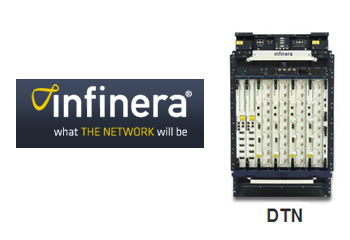
ESnet is using Infinera's DTN platform.  ESnet first deployed the Infinera DTN platform for an advanced network testbed, and then leveraged the platform to provide production network services over the dark fiber ring in Long Island.

Brookhaven National Laboratory is one of two facilities in the U.S. making data from the Large Hadron Collider’s ATLAS experiment available to the 44 U.S. institutions participating in the ATLAS project. 

http://www.infinera.com
http://www.es.net/


  • In November, Infinera and the U.S. Department of Energy's (DOE) Energy Sciences Network (ESnet) demonstrated a prototype Software Defined Network (SDN) Open Transport Switch (OTS) capable of dynamically controlling bandwidth services at the optical layer via an extensions to the OpenFlow protocol. The idea is to provide a lightweight virtual transport switch on optical transport systems with an interface to an SDN Controller.
  • The proof-of-concept demonstration, which used ESnet's Long Island Metropolitan Area Network (LIMAN) control plane test bed, tested a prototype of the OTS running on the Infinera DTN platform, allowing ESnet’s optical transport network to be configured by an SDN controller via the OpenFlow protocol. 

Thursday, November 29, 2012

ESnet and Infinera Test SDN Open Transport


Infinera and the U.S. Department of Energy's (DOE) Energy Sciences Network (ESnet) demonstrated a prototype Software Defined Network (SDN) Open Transport Switch (OTS) capable of dynamically controlling bandwidth services at the optical layer via an extensions to the OpenFlow protocol. The idea is to provide a lightweight virtual transport switch on optical transport systems with an interface to an SDN Controller.

The proof-of-concept demonstration, which used ESnet's Long Island Metropolitan Area Network (LIMAN) control plane test bed, tested a prototype of the OTS running on the Infinera DTN platform, allowing ESnet’s optical transport network to be configured by an SDN controller via the OpenFlow protocol. ESnet enhanced its SDN controller and demonstrated on-demand bandwidth Ethernet services including bandwidth elasticity for data-intensive science experiments at Brookhaven National Laboratory on their LIMAN network, spanning from Manhattan, NY, to Upton, NY.

The services were provisioned by a high-capacity bandwidth-on-demand application utilizing the SDN controller in three different transport network abstractions, including one based on Infinera’s standards-based GMPLS control plane, showcasing the potential to deploy Transport SDN in networks with existing control planes in production. Brookhaven National Lab’s networking team and researchers used this SDN platform to experiment with ultra-high speed data transfer applications being developed for next-generation networks using RDMA over Ethernet protocols.

ESnet Chief Technologist Inder Monga said big data is a reality for science conducted at the national labs and at research universities across the country.  While some of the traffic flows are persistent and can use nailed up optical circuits efficiently, the sharing of big data sets generates bursty traffic. By enabling multi-layer coordination and control, including converged wavelength, OTN and packet transport technologies, ESnet is looking to improve the utilization and efficiency, while simplifying and automating operations.

“The emerging era of data-intensive science demands the highest level of performance from the network. The ability for the network to scale and handle large data flows efficiently across a multi-layer network is an essential capability,” said ESnet Chief Technologist Inder Monga. “The type of bandwidth flexibility, automation and resource efficiency demonstrated in this test are critical to supporting the large-scale data transfer requirements of data-driven science research.”

Infinera described the proof-of-concept demonstration as a first step in realizing the potential of Transport SDN at the optical transport layer.  The company's Bandwidth Virtualization technology already provides an abstraction layer via a standards-based GMPLS software control plane, integrated OTN switching and photonic integrated circuit (PIC) technology.  Key learnings from this demonstration are that Transport SDN can provide useful, programmable interfaces to Tier 1 service providers, and that optical hardware and software are SDN ready.

“This pioneering demonstration is an important first step on the path toward enabling Transport SDN,” said Chris Liou, VP Network Strategy, Infinera. “For service providers interested in deploying Transport SDN, we believe the OTS can play a key role in realizing many benefits, including simplified provisioning of bandwidth services in multi-tiered, multi-vendor, multi-domain environments, increased efficiency and utilization of network resources, and an open, programmable transport network for enhancing integration and automation with applications.”

http://www.infinera.com/go/SDN