Monday, October 3, 2022

Samsung updates roadmap, aims for 1.4nm nodes in 2027

At its annual Samsung Foundry Forum event in San Jose, California, Samsung Electronics outlined its goals to drive process nodes to 1.4nm in 2027. 

Samsung, which currently has 3nm process technology in mass production, Samsung will be further enhancing gate-all-around (GAA) based technology and plans to introduce the 2nm process in 2025 and 1.4nm process in 2027.

The event focused on foundry process technology innovation, process technology optimization for each specific applications, stable production capabilities, and customized services, including the enhancement its GAA-based 3nm process support for HPC and mobile applications. Samsung will also diversify the 4nm process for HPC and automotive applications.
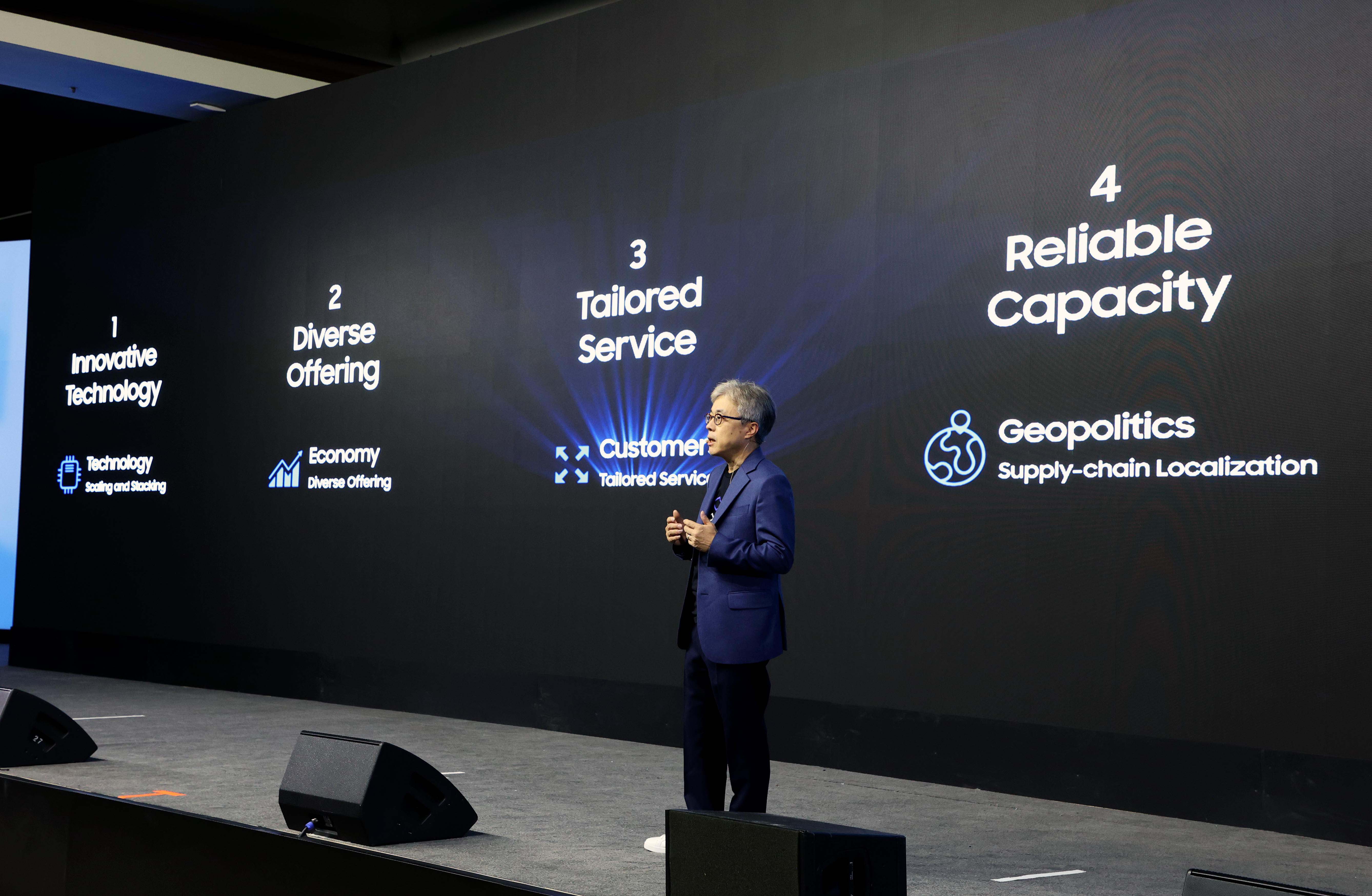
For automotive customers specifically, Samsung is currently providing embedded non-volatile memory (eNVM) solutions based on 28nm technology. In order to support automotive-grade reliability, the company plans to further expand process nodes by launching 14nm eNVM solutions in 2024 and adding 8nm eNVM in the future. Samsung has been mass producing 8nm RF following 14nm RF, and 5nm RF is currently in development.

“The technology development goal down to 1.4nm and foundry platforms specialized for each application, together with stable supply through consistent investment are all part of Samsung’s strategies to secure customers’ trust and support their success,” said Dr. Si-young Choi, president and head of Foundry Business at Samsung Electronics. “Realizing every customer's innovations with our partners has been at the core of our foundry service."

Samsung also confirmed that its 3D packaging X-Cube with micro-bump interconnection will be ready for mass production in 2024, and bump-less X-Cube will be available in 2026.

In addition, Samsung highlighted its production expansion. The company plans to expand its production capacity for the advanced nodes by more than three times by 2027 compared to this year. Including the new fab under construction in Taylor, Texas, Samsung's foundry manufacturing lines are currently in five locations: Giheung, Hwaseong, and Pyeongtaek in Korea; and Austin and Taylor in the United States.

Lockheed Martin and Verizon demo 5G.MIL drones

Lockheed Martin and Verizon demonstrated 5G-enabled drones for capturing and securely transfering real-time intelligence, surveillance and reconnaissance (ISR) data from aircraft in flight. 

The demonstration, which occurred at Lockheed Martin’s 5G test range in Waterton, Colorado, used mmWave 5G to move data from aircraft in flight over Lockheed Martin’s multi-site, multi-vendor 5G.MIL pilot network.

Lockheed Martin flew four rotary wing drones on coordinated ISR missions while linked to two Verizon On Site Private Network nodes. The companies then seamlessly and securely moved the data captured by the drones between a 5G private network and a surrogate public network. 

The companies said the ability to use private and public 5G networks is key because it will extend the reach of 5G.MIL technology to a range of military environments where commercial networks may not be available or appropriate.

The drones then successfully located a target in the field that was transmitting a low power RF signal. The signal was detected because real-time drone sensing data was transmitted over the Verizon network and then processed by advanced signal processing algorithms running on edge compute resources, enabling geolocation of the signal source.

“To stay ahead of our adversaries, military decision-makers need the timely and accurate information that 5G.MIL delivered in this demonstration,” said Dan Rice, vice president of 5G.MIL Programs at Lockheed Martin. “By blending advanced commercial 5G capabilities with military capabilities using secure, open standards, we are helping to make the DOD’s vision for integrated deterrence a reality.”

“Verizon is the network America relies on, and our Private 5G Ultra Wideband networks provide the security, reliability, capacity and low latency that the defense sector depends on,” said Srini Kalapala, Senior Vice President for Technology and Product Development at Verizon. "By demonstrating the mission critical connectivity that our network provides, we are demonstrating how 5G and edge computing can help the DOD address their strategic priorities and continue to develop advanced solutions.”

https://www.verizon.com/about/news/lockheed-martin-verizon-demonstrate-5g-connected-isr

Black Hawk flight data transferred via AT&T 5G

In a test conducted last month at Lockheed Martin's Sikorsky headquarters in Stratford, Connecticut, AT&T securely and rapidly transferred UH-60M Black Hawk health and usage data through an AT&T 5G private cellular network and Lockheed Martin's 5G.MIL multi-site pilot network.The AT&T 5G millimeter wave private cellular network wirelessly transferred data to the 5G.MIL network through ground support equipment from the Black Hawk's Integrated...


Lockheed Martin and Keysight test 5G.MIL for aerospace/defense

Lockheed Martin and Keysight Technologies are actively collaborating on a 5G.MIL testbed that Lockheed Martin teams will use to advance 5G capabilities for multiple aerospace and defense applications. The testbed, which reached initial operational capability in July, will help Lockheed Martin’s 5G.MIL teams quickly verify interoperability and performance with a wide range of 5G assets and simulate reliable and secure communications. Since that...

Verizon and Lockheed Martin collaborate on 5G.MIL

Verizon (NYSE: VZ) and Lockheed Martin are collaborating on 5G.MIL technologies that will provide ultra-secure, reliable connections for U.S. Department of Defense systems , bringing together high-tech platforms into a cohesive network spanning air, land, sea, space and cyber domains. The companies highlighted a joint demonstration that used a Verizon private 5G network installed at Lockheed Martin Space’s 5G Test Range in Colorado, connected...


Dell'Oro: Data Center Physical Infrastructure spending up 9%

Data Center Physical Infrastructure (DCPI) revenues grew 9 percent year-over-year in 2Q 2022, driven by average selling price increases and marginal improvement in unit shipments, according to a report from Dell'Oro Group.  Supply chain constraints are expected to linger into 2023 but minor improvements are forecast to lead to increasing unit shipments, alongside continued price realization in 2H 2022. These factors have led the 2022 full-year outlook for data center physical infrastructure to be raised by nearly 2 percent year-over-year (Y/Y).

“The Data Center Physical Infrastructure market remained resilient in 2Q 2022, despite Russia’s invasion of Ukraine and COVID-related lockdowns in China resulting in global macroeconomic uncertainty,” said Lucas Beran, Principal Analyst at Dell’Oro Group. “Furthermore, the global trends of electrification and digitalization, inherently linked to sustainability, are solidifying themselves as major DCPI market drivers, both in the short and long term. Historically high DCPI vendor backlogs provide the market with a strong runway into 2023. However, growing macroeconomic uncertainty and waning price realization are expected to moderate DCPI growth in 2023, particularly in the enterprise market segment.”

Additional highlights from the 2Q 2022 Data Center Physical Infrastructure Quarterly Report:

  • Eaton, Cyberpower, Huawei, and Schneider Electric gained revenue share in 2Q 2022.
  • North America and Asia Pacific (excluding China) were the fastest growing regions, at double-digit growth rates, in 2Q 2022. China was the only region to decline Y/Y, due to COVID-related lockdowns.
  • Product growth was broad-based, with shorter sale cycle products such as single-phase UPS and rPDU growing at double-digit rates, while longer sale cycle products such as three-phase UPS and cabinet power distribution grew at slightly lower rates.
  • Worldwide DCPI revenue growth is forecast above 10 percent in 2022, driven by double-digit cloud and colocation service provider growth and mid-single-digit enterprise growth.

https://www.delloro.com/news/

DE-CIX expands cloud connectivity in Dallas region

DE-CIX has enhanced its cloud connectivity capabilities in the Dallas market via the DE-CIX Dallas multi-service interconnection platform, which now offers direct access to Amazon Web Services (AWS), Google Cloud and Microsoft Azure solutions, including Microsoft Azure Peering Services – the most reliable and SLA-backed way to reach cloud-based Microsoft365 and Dynamics365 solutions. 

DE-CIX Dallas' growing interconnection ecosystem now offers access to over 120 networks, including direct and dedicated access to clouds to support enterprise network requirements.

Once connected via DirectCLOUD, enterprises and ISPs serving enterprises benefit from DE-CIX’s business class interconnection services to readily set up VLANs for multi-cloud connectivity solutions. DE-CIX’s private connectivity capabilities deliver controlled, secure and direct connectivity to multiple global cloud providers through a single connection.

“Network interconnection and improving cloud access are growing concerns for enterprises.” comments Ed d’Agostino, VP and GM DE-CIX North America. “In developing the Dallas market, we specifically deployed our core switches where most networks reside. Our Transport Partner program enhances reach to DE-CIX Dallas through partner networks including Gigabit Communications, LOGIX Fiber Networks and PacketFabric that serve the greater Texas market. Now businesses across Texas can leverage turnkey access to DE-CIX Dallas to take advantage of the interconnection data gravity and our enhanced DirectCLOUD service capabilities available in the market.”

https://www.de-cix.net/north-america

SiTime supplies precision timing Tesla Dojo AI supercomputer

SiTime is delivering precision timing solutions for the Tesla Dojo System, a supercomputer that has been built with a no limits philosophy. 

Through close engineering collaboration and multiple iterations over an extended period, SiTime’s engineers provided an alternative MEMS oscillator, along with system-level techniques, that fixed the problem for dense integration design of Dojo power module.

“The problem on Tesla’s Dojo power module is one of the more unique cases in my 35 year engineering career,” stated Nara Bharath, executive vice president of systems engineering at SiTime.“The power module for Tesla’s Dojo system is very dense, with vertical integration of key components, including clocks. We worked closely with Tesla engineers to find the root cause, select the right SiTime part and program it appropriately to fix this problem, ensuring that the system works in harsh conditions. Our collaboration with Tesla is a great example of how leaders can work together to advance the future of electronics.”

Bill Chang, Dojo’s system design lead, noted, “Solving density problems is the cornerstone of achieving our system performance. Unlike conventional designs, we had to design a unique power module which is very dense and integrates all components, including timing. SiTime’s MEMS clocking technology and system-level knowledge enabled a power module that optimized unprecedented density and complex integration, which in turn, enabled high system performance on Dojo.”


Intel's Mobileye files for IPO

Intel's subsidiary, Mobileye, filed a registration statement on Form S-1 with the U.S. Securities and Exchange Commission for an initial public offering of its Class A common stock. 

Mobileye intends to list its Class A common stock on the Nasdaq Global Select Market under the ticker symbol “MBLY.”

Intel plans IPO for Mobileye

Intel plans to take Mobileye public in the United States in mid-2022 via an initial public offering (IPO) of newly issued Mobileye stock.Intel will remain the majority owner of Mobileye, and the two companies will continue as strategic partners, collaborating on projects as they pursue the growth of computing in the automotive sector.Mobileye focuses on advanced driver-assistance systems (ADAS) and self-driving solutions. In 2021, Mobileye shipped...

Intel acquires Moovit for Urban Mobility App

Intel has acquired Moovit, an Israeli-based mobility-as-a-service (MaaS) solutions company, for approximately $900 million ($840 million net of Intel Capital equity gain). Moovit's urban mobility application offers multimodal trip planning by combining public transportation, bicycle and scooter services, ride-hailing, and car-sharing. The app has more than 800 million users and services in 3,100 cities across 102 countries. Moovit was founded in...

Intel to Acquire Mobileye for $15.3 Billion - Automated Driving

Intel agreed to acquire Mobileye, a developer of machine vision systems for automated driving, for $63.54 per share in cash, representing a fully-diluted equity value of approximately $15.3 billion and an enterprise value of $14.7 billion. The acquisition will couple the best-in-class technologies from both companies, including Intel’s high-performance computing and connectivity expertise and Mobileye’s leading computer vision expertise to create...

Calix names Michael Weening as president and CEO

Calix named Michael Weening as president and chief executive officer, replacing Carl Russo, who remains as Chairman of the Board.

Weening has been a member of the Calix leadership team for over six years. During his tenure at Calix, he has led functions including sales, services, marketing, products, and operations. In January of 2021, he was promoted to the role of president and chief operating officer. 

“I joined Calix in 2016 because I was inspired by the Calix strategy to completely transform the broadband market at a time when the industry required transformation,” said Mr. Weening. “I believe that Calix is a special company where I can partner with and learn from a visionary leader, Carl Russo, and the entire Calix team. Thanks to Carl’s leadership, we have completed the second phase of our evolution - from a networking innovator to the broadband industry’s only platform and cloud company. I am honored to lead Calix as we enter the third phase of our evolution. "

“Michael has been a core leader and strategic contributor since joining Calix more than 6 years ago. In recent times, he has led the team as we have executed with excellence,” said Carl Russo, Calix board chairman. “Michael has the right vision and leadership for Calix as we become an ecosystem partner for broadband service providers. I am excited that our partnership will continue as I shift my focus to leading the board in our mission to ensure that Calix stays in front of this enormous opportunity.”

Sunday, October 2, 2022

GSMA Post-Quantum Telco Network Taskforce gets underway

A new GSMA Post-Quantum Telco Network Taskforce has been established with a mission to help define policy, regulation and operator business processes for the enhanced protection of telecommunications in a future of advanced quantum computing. Organizers believe that without quantum-safe controls in place, sensitive information such as confidential business information and consumer data could be at risk from attackers who harvest present-day data for later decryption. 

IBM and Vodafone are initial members.

“The GSMA Taskforce’s goal is to bring together leading global communication services providers with experts from IBM, Vodafone and other operators and ecosystem partners to understand and implement quantum-safe technology. By working together to establish consistent policies, we can define quantum-safe approaches that protect critical infrastructure and customer data, complementing our ongoing security efforts to increase resiliency in future networks,” said Alex Sinclair, the GSMA’s Chief Technology Officer.

To address the challenges presented by emerging quantum technology, the U.S. National Institute of Standards and Technology (NIST) announced in July 2022 that it had chosen the first four post-quantum cryptography algorithms to be standardised for cybersecurity in the quantum computing era. These algorithms are designed to rely on the computational difficulty of problems from the mathematical areas of lattices, isogenies, hash functions and multivariate equations — and protect today’s systems and data from future quantum computers.

IBM, a leader in cryptography and pioneer in quantum technology – with the world’s largest fleet of cloud-accessible quantum computers – contributed to the development of three of NIST’s four chosen post-quantum algorithms.

https://www.gsma.com/newsroom/press-release/gsma-ibm-and-vodafone-establish-post-quantum-telco-network-taskforce/

IQM and QphoX to develop optical interface for quantum computers

IQM Quantum Computers is collaborating with QphoX, a start-up based in The Netherlands, to  develop an optical interface for scaling quantum computers.IQM provides on-premises quantum computers for supercomputing data centres and research labs and offers full access to its hardware. IQM delivers these machines as a full-stack system integrator with its own quantum processors using superconducting qubits.QphoX specializes in photon wavelength...


Ericsson and O2 Telefónica demo 5G microwave backhaul at 10 Gbps

Ericsson and O2 Telefónica demonstrated 5G wireless backhaul at speeds of up to 10 Gbps over a distance of more than 10km.

Ericsson said the demo showed that microwave backhaul over traditional bands can support the continued build-out of high-performing 5G networks and enhanced mobile broadband services from urban to suburban and rural areas – one of the key challenges facing communications service providers in scaling up their 5G deployment.

“We deliver fast mobile 5G connections to millions of customers across Germany. Bringing digitalization to suburban and rural areas through mobile connectivity and fast 5G network rollout has therefore priority for us,” says Aysenur Senyer, Director of Transport Networks at O2 Telefónica.

“Together with our partner Ericsson, we are pioneering new powerful microwave solutions using Carrier Aggregation and MIMO technology to backhaul 5G traffic over long distances in rural areas, when fiber is not an option. This type of technology enables us to deliver fiber-like connectivity via microwave and further accelerate our 5G deployment.”

https://www.ericsson.com/en/news/2022/9/ericsson-and-o2-telefonica-demo-5g-wireless-backhaul-for-non-urban-areas

Mavenir now runs on Google Cloud

Mavenir's cloud-native 5G solutions will now be available with public cloud infrastructure on Google Cloud.

The company has previously announced integration on AWS.

Mavenir said this collaboration demonstrates true cloud-native Open RAN products in production deployment on Google Distributed Cloud. Open RAN technology separates software from hardware, meaning more flexibility for mobile operators and customers. The Open RAN approach will see many companies providing the components that make up a mobile network site, where previously one vendor would have delivered a closed solution.

Validation of Mavenir’s Open RAN product in Google Cloud allows CSPs to deploy Mavenir’s 5G Open RAN products with Google Distributed Cloud Edge, global infrastructure and state-of-the-art unified container platform Anthos. The fully containerized Distributed Units (DUs) and Central Units (CUs) software run on Google Distributed Cloud Edge, enabled by Anthos, and Mavenir’s Webscale Telco PaaS to deliver ORAN-compliant RAN networks. Validation testing includes end-to-end UE calls with other simulated 5G network components. The critical DU components are incorporated with Google Distributed Cloud Edge’s new OS and RT kernel.

“Working with Google Distributed Cloud Edge enables us to bring innovative 5G products to a broader customer base at faster pace with unique capabilities to realize true 5G potential leveraging strength within the Mavenir portfolio,” said Bejoy Pankajakshan, Mavenir’s Chief Technology & Strategy Officer. “Mavenir’s 5G solutions are proven to support full public cloud as well as hybrid cloud deployments.”

“We’re delighted to collaborate with Mavenir to offer Open RAN solutions for 5G networks,” said Amol Phadke, GM: Global Telecom Industry, Google Cloud. “Combining Mavenir’s expertise in Open RAN, 5G core, and IMS with Google Distributed Cloud Edge and global infrastructure, we look forward to providing cloud-native solutions that improve agility, scale, slicing, and resiliency for our CSP customers.”

https://www.mavenir.com/press-releases/mavenir-to-deliver-cloud-based-5g-solutions-on-google-cloud/

Mavenir now offers its Converged Packet Core on AWS

Mavenir announced support for deployments and integration of cloud-native telecom network functions with telco infrastructure solutions on Amazon Web Services, Inc. (AWS).Mavenir's 5G solutions on AWS include its Converged Packet Core, IMS, Messaging, Orchestration, AI and Telco Analytics and Open RAN products.“The collaboration with Mavenir and AWS allows us to build out our 5G network and messaging platforms in a true cloud-native manner, harnessing...

Telefónica builds cloud native IoT with Mavenir packet core and AWS

Telefónica is preparing to launch a managed IoT connectivity service based Mavenir’s packet core solution and AWS’s cloud infrastructure. Mavenir's cloud native functions will be hosted in AWS. Mavenir said the use of the cloud enables advanced, new functionalities for end users that were not previously possible: local data processing/storage, direct connectivity to other cloud services, and global low latency. The new service is managed...


FCC: Florida cell sites recover from Hurricane Ian

A total of 444 cell sites remained out-of-service in Florida as of 02-October-2022, representing 5.5% of the state's cell sites. The down significantly from the peak of 1,552 cell sites out of commission on Thursday.

Cable and wireline companies reported the following number of subscribers out of service by state in the disaster area; this may include the loss of telephone, television, and/or Internet services:

Florida: 606,553 

South Carolina: 9,845

https://www.fcc.gov

Ericsson to supply 5G FWA in Greenland

Ericsson is expanding its partnership with Tusass for the joint vision of a wireless Greenland. The partnership started in 2017 with a complete modernization of the mobile network while simultaneously adding high-quality 4G services across all populated areas in Greenland.

Now non-standalone (NSA) Fixed Wireless Access (FWA) 5G will be rolled out in Sisimiut, Maniitsoq, and Narsaq, before it is realized in several places in the rest of the country.

Tusass’ CEO Kristian Reinert Davidsen says: “By deploying 5G we will touch the daily life of all Greenlanders. Mobile connections are extremely important in the Arctics and to many families and households in Greenland it is the only line of contact.” 

Jenny Lindqvist, Head of Northern and Central Europe, Ericsson says: “With our resilient 5G technology, the people of Greenland will be able to connect over vast distances, bringing people closer to each other and to the rest of the world. From a broad perspective, this partnership serves the digitalization of Greenland, from enabling use cases for control of critical infrastructure and remote devices to bringing new entertainment services for the people. Regardless of how challenging the project is or extreme the weather conditions, Ericsson remains committed to create a wireless Greenland together with Tusass.” 

  • TELE Greenland A/S was rebranded as Tusass in 2021. Tusass is Greenlandic slang for "talk to you later".

TELE Greenland rules out Huawei for 5G

TELE Greenland said in a statement that it has ruled out Huawei as a supplier for a future 5G rollout. Currently, the carrier has some Huawei gear in its network, although Ericsson is the principal supplier of its 4G network. TELE Greenland is able to provide mobile broadband to 92% of the population. The population of Greenland is approximately 56,000. https://telepost.gl/da/nyheder/tele-greenland-as-om-4g-mobile-first-og-5g-i-groenland Subsea...

Subsea connectivity restored to northern Greenland

Following repairs to a subsea cable linking Greenland and Canada, connectivity has been restored to customers north of the town of Sisimiut. The population of South Greenland will have to wait for another 15-20 days before the southern branch of the damaged subsea cable is repaired. Greenland is an autonomous territory of Denmark with a population of about 56,000, most of whom live along fjords in the southwest. TELE-POST is the service provider...


Nokia deploys IP/MPLS for Poland’s nationwide TV network

Nokia, in collaboration with Emitel and Oscilloquartz, completed the deployment of Poland’s most advanced IP transport and synchronization network for the nationwide coverage of digital TV broadcast services. 

The IP/MPLS network supports the nationwide infrastructure for Digital Terrestrial Television (DTT) and multimedia distribution. Digital Terrestrial Television (DVB-T2) is the primary TV source for over 13 million Polish viewers. This transport network, comprising over 500 Nokia IP/MPLS routers across 300 locations and more than 130 advanced Primary Reference Timing Clocks by Oscilloquartz simultaneously with other infrastructure and network elements, is one of the most advanced IP/MPLS transport networks supporting time synchronization distribution in Europe today.

The strategic decision by the Polish government and regulators to upgrade all broadcast systems to the new DVB-T2 standard required upgrading the transport network in order to increase capacity, support new applications, and ensure very high synchronization accuracy and resilience, providing viewers with consistently excellent sound and video quality. Since DVB-T2 broadcasting involves very stringent time synchronization requirements, the transport network plays a key role in ensuring network time synchronization with sub-microsecond accuracy for each DVB-T2 transmitter, protecting against signal interference and spoofing.

Marcin Guzy, Customer Team Head Poland at Nokia, said: “We are very excited to be a part of this project, bringing next-generation TV services to millions of households in Poland. This was one of the most technically advanced projects we have deployed recently. Thanks to the professionalism of the Emitel, Nokia and Oscilloquartz teams, we have proven that even the most complex network infrastructure can be put into operation within one year.”

https://www.nokia.com/about-us/news/releases/2022/09/29/nokia-deploys-state-of-the-art-network-to-support-polands-nationwide-tv-broadcasting-infrastructure/

Mavenir offers 2G, 4G and 5G Open RAN radios made-in-India

Mavenir commenced the production of 2G, 4G and 5G Open RAN Radios for the OpenBeam portfolio in India, for Indian and other prominent worldwide bands.

The OpenBeam portfolio includes massive MIMO, mmWave and multi-band remote radio heads (RRHs). The OpenBeam Open RAN radio solutions are available across all frequency bands and can be used for a wide range of use cases, including enterprises and public settings across urban or rural environments.

“Our manufacturing partner network is very well positioned for the sustainable and rapid scaling of Open RAN volumes and made in India requirements. With these new production sites coming online, we have reached another important milestone in our strategy to expand and evolve the Open RAN ecosystem”, said Ramnik Kamo, EVP, CIO and CPO of Mavenir.


STL develops multicore fibre and cable in India

STL introduced a line of multicore fibre and cable products developed at its Centre of Excellence in Maharashtra, India.

STL's Multiverse leverages Space Division Multiplexing to gain 4X transmission capacity per fibre, within the same diameter.

Speaking at the launch, Randeep Sekhon, CTO, Bharti Airtel, said: "I am excited to see this optical fibre innovation from a homegrown company. STL's Multiverse fibre and cable will enable 4X capacity and play a vital role in 5G scale-up. I wish STL all the very best for their efforts towards supporting network build outs."

https://www.stl.tech/

Thursday, September 29, 2022

Hurricane Ian knocks out 1,552 cell sites in Florida

As of 29-September-2022, the FCC reports that 1,552 cell sites were out of service in Florida, approximately 11% of the 14,188 cell sites in the state. 

Of these, the FCC lists 180 cell sites as damaged/destroyed by the storm, while 795 cell sites are offline due to power issues, while 527 are on backup power.


The number of cell site outages in a specific area does not necessarily correspond to the availability of wireless service to consumers in that area. 

Cable and wireline companies reported 525,966 subscribers out of service in the disaster area for Hurricane Ian; this includes the loss of telephone, television, and/or Internet services. 

https://www.fcc.gov/document/hurricane-ian-communications-status-report-september-29-2022

ADVA launches pluggable 10G edge demarcation device

ADVA introduced a pluggable 10Gbit/s demarcation SFP+ device specifically designed for space-constrained environments. 

The ADVA NIDPlug+ device consumes less than 2.5 watts and provides enterprises and communication service providers (CSPs) with the comprehensive management capabilities needed to deliver strict SLA-based Carrier Ethernet. With standards-compliant performance assurance and service activation testing, it integrates seamlessly into existing networks and enables MEF 3.0-compliant mobile and business services.

“Today’s launch answers the urgent need of network operators to deliver high-speed Carrier Ethernet in environments where standalone demarcation solutions can’t be deployed. With its low-power consumption, our NIDPlug+™ offers a highly cost-effective route to getting more from existing infrastructure,” said Eli Angel, VP of product line management at ADVA. “CSPs throughout the world trust our demarcation products to provide assured bandwidth services. Now, they can easily plug this technology into an existing switch, router or other customer premises device that requires network connectivity. We’re empowering operators to scale up their network capabilities while ensuring lower cost per bit and reducing the expense of ongoing operations.”

https://adva.li/nidplug-slides.

ECOC22 Update: ADVA's Optical Engines

https://youtu.be/A-RdO1q1F3oThink optical engines!Here is an overview from Saeid Aramideh, VP of Business Development, Optical Engines Business Unit, ADVA.Learn more about the Consortium for Onboard Optics and why your company should join:https://www.onboardoptics....

ADVA launches AccesWave25 optical transceiver

ADVA launched its AccessWave25 pluggable optical transceiver for mobile X-Haul, cable access and wholesale networks.The SFP28 transceiver offers 25 Gbps connectivity and a reach of 40km and features G.metro auto-tuning technology to reduce provisioning efforts and simplify operations. It uses less than 3 watts and has an I-temp hardened design.“Our AccessWave25 is the key to unlocking more bandwidth at the edge. Now network operators have an easy,...

ADVA introduces new 10G edge device

ADVA introduced an outdoor 10G Carrier Ethernet edge demarcation device that complies with MEF 3.0 specificationsThe ADVA FSP 150-XO106 is compact and temperature-hardened, making it ideal for deployment in space-restricted locations and harsh outdoor conditions. Requiring no cabinet or cooling, it can be easily deployed on walls, poles and cell towers. The feature-rich solution includes advanced OAM capabilities, supports precise synchronization...