Monday, September 19, 2022

ECOC22: Keysight announces 224G BERT, paving way for 1.6 Tbps transceivers

Keysight Technologies announced a 224G Ethernet bit error rate test (BERT) solution to enable system-on-a-chip (SoC) makers to validate next generation electrical interface technology, accelerating 1.6 terabit per second (1.6T) transceiver design and pathfinding.

“Keysight is pleased to collaborate with Synopsys, and other semiconductor makers, capture early market opportunities associated with the transition from 800 gigabit per second (800G) to 1.6T,” said Dr. Joachim Peerlings, vice president of Network and Data Center Solutions at Keysight Technologies. “Keysight’s unique portfolio of high-speed digital interface test solutions enable SoC makers to validate the performance of 224G designs accelerating 1.6T design and pathfinding.”

Keysight says its M8050A BERT offers users a unique 224 Gbps test solution for electrical design and validation of transceiver SoCs used in data centers and networks for transferring large amounts of data at high speeds. Keysight’s M8050A BERT provides signal integrity that enables accurate characterization of receivers used in next-generation data center networks and server interfaces. Synopsys used Keysight’s M8050A BERT, M8199 Arbitrary Waveform Generator (AWG) and Infiniium UXR-Series Oscilloscope to develop and validate 224G serializer/deserializer (SerDes) IP designs.

“High-performance computing systems depend on high-speed, low-latency interfaces to process massive amounts of data with minimal power,” said John Koeter, senior vice president of marketing and strategy for the Solutions Group at Synopsys. “As a leading provider of high-speed Ethernet IP solutions, Synopsys utilizes Keysight’s comprehensive digital interface test solutions to validate the performance of the PHY IP, enabling designers to meet their design and system-level requirements for high-performance computing, networking and AI SoCs.”

At the European Conference on Optical Communication (ECOC) 2022 in Basel, Switzerland, Keysight and Synopsys are demonstration the industry’s first common electrical interface (CEI) SoC supporting 224Gbps. 


ECOC22: Avicena demos microLED-array for chip-to-chip at 14G per lane

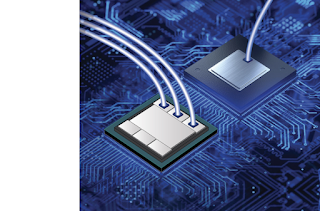
Avicena is demonstrating its LightBundle multi-Tbps chip-to-chip interconnect technology at this week's ECOC22 exhibition in Basel, Switzerland.

The company says the parallel nature of its LightBundle is well-matched to parallel chiplet interfaces like UCIe, OpenHBI, and BoW, and can also be used to extend the reach of existing compute interconnects like PCIe/CXL, and HBM/DDR/GDDR memory links, as well as various inter-processor interconnects like NVLink with low power and low latency.

“We have already demonstrated LightBundle links running at less than 1pJ/bit,” says Bardia Pezeshki, founder and CEO of Avicena, “Here at ECOC 2022 we are demonstrating individual microLED links running at 14Gbps. Compact, low-cost interconnects using hundreds of these links can support many terabits per second.” LightBundleTM is based on arrays of innovative GaN microLEDs that leverage the microLED display ecosystem and can be integrated directly onto high performance CMOS ICs. Each microLED array is connected via a multi-core fiber cable to a matching array of CMOS-compatible PDs.

“We have just closed our Series A funding with a distinguished group of existing and new investors,” continues Bardia Pezeshki. “And we will use the new funds to scale our team and build initial products for our growing family of partners and customers.”

Today’s high-performance ICs use SerDes-based electrical links to achieve adequate IO density. However, the power consumption and bandwidth density of these electrical links degrade quickly with length. Conventional optical communications technologies developed for networking applications have been impractical for inter-processor and processor-memory interconnects due to their low bandwidth density, high power consumption, and high cost. Moreover, co-packaging existing laser sources with hot ASICs does not fit well for reliability reasons unless external laser sources (ELS) are used which increases complexity and cost.

“All of this is now changing,” says Bardia Pezeshki. “We are developing ultra-low power, high-density optical transceivers based on microLED arrays. These innovative devices leverage recent display industry advances and would have been impractical just a few years ago. Our optimized links support up to 14Gbps per lane over -40°C to +125°C temperature with excellent reliability. A LightBundle interconnect uses hundreds of parallel optical lanes connecting a microLED-based optical transmitter array to a simple CMOS-based optical receiver array over multi-core fiber cables to create low-cost multi-Tbps interconnects with up to 10 meter reach.”

Avicena raises $25 million for microLED interconnects

AvicenaTech, a start-up based in Mountain View, California, announced $25 million in Series A funding for its development of microLED-based chip-to-chip interconnects.Avicena's LightBundle technology is based on arrays of GaN micro-emitters that leverage the microLED display ecosystem. The company says this can be integrated onto a high-performance CMOS IC. “We are excited about closing our Series A funding with a distinguished group of existing...


ECOC22: Semtech adds VCSEL driver for 400G and 800G

Semtech announced a new addition to its FiberEdge platform of PAM4 chipsets - the GN1848 is a 56GBd quad low power, low cost, low noise and industry leading linear VCSEL driver with programmable bias and modulation currents, enabling interoperability with multiple VCSELs. The FiberEdge GN1848 is designed for 400GBASE-SR4/VR4 and 800GBASE-SR8/VR8 PAM4 multimode optical transceivers and active optical cables (AOC). The FiberEdge GN1848 is sampling now as wire-bondable bare die, allowing direct wire bonding to a quad channel 250μm pitch VCSEL without the need of a bias tee.

Semtech’s FiberEdge platform includes:

  • GN1089: Single Channel 56GBd PAM4 Linear TIA
  • GN1089SC2: Single Channel 28GBd PAM4 Linear TIA
  • GN1800: Second Generation Single Channel 56GBd PAM4 Linear TIA
  • GN1800SC2: Second Generation Single Channel 28GBd PAM4 Linear TIA
  • GN1700: 50Gbps PAM Linear TIA for 5G Wireless
  • GN1810: Quad 56GBd PAM4 Linear TIA
  • GN1812: Second Generation Quad 56GBd PAM4 Linear TIA
  • GN1814: 500μm Pitch Quad 56GBd PAM4 Linear TIA
  • New– GN1816: 250um Pitch Quad 56GBd PAM4 Linear TIA
  • New– GN1848: Quad 56GBd PAM4 Linear VCSEL Driver
  • GN1862: Single Channel 56GBd PAM4 Linear EML Driver

“The high performance and low cost required by our customers in high-speed short reach multimode and active copper cable (AOC) applications can now be achieved with the FiberEdge GN1848 VCSEL driver, coupled with our newly introduced FiberEdge GN1816 transimpedance amplifier (TIA),” said Nicola Bramante, senior product line manager for Semtech’s Signal Integrity Products Group. “The interoperability of Semtech’s FiberEdge multimode chipset extends the well-established FiberEdge portfolio and enables high-speed optical manufacturers to quickly and more easily develop industry-leading and low-cost optical modules.”

ECOC22: Semtech unveils 25G quad CDR transmitter with DML driver

Semtech has begun sampling its new ClearEdge CDR Transmitter solution for 4x25G data center and wireless long-reach (LR) optical links. 

The GN2105S is a quad channel 25G NRZ CDRs with integrated high-performance DC-coupled Direct Modulated Laser (DML) drivers offering superior transmitter (Tx) performance with various low cost and low bandwidth laser with the lowest possible power.

The ClearEdge GN2105S can be paired with the GN2110S receiver for a complete 100G PSM4/CWDM4/LR4 solution. Semtech applications engineering teams are available to support immediate design-in activities to enable rapid adoption of Semtech’s solution.

Semtech’s data center ClearEdge CDR portfolio includes:

  • New - GN2105S: Quad channel 25G NRZ CDRs with integrated DC-coupled DML drivers
  • GN2110S: Quad CDR with integrated TIA
  • GN2105B: Quad CDR with integrated DML laser drivers
“Building upon Semtech’s robust and proven 25G ClearEdge technology, the GN2105S has a new generation DML driver and offers proprietary laser compensation to enable a wide range of low-cost laser options for data center and wireless optical interconnects,” said Tim Vang, vice president, marketing and applications for Semtech’s Signal Integrity Products Group. “Due to the complementary nature of the ClearEdge GN2105S and GN2110S, Semtech is offering the ClearEdge integrated circuit (IC) bundle (GN2105S and GN2110S) assisting our optical module customers to differentiate their products with maximum Tx and receiver (Rx) performance, while achieving industry leading low power.”

.


ECOC22: Jabil intros CFP2 DCO transceivers based on Nokia

Jabil Photonics announced general availability and customer testing of its CFP2 DCO ECO Coherent Transceiver. 

This latest module is based on Nokia’s CSTAR200+ silicon photonics optical engine. 

Jabil Photonics offers the coherent technologies and solutions required for a wide range of applications, including 5G, metro networking and data-center interconnects. Moreover, the second-generation 100G/200G modules comply with the most recent communications standards requirements while minimizing power consumption with the most recent Digital Signal Processing (DSP) and optical-engine technologies.

“We are pleased to integrate Nokia’s CSTAR-200+ optical engine as part of our complete coherent transceiver solution,” said KW Hoo, GM of Jabil Photonics. “Together, we can accelerate the pace of technology advancements while bringing industry-leading optical products to market faster on behalf of customers worldwide.”

http://www.jabil.com

IP Infusion and Jabil Photonics debut 400G ZR OLS 

IP Infusion and Jabil Photonics introduced a 400G Open Line System – the 400G ZR OLS.The solution optimizes the transport of 400ZR signals over 80/120 kilometers by utilizing the IP Infusion OcNOS software stack to meet the massive demand for bandwidth globally.Within the optical domain, this surge has impacted the products and modules that translate client signals into an optical signal, such as transponders and mux-ponders. Additionally, this surge...

EFFECT Photonics and Jabil Photonics target QSFP-DD

EFFECT Photonics and Jabil Photonics agreed to co-develop a next generation of coherent QSFP-DD  optical modules. EFFECT Photonics will make available its System-on-Chip optical technology and Jabil will leverage its track record of manufacturing coherent modules in very large quantities with extensive sourcing capabilities.“One of the ambitions we have as an organization is to build strong partnerships to increase our ability to develop...


ECOC22: Source Photonics hits 2.5 million shipments for EML chips

Source Photonics has surpassed shipment of more than 2.5 million pieces of 28G and 53G high speed EML laser chips for data centers and optical transmission applications. In addition to high end EML chips, Source Photonics exceeds the shipments of over 100 million pieces of 2.5G, 10G and 25G FP/DFB, and 10G EML chips for PON access and wireless fronthaul markets.

Source Photonics began production shipments of 53G EMLs with 100G single lambda PAM4 based 100G/400G transceivers when 400G industry adoption started to take off from 2021. It has undergone a successful introduction and qualification by many of our leading customers and partners throughout 2020. Empowered by the internally developed 53G EML chips and 100G PAM4 technology, Source Photonics has entered volume production of a series of product families which include 100G DR1/FR1/LR1/ER1 QSFP28, 400G DR4/FR4/LR4 QSFP56-DD, and 800G DR8/2xFR4 QSFP-DD800/OSFP.

“We are excited to announce this key milestone of shipping 2,500,000 high speed EML chips as it's both an extraordinary achievement for optics market and for Source Photonics. Today’s announcement further strengthens our commitment and leadership in large-scale production capacity of higher speed EML chip and transceiver products.” said John Wang, CEO of Source Photonics, “Vertical integration remains Source Photonics’ business model and core competitiveness. More than 90% of transceiver products transition to use our own optics chips now, including the newest 800G products under production. The company continues to invest in leading edge technology and will lead the transition from 53G to 100G EMLs for future products.”

The next logical step is to support 8x200G design of 1.6T modules. Source Photonics has embarked the development of 200G PAM4 EML chips to its market leading EML portfolio for achieving modulation bandwidth of over 60GHz. And technical feasibility of operating 200G per lambda PAM4 signaling has been demonstrated to run 2km and 10km fiber distances. It is foreseeable to expect the product commercialization of 1.6T modules will happen in 2023.

www.sourcephotonics.com

ECOC22: AIO Core's Silicon Photonics micro transceivers


What's next at ECOC22 for AIO Core?

The company has developed a wafer-level process for packaging micro transceivers with multimode chips at 25G.


Learn more about the Consortium for Onboard Optics and why your company should join: https://www.onboardoptics.org

ECOC22: Update on the Multi-Mode Waveguide Working Group

What's next at ECOC22?

In 2021,  the Consortium for Onboard Optics established a Multi-Mode Waveguide Interconnect System (MWIS) Working Group to focus specifically on the replacement of copper traces with multi-mode waveguides and adding an extra thin interface for Electrical/Optical and Optical/Electrical conversion within close proximity to the electrical component.

Here is an update for MWIS Working Group chair, Joshua Kim.

https://youtu.be/ZRIFFBx39lw


ECOC22: Furukawa and the Ethernet roadmap to 800G

What's Next at #ECOC22 for Furukawa? 

Look ahead to the Ethernet roadmap to 800G and eventually 1.6T and we can think about different topologies and connectors for making it possible.

Here is an overview from Flávio Marques, Product Line Manager.

Learn more about the Consortium for Onboard Optics and why your company should join:

https://www.onboardoptics.org

ECOC22: Vario-Optics on waveguides embedded on circuit boards

What's Next at #ECOC22 for Vario-Optics? 

How about electro-optical waveguides embedded in printed circuit boards?

Here is an demo conducted at ECOC22 in Basel, Switzerland by Nikolaus Flöry, Business Development Manager, Vario-Optics AG.

Here is another view of this concept on the Vario-Optics website: https://vario-optics.ch/on-board-optics-demo

Learn more about the Consortium for Onboard Optics and why your company should join:

https://www.onboardoptics.org

Sunday, September 18, 2022

SpaceX launches 54 more Starlinks with lasers

On Sunday, September 1, SpaceX launched 54 Starlink satellites to orbit from Space Launch Complex 40 (SLC-40) at Cape Canaveral Space Force Station in Florida.

This was the sixth launch and landing of this Falcon 9 first stage booster, which previously launched CRS-22, Crew-3, Turksat 5B, Crew-4, CRS-25, and now one Starlink mission.

The mission was SpaceX’s 61st Starlink mission to date. 

It was SpaceX's 3rd Starlink mission in September and 28th Starlink mission this year.

https://www.spacex.com/launches/sl4-34/

ECOC22: ColorChip unveils 100G PAM4 400G & 800G transceivers

ColorChip is unveiling a full spectrum of 100G PAM4 400G & 800G optical transceiver and copper cable solutions at this week's the European Conference on Optical Communication conference in Basel, Switzerland. 

ColorChip will showcase its 400G and 800G optical transceivers and copper cables including Direct Attach Cable (DAC), Active DAC (ACC), Multi-Mode and Single Mode optical Transceivers, and Active Optical Cable (AOC) covering from 1st mm to 10km. Powered by its proprietary Hairtail+ copper technology and SystemOnGlass technology, ColorChip claims the best cost-performance in the market give the technology advantages over other implementations in the market. 

In addition to the datacom connectivity solutions, ColorChip will also introduce AV hybrid and pure fiber USB/HDMI/DisplayPort optical cable product lines for high-performance Audio/Video, AR/VR devices, and medical market where longer reach, minimum RFI/EMI impact, and higher bandwidth is highly preferred.

"The introduction of these products places ColorChip as a front runner in data center transceivers" said Yigal Erza, ColorChip CEO. "ColorChip's advanced technology and world class manufacturing enabled the company to deliver volume production with the capability to expand and scale our offering to partners who are looking for a company with the right capability and global operation scale to strengthen their supply chain security moving forward in the post-pandemic globalization."

https://www.color-chip.com


ECOC22: Coherent intros micro-pump lasers for optical access

Coherent introduced I-Temp micro-pump lasers for extended ambient temperature operation in broadband optical access networks.

Coherent’s new industry-leading I-Temp micro-pump lasers are now capable of operating over the extended temperature range of -40 to 85 degrees Celsius, enabling optical amplifiers deployed at the network edge to withstand extreme weather conditions.

“The combination of small size, wide operating temperature, and low power consumption makes the I-Temp micro-pump a perfect solution for environmentally hardened optical amplifiers installed, for example, on utility poles,” said Dr. Richard Smart, Senior Vice President, ROADM Business Unit. “The I-Temp micro-pump leverages differentiated technology at every level of its vertically integrated design, including our GaAs semiconductor laser technology platform, with its proven reliability through decades of field deployments.”

The I-Temp micro-pumps maintain a steady output power of 400 mW with less than 2 W of power consumption and remain optimally wavelength-locked with a fiber Bragg grating, without the need for an internal cooler. They are available with 80 μm PM980 polarization-maintaining fibers and 125 μm HI 1060 bend-insensitive single-mode fibers.


Dell’Oro: Hyperscalers increased data center CAPEX by 45% in Q2

The U.S. cloud hyperscalers — Amazon, Google, Meta, and Microsoft — increased data center capex by 45 percent in 2Q 2022, propelling global data center capex to new heights. However, demand pullback is anticipated among certain Chinese and Tier 3 US cloud service providers and select enterprise verticals, according to a newly published report from Dell’Oro Group.

 “Data center capex attained the highest growth in more than three years, driven by ongoing footprint expansion and adoption of accelerated computing by the US hyperscalers,” said Baron Fung, Research Director at Dell’Oro Group. “However, growth in other markets was mixed, as some enterprise customers are delaying their data center purchases due to mounting economic uncertainties, while others continue to contend with persistent supply challenges. Nevertheless, double-digit growth in server average selling prices from the transition to new server architectures and higher supply chain costs fueled topline growth for the quarter,” explained Fung.

 Additional highlights from the 2Q 2022 Data Center IT Capex Quarterly Report:

  • Backlog and higher equipment pricing are projected to drive data center capex in the second half of 2022.
  • The Top 4 US cloud service providers are scheduled to launch services in more than 30 new regions in 2022.
  • Data center capex growth is expected to moderate in all segments in 2023.

https://www.delloro.com


T-Mobile US scoops us more than 7,000 2.5 GHz licenses

 T-Mobile U.S. won more than 7,000 county-based licenses covering 81 million people primarily in rural areas in the FCC's recently-completed Auction 108.  The cost is $304 million.

best value, backed by the best customer experience from the best team. This additional spectrum only accelerates that mission,” said Mike Sievert, CEO of T-Mobile. “Our competitors have been distracted, whether they were trying to become media conglomerates or were betting on the wrong 5G strategy, and their customers are paying the price. Meanwhile, we have been laser focused on being the best in wireless, and we’re seeing the results of that focus play out now.”

“We’ve been clear in our mission for years. We've supercharged the Un-carrier by building the leading wireless network in America – with leading breadth and depth – and paired it with the 

https://www.t-mobile.com/coverage/coverage-map

FCC grants first Satellite-to-Mobile license to Lynk Global

The FCC granted the first-ever commercial license for a satellite-direct-to-standard-mobile-phone service to Lynk Global. The license enables Lynk to launch commercial services for its global constellation of satellites later this year.

Lynk launched Lynk Tower 1, the first satellite covered by the FCC license, on April 1. Lynk is scheduled to launch three more satellites — also known as Lynk Towers 2, 3 and 4 and Lynk’s 7th, 8th, and 9th cell-towers-in-space — later this year as the company advances toward deploying its global service. Lynk has signed contracts with 15 mobile network operators (MNOs) in 36 countries representing over 240M mobile subscribers, and is actively testing in 10 countries.

Steve Case, Chairman of Revolution (Revolution’s Rise of the Rest Seed Fund is an investor in Lynk) and Co-Founder of America Online (AOL) stated, “Having co-founded America Online, I understand and support Lynk’s mission to connect everyone on Earth via its satellite-direct-to-cell-phone service. With the FCC approval of the world’s first commercial satellite-direct-to-phone license, Lynk is one major step closer to achieving its goals. Revolution’s Rise of the Rest Seed Fund is proud to back a business that recognizes the value in connecting the 8 billion people on this planet—from both a business and global safety perspective.”

https://lynk.world

ECOC22: Broadcom’s Silicon Photonics Chiplets in Package

What's Next at #ECOC22 for Broadcom? 

Broadcom's Silicon Photonics Chiplet in Package (SCIP). 

Rebecca Schaevitz, Product Line Manager & Principal Engineer at Broadcom, provides an introduction. 

Learn more about the Consortium for Onboard Optics and why your company should join:

https://www.onboardoptics.org

https://youtu.be/UWmcFN_y25w

ECOC22 Update: ADVA's Optical Engines

https://youtu.be/A-RdO1q1F3o

Think optical engines!

Here is an overview from Saeid Aramideh, VP of Business Development, Optical Engines Business Unit, ADVA.

Learn more about the Consortium for Onboard Optics and why your company should join:

https://www.onboardoptics.org

ECOC22: Ragile's NPO and CPO switching projects

At the 2021 OCP Summit, Ragile demonstrated a 25.6T NPO proof-of-concept switch for COBO.

At OFC 2022, Ragile showed a 51.2T NPO mechanical demo in collaboration with the OIF CPO working group.

What's next? Here is a perspective from Kevin Yao, Business Director, Ragile Networks.

https://youtu.be/ulH7JfC0ho8

ECOC22: Optiworks update on high speed transceivers


What's Next at #ECOC22 for Optiworks? 

Think high speed transceivers for data centers.

Here is an overview from Jacob Sun, VP of High Speed Transceivers, Optiworks.  

Learn more about the Consortium for Onboard Optics and why your company should join:

https://www.onboardoptics.org

https://youtu.be/Ongo5dret0Y