Sunday, October 31, 2021

UPC Poland picks Juniper for PTX10008 core router

 UPC Poland, Liberty Global’s largest revenue-generating operation in Central and Eastern Europe and Poland’s largest cable TV operator, selected Juniper to provide a new, 400G-ready network to power its UPC Poland’s international core infrastructure. UPC Poland’s network provides broadband internet, digital television, mobile and digital telephony (VoIP) services to millions of consumers and a range of 1 Gbps business voice and data services. 

The deployment features Juniper's latest generation PTX10008 Series Router. The first network node has already been successfully deployed in Poznan, with another in Warsaw to follow. A further three nodes will then be rolled out to create a nationwide infrastructure to underpin UPC Poland’s digital transformation.

“Increasingly, service providers need to balance cost, capacity and performance with sustainability factors in their networks. UPC Poland’s deployment demonstrates that less can be more with intelligent solutions that combine physical and virtual innovations to deliver the dynamic, responsible network of the future,” stated Brendan Gibbs, Vice-President Automated WAN Solutions, Juniper Networks.


Credo announces 800G HiWire Active Electrical Cables

Credo announced its new 800G HiWire LP CLOS Active Electrical Cable (AEC) for distributed, disaggregated chassis (DDCs) used in hyperscale infrastructure. 

The new 8 x 112G per lane copper cable interconnect is the first member of Credo’s 800G AEC family.


At just 32AWG, 800G AECs are about as thick as standard Cat6e cabling. This narrower gauge reduces cabling volume by up to 75% versus passive copper DACs. LP CLOS AECs are available in lengths up to 2.5m. Credo’s new AECs consume half as much power as optical cabling solutions and feature superior reliability with up to 100 million hours of Mean Time Between Failure (MTBF).

The LP CLOS AEC 800 PAM4 cables come in QSFP-DD800 (Quad Small Form Factor Pluggable Multi-Source Agreement Group) and OSFP (Octal Small Form Factor Pluggable) types. Integrated Credo retimers enable the cable to achieve high performance without needing additional external components, simplifying the design and lowering system cost and power. The new 800G AECs are identified by their distinctive HiWire purple color sheath. 

Credo is sampling the LP CLOS AEC 800 now with general availability expected in early 2022.

Credo says that  at 400G and higher, AECs offer greater signal integrity and break through the physical weight, bend radius, and range limits of passive copper Direct Attached Cables (DACs). 

“Credo sees 800G as the point where passive DACs hit the wall – they are far too thick and rigid for many customer applications and impose a high cost and engineering burden on switch manufacturers,” said Don Barnetson, Vice President of Product at Credo. “Credo’s new 800G LP CLOS AECs route like Cat6 cables and offer up to 100 times better reliability and half the power of optical cabling solutions. The future of connectivity is clearly purple.”

https://www.credosemi.com/credo-hiwire-lp-clos-aec-active-electrical-cable

Windstream Wholesale brings DWDM to U.S. military bases

Windstream Wholesale Federal will bring diverse, high-bandwidth DWDM services to a number of U.S. military installations. The builds will be lit by the company’s Intelligent Converged Optical Network (ICON).

The new fiber connections include pathways to Offutt Air Force Base in Omaha, completed earlier this year, as well as to the Defense Logistics Agency in Columbus, Ohio, and the Philadelphia Navy Yard, both of which are scheduled to be completed in the first quarter of 2022. Windstream Wholesale Federal currently provides fiber network connections to a number of U.S military installations, including Scott Air Force Base, Mechanicsburg Naval Depot, Fort Knox, and Fort Campbell.

“The Windstream Wholesale network continues to expand to meet the growing data transport needs of our government customers,” said Joe Scattareggia, executive vice president of Windstream Wholesale. “These new fiber builds to U.S. military bases will provide the federal government with vendor diversity, more competitive bids, and customized solutions featuring significantly greater bandwidth, including our market-leading 400 Gigabit services. We are bringing the Windstream Wholesale Fast and Flexible approach to our government agencies.”


Vertical Systems: Worldwide Carrier Ethernet port demand recovers

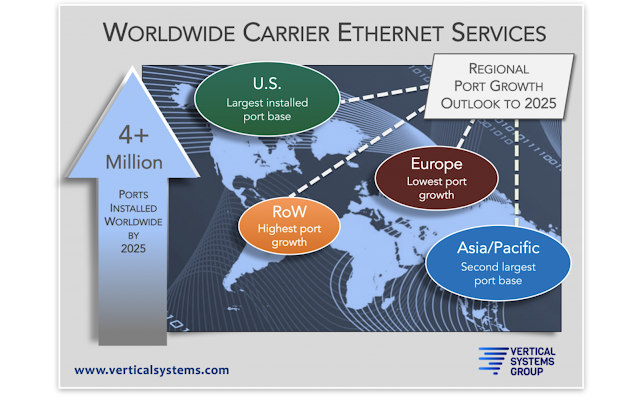
A new research report from Vertical Systems Group finds that demand for Ethernet services is recovering as customers focus on network transformations to accommodate future bandwidth and application requirements. Installations of retail Ethernet services are projected to reach more than four million ports worldwide by 2025. 

However, the outlook for revenue growth during this time period is restrained by price compression, delayed customer payments, and supply chain issues. 

Currently, the primary challenges to Ethernet growth are market maturity and competition from alternative technologies. The most potentially disruptive alternatives are Managed SD-WAN solutions, Wavelength services, and dark fiber.

https://www.verticalsystems.com/2021/10/27/ethernet-blog2021/

Thursday, October 28, 2021

Orange and Liquid enter network partnership for Africa

Orange and Liquid Intelligent Technologies formed a partnership to leverage each other's existing networks in Africa.

This partnership will give Liquid access to Orange’s extensive network in West Africa, including the new Djoliba network, which is operated and maintained from Dakar, Senegal. Djoliba boasts more than 10,000km of terrestrial fiber, coupled with 10,000km of undersea cables. The network covers 16 points of presence with a grid of nearly 155 technical sites and offers connections with Europe, America and Asia. It is based on Orange's Tier 1 network and therefore provides a seamless connection to the Group's international networks.

Likewise, the deal will give Orange access to Liquid’s pan-African network, which encompasses 100,000km of fiber backbone and covers most of sub-Saharan Africa. The network development plans include extending the organization's reach into the North African countries like Morocco, Libya, Tunisia, and Algeria.


"We are excited about embarking on this partnership with Orange, becoming a major customer on Djoliba as we continue to grow our existing relationship. We've long been committed to providing digital services that allow our customers to grow their businesses and the larger African economy. Partnering with a provider like Orange strengthens this offering. Our customers are the real winners in this partnership. Not only do they get access to the networks, but also the benefit of working with two carriers with proven track records of building African business and digital technology," said David Eurin, Liquid Intelligent Technologies international wholesale CEO (Liquid Sea).

“I am very happy to announce this important partnership with Liquid Intelligent Technologies which will enable Orange to expand its broad portfolio of convergent solutions across Africa. It further demonstrates Orange’s commitment across Africa to deliver highly reliable connectivity to its customers. Furthermore, this partnership also clearly illustrates Orange's unique expertise in cybersecurity and our crucial role in building a safer digital society,” said Emmanuel Rochas, CEO of Orange International Carriers.

Intel demos Xeon + Tofino switch + Mount Evans IPU

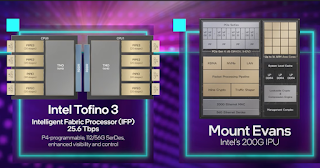
As part of the Intel Innovation event this week, Intel demonstrated an Intelligent Fabric based on its Xeon Scalable processors and next-generation Xeon D processors, Tofino 3 programmable switching silicon and new "Mount Evans" infrastructure processing unit (IPU). 

The idea is to leverage P4 programming across all 3 processing platforms for use cases such as near real-time telemetry and analytics with the Intel Deep Insight Network Analytics software.

The Intel Tofino 3 intelligent fabric processor is fully P4-programmable and is supported by a suite of development and network-monitoring tools, including Intel P4 Studio and Intel Deep Insight Network Analytics Software, which provides increased visibility and control, simplifies integration of container-based micro-services, and paves the way to more secure and self-healing cloud fabric.

https://youtu.be/npzwZ9St1Z8

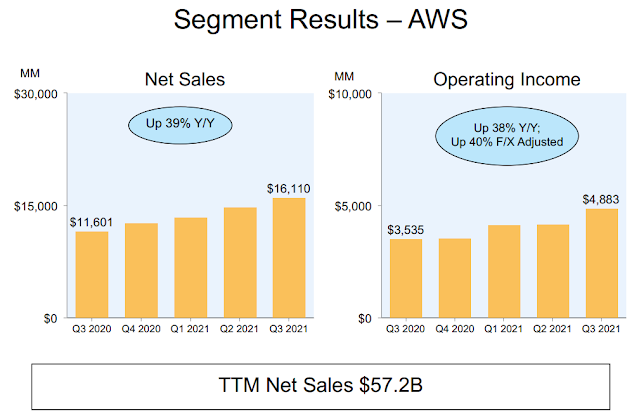
AWS hits quarterly revenue of $16 billion, up 39% yoy

AWS highlighted significant customer momentum with new wins with NXP, Capgemini Engineering, CARIAD, and Continental, Wyndham Hotels & Resorts, Boingo Wireless, Arctic Wolf Networks.

AWS announced plans to open an infrastructure Region in New Zealand in 2024 that will consist of three Availability Zones. A newly released AWS economic impact study estimates that the new infrastructure Region will create 1,000 new jobs in New Zealand over the next 15 years through the investment of $5.3 billion (NZ$7.5 billion). 

Globally, AWS has 81 Availability Zones across 25 geographic Regions, with plans to launch 24 more Availability Zones and eight more AWS Regions.

https://ir.aboutamazon.com/overview/default.aspx

DustPhotonics raises $33M for its silicon photonics

DustPhotonics, a start-up based in Modi'in, Israel, announced $33 million in venture funding for its silicon photonics solutions for cloud, data center, enterprise and HPC applications. The company's InP Laser to Silicon Photonics integration technology will provide significant value differentiation enabling superior performance to support 800 Gbps, 1.6Tbps, CPO and future products.

The funding round was led by Greenfield Partners, who join DustPhotonics' Round B investors Intel Capital, veteran entrepreneur Avigdor Willenz, and others.

In addition, the company also announced it has completed an organizational realignment to support its strategic and business direction. The company will focus its resources on silicon photonics solutions and phase out its transceivers product line. 

As part of the reorganization, Ronnen Lovinger, president of DustPhotonics, has assumed the role of CEO. Ben Rubovitch, the company's previous CEO, has stepped down and will lead the business side of the company.

"This latest investment and the organizational changes will enable us to take advantage of new business opportunities and to continue focusing on serving our customers' strategic requirements. Our disruptive silicon photonics technology addresses their key and most challenging problems, creating scalable, cost-effective silicon photonics and driving it as the mainstream solution for the Cloud and Telecom markets," said Ronnen Lovinger, CEO of DustPhotonics. "We are thrilled at the continued confidence of our investors in our strategic direction."

"With the rapid evolution of the connectivity and silicon optics markets, there is a growing need for innovative technologies. DustPhotonics is well-positioned at the forefront of silicon photonics technology development and we are excited to take part in their journey," said Yuda Doron, Managing Partner at Greenfield Partners.

http://www.dustphotonics.com 


Nokia posts 2% rise in Q3 sales, cites supply chain constraints

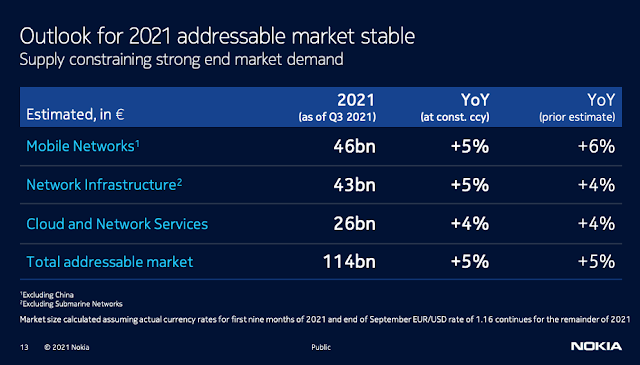
Nokia reported Q3 revenue of EUR 5.399 billion, up 2% over EUR 5.294 billion in sales for the same period last year. Sales were contrained by expected supply chain and Mobile Networks North America headwinds. Comparable diluted EPS of EUR 0.08; reported diluted EPS of EUR 0.06.


Pekka Lundmark, President and CEO of Nokia, states: "We delivered another great quarter driven by our increased investments in technology leadership and strong market demand. The highlight of the quarter was the launch of our next generation FP5 IP routing silicon – delivering up to three times more capacity while reducing power consumption by up to 75% per bit compared to previous generation. This will help reduce the carbon footprint of both Nokia and our customers, while also helping customers to manage their operating expenses."


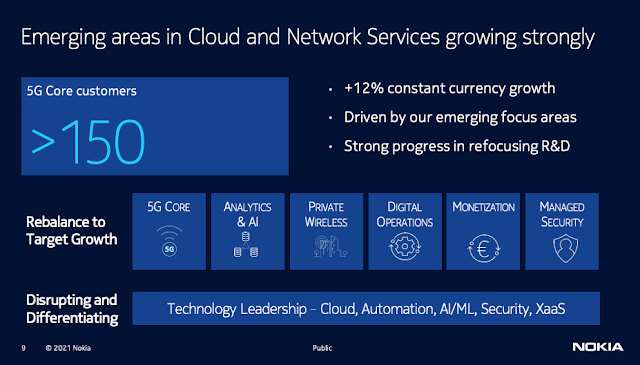
"The third quarter saw us achieve 2% constant currency net sales growth despite the impact of earlier communicated headwinds in North America for Mobile Networks and global supply chain constraints. These headwinds were offset by strong growth in Network Infrastructure against a tough year-on-year comparison and by Cloud and Network Services achieving double-digit growth. Our comparable operating margin for the quarter was 11.7%, which is a further testament to the accountability and financial discipline that our new operating model is driving through the organization.

"We now have over 380 private wireless customers and the business continues to grow strongly. We are further increasing our investment to ensure we maintain the lead we have built with the industry’s most complete offering.

"Overall, I am pleased with our strong financial performance in 2021 so far. We continue to expect seasonality to be less pronounced this year than previously and are reiterating our full year 2021 outlook. Considering our continued strength, we now expect to be towards the upper-end of our comparable operating margin range. As we look ahead, we believe we are well positioned to capitalize on strong demand in our end markets through strengthened technology leadership and improved cost competitiveness. However, the uncertainty around the global semiconductor market limits our visibility into Q4 and 2022. We are working closely not only with our suppliers to ensure component availability but also with our customers to ensure we can meet their needs and mitigate the unprecedented component cost inflation our industry faces. Coupled with the one-offs we’ve benefited from this year, this may limit our margin expansion potential in 2022."

https://www.nokia.com/about-us/investors/

Skorpios presents its Co-packaged Optics at ACP2021 in Shanghai

Skorpios Technologies presented its Tru-SiPh platform for integrating lasers, modulators, and other components on a polarization-insensitive silicon photonics platform at the ACP2021 Conference in Shanghai, China. 

Skorpios' highly integrated photonic chip will provide 3.2 Tb/s FR4 optical interfaces and is small enough that 16 can be placed around an Integrated Circuit to provide 51.2 Tb/s as a chip-scale interface for the next generation of high bandwidth switches.

Skorpios' Silicon Photonics platform integrates lasers, electro-absorption modulators (EAM), semiconductor optical amplifiers (S)A) and photodiodes (PD) in III-V compounds directly into silicon-based wafers. Electronics and optics can then be integrated, burned in, and tested at wafer scale. Laser materials are bonded directly to the silicon substrate vastly improving heat management and minimizing size of the laser. Since all laser stripe processing happens after bonding, multiple devices can be implemented on each implanted epitaxial layer, and laser power into the waveguide is optimized. Similarly, EAMs are built from other implanted epitaxies, reducing size and control complexity of the modulator.

The thick silicon platform Skorpios uses offers several advantages: Low waveguide loss, low coupling loss, polarization insensitivity, and high optical power handling. Multiplexing (Mux) and demultiplexing (DeMux)functions do not require tuning. The entire platform is covered in silicon dioxide after fabrication meaning that III-V devices and facets are environmentally protected, eliminating the need for hermetic packaging.

"It was exciting to present our 3.2Tb/s CPO design at this conference. With our design, we can integrate all devices on a single small chip, including 16 lasers (plus 16 redundant), 32 EAMs, 32 SOAs, 32 PDs, and 8 tuning-free wavelength Mux and DeMux, to provide eight standard 400Gb/s FR4 links," said Glenn Li, Skorpios' CTO. "This product is an outstanding demonstration of highly integrated heterogeneous silicon photonics possible with our platform."

http://www.skorpiosinc.com

Comcast adds 300K broadband subs as growth rate slows

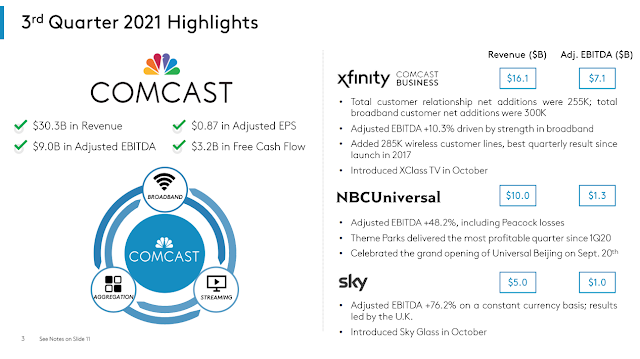
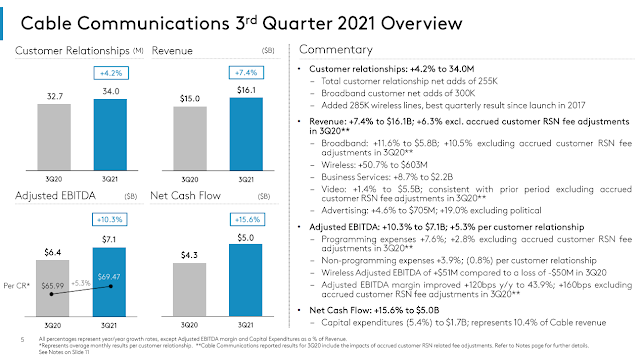
Comcast reported Q3 revenue of $30.298 billion and earnings per share of $0.86. Cable Communications increased 7.4% to $16.1 billion in the third quarter of 2021, driven by increases in broadband, wireless, business services, video, other, and advertising revenue, partially offset by a decrease in voice revenue.

Some highlights:

  • Cable Communications total customer relationship net additions were 255,000 
  • Total broadband customer net additions were 300,000
  • Cable Communications Wireless Customer line net additions were 285,000
  • Capital expenditures for cable communications decreased 5.4% to $1.7 billion in the third quarter of 2021, primarily reflecting decreased investment in customer premise equipment, partially offset by increased investment in line extensions and scalable infrastructure. 


"I am pleased with our strong operating and financial results this quarter. Each of our businesses posted significant growth in Adjusted EBITDA, contributing to a double-digit increase in our Adjusted EPS. At Cable, our customer and financial metrics remained strong, highlighted by 10% growth in Adjusted EBITDA, the highest level of customer retention on record for a third quarter, and the most wireless net additions since the launch of Xfinity Mobile in 2017. Our results at NBCUniversal continue to be driven by the ongoing recovery at our domestic Theme Parks, as well as the success of our linear and streaming Media platforms. At Sky, our UK business maintained its momentum, delivering healthy growth in revenue, EBITDA, and customer relationships. Going forward, I am excited about the opportunity to continue to invest in our global technology platform and other businesses while returning more capital to shareholders. This strategy is reflected in our most recent product launches – XClass TV in the U.S. and Sky Glass in Europe – as well as the $2.7 billion we returned to shareholders through a combination of share repurchases and dividend payments," commented Brian L. Roberts, Chairman and Chief Executive Officer of Comcast Corporation.

https://www.cmcsa.com/news-releases/news-release-details/comcast-reports-3rd-quarter-2021-results

AT&T brings private 5G to GE Research Campus

 GE Research has added AT&T 5G to its cross-industry 5G testbed at its research facility in Niskayuna, New York.

AT&T currently provides 2 flavors of 5G to GE's testbed: AT&T 5G, using low-band or sub-6 spectrum; and AT&T 5G+ via mmWave spectrum.

"The power of reliable, robust sub-6 and 5G+ networks will transform healthcare by bringing care more directly to the patient," said Eric Tucker, senior director of technical products, GE. "We're already seeing how doctors have become more connected to their patients through the power of telemedicine or teleconsulting. Just imagine what will be possible when millions of medical devices and diagnostics tools can be reliably connected to help doctors deliver faster, more effective patient care."

Tucker added, "Today, when you don't feel well, you call the doctor and schedule an appointment so that the doctor can examine you and figure out what's wrong.  Depending on schedules, it may take several hours or even days before you get into the doctor's office. But with the development of wearable sensors and other medical monitoring devices that GE and others are innovating, a future scenario could well be that the doctor calls the patient to tell them something is wrong first. This is possible in a very limited way today. The power of 5G networks could make it pervasive."


"A critical focus for the GE 5G testbed is democratizing technology and building solutions that work in the real-world setting," said SM Hasan, 5G Mission Leader, GE Research. "Having both flavors of 5G enables us to build solutions that span both high speeds, in building networks and the over-the-air 5G network available to AT&T customers."

http://www.business.att.com/learn/5G

A10 Networks hits Q3 sales of $65.4 million, up 15% year-over-year

A10 Networks reported Q3 revenue of $65.4 million, up 15% year-over-year. GAAP gross margin was 79.8%; non-GAAP gross margin of 80.4% as the company successfully navigated short-term input cost pressures. GAAP net income of $74.9 million (114.6% of revenue), or $0.94 per diluted share, inclusive of a non-recurring tax benefit, compared with net income of $6.5 million, or $0.08 per diluted share in the third quarter of 2020.

Sales of security products grew 18% year-over-year.

"We achieved strong top- and bottom-line results as our security-led solutions are enabling us to capture market share and driving accelerated growth,” said Dhrupad Trivedi, President and Chief Executive Officer of A10 Networks. “Long-term deferred revenue has grown 16% year-over-year, outpacing total revenue growth. Our diversified model is enabling us to successfully navigate regional and logistical challenges, as evidenced by our 15% revenue growth and nearly 26% adjusted EBITDA margin validating the business model transformation. The increasing profitability of our business required us to release our full tax valuation allowance, as we now expect to utilize our entire net operating loss carryforwards in future periods. Our business model positions us to meaningfully drive growth and continue to improve the business model. In addition, the strong, sustainable free cash flow has enabled our Board to return capital to stockholders by declaring a quarterly cash dividend and significantly expanding our share repurchase program.”

“With a transformed portfolio focused on cybersecurity, improving market conditions and our relentless focus on execution, we are outperforming the industry as well as the expectations we set at the start of the year,” continued Trivedi. “We have solid visibility and confidence in our ability to accelerate growth beyond the previous targets of 6-8%, though we are cognizant of continued supply chain challenges and other global headwinds which could impact quarter-to-quarter performance.”

Wednesday, October 27, 2021

Google collaborates on Intel's ASIC-based infrastructure processor

Intel and Google Cloud announced a deep collaboration to develop an ASIC P4-programmable infrastructure processing unit (IPU).

Code-named “Mount Evans,” this open solution supports open source standards, including an infrastructure programmer development kit (IPDK) to simplify developer access to the technology in Google Cloud data centers. 

Machine learning, large-scale data processing and analytics, media processing, and high-performance computing are all workloads that can benefit from the IPU. Another key design ambition is to separate infrastructure management functions from client workloads, thereby ensuring true bare-metal performance. Google and Intel also agreed to collaborate on open standards for transport and on P4 for programmable packet processing.

Intel said its goal is to enable developers to create an end-to-end programmable network based on Intel Xeon Scalable processors and next-generation Intel Xeon D processors, IPUs, and its new, P4-programmable Intel Tofino intelligent fabric processor (IFP) switch.

AT&T, supported by an established ecosystem of solution providers, will use Intel as a silicon provider for deployment of its forthcoming virtualized radio access network (vRAN), giving it the flexibility to bring automation and cloud-like capabilities into its network, along with optimizations for performance, cost and operational efficiency.

An archived webcast of the Intel Innovation 2021 event is posted.

Discussion of the IPU between Intel CEO Pat Gelsinger and Google Fellow Amin Vahdat begins around 1:37:00 


https://www.intel.com/content/www/us/en/newsroom/news/innovation-event-livestream-replay.html#gs.essztu

Intel rolls FPGA-based Infrastructure Processing Unit (IPU)

Intel outlined its vision for the infrastructure processing unit (IPU), a programmable network device that intelligently manages system-level infrastructure resources by securely accelerating those functions in a data center.

In a video, Guido Appenzeller, chief technology officer with Intel's Data Platforms Group says the idea is to cleanly separate the processing of client workloads from workloads of the cloud service provider.

Intel cites several advantages for an IPU architecture. First, cloud service providers will be able to process their workloads very efficiently on silicon designed for the tasks. The cloud service provider will be able to rent out 100% of available CPU resources to the clients. The clients are now able to fully control the CPUs including with their own hypervisors. In addition, local disk storage can be enhanced or replaced with virtual storage connected to the network. 

The first instances of Intel's FPGA-based IPU platforms are already shipping. Intel will be rolling out additional FPGA-based IPUs and integrated ASICs as well. "As a result of Intel’s collaboration with a majority of hyperscalers, Intel is already the volume leader in the IPU market with our Xeon-D, FPGA and Ethernet components,” said Patty Kummrow, vice president in the Data Platforms Group and general manager of Ethernet Products Group at Intel. “The first of Intel’s FPGA-based IPU platforms are deployed at multiple cloud service providers and our first ASIC IPU is under test.”

https://youtu.be/ahChxDyl8t4

https://www.intel.com/content/www/us/en/newsroom/news/infrastructure-processing-unit-data-center.html

12th Gen Intel Core brings DDR5, PCIe 5.0, Wi-Fi 6E, Thunderbolt 4

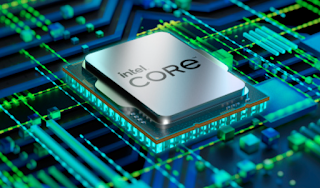
Intel launched the first products in the 12th Gen Intel Core family, boasting faster processing and the latest connectivity standards.  The family includes six new unlocked desktop processors offering a max turbo boost of up to 5.2 GHz and as many as 16 cores and 24 threads. 

The full 12th Gen Intel Core family will include 60 processors, set to power more than 500 designs from a broad set of partners. The 12th gen chips are the first built on Intel 7 process.

“The performance hybrid architecture of 12th Gen Intel Core processors is an architectural shift made possible by close co-engineering of software and hardware that will deliver new levels of leadership performance for generations,” said Gregory Bryant, executive vice president and general manager of the Client Computing Group at Intel. “This begins with the arrival of our flagship Core i9-12900K – the world’s best gaming processor – and you will see even more incredible experiences as we ship the rest of the 12th Gen family and beyond.”

Key platform advancements include:

  • The first processors in the industry to offer DDR5 memory for up to 4800MT/s.
  • The first processors in the industry to offer PCIe 5.0 (up to 16 lanes), which offers up to 2X I/O throughput over PCIe 4.0, with up to an additional four lanes of PCIe 4.0 support.
  • Up to 30MB Intel Smart Cache (L3) and 14MB L2 cache for increased memory capacity with reduced latency.
  • Integrated high-speed wireless with Intel Killer Wi-Fi 6E, which combines industry-leading Wi-Fi 6E connectivity with powerful gaming network technology to minimize lag, latency, and packet loss.
  • Discrete Thunderbolt 4 universal cable connectivity for external device expansion.

Ciena and Samsung partner on mobile solutions

Samsung Electronics will offer Ciena’s xHaul solutions with its own 5G solutions to support 5G networks.

The companies agreed to collaborate on hardware and software solutions to telecom operators.  The arrangement combines Samsung’s 5G RAN and Core, including vRAN solutions, baseband units and radios, with Ciena’s xHaul Routing and Switching portfolio and next-generation Manage, Control and Plan (MCP) domain controller.


“As 5G proliferates, immersive services like AR/VR and HD video streaming are becoming the center of our daily mobile lives. In order to deliver more powerful 5G services, the current network architecture needs to evolve,” said Wonil Roh, Senior Vice President and Head of Product Strategy, Networks Business at Samsung Electronics. “Samsung’s ability to couple our best-in-class 5G solutions with a leader in transport technologies like Ciena will give customers a solution to address this need, and do so with the confidence to scale and evolve their networks to support the future of 5G.”

“Together with Samsung, we’re fueling the next generation of mobile connectivity to unleash the full potential of 5G,” said Matt Cook, Vice President, Global Partner Organization, Ciena. “As both companies are leading innovators in our respective spaces with strong customer bases for these portfolios, this powerful collaboration leverages our collective leadership to create best-in-breed 5G networks that are open, scalable and adaptive.”


CyrusOne says data center leasing remains strong

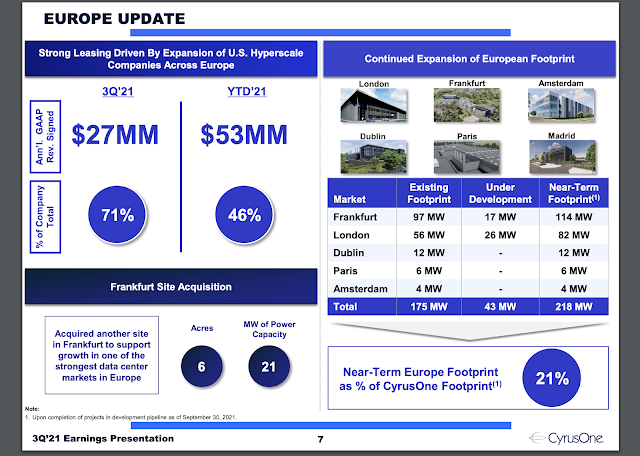
CyrusOne reported Q3 2021 revenue of $304.1 million, up 16% compared to a year earlier.  The increase in revenue was driven primarily by a 13% increase in occupied CSF and higher metered power reimbursements.

Net income was $6.7 million for the third quarter, compared to net loss of $(37.3) million in the same period in 2020. Net income for the third quarter included a $14.4 million gain associated with a change in fair value on the undesignated portion of the Company’s net investment hedge compared to a $(22.9) million loss in the third quarter of 2020. 

“We had strong financial results and another good bookings quarter, including a significant contribution from our European markets and healthy pricing across the leases,” said David Ferdman, interim president and chief executive officer of CyrusOne. “The demand environment remains strong, we continue to have productive discussions with our customers, and we are well positioned with capacity across the portfolio and more than $2 billion of available liquidity to support our growth.”

Some highlights:

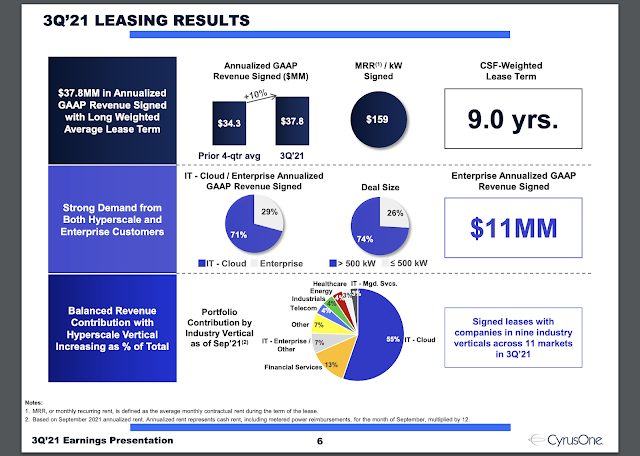
  • CyrusOne leased approximately 20 MW of power and 100,000 CSF in the third quarter, representing approximately $3.2 million in monthly recurring rent, inclusive of the monthly impact of installation charges. 
  • The leasing for the quarter represents approximately $37.8 million in annualized GAAP revenue, excluding estimates for pass-through power. 
  • The weighted average lease term of the new leases, based on square footage, is 108 months (9.0 years), and the weighted average remaining lease term of CyrusOne’s portfolio is 51 months (taking into consideration the impact of the backlog). 
  • Recurring rent churn percentage for the third quarter was 0.5%, compared to 0.6% for the same period in 2020.
  • In the third quarter, the Company completed construction on 161,000 CSF and 38 MW of power capacity across Phoenix, Northern Virginia, the New York Metro area, Cincinnati, Paris and Frankfurt. 
  • Percentage CSF leased as of the end of the third quarter was 86% for stabilized properties and 84% overall. 
  • In addition, the company has development projects underway in London, Frankfurt, Northern Virginia and San Antonio that are expected to add approximately 211,000 CSF and 49 MW of power capacity plus 469,000 square feet of powered shell.


https://investor.cyrusone.com/events/event-details/cyrusone-reports-third-quarter-2021-earnings

MaxLinear reports solid Q3 growth, supply chain constraints

MaxLinear posted Q3 2021 revenue of $229.8 million, up 12% sequentially and up 47% year-over-year. GAAP gross margin was 56.5%, compared to 54.8% in the prior quarter, and 42.3% in the year-ago quarter.

Non-GAAP diluted earnings per share was $0.75, compared to diluted earnings per share of $0.53 in the prior quarter, and diluted earnings per share of $0.32 in the year-ago quarter.


“In the third quarter, revenue was up 12% sequentially and up 47% year-over-year, driven by growth across our broadband, connectivity and industrial and multi-market markets. Solid demand for our broadband access and connectivity and high-performance analog products was due to a combination of end-market strength and company-specific drivers, including platform-level silicon content increases and market share gains. Non-GAAP gross margin for Q3 of 61.3% is ahead of our original plan, as product mix shift towards higher value products continues to accelerate across broadband, connectivity, infrastructure, and high-performance analog end markets. We remain focused on improving the supply chain constraints to meet the strong and growing market demand for our connectivity, broadband, and infrastructure products in the short and long term,” commented Kishore Seendripu, Ph.D., Chairman and CEO.

https://www.maxlinear.com/

Renesas acquires Celeno for Wi-Fi 6 & 6E silicon

Renesas Electronics agreed to acquire Celeno Communications, a start-up providing Wi-Fi solutions, for approximately US$315 million (approximately 35.9 billion yen at an exchange rate of 114 yen to the dollar) in cash. 

Celeno, which is headquartered in Israel, offers advanced Wi-Fi chipsets and software solutions, for high-performance home networks, smart buildings, enterprise and industrial markets. Its compact chipset offerings for Wi-Fi 6 and 6E deliver exceptional Wi-Fi network performance and increased security with low latency and low power consumption. Celeno’s breakthrough Wi-Fi Doppler Imaging technology, a Wi-Fi based, high-resolution imaging technology, is ideal for home elderly care and assisted living, home security, safe driving and digital and connected factories. It depicts, tracks and analyzes the motion, behavior and location of people and objects using standard Wi-Fi, eliminating the need for multiple cameras or sensors in home environments and commercial buildings.

As the world’s No.1 embedded processor supplier, Renesas offers a breadth of low-power MCU/MPU/SoC processors, wireless ICs, sensors and power management technologies. Celeno’s field-proven Wi-Fi and software capabilities are highly complementary to Renesas. The combination creates comprehensive, end-to-end embedded solutions for addressing the fast-growing markets for low-power connectivity in IoT, infrastructure, industrial and automotive applications.

“The transaction announced today underscores our continuous commitment to improve performance and efficiency in electronic systems,” said Hidetoshi Shibata, President and CEO of Renesas. “Building on our recently-expanded connectivity portfolio following the Dialog acquisition, the addition of Celeno provides us with more advanced Wi-Fi connectivity capabilities to deliver end-to-end connectivity solutions for both clients and access points. Renesas is now strongly positioned to capitalize on the growing opportunities from the massive rise in connectivity and requirements created by today’s increasingly connected world.”

“This is a compelling transaction for both our customers and employees. Our depth and strength in connectivity combined with Renesas’ industry leading portfolio of embedded solutions will allow us, together, to open up new growth areas we can target,” said Gilad Rozen, President and CEO of Celeno. “Renesas will also provide us with the go-to-market capabilities to bring Celeno to a broader range of customers.”

Verizon Business adds Fortinet to its SD-WAN portfolio

Verizon Business has added Fortinet Secure SD WAN to its global SD WAN offering.

“The quick transition to hybrid and/or remote working models opened new avenues for cyber threat actors,” said Sampath Sowmyanarayan, Chief Revenue Officer for Verizon Business. “Solutions like Verizon’s Software Defined Secure Branch with Fortinet add those layers of security that help safeguard your employees, your business and ultimately your customers against cyberattacks.”

 Fortinet Secure SD WAN, which integrates SD WAN, firewall, and advanced routing, works with many types of network transports including MPLS, broadband, and wireless.

“Fortinet is committed to supporting our partners and customers with innovative Secure SD WAN technology based on a security-driven networking approach that tightly integrates an organization’s network infrastructure and security architecture,” said John Maddison, EVP of products and CMO at Fortinet. “By leveraging Fortinet Secure SD WAN, Verizon enables organizations to take a ‘work from anywhere’ approach to their network and security to support remote and hybrid workforces.”