Monday, April 3, 2023

NTT suffers optical network outage

NTT East and NTT West suffered a rare network outage on Monday, 03-April-2023, beginning at 07:10am and impacting optical lines in Tokyo and several prefectures.

The outage hit as many as 359,000 internet lines and 186,000 landline telephone services. Service restoration took between 90 minutes to more than 2 hours.

The cause of the outage is under investigation. NTT Docomo and SoftBank Corp. also reported service disruptions on Monday due to the optical line problem.


Midjourney runs its text-to-image AI on Google Cloud

Midjourney, the independent research lab that provides amazing text-to-image generative AI, has selected Google Cloud as its infrastructure provider of choice for training its large-scale AI models.

As part of the partnership, Midjourney has employed Google Cloud's custom-developed AI accelerators, Tensor Processor Units (TPUs), to train its fourth generation AI model. In combination with Google Cloud's GPU VMs, which run on NVIDIA GPUs, Midjourney can render the generated images on the platform with breathtaking speed.

"We're proud to provide incredible tools for our creative community using Google's global and scalable infrastructure," said David Holz, founder and CEO of Midjourney. "From training the latest versions of our algorithms on the v4 TPUs with JAX, to running inference on huge clusters of GPUs, we have been happy working with Google as a partner."

"As AI opens the door for innovation across industries, companies like Midjourney are choosing Google Cloud to take advantage of our open, flexible, and performant infrastructure, which runs with incredible scale and efficiency," said Amin Vahdat, VP/GM Systems and Services Infrastructure, Google Cloud. "We are excited to see the Midjourney community create impressive imagery thanks to our industry-leading offerings."

https://midjourney.com

https://www.googlecloudpresscorner.com/2023-03-14-Midjourney-Selects-Google-Cloud-to-Power-AI-Generated-Creative-Platform

EdgeCore Digital expands data center presence in northern Virginia

EdgeCore Digital Infrastructure, a wholesale data center operator that was recently acquired by  Partners Group, unveiled plans to develop a new data center campus on 7.6 acres centrally located in the heart of data center alley in northern Virginia. The project will be co-developed with Penzance, a Washington, D.C. based real estate developer.  The site supports customers seeking high-performance capacity with low-latency access to leading cloud hubs and supporting network access across Northern Virginia.  

This newly acquired parcel is planned to accommodate a 285,000 square foot, three-story data center, capable of supporting 36 MW of critical load. The site plan approval process is expected to be completed by the end of 2023. A dozen local and national long-haul fiber providers are located adjacent to the site, making EdgeCore’s newest data center location in Northern Virginia an attractive option for leading cloud and internet companies.

EdgeCore’s existing site in Northern Virginia, comprised of348,000 square feet and capable of supporting 54 MW of critical load, is located just two miles from this newly acquired land. Combined, both EdgeCore data center sites provide 633,000 square feet of space and 90 MW of critical load to customers seeking space in the world’s most vital data center market.

“With the acquisition of additional land in Northern Virginia, EdgeCore adds another key data center location to our portfolio and continues to advance our focus on rapid growth and development in key datacenter markets,” said Lee Kestler, CEO, EdgeCore. “We are pleased to have partnered with Penzance on this project and are grateful for the acceleration they are bringing to the process through their deep regional expertise and connections.”

https://www.edgecore.com/blog

PacketFabric and Unitas Global complete merger - NaaS

PacketFabric and Unitas Global completed their previously-announced merger. 

PacketFabric helps businesses build new secure, private network fabrics to connect their core sites, cloud assets and manage shifts in data gravity with their unique fabric integrated storage. PacketFabric Converge orchestrates on-demand connectivity across colocation facilities, cloud providers, and private network interconnection across the globe.

Unitas Global offers intelligent automation for business internet connectivity, providing end-to-end network design, pricing, ordering and visibility across more than one thousand first/middle/last mile networks, accessing more than 50 million fiber lit buildings.

The new PacketFabric said it is focused on being "the premier Network as a Service (NaaS) provider, offering extensive capabilities in both public and private transport for enterprises, global channels and technology partners."

https://packetfabric.com/


Ericsson and Intel partner on 5G use cases in Malaysia

 Ericsson and Intel agreed to collaborate on the development of 5G use cases that can accelerate digitalization in Malaysia as well as spur the adoption of the new technology by enterprises in Malaysia.

David Hägerbro, Head of Ericsson Malaysia, Sri Lanka and Bangladesh, says: “5G is a platform for innovation and will transform the way enterprises operate. Ericsson’s collaboration with Intel in Malaysia will contribute to the adoption of 5G and development of the local ecosystem that will in turn drive Malaysia’s digital transformation.”

AK Chong, Managing Director of Intel Malaysia, says: “With the increasing digitalization of our society and economy, 5G is becoming a fundamental component to drive innovation across all business segments. This collaboration demonstrates how the Malaysian 5G infrastructure with innovative edge services – powered by Ericsson and Intel technologies – enables local enterprises to transform and accelerate their businesses through digital solutions.”

Australia's NBN Co expands fixed wireless access

Around 24,000 homes and businesses across regional Australia are now eligible to access the nbn® fixed wireless network for the first time. The locations of the 24,000 premises have been selected based on their proximity to existing nbn fixed wireless towers, with priority given to those located in the most heavily used parts of the nbn satellite footprint. 

The upgrade is being enabled by a $750 million investment – including $480 million from the Australian Government and $270 million from nbn.

NBN Co plans to introduced two new wholesale higher speed plans.

Gavin Williams, nbn Chief Development Officer for Regional and Remote, states: “We are in the middle of the next evolution of the nbn fixed wireless network to extend its reach and capability and bring improved service deeper into rural and regional Australia. The nbn fixed wireless network is the digital backbone for many regional Australians. With more people living in regional areas, connectivity has never been more important and that is why we are not just responding to existing demand, but also planning for the future. We expect that by around the end of 2024, the upgrades we are making across the nbn fixed wireless network will enable around 750,000 homes and business to enjoy better broadband, which will allow more people to be online at the same to work, study, and stream with less buffering.” 

Sunday, April 2, 2023

Canada's Rogers + Shaw merger reaches the finish line

After receiving final regulatory approval, Rogers Communications and Shaw Communications now expect to close their historic merger prior to the outside date of April 7, 202.

The deal, which was first announced in March 2021, is trasformative for Canada's communications market and builds on the legacies of JR Shaw and Ted Rogers, two of Canada’s most successful entrepreneurs.

Rogers will pay approximately CAD$26 billion to acquire all of the shares of Shaw. The companies will also divest Shaw's Freedom Mobile to Videotron, a unit of Quebecor, for $2.85 billion.

“We are very pleased to move forward with this transformative merger and proudly deliver on our commitments to enhance and expand network coverage, connect underserved communities, and improve access for low-income Canadians,” said Tony Staffieri, President and CEO, Rogers. “Building on a shared legacy with Shaw, we will invest substantially to bring more choice, more value, and more connectivity to Canadians across the country.”

“Today begins an exciting new chapter for the future of connectivity in Canada,” said Brad Shaw, Executive Chair and CEO, Shaw. “In today’s telecommunications industry, we recognize that companies need even greater scale to compete and make ongoing investments for future technology. This merger will provide the scale necessary for the future success and competitiveness of the wireline business that Shaw has built over the past five decades.” 

Rogers today reaffirmed the company’s merger commitments, including:

  • Investing $1 billion to improve connectivity for rural, remote, and Indigenous communities and unserved remote highways in Western Canada
  • Investing $2.5 billion to expand and upgrade Rogers 5G network for consumers and businesses in Western Canada
  • Investing $3 billion in technology and network services in Western Canada, including modernizing and expanding fibre-powered internet
  • Creating 3,000 new jobs in Western Canada to support the multi-billion-dollar investment in networks, services, and technology
  • Maintaining a Western Canada headquarters in Calgary
  • Expanding our low-cost Connected for Success Internet program to eligible Canadians across Western Canada
  • Introducing a new low-cost Connected for Success wireless program nation-wide for eligible Canadians
  • Honouring a five-year price commitment for Shaw Mobile customers


https://assets.ctfassets.net/tzb4ihmthaev/1DHYe86b2YxhmFtEKbXt4w/d9c3d38e22d8104c9aa749b23277ee82/Shaw_Company_Overview_-_January_2023_FINAL.pdf

Huawei's 2022 revenue holds steady, profits and assets drop

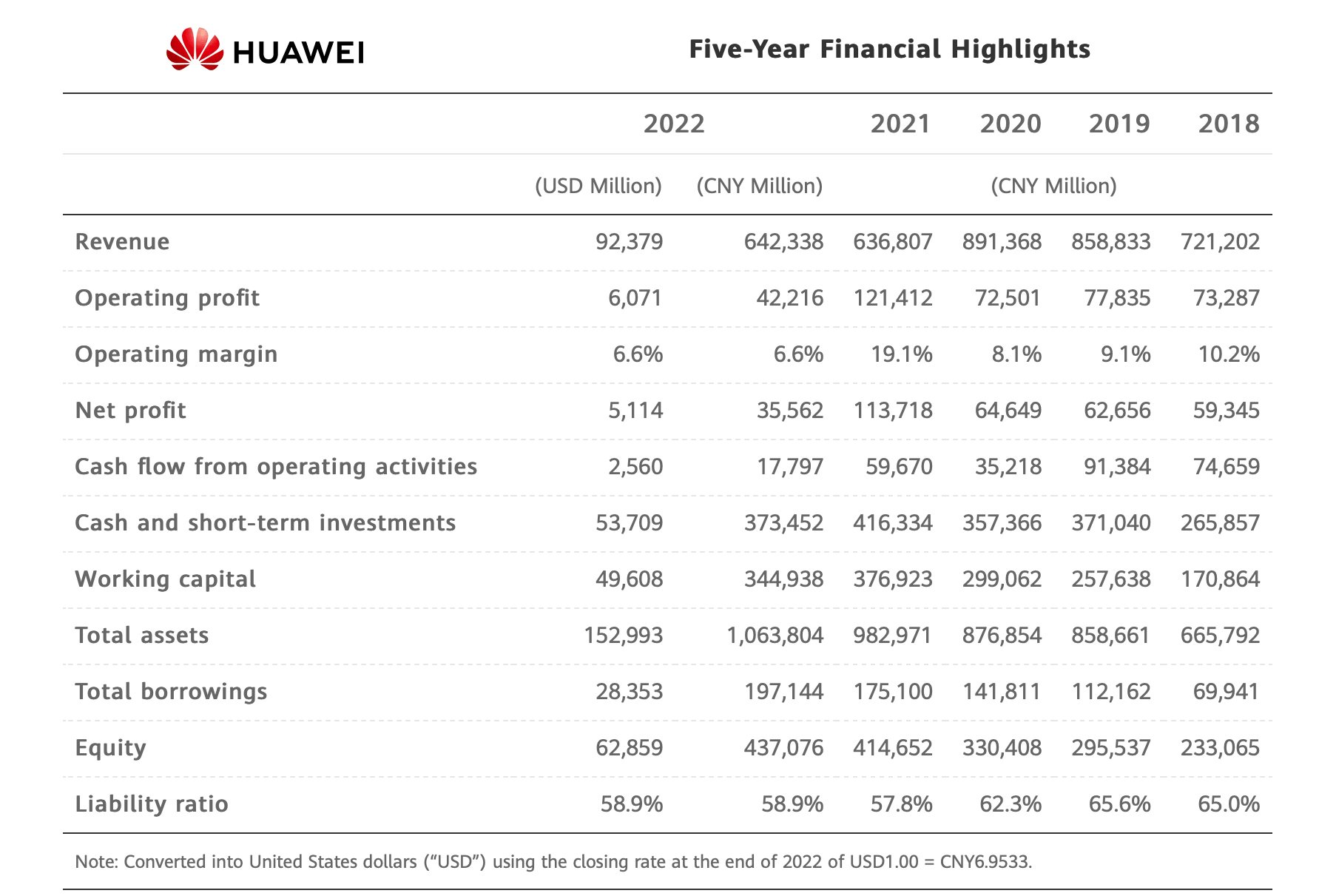
Huawei reported 2022 annual revenue of CNY 642.338 billion (approx US$92.379 billion), a YoY increase of 0.9% and in-line with company forecasts.

The company remained profitable, however the reports shows a significant drop in profits, margins, cash flow, working capital and total assets compared to the past few years.

In the annual report released on Friday, Huawei's Rotating Chairman Xu Zhijun writes:

"Plum blossoms tend to grow sweeter from a harsh winter’s freeze. Today, Huawei is like a plum blossom. While it’s true that we have considerable pressure ahead of us, we have what it takes to come out the other end – with opportunities to grow, a resilient business portfolio, a unique competitive edge, the enduring trust of our customers and partners, and the courage to invest heavily in R&D. We are confident in our ability to rise above any challenge that comes our way, laying a solid foundation for sustainable survival and development."


Additional highlights from Huawei's 176-page annual report:

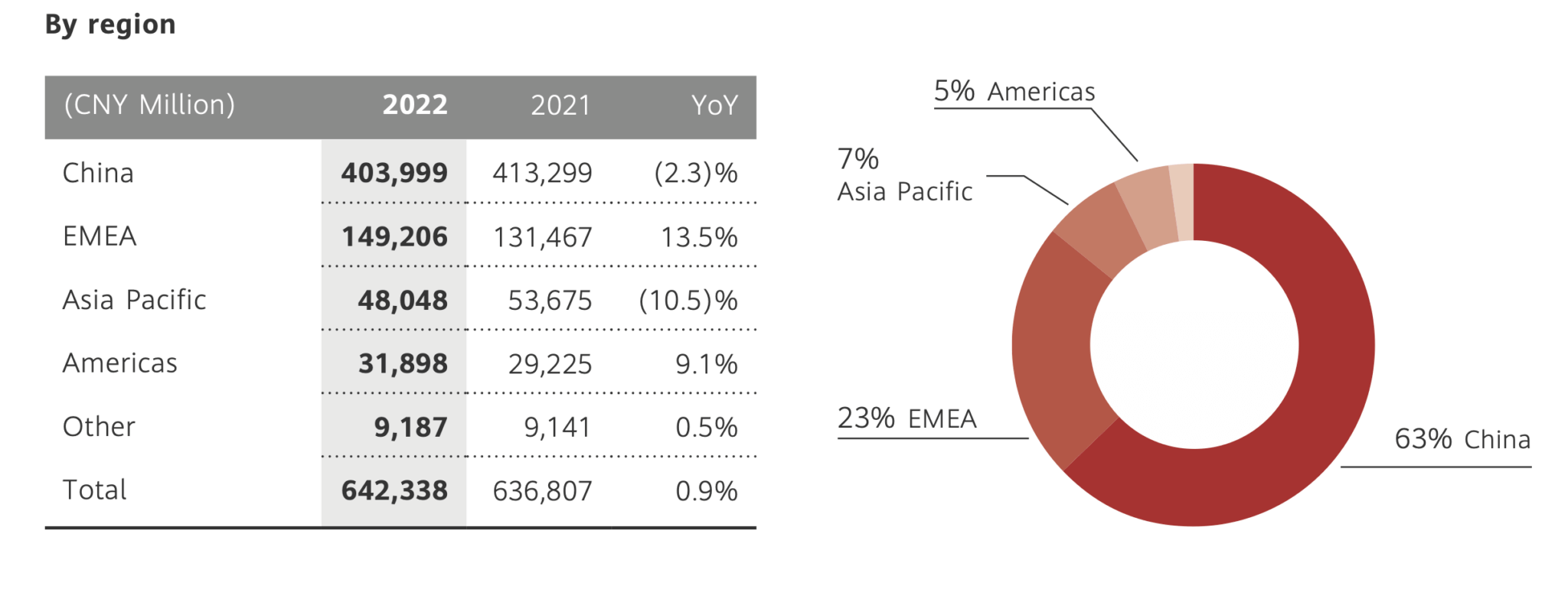
  • Huawei’s revenue from the Chinese market amounted to CNY403,999 million in 2022.
  • In 2022, Huawei's R&D spend was about CNY161.5 billion, about 25.1% of the company’s annual revenue
  • By the end of 2022, Huawei’s 400G solution had been deployed by more than 60 carriers around the world.
  • In China, Huawei helped carriers build more than 30 all-optical cities using the optical cross-connect (OXC) and OTN optical-electrical converged solution, improving user experience on dual-gigabit networks and meeting enterprise customers’ requirements for digital transformation.
  • In China, Huawei used the ultra-broadband ultra-stable converged backbone network architecture to help carriers build the world’s largest end-to-end 400GE IP backbone network, which boasts 99.9999% reliability
  • Huawei's mobile HarmonyOS has already been deployed on 330 million Huawei devices. HarmonyOS 3 was officially launched in 2022, representing a full expansion of the Super Device feature, which is now available on 12 different device types, including smartphones, tablets, PCs, HUAWEI Vision products, earphones, smart watches, and head units.


https://www.huawei.com/en/annual-report/2022

NTT offers Microsoft Sentinel Managed Detection and Response

NTT Ltd. launched a Managed Detection and Response (MDR) security service that combines human and machine expertise with leading technologies and threat intelligence to reduce the mean time to detect and respond to cyber attacks. Using analytics, machine learning, and threat intelligence, the service hunts for suspicious activities and minimizes false positives.

The MDR service is built on Microsoft Sentinel, Microsoft’s leading next-gen security information and event management (SIEM) platform, powered by AI, automation, and threat intelligence. Sentinel enables organizations to collect data at scale across all users, devices, apps, and infrastructure, both on-prem and in multicloud environments.

This latest offering represents another step forward in NTT and Microsoft’s multi-year Strategic Alliance Agreement (SCA) signed in 2020. Since then, the two companies have collaborated to build advanced solutions in public, private and edge cloud, data & AI, digital & app innovation, modern workplace, and now most recently in security.

“Organizations are typically utilizing a patchwork of security technologies that lack alignment,” said Charlie Li, Senior Executive Vice President: Managed Cloud and Infrastructure Services, NTT Ltd. “This disjointed approach has left businesses often unable to detect hard-to-find threats and lacking the necessary agility to mitigate them. Many are simply adding more security layers, increasing complexity, and generating even more logs and alerts that go untreated.”

“NTT’s MDR service helps organizations stay ahead of attackers and has a direct impact on workforce productivity and customer satisfaction through real-time and long-term threat correlation, advanced analytics, and continuous monitoring of digital transactions. It delivers a strong cyber-resilience posture, directly impacting an organization’s operational, financial, and resource resilience,” he added.

https://group.ntt/en/newsrelease/

Kioxia and Western Digital detail next gen 218-layer 3D Flash memory

Kioxia and Western Digital provided an updated on their next generation flash memory technology.

The 218-layer 3D flash leverages 1Tb triple-level-cell (TLC) and quad-level-cell (QLC) with four planes and features innovative lateral shrink technology to increase bit density by over 50 percent. Its high-speed NAND I/O at over 3.2Gb/s, a 60 percent improvement over the previous generation, combined with a 20 percent write performance and read latency improvement, will accelerate overall performance and usability for users.

The advancements are achieved by applying advanced scaling and wafer bonding technologies. 

Kioxia and Western Digital reduced the cost by introducing several unique processes and architectures, enabling continued lateral scaling advancements. This balance between vertical and lateral scaling produces greater capacity in a smaller die with fewer layers at an optimized cost. The companies also developed groundbreaking CBA (CMOS directly Bonded to Array) technology, wherein each CMOS wafer and cell array wafer are manufactured separately in its optimized condition and then bonded together to deliver enhanced bit density and fast NAND I/O speed.

“The new 3D flash memory demonstrates the benefits of our strong partnership with Kioxia and our combined innovation leadership,” said Alper Ilkbahar, Senior Vice President of Technology & Strategy at Western Digital. “By working with one common R&D roadmap and continued investment in R&D, we have been able to productize this fundamental technology ahead of schedule and deliver high-performance, capital-efficient solutions.”

“Through our unique engineering partnership, we have successfully launched the eighth-generation BiCS FLASHTM with the industry's highest1 bit density,” said Masaki Momodomi, Chief Technology Officer at Kioxia Corporation. “I am pleased that Kioxia’s sample shipments for limited customers have started. By applying CBA technology and scaling innovations, we’ve advanced our portfolio of 3D flash memory technologies for use in a range of data-centric applications including smartphones, IoT devices and data centers.”

https://www.westerndigital.com/company/newsroom/press-releases/2023/2023-03-30-kioxia-and-western-digital-announce-newest-3d-flash-memory

Friday, March 31, 2023

CommScope expands fiber production in North Carolina

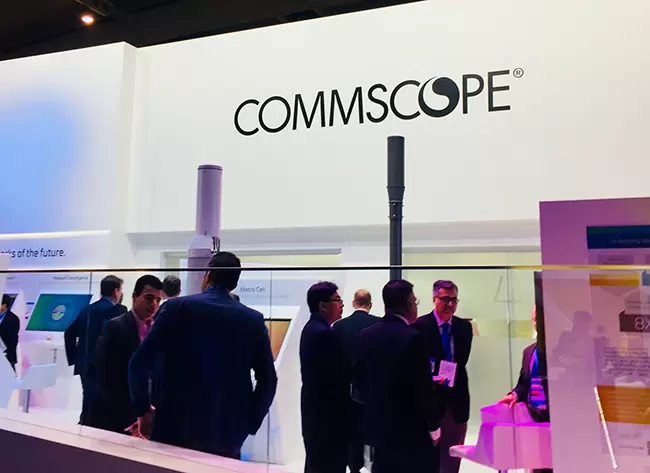
CommScope announced will invest $47 million to expand its fiber optic cable production in North Carolina. 

CommScope plans to expand its two fiber-optic cable production facilities in North Carolina, one in Catawba and the other in Claremont, by adding lines of production for its HeliARC cable line.

HeliARC is a smaller and lighter-weight cable allowing for faster installation and lower cost of deployment. Its reduced size and weight also lowers shipping costs, permitting more product to move in one shipment, thereby making it a more sustainable and environmentally friendly product.

The company said the increased fiber capacity is needed for rural deployments. CommScope’s HeliARC lines are expected to support 500,000 homes per year in fiber-to-the-home (FTTH) deployments. 

“We are in the business of connectivity. We strive to provide superior solutions to our customers who, in turn, provide connectivity for businesses, individuals and communities. This increase in fiber-optic cable production is a great step forward for our ‘Broadband for Everyone’ program, furthering our commitment to serve the fiber optic cable market,” stated Chuck Treadway, President & CEO, CommScope. “We will produce more cost-effective and easier-to-deploy fiber-optic cable, add new jobs and simultaneously strengthen the supply chain in America. This is a trifecta we are thrilled to announce, and we are particularly pleased to share this news today in the company of Secretary Raimondo and Governor Cooper.”


Telecom Egypt appoints a new Managing Director & CEO

Telecom Egypt named Eng. Mohamed Nasr Eldin Mohamed Ali as Managing Director and CEO, replacing Eng. Adel Hamed Ibrahim Gadallah, who will assume a new role at Egypt's Ministry of Communications and Information Technology. However, Eng. Hamed will remain on Telecom Egypt’s board of directors as a non-executive member. 

Eng. Mohamed Nasr Eldin was appointed as a member of Telecom Egypt’s Board of Directors in July 2020, representing the government. He joined Telecom Egypt in 2004, eventually becoming Head of the International Cables and Networks Business Unit in 2014. During that period, Eng. Nasr Eldin undertook several initiatives that contributed to maximizing Telecom Egypt's revenues and capitalized on Egypt’s strategic position as a route for international submarine cables.

“The Board appointed Eng. Mohamed Nasr ElDin as the new Managing Director and CEO given his track record and profound ICT experience, including his previous role as Head of Telecom Egypt’s International Cables and Networks Business Unit in 2014. We are confident he is the ideal candidate to take over the helm and maintain Telecom Egypt’s leadership in various areas at the local and international levels, while continuing to drive quality and sustain customer base growth, maximizing our assets and creating value for all our stakeholders and the society at large. We wish him success in his new role. I would also like to thank former Managing Director and CEO Eng. Adel Hamed for his distinguished efforts and successful leadership of the company despite the many challenges we faced in the previous period. I wish him all the best in his new position and future endeavors.”

https://ir.te.eg/en/CorporateNews/PressRelease/175/Telecom-Egypt-announces-changes-to-board-structure-and-executive-management


Thursday, March 30, 2023

Cisco debuts 36 x 800G line card for its 8000 series routers

Cisco introduced a 36 x 800G line card with a capacity 28.8 Tbps for use in its Cisco 8000 Series Routers. The line card offers double the density of the previous generation, with support for 2x400G-FR4 and 8x100G-FR interfaces.


The high density solution is aimed at IP backbone, metro core, and data centers supporting AI/ML workloads.

The new 28.8Tbps / 36 x 800G line card is powered by Cisco Silicon One P100 chip, which is implemented in 7nm. The silicon design packs 192 x112G SerDes in single chip. It features on-chip SRAM/TCAM memory with high-capacity HBM for buffering and LPM scale. The new chip also brings advanced traffic management, load balancing, instrumentation and telemetry. Cisco is also introducing an IOS XR Path Tracing capability that provides hop-by-hop visibility of the packet’s path through the network.


“We continue to expand 800G to more use cases, from AI/ML fabrics to the core, to help our customers meet their performance and sustainability goals,” said Kevin Wollenweber, Senior Vice President and General Manager, Cisco Networking, Data Center and Provider Connectivity. “With our dense core and spine solutions using new double density line cards with Cisco Silicon One, we have accelerated the transition to 800G anywhere.”

The line card could be populated with Cisco's forthcoming 800G pluggable transceivers. Because it supports industry standards, the line card could also accept third party optics conforming to MSA specs.

https://newsroom.cisco.com/c/r/newsroom/en/us/a/y2023/m03/new-cisco-800g-innovations-help-to-supercharge-the-internet-for-the-future-by-improving-networking-economics-and-sustainability-for-service-providers-and-cloud-providers.html

Cisco boosts its Routed Optical Networking solutions

Cisco is rolling out a number of enhancements to its Routed Optical Networking portfolio with new products and features, including a new Cisco NCS 1010 open optical line system, Bright ZR/ZR+ pluggable optics, and expansion of Cisco Crosswork Automation portfolio.   "Cisco is committed to powering an inclusive future for all, where everyone has access to quality internet, and that requires fundamental changes in networking,” said Bill Gartner,...


Sabrina Meng takes a turn as Chair of Huawei

Sabrina Meng will assume the position of Rotating and Acting Chair of Huawei from April 1, 2023 to September 30, 2023, serving as head the Board of Directors and its Executive Committee.

Meng Wanzhou has held positions including Director of the International Accounting Dept, CFO of Huawei Hong Kong, and President of the Accounting Mgmt Dept. Ms. Meng now serves as Deputy Chairwoman of the Board, and Rotating Chairwoman and CFO of Huawei.

On Friday, March 31, Huawei is expected to announce its 2022 financial results.

https://www.huawei.com/en/news/2023/3/rotating-chair-tenure

  • In September 2021, after nearly 3 years of house arrest in Vancouver, Canada, pending extradition to the United States, Meng reached a settlement with U.S. Department of Justice resolving the case of alleged fraud.
  • Meng is the daughter of Huawei founder Ren Zhengfei.


Windstream completes rip-n-replace of Huawei gear

Windstream confirmed that it has now removed all Huawei equipment from its network.

Windstream’s network included Huawei gear acquired as part of its 2017 purchase of EarthLink. 

The company says the prohibited equipment represented a small fraction of its routing and transportation capability.

As a federal contractor, Windstream implemented a multi-year engineering plan to remove this equipment in 2019, before the FCC made removal mandatory. By fall 2022, all Huawei equipment had been disconnected from Windstream’s network and was no longer operative.

“As an industry leader in network intelligence and infrastructure expansion, Windstream was prepared to quickly and effectively remove the impacted equipment,” said Art Nichols, Windstream’s chief technology officer. “Our multi-pronged approach included using alternate routes, replacing equipment where necessary, and leveraging the company’s winning Fast and Flexible process.”

https://www.windstream.com

Verizon Frontline intros two connectivity nodes for first responders

Verizon Frontline introduced two new portable communications assets for delivering mission-critical communications to first responders when network connections and coverage are impacted by natural disasters or damaged infrastructure.

The first of the two new assets is the compact Verizon Rapid Response Connectivity unit, whichis designed to be deployed by one person in fewer than 15 minutes and is capable of delivering secure and reliable voice and internet service for first responders under austere conditions. The Verizon Rapid Response Connectivity Unit is C-Band-enabled (5G) and features Low Earth Orbit (LEO) and Medium Earth Orbit (MEO) satellite connectivity options, a cloud-managed firewall, a cloud-managed router/switch and 4G LTE network extenders capable of supporting up to 120 active users. This asset is also built on a rugged, all-terrain motorized carriage, includes a gasoline generator with an extra five-gallon fuel tank and functions at nearly any altitude, in nearly any climate.

The second new asset is Verizon Frontline’s Mobile Connectivity Agile Vehicle, a modified electric motorcycle capable of providing first responders with mission-critical communications capabilities when operating in areas that traditional vehicles and larger deployable assets can’t reach.

For example, the Mobile Connectivity Agile Vehicle is able to navigate narrow, hard-to-access trails to provide wildland firefighters deep in a forest with satellite connectivity directly on the front lines. In addition to its satellite capabilities, the Mobile Connectivity Agile Vehicle is also equipped with a cellular network extender and WiFi router to help provide public safety agencies with critical voice and data service during emergency response operations.

https://www.verizon.com/about/news/verizon-frontline-debuts-two-newest-deployable-asset-prototypes

FCC looks to reevaluate licenses of foreign telecom operators

The FCC is considering whether to periodically reassess the operating licenses of foreign-owned companies that provide telecommunications services in the United States. The new rules would require foreign-owned license holders to undergo a periodic review and renewal process, which would involve close consultation with our national security colleagues in the Executive Branch.

 FCC Chairwoman Jessica Rosenworcel said the rules need to be updated to stay ahead of evolving security threats. 

“Across the board, the FCC is taking clear and decisive action to address national security risks in our communications networks,” said Chairwoman Rosenworcel.  “That is why it is so important to have the agency regularly review foreign companies’ authorizations to provide telecommunications services in the United States.  If a provider poses a threat that cannot be mitigated, we will take the steps necessary to remove their access to our networks.”

In the last few years, the FCC has revoked the Section 214 operating authorities of four Chinese state-owned carriers based on recommendations from national security agencies. 

The FCC has also brought a case against a company that was required to divest unvetted Russian ownership.

https://www.fcc.gov/document/chairwoman-proposes-periodic-national-security-sec-214-reviews


Israel's Partner Comm picks Adtran's fiber access

Partner Communications is leveraging Adtran's open, disaggregated 10Gbit/s fiber access platform.

Partner Communications is Israel’s second-largest mobile operator, and it also operates a fiber broadband network that passes nearly one million homes and connects hundreds of thousands of fiber customers. 

Adtran’s Combo PON technology enables Partner Communications to simultaneously provision a mix of GPON and XGS-PON services across the same fiber infrastructure using a single access port while maximizing the efficiency of their operations. This simplifies the migration to multigigabit services as demand increases while saving space and power.

“There is competition across our market in Israel. It’s imperative that we can offer higher internet speeds and deliver them quickly. We already see high market demand for our multigigabit service tiers. Adtran’s solution simplifies our network operations, lowering our cost to scale fiber broadband,” said Yaniv Bar-Gil, head of fiber infrastructure division at Partner Communications. “Adtran also offers a high level of customer support that we cannot find with other solution vendors. The team works hard to understand our unique challenges and helps us address them quickly so we can focus on delivering the best experience to our subscribers.”

“Like many service providers, Partner Communications needed the ability to rapidly deploy efficient FTTH technologies with open architectures to increase their service velocity while lowering operational cost. Our open and disaggregated fiber access solution creates networks with greater simplicity, sustainability and scalability,” commented Ronan Kelly, CTO of EMEA and APAC regions at Adtran. “We’re providing a highly differentiated, multi-vendor, multi-technology platform that delivers the high-speed broadband services needed to attract new subscribers, launch new services and enter new markets.”

https://www.adtran.com/en/newsroom/press-releases/20230330-partner-communications-picks-adtran-to-quickly-launch-multigigabit-fiber-broadband-services

EnerTribe picks Tarana's fixed wireless access

EnerTribe, a Native American and woman-owned consulting firm specializing in telecommunications and infrastructure projects, has selected Tarana's next-generation fixed wireless access (ngFWA) for broadband projects serving tribal communities across the United States. For this project, EnerTribe will assist the Round Valley Indian Tribes (RVIT) in deploying wireless infrastructure to provide improved broadband capacity and coverage in Covelo Valley, California.

EnerTribe serves as a resource for operators, value added resellers, and other organizations that provide essential services to tribal residents, governments, and enterprises. 

Tarana’s G1 platform, which was launched commercially in late 2021, is currently in use in over 210 active operator networks across 19 countries.

Tarana President, Dirk Gates, added, “We are thrilled to be partnering with EnerTribe on such significant projects. EnerTribe’s focus on providing broadband and other essential infrastructure to indigenous communities is well-aligned with our mission to enable connectivity in un- and under-served regions. We are excited about the prospects for our partnership, which will expand quality internet access to the Round Valley Indian Tribes and beyond.”

Ribbon completes $55 Million preferred stock private placement

In a private placement financing transaction, Ribbon issued 55,000 shares of Series A preferred stock, along with warrants to purchase approximately 4.86 million shares of common stock. Each share of Series A preferred stock was sold at a price of $970 per share. 

The private placement resulted in gross proceeds of approximately $53.4 million, with participation from Ribbon's three largest stockholders - Neuberger Berman client funds, JPMorgan Chase & Co., and Swarth Investments Ltd. 

Ribbon used the net proceeds, together with cash on hand and funds received from the sale of its fixed rate interest rate swap, to prepay $75 million of the principal amount outstanding on the Term Loan A under Ribbon's senior secured credit agreement. 

"We are pleased with the continued interest and support we received from both existing and new stockholders, as well as the banks included in our credit facility," said Ribbon Communications CFO Mick Lopez.  "We believe the structure of the preferred stock, coupled with the previously announced amendment to the credit facility, complements our existing senior secured credit facility in a stockholder friendly way, while preserving balance sheet flexibility going forward. With the outlook for future interest rate increases diminishing, we believe the value of our fixed rate swap has likely peaked, making this an ideal time to capture this value and effectively reduce our total outstanding debt by approximately $20 million," continued Mr. Lopez.