Wednesday, January 18, 2023

Red Hat aims for zero greenhouse gas emission

Red Hat aims to achieve net-zero operational greenhouse gas (GHG) emissions by 2030.

Red Hat said its 2030 operational net-zero goal includes scope 1 and 2 emissions, and scope 3 emissions associated with its electricity consumption in third-party colocation data centers. The company has been through a rigorous exercise to develop an emissions accounting profile which establishes a baseline year of 2019.

To achieve the net-zero goal by 2030 or sooner, Red Hat will:

  • Reduce its operational GHG emissions 65% by 2025 against 2019.
  • Prioritize energy efficiency efforts and renewable energy procurement, including a goal to achieve 75% renewable electricity by 2025, and 90% by 2030. Red Hat plans to expand renewable energy contracts to support the full operations of top consuming facilities and deploy sustainable design standards throughout the company’s real estate portfolio to reduce consumption.

To drive the continual improvement among suppliers and within its own value chain, Red Hat will:

  • Engage ⅔ of suppliers (by spend) by 2027 and ask them to establish and maintain their own environmental management systems, and set goals to reduce their GHG emissions.
  • Invest in open source software, standardization projects, and communities, such as the CNCF Environmental Sustainability Working Group, to harness the power of open source in helping customers, partners, suppliers, and other stakeholders to meet their climate goals and improve emissions.
  • Develop a methodology for measuring software energy consumption and evolve reduction targets.

To ensure transparency and accountability, Red Hat will document and publicly disclose its GHG emissions reduction journey through the company’s annual Community and Social Responsibility (CSR) report and company website. Red Hat’s 2019–2021 GHG emissions data is available in Red Hat’s 2021 CSR report. These goals align with IBM’s commitment to achieve net zero greenhouse gas emissions by 2030.

“By creating a comprehensive roadmap that is built on our open hybrid cloud strategy and aligned to IBM’s overall climate goals, we will reduce the impact we have on the environment and preserve the planet for generations to come,” shared president and chief executive officer of Red Hat, Matt Hicks. “We all play a role in reducing our carbon footprint and this is just one of the many ways that Red Hat is doing our part.”


Clearfield has shipped over 50 million fiber ports

Clearfield announced a big shipment milestone - over 50 million fiber ports of its craft-friendly, Labor Lite family of Clearview cassettes, FieldShield Assemblies, and YOURx Terminals. 

The company reports record-setting deployments in calendar year 2022, with over 8.5 million ports supplied during the year. 

“Success in the fiber broadband market is as much about execution as it is innovation,” said Kevin Morgan, Chief Marketing Officer at Clearfield. “At Clearfield, we’re dedicated to our customers’ success and have prioritized ensuring they have the products and support they need, when they need it, to take their fiber broadband networks as far as they can go. As we address ongoing strong customer demand for broadband, we remain focused on further enhancing capacity and improving our lead times to maintain our momentum in the year ahead.”


Tuesday, January 17, 2023

Talen builds data center campus adjacent to Susquehanna nuclear station

Cumulus Data completed construction of the powered shell for its first 48-megawatt, 300,000 square foot data center located next to Talen Energy's Susquehanna nuclear station in northeast Pennsylvania. Cumulus Data is a subsidiary of Talen Energy.

Cumulus said its 1,200-acre campus will provide zero-carbon, low-cost, reliable energy thanks to nuclear power generation. The Cumulus data centers will be directly connected to the 2.5-gigawatt Susquehanna power stations, without intermediation by legacy electric transmission and distribution utilities, providing data center customers significant value and competitive advantages.

"Our flagship Cumulus Susquehanna data center campus is positioned to welcome its first tenant and commence commercial operations this year," said CEO Alejandro "Alex" Hernandez. "We look forward to advancing our mission to solve the energy 'trilemma' which we define as the rapidly increasing consumer demand for zero-carbon, low-cost, and reliable electricity by data center customers, beginning with our first Cumulus Susquehanna data center campus." 

Scott Hanna, Cumulus Chief Revenue Officer, added, "There are currently few options that fulfill all three requirements at once - at massive scale, while offering data center customers an industry-leading TCO.  As a member of the iMasons Climate Accord, Talen and Cumulus will support our customers in achieving carbon neutrality by uniting together to adopt a common standard enabled by solutions such as the Cumulus carbon-free data center platform."

Louisiana Optical Network Infrastructure upgrades with Infinera

 Louisiana Optical Network Infrastructure (LONI), which as the state's research network connects 38 university campuses and data centers and provides connectivity to additional research and education networks in other states, has deployed Infinera’s advanced coherent optical networking solutions. The initial deployment includes four 400G optical channels along a 220-mile intrastate route in Louisiana.

The solution, which increases LONI’s network capacity by a factor of 10, comprises Infinera’s XTM Series open line system and GX Series transponders. 

Infinera’s XTM Series line system coupled with GX Series high-performance transponders equips LONI with a 200G/400G/600G solution that offers unmatched high-bandwidth services to its customers today and is scalable to 800G in the future. Infinera’s combined solution delivers superior performance, increasing LONI’s service offering with more bandwidth, greater flexibility, and faster data transfer capabilities.

“A high-capacity state-of-the-art network is critical to enabling breakthrough discoveries that can only be achieved through multi-site collaboration and cloud connectivity,” said Lonnie Leger, LONI’s Executive Director. “We are committed to offering our members up to 100G and deploying Infinera’s innovative solutions, which exceeded both our expectations and commitment, enabling us to exceed what other state universities can offer.”

“LONI operates with a small staff, which requires a highly automated network and cost-effective solution that enables them to meet their bandwidth growth requirements,” said Nick Walden, Senior Vice President, Worldwide Sales, Infinera. “The Infinera team worked closely with LONI to deliver a solution that met their needs now and positions them to meet future bandwidth needs with minimal maintenance and manpower to operate.”

https://www.infinera.com/press-release/lsu-deploys-infinera-xtm-and-gx-series-to-upgrade-research-and-education-network

Netcracker delivers charging gateway for DOCOMO's 5G core


Netcracker, an NEC subsidiary, has provided a Charging Gateway Function (CGF) for high- performance processing of billing information for NTT DOCOMO.

The CGF began operating in December 2022 as a gateway-packaged product that connects DOCOMO's existing standalone 5G mobile core network (SA 5GC), which was provided by NEC, to its business support system (BSS) for customer administration and billing. 

Netcracker built the solution using DigitalRoute's product for high traffic processing to achieve efficient billing. DigitalRoute's CGF packaged products have been deployed at more than 400 businesses around the world and comply with international standards (3GPP). The CGF can organize large amounts of billing information generated for each service, such as packet communications and voice calls, and link it to the BSS for efficient billing processing. Netcracker has extensive global experience implementing solutions based on the DigitalRoute product suite and was instrumental in its implementation at NTT DOCOMO, working closely with NEC as the system integrator and DigitalRoute as the product vendor.

"NEC is proud to have provided DOCOMO with this total 5GC system featuring CGF. We have a long history of collaboration with DOCOMO spanning a wide variety of solutions, and we look forward to continuing the provision of high-quality, highly reliable end-to-end networking solutions in the future," said Michio Kiuchi, Senior Vice President, NEC Corporation.


Mavenir intros Fixed Wireless Access solution

Mavenir introduced its Fixed Wireless Access solution (FWA) combining its Open Virtualized RAN, Converged Packet Core and OpenBeam portfolio of radio units. 

The solution is targeted at low-footprint deployments that leverages public and private cloud infrastructure. 

Mavenir’s FWA solution supports 4G, 5G NSA (non-standalone) and 5G SA deployments, supporting massive MIMO radio technology and 5G millimeter wave frequency bands to enable gigabit downlink speeds to multiple users in the same coverage area. 

“5G and Open RAN transform the Fixed Wireless Access space to make it easier and more feasible to connect the unconnected and foster much needed competition,” said BG Kumar, President of Access Networks and Platforms, Mavenir. “The combination of Mavenir’s award-winning Converged Packet Core and Open Virtualized RAN solutions, with the OpenBeam broad portfolio of radios enables mobile operators to position themselves as an affordable and reliable alternative to cable and fiber deployments in rural, suburban and even urban settings”.

Mavenir notes that itsFWA solution has been deployed by several customers, including 360 Communications, RINA Wireless, Triangle Communications, in the United States as well as Quickline in the United Kingdom.


Telefónica España tests 25G PON with Nokia

Telefónica España has demonstrated symmetric speeds of 20 Gbps using Nokia's 25G PON solution.

Telefonica, with almost 60 million FTTH homes passed already deployed in their multiple business units, has validated with this trial that current GPON and XGS-PON broadband technologies can co-exist seamlessly on the same fiber with the 25G PON. 

Gonzalo Garzón, Head of Fixed Access at Telefónica España at Telefonica, said: “Telefonica was the first operator in Spain to provide gigabit connectivity, but we are not stopping there. Consumer bandwidth demands never halts and exciting applications, like VR gaming, will always be evolved to make the most of available bandwidth. New FTTH technologies give us even more opportunities than home connectivity. With their massive uptick in capacity we’ll be able to offer new business services on the same network.”

Bjorn Capens, VP Europe, Nokia Fixed Networks, said: “Thanks to our Quillion chipset, this 25G PON proof of concept with Telefonica has demonstrated that the huge bandwidth-capacity can be easily added to their existing networks, co-existing with their existing PON technologies. This means customers on the same fiber line can be served with GPON, XGS-PON or 25G GPON, making it much easier to manage upgrade cycles.”


Microsoft releases Azure OpenAI

Microsoft announced general availability of Azure OpenAI Service in partnership with OpenAI.

Azure OpenAI Service now includes GPT-3.5, Codex, and DALL•E 2, all backed by the enterprise-grade capabilities and AI-optimized infrastructure of Microsoft Azure.

Customers will also be able to access ChatGPT — a fine-tuned version of GPT-3.5 that has been trained and runs inference on Azure AI infrastructure.

https://azure.microsoft.com/en-us/blog/general-availability-of-azure-openai-service-expands-access-to-large-advanced-ai-models-with-added-enterprise-benefits/

Kuwait's Mada Comm deploys Nokia’s Wavence microwave backhaul

Mada Communications, a telecommunications service provider in Kuwait, will deploy Nokia's Wavence microwave solution to replace its existing transport network.

Nokia’s Wavence microwave portfolio includes its compact, high-capacity ultra-broadband transceivers.  Wavence products support the evolution of both backhaul and fronthaul with multi-gigabit capacity, low-latency characteristics and industry-leading RF output power for deployment flexibility.

Hamad Al Marzouq, Chief Executive Officer of Mada, said: "We are excited to work with global technology leader, Nokia, for the modernization of our transport network. Nokia's industry leading Wavence microwave solution will help us provide a truly differentiated service not possible with the existing transport network as well as reduce energy consumption.”

Rima Manna, VP, Middle East Market Unit at Nokia, said: “Nokia’s Wavence portfolio has emerged as a market leading transport solution, designed to help service providers improve performance and future-proof their investment. We look forward to helping Mada modernize its transport network to support advanced packet networking. We believe this project marks the beginning of a new and long-term association with Mada."

What’s next for networking in 2023?

How will supply chain challenges, the energy crisis, cybersecurity, and sustainability impact the networking sector in 2023?

Here are 3 predictions from Ekinops’ Sylvain Quartier.

https://youtu.be/-XC-XnG-XYc

— *Check out other 2023 Predictions* —

See what other experts have to say on NextGenInfra

— *Amplify your MWC 2023 presence* —

Looking to record your video for our channel for our *MWC 2023 Showcase* in Barcelona?  We will be there! Book your session now.

What's next for SD-WAN in 2023?

How is the market for SD-WAN and SASE likely to evolve in 2023?

Here are 3 predictions from Nuage Networks from Nokia’s Saurabh Sandhir.

https://youtu.be/zehwqolXir4

-- *Check out other 2023 Predictions* --

See what other experts have to say on NextGenInfra https://ngi.fyi/predict2023yt

-- *Amplify your MWC 2023 presence* --

Looking to record your video for our channel for our *MWC 2023 Showcase* in Barcelona?  We will be there! Book your session now. 

What's next for fiber rollouts in 2023?

 Can operators accelerate their fiber deployment? How can they overcome the obstacles holding back the rapid rollout of fiber broadband networks?

Here are 3 predictions from Clearfield’s Kevin Morgan.

https://youtu.be/2Qje1aEVvRo

-- Check out other 2023 Predictions --

See what other experts have to say on NextGenInfra 

-- Amplify your MWC 2023 presence --

Looking to record your video for our channel for our MWC 2023 Showcase in Barcelona?  We will be there! Book your session now. https://ngi.fyi/mwc2023yt

Monday, January 16, 2023

Zayo adds fiber routes connecting Paris and Marseille

Zayo has activated a new 400G enabled fiber route connecting Paris and Marseille.

The new Paris-to-Marseille route 24 Tbps of expected capacity per fiber pair and offers critical path diversity options.

Zayo notes that its new route will also provide direct access to Bordeaux—the landing city for Amitié, a new private transatlantic cable that will connect the U.S. with the UK and France. Once ready for service, the connection will enable direct access to Asia, Africa, and the Middle East.

“We are continuously expanding, improving and diversifying our network in order to support our customers with their increasing bandwidth,” said Yannick Leboyer, Europe Chief Operating Officer at Zayo. “With several new subsea cable projects set to deploy in the coming years, Marseille is on its way to becoming one of the top five internet connectivity hubs globally, and Zayo is uniquely positioned to provide the necessary infrastructure to support this growth. The Paris-to-Marseille route is built to support and transport the fast-paced bandwidth growth and increasingly high demand for connectivity in these markets, giving customers a more reliable, scalable and secure way to share data to the rest of Europe and the U.S.”

https://www.zayo.com/newsroom/zayo-boosts-infrastructure-leadership-in-europe-with-pivotal-fiber-expansion/

SES demos satellite-enabled 5G backhaul

SES demonstrated its current generation O3b Medium Earth Orbit (MEO) satellites for 5G backhaul .

The proof-of-concept, which was held with du from Emirates Integrated Telecommunications Company (EITC), saw numerous tests conducted over an SES’s O3b satellite, including voice and data scenarios to measure quality of service performance and stress test load capacity. The low latency and high throughput 5G backhaul link showed O3b is an ideal solution for 5G satellite-enabled networks with Quality of Experience (QoE) at par with terrestrial backhauling technologies.

“du has vast experience using satellites for its own cellular backhaul, as well as for delivering satellite-enabled data communications services to our enterprise customers, but we need much better throughputs and low-latency performance to support our enterprise, cloud, and data growth applications. O3b mPOWER promises to provide the dedicated multi-gigabit per connection scale with cloud-optimised and low-latency performance to provide the required Quality of Experience (QoE) with the flexibility of satellite,” said Saleem AlBlooshi, Chief Technology Officer, du.

John-Paul Hemingway, Chief Strategy & Product Officer of SES, said, “We appreciate the opportunity to collaborate with du on this demonstration of high-performance MEO services and how we can jointly deploy the Middle East’s first satellite-enabled 5G backhaul network. du can leverage more guaranteed-SLA bandwidth, with greater flexibility, via O3b mPOWER to rapidly generate new revenue streams by expanding high-quality 4G/5G to remote areas and by cost effectively connecting its enterprise customers.”

SES opens new era with O3b mPOWER MEO constellation

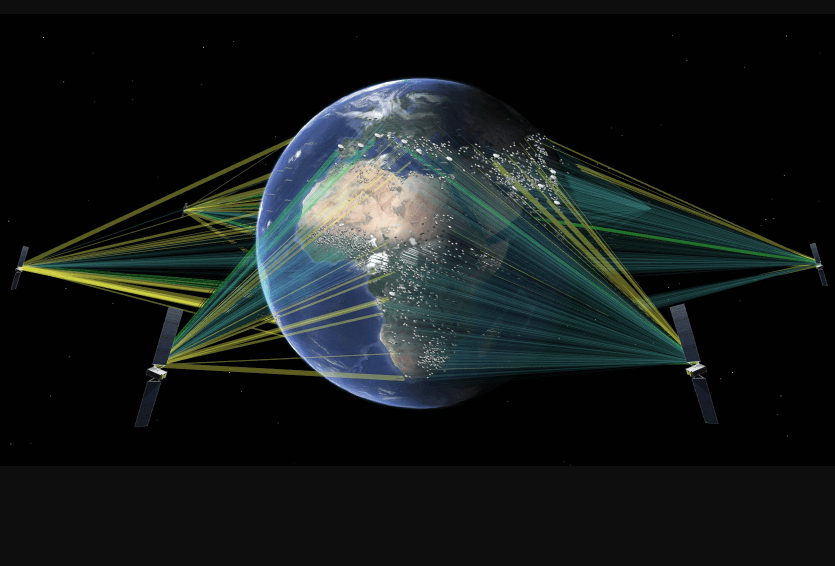
SES heralded the first launch for O3b mPOWER, its second-generation medium earth orbit (MEO) constellation poised to enable tens of thousands of multi-gigabit class spotbeams across the planet. 

SpaceX succesfully orbited the first two satellites, which a software-defined capability to deliver more than 5,000 steerable beams that can be repositioned based on real-time data from SES customers’ terminals. The satellites were launched aboard a Falcon 9 rocket from Space Launch Complex 40 (SLC-40) at Cape Canaveral Space Force Station in Florida. 

The satellites are based on Boeing’s 702 platform use Spectrolab’s custom-designed solar arrays built to withstand harsh MEO radiation.

SES contracted with Boeing to deliver 11 O3b mPOWER satellites to SES, Boeing continues production, integration and testing of the remaining nine spacecraft. The O3b mPOWER satellites are also flexible in their launch configuration, with the ability to launch two or three satellites at a time.

SES said its new MEO satellites will be able to deliver roundtrip latency of less than 150 milliseconds. The company is also partnering with Microsoft to bring one-hop connectivity from the satellites into Microsoft Azure data centers. The terabit-scale capacity of the new O3b mPOWER constellation, the automated and software-defined steerable beams of the satellites, upgraded customer terminals and telco/cloud partnerships are expected many new use cases and deployment sites.

“Much more than just another launch, today marks the next milestone of our MEO journey. Since starting this journey, we have gone on to positively impact millions around the world. Today, with our second-generation O3b mPOWER, we are bringing game-changing technology that delivers a unique combination of multiple gigabits per second of throughput at any location, guaranteed reliability and service flexibility that is a first in the industry,” said Steve Collar, CEO of SES. “Whether we are enabling governments to carry out critical missions securely, cruise operators to provide high-speed broadband access to passengers at all times, or mobile network operators to deploy 4G/5G networks in underconnected areas or restore communications networks in down time, O3b mPOWER is the satellite system of choice for applications where performance matters most.”

Transpacific “Unity” cable doubles capacity with Infinera’s ICE6

The transpacific Unity Submarine Cable System, which spans 9,620 kilometers between Japan and the U.S., will double its capacity by upgrading to Infinera’s ICE6 solution. The upgrade is expected to increase the life span of the cable by nearly 25% and deliver up to 7.4 Tbps per fiber pair.

The Unity Submarine Cable System is a subsea consortium representing Bharti Airtel Limited, Global Transit Limited (a wholly-owned subsidiary of TIME), Google, KDDI Corp., Telstra and Singtel.

“Infinera’s innovative ICE6 technology was selected to upgrade our system because it enables us to extend the life of the Unity Submarine Cable System while providing the highest level of quality for our customers,” said the Unity consortium. “The Unity Submarine Cable System is a critical connection between two continents with the fastest growing bandwidth needs. We needed an industry-leading solution that would enable us to be competitive now and in the future.” 

“The Unity Submarine Cable System is one of the highest capacity underwater fiber optic cables ever built between Asia and North America, and Infinera is proud to power it with our latest optical engine technology,” said Nick Walden, Senior Vice President of Worldwide Sales at Infinera. “The increased capacity will help operators in Asia and the U.S. meet the increasing bandwidth demands on both sides of the Pacific.”

https://www.infinera.com/press-release/unity-submarine-cable-system-leverages-infinera-ice6-800g-solution


IDC: Spending continues at fast clip for cloud infrastructure

 Spending on compute and storage infrastructure products for cloud deployments, including dedicated and shared IT environments, increased 24.7% year over year in the third quarter of 2022 (3Q22) to $23.9 billion, according to IDC's Worldwide Quarterly Enterprise Infrastructure Tracker: Buyer and Cloud Deployment report.

Some highlights from IDC:

Spending on cloud infrastructure continues to outgrow the non-cloud segment although the latter had strong growth in 3Q22 as well, increasing at 16.5% year over year to $16.8 billion. The market continues to benefit from high demand and large backlogs, coupled with an improving infrastructure supply chain.

Spending on shared cloud infrastructure reached $16.8 billion in the quarter, increasing 24.4% compared to a year ago. IDC expects to see continuous strong demand for shared cloud infrastructure with spending expected to surpass non-cloud infrastructure spending in 2023. The dedicated cloud infrastructure segment grew 25.3% year over year in 3Q22 to $7.1 billion. Of the total dedicated cloud infrastructure, 45.2% was deployed on customer premises.

For the full year 2022, IDC is forecasting cloud infrastructure spending to grow 19.6% year over year to $88.1 billion – a noticeable increase from 8.6% annual growth in 2021. 


Non-cloud infrastructure is expected to grow 10.7% to $64.7 billion. Shared cloud infrastructure is expected to grow 19.0% year over year to $60.9 billion for the full year while spending on dedicated cloud infrastructure is expected to grow 21.2% to $27.3 billion for the full year.

IDC tracks various categories of service providers and how much compute and storage infrastructure these service providers purchase, including both cloud and non-cloud infrastructure. The service provider category includes cloud service providers, digital service providers, communications service providers, and managed service providers. In 3Q22, service providers as a group spent $23.9 billion on compute and storage infrastructure, up 22.5% from the prior year. This spending accounted for 58.7% of the total market. Non-service providers (e.g., enterprises, government, etc.) increased their spending at a similarly high rate, 19.3% year over year. IDC expects compute and storage spending by service providers to reach $87.8 billion in 2022, growing at 17.5% year over year.

On a geographic basis, year-over-year spending on cloud infrastructure in 3Q22 increased in all regions except Central and Eastern Europe (CEE), which is impacted by the Russia-Ukraine war. Spending in CEE declined 35.1% year over year in the quarter. The Middle East and Africa (MEA), the United States, and Western Europe grew the most at 65.8%, 32.1%, and 31.3% year over year, respectively. All other regions demonstrated growth in the teens and twenties percentage range. 

For the full year 2022, cloud infrastructure spending is expected to grow in all regions except CEE, with four regions – Asia/Pacific (excluding Japan and China), MEA, USA, and Western Europe – expecting to post annual growth in the 20-35% range.

Long term, IDC predicts spending on cloud infrastructure to have a compound annual growth rate (CAGR) of 12.9% over the 2021-2026 forecast period, reaching $135.1 billion in 2026 and accounting for 67.3% of total compute and storage infrastructure spend. Shared cloud infrastructure will account for 72.3% of the total cloud amount, growing at a 13.8% CAGR. Spending on dedicated cloud infrastructure will grow at a CAGR of 10.7% to $37.4 billion. Spending on non-cloud infrastructure will have a CAGR of 2.3%, reaching $65.6 billion in 2026. 

Spending by service providers on compute and storage infrastructure is expected to grow at a CAGR of 12.1%, reaching $131.9 billion in 2026.

https://www.idc.com/getdoc.jsp?containerId=prUS50037523

What's next for data center technology in 2023?

 Will 800G pluggables arrive for data center switches in 2023? 

 Here are 3 predictions from Credo’s Scott Feller.

https://youtu.be/DoPY_UOqtJQ

Check out other 2023 Predictions

See what other experts have to say on NextGenInfra.io  - https://nextgeninfra.io/2023-predictions/

Amplify your MWC 2023 presence

Looking to record your video for our channel for our MWC 2023 Showcase in Barcelona? We will be there! Book your session now. https://ngi.fyi/mwc2023yt

PacketFabric and Unitas Global to merge

PacketFabric and Unitas Global have agreed to merge to become a larger Network as a Service (NaaS) platform. 

PacketFabric helps businesses build new secure, private network fabrics to connect their core sites, cloud assets and manage shifts in data gravity with their unique fabric integrated storage. PacketFabric Converge orchestrates on-demand connectivity across colocation facilities, cloud providers, and private network interconnection across the globe.

Unitas Global offers intelligent automation for business internet connectivity, providing end-to-end network design, pricing, ordering and visibility across more than one thousand first/middle/last mile networks, accessing more than 50 million fiber lit buildings.

The companies said their merger will create a company that is changing the business internet architecture to one that is finally software-defined and fully programmable, versus legacy systems that are rigid and struggle to meet the price, performance, and flexibility needs of today’s enterprise customers. The combined platform assets and automation capabilities of the two companies will deliver real-time, on-demand control to our customers from The Edge to Everywhere.

“We are the only company that helps businesses shift from being reactive to proactive when it comes to the constant change of digitized operations,” said PacketFabric CEO Dave Ward. “Our platforms enable a fundamental shift in the way to architect and operationalize a modern business. We enable a reimagination of simplified operations with real-time, on-demand automation, self-service, complete telemetry and flexible consumption, applied to every aspect of business connectivity. We do this by fulfilling the promise of software-defined-networking and AIOps via our cloud native platforms. Not one other NaaS offer enables Edge to Everywhere through their platform, we believe this makes us the one true NaaS.”

https://packetfabric.com/press-releases/packetfabric-and-unitas-global-announce-merger

Deutsche Telekom cloudifies its Next Gen IMS platform

Deutsche Telekom announced some major deployment milestones with its NIMS (Next Generation IP Multimedia Subsystem) project to ‘cloudify’ and automate the core of its IP-based voice telephony platform. 

More than ten million voice subscribers have successfully been migrated. 

In addition, billions of interconnect voice minutes with approximately 100 Interconnect partners are now completely processed via NIMS.

“With the launch of our NIMS platform, we have implemented a game-changing level of lifecycle automation for all telco cloud and payload components. This enables Deutsche Telekom to validate and deploy new software for our customers in a few days, or soon even minutes, instead of weeks – thanks to our great team and ambitious partners,” says Abdu Mudesir, CTO of Telekom Deutschland.

DT said the most fundamental innovation is the automation of the platform from end-to-end. 

In addition, Telekom has created an innovative and highly-collaborative multi-vendor ecosystem to deliver on the vision of this highly-automated, cloud-based architecture. Current partners are Juniper Networks (Cloud Infrastructure & Prime Integrator), Mavenir, Metaswitch, Hewlett Packard Enterprise, Lenovo und Red Hat. Due to the high level of disaggregation and the horizontal cloud approach, more technology partners can easily be added as the demand for services grows.

https://www.telekom.com/en/media/media-information/archive/voice-subscribers-cloudified-voice-production-1023708

What's next for edge services in 2023?

What are the prospects for virtualized services at edge locations in 2023? 

Here are 3 predictions from Zededa's Said Ouissal .

https://youtu.be/x7iOEKlExts

Check out other 2023 Predictions

See what other experts have to say on NextGenInfra.io  - https://nextgeninfra.io/2023-predictions/

Amplify your MWC 2023 presence

Looking to record your video for our channel for our MWC 2023 Showcase in Barcelona? We will be there! Book your session now. https://ngi.fyi/mwc2023yt