Monday, August 15, 2022

BT faces further strikes on August 30 and 31

The Communications Workers Union (CWU), which represents BT Group employees, served notice of pending industrial action on August 30th and 31st, directly after the August bank holiday weekend.  As part of their ongoing campaign to seek higher wages and benefits, the union already held strikes on 29th July and 1st August, 2022.

CWU deputy general secretary Andy Kerr states “There’s no doubt that we were as solid as we could have been in the first industrial action – and I have no doubt that will be repeated on August 30th and 31st. We’re still hoping to get BT back round the table for serious negotiations , but as things stand it has sadly become clear that simply isn’t going to happen unless we take further action…so that’s precisely what we’re going to do.”

A BT Group spokesperson commented “We know that our colleagues are dealing with the impacts of high inflation and, although we’re disappointed, we respect their decision to strike. We have made the best pay award we could and we are in constant discussions with the CWU to find a way forward from here. In the meantime, we will continue to work to minimise any disruption and keep our customers and the country connected”.

https://www.cwu.org/news/notice-served-for-second-round-of-national-bt-group-strike-action/

https://newsroom.bt.com/bt-group-response-to-notification-by-the-cwu-of-industrial-action-in-august/

BT braces for nationwide strike on July 29 and August 1

In the wake of a vote by the Communication Workers Union (CWU), BT confirmed that it will not raise the pay increase it implemented in April and will instead brace itself for industrial action.At a press conference today (30th June), the CWU – the union for all BT Group employees – announced that on a 74.8% turnout, the union’s 30,000 Openreach engineers have voted by 95.8% to take strike action. This number was followed by workers in BT, approximately...


Sunday, August 14, 2022

AWS goes live with its Private 5G service

Amazon Web Services announced commercial availability of its Private 5G service, which uses CBRS spectrum and AWS-managed infrastructure to enable a private mobile network.

The service, which currently is only available in 4G mode with future 5G capability, promises long range coverage, indoors and out, and fine-grained access control.

In a blog, Jeff Barr, Chief Evangelist for AWS, writes " This cool new service lets you design and deploy your own private mobile network in a matter of days. It is easy to install, operate, and scale, and does not require any specialized expertise. You can use the network to communicate with the sensors & actuators in your smart factory, or to provide better connectivity for handheld devices, scanners, and tablets for process automation."

There are no upfront fees or per-device costs. The customer is charged at an hourly rated based on the number of active radio units on premise. A starter package includes a radio unit and ten SIM cards. The radio unit requires AC power and wired access to the public Internet, along with basic networking (IPv4 and DHCP).

https://aws.amazon.com/blogs/aws/new-aws-private-5g-build-your-own-private-mobile-network/

Amazon previews AWS Private 5G

Amazon Web Services (AWS) announced a new managed service that helps enterprises set up and scale private 5G mobile networks using license-free CBRS spectrum.

Customers of the forthcoming AWS Private 5G service will be able to use the AWS console to specify where they want to build a mobile network and the network capacity needed for their devices. AWS will then deliver and maintain the small cell radio units, servers, 5G core and radio access network (RAN) software, and subscriber identity modules (SIM cards) required to set up a private 5G network and connect devices. AWS Private 5G automates the setup and deployment of the network and scales capacity on demand to support additional devices and increased network traffic. Pricing is based on network capacity and throughput. There are no upfront fees or per-device costs. 

“Many of our customers want to leverage the power of 5G to establish their own private networks on premises, but they tell us that the current approaches make it time-consuming, difficult, and expensive to set up and deploy private networks,” said David Brown, Vice President, EC2 at AWS. “With AWS Private 5G, we’re extending hybrid infrastructure to customers’ 5G networks to make it simple, quick, and inexpensive to set up a private 5G network. Customers can start small and scale on-demand, pay as they go, and monitor and manage their network from the AWS console.”

“We deploy technology outside of Amazon Fulfillment Centers (FCs) to make moving tractor trailers around safer and more accurate and efficient. We have to provide network services for these systems across millions of square feet of outdoor space. Previously, to get proper Wi-Fi coverage in the parking lots around our FCs, we had to add light poles for the Wi-Fi equipment, modify our outdoor electrical systems and either trench fiber or support Mesh systems. This was expensive, disrupted productivity during installation, and had a high support burden,” said Jeff Armstrong, Director of Infrastructure Engineering at Amazon. “With AWS Private 5G, we can use two outdoor small cells mounted on the corners of our warehouses and achieve additional coverage in our parking lots, which was much quicker and cheaper to deploy. Just as important, we will be able to scale up our AWS Private 5G deployment as we expand our facilities.”

https://aws.amazon.com/private5g/?nc2=h_ql_re_nw

https://youtu.be/7RXZGn8F0Ts


WSJ: $42 billion broadband plan is slowed by lack of accurate maps

A feature article in The Wall Street Journal argues that the U.S. government's $42.5 billion broadband initiative  "is stuck in a holding pattern nearly nine months after approval, largely because authorities still don’t know where gaps need to be filled.". 

The delay is attributed to the FCC's mapping of unserved or underserved locations. Once these are complete, the NTIA will allocate funds to each state.

https://www.wsj.com/articles/faster-internet-is-coming-to-americaas-soon-as-the-government-knows-where-to-build-it-11660469400?mod=hp_lead_pos10

Friday, August 12, 2022

U.S. implements new controls on advanced semiconductor tech

The U.S. Department of Commerce Department’s Bureau of Industry and Security (BIS) issued an interim final rule that establishes new export controls on four technologies that support the production of advanced semiconductors and gas turbine engines.

The restrictions target two substrates of ultra-wide bandgap semiconductors: Gallium Oxide (Ga2O3), and diamond; Electronic Computer-Aided Design (ECAD) software specially designed for the development of integrated circuits with Gate-All- Around Field-Effect Transistor (GAAFET) structure

The Department of Commerce says GAAFET technology approaches are key to scaling to 3 nanometer and below technology nodes. GAAFET technologies enable faster, energy efficient, and more radiation-tolerant integrated circuits that can advance many commercial as well as military applications including defense and communications satellites.

“Technological advancements that allow technologies like semiconductors and engines to operate faster, more efficiently, longer, and in more severe conditions can be game changers in both the commercial and military context,” said Under Secretary of Commerce for Industry and Security Alan Estevez. “When we recognize the risks as well as the benefits, and act in concert with our international partners, we can ensure that our shared security objectives are met, innovation is supported, and companies across the globe operate on a level playing field.”

“Global commerce is driven by innovation—new ideas, and novel ways to apply old ones. BIS is vigilant in assessing the development of new technology and whether it may be used for civil and military purposes,” said Assistant Secretary of Commerce for Export Administration Thea D. Rozman Kendler. “We are protecting the four technologies identified in today’s rule from nefarious end use by applying controls through a multilateral regime. This rule demonstrates our continued commitment to imposing export controls together with our international partners. Export controls are most effective when multilaterally imposed.”

https://www.bis.doc.gov/index.php/documents/about-bis/newsroom/press-releases/3116-2022-08-12-bis-press-release-wa-2021-1758-technologies-controls-rule/file

https://www.federalregister.gov/documents/2022/08/15/2022-17125/implementation-of-certain-2021-wassenaar-arrangement-decisions-on-four-section-1758-technologies

SpaceX launches 46 more Starlinks from Vandenberg

SpaceX launched 46 Starlink satellites to low-Earth orbit on Friday, August 12, from Space Launch Complex 4 East (SLC-4E) at Vandenberg Space Force Base, California.

This was the 10th flight for this Falcon 9 first stage booster, which previously launched Crew-1, Crew-2, SXM-8, CRS-23, IXPE, Transporter-4, Transporter-5, Globalstar FM15, and now two Starlink missions. 

The mission was SpaceX’s 56th Starlink mission to date. 

It was SpaceX's second Starlink mission in August and 22st Starlink mission this year.


Huawei's first half 2022 revenue drops 5.9% yoy

Huawei reported unaudited revenue of CNY301.6 billion (approximately US$44.73 billion) for the first half of 2022, down by 5.9% compared to a year earlier. There was a net profit margin of 5.0%.

Revenue by business group

  • Carrier - CNY142.7 billion (US$21.1 billion), up 7.5% yoy
  • Enterprise - CNY54.7 billion (US$8.11 billion),  up 25% yoy
  • Device  - CNY101.3 billion (US$15.0 billion), down 25% yoy

Huawei said its 1H2022 overall performance was in line with forecast.

"While our device business was heavily impacted, our ICT infrastructure business maintained steady growth," said Ken Hu, Huawei's Rotating Chairman. "Moving forward, we will harness trends in digitalization and decarbonization to keep creating value for our customers and partners, and secure quality development."

https://www.huawei.com/cn/news/2022/8/h1-2022-business-performance


Huawei reports Q1 sales of CNY131 billion, down 13.8% yoy

Huawei reported Q1 2022 revenue of CNY131 billion in revenue (approx US$19.80 billion), with a net profit margin of 4.3%."In Q1, our overall business results were in line with forecasts. Our consumer business was heavily impacted, and our ICT infrastructure business experienced steady growth," said Ken Hu, Huawei's Rotating Chairman. "We have yet again increased our investment in R&D to harness the momentum of our innovation and create new value...

Huawei reports 2021 revenue of CNY142.7 billion, down 28%

Huawei reported 2021 revenue of CNY636.8 billion (US$99.885 billion), down 28.6% compared to CNY891,368 in 2021.Net profit for amounted to CNY113.7 billion, an increase of 75.9% year-on-year. Revenue for Huawei's Carrier Business dropped 7%, while its Enterprise Business revenues rose 2%.Regionally, sales in its home market of China fell 31% as carrier completed 5G deployments. Sales in dropped in other geographies as well, with EMEA down 27%,...

Huawei's first half 2021 revenue drops 29% yoy - shift to enterprise

Huawei released the following business results for the first half of 2021:In H1, Huawei generated CNY320.4 billion (approximately US$49.4 billion) in revenue, down 29.4% yoy, with its net profit margin reaching 9.8%.Carrier business revenue: CNY136.9 billion, down 14.2% yoy Enterprise business revenue: CNY42.9 billion, up 36.3% yoyConsumer business revenue: CNY135.7 billion, down 46.9% yoy"We've set our strategic goals for the next five years,"...


Webinar replay: New Design Considerations for a CPO or OBO Switch


https://youtu.be/XZWx7XOWc7o

Next generation applications trend toward disaggregation. To meet the requirements for cost, power, latency, and overall bandwidth of each component needs to be considered.  The removal of the optical pluggables from the faceplate provides an opportunity to re-evaluate the faceplate configuration for optical connections, heat management, and power into a network switch or datacenter server.

 The Consortium for On-board Optics (COBO) recently published a detailed 46-page industry guidance document addressing the design options ahead for a Co-Packaged or On-Board Optics Switch.   The guidance document represents the work of 47 COBO Members and took over 2 years to complete.  

This hour-long webinar discusses key engineering topics, including these design options and their potential impacts on optical signal, thermal, and safety criteria.

Presenters include Tiger Ninomiya, Technology and Innovation Manager, SENKO Advanced Components, and Peter Johnson, Staff Scientist, SABIC, and who served as the Chief Editor of COBO CPO Whitepaper.

This was the 11th in a series of webinars presented by COBO, the Consortium for On-board Optics, and sponsored by DuPont’s Silicon Valley Technology Center.

Thursday, August 11, 2022

FiBrasil partners with Padtec on Network Operations Center

FiBrasil, a Brazilian operator of neutral networks, has formed a partnership with Padtec focused on managing the operation of its communication networks in Brazil. The services include monitoring and technical support through Padtec’s Network Operations Center (NOC).

Located at its headquarters in Campinas, in the interior of São Paulo, Padtec’s NOC offers remote network monitoring and support services, available 24 hours a day, 7 days a week. Services are provided by specialized technicians who have an advanced infrastructure, with resources such as dual approach fiber optic routes,  fire protection systems, UPS and generators to ensure uninterrupted operation in the event of a power failure, and a disaster recovery plan that allows for fully remote operation. All this with the capability of defining service level agreements (SLAs) suited to the needs and requirements – as well as the investment capacity – of each provider.

Padtec’s NOC service (contracted by FiBrasil) is part of the company’s business unit, which currently has 40 points of presence distributed throughout Brazil, Argentina and Colombia. The objective is to help and boost the business of providers operating in the broadband market by optimizing the resources of their networks.

FiBrasil is a joint venture that works in the construction, operation and commercialization of a neutral fiber optic network for internet providers and telecommunications operators who wish to expand their coverage throughout Brazil. The company aims to triple the number of municipalities covered by the end of this

“Our current coverage is approximately 70 cities, and the goal is to reach 200 cities by the end of 2022”, highlights Atila Branco, FiBrasil’s CTIO. “Padtec is a reference in the operation of fiber optic networks and therefore is the ideal partner for our business, allowing us to focus on the expansion of our network and on the high quality operational characteristics of FiBrasil“, he adds.

“With the offer of a complete solution of telecommunications services, which involves the planning of the system to the installation, operation and maintenance of the networks, we add value to our delivery and provide more security and comfort to our customers”, said Carlos Raimar, CEO of Padtec.

https://www.padtec.com.br/en/fibrasil-announces-partnership-with-padtec-to-manage-the-operation-of-its-communication-networks-in-brazil/

Brazil's AdylNet picks Padtec for optical backbone

AdylNet, a telecommunications service provider in Rio Grande do Sul with an optical network of more than 22,000 kilometers, has adopted  Padtec’s line of 800 Gbps transponders (up to 400 Gbps per optical channel) for an optical backbone linking the capitals of São Paulo, Curitiba, Florianópolis and Porto Alegre and cities from the interior of Rio Grande do Sul. 

Based in Nova Prata (RS), AdylNet currently serves more than 50,000 residential, corporate and wholesale (ISP) users. The decision to modernize its network infrastructure is part of the company’s strategy to meet – with quality – the growing demands for bandwidth and new services in the regions where it operates. 

Padtec’s LightPad i6400G platform’s 800 Gbps line of transponders allows transmitting extremely high data rates over short to long distances in terrestrial and underwater DWDM networks. 

“With this generation of transponders, providers optimize their operation, since it is possible to carry more traffic with a smaller amount of equipment. This reduces the cost per transmitted bit, as well as energy and space consumption, which are scarce in telecommunications environments”, explains Argemiro Sousa, Padtec’s Business Director.

https://www.padtec.com.br/en/adylnet-from-rio-grande-do-sul-modernizes-its-network-with-800-gbs-transponders-from-padtec/

Colt optimises low latency routes between Singapore and Sydney

by James E. Carroll

Colt Technology Services, has substantially reduced the latency between the Singapore and Australian exchanges, realising the fast connectivity in the market of less than 87ms.

The round-trip latency values were measured with 1000Base-X and 64-byte packets on a 1Gbps test line between Colt POPs located at ASX and SGX Building.

The low latency route upgrade follows recent upgrades and additions to Colt’s other ultra-low latency routes, including new ultra-low latency routes between the SET, HKEX and SGX, between JPX and HKEX, HKEX to SGX and ASX to CME, as well as new services connecting markets in South Korea and Taiwan. This is an addition to other markets across Asia, Europe and the US, where Colt is a market leader in connectivity, hosting and exchange colocation facilities provision.

Arthur Rank, Global Director, Capital Markets Solutions, said: “We are continuing to invest heavily in upgrading our ultra-low latency infrastructure in the Asia-Pacific and around the world. The SGX-ASX route is particularly important for derivative and FX players in the region. We will continue to push boundaries to bring the fastest connectivity speeds in a competitive market.”

“Fast connectivity is critical for enabling capital market firms of all kinds to execute trading strategies faster. Our highly secure ultra-low latency network services are used by the most demanding buy-side and sell-side firms in key liquidity hubs globally, including Tier 1 financial institutions. We are committed to helping them thrive in the Asia-Pacific.”

https://www.colt.net/resources/colt-optimises-low-latency-routes-between-singapore-and-sydney/


* 


Deutsche Telekom remains on course as sales rise 5.9% yoy

Citing strong earnings trends despite macroeconomic headwinds, Deutsche Telekom reported Q2 2022 net revenue of 28.2 billion euros, up 5.9 percent compared to a year earlier. Adjusted net profit was up 15.7 percent to 2.4 billion euros.

“We continue to grow, despite the difficult economic environment,” said Tim Höttges, Chairman of the Board of Management at Deutsche Telekom. “We are well on track this year to meet our ambitious targets announced at the 2021 Capital Markets Day. Our investments are paying off.” 

Some highlights

Germany: revenue and earnings continue to grow 

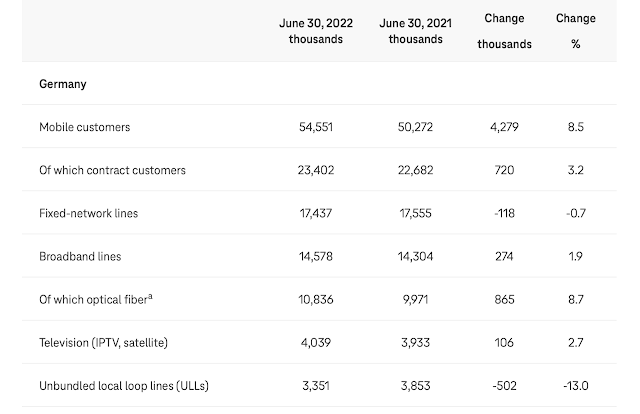
The Germany segment delivered strong financials in the second quarter of 2022. Revenue grew by 2.7 percent year-on-year to 6.1 billion euros. Adjusted EBITDA AL recorded even stronger growth of 3.1 percent to 2.4 billion euros in the second quarter. This corresponds to an EBITDA margin of 40.0 percent and earnings growth for 23 quarters in a row.

In mobile communications, service revenues grew by 2.6 percent, continuing the high-level growth of the previous quarters. Branded contract net additions of 194,000 substantially exceeded the prior-year quarter.

Telekom remains the strongest broadband provider in the German market, which was weaker overall in the second quarter. 45,000 broadband net additions were recorded between April and June. The number of fiber-optic-based lines (FTTx, retail and wholesale) increased to 17.7 million. This means that around 75 percent of retail broadband customers are already using the fiber infrastructure. 

United States: customer growth at record level

In the second quarter of 2022, the mobile postpaid net additions were at a record level of 1.7 million: the best-ever customer growth in a second quarter, more than the competitors AT&T and Verizon in this quarter combined. The total customer base increased to 110 million, up 5.2 million year-on-year. 

Total revenue at T-Mobile US decreased slightly by 1.1 percent in the reporting quarter to 19.8 billion U.S. dollars. This was due to the decline in revenue from handset leasing, due to the planned gradual withdrawal from this Sprint business model. Adjusted EBITDA AL declined by 2.4 percent to 6.7 billion U.S. dollars. 

Thanks to the fact that the integration of Sprint has continued to progress well and rapidly, T-Mobile US is raising its guidance for the synergies from the business combination to between 5.4 and 5.6 billion U.S. dollars in 2022, up from the previous range of between 5.2 and  5.4 billion U.S. dollars. 

Europe: growth course continues unabated

The European national companies continued to grow unabated in the second quarter. Adjusted EBITDA AL grew 4.5 percent year-on-year in organic terms, making 18 successive quarters of growth. 

Revenue also recorded organic growth of 4.2 percent. The reported revenue of 2.7 billion euros was 2.7 percent lower than in the prior-year quarter. The difference between the reported and organic figures essentially results from the sale of the Romanian fixed-network business at the end of September 2021. 

243,000 mobile contract net additions were recorded in the second quarter. Broadband net additions were at the same level as in the previous quarter at 70,000. 186,000 new users were won for fixed-mobile convergence products. 

https://www.telekom.com/en/media/media-information/archive/second-quarter-report-2022-1012842

Milestone: Deutsche Telekom now has 5,000 5G antennas

Deutsche Telekom reports that its 5G rollout continues at pace with more than 5,000 antennas now part of its 5G network. Around 350 new sites have been added in recent weeks. In total, almost 1,700 sites make up the very fast 5G network. The antennas transmit at the 3.6 gigahertz (GHz) frequency. The network can provide up to one gigabit per second for download speeds. New additions to the list are locations from all over Germany,...

Deutsche Telekom ends software development in Russia

Deutsche Telekom confirmed that it is closing it software development activities.In a follow-up to its press conference on February 24, the German carrier issued the following statement:"Deutsche Telekom does not operate any networks in Russia. We have no business relationships with companies in Russia. However, we have a team of software developers, mainly in St. Petersburg, who provide services to customers outside Russia.In recent weeks, we have...


Intelsat and OneWeb offer multi-orbit connectivity to airlines

OneWeb and Intelsat  signed a global distribution partnership agreement to offer airlines a seamless inflight connectivity solution with the best combination of performance, coverage, and reliability on the market. 

The partnership enables Intelsat to distribute OneWeb’s low Earth orbit (LEO) satellite services to airlines worldwide, coupled with Intelsat’s extensive IFC experience and existing geo-stationary (GEO) satellite service.  The companies expect the multi-orbit solution to be in service by 2024.

“This level of connectivity will enable airlines to maximize brand affiliation with passengers through all their onboard services – delivering a truly connected end-to-end passenger journey,” said Jeff Sare, president of Intelsat’s Commercial Aviation. “The hybrid service offering further allows the global airline community to plan their suite of next-generation onboard services with confidence – not only ensuring a future-proofed passenger inflight connectivity experience, but also the implementation of a connected airline digitalization strategy.”

“This is a watershed moment for the inflight connectivity market, and we’re excited to work together with Intelsat to bring our multi-orbit solution to commercial aviation. We’re committed to delivering the most differentiated and innovative solution for airlines,” said Ben Griffin, OneWeb vice president, Mobility Services. “We are proving that, through the power of partnership, a superior suite of multi-orbit capabilities can be offered to better serve the growing connectivity needs of the commercial aviation industry, delivering the highest value coupled with the lowest risk.”

http://www.oneweb.world

Eutelsat and OneWeb merger looks to GEO + LEO satellite opportunities

 Eutelsat Communications and OneWeb agreed to merge.  The deal combines Eutelsat's fleet of 36 GEO satellites with OneWeb’s constellation of 648 Low Earth Orbit satellites, of which 428 are currently in orbit.The companies say their operations are highly complementary and that a clear roadmap has been designed to develop over time a complementary GEO/LEO service including a common platform, hybrid terminals and a fully mutualized network...


Dell'Oro: SaaS-based network security revenue to surpass $60 billion

Demand for network security–which includes email security, firewall, security service edge (SSE), secure web gateway (SWG), and web application firewall (WAF) technologies–is expected to remain healthy over the next five years as solid enterprise investment in cloud applications and hybrid work drive the need for greater security and offset macro-economic headwinds, according to a new report from Dell'Oro Group.

“Compared with our previous forecast in January 2022, the world is a different place with stubbornly high inflation and a regional war in Europe, and as a result, we incrementally lowered our near-term network security revenue projections,” said Mauricio Sanchez, Research Director, Network Security, and SASE & SD-WAN at Dell’Oro Group. “However, we see the near-term softness to be transitory and offset by stronger growth in later years as enterprises remain focused on securing the shift to being cloud-first and mobile-friendly,” added Sanchez.

Additional highlights from Network Security July 2022 5-Year Forecast Report:

  • SSE market revenue to experience a compounded annual growth rate (CAGR) of nearly 30 percent from 2021 to 2026. Secure Web Gateway (SWG) and Cloud Access Security Broker (CASB) are expected to remain the most significant revenue components over the five-year forecast horizon, but Zero Trust Network Access (ZTNA) and Firewall-as-a-Service (FaaS) are estimated to flourish at a faster rate.
  • Firewall market is expected to remain the largest network security segment by revenue and is forecasted to grow at an 8 percent CAGR over the forecast horizon.

Sierra Wireless reported Q2 revenue of $188.0 million, up 41%

Citing strong demand and the realization of investments in inventory to combat the ongoing supply chain tightness, Sierra Wireless reported Q2 revenue of $188.0 million, an increase of 41.5% compared to the second quarter of 2021.

Gross margin was 33.6% as compared to 34.8% in the second quarter of 2021. In the second quarter of 2022, gross margin was impacted by product mix and higher component costs.


Operating expenses were $44.6 million compared to $55.6 million in the second quarter of 2021. Second quarter expenses included a $9.2 million gain on sale of our Omnilink offender monitoring business. Adjusted EBITDA was $22.4 million compared to $4.3 million in the second quarter of 2021.

Some highlights:

  • Connectivity, software, and services revenue was $31.4 million, a decrease of 10.7% compared to the second quarter of 2021. This decrease was primarily due to the sale of the Omnilink offender monitoring business and the impact of the shutdown of 2G/3G networks in the United States on the company's home security business.
  • Monthly recurring revenue ("MRR")2, 3 was $9.1 million in June 2022 compared to $9.3 million in June 2021.
  • Revenue from IoT Solutions increased 54.7% to $139.7 million as compared to $90.3 million in the second quarter of 2021. The increase was primarily due to strong demand for connected devices globally and the realization of investments in inventory to combat the ongoing supply chain tightness. Increase in demand includes acceleration in IoT modules deployment across  industrial customers. IoT Solutions gross margin was 30.1%, compared to 27.0% in the second quarter of 2021. The increase in gross margin was primarily due to price increases, product mix, and improved absorption of fixed costs from increased volume.
  • Revenue from Enterprise Solutions increased 13.6% to $48.3 million as compared to $42.5 million in the second quarter of 2021. The increase was primarily due to strong demand for routers in our key industrial and public safety verticals, partially offset by decline in connectivity, software, and services revenue resulting from the sale of the Omnilink offender monitoring business and the impact of the shutdown of 2G/3G networks in the United States on the company's home security business. Enterprise Solutions gross margin was 43.9% as compared to 51.3% in the second quarter of 2021. The decrease in gross margin was primarily due to product mix and higher component costs.

https://www.sierrawireless.com

Semtech to acquire Sierra Wireless for LoRa + Cellular IoT

Semtech agreed to acquire Sierra Wireless, a leading supplier of Internet of Things (IoT) solutions, for US$31 per share in an all-cash transaction representing a total enterprise value of approximately US$1.2 billion.Semtech said the deal will significantly expand its addressable market and is expected to approximately double Semtech’s annual revenue and create a strong and diverse portfolio of connectivity solutions for the growing IoT market. Significantly,...

NETGEAR to Acquire Sierra Wireless' AirCard Business

NETGEAR agreed to acquire Sierra Wireless' AirCard business, including customer relationships, certain intellectual property, inventory and fixed assets, for approximately $138 million in cash. Sierra Wireless expects to net about $100 million from the asset sale, after related liabilities, taxes, expenses, and funds held in escrow. Sierra Wireless' AirCard business supplies a range of data cards, dongles, and hotspots for 3G and 4G networks....

Sierra Wireless to sell its Automotive Embedded Module business

Sierra Wireless will divest its Shenzhen, China-based automotive embedded module product line for US$165 million in cash. The purchaser, Rolling Wireless (H.K.) Limited, is a consortium led by Fibocom Wireless Inc. of Shenzhen. The divested product line is part of the company’s Embedded Broadband reporting segment. Sierra Wireless will exit automotive applications but will continue to invest in other product lines in its Embedded Broadband segment,...


VIAVI hits revenue of $335.3 million, up 7.8% year-over-year

VIAVI reported net revenue of $335.3 million  for its fourth fiscal quarter ended July 2, 2022.. GAAP net income was $16.5 million, or $0.07 per share. Non-GAAP net income was $55.8 million, or $0.24 per share.

"I am pleased with VIAVI's performance in the fiscal year 2022. We generated record revenue, close to $1.3 billion, and record operating profit, exceeding our strategic plan goals that we set out three years ago before the pandemic, global supply chain issues, and inflationary pressures," said Oleg Khaykin, VIAVI's President and Chief Executive Officer.

Khaykin added, "I am also pleased with VIAVI's performance and momentum during the fiscal Q4 2022, resulting in record revenue and record fourth quarter profitability driven by Fiber-to-the-Home deployment, 400GbE network and data center upgrades, and the investments in O-RAN network expansions."

Americas, Asia-Pacific and EMEA customers represented 38.7%, 38.7% and 22.6%, respectively, of total net revenue for the quarter ended July 2, 2022.

As of July 2, 2022, the Company held $564.9 million in total cash, short-term restricted cash and short-term investments.

https://investor.viavisolutions.com/overview/default.aspx

Wednesday, August 10, 2022

DustPhotonics and MaxLinear demo silicon photonics + integrated lasers

DustPhotonics and MaxLinear demonstrated a silicon photonics chipset with integrated lasers directly driven from a DSP without the use of any external driver chip.

The MaxLinear Keystone DSP (Digital Signal Processor) and DustPhotonics Carmel Silicon Photonics chip were shown together to support direct-drive operation, which reduces the overall cost and power dissipation of optical transceivers for data communication. 

Potential applications include 400 Gbps and 800 Gbps pluggable modules and on-board optics.

The DustPhotonics chip includes an integrated DFB (Distributed-feedback) laser and DustPhotonics Low Loss Laser Coupling technology (L3C), achieving a very efficient coupling of light into the Photonic Integrated Circuit (PIC). This unique technology enables the use of 1 laser for every 4 channels.

The MaxLinear Keystone chip is part of a family of DSPs capable of both 400 Gbps and 800 Gbps operation, based on TSMC’s 5nm process. The Keystone DSP provides a rich set of features for transceivers, CPO (Co-Packaged Optics) modules and on-board optics while achieving significantly lower power than competitive solutions. The integrated drivers are optimized for silicon photonics direct-drive and provide the best industry performance for this application.

The companies say their combined solution enables performance that significantly exceeds all IEEE specifications. In terms of power consumption, 400 Gbps transceivers can now be designed to reach sub 7W.

“DustPhotonics is focused on enabling best-in-class Silicon Photonics chips to simplify the efforts of transceiver and systems designers,” said Yoel Chetrit, Vice President R&D of DustPhotonics. “Not only can our Carmel chip simplify the overall system design by reducing the total number of lasers to a single laser for 4 channels, but it also eliminates the external driver, which reduces the cost, power and complexity of the overall system.”

“The combination of our Keystone 5nm integrated driver DSPs with DustPhotonics’ silicon photonics demonstrates the significant power and performance advantages achievable with our integrated drivers,” said Drew Guckenberger, Vice President of Optical Interconnect at MaxLinear. “With double-digit year-on-year growth in market demand for 400Gb/s and 800Gb/s transceivers, this integrated solution can create tremendous value for our customers. We look forward to seeing full transceiver deployments in the near future.”

http://www.dustphotonics.com

http://www.maxlinear.com


MaxLinear, MACOM and II-VI eye 800G modules

MaxLinear, MACOM and II-VI, demonstrated 100G/lane multi-mode links targeted for 800G optical modules. These links incorporate the MaxLinear Keystone 5nm 800G DSP, MACOM 100G/lane TIAs and VCSEL drivers and II-VI latest 850nm VCSELs and photodetectors.MaxLinear's Keystone family of 5nm PAM4 DSPs includes 400G and 800G variants with and without integrated laser drivers. This demonstration uses the 800G DSP, in conjunction with the MACOM four-channel...

MaxLinear showcases 5nm CMOS 800G PAM4 DSP

MaxLinear will showcase a 5nm CMOS 800Gbps PAM4 DSP for data center applications at the virtual Optical Fiber Communication Conference and Exhibition (OFC) from June 6 to June 11, 2021. “With the exponential growth of data traffic within hyperscale cloud networks, the needed increase in interconnect bandwidth in those networks requires lower-power, higher-density optical modules that support higher lane rates,” said Drew Guckenberger, Vice President...


Google Cloud regions coming to Malaysia, Thailand, New Zealand

Google Cloud announced plans to add cloud regions in Malaysia, Thailand, and New Zealand.  Earlier this year, the company announced new cloud regions in Berlin, Dammam, Doha, Mexico, Tel Aviv, and Turin. 

Google Cloud is currently operating 34 cloud regions worldwide - 11 of which are located in Asia Pacific. 

“The new Google Cloud regions will help to address organizations’ increasing needs in the area of digital sovereignty and enable more opportunities for digital transformation and innovation in Asia Pacific. With this announcement, Google Cloud is providing customers with more choices in accessing capabilities from local cloud regions while aiding their journeys to hybrid and multi-cloud environments," said Daphne Chung, Research Director, Cloud Services and Software Research, IDC Asia/Pacific.

https://cloud.google.com/blog/products/infrastructure/announcing-new-google-cloud-regions-in-asia-pacific