Showing posts with label OLT. Show all posts

Monday, October 17, 2022

DZS breaks terabit barrier with V6 fiber access platform

DZS expanded its fiber access portfolio with a multi-terabit, 6 rack unit (6RU) ONT platform for serving XGS-PON and other fiber access service in high-density locations aggregating over 24,000 subscribers.

The new DZS Velocity V6 system scales to 800 Gbps of non-blocking switching capacity per slot, supporting today's 10 gigabit-class services. DZS says its V6 system design will support in-place upgrades to future 50 Gbps and 100 Gbps PON while maintaining non-blocking performance.

DZS' Cloud software solutions brings orchestration, automation, service assurance and WiFi experience management capabilities.

Significantly, the 6RU ONT provides a direct, form-factor replacement for Huawei OLTs while significantly delivering greater performance and subscriber density. This enables the platform to be depolyed by service providers seeking to “cap and grow“ or “rip and replace“ their existing Huawei fiber access deployments.

“The disruptive innovation underpinning our next generation Velocity V6 enables a cost-effective replacement option of Huawei’s legacy OLT, which has been deployed around the world and is of the same form fit size, though with unparalleled capacity and software defined intelligence,” said Charlie Vogt, CEO, DZS. “From a capacity, switching and fabric perspective, the future-proof V6 enables 800 Gbps of capacity per slot paving the way for 50/100G access technology. The V6 supports simultaneous 24,000 GPON/XGS PON subscribers in one compact system and is ideally suited for network designs of 20,000 to 20 million subscribers.”

“The DZS Velocity V6 can be easily inserted into existing environments to become the catalyst for transformation in any network. With its state-of-the-art performance in a 6RU chassis, non-blocking architecture, minimum latency optical broadband performance and the ability to shift from a centralized to a disaggregated deployment model, the DZS Velocity V6 stands ready to scale and transform as new advanced services emerge and future-generation technologies like 50 gigabit PON become available,” said Miguel Alonso, Chief Product Officer, DZS.

https://dzsi.com/news/news-releases/dzs-extends-velocity-fiber-access-portfolio/

  • Earlier this month, DZS introduced Saber-4400 compact, modular, coherent optical metro and edge transport platform supporting up to 400 Gbps per wavelength and multi-degree CDC ROADM functionality.
    Each 1RU DZS Saber-4400 shelf features 4 hot-swappable modules. The platform is scalable to 1.6 Tbps transponder capacity per shelf and supporting a stackable virtual chassis configuration with a single management interface.


DZS perspective: America's $65 billion broadband investment

https://youtu.be/Mh6bXzXjKSQAmerica's $65 billion investment in broadband will be a game changer for the entire industry, says Charlie Vogt, president and CEO of DZS. It represents an opportunity to move forward to 10G and 25G architecture. Here is his 1-minute perspecti...


Thursday, June 25, 2020

Champion ONE 10G SFP+ - a pluggable FTTx solution

Champion ONE began shipping 10G SFP+ transceivers for 10G EPON and XGS-PON applications, developed by Tibit Communications, that can function as an alternative to dedicated OLT equipment.

The OLT solution embedded in a transceiver can plug directly into a commercially available Ethernet switch with SFP+ ports.

Champion ONE said its design makes an ideal fit for virtualized PON (vPON) solutions and software-defined networking (SDN) implementations. The OLT and open-architecture management solution can interoperate with 3rd party ONUs. This interoperability includes pairing with Ethernet-pluggable ONU solutions for a plug-and-play PON deployment without manual provisioning and SLA configuration.

“We are excited to have Champion ONE as an integration partner. They are a proven innovator in both carrier and enterprise solutions which are they key target marker for our MicroPlug™ OLT,” said Jay Teborek, VP Sales and Marketing at Tibit Communications. “Champion ONE continually demonstrates a high level of support for their customers and we’re proud to be a Champion ONE partner. With their product line breadth, they have the unique capability of delivering and servicing the needs of a complete 10G PON solution to their clients.”

“Champion ONE is excited to partner with Tibit Communications to bring the market leading Pluggable 10G OLT / ONU MicroPlug™ to the North American market,” said Tim Yanda, Director of Engineering at Champion ONE. “The ability to support 10G PON technologies from a traditional Ethernet switch is an excellent opportunity to expand in the last mile fiber connectivity market segment.”

https://www.championone.com/press/champion-one-launches-pluggable-10g-microplug-olt-transceivers-powered-by-tibit-communications
https://tibitcom.com/technology/

Monday, February 8, 2016

NTT Develops Flexible Access System Architecture with Virtualized OLTs

NTT is developing a new Flexible Access System Architecture (FASA) that aims to leverage a new generation of virtualized optical line terminals (OLTs).

NTT said FASA will not make use of conventional purpose-built equipment, but instead modularize the various individual functions of access equipment as much as possible. The idea is to use generic OLT hardware that allows modularized software components to run for specific functions, such as bandwidth control, OAM, multicast, and future services.  NTT is developing an API with multiple industry partners. The first API is schedule for release in May 2016.

With FASA, the components of access equipment are separated into the three types: 1) Software components, 2) Generic hardware, and 3) External modules. FASA enables access equipment to provide its necessary functions through the unrestricted combination of these three component types. With software components (1), it will become possible to add new functions quickly and flexibly just by adding or updating necessary software in response to the requirements of services. For the generic functions of access equipment, generic hardware (2) will make it less frequently necessary to newly develop equipment from the device level by striving to achieve a set of common generic components. The creation of such components can also be expected to lower equipment costs and make maintenance simpler by reducing the number of component types that need maintenance. For functions like optical transmission that are difficult to address with either software components or generic hardware, things like optimal transmission capacities can be achieved through the use of external modules (3) that can be substituted for dedicated hardware in response to the requirements of services.

NTT is also working on a a visualized testing environment.  Its NetroSphere concept will undertake testing of FASA and other key technologies, such as Multi-Service Fabric (MSF), new server architecture (MAGONIA), and Integrated Management.

http://www.ntt.co.jp/news2016/1602e/160208a.html

NTT's NetroSphere Concept Pushes NFV to Next Level

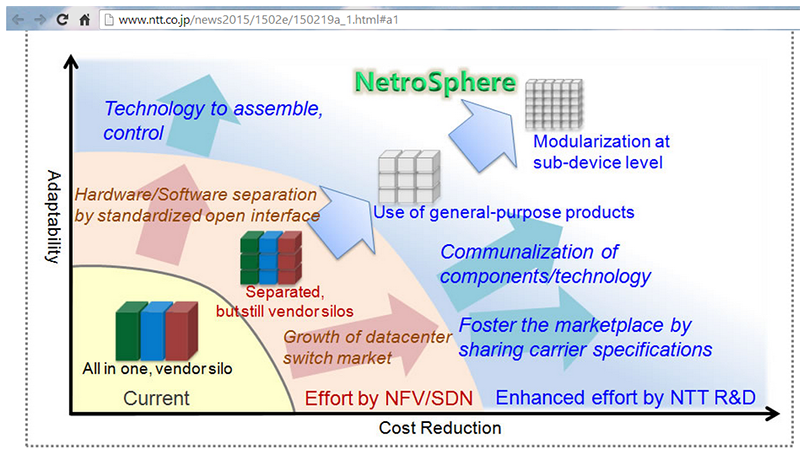
NTT outlined its work developing the “NetroSphere concept” -- a new way build carrier network infrastructure that differs from other NFV approaches by taking the decoupled software/hardware paradigm all the way down to the component level.

NTT said its approach promises enhanced flexibility and elasticity while also drastically reducing costs. Breaking up the functions of conventional large-scale equipment into modules will enable a greater diversity of suppliers to participate in the market and hence widen the selection of available products.

Instead of using conventional purpose-built high-functionality equipment, NetroSphere aims to divide them into small modular components, and flexibly assemble those components at will.  NetroSphere will not limited to decoupling software components from equipment. It pursues modularization as much as possible, ultimately at the sub-device level such as the CPU and memory. These modules will be distributed in locations that are optimal for each type of them, and prepared to be used as resource pool. Then, they will be virtually assembled to form a virtual system to provide required functions.

There are two components to the NetroSpher concept:  (1) Multi-Service Fabric (MSF), an architectural design of carrier network in which functions are achieved using simple general-purpose servers and switches, and (2) New Server Architecture (MAGONIA).

NTT plans to open its work on “MAGONIA” and “Multi-Service Fabric (MSF)” to other carriers and vendors.

http://www.ntt.co.jp/news2015/1502e/150219a.html