It comes as no surprise that one of the hottest topics from the past 3 years is still a hot topic at #OFC22. 400ZR is ramping with new applications now coming on, says Tom Williams, Vice President, Acacia - now part of Cisco.


It comes as no surprise that one of the hottest topics from the past 3 years is still a hot topic at #OFC22. 400ZR is ramping with new applications now coming on, says Tom Williams, Vice President, Acacia - now part of Cisco.
Acacia, which is now part of Cisco, introduced the first, single-carrier 1.2 terabits per second (1.2T) faceplate pluggable coherent module powered by its "Jannu" 5nm CMOS digital signal processor (DSP) ASIC.
The new 1.2 Tbps pluggable, which represents the 8th generation of Acacia's coherent module family, combines the Jannu DSP with 3D Siliconization packaging technology, including the silicon photonics integrated circuit (SiPh PIC), high-speed modulator driver and transimpedance amplifier (TIA) in a single opto-electronic package.

“Today is an exciting new milestone in Acacia’s history as we once again introduce an exciting new product that delivers the type of disruption needed to cost-effectively scale network capacity in the future,” said Mehrdad Givehchi, Sr. Director of Engineering for Hardware and Software and Founder at Acacia. “With every generation of product, we have been able to deliver higher transmission data rates, lower power consumption and higher performance and I am proud to see this new product carry on that legacy.”
Acacia notes that its new Coherent Interconnect Module 8 (CIM 8) can address transmission of multiple 400GbE client interfaces, delivering 1.2T per carrier capacity for high-capacity DCI interfaces and 800G per carrier capacity over most optical links using 4 bits/symbol (~16QAM) modulation.
The Jannu DSP features Acacia’s second-generation 3D Shaping technology, which leverages enhanced probabilistic constellation shaping (PCS) algorithms and Adaptive Baud Rate. This provides continuous baud rate adjustment up to 140Gbaud to optimize utilization of available spectrum in a single-span or in cascaded ROADM paths. The Jannu DSP also includes Acacia’s advanced line-rate processing algorithms to efficiently overcome fiber transmission impairments over greenfield or brownfield fiber infrastructures. These power-efficient algorithms are designed to compensate linear and non-linear impairments, as well as provide state-of-polarization (SOP) tracking with industry leading response times. In addition, the Jannu DSP leverages Acacia’s new soft-decision error correction (SD-FEC) to further enhance performance.

Colt Technology Services is transforming its global IQ Packet Network through the deployment of Cisco’s Silicon One hardware alongside 400G OpenZR+ pluggable technology and Segment Routing MPLS software throughout the network. As part of this initiative, Colt is looking to Acacia’s 400G OpenZR+ technology for long-haul inter-metro connections greater than 200 km.
Colt's IQ Network, which launched in 2016, currently connects over 900 data centers across Europe, Asia and North America’s largest business hubs, with over 29,000 on net buildings and growing.
Cisco’s Silicon One hardware converges IP and optical networking layers for a simpler and more scalable architecture that delivers cost efficiency and reduces space and power usage in data centers and colocations. Segment Routing MPLS offers software capabilities which further simplify the network and provide fine-grained control for guaranteeing stringent SLAs. Combined with pluggable 400G OpenZR+ technology within the IQ Network, Colt will deliver high-bandwidth and software-defined networking that meets connectivity demands of today and the future.
“Colt is committed to ensuring its network is at the forefront of technological innovation, and this latest investment is the next step in our network optimisation strategy, as we continue to leverage next- generation optical and packet technologies”, says Vivek Gaur, Vice President – Network Engineering, for Colt. “Over the last couple of years, Colt and Cisco have built a strategic relationship centered on innovation, and we’re excited to continue to push boundaries for our customers and the industry. We know the requirement for ultra-high bandwidth services is increasing. With Cisco’s technology in specific layers of our network, we’ll have a scalable and efficient packet core network that fulfils the connectivity demands of our customers across the globe.”
“The internet is now an integral part of critical national infrastructure and must be continually reimagined to help transform the way we live. Colt is helping accelerate this as one of the first network providers to leverage the full capability of 400G OpenZR+ coherent pluggable optics in data center interconnect for metro and long-haul applications,” said Adam MacHale, Vice President of EMEAR Service Provider, Cisco. “We look forward to continuing our exciting journey together with Colt and unleashing the full power of Routed Optical Networking technologies.”
ADVA demonstrated interoperability between its FSP 3000 DCI open line system (OLS) and QSFP-DD 400ZR modules from Acacia Communications and Inphi Corporation.

The trial, which was conducted over a 120km amplified link, featured 400 Gbps WDM transport using low-power 400ZR pluggable QSFP-DD transceivers from Acacia and Inphi with ADVA’s FSP 3000 DCI OLS. It was carried out under real-world conditions with 400 Gbps channels placed next to the test channels as well as a fully loaded spectrum. To validate three-way line-side interoperability, 400ZR was transmitted from Acacia to Inphi and vice versa. Test results showed that this multi-vendor ecosystem exceeds all OIF 400ZR Implementation Agreement performance metrics. Large-scale DCI network operators now have an easy and cost-effective route to a dynamic, future-proof and open environment.
ADVA said the latest trials using a 120km single-mode fiber show that it exceeds 400ZR performance requirements under fully loaded conditions including 75GHz channel spacing, enabling an aggregate capacity of 26Tbit/s per fiber. ADVA’s DCI OLS and Acacia and Inphi’s QSFP-DD 400ZR modules offer operators a complete and validated solution built on best-of-breed components.
“Today, we’re showing a direct route to open DCI networking using 400ZR. By proving the next-level interoperability of our platform with Acacia and Inphi’s optical interconnect technology, we’re empowering network operators to effortlessly harness the benefits of both 400ZR and open infrastructure. This will be key to reducing cost and complexity in the new breed of high-bandwidth DCI networks,” said Steve Penticost, VP, global business development, ADVA.
“Acacia has a long, proven history of pluggable silicon photonics innovation and has continually driven down the level of power consumption, size and cost of coherent interconnects,” said Tom Williams, VP, marketing, Acacia Communications. “400Gbit/s coherent pluggables enable network operators to support their growing bandwidth demands using power-efficient solutions that offer operational flexibility. By showcasing the interoperability of our high-performance coherent platform in a QSFP form factor with ADVA’s new DCI OLS, we’re giving DCI networks a clear path to a compact and cost-efficient optical layer assembled with best-in-class innovation.”
“ COLORZ II 400ZR enables large cloud operators to connect metro data centers at a fraction of the cost of traditional coherent transport systems and allows switch and router companies to offer the same density for both coherent DWDM and client optics in the same chassis. Interoperable 400ZR solutions allow customers to deploy a validated ecosystem with our innovative low-power, high-performing pluggable solutions and ADVA’s next-generation DCI OLS,” said Josef Berger, AVP, optical interconnect, Inphi.
Cisco completed its acquisition of Acacia Communications (NASDAQ: ACIA) following approval by a majority of Acacia’s shareholders. Cisco paid $115.00 per share in cash, or approximately $4.5 billion on a fully diluted basis, net of cash and marketable securities. Acacia employees join Cisco’s Optics business as part of the Mass-Scale Infrastructure Group.
Acacia offers a complete portfolio of long-distance data transmission solutions that address the full range of applications in the Data Center Interconnect and Wide Area Network segments for Metro, Regional, Long Haul and Subsea links.

“We are thrilled to welcome the Acacia team to Cisco,” said Chuck Robbins, Cisco chairman and CEO. “Our Internet for the Future strategy puts Acacia’s high-speed coherent optics technologies front and center as we work to empower webscale companies, service providers and data center operators to meet today’s fast-growing demands for data.”
In a blog post, Acacia's Raj Shanmugaraj writes "With the explosion of bandwidth in the multi-cloud era, optical interconnect technology is becoming an increasingly strategic part of the network. Coherent technology has been a game-changer for optical networking and continues to evolve with the deployment of pluggable coherent optics. Bringing the innovative talent of our two companies together will help expand Cisco’s optical systems offerings for customers and drive Cisco’s Internet for the Future strategy."
https://newsroom.cisco.com/press-release-content?type=webcontent&articleId=2144825
Windstream Wholesale successfully carried a 400 Gbps single-wavelength transmission over 1,027 kilometers across its long-haul network between Phoenix and Los Angeles.
The live network trial used Acacia Communications’ digital coherent optics technology.

“This record-setting accomplishment by Windstream Wholesale is a gamechanger for optical networks going forward,” said Buddy Bayer, chief network officer at Windstream. “Windstream is executing a well-crafted architectural strategy that embraces fundamental design principles of disaggregation, openness and flexibility. Windstream continues as an early adopter of coherent optical technologies to drive efficient growth and scale of our network and services for our customers. We expect to begin deploying ZR+ coherent pluggable modules in the second half of 2021, a technology that has applicability in as many as 80% of our existing links.”
“Windstream has demonstrated that 400G pluggable coherent modules can support not only metro, but also regional and long-haul network applications,” said Benny Mikkelsen, founder and chief technology officer of Acacia Communications. “Built on highly scalable technology that offers benefits in cost, size and power, we are excited about the opportunities for these pluggables in service provider networks.”
Cisco and Acacia Communications reached a new deal under which Cisco will pay $115 per share in cash, or for approximately $4.5 billion on a fully diluted basis, to acquire Acacia.
The companies believe the acquisition can be completed by the end of this quarter.
"I am delighted that Cisco and Acacia have decided to come together in this mutual deal," said Chuck Robbins, chairman and CEO, Cisco. "We look forward to welcoming Raj and the Acacia team to Cisco to offer our customers world-class coherent optical solutions to power the Internet for the future.""Both Cisco and Acacia have been focused on helping customers create a simpler operations environment, with a shared vision for the future of routing and switching with pluggable optics," said Bill Gartner, senior vice president and general manager, Cisco Optical Systems and Optics Group. "Together we will ignite our strategy to transform the optical world as we know it, with innovative solutions to boost network capacity inside and outside the data center."
"We maintain our strong conviction in the strategic benefits of joining the Cisco family and believe it will enable us to better support our existing customers, while reaching an expanded footprint of new customers globally," said Raj Shanmugaraj, president and CEO of Acacia. "We are pleased to have reached this agreement with Cisco and are excited to move forward with the combination which we believe will transform the optical industry, while providing great opportunities for Acacia employees to continue their innovation."
Cisco agreed to acquire Acacia Communications for $70.00 per share in cash, or for approximately $2.6 billion on a fully diluted basis, net of cash and marketable securities. The deal is expected to close during the second half of Cisco's FY2020. Acacia employees will join Cisco's Optical Systems and Optics business within the networking and security business under David Goeckeler.
Acacia, which is headquartered in Maynard, Massachusetts and is publicly traded ((NASDAQ: ACIA), develops, manufactures and sells high-speed coherent optical interconnect products, including digital signal processing / photonic integrated circuit modules, and transceivers.


Acacia Communications reported preliminary Q4 2020 revenue in the range of $160.0 million to $164.0 million. The company was expecting GAAP net income to be $31.7 million to $35.4 million, while Non-GAAP net income was expected in the $38.3 million to $42.2 million range. Further details posted online.

http://ir.acacia-inc.com/

Acacia Communications terminated its merger agreement with Cisco Systems, Inc., effective immediately.
The company said it was not able to obtain approval from the Chinese government’s State Administration for Market Regulation within the timeframe contemplated by the merger agreement.
Acacia also advised that Cisco may dispute Acacia’s right to have terminated the merger agreement.
Cisco agreed to acquire Acacia Communications for $70.00 per share in cash, or for approximately $2.6 billion on a fully diluted basis, net of cash and marketable securities. The deal is expected to close during the second half of Cisco's FY2020. Acacia employees will join Cisco's Optical Systems and Optics business within the networking and security business under David Goeckeler.
Acacia, which is headquartered in Maynard, Massachusetts and is publicly traded ((NASDAQ: ACIA), develops, manufactures and sells high-speed coherent optical interconnect products, including digital signal processing / photonic integrated circuit modules, and transceivers.
Telia Carrier is preparing to converge their IP and optical networking layers by plugging Acacia's 400G coherent modules directly into Cisco routers.
In preparation for this new solution, Telia Carrier has already deployed open line systems and terminal equipment that can support new 400G pluggable technology.
Telia Carrier said it is one of the first network operators to perform full end-to-end validation of the solution. Leveraging Acacia's 400G QSFP-DD coherent modules with OIF 400ZR and OpenZR+ operating modes, the solution can support data rates from 100G to 400G depending on the desired reach. The modules also support client n x 100GbE multiplexing functionality as well as 400GE transport.

"Conventional architectures and technologies built on decades of accumulated complexity and yesterday's truths fall short in helping us keep up with customer demands for more, consistent bandwidth and a high-quality experience. Starting in the metro, standardized coherent pluggable modules are the next natural step in evolving cost structures, efficiency and scaling capabilities. This follows our global deployments of open optical line-systems and bandwidth-optimized switch-router silicon already powering thousands of 400GE capable ports in the network," said Staffan Göjeryd, CEO at Telia Carrier.
"Pluggable 400G coherent optical transceiver modules are important to enable service providers such as Telia Carrier to migrate to a more converged network architecture capable of enabling OpEx and CapEx savings, as well as a pay as you grow business model," said Fenghai Liu, Vice President of Product Line Management at Acacia Communications.
https://www.teliacarrier.com/about-us/press-releases/tc-pluggables-using-acacias-modules-cisco.html
Acacia’s family of 400G pluggable coherent solutions have won the optical integration (Silicon Photonics) category of the first-ever ECOC Exhibition Industry awards.
Utilizing Acacia’s 3D siliconization technology, Acacia’s 400G pluggable module family features an expansive list of interoperability solutions (400ZR, OpenZR+, Open ROADM MSA and CableLabs Coherent Optics Physical Layer Specification) in QSFP-DD, OSFP and CFP2-DCO pluggable form factors for cloud data center (DCI) interconnects and service provider networks. Acacia’s 400G pluggable coherent solutions were designed to enable network operators to address increasing bandwidth demand through a simplified network architecture, to help reduce both capital and operational expenditures.
Acacia Communications has begun sampling multiple variants in its family of 400G pluggable optical transceiver modules, including 400ZR, OpenZR+, and Open ROADM MSA. Volume production is expected in the second half of 2020. Acacia’s 400G pluggable module family features an expansive list of interoperability solutions in QSFP-DD, OSFP and CFP2-DCO pluggable form factors for cloud data center interconnects (DCIs) and service provider networks. The modules are based on Acacia's Greylock 7nm DSP, its 3rd generation of coherent DSP. The company is pursuing a 3D Siliconization approach that allows for high volume manufacturing processes.
OpenZR represents the combination of 400ZR and the Open ROADM MSA. It targets metro regional DCI applications.
Acacia said 400G pluggable modules represent a key architectural change in high-bandwidth data center interconnects because they can be plugged directly into switches and routers offering the same density for both coherent DWDM and client optics in the same chassis.

Acacia reported Q3 revenue of $158.5 million, compared to $119.6 million for the same period last year. GAAP gross margin was 50.4%; non-GAAP gross margin was 50.6%. GAAP net income was $24.3 million and non-GAAP net income was $33.9 million. GAAP diluted EPS was $0.56; non-GAAP diluted EPS was $0.78.
http://ir.acacia-inc.com/investor-overview

Acacia Communications and Inphi have demonstrated error free links in 400ZR mode between Inphi’s COLORZ II QSFP-DD and Acacia’s 400ZR QSFP-DD module in Arista switches over a 120 km amplified link using 75GHz channel spacing.
“Hyperscale network operators are planning to utilize interoperable 400ZR solutions to support growing bandwidth requirements between data centers,” said Josef Berger, AVP of Marketing, Optical Interconnect at Inphi. “This testing provides an exciting validation of the 400ZR ecosystem designed to meet the need for high-performance, low power coherent pluggable solutions that support cost-effective DWDM architectures for DCI.”
“The industry has been anticipating the availability of interoperable 400ZR solutions to meet the growing demand for DCI bandwidth, particularly for network operators evolving their data center architectures to 400G Ethernet with optical connections between switches,” said Tom Williams, Vice President of Marketing at Acacia. “These solutions provide data center operators with greater flexibility in the components and suppliers they use to build out their networks.”
 OIF published the Implementation Agreement (IA) for a low-cost, 400ZR coherent optical interface.
Acacia Communications is sampling new coherent bi-directional pluggable optical modules that were designed to transmit and receive data in both directions on a single fiber for 100G. In cable networks, particularly Remote PHY and fiber deep applications, providers often run into situations where only a single fiber is available. Historically, these networks have been served by 10G bi-directional optical modules.

Acacia’s coherent bi-directional module is offered in a pluggable CFP2-DCO form factor.
The company said its new products leverage its 3D Siliconization approach, which utilizes high-volume manufacturing processes and benefits from the maturity of Acacia’s silicon photonics technology. Acacia’s coherent point-to-point, DWDM and bi-directional pluggable solutions were designed to meet the form factor, low power consumption and cost requirements that edge and access providers need to scale their networks in the future.
“With the addition of this coherent bi-directional solution to our recently announced 100G point-to-point and DWDM coherent solutions, Acacia is now able to offer a portfolio of products to address a wide variety of requirements in the edge and access market,” said Fenghai Liu, Vice President of Product Line Management at Acacia Communications. “In fiber-limited networks, optical waves are transmitted in a single fiber medium from both directions. In these networks, coherent receivers can efficiently help to eliminate the crosstalk from back reflections when it operates at a different wavelength than its transmitter. Acacia’s coherent bi-directional CFP2-DCO module is purpose-built for these applications.”
Acacia Communications has begun sampling a new 100G coherent DWDM pluggable aimed at edge and access applications.
The new 100G coherent DWDM module , which is offered in the QSFP-DD form factor, is designed to provide scalable traffic aggregation. It also provides an upgrade path to migrate from existing 10G WDM networks to higher-performing 100G DWDM coherent links for new architectures in access networks, such as cable/fiber deep and 5G wireless X-haul applications.

The company said its 3D Siliconization approach, based on silicon photonics, will enable it to achieve high-volume manufacturing with this product. In addition, Acacia’s pluggable coherent solutions in QSFP-DD were designed to enable network scalability to 200G and 400G versions in the future.
“As with our recently announced 100G point-to-point solutions, Acacia is working to satisfy the requirements of service provider edge and access applications with coherent solutions designed for this market,” said Anuj Malik, Director of Product Management at Acacia Communications. “The benefits of coherent have been demonstrated in the metro, long-haul and submarine markets and, with these new products, Acacia is looking to deliver the same scalability, operational simplicity and improved total cost of ownership to the edge and access space.”
“The edge of the network is evolving, and we’re bringing new solutions to market designed to provide scale and ease of use for new applications around IoT and edge computing,” said Jörg-Peter Elbers, Senior Vice President of Advanced Technology, ADVA. “As service providers upgrade their access and aggregation infrastructure, it is only a matter of time before coherent technologies make inroads in this space. Acacia has been a leading provider of pluggable coherent optics and their latest innovation provides interesting possibilities.”
 Acacia says its coherent P2P solutions are extremely tolerant to fiber types, chromatic dispersion, polarization mode dispersion (PMD), and back reflections. This simplifies installation, especially in edge and access networks because coherent technology ample optical margins to compensate for sometimes challenging fiber conditions. In addition, pluggable coherent solutions in QSFP-DD were designed to enable network scalability to ensure that data rates can scale-up by leveraging the QSFP-DD slots with 200G and 400G versions in the future.
Acacia’s 400G pluggable module family features an expansive list of interoperability solutions in QSFP-DD, OSFP and CFP2-DCO pluggable form factors for cloud data center interconnects (DCIs) and service provider networks. The modules are based on Acacia's Greylock 7nm DSP, its 3rd generation of coherent DSP. The company is pursuing a 3D Siliconization approach that allows for high volume manufacturing processes.

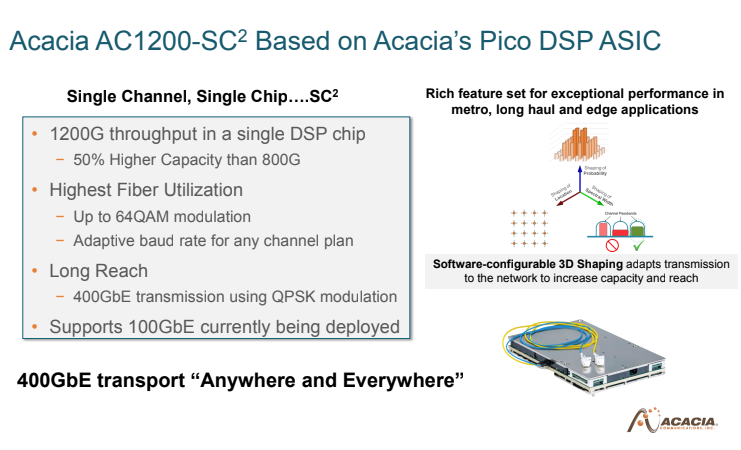 The AC1200-SC2 module leverages Acacia’s 3D shaping technology, which is designed to optimize fiber capacity and reach by filling gaps in margin and spectrum. The module is capable of adapting to any channel spacing up to 150 GHz.
 The Acacia AC1200 module supports transmission capacity of up to 1.2 Tbps in a footprint that is 40 percent less than the size of the 5” x 7” modules that support transmission speeds of 400 Gbps today.
 The FSP 3000 TeraFlex now optimizes all optical paths over every distance, ensuring the lowest cost per bit for any network. It achieves this through fractional QAM modulation, which switches between lower and higher schemes for maximum spectral efficiency, significantly boosting capacity or extending the reach of installed legacy infrastructure. This transforms existing carrier networks, with those designed for 10 Gbps channels able to transport 30 times more traffic and outperforming upgrades based on 200 Gbps by 50%.


