Wednesday, October 25, 2017

Cisco and Google Partner on New Hybrid Cloud Solution

Cisco and Google Cloud have formed a partnership to deliver a hybrid cloud solutions that enables applications and services to be deployed, managed and secured across on-premises environments and Google Cloud Platform. The pilot implementations are expected to be launched early next year, with commercial rollout later in 2018.

The main idea is to deliver a consistent Kubernetes environment for both on-premises Cisco Private Cloud Infrastructure and Google’s managed Kubernetes service, Google Container Engine.

The companies said their open hybrid cloud offering will provide enterprises with a way to run, secure and monitor workloads, thus enabling them to optimize their existing investments, plan their cloud migration at their own pace and avoid vendor lock in.

Cisco and Google Cloud hybrid solution highlights:


  • Orchestration and Management – Policy-based Kubernetes orchestration and lifecycle management of resources, applications and services across hybrid environments
  • Networking – Extend network policy and configurations to multiple on-premises and cloud environments
  • Security – Extend Security policy and monitor applications behavior
  • Visibility and Control – Real-time network and application performance monitoring and automation
  • Cloud-ready Infrastructure – Hyperconverged platform supporting existing application and cloud-native Kubernetes environments
  • Service Management with Istio – Open-source solution provides a uniform way to connect, secure, manage and monitor microservices
  • API Management – Google's Apigee enterprise-class API management enables legacy workloads running on premises to connect to the cloud through APIs
  • Developer Ready – Cisco's DevNet Developer Center provides tools and resources for cloud and enterprise developers to code in hybrid environments
  • Support – Joint coordinated technical support for the solution

"Our partnership with Google gives our customers the very best cloud has to offer— agility and scale, coupled with enterprise-class security and support," said Chuck Robbins, chief executive officer, Cisco. "We share a common vision of a hybrid cloud world that delivers the speed of innovation in an open and secure environment to bring the right solutions to our customers."

"This joint solution from Google and Cisco facilitates an easy and incremental approach to tapping the benefits of the Cloud. This is what we hear customers asking for," said Diane Greene, CEO, Google Cloud.

AWS launches NVIDIA Tesla V100 GPUs instances

Amazon Web Services began offering P3 instances, the next generation of Amazon Elastic Compute Cloud (Amazon EC2) GPU instances for compute-intensive applications that require massive parallel floating point performance, including machine learning, computational fluid dynamics, computational finance, seismic analysis, molecular modeling, genomics, and autonomous vehicle systems. The instances are based on NVIDIA Tesla V100 GPUs.

AWS said the new P3 instances allow customers to build and deploy advanced applications with up to 14 times better performance than previous-generation Amazon EC2 GPU compute instances, and reduce training of machine learning applications from days to hours.

P3 instances can combine up to eight NVIDIA Tesla V100 GPUs to provide up to one petaflop of mixed-precision, 125 teraflops of single-precision, and 62 teraflops of double-precision floating point performance. A 300 GB/s second-generation NVIDIA NVLink interconnect enables high-speed, low-latency GPU-to-GPU communication. P3 instances also feature up to 64 vCPUs based on custom Intel Xeon E5 (Broadwell) processors, 488 GB of DRAM, and 25 Gbps of dedicated aggregate network bandwidth using the Elastic Network Adapter (ENA).

“When we launched our P2 instances last year, we couldn’t believe how quickly people adopted them,” said Matt Garman, Vice President of Amazon EC2. “Most of the machine learning in the cloud today is done on P2 instances, yet customers continue to be hungry for more powerful instances. By offering up to 14 times better performance than P2 instances, P3 instances will significantly reduce the time involved in training machine learning models, providing agility for developers to experiment, and optimizing machine learning without requiring large investments in on-premises GPU clusters. In addition, high performance computing applications will benefit from up to 2.7 times improvement in double-precision floating point performance.”

Sprint's revenue declines but income rises as it gains subscribers

Driven by lower wireless and wireline service revenue, partially offset by higher equipment revenue, Sprint reported net operating revenues of $7.9 billion for the quarter declined $320 million year-over-year and declined $230 million sequentially.  Sprint reported operating income of $601 million and its highest fiscal second quarter adjusted EBITDA in 10 years at $2.7 billion.

Some highlights:

  • The company had 378,000 net additions in the current quarter compared with 599,000 in the year ago period and 61,000 net additions in the prior quarter.
  • Sprint ended the quarter with just over 54.0 million connections, including 31.7 million postpaid, 8.7 million prepaid, and 13.6 million wholesale and affiliate connections.
  • The company has had nearly 1.4 million net additions over the last four quarters.
  • Postpaid net additions were 168,000 during the quarter compared to net additions of 344,000 in the year-ago period and net losses of 39,000 in the prior quarter. 
  • Tablet and other device net losses of 111,000 in the quarter compared to 3,000 in the year-ago period and 127,000 in the prior quarter. 

“Sprint was able to deliver net additions in both its postpaid phone and prepaid business for the third consecutive quarter,” said Sprint CEO Marcelo Claure. “I’m even more proud that the team was able to deliver this customer growth while continuing to attack the cost structure, improve the network, and maintain positive adjusted free cash flow.”


Ixia issues warning on Reaper IoT botnet

Ixia warned that new botnet known as “Reaper” is gaining traction and attacking IoT devices, especially routers, using publicly disclosed vulnerabilities which have not yet been patched on these devices. There is concern that a new wave of DDoS or other attacks could follow.

Ixia's Application Threat Intelligence (ATI) Research Center began tracking “Reaper” during the first week of October.

Last year, an IoT botnet known as “Mirai” created havoc for enterprise cyber business through DDoS attacks utilizing bots made up of IoT devices.

Ixia has applied the Reaper’s IoT router compromises to its ATI service for the company’s BreakingPoint and ThreatARMOR solutions.

“Ixia suggests that any IoT device with public Internet facing connectivity be patched with the latest updates and be closely monitored,” stated Steve McGregory, Senior Director of Application Threat Intelligence at Ixia. “Network visibility is the ability to know what is in your network and what it is doing, and it is a key tenet to being prepared to defend and proactively mitigate weaknesses in your network.”


Intel ships Stratix 10 FPGA with ARM Cortex-A53

Intel has begun shipping a high-end FPGA family with an integrated quad-core ARM Cortex-A53. 

The ARM-based Intel Stratix 10 FPGA, which packs more than 1 million logic elements (MLE) with an integrated ARM processor, could serve multiple application categories, such as 5G wireless communication, software defined radios, secure computing for military applications, network function virtualization (NFV), and data center acceleration.

For NFV, Intel said its new FPGA can handle the high-speed data path while the integrated processors enable low latency transactions needed to manage flow tables for control plane processing. With hardware acceleration, Intel Stratix 10 SX FPGAs provide a heterogeneous computing environment to create optimized, low latency accelerators.

“With Stratix 10 SX, Intel reaffirms its ‘all in’ commitment to SoC FPGA devices combining integrated, flexible ARM cores with high-performance Intel Stratix® 10 FPGAs,” said Reynette Au, vice president of marketing, Intel Programmable Solutions Group. “We now provide a wide set of options for customer needing processors and FPGAs, with device offerings across the low-end, mid-range and now, high-end FPGA families, to enable their system designs.”

Skybox Security raises $150 million

Skybox Security, a privately-held company based in San Jose, California, raised $150 million in venture funding for its cybersecurity management software.

The Skybox Security Suite combines attack vector analytics and advanced threat intelligence to continuously analyze vulnerabilities in a customer's environment and correlate them with exploits in the wild. Skybox extends across complex networks, including those in physical, virtual, cloud and operational technology (OT) environments.

Skybox says it has a compound annual growth rate (CAGR) of 46 percent and positive cash flow (2014 ­– 2016).

The new funding includes $100 million from the CVC Capital Partners’ Growth Fund (CVC Growth) and $50 million from Pantheon.

Skybox was founded in 2002. The company is headed by Gidi Cohen.


F5 posts sales of $538m, rising services revenue

F5 Networks posted revenue of $538.0 million for its fourth quarter of fiscal 2017, up 2.4% from $525.3 million in the fourth quarter of fiscal 2016. For fiscal year 2017, revenue was $2.1 billion, up 4.8% from $2.0 billion last year. GAAP net income for the fourth quarter of fiscal 2017 was $135.7 million, or $2.14 per diluted share, compared to $108.9 million, or $1.64 per diluted share in the fourth quarter of fiscal 2016

“We finished fiscal 2017 on a solid note, delivering record fourth quarter and annual revenue and earnings,” said François Locoh-Donou, F5 President and Chief Executive Officer. “We are excited by the meaningful role we are playing in helping customers solve the complexity of deploying applications across on-premise and multi-cloud environments.


Mellanox Posts Q3 sales of $225.7 million - flat yoy

Mellanox Technologies reported Q3 2017 revenue of $225.7 million, up 0.7 percent compared to $224.2 million in the third quarter of 2016. GAAP gross margins were 65.7 percent, compared to 65.1 percent in the third quarter of 2016. GAAP net income was $3.4 million, compared to $12.0 million in the third quarter of 2016.

“We are pleased to achieve a record revenue quarter and resume our growth. Our third quarter Ethernet revenues achieved double digit sequential growth, driven by increasing deployments of our 25 gigabit per second and above products, which demonstrates our leadership position in these markets,” said Eyal Waldman, President and CEO of Mellanox Technologies. “During the third quarter, InfiniBand revenues declined seven percent sequentially mainly due to a large Department of Energy CORAL deployment in the second quarter. On a year-over-year basis, our InfiniBand high-performance computing and artificial intelligence revenues increased by double digit percentages."

Telefónica Colombia deploys Coriant Groove G30

Telefónica Colombia is deploying the Coriant Groove G30 muxponder DCI platform to deliver high-performance 100G interconnect solutions to large enterprises and web-scale Internet operators,

In addition to the recent deployment of the Groove G30 platform, the Coriant metro to long haul packet optical transport solution for Telefónica Colombia includes the latest features of the Coriant hiT 7300 Multi-Haul Transport Platform and the Coriant mTera Universal Transport Platform.

“We are pleased to support one of the most technically advanced networks in the region that is optimized to serve the needs of Telefónica Columbia’s customers today and into the future,” said Uwe Fischer, Executive Vice President, R&D and PLM, and Chief Technology Officer, Coriant.

Molex opens Silicon Valley Technology Center

Molex, a subsidiary of Koch Industries, has opened a technology center in Fremont, California. The facility will be one of the main innovation hubs for Molex Optical Solutions business and home to sales and customer development teams serving all of Molex customers in the region. 

The 108,000-sq. ft. building features over 50 miles of Molex Optical and Copper Cable Assembly Solutions, patch panels, adapter panels, modular office electronics and wire management tools. Advanced building capabilities include an intelligent, low-voltage Molex Transcend Network Connected Lighting System using a Power over Ethernet (PoE) LED lighting network to enable energy savings through sensor feedback.

Tuesday, October 24, 2017

OPNFV Project advances its Euphrates release

The OPNFV Project released its fifth software platform for facilitating the development and evolution of Network Functions Virtualization (NFV) components.

"With this initial integration of Kubernetes with the existing stack of open source network components, Euphrates enables NFV to make significant advances in the journey towards cloud native,” said Heather Kirksey, director, OPNFV. “Combined with a focus on XCI and modern DevOps practices, more efficient infrastructure, and enhanced operations capabilities, we’re witnessing the powerful culmination of three years’ worth of collaboration across a broad swath of open source communities, come to life.”

Key enhancements available in OPNFV Euphrates include:

  • Architecture - Euphrates brings Kubernetes and container integration with multiple components of the end-to-end stack, as well as the ability to deploy containerized OpenStack via Kolla, which provides production-ready containers and deployment tools for operating OpenStack clouds. These enhancements enable easier management of the infrastructure, support of cloud-native network applications in NFV, and lighter weight control plane capabilities as service providers prepare for edge architectures to support 5G and IOT.
  • Integration - access to the latest upstream code. Building on the continuous integration/continuous deployment (CI/CD) pipeline integration work in Danube, Euphrates introduced the implementation of the XCI integrated CI/CD pipeline amongst OPNFV, OpenStack, OpenDaylight, and FD.io. Instead of waiting for an official stable release, the OPNFV CI pipeline integrates the latest upstream code from these upstream projects in order to more quickly resolve bugs and validate features. This reduces the time it takes for feedback on a new feature or bug-fix from months to days, greatly increasing the pace of innovation. XCI also enables multi-distribution support and fosters closer developer relationships.
  • New carrier-grade features - integration of the new Calipso project proved operational visibility into complex virtual networks. When combined with telemetry enhancements in existing Barometer and Doctor projects, users have access to a powerful service assurance framework. Euphrates also includes performance improvements on the Arm architecture, and in Layer 3 performance with FD.io. Euphrates also brings security and user management capabilities with Moon, continued improvement in Service Function Chaining (SFC), FD.io, and new EVPN features. Euphrates also integrates the OVN network virtualization project along with the most recent versions of other upstream projects to provide additional choice in networking control options.
  • Enhanced testing and integration - includes an extensive set of tools to test the NFV cloud, VNFs, and complete network services. New projects—including Sample VNF, which provides testing of the VIM/NFVI layer with applications approximating real-life application workloads; and NFVBench, which provides an end-to-end dataplane benchmarking framework—have been introduced. Additionally, existing test projects have continued to evolve with new features, capabilities, and test cases.


AT&T revenues decline in Q3

AT&T recorded Q3 revenues of $39.7 billion, down from $40.9 billion in the year-ago quarter, primarily due to declines in legacy wireline services and consumer mobility. Net income totaled $3.0 billion, or $0.49 per diluted share, compared with $3.3 billion, or $0.54 per diluted share, in the year-ago quarter.

AT&T estimates it lost $100 million in sales due to hurricanes and earthquakes in the third quarter.

“We continued to operate our business efficiently in the quarter. At a time of transformation in our wireless and video businesses, as well as investment in growth opportunities, we’re able to maintain our full-year guidance. Wireless margins and phone churn continue to run at record levels, our fiber deployment is helping drive broadband growth and DIRECTV NOW had another strong quarter. We’re also pleased with our FirstNet progress. Already 27 states and territories have opted in, and we’re working closely with them as we prepare to deploy the FirstNet network,” stated Randall Stephenson, AT&T Inc. chairman and CEO.

Some Q3 highlights:


  • Expanding operating income margin of 30.5% with best-ever EBITDA margins of 42.0% and wireless service margin of 50.4%
  • Best-ever third-quarter postpaid phone churn of 0.84%, showing the success of video and wireless bundling strategy
  • Continued growth of postpaid smartphone base -3.0 million total wireless net adds
  • Nearly 700,000 Mexico net adds
  • 125,000 IP broadband net adds; 29,000 total broadband net adds
  • More than 6 million customer locations passed with fiber
  • Nearly 300,000 DIRECTV NOW net adds helped offset traditional TV subscriber decline. There are now 800,00 DIRECTV NOW subscribers
  • There are now 25 million total TV subscribers, down by 90,000 for the quarter
  • International revenues up 11.7% with continued strong revenue growth in Mexico
  • the Time Warner deal is expected to close by year end
  • in SDN, 45% of networking functions are now virtualized.

Juniper posts Q3 revenue of $1,257.8 million, trims outlook

Citing ongoing large deployment timing delays by some major customers, Juniper Networks reported Q3 expected net revenues of $1,257.8 million, a decrease of 2% year-over-year and 4% sequentially. GAAP net income was $174.4 million, an increase of 1% year-over-year and a decrease of 3% sequentially, resulting in diluted earnings per share of $0.46. Juniper's GAAP operating margin was 19.4%, a decrease from 19.5% in the third quarter of 2016, and a decrease from 19.7% in the second quarter of 2017.

Juniper also trimmed its Q4 forecast, saying it now expects Q4 revenues to be approximately $1,230 million, plus or minus $30 million.

"While we are disappointed in our third quarter revenue results which were impacted by timing of switching deployments, we have made significant progress on executing on our cloud strategy," said Rami Rahim, chief executive officer, Juniper Networks. "We believe our deliberate and intentional strategy of focusing on cloud-oriented architectures and solutions has resulted in a strong footprint and a compelling product pipeline. We are excited about the opportunity we have in front of us."


Sckipio hits 4 Gbps aggregate with G.fast

Sckipio has demonstrated over 3.1Gbps of download and 900Mbps of upload on production silicon using Gfast bonding running at 212Mhz on two bonded pairs of CAT-3 wiring (regular copper telephone wires).

The demonstration, which is being conducted at the Broadband World Forum in Berlin, Oct. 24-26, was developed in partnership with software company Civica. The demonstration uses Sckipio’s SCK23000 chipsets, Civica WanStaX software and the Microsemi WinPath network processor.

“Sckipio is pushing Gfast to astonishing speeds with production silicon,” said David Baum, Co-founder and CEO of Sckipio. “No other Gfast solution delivers end-to-end 212a profile bonding.”


ADTRAN offers next-gen mmWave Backhaul and Access with CCS

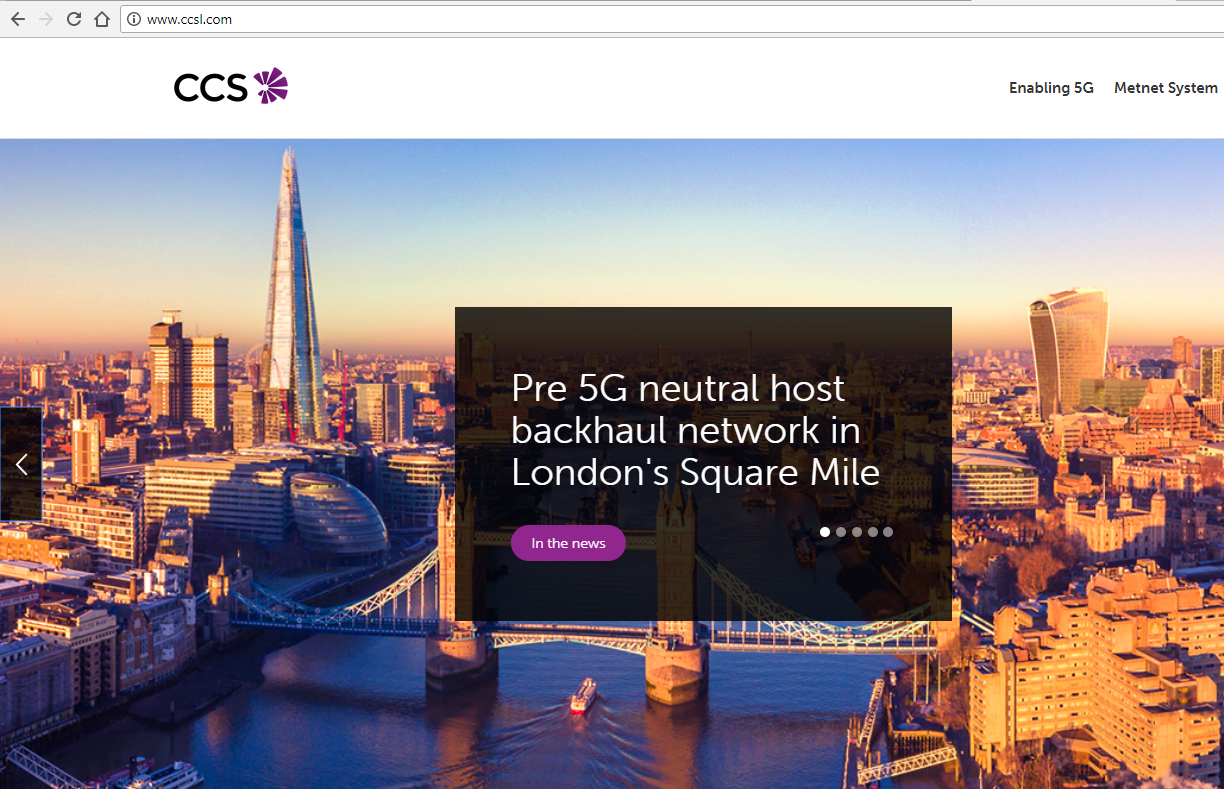
ADTRAN is teaming with CCS (Cambridge Communication Systems)  to deliver self-organizing mmWave technology for backhaul and access capabilities to wired and wireless operator.

CCS (Cambridge Communication Systems) is the creator of Metnet – a self-organising 5G microwave backhaul for small cell, 5G Fixed Wireless Access (FWA), CCTV and fibre extension applications.

ADTRAN said the global agreement with CCS forms the latest development in its Mosaic Open Network Alliance initiative. It complements ADTRAN’s existing SD-Access based NG-PON2 solution for 5G backhaul, featuring non-service impacting wavelength agility and ultra-low latency to safeguard the extraordinary SLA performance demands of 5G, IoT and other mission-critical services.

“The resiliency, scale and low-latency capabilities of the ADTRAN SD-Access based mmWave solution make it the clear choice for operators seeking an affordable and sustainable 5G rollout, specifically in those instances where backhaul fiber is initially unavailable or impractical,” said Hossam Salib, VP, cable & wireless strategy at ADTRAN.

“We see this open network alliance as driving value for customers around the world by bringing together the global technology leaders for both fixed and wireless access and backhaul solutions,” said Steve Greaves, CEO at CCS. “The combination of our pioneering wireless mesh/SON technology, with ADTRAN’s 5G-ready NG-PON2 solution, offers huge advantages to operators as they pursue next-generation service opportunities and roll out open, software-defined networks.”

ADTRAN Launches Mosaic Open Network Alliance


ADTRAN is establishing a Mosaic Open Network Alliance (Mosaic Alliance) to bring together market participants dedicated to delivering, demonstrating and testing open and proven SDN and NFV solutions. ADTRAN Mosaic serves as the foundation for this program. The company said this new alliance builds on the success of its Mosaic SD-Access platforms. Through the program, ADTRAN is providing operators around the globe a single point of reference for...

Ciena selected for New Batelco Gulf Network

Bahrain Telecommunications Company (Batelco), which is the incumbent carrier in Bahrain, has selected Ciena’s Converged Packet Optical Platform as the foundation for the new Batelco Gulf Network (BGN), which will connect all the countries across the GCC (Gulf Cooperation Council) in the Arabian Gulf region. Financial terms were not disclosed.

BGN will operate state-of-the-art OTN infrastructure as an alternative to more vulnerable submarine cables. The BGN terrestrial fibre cable extends 1,400km and is managed by Batelco with full control and manageability and can be interconnected with other regional and global cable systems for access to onward connectivity to Europe, Asia, Africa and the rest of the world.

Batelco Chief Global Business Officer Adel Al-Daylami said that Batelco chose to invest in the Batelco Gulf Network as a fully owned and managed terrestrial fiber optic cable network, thus providing the country a new state of the art international gateway that will enable Bahrain to meet the growing demand for data services and applications.

Ciena Vice President and General Manager EMEA, Keri Gilder said, “Ciena is delighted to partner with Batelco on the Batelco Gulf Network, which will enhance communications and deliver world class networking services for customers, and position Bahrain as a regional leader and innovator in telecoms services. Ciena is committed to supporting Batelco through our extensive global experience and expertise, and comprehensive professional services in the region, to deliver highly secure and reliable connectivity to Batelco and its customers.”


.

Monday, October 23, 2017

Cisco to acquire Broadsoft for collaboration software

Cisco agreed to acquire BroadSoft $55 per share, in cash, for an aggregate price of $1.9 billion. The companies said the deal is driven by the opportunities presented for business collaboration tools, especially integrated experiences across meetings, calling and contact centers, both on-premise and in the cloud.

Broadsoft, which is based in Gaithersburg, Maryland, is a leading provider of unified communications (UC) software and services. It Broadsoft Business product is an open communication suite with mobility and security features for enterprises. Its flagship BroadWorks application software lets service providers deploy an extensive portfolio of business communications and collaboration services from a common network platform. BroadWorks operates in IMS and next-generation network configurations, delivering services over traditional wireline, mobile (2G, 3G, VoLTE, WiFi), wireless and cable networks. In cloud UC call control new line shipments, Broadsoft claims the largest market share (followed by Cisco), with UC installations by 25 of the world's top service providers, for over 3 million lines installed.

As of the end of 2016, BroadSoft had 1,597 employees in 23 countries, including 732 in the U.S.

Broadsoft total revenues:

2012 - $165 million
2013 - $178 million
2014 - $217 million
2015 - $279 million
2016 - $341 million

"We are excited about this transaction, which represents the culmination of a robust process undertaken by BroadSoft's Board of Directors to maximize shareholder value," said Michael Tessler, president and CEO, BroadSoft. "As businesses continue to move toward the cloud in search of simplicity and speed, joining Cisco will allow us to deliver best-in-class collaboration tools and services. BroadSoft's hosted offerings, sold through the Service Providers and aimed at small and medium businesses, are highly complementary to Cisco's on-premises and enterprise-centric HCS offerings. Together, we can inspire teams to create, collaborate and perform in ways never before imagined."

"Cisco recently marked a significant milestone with our 200th acquisition. Acquisitions continue to be a core part of our innovation strategy and over the past two years have helped Cisco accelerate or enter areas such as IoT, application intelligence, AI, hyperconvergence and SD-WAN," said Rob Salvagno, vice president of Cisco Corporate Development. "With the addition of BroadSoft, we expect to accelerate the pace of innovation across our entire collaboration portfolio."

T-Mobile U.S. revenues rise 7% as it adds subscribers

T-Mobile U.S. reported record service revenues of $7.6 billion, up 7% year-over-year, and net income of $550 million, up 50% yoy. The carrier is expected to lead its peers on both metrics.

In a pre-recorded video statement, John Legere, President and CEO of T-Mobile, said "Just step back and look at these financial results - they’re incredible! Record service revenues, record free cash flow, record Q3 Adjusted EBITDA - and that’s on top of 18 quarters in a row with more than one million customers added."

There was no discussion about a possible acquisition offer or merger attempt with Sprint.

Some notable items from the quarterly report

  • Hurricanes - Costs attributed to the multiple hurricanes during Q3 amounted to $31 million. (T-Mobile's network is not fully restored yet in Puerto Rico).
  • ARPU is pretty stable - branded postpaid phone Average Revenue per User (ARPU) was $46.93 in Q3 2017, down 0.3% from Q2 2017 and down 2.5% from Q3 2016 primarily due to the continued adoption of T-Mobile ONE including taxes and fees. Branded prepaid ARPU was a record-high $38.93 in Q3 2017, up 2.4% from Q3 2016, primarily due to the continued growth of MetroPCS customers who generate higher ARPU, partially offset by negative hurricane-related impacts of $0.18.
  • Customer additions - during Q3, T-Mobile added 1.3 million users, bringing the total customer count to 70.7 million. Q3 2017 marks 18 straight quarters in which T-Mobile generated more than 1 million total net customer additions. Branded postpaid additions with 817,000.
  • 600 MHz update - at least 10 MHz covering more than 1.2 million square miles will be clear and ready to deploy in 2017
  • Big retail store expansion - 3,000 total new stores are planned for 2017, with 1,200 new T-Mobile and 1,300 net new MetroPCS stores opened year-to-date.
  • The carrier is raising its 2017 guidance for between 3.3 and 3.6 million new users.

ZTE wins 100G backbone project in India

ZTE has been awarded a 100G WDM Backbone Network Project and metro area network (MAN) construction contract with Idea Cellular, the third largest mobile operator in India with 189 million subscribers.

ZTE’s optical transport key product, ZXONE 9700, obtained 95% market share in the MAN project.

Financial terms were not disclosed.

The ZXONE 9700 is an OTN device with ultra-large cross-connect capacity. It supports up to 64T cross-connect capacity and 100G/beyond 100G rates for long-haul transmission.

SK Telecom tests 802.11ax at 4.8 Gbps

SK Telecom has demonstrated a next gen wireless system based on IEEE 802.11ax operating at up to 4.8 Gbps at its Bundang Center lab in South Korea.

The technology uses four antennas to transmit data and uses 160 MHz bandwidth, twice wider than the gigabit Wi-Fi service, and operates in the 2.4 GHz and 5 GHz spectrums. It leverages OFDMA, Multi-user MIMO as well as the Dynamic Sensitivity Control (DSC) technology.

Once the technology is commercially implemented, SK Telecom believe it will play a tremendous role in delivering sufficient wireless access in any dense traffic scenarios. 

“By introducing the technology for the next generation Wi-Fi that can deliver as fast as 5G technology, we at SK Telecom have successfully laid foundation to offer better mobile services,” said Park Jin-hyo, Senior Vice President and Head of Network Technology R&D Center at SK Telecom. Park added, “We are thrilled to work on the preparation on commercializing the technology and continue to innovate our capabilities to provide differentiated services to our customers.”