Wednesday, January 23, 2019

Jingfang Optotelectronics acquires Eindhoven-based Anteryon

Jingfang Optotelectronics (WLOPTs), which is based in Suzhou, China, has acquired Anteryon International B.V and Anteryon Wafer Optics B.V. Financial terms were not disclosed.

acquired the Dutch optical precision components and assembly designer and manufacturer Anteryon to steal a march on new opportunities.

Anteryon, which is based in Eindhoven, Netherlands, was spun off from Philips. The company is an assembly designer and manufacturer of precision optical components. Its core technologies comprise of IP and a proprietary world class replication technique to produce high-end hybrid optical lenses combined with ultraprecise glass and surface structuring, optical and mechanical coatings and opto-mechanical and -electronic assemblies including Hyper Spectral Imaging. Industrial applications range from semiconductor, industrial sensing/scanning, construction, agriculture, medical and security and consumer applications.

"This acquisition is an important milestone in WLOPTs long-term growth strategy and provides WLOPT with access to key technologies for the development of miniaturized optical solutions for high-volume consumer applications, such as smartphones, next-generation security and automotive applications," said Wang Wei, WLOPT's chairman. "By leveraging our core competencies in building mega scale service, technology and IP businesses, we believe that we can effectively enter emerging application areas related to the Internet of Things and Artificial Intelligence, next to current applications as 3D scanning, Imaging and Fingerprint while vertically integrating in the value chain. The Anteryon technology and renowned team of experts in micro-optics, combined with our resources, will strengthen our ability to provide radically distinctive solutions in a variety of high-growth, high-volume consumer optics applications."

"We are extremely excited about the vision, commitment, drive and innovation power of our new partner. The technology and innovation level and execution power of WLOPT is unique and guarantees a market introduction of the upcoming OptiL products in line with high-volume market demands," said Gert-Jan Bloks, CEO of Anteryon.

https://anteryon.com/

OIF to provide CEI-112G project update at DesignCon

At next week's DesignCon conference in Santa Clara, California,

The panel, called “112-Gbps Electrical Interface: An OIF Update on CEI-112G,” is scheduled for Thursday, January 31 at 3:45 pm (local).

Since 2000, OIF has defined Interoperability Agreements (IA)s for electrical interconnects known as CEI. CEI is a clause-based document that defines implementation details for interoperable electrical channels initially issued for 6 Gbps, then 11, 28, and 56 and includes definitions for multiple channel implementation topologies and will soon include 112 Gbps clauses. In August of 2016, OIF announced the first CEI-112G project in an overall effort that has now expanded to five projects.

“Previous CEI development has been highly influential and has been adopted, influenced or adapted by many other high-speed interconnect specifications throughout the industry,” said Tracy. “Given that the CEI-112G generation of high-speed transmitters, receivers and channels will be challenging to define, implement and measure, this panel will provide guidance to where the industry is headed and what the key challenge points are likely to be.”

Check the status of OIF’s current work in CEI-112G here: https://www.oiforum.com/technical-work/current-oif-work/#CEI-112G-XSR


Rakuten picks VIAVI to validate cloud-native mobile network

Rakuten, one of the world's leading internet services companies and soon to be the newest mobile network operator in Japan, selected the VIAVI TM500 system to support the rapid deployment of a nationwide, end-to-end cloud-native mobile network.

Rakuten offers e-commerce, fintech, digital content and communications services to over one billion members worldwide. The company received approval for its 4th generation mobile communications system (4G) special base station deployment plan, and is targeting October 2019 to launch the new service.

Rakuten's network will leverage cloud-based architecture, from the RAN to the core, an industry-leading level of automation, and collaboration with the top vendors in the mobile ecosystem.

Viavi said Rakuten will use its TM500 for user equipment (UE) simulation as part of a state-of-the-art operator lab, designed to simulate and stress the network from end to end. As consumers and regulators increasingly demand highly resilient and high-quality network performance, the lab's mission is to provide all stakeholders with a high degree of confidence in the quality of service and reliability of the live network for both existing and future services.

"Consumers across Japan trust Rakuten for services throughout their daily lives, from e-commerce to fintech to digital content, and we are immensely excited to prepare to deliver a new mobile network service to them this year, with the support of world-class technology partners such as VIAVI," said Tareq Amin, Chief Technology Officer, Rakuten Mobile Network. "As we aim to realize our vision for the world's first end-to-end cloud-native, nationwide mobile network, VIAVI's know-how and expertise in network testing will be key to building a high-quality, highly resilient network for our customers."

Confluent adds $125M in funding for business data streaming

Confluent, a start-up based in Palo Alto, California, announced $125 million in Series D funding for its live data streaming solutions based on Apache Kafka technology. The founders of Confluent created Apache Kafka while at LinkedIn to help cope with the very large-scale data ingestion and processing requirements of the business networking service.

Apache Kafka, an open source technology created and maintained by the founders of Confluent, acts as a real-time, fault tolerant, highly scalable messaging system. It is widely adopted for use cases ranging from collecting user activity data, logs, application metrics, stock ticker data and device instrumentation.

The company said 2018 was a banner year, with 3.5X subscription bookings growth year over year. During the year, the company launched its Confluent Platform 5.0, which introduced significant new capabilities, from making infrastructure more secure, reliable and easier to manage, to enabling more powerful applications with streaming data. Confluent made KSQL generally available and released theStream Processing Cookbook, which features KSQL recipes to solve specific, domain-focused problems using KSQL. The company also launched Confluent Hub, an online service for finding, reviewing and downloading extensions for the Apache Kafka and Confluent Platform ecosystems.

The latest funding round was led by Sequoia Capital, joined by existing investors Index Ventures and Benchmark. This brings Confluent’s total funding to $206 million.

“Industry-leading companies are re-architecting their businesses around real-time events,” said Jay Kreps, co-founder and CEO at Confluent. “With Confluent, companies can connect all of their applications and data sources, enabling them to react and engage their customers in a faster, more personalized and more efficient manner. We think event streaming has the opportunity to become as big a category in infrastructure technology as databases, and we’re excited to be creating that future.”

F5 posts revenue of $544 million, up 4% yoy

F5 Networks reported $543.8 million for its first quarter of fiscal year 2019, up 4% from $523.2 million in the first quarter of fiscal year 2018. Growth compared with the first quarter of fiscal year 2018 was driven by continued momentum in software solutions, which drove year over year product revenue growth for the third consecutive quarter.

GAAP net income for the first quarter of fiscal year 2019 was $130.9 million, or $2.16 per diluted share, compared to $88.4 million, or $1.41 per diluted share, in the first quarter of fiscal year 2018. Non-GAAP net income for the first quarter of fiscal year 2019 was $163.5 million, or $2.70 per diluted share, compared to $141.6 million, or $2.26 per diluted share, in the first quarter of fiscal year 2018.

For its Q2 of fiscal year 2019, ending March 31, 2019, F5 set a revenue goal of $543 million to $553 million with a non-GAAP earnings target of $2.53 to $2.56 per diluted share.

Xilinx posts record sales of $800M, up 34% yoy

Xilinx reported record revenues of $800 million for the third quarter of fiscal year 2019, up 7% from the prior quarter and up 34% year over year. GAAP net income for the December quarter was $239 million, or $0.93 per diluted share.  Non-GAAP net income for the December quarter was $237 million, or $0.92 per diluted share.

"I am very excited to report yet another record revenue and earnings quarter.  During the third fiscal quarter, we delivered revenues of $800 million, representing 34% year over year growth. Based on the guidance we are providing for the fiscal fourth quarter, we expect to exceed $3 billion in annual revenues for the first time in our history. In addition to the robust revenue growth, we also demonstrated strong profitability by posting over 60% growth in non-GAAP operating income and over 40% growth in non-GAAP diluted earnings per share year over year.  We continue to execute to our strategy and drive growth across our portfolio," said Victor Peng, President and Chief Executive Officer.

ADTRAN posts Q4 sales of $140 million

ADTRAN posted Q4 2018 sales of $140.1 million, compared to $126.8 million for the fourth quarter of 2017. Net loss was $8.4 million compared to a net loss of $11.1 million for the fourth quarter of 2017. Earnings per share were a loss of $0.18 compared to a loss of $0.23 for the fourth quarter of 2017. Non-GAAP earnings per share were a loss of $0.12 compared to earnings of $0.05 for the fourth quarter of 2017.

ADTRAN Chairman and Chief Executive Officer Tom Stanton stated, “Operating results for the final quarter of 2018 came in largely as expected with strong international revenue growth and an increase in U.S. tier 1 sales allowing the company to offset its normal sequential seasonal trend. International revenue contributed 46.6% of the total with strong contributions from the Asia-Pacific and LATAM regions. Our customer engagements increased, centering around our comprehensive portfolio of software-defined access, 10G solutions and G.fast products. During the quarter, we also acquired SmartRG, a leading provider of open-source connected home platforms and cloud services, whose software approach to delivering both hardware-based and virtualized solutions will enable us to extend the value of our open, programmable and web scalable Mosaic Cloud platform."

Santec introduces Liquid Crystal on Silicon spatial light modulator

SANTEC introduced a high-power, durable LCOS spatial light modulator (SLM) with enhanced Liquid Crystal on Silicon (LCOS). The SLM-300 has been tested to withstand up to 200 Watts of power, making it the world’s most durable SLM. Target applications include high-power laser processing, 3D-Printing and IC trimming applications.

Features

  • 100 times higher power durability (up to CW 200 Watts in Visible ~ IR) compared to the SLM-200
  • High precision resolution, WUXGA (1920 x 1200) and Full-HD (1920 x 1080) support
  • 10 times higher relative phase stability (~0.002 πrad) than conventional products
  • 4 times superior 10-bit (1024 gray level) than conventional products


https://www.santec.com/en/14188

Airtel rolls out LTE 900 in Andhra Pradesh and Telangana

Airtel has begun rolling out LTE in the 900 Mhz spectrum band in the states of Andhra Pradesh and Telangana.

In Andhra Pradesh and Telangana, Airtel is already using 2300 Mhz (TD LTE) and 1800 Mhz (FD LTE) for its 4G network. The 900 Mhz deployment boosts in-building penetration. The carrier said it is also working on Massive MIMO and 4G Advanced and Carrier Aggregation to step up high speed network capacity and coverage.     

Recently, the company announced that it will expand its network in the Andhra Pradesh by rolling out 15,000 new sites and 3,000 km of optic fiber during FY 19 under its network transformation program – Project Leap.


Tuesday, January 22, 2019

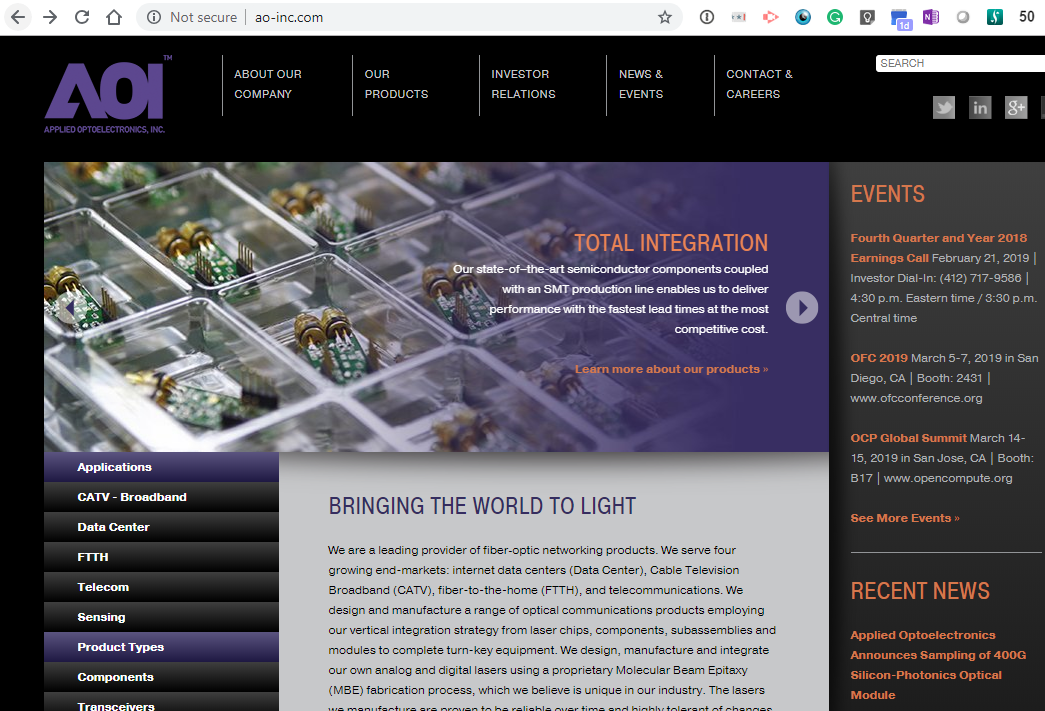
AOI samples 400G silicon-photonics module based on COBO

Applied Optoelectronics (AOI) has begun sampling 400G optical modules designed to demonstrate the feasibility of on-board optics (OBO), as outlined in specifications such as the recently-released version 1.1 of the onboard optical module specification published by the Consortium for Onboard Optics (COBO). AOI is an active member of COBO.

In contrast to traditional pluggable optical modules, OBO modules are designed to be used in higher-speed data switches, with interface speeds ranging from 400 Gbps to 1.6 Tbps. By designing the optical modules to be mated directly to a circuit board within such a switch, the OBO modules enable an increase in the density of optical interfaces to the switch, which in turn enables greater data throughput through the switch fabric, while also simplifying cooling and electrical interfaces, two areas where traditional pluggable modules have increasing difficulty as interface speeds increase.

AOI said its sample OBO modules are specifically designed for customers developing next-generation switches for large data centers, as these switches gradually evolve from 100 Gbps interconnects to 400 Gpbs, and higher. The modules currently leverage new silicon-based optical technology to support 16 optical channels with a total data throughput of 400 Gbps. Future versions of the device are expected to leverage the same silicon-photonics technology, but increase the bandwidth up to 100 Gbps per optical channel, ultimately enabling 1.6 Tbps of data throughput over a single OBO module. In turn, this would enable next-generation 12.8 Tbps switches to utilize only 8 optical modules, significantly improving density and reducing power consumption compared to a similar solution, which would require 32 400-Gbps pluggable modules.

“We gathered very positive feedback while demonstrating early 16-channel OBO prototypes at the European Conference on Optical Communications (ECOC) in Rome last year,” commented David Chen, AOI’s AVP of Transceiver Technology. “We are very excited to take the next step in offering samples to our customers. This OBO module incorporates several new technologies, including an advanced silicon-photonics based optical sub-assembly, which are the culmination of years of R&D effort by AOI and our technology partners. We believe that this platform will enable solutions well beyond 400 Gbps, and eventually, 1.6 Tbps.”

“AOI has made significant progress on the development of OBO modules since the publication of revision 1.0 of COBO’s specification,” stated Brad Booth, President of the Consortium for On-Board Optics. “AOI’s ability to sample OBO modules after their ECOC demonstration of an OBO prototype shows their commitment to bringing alternative solutions for the next generation of networking equipment. Having a single module footprint that supports bandwidth scaling from 400 Gbps to 1.6 Tbps provides flexibility to equipment vendors.”

http://ao-inc.com/news-events/applied-optoelectronics-announces-sampling-of-400g-silicon-photonics-optica

OFS intros rollable fiber ribbon backbone cable

OFS introduced its R-Pack Rollable Ribbon (RR) Backbone Cable in 24, 48 and 72 fiber counts. The R-Pack RR Backbone Cable, which meets Telcordia GR409 standards for horizontal backbone applications and NFPA 202 requirements, can be used in data center, central office and Fiber-to-the-Business (FTTB) applications.

OFS said that to form a rollable ribbon, 12 (twelve) 250 micron (µm) optical fibers are connected intermittently by
matrix material to form a very flexible ribbon. This design allows the ribbons to be rolled into very tight bundles, helping to double the fiber density of a cable. These fibers can then be unrolled into preorganized ribbon packages that help to reduce fiber crossovers and speed termination. The rollable ribbons can be spliced using traditional flat ribbon splicing machines and procedures.

Benefits of rollable ribbons include efficient and cost-effective mass fusion splicing, easy individual fiber breakout and fiber alignment that aids with multi-fiber connector terminations.

"This unique cable design combines plenum-rated materials with OFS rollable ribbons. The result is a cable that literally doubles the available fiber density in a highly-compact, robust cable that helps customers to substantially improve cable routing and save on space in demanding and congested pathways,” states Dan Hendrickson, Premises Cable Product Manager, OFS.

https://www.ofsoptics.com

Digital Realty brings Internet Exchange to Chicago and Ashburn, Virginia

Digital Realty is expanding its Internet Exchange service to Chicago and Ashburn, Virginia.

The Digital Realty Internet Exchange Platform, or “DRIX,” is currently available at the company's data centers in New York, Atlanta, Dallas, and Phoenix, connecting a variety of facilities within each of these metros to the peering platform. The service is a neutral, privately-owned Internet exchange that provides performance peering platform across a broad cross-section of carriers, cloud service providers and digital media companies.

“The explosion of IP traffic has created the need for a highly scalable, reliable and cost-efficient internet exchange solution,” said Digital Realty Chief Technology Officer Chris Sharp.  “Our track record as a stable, trusted business partner has enabled us to reduce the complexities of interconnection for our customers, deliver innovative ways to simplify provisioning and improve their network performance for a better end-user experience.”

VIRTUS Data Centres begins major expansion in London

VIRTUS Data Centres is embarking on the simultaneous construction of five additional data centres across its London sites.

VIRTUS, which is backed by ST Telemedia Global Data Centres (STT GDC), is committing over £500m to the launch of the five new data centres in the London market, and the completion of its existing four live sites in Slough, Hayes and Enfield. The five new sites, which go live in 2019 and 2020, will add 76MW to VIRTUS’ London portfolio, doubling the total portfolio size to 145MW. Construction is expected over the next two years.

  • Slough campus: VIRTUS is launching LONDON3, LONDON9 and LONDON10, delivering 36MW between them to add to its LONDON4 data centre. This will bring the total VIRTUS Slough Campus to 63MW, the largest on the Slough Estate. LONDON3, which completed its fit out in December 2018, is already more than 70 per cent contracted. LONDON9 and LONDON10 will go live in 2019 and 2020 and have anchor tenants already contracted. 
  • Stockley Park campus: the accelerated delivery programme of LONDON6 and LONDON7 follows the successful launch of LONDON5, hich went live in July 2018, offers 24MW of IT load, of which over 75 percent is now sold.  LONDON6 and LONDON7 will deliver an additional 40MW of data centre space.  When complete, the Stockley Park campus will deliver 80MW of power across four data centres which total 32,000 sqm of IT space connected by high-count fibre cables from all of the leading fibre owners and operators. 

Neil Cresswell, CEO of VIRTUS Data Centres commented: “VIRTUS and our global platform partners, ST Telemedia Global Data Centres and GDS are leading the market in providing our customers flexible, high quality colocation at scale. Our enterprise and cloud customers have capacity and speed to market challenges in key markets like London. Our ability to deliver large amounts of capacity, faster and at a lower cost than other operators is solving these issues for them. We believe this scale and speed are two key factors which led VIRTUS to achieve over 50 per cent market share in London in 2018."

BBC: Huawei chairman warns of end to global 'partnerships'

Huawei's chairman, Mr Liang Hua, warned that his company may end partnership programs in countries where it feels no longer welcomed, according to a BBC report filed from the World Economic Forum in Davos, Switzerland.

Over the past decade, Huawei was formed many partnerships with leading universities, carriers and even municipalities around the world.

Speaking to the Davos audience, Hua said says it remains committed to its £3bn investment in Britain but, if it faced further hurdles in doing business, it would go to where it is welcome.

https://www.bbc.com/news/business-46963971

Open-IX pursues better standards for data center interconnection and Internet exchanges

Open-IX, a non-profit industry association, is pursuing better standards for data center interconnection and internet exchange. The organization has ratified a new standard enabling non-profit organizations and Internet exchange community members to achieve Open-IX (OIX) certification at no cost. Identical to the costed version, the standard was approved in December 2018 and ratified by the newly elected board.

“We are proud to announce this new standard,” commented Rob DeVita, Executive Director. “We believe it will enable significant growth for OIX certified entities moving forward. We thank the community as a whole for bringing this idea to us and we are delighted to enact it so early in our tenure.”

The new Open-IX Board of Directors

Robert DeVita, Executive Director and Secretary (Mejeticks)
Aaron Hughes, Chairman (6connect, Inc.)
Eli Scher, Vice Chairman (New Continuum Holdings Corporation)
Corey J. Gallon, Treasurer (PricewaterhouseCoopers)
Sagi Brody, Director (Webair)
Matt Griswold, Director (United IX)
Arnold Nipper, Director (DE-CIX)

http://www.open-ix.org

BICS: Global 4G LTE roaming traffic up 95% in 2018

BICS, a leading international voice interconnection carrier, reported that 4G/LTE roaming traffic across its global network grew by over 95% in 2018 – almost double that of 2017.

BICS’ IPX platform, which includes LTE signalling, allows service providers to exchange IP traffic bilaterally to any IPX destination, through a single interconnection which manages service quality. Operators are able to establish roaming and inter-working agreements with other over 610 members on the network.

“4G/LTE roaming has opened up a plethora of opportunities for individual subscribers and businesses alike,” said Mikaël Schachne, VP Mobility Solutions, BICS. “However, when demand and reliance increase, so too must supporting infrastructure and service availability. European subscribers have enjoyed being able to ‘Roam Like at Home’ and now seek high quality, affordable roaming services, wherever they travel. This is forcing operators in other regions outside of the EU to match the European offering by coming together to offer more cost-effective packages to subscribers, while optimising traffic flow at the back-end.”

Since 2014, BICS’ 4G/LTE roaming footprint has grown by 316%, from 44 countries to 183. In the last five years, there has also been a 771% growth in the number of operators using BICS’ roaming solutions. While the total number of operators using 4G/LTE globally has grown from 70 in 2014 to 610 in 2018, the number using BICS’ LTE solution has now reached 200, giving the company a 30% market share.

IDC: LTE Router/Gateway market to hit $1.9 billion in 2022

The LTE router/gateway market will grow from approximately $804.2 million in 2018 to $1.9 billion in 2022 at a compound annual growth rate (CAGR) of 27.4%, according to a new report from IDC. Regionally, North America will remain the largest consumer of LTE routers/gateways, but Asia/Pacific, including Japan and China, will grow the fastest over the forecast period supported by continued expansion and/or densification of macro LTE networks in the region.

"The enterprise LTE appliance market is seeing rapid uptake globally, prompting incumbent suppliers and new players to seek differentiation to demonstrate value. Some are focusing on the software layer, or wireless SD-WAN, while others are leaning on their technology heritage in addressing IoT requirements. Whatever the strategy, branch, mobile, and IoT are emerging as the three main use cases for LTE routers and gateways," said Patrick Filkins, senior research analyst, IoT and Mobile Network Infrastructure.

IDC highlights three main use cases that LTE router/gateway suppliers are moving to address:

  • Branch connectivity: Products designed for stationary, onsite functionality are often integrated with LTE, WiFi, and wired functionality. In addition, solutions often incorporate enhanced security features (e.g., firewall, threat management). An overarching software-defined component, often delivered from the cloud, can be incorporated to deliver enhanced management and coordination.
  • Mobile connectivity: Mobile LTE routers are often affixed to vehicles, rail systems, or other "on the move objects" that require connectivity. An emerging use case is for public safety networks, including first-responder networks, where cellular connectivity can meet the stringent demand for mission-critical communications.
  • Internet of Things/M2M: These solutions, which can be gateways, often offer a base feature such as protocol conversion but may incorporate the advanced features included in branch and mobile solutions as well.


https://www.idc.com/getdoc.jsp?containerId=US44528618

IDC: 5G network infrastructure market to grow at 118% CAGR

The worldwide 5G network infrastructure market is expected to grow from approximately $528 million in 2018 to $26 billion in 2022, according to IDC's inaugural forecast for this market segment, and representing a compound annual growth rate (CAGR) of 118%.

The 5G network infrastructure market includes 5G RAN, 5G NG core, NFVI, routing and optical backhaul.

IDC expects 5G RAN to be the largest market sub-segment through the forecast period, in line with prior mobile generations.

In addition to 5G NR and 5G NG core, procurement patterns indicate communications service providers (SPs) will need to invest in adjacent domains, including backhaul and NFVI, to support the continued push to cloud-native, software-led architectures.

"Early 5G adopters are laying the groundwork for long-term success by investing in 5G RAN, NFVI, optical underlays, and next-generation routers and switches. Many are also in the process of experimenting with the 5G NG core. The long-term benefit of making these investments now will be when the standards-compliant SA 5G core is combined with a fully virtualized, cloud-ready RAN in the early 2020s. This development will enable many communications SPs to expand their value proposition and offer customized services across a diverse set of enterprise verticals through the use of network slicing," says Patrick Filkins, senior research analyst, IoT and Mobile Network Infrastructure.

The report, Worldwide 5G Network Infrastructure Forecast, 2018-2022 (IDC #US44392218), presents IDC's inaugural forecast for the 5G network infrastructure market. Revenue is forecast for both the 5G RAN and 5G NG Core segments and each of the three related sub-segments (NFVI, Routing Backhaul, and Optical Backhaul). The report also provides a market overview, including drivers and challenges for communications service providers and advice for technology suppliers.

MACOM expands GaN-on-Si power amplifier portfolio

MACOM Technology Solutions expanded its GaN-on-Si power amplifier portfolio with the introduction of its new MAMG-100227-010 broadband PA module optimized for use in land mobile radio (LMR) systems, wireless public safety communications and military tactical communications and electronic countermeasures (ECM).

The new device leverages high-performance MACOM GaN-on-Si to achieve an extremely wide frequency bandwidth of 225 – 2600 MHz, with 10W CW output power, 40% typical power added efficiency (PAE) over the band, 22 dB typical power gain, and up to 36V operation (28V typical). Provided in a compact 14x18 mm air-cavity laminate package with integrated gold-plated copper heatsink, the MAMG-100227-010 can eliminate the need for additional componentry and PCB space required for unmatched PA architectures, with top and bottom accessibility for improved mounting and heatsinking agility.

“The MAMG-100227-010 builds on MACOM’s rich legacy of providing high-performance GaN-on-Si solutions with field-proven reliability,” said Mark Murphy, Senior Director of Marketing, RF Power and Basestation, MACOM. “For customers seeking exceptional design flexibility, the MAMG-100227-010 exemplifies the design and application expertise that MACOM provides across a wide range of broadband frequencies and power levels.”

https://www.macom.com/products/product-detail/MAMG-100227-010C0L

Mellanox supplies 200 Gigabit HDR InfiniBand to Finnish IT Center for Science

Mellanox Technologies will supply its 200 Gigabit HDR InfiniBand solutions to accelerate a multi-phase supercomputer system by CSC – the Finnish IT Center for Science. The new supercomputers, set to be deployed in 2019 and 2020, will serve the Finnish researchers in universities and research institutes, enhancing climate, renewable energy, astrophysics, nanomaterials and bioscience, among a wide range of exploration activities. The Finnish Meteorological Institute (FMI) will have their own separate partition for diverse simulation tasks ranging from ocean fluxes to atmospheric modeling and space physics.

Mellanox said its HDR InfiniBand interconnect solution was selected for its fast data throughout, extremely low latency, smart In-Network Computing acceleration engines, and enhanced Dragonfly network topology.

HyperX hits DDR4 overclocking world record of 5608MHz

HyperX, the gaming division of Kingston Technology company, set a new overclocking world record for the fastest DDR4 memory frequency at 5608MHz.

Current Predator DDR4 memory modules ship in frequencies up to 4133MHz along with low latencies CL12-CL19. Predator DDR4 memory is Intel XMP-ready including certified profiles optimized for Intel’s latest chipsets and are compatible with many of AMD’s latest chipsets.

A sample Predator DDR4 module was used in this overclocking world record. New 8G modules are scheduled to launch in Q2 2019 in kits of two, at 4266MHz and 4600MHz.