Tuesday, December 15, 2015

Palo Alto Networks VNF Runs on Mirantis OpenStack

Mirantis and Palo Alto Networks announced a joint partnership and availability of Palo Alto Networks next-generation security as a virtual network function (VNF) within Mirantis OpenStack, a production-grade OpenStack distribution. The combination protects applications from cyberthreats while taking advantage of the agility, cost savings, and innovation of the OpenStack cloud ecosystem.

“OpenStack cloud environments are an attractive choice for many organizations because it gives them flexibility to accelerate innovation by rapidly deploying emerging technologies such as network function virtualization (NFV). We have teamed with Mirantis to give organizations next-generation security as a virtual network function (VNF) needed to operationalize OpenStack and effectively prevent successful cyber breaches,” said Marc Benoit, vice president of technical business development, Palo Alto Networks.

“As enterprises transition to a cloud infrastructure model, they migrate from hardware-based network services to a software-based, virtualized approach. Integrating Mirantis OpenStack with Palo Alto Networks VM-Series next-generation firewall is a good example of helping accelerate and secure this transition,” said Kamesh Pemmaraju, Mirantis vice president of product marketing. “Our Unlocked partner ecosystem makes it easy for companies to build an OpenStack cloud infrastructure with best-of-breed components.”

https://www.mirantis.com
http://www.paloaltonetworks.com

Telefónica Enters Alliance with MTN

Spain’s Telefónica Group announced a strategic alliance with the South African headquartered MTN Group.

The companies have agreed to work together to capture synergies in a number of strategic areas. Many of the initial areas are aiming to improve both companies’ stand in regards to Enterprise customers, including services to multinational companies in each other’s footprint, collaboration in M2M and new digital products and services targeting the B2B segment. Additionally, the Groups will also cooperate in various strategic initiatives and exchange best practices to capture the new industry opportunities. Both companies will also enter in discussions on how to engage effectively in International Wholesale, Devices and Network/IT Procurement.

The Strategic Partnership is supported by the Telefónica Partners Program, an initiative launched by Telefónica in 2011, which includes other leading telcos covering a total of 35
markets in Europe, Latin America, Asia and Middle East.

http://saladeprensa.telefonica.es

Zonamérica Installs Cisco for Business Park

Zonamérica, a special business park in Uruguay, has implemented a cloud-based Cisco collaboration solution to provide services to its clients.

This is the first project in Uruguay to deliver cloud-based services build on the Cisco Unified Computing System (Cisco UCS). The solution built for Zonamérica provides computing, storage, memory and software via an auto-provisioning system to the 200 customers within the park.

http://newsroom.cisco.com/

Monday, December 14, 2015

NTT Communications Develops SDN OAM

NTT Communications announced the development of a basic operations, administration and maintenance (OAM) function for software-defined networking (SDN) on multiple wide area networks (WAN). The new SDN OAM functions enable end-to-end network connection quality to be visualized on multiple WAN using link trace and loopback tests.

The new technology visualizes network topology by automatically collecting connection information on physical networks configuring SDN. It enables SDN operation and maintenance personnel to remotely monitor circuits and isolate problems and test circuits more accurately by verifying network connection quality and normality of link trace in end-to-end areas, even in WAN.

Key capabilities

  • Visualization of physical network topology: Visualizes the types of machines used in end-to-end networks.
  • SDN connectivity test: Identifies the end-to-end segment where trouble is occurring.
  • SDN link trace test: Tests for end-to-end continuity when establishing circuits or changing circuit paths.
  • SDN loopback test: Tests for loopback continuity when establishing circuits or changing circuit paths.

A demonstration of various verification tests for network normality using NTT Com's SDN OAM function technology will be conducted at Okinawa Open Days 2015, which will be held at Okinawaken Shichoson Jichikaikan in Okinawa, Japan from December 14 to 18.

NTT Com said it is now working to commercialize the technology for various environments involving SDN, including big data processing, high-quality broadcasting networks, enterprise global intranets, etc..

http://www.ntt.com/aboutus_e/news/data/20151214_2.html

Japan's O3 Project Announces First Milestones for Multi-Carrier, Multi-Layer SDN

Japan's "Open Innovation over Network Platforms" research and development (R&D) project, also known as the "O3 Project", announced the first milestones in its development of multi-carrier, multi-layer SDN, including the development of a database of expressions for integrating the optical layer of the network with packet layer.

The O3 project is supported by Japan's Ministry of Internal Affairs and Communications and includes the participation of Fujitsu, Hitachi, NEC, NTT Communications and NTT.
More: http://www.convergedigest.com/2014/03/japans-o3-project-announces-first.html


F5's CEO Steps Down Following An Issue of Personal Conduct

F5 Networks announced that Manuel Rivelo has resigned from his position of President and Chief Executive Officer, and as a member of the F5 Board of Directors, for matters regarding personal conduct unrelated to the operations or financials of the company.

John McAdam, Chairman of the F5 Board of Directors, has been appointed President and CEO until a permanent replacement is found. McAdam will remain a member of the F5 Board but will step down as Chairman in order to focus on his executive duties and actively lead the company forward. Alan Higginson, who currently serves as F5’s Lead Independent Director, has been appointed Non-Executive Chairman of the Board.

“I want to thank Manny for his many contributions to F5 over the past four years. Manny has been a key member of F5’s strong leadership team who have developed our current strategy,” stated John McAdam.

https://f5.com/

F5 Names Manny Rivelo as New CEO


F5 Networks appointed Manny Rivelo as its new President and Chief Executive Officer and a member of F5’s Board of Directors effective July 1, 2015. He succeeds longtime CEO, John McAdam, who will become Chairman of the Board of Directors upon his retirement on July 1st. Al Higginson, who has been on the F5 Board of Directors since 1996, and has served as Board Chairman since 2004, will remain on F5’s Board as Lead Independent Director.

Previously, Rivelo served as F5’s Executive Vice President of Strategic Solutions. Before joining F5 in October 2011, Rivelo was Senior Vice President of Engineering Systems and Operations for Cisco Systems.  He holds bachelor's and master's degrees in Electrical Engineering from the Stevens Institute of Technology. https://f5.com/

Marvell Intros 100GbE Gearbox Transceive for 4x25G

Marvell introduced a fully integrated, 100 Gigabit Ethernet (GbE) Gearbox with Multilink Gearbox (MLG) functionality. The MLG functionality aligns with OIF MLG 2.0 specifications, enabling aggregation of 10 independent streams of 10Gbps Ethernet or two independent streams of 40Gbps Ethernet to be multiplexed onto a 4x25Gbps stream.

The new Marvell Alaska C 88X5111 transceiver enables 100 Gbps full duplex transmission and performs all physical layer functions required for a variety of media, including single mode and multimode optical modules, copper backplanes, and passive and active copper direct attach cables. The 88X5111 line interface is fully compliant with IEEE 802.3BJ and supports the Reed Solomon Forward Error Correction (RS-FEC) function required for 100G-CR4, 100G-KR4 and 100G-SR4 operation, as well as auto-negotiation and coefficient training protocol required by IEEE 802.3 standards. The 88X5111 currently is sampling to Marvell’s global customers and will be sold as a standalone PHY, as well as with Marvell switches.

Key features:

  • Long reach line Serializer/Deserializer (SerDes) capable of compensating an Insertion Loss of up to 30dB without FEC
  • Integrated Reed-Solomon FEC capable of driving 100G-CR4 cables, 100G-KR4 backplanes and 100G-SR4 optical modules
  • MLG 2.0 Gearboxing functionality enabling aggregation of 10 independent 10GbE streams or two independent 40GbE streams to a 4x25G pipe
  • Integrated IEEE auto-negotiation and training protocol enabling seamless interoperability with IEEE-compliant devices from other vendors
  • Fully autonomous equalizer adaptation

“The 88X5111 further exemplifies Marvell’s commitment to delivering a robust portfolio of solutions for next generation data centers and enterprise networks with comprehensive features, increased integration, and reduced power consumption,” said Michael Zimmerman, Vice President and General Manager, Connectivity, Storage and Infrastructure (CSI) Business Unit at Marvell. “As the latest addition to our Alaska C family, the 88X5111 is unique in its support for all 100GbE media types – 100G-LR4 and SR4 optics, 100G-KR4 backplanes, and 100G-CR4 passive copper cables, giving flexibility in deployment that is critical to the end user. In addition, the Multilink Gearbox functionality integrated into the 88X5111 enables next generation switch ASICs with 25G/s I/Os to support 10GbE and 40GbE ports in a power- and cost-efficient manner.”

The device is manufactured with 28 nanometer lithography in a 17mm x17mm package footprint.

http://www.marvell.com/transceivers

Facebook Launches Innovation Challenge for Africa

Facebook is taking its Internet.org Innovation Challenge to Africa the aim of recognizing developers and entrepreneurs who are using the Internet to improve the standard of education and economic health in their communities. Developers across Africa are invited to enter the challenge.

Facebook will present an Innovation Challenge Award of US $150,000 to the app, website or service judged to be the best in two categories: learning/education and economic empowerment. Each Innovation Challenge Award winner will also receive a package of tools and services worth up to $60,000 from Facebook’s FbStart program. Two apps, websites or services in each category will receive an Impact Award prize in the amount of $50,000.

All entries must be received by May 1, 2016.

“The Internet.org Innovation Challenge in Africa supports our vision of a connected world by recognizing those who are working on solutions that aim to improve education and economic health of communities in Africa,” says Ime Archibong, director of strategic partnerships at Facebook. “We’re looking forward to seeing how African developers are providing real value for their communities. By connecting people and empowering them with access to services and information, we can help them achieve extraordinary things and help them to enhance their lives.”

https://info.internet.org/en/story/innovation-challenge

U.S. Department of Defense Approves Mellanox 10/40 Gig Ethernet Switches

The Defense Information Systems Agency (DISA) has approved the Mellanox SwitchX series of 10/40 Gigabit Ethernet switches for use on U.S. Department of Defense (DoD) networks. This move comes as a direct result of the DISA awarding Mellanox Federal Systems the Unified Capabilities Approved Product List (UC APL) certification for the Mellanox SwitchX series of Ethernet switches.

“Federal agencies of the U.S. government, specifically the Department of Defense, require the most advanced and high-performance networking solutions available,” said Dale D’Alessio, CEO of Mellanox Federal Systems. “These solutions must also adhere to the strictest security requirements to ensure data protection and guarantee that their system is up and running at all times. The UC APL certification is the latest confirmation that Mellanox has become the leading provider of the world’s fastest and most flexible Ethernet interconnect solutions that can be trusted by federal agencies to deliver unrivaled security and accelerated performance for their data centers.”

This UC APL certification is mandatory for all switch hardware to be sold for use on DoD programs of record and is testimony to the rapidly expanding success of Mellanox’s Ethernet switches being approved for use on large DoD tactical programs. The certification ensures that Mellanox Ethernet hardware can be utilized for the production system of the DoD network and also grants the hardware recognition from additional federal agencies and foreign governments.

http://www.mellanox.com

Cloudyn Raises $11 Million for Hybrid Cloud Monitoring

Cloudyn, a start-up based in Israel, raised $11 million in Series B funding for its hybrid, multi-cloud monitoring and optimization solutions.

Cloudyn's SaaS solution delivers insights into usage, performance and cost, coupled with actionable recommendations for optimizing performance and streamlining clouds for growth. The company said its tools help businesses select the right mix of cloud vendors (AWS, MS Azure, Google Cloud Platform and OpenStack), and enables "SmartSizing" of their cloud resources for maximum operational performance and control.

Currently monitoring more than 200,000 virtual machines and over 12,000 concurrent applications, Cloudyn will use the proceeds to further its market share and brand, as well as continue advancing first-to-market solutions to ensure customer delight.

The funding was led by Carmel Ventures, a member of the Viola Group, with participation of previous investors, Titanium Investments and RDSeed [a collaboration of Rafael and Elron Electronics (ELRNF)]. The company also announced that Ronen Nir, General Partner at Carmel, will join its Board of Directors.

“Cloudyn has been at the forefront of cloud monitoring and optimization for public and more recently, private cloud,” said Sharon Wagner, CEO of Cloudyn. “We have a superb team, disruptive technology, an ongoing commitment to product innovation, and it’s getting noticed,” he noted. “The funding will allow us to build on this momentum and increase our market share in North America and global markets.”

https://www.cloudyn.com

CellMining Raises $5 Million

CellMining, a start-up based in Israel, raised $5 million in Series A funding for its Self-Organizing Networks (SON) and subscriber network experience solutions.

CellMining's Behavior-Based SON solution analyzes the subscriber network experience in a unique way, identifying usage patterns to optimize network performance based on Customer Experience Management (CEM) metrics. This goes far beyond the capabilities of existing SON technologies, which offer mobile network operators (MNO) only limited ability to understand, measure and improve their subscriber experience. This disruptive technology aligns with a shift in the SON solution roadmap predicted by SNS Research in a recent report, which stated that implementations will start to focus towards optimizing end user experience by dynamically adjusting the network based on QoE (Quality of Experience) and QoS (Quality of Service) related information derived from the user.

The funding round was led by Lazarus Israel Opportunities Fund.

"No other company provides this depth of SON and CEM integration into a single platform, which delivers intelligent network optimization powered by subscriber experience analytics," said Greg Snipper, CEO of CellMining. "This investment acknowledges the rapidly-growing demand for CellMining's solutions, and will enable us to continue building the world's most advanced CEM-based SON technologies based on big data analytics. In the months ahead, we plan to significantly expand our operations in terms of both the technology and our market reach."

http://www.cellmining.com

BT's Openreach Uses ADVA FSP 150 for 10G EAD Service

BT's Openreach infrastructure division has deployed the ADVA FSP 150CC-XG210 as the foundation of its new, point-to-point 10 Gbps Ethernet Access Direct (EAD) service.

The new service is expected to cost a little more than twice the price of the current 1 Gbps service.

ADVA said its FSP 150 delivers strict service level assurance for carrier and enterprise applications through its extensive quality of service management.

“EAD 10G is going to bring substantial benefits to a great number of UK enterprises and we’re proud to have played such a big part in helping Openreach take this exciting leap forward,” said Sarah Mendham, sales director, ADVA Optical Networking.

http://www.advaoptical.com

Sunday, December 13, 2015

Blueprint: Predictions for 2016 and the Evolving Threat Landscape

by Derek Manky, Global Security Strategist, Fortinet

From the “just when you thought things couldn’t get worse” department…

2015 was not an easy year for cybersecurity, whether you worked for one of the countless organizations that got hacked, had to pay a ransom to decrypt files on your hard drive, or spent your days trying to stay ahead of increasingly sophisticated hackers and well-funded nation states. Unfortunately, 2016 looks to have more of the same in store, as well as new and emerging threats that will challenge both security vendors and the organizations and consumers they work to protect.

That IoT Thing

The Internet of Things (IoT) encompasses far more than just fitness trackers and fancy watches. To date, we’ve seen plenty of vulnerabilities in devices that range from surveillance cameras to industrial control systems to connected vehicles, but haven’t observed much in the way of actual attacks that exploit these vulnerabilities. One exception is Point of Sale (PoS) systems, malware for which now ranks in Japan’s top 10 list of malware in the wild and is a key platform for credit card theft.

However, in 2016, we expect connected devices to become strategic beachheads for attackers to “land and expand”, whether propagating malware among devices or, more likely, using the increasing number of IoT devices to gain entry to the corporate networks they access.  Because these corporate networks are already hardened against attack, new, less secure attack surfaces will be attractive targets for cybercriminals.

In many cases, this will require more sophisticated malware with ever smaller footprints, but we’ve already seen proofs of concept for malware that can persist and propagate on connected devices with miniscule amounts of available memory.  The notion of “headless worms on headless devices” is more than a catchy tag line. If we look back on the damage the Morris Worm was able to do back in 1989 with an attack surface of just 60,000 Unix servers (10% of which it was able to infect), imagine an attack surface of the 20 billion connected devices Gartner is predicting will be online by 2020.

Jailbreaking the Cloud

You’ve heard of jailbreaking your iPhone. Basically you install custom software to unlock all sorts of capabilities that are normally hidden from users. With this extra power comes a host of security risks, not to mention some dire warnings from Apple. This year, though, we expect to see malware begin “jailbreaking the cloud.”

What does that mean, exactly? Consider the Venom vulnerability that made headlines this year: attackers were able to exploit old floppy disk drivers to break out of the hypervisor on a virtualized system and gain access to the host operating system. Malware can (and will) be designed to crack the hypervisor on virtualized systems, making lateral movement to other guest operating systems and tenants much easier.

Because so many public and private clouds rely on virtualization to provide multitenancy, scalability, and agile infrastructure, this can have far-reaching impacts, both in corporate data centers and for cloud providers.

Additionally, many mobile applications, delivered both through public and corporate app stores, access cloud-based and virtualized systems. These systems may drive the user experience, provide data input and output on the back end, or capture data for a wide range of purposes. Compromised apps, then, as well as specific mobile malware, will become less of an annoyance or privacy concern and more of a vector for attackers seeking vulnerabilities in public and private clouds.

New Malware? Yes, Indeed

Vendors have gotten very good at detecting and blocking a range of malware. Standard client anti-virus applications can pick up known viruses and other malicious applications quickly, while cloud-based services and gateway antimalware provide extra layers of protection. The best are performing deep packet inspection to pick out not just known signatures but also suspicious behaviors, traffic associated with command and control servers, and other “indicators of compromise.”

Many companies are also adding sandboxing technologies to their networks that can observe the behavior of unknown or suspicious files in controlled environments before those files are allowed on a network. At the same time, malware authors are building in obfuscation and evasion technologies to make detection more difficult.

So-called “blastware,” for example, like the Rombertik virus that gained media attention this year, can render a vulnerable host computer unusable. This is really only a problem if Rombertik detects that it is being analyzed or altered and many of the headlines about the software were overly sensational, but the concept is important. Malware is getting smarter about the environment in which it is running.

We’ll see this play out more frequently in 2016 in “ghostware” and “2-faced malware”. Ghostware, as its name suggests, is designed to penetrate a system, steal particular types of data, and then leave without a trace, erasing itself and any indicators of compromise that security systems might detect. Without these indicators of compromise, organizations might not even know they had lost data, much less be able to conduct a forensic analysis to determine the extent or nature of the breach.

Two-faced malware detects when it is being examined in a sandbox and behaves like a benign file. When it clears the sandbox, it then completes whatever malicious action it was designed to execute. There are, appropriately, two major challenges associated with 2-faced malware:

  1. It’s very hard to detect, even with sophisticated sandboxing technology and
  2. Sandboxes generally feed threat intelligence back into a larger ecosystem and could result in a particular piece of 2-faced malware being automatically cleared by the system, enabling other instances to pass through security mechanisms unfettered.

Evolution, Not Revolution

2016, then, will be a year of evolving threats. Much of this we’ve seen before, if in less sophisticated forms. The arms race between the bad guys developing smarter and more effective malware and vendors creating more intelligent security products will continue and IoT will move from proof of concept vulnerabilities to a viable attack surface. As threats evolve, though, organizations will need to be increasingly mindful about their deployments, adoptions, and the devices and services on which they rely to conduct business.

About the Author

Derek Manky formulates security strategy with more than a decade of advanced threat research, his ultimate goal to make a positive impact towards the global war on cyber crime. Manky has presented research and strategy world-wide at premier security conferences. As a cyber security expert, his work has included meetings with leading political figures and key policy stakeholders, including law enforcement, who help define the future of cyber security. He is involved with several threat response and intelligence initiatives, including FIRST (first.org) and is on the board of the Cyber Threat Alliance (CTA) where he works to shape the future of actionable threat intelligence. Manky’s areas of expertise include FortiGuard, Threat Intelligence, advanced threat research, global war on cyber crime, Cyber Threat Alliance, zero-day vulnerabilities, mitigation advice and threat forecasts.

About Fortinet

Fortinet (NASDAQ: FTNT) protects the most valuable assets of some of the largest enterprise, service provider and government organizations across the globe. The company's fast, secure and global cyber security solutions provide broad, high-performance protection against dynamic security threats while simplifying the IT infrastructure. They are strengthened by the industry's highest level of threat research, intelligence and analytics. Unlike pure-play network security providers, Fortinet can solve organizations' most important security challenges, whether in networked, application, wireless or mobile environments -- be it virtualized/cloud or physical. Nearly 250,000 customers worldwide, including some of the largest and most complex organizations, trust Fortinet to protect their brands. Learn more at http://www.fortinet.com, the Fortinet Blog or FortiGuard Labs.

Friday, December 11, 2015

OpenAI Sets Out to Guide Artificial Intelligence Development

OpenAI, a new non-profit artificial intelligence research company, has set a course to guide the development of artificial intelligence technology "to benefit humanity as a whole, unconstrained by a need to generate financial return."

In a blog posting, the OpenAI team said it is "hard to fathom how much human-level AI could benefit society, and it's equally hard to imagine how much it could damage society if built or used incorrectly."

The endeavor is backed by $1 billion in funding commitments from prominent Silicon Valley figures, including Elon Musk, Reid Hoffman, Jessica Livingston, Peter Thiel, amongst other. Corporate backers include Amazon Web Services (AWS), Infosys, and YC Research.

OpenAI's research will be led by Ilya Sutskever, previously a leading researcher at Google and one of the world experts in machine learning. The technology team includes Greg Brockman, formerly the CTO of Stripe.

https://openai.com/blog/introducing-openai/

Another Buyer Bids for Atmel

Atmel confirmed the receipt of an unsolicited proposal to acquire all of the outstanding shares of Atmel common stock for $9.00 in cash per share. The name of the bidder was not disclosed.

Atmel said the offer also provided the option to receive, in lieu of cash, shares of the acquiror in an amount of up to $1.0 billion in aggregate value, based on a ten-day trailing average of the acquiror's closing stock price measured as of transaction close.

Atmel's board of directors, in consultation with its financial and external legal advisors, has determined that the proposal would reasonably be expected to result in a "Company Superior Proposal" (as defined in the Dialog merger agreement) and that the failure to participate in discussions or negotiations with the potential acquiror regarding the proposal would reasonably be expected to be inconsistent with the directors' fiduciary duties under applicable law.

http://ir.atmel.com/releases.cfm


  • On September September 20, Atmel entered into a merger agreement with Dialog Semiconductor plc.


India Grants National Long Distance license to NTT Com

The government of India has granted a National Long Distance license to NTT Communications India Network Services, a newly established Indian subsidiary of the Japanese carrier.

NTT Com anticipates launching India domestic network services by the end of this month. The launch will include IP-VPN and other reliable, high-quality connectivity services to meet the growing demands of companies such as automobile dealers and retailers with distributed sites across India. Customers will be able to use multiple local carriers for carrier-redundant access, one of the many ways NTT Com aims to provide secure, cost-efficient networks backed by strong service-level agreements for the mission-critical systems of its enterprise customers.

NTT Com will combine its new network services with managed-hosting and cloud services currently offered by another NTT Com subsidiary, Netmagic Solutions, which owns nine data centers in India.

Sharad Sanghi, the managing director and CEO of Netmagic, stated: “NTT Com – Netmagic will now offer world-class ICT solutions comprising secure, high-quality private-network services, including IP-VPN connecting data centers and the cloud to customers’ domestic sales or production bases. Netmagic, which launched its largest data center in Mumbai recently, is committed to constantly upgrading its product roadmap for data centers & cloud offerings.”

http://www.ntt.com
http://www.netmagicsolutions.com

CloudEndure Raises $7 million for Migration & Recovery Solutions

CloudEndure, a start-up based in Israel, announced $7 million in new funding for its cloud live-migration and disaster recovery solutions.

CloudEndure’s Cloud Workload Mobility technology creates an exact copy of an entire application at an alternative cloud location – at the touch of a button, within minutes, and with the latest data. CloudEndure supports physical, virtualized or cloud-based applications as the source and Amazon Web Services (AWS), Google Cloud Platform, Microsoft’s Azure and OpenStack as target cloud locations. The company was founded in 2012.

Infosys, a leading information technology services provider working with the world’s leading enterprises, co-led the round, along with previous investor, Magma Venture Partners. The new capital will enable CloudEndure to scale its sales and marketing operations to meet increasing demand for its enterprise-grade Disaster Recovery (DR) solution.

“We are excited to announce this investment and validation from Infosys and our existing investors,” stated Ofer Gadish, CEO of CloudEndure. “This new capital will enable us to scale our efforts to meet increased demand from enterprise companies seeking a new generation of DR solutions. We’ll also continue to innovate and extend our solution to meet the dynamic needs of our growing customer base.”

http://www.cloudendure.com


  • CloudEndure is headed by Ofer CEO, who previously was the CEO and Co-Founder of AcceloWeb and VP & General Manager in Limelight Networks after its acquisition of AcceloWeb.

First Intelsat EpicNG Satellite Arrives in French Guiana Ahead of Launch

The first of the Intelsat EpicNG series of High Throughput Satellites, Intelsat 29e, arrived at the Guiana Space Center ahead of its scheduled launch on an Ariane 5 rocket on the 27th of January 2016.

Manufactured by Boeing and equipped with the most advanced digital payload on a commercial spacecraft,

Intelsat 29e will bring High Throughput capacity in both C- and Ku-band to North and Latin America and the North Atlantic region. The satellite was manufactured by Boeing and is designed to be fully interoperable with the already deployed Intelsat satellite fleet and terrestrial infrastructure.

Intelsat named a number of customers in the region who have already committed to Intelsat EpicNG, include Compania Anonima Nacional Telefonos de Venezuela, BT Latam Venezuela, Anditel, S.A.S, Axesat, Amazonia Cabo Ltda., Cadena Ecuatoriana de Television C.A., Canal 10 CETV, Corporacion Nacional de Telecommunicaciones CNTE.P., Fox Latin America Channels do Brasil, Igrege Mundial do Poder de Deus, Radio e Televisao Banderantes and Telefonica del Peru.

http://www.intelsat.com/infrastructure/intelsat-epicng/


 Intelsat Plans "EpicNG" Broadband Satellites

Intelsat unveiled its EpicNG platform -- a new approach to satellite and network architecture utilizing multiple frequency bands, wide beams, spot beams and frequency reuse technology. EpicNG will be the company's next generation of satellites, promising higher throughputs and lower cost per bit. It will be a complementary overlay to the company's existing constellation of satellites and global IntelsatONE terrestrial network.

Target markets include wireless and fixed telecommunications, enterprise, mobility, video and government applications requiring broadband infrastructure across the major continents. Intelsat said its EpicNG platform will bring high throughput technology to its spectral rights in the C-, Ku- and Ka-bands. Customers will be able to use existing hardware and network topologies, and in many cases, define their own service characteristics, enabling them to offer customized solutions to their end users and build upon their current business success. Initially, the Intelsat EpicNG platform will feature two next generation satellites, and Intelsat is currently evaluating proposals by several manufacturers. These first two satellites, Intelsat 29e and Intelsat 33e, have projected in-services dates in 2015 and 2016, and feature wide coverage and high throughput capacity; combined they will serve every populated region in the world.

 "The Intelsat EpicNG platform represents the next generation of satellites, a progressive evolution of the Intelsat fleet," said Intelsat Chief Executive Officer Dave McGlade. "As the global demand for bandwidth surges and penetration of communications reaches ever further into developing regions and mobile applications, we are strategically investing in this platform to support our customers with a highly reliable and efficient broadband infrastructure as they launch new services and enter new geographies." “With Intelsat EpicNG, we will deliver innovation that creates immediate value for our customers,” said Intelsat SVP and Chief Technical Officer Thierry Guillemin. "As bandwidth demand grows, speed and throughput is critical. However, equally important is the operating environment. Our customers operate vast infrastructures, with millions of dollars invested in capital equipment and operational teams that must be managed efficiently. Intelsat EpicNG caters to this environment, with an architecture open to a wide array of network topologies and terminal technologies. Combined with multi-band frequency reuse, this is high throughput with the benefits of backward and forward compatibility. Operational excellence is core to our approach, and Intelsat EpicNG is designed to support the same in our customers’ businesses."
http://www.intelsatepic.com

Microsoft Looks to Build Huge Data Center in San Antonio

Microsoft has acquired 158 acres of land in San Antonio with plans to build one of the largest data centers in the country, according to a report from the San Antonio Business Journal.

Microsoft reportedly looks to break ground in the coming months on an eight-building data center campus of over 1 million square feet.  The company did not comment on the report.
feet.
http://www.bizjournals.com/sanantonio/news/2015/12/10/exclusive-microsoft-buys-nearly-160-acres-in-far.html

Microsoft Azure Takes Big Steps Forward

At its AzureCon 2015 event, Microsoft rolled out a number of big improvements to its Azure cloud platform centered around containers, security, infrastructure and the Internet of Things (IoT). The company also announced the availability of Microsoft Azure services in India from three regional data centers:  Central India in Pune, South India in Chennai, and West India in Mumbai


"We live in a connected world, and the intelligent cloud is powering it all,” said Scott Guthrie, executive vice president of Microsoft’s Cloud + Enterprise Division. “As data and devices continue to proliferate, there is vast opportunity for businesses to tap into their data to make their applications more intelligent

Highlights include:

General availability of Azure File Storage, featuring support of SMB 3.0 and the ability to mount file shares from anywhere (Azure or on-premises).

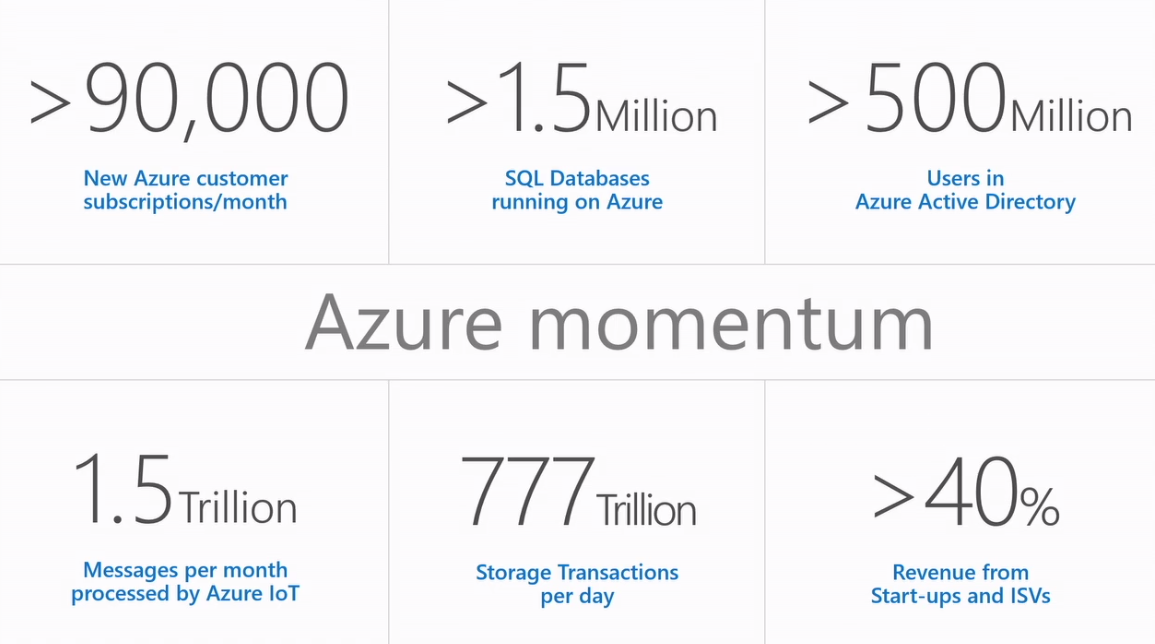
  • More that 40% of revenue on Azure comes from start-ups
  • 80% of Fortune 500 are using the Microsoft cloud.
  • New Azure Container Service -- building on work with Docker and Mesosphere to create and manage scalable clusters of host machines onto which containerized applications can be deployed, orchestrated, and managed. Azure Container Service makes it easier to create and manage clusters of hosts pre-configured with Docker, Apache Mesos, Marathon and Docker Swarm. This work couples Azure's hyper-scale and enterprise-grade cloud with proven open source technologies to deliver the foundation for the container deployment, orchestration, and management service any team building container apps will need.
  • New N-series, a new family of Azure Virtual Machines (VMs) powered by NVIDIA GPUs. Microsoft is the first hyper-scale provider to announce VMs featuring NVIDIA Grid 2.0 technology and the industry-leading Tesla Accelerated Computing Platform for professional graphics applications, deep learning, high-performance computing and more. A preview will be available in a few months.
  • New Azure Mobile Engagement -- a new SaaS-delivered, data-driven user engagement platform that enables real-time fine-grain user segmentation, app user analytics, contextually-aware smart push notifications and in-app messaging across all connected devices.
  • New Linux for Azure Data Lake -- aiming to make big data technology simpler and more accessible. Azure Data Lake makes HDInsight, which is Microsoft's Apache Hadoop-based service. Customers logging into the Azure Portal will now have a choice to select either Windows or Linux when deploying HDInsight. 
  • New Azure IoT Suite -- brings together preconfigured offerings to enable companies to leverage Azure Stream Analytics for IoT. The latest Stream Analytics updates include support for IoT Hub input the ability to output stream analytics to Azure DocumentDB.
  • New Azure CDN using the Akamai network -- integrating Akamai’s  CDN capabilities directly into the Microsoft Azure cloud platform. 
  • New Shared Access Signatures, delivering full parity with storage account keys and providing a more secure alternative to delegating access to storage users than storage account keys provide.
  • New Azure Storage client library for iOS.
  • The Azure Storage client library for Java will soon support client-side encryption complementing the existing capability in the Azure Storage client library for .Net.
  • New Azure support for the Financial Services Industry, including a detailed set of Payment Card Industry (PCI) and Data Security Standard (DSS) guidance describing Azure and customer shared responsibilities.

https://azure.microsoft.com/en-us/blog/

LookingGlass Acquires Cyveillance, Adds $50 Million in Funding

LookingGlass Cyber Solutions announced its acquisition of Cyveillance, a provider of open-source threat intelligence (OSINT), along with a $50 million round of Series C financing.

Founded in 1997, Cyveillance delivers an open source intelligence-led approach to security through continuous, comprehensive monitoring and analysis of millions of online data sources to protect client information, infrastructure, and employees from physical and online threats. The Cyveillance Cyber Threat Center, a cloud-based platform, combines web search, social media monitoring, underground channel information, and global intelligence with investigative tools and databases of threat actors, domain names and IP data, phishing activity, and malware to help identify risks and threats to every aspect of a business.


LookingGlass said the combination of its suite of threat and Internet intelligence driven solutions with Cyveillance’s customer-specific customized solutions focused on unstructured and open source intelligence enables broad visibility and unparalleled understanding of risks and threats across the entire Internet to help clients take swift, confident action on prioritized, relevant threats.

The new funding was led by NewSpring Capital. In addition to supporting the acquisition of Cyveillance, capital from the transaction will be used to fund further growth initiatives including product development, further product integration, international expansion, sales, marketing and customer support. ARC Securities advised LookingGlass on the acquisition and capital raise. In addition to NewSpring Capital, LookingGlass investors include Alsop Louie Partners and the Neuberger Berman Group.

This caps off a record year following the company’s $20 million Series B Funding and earlier acquisitions of CloudShield and Kleissner & Associates.

“Our acquisition of Cyveillance further advances our corporate strategy of delivering the most comprehensive threat intelligence capability in the market. The addition of Cyveillance allows LookingGlass to expand our coverage across the risk landscape helping security teams stay ahead of threats in an efficient and effective way,” said Chris Coleman, CEO of LookingGlass.

http://www.LGScout.com

Vonage Picks Velocloud for SD-WAN

Vonage has selected VeloCloud's Cloud-Delivered SD-WAN (Software-Defined Wide Area Network) technology to launch a new SmartWAN service.

Vonage SmartWAN will help to enhance the performance of mission critical applications such as Virtual Desktop, Software-as-a-Service (SaaS), CRM tools and Hosted Email. Additional benefits include QoS and brownout/blackout protection, as well as the ability to maximize bandwidth resources across multiple locations. The same technology also benefits customers with a single broadband connection.

Vonage chose VeloCloud Cloud-Delivered SD-WAN technology for its unique combination of Dynamic Multipath Optimization and on-demand remediation capabilities across multiple network connections or over a single connection. It also enables bandwidth on-demand, provides direct & optimal access to cloud-based applications, and simplifies deployment of services.

“Vonage is renowned for its commitment to providing reliable and high performance UCaaS voice and data services solutions in the cloud over both private networks and broadband connections,” said Sanjay Uppal, CEO and Co-Founder of VeloCloud. “Vonage’s choice of VeloCloud Cloud-Delivered SD-WAN technology for their next generation Managed UC and SD-WAN solutions is a great testament to the high quality, cost effective experience it delivers.”

“As businesses increase the usage of video, online collaboration tools and other cloud applications, maintaining the quality of shared bandwidth becomes vital,” said Sanjay Srinivasan, Vice President and Chief Technology Architect Business Engineering for Vonage. “Vonage SmartWAN complements the features and functionality of a company’s cloud-based unified communications solution with the added reliability they need to maintain Quality of Service and keep their businesses running smoothly.”

http://www.vonage.com
http://www.velocloud.com