Showing posts with label DPI. Show all posts

Monday, May 7, 2018

Gigalight launches 40km 100G Single Receiver Optical Modules for DPI

Gigalight, which is based in Shenzhen, introduced two 40km single receiver optical modules for Deep Packet Inspection (DPI) applications.

  • a single receiver 100G QSFP28 ER4 Lite optical module with a power dissipation less than 2.5W. This module uses a high-sensitivity APD detector (ROSA) with a receiving sensitivity up to -15dBm per channel (1E-12, @25G). This module increases the optical transmission budget for users and meets the optical transmission applications (optical fiber directly connected without splitting) up to 40km when the Forward Error Correction (FEC) function in the front of the system side is enabled.
  • a single receiver 100G CFP2 ER4 optical module with a power dissipation less than 3.5W. It uses the PIN photodetector (ROSA) and the miniaturized Semiconductor Optical Amplifier (SOA). At the same time, it adopts the SOA closed-loop adaptive gain control algorithm developed by Gigalight, which can quickly lock the working current of SOA and quickly adjust the amplification performance of SOA, to ensure that the receiver's acceptance sensitivity is as high as -21.4dBm per channel (1E-12, @25G). 
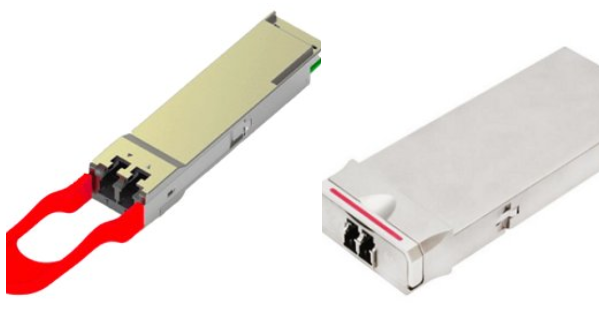
Gigalight said the optical interface of the front-end, DPI flow collection and distributary equipment needs to be upgraded from 10GE to 100GE ports. When the flow collection equipment cannot be placed in the same room as the analytics and storage, a long distance fiber transmission is needed.

http://www.gigalight.com/news_detail/newsId=431.html


Tuesday, December 6, 2016

Mellanox NPS-400 Processor Deliver 400 Gbps

Mellanox Technologies reported unprecedented packet processing performance of its NPS-400 Network Processor when using its newly released Deep Packet Inspection and Stateful Packet Processing software libraries.

Mellanox said these new software libraries, coupled with the hardware acceleration capabilities of the NPS-400, enable Deep Packet Inspection processing for application recognition at record breaking processing rates of up to 400Gbps, in conjunction with handling of 100 million flows with an average packet size of 400 bytes.

These processing capabilities could be used for Intrusion Detection Systems and Intrusion Prevention Systems and to accelerate processing capabilities for switch routers.

“Qosmos is very excited to collaborate with Mellanox providing a record breaking performance of Stateful Packet Processing and Deep Packet Inspection at 400Gb/s on the Mellanox NPS-400 solution,” said Thibaut Bechetoille, CEO of Qosmos. “Deep Packet Inspection drives L7 applications intelligence in the network and we expect further deployment of L7 services at more and more places in the network.”

http://www.mellanox.com/

Thursday, October 22, 2015

IHS: 15% Growth Forecast for Deep Packet Inspection

The global deep packet inspection (DPI) market is forecast to grow to $972 million in 2015, up 15 percent year-over-year, as communications service providers continue to use DPI as a key tool for bandwidth management and the creation of new services and features, according to a new report from IHS.

Some highlights:


  • There is renewed opportunity for DPI suppliers to address operators’ security concerns, leveraging their solutions to tackle network infrastructure threats such as distributed denial of service (DDoS) attacks, worms and viruses on a real-time basis
  • More than half the world’s internet traffic is likely to be encrypted by the end of 2015, driving interest in DPI systems that leverage heuristic classification to identify encrypted packets
  • The majority of the traditional DPI appliance suppliers had a challenging first half of 2015, but smaller players, particularly the embedded DPI suppliers such as Qosmos, saw healthy year-over-year growth


“While the major DPI suppliers are tackling the virtualization trend head-on, moving aggressively to introduce virtualized versions of their products and forge relationships within the NFV ecosystem, their customers are slower to jump on the bandwagon. Performance concerns remain an issue, and operators continue to be conservative with deployments of virtualized DPI technology,” said Shira Levine, research director for service enablement and subscriber intelligence at IHS.

http://www.infonetics.com/pr/2015/1H15-Service-Provider-DPI-Highlights.asp

Sunday, May 3, 2015

Infonetics: Virtualized Deep Packet Inspection (DPI) to Take Off

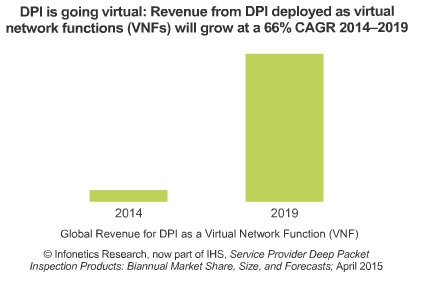
The market for deep packet inspection (DPI) solutions deployed as a virtual network function (VNF) will grow at a 66 percent compound annual growth rate from 2014 to 2019, according to a new report from Infonetics.

SERVICE PROVIDER DPI MARKET HIGHLIGHTS

  • The FCC has released its net neutrality rules in the US, but the issue is far from resolved and court challenges are underway; regulations in Western Europe are under reevaluation as well and the topic is rearing its head in emerging markets
  • The focus of the deep packet inspection market is shifting toward use cases such as video optimization, granular charging, network security and content connectivity
  • In machine-to-machine (M2M) applications, DPI technology is being used to enable better identification of traffic generated by connected devices and mitigate its impact on the network
  • Sandvine and Allot are neck-and-neck in the race for the DPI market share lead, followed by Cisco and Procera.

“As operators evaluate likely targets for virtualization as part of a larger network functions virtualization strategy, DPI is a clear target, though ongoing concerns around performance and capacity will constrain the market for virtualized DPI in the short term,” said Shira Levine, research director for service enablement and subscriber intelligence at Infonetics Research, now part of IHS.

http://www.infonetics.com/pr/2015/2H14-Service-Provider-DPI-Market-Highlights.asp

Thursday, February 27, 2014

Napatech Launches 40 Gbps Adapter

Napatech introduced a 4-port 10 Gbps adapter provides a full 40 Gbps of packet analysis in networking appliciances.

Napatech software provides hardware abstraction that allows up to eight network adapters in an appliance to appear as one, enabling up to 320 Gbps of throughput per appliance.

Napatech allows real-time data from multiple points in the network to be collected and merged into a single analysis stream, allowing for easier correlation of analysis data.

Precise merging is made possible by nanosecond precision time-stamping of every Ethernet frame, based on flexible support of multiple time synchronization schemes including IEEE1588-2008 Precision Time Protocol (PTP).

"Network equipment manufacturers are focused on improving efficiency, performance and cost. To stay ahead of the data growth curve, our customers will need higher capacity appliances with multiple analysis ports that help them reduce their time to market and risk. Our new 4 port 10G product and Napatech Software Suite addresses these needs. Napatech will continue to offer the broadest portfolio to enable unprecedented throughput with guaranteed delivery of data," stated Erik Norup, president and CMO, Napatech.

http://www.napatech.com

Tuesday, February 4, 2014

Procera Networks Introduces Service Plan Assurance

Procera Networks announced "Service Plan Assurance," enabling fixed and mobile operators to provide individual subscribers with real-time and historical score cards detailing application performance and traffic management impact.

This solution demonstrates to subscribers that they are getting the performance and quality of experience that the network operators are promising, making any network management policies enforced in the network transparent to end users. It uses Procera's PacketLogic solutions, which are able to ensure that the correct level of service is being delivered to the customer, as well as measure the impact of network congestion on the customer's end user experience. The operators' customer service team can also see a real-time and historical view of exactly what quality of service that user has been delivered, regardless of their location or the devices that they are operating.


"Service providers want to make a commitment to their subscribers that they will get the value they are expecting from their service plan choices," said James Brear, President and CEO of Procera Networks. "Procera's technology has always designed fairness and transparency into its PacketLogic™ traffic management products so that service providers implementing network management policies can readily understand the impact these algorithms have on their customers. By introducing our Service Plan Assurance solution we believe that our philosophy of fairness can be easily implemented and demonstrated to subscribers."

http://www.proceranetworks.com

Thursday, December 5, 2013

Video: Procera's Deep Packet Inspection Software Engine


Procera Networks' Network Application Visibility Library (NAVL) features next-generation Deep Packet Inspection (DPI) technology, providing real-time, Layer-7 application classification and metadata extraction for network traffic. NAVL uses a combination of deep packet inspection and application classification techniques to deliver industry leading coverage and accuracy of network traffic. 

NAVL is delivered as an OEM Software Development Kit (SDK) to dramatically reduce the time, cost and complexity of adding DPI technology and true Layer-7 application intelligence to your networking infrastructure device.   See video:


Tuesday, November 12, 2013

Infonetics: Deep Packet Inspection Segment is Hot

Driven largely by the mobile segment, spending on standalone DPI solutions to grow 30% year-over-year in 2013, according to a new report from Infonetics.  Mobile operators are turning to deep packet inspection (DPI) to better manage bandwidth use and to create innovative and bundled services.

As devices become more sophisticated, subscribers are using more bandwidth-intensive services such as video, and that trend will only intensify as operators roll out their LTE networks,” notes Shira Levine, directing analyst for service enablement and subscriber intelligence at Infonetics Research. “This is driving investment in DPI, often in conjunction with adjacent functionality such as policy, analytics, and real-time charging, to better monetize that usage and create more compelling offerings for the customer.”

Some highlights of the report:

  • The concept of "DPI inside" is gaining traction as manufacturers embed DPI into larger solutions such as video optimization, content charging, and service assurance.
  • Sandvine passed Allot to take the lead in the DPI market in the first half of 2013 (1H13).

http://www.infonetics.com

Monday, September 30, 2013

Intel to Acquire Sensory Networks for DPI Pattern Matching

Intel agreed to acquire Sensory Networks, a start-up which specializes in pattern matching and acceleration software technology, for approximately US$20 million.

Sensory Networks developed "HyperScan" high-speed, L4-L7 pattern matching software that accelerates deep packet inspection applications running on Intel processors.  The company was founded in Sydney Australia and is headed by Sab Gosal.

In 2012, Sensory reported that its HyperScan library delivers DPI throughput of 160Gbps with linear scalability, based on an intensive benchmark of HyperScan on a dual-socket platform (8-core, 16 threads per socket) using the new Intel Xeon processor E5-2600 family and Intel C604 chipset, scanning against a tier-1 commercial IPS signature set. HyperScan fully scales across Intel architecture, extending from the Intel Atom processor to the highest performing Intel Xeon processor.

http://www.sensorynetworks.com
http://www.intel.com

Tuesday, February 19, 2013

Cavium Advances TurboDPI Software for its OCTEON Processors


Cavium introduced TurboDPI II software for its OCTEON II processors.  The software includes up to nine major DPI functional modules.  Cavium's design ensures that data is only scanned once by the OCTEON's built-in hardware HFA DPI engines, and then the results are passed to the appropriate module.

The company said its TurboDPI II enables market-leading DPI performance and speeds up time to market for Enterprise Cloud, Data Center and 3G/4G/LTE Wireless equipment manufacturers.

"In the last two years, our TurboDPI product line has been taken up by a number of Tier 1 players in the 3G/4G infrastructure and Enterprise Markets," said YJ Kim, Vice President, Infrastructure Processor Division, Cavium. "Now with nine DPI modules, TurboDPI II provides new functionality for the Cloud and Data Center markets and will help service the ever growing demand for more fine grained network, application visibility and security."

http://www.cavium.com

Wednesday, January 23, 2013

Procera Networks Digs Deeper with Content Intelligence

 Procera Networks is enhancing its Deep Packet Inspection (DPI) technology with a PacketLogic Content Intelligence solution that is capable of correlating the categories of content consumed by broadband subscribers for up to 100 million URLs.

The content categorization occurs with minimal performance impact to any of the PacketLogic Real-Time Enforcement systems.

Procera Networks said a single one of its PL20000 platforms can replace several racks of competing content categorization or filtering solutions, in addition to performing Intelligent Policy Enforcement.

PacketLogic Content Intelligence solutions are currently in trials worldwide, and will be generally available in Q2 2013.

“From the service provider perspective, Procera is delivering the final piece of the puzzle in understanding and responding to what is happening on their networks,” said Jim Brear, president and CEO for Procera Networks. “In adding content categorization intelligence to location, subscriber and application intelligence, operators now have even greater control in delivering the highest quality of experience to consumers. This adds the dimension of content to our understanding of user context which is truly differentiating.”

The traffic landscape on the Internet is dramatically changing, with streaming video driving usage, social networks dominating consumer on-line activities, and traffic often secured using SSL.

http://www.proceranetworks.com/recent-press-releases/1101-procera-networks-launches-content-intelligence-solution.html

Monday, January 7, 2013

Procera Acquires Vineyard Networks for Enterprise DPI

Procera Networks agreed to acquire Vineyard Networks, a developer of deep packet inspection (DPI) technology for the enterprise market, for $28.0 million CAD, comprised of $15.4 million CAD in Procera common stock and $12.6 million CAD in cash.

Vineyard's Network Application Visibility Library (NAVL) is a deep packet inspection ( DPI) that provides real-time, Layer-7 classification of all network application traffic. It provides the application visibility that enables developers of firewalls, unified threat management (UTM) and other network security and management solutions to apply and enforce application admission, control and performance policies for their enterprise and service provider customers.  NAVL is delivered as a software developer kit for integration into network infrastructure platforms.

Procera said the acquisition will extend its Intelligent Policy Enforcement business into the growing Enterprise DPI market.

“Every network element will require intelligence. Our strategic vision is to enable networks of any size to have the intelligence needed to operate effectively. Procera directly addresses this need for service providers of all types through our PacketLogic solutions. Vineyard enables Procera to expand our total addressable market through their OEM business to include enterprise network equipment vendors, adding the entire enterprise space along with additional opportunities in the service provider OEM market. The addition of Vineyard, which has 34 employees mostly in engineering and product development, establishes Procera as the clear leader in the high-growth DPI market,” stated James Brear, Procera’s President and CEO.

Vineyard was founded in 2008 by Jason Richards (CEO), Derek Lownsbrough (CTO/VP R&D) and Josh Zieske (VP Technology Operations). Vineyard is based in Kelowna, British Columbia.

http://www.proceranetworks.com
http://www.vineyardnetworks.com


  • In December 2012, Vineyard announced that Xirrus licensed its Network Application Visibility Library (NAVL) for integration with the recently announced Xirrus Application Control platform.
  • In October, Vineyard announced that Riverbed licensed its Network Application Visibility Library (NAVL) deep packet inspection (DPI) engine.

Monday, October 22, 2012

Procera Cites Traction with Multiple Rural Wireless Internet Service Providers

Procera Networks cited new deployments of its PacketLogic systems by several rural Wireless Internet Service Providers (WISPs), including Utah Broadband, Evertek and United Farmer’s Telephone.   Procera's solutions are used for monitoring network usage, from individual subscribers to network-wide views of application and device adoption.

“I use the Service Delivery Dashboard, a cloud-based application service from Procera, on a daily basis to monitor high-level trends regarding network traffic,” said Roxanne White, CEO and general manager of Evertek and United Farmer’s Telephone. “For example, we now know the breakdown of different devices on the network, and our experience dictates that certain devices account for the majority of our support effort while others require substantially less attention from our help desk. We are considering incentive programs to drive subscribers toward devices that require less support from us. This will improve customer satisfaction, limit our support exposure and increase service revenue.”

http://www.proceranetworks.com

Friday, October 19, 2012

Infonetics: Mobile momentum drives DPI market to 34% CAGR through 2016


Driven by the increased use of DPI in wireless networks, the service provider deep packet inspection (DPI) market will grow at a 34% compound annual growth rate (CAGR) from 2011 to 2016, according to a new report from Infonetics.

Traffic management is still the primary use case for DPI technology, but we’re seeing a growing interest in folding DPI into larger solutions, such as video optimization, content caching, and usage-based billing,” notes Shira Levine, directing analyst for service enablement and subscriber intelligence at Infonetics Research. “This ‘DPI inside’ approach provides operators with the visibility into network traffic needed to enable new service models and pricing plans and to support new architectures like software-defined networks (SDNs).”

Some other key points:


  • DPI product revenue is on track to pass the $600-million mark this year
  • Mobile operators are deploying DPI hand-in-hand with LTE for more granular traffic management and to enable value-added services, tiered services, and sophisticated pricing models
  • Infonetics expects operators to push DPI deeper into the access network and eventually to the device level via enforcement agents that enable greater network and service control on smartphones, tablets, and set-top boxes

http://www.infonetics.com