Wednesday, February 21, 2024

Intel Foundry sets ambitious agenda for the AI era

Three years after returning to Intel as its CEO, Pat Gelsinger launched Intel Foundry as a “systems foundry business for the AI era.”

In a press event in San Jose, Gelsinger set a target to become the No.2 foundry globally by the end of the decade.   The idea of a “systems foundry” versus a traditional foundry is that a systems foundry approach offers full-stack optimization from the factory network to software. 

Gelsinger also unveiled an expanded process roadmap for Intel Foundry. He highlighted an expanding ecosystem of partners, and confirmed that Microsoft will be a lead  customer on the Intel 18A process. As a measure of progress,  Intel Foundry’s expected lifetime deal value is now greater than $15 billion. It will have to reach the $100 billion by the end of the decade for a chance to displace the industry’s current No.2 fab - Samsung.

Speaking via an online video link, U.S. Secretary of Commerce Gina Raimondo called for long-term investments to rebuild America’s manufacturing. Chips Act grants for Intel Foundry’s expansions in Arizona, New Mexico and Ohio are expected, but still pending.

“AI is profoundly transforming the world and how we think about technology and the silicon that powers it,” said Intel CEO Pat Gelsinger. “This is creating an unprecedented opportunity for the world’s most innovative chip designers and for Intel Foundry, the world’s first systems foundry for the AI era. Together, we can create new markets and revolutionize how the world uses technology to improve people’s lives.”

Some highlights from the event:

  •  Intel 14A is the newest and smallest node on the company's updated process roadmap  
  • Gelsinger affirmed that the five-nodes-in-four-years (5N4Y) process roadmap remains on track and that Intel will regain process leadership with Intel 18A in 2025.
  • The new roadmap includes evolutions for Intel 3, Intel 18A and Intel 14A process technologies. It includes Intel 3-T, which is optimized with through-silicon vias for 3D advanced packaging designs and will soon reach manufacturing readiness. 
  • Intel Foundry is collaborating with Taiwan-based UMC on new 12 nanometer nodes.
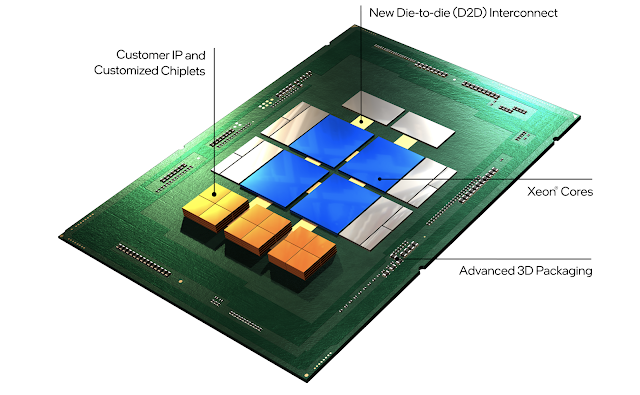
  • Intel also announced the addition of Intel Foundry FCBGA 2D+ to its suite of ASAT offerings, which already include FCBGA 2D, EMIB, Foveros and Foveros Direct.
  • Intellectual property and electronic design automation (EDA) partners Synopsys, Cadence, Siemens, Ansys, Lorentz and Keysight disclosed tool qualification and IP readiness to enable foundry customers to accelerate advanced chip designs on Intel 18A, which offers the foundry industry’s first backside power solution. 
  • Several vendors announced plans to collaborate on assembly technology and design flows for Intel’s embedded multi-die interconnect bridge (EMIB) 2.5D packaging technology. These EDA solutions will ensure faster development and delivery of advanced packaging solutions for foundry customers.
  • Intel also unveiled an "Emerging Business Initiative" that showcases a collaboration with Arm to provide cutting-edge foundry services for Arm-based system-on-chips (SoCs). 

Stuart Pann, senior vice president of Intel Foundry at Intel said, “We are offering a world-class foundry, delivered from a resilient, more sustainable and secure source of supply, and complemented by unparalleled systems of chips capabilities. Bringing these strengths together gives customers everything they need to engineer and deliver solutions for the most demanding applications.”


false

NVIDIA's data center revenue hits $18.4 billion, up 409% YoY

NVIDIA reported record quarterly revenue of $22.1 billion, up 22% from Q3, up 265% from year ago. Of this, data center revenue amounted to a record $18.4 billion, up 27% from Q3, up 409% from year ago. Non-GAAP earnings per diluted share was $5.16, up 28% from the previous quarter and up 486% from a year ago.

“Accelerated computing and generative AI have hit the tipping point. Demand is surging worldwide across companies, industries and nations,” said Jensen Huang, founder and CEO of NVIDIA.

“Our Data Center platform is powered by increasingly diverse drivers — demand for data processing, training and inference from large cloud-service providers and GPU-specialized ones, as well as from enterprise software and consumer internet companies. Vertical industries — led by auto, financial services and healthcare — are now at a multibillion-dollar level.

“NVIDIA RTX, introduced less than six years ago, is now a massive PC platform for generative AI, enjoyed by 100 million gamers and creators. The year ahead will bring major new product cycles with exceptional innovations to help propel our industry forward. Come join us at next month’s GTC, where we and our rich ecosystem will reveal the exciting future ahead,” he said.

Some Data Center highlights for the quarter

  • Launched, in collaboration with Google, optimizations across NVIDIA’s data center and PC AI platforms for Gemma, Google’s groundbreaking open language models.
  • Expanded its strategic collaboration with Amazon Web Services to host NVIDIA DGX Cloud on AWS.
  • Announced that Amgen will use the NVIDIA DGX SuperPOD™ to power insights into drug discovery, diagnostics and precision medicine.
  • Announced NVIDIA NeMo Retriever, a generative AI microservice that lets enterprises connect custom large language models with enterprise data to deliver highly accurate responses for AI applications. 
  • Introduced NVIDIA MONAI cloud APIs to help developers and platform providers integrate AI into their medical-imaging offerings. 
  • Announced that Singtel will bring generative AI services to Singapore through energy-efficient data centers that the telco is building with NVIDIA Hopper architecture GPUs.
  • Introduced plans with Cisco to help enterprises quickly and easily deploy and manage secure AI infrastructure.
  • Supported the National Artificial Intelligence Research Resource pilot program, a major step by the U.S. government toward a shared national research infrastructure.

false

Nokia taps NVIDIA for AI-ready RAN

Nokia is collaborating with NVIDIA on the future of AI-ready radio access network (RAN) solutions. The collaboration, which further enhances Nokia’s anyRAN approach, aims to position AI as fundamental to transforming the future of the telecommunications network business. 

Nokia will collaborate with NVIDIA on Cloud RAN solutions that leverage the NVIDIA Grace CPU Superchip for Layer 2+ processing, Nokia’s high-performance, energy-efficient In-Line Layer 1 (L1) accelerator technology, and Cloud RAN software. Additionally, Nokia will use NVIDIA GPUs for AI applications and vRAN acceleration, paving the way for AI-RAN.

The NVIDIA Grace CPU is based on the latest Arm Neoverse V2 CPU reference architecture, promising performance, power efficiency, and high-bandwidth connectivity covering all data center requirements. Nokia’s customers will benefit from diversity and choice in selecting CPUs for Cloud RAN networks. 

Nokia says this collaboration is a continuation of its flexible anyRAN approach that supports any purpose-built, hybrid or Cloud RAN environment. It’s designed to help customers get their Cloud RAN services up and running much faster, removing complexity and ensuring openness and flexibility. Nokia’s high-performance, energy-efficient In-Line acceleration architecture  integrates with all leading cloud or server infrastructures. Nokia has successfully performed end-to-end 5G data calls (Layer 3 calls) in multi-vendor setups with several partners. 

Tommi Uitto, President of Mobile Networks at Nokia, said: “This is an important collaboration with NVIDIA that will explore how artificial intelligence can play a transformative role in the future of our industry. It is a further example of our anyRAN approach that is helping to make Cloud RAN a commercial reality. The strength of our industry collaborations means we can drive efficiency, innovation, openness, and scale by delivering competitive advantage to operators and enterprises.”

Ronnie Vasishta, Senior Vice President of Telecom at NVIDIA, said: “Bringing the power of NVIDIA’s advanced computing to Nokia’s platform will deliver more performant and energy-efficient Cloud RAN solutions. Plus, as AI creates unprecedented transformational opportunities across industries, our collaboration with Nokia deepens AI-enabled innovation in radio access networks for improved operational efficiency in telecommunications.”

Nokia adds GenAI to its NetGuard Cybersecurity Dome

Nokia’s XDR security platform, NetGuard Cybersecurity Dome, will be integrated with a telco centric GenAI assistant to give enterprises faster and higher quality detection and resolution capabilities. The new telco-focused GenAI assistant is based on Microsoft Azure OpenAI Service with telecommunications and mission critical security training. The training incorporates a variety of categories of information, including: 3GPP and NIST network architecture specifications; 5G topology spanning RAN, Transport, and Core; and MITRE ATT&CK and FiGHT (5G Hierarchy of Threats) for mapping adversary tactics

Nokia says its AI assistant will be useful in countering cyber criminals who are increasingly using GenAI to launch more sophisticated attacks on critical infrastructure.

Nokia’s newly integrated Telco GenAI assistant tool is:

  • Expected to reduce the time it takes to identify and resolve a threat by up to 50%, depending on the nature of a cyberattack.
  • Based on large language models within Microsoft Azure OpenAI Service, which have been trained on insights from 5G Network architecture, 5G Security practices, and Nokia’s telco domain expertise.
  • Set to begin testing with several Nokia customers in the coming weeks and will be commercially available in the second quarter of the year.

Fran Heeran, Senior Vice President and General Manager, Product and Engineering, Cloud and Network Services at Nokia, said: “The combination of Nokia’s telecoms domain and security expertise with Microsoft’s leading generative AI solutions such as Azure OpenAI Service provides enriched and context aware outcomes. Combining Nokia’s NetGuard Cybersecurity Dome with the telco-centric GenAI assistant gives communication service providers and enterprises significantly more agility in mitigating destructive cybersecurity attacks on their mission-critical operations.”

Silvia Candiani, Vice President Telco and Media at Microsoft, said: “Microsoft’s leading Azure cloud and AI capabilities deliver massive efficiency gains for the most vital security use cases, so we are thrilled to combine forces with Nokia to enable this new and important GenAI assistant for NetGuard Cybersecurity Dome. We believe the joint solution will have a significant impact on the security capabilities of communication service providers and their customers.”

false

#MWC24 Preview: Telcos Will Operate on AI

AI will be the talk of MWC 2024, but what does this mean in practical terms?  How will telcos use AI to operate their networks? Andrew Coward, GM of Software Networking from IBM, explains:

  • The potential of AI in telecommunications: AI can be used to automatically detect and fix network issues, improve customer service, and even predict and manage network capacity during high-demand events like the Super Bowl.
  • The challenges in implementing AI: To fully leverage AI, the industry needs advanced analytics to understand user experiences, orchestration to manage network resources, and AI itself. Currently, these elements are not fully developed in the telecommunications infrastructure.
  • The importance of education: IBM is working with GSMA to create a training academy to educate industry professionals about AI and the necessary supporting technologies. This initiative is a crucial step towards the widespread adoption of AI in telecommunications.


https://youtu.be/ICNl4CXcwBM

Like our videos? Want to participate? Contact info@nextgeninfra.io

false

#MWC24 Preview: AI's Role in 5G & Spectrum Innovation

 How will AI impact 5G network operations? 

Chris Pearson, President, and Viet Nguyen, VP of Public Relations & Technology from 5G Americas explain:

  • The integration of artificial intelligence into the fabric of communication, enhancing network performance through automated networks and improved security.
  • The impact of AI on customers and enterprise applications, with a focus on network optimization and security.
  • The dawn of 5G Advanced and its technological advances, including 5G Red Cap, which will significantly impact the cellular IoT conversation and the private 5G marketplace.
  • The role of non-terrestrial networks in the 5G conversation, with a focus on satellite operators and direct-to-cell conversations.
  • The importance of monetization in the context of 5G advancements, emphasizing the need for continued investment in network capabilities and features.


https://youtu.be/RNGBHw5_bYA

Like our videos? Want to participate? Contact info@nextgeninfra.io

false

Dust Photonics raises US$24 million in Series B

DustPhotonics, a start-up based in Modi'in, Israel, raised US$24 million in Series B funding for its silicon photonics technology for data center and AI applications, 

The oversubscribed funding round was funded by a combination of prominent investors, including new and existing investors such as Sienna Venture Capital, Greenfield Partners, Atreides Management, and Exor Ventures.

DustPhotonics said it plans to use the funding to scale production of its Carmel-4 and Carmel-8 products, used for 400Gb/s and 800Gb/s applications and to accelerate development of its next generation products which will enable 1.6Tb/s applications.

"We looked at innovative technologies supporting the fast-growing AI compute market, and DustPhotonics stood out as a leader in this market due to their technology and customer traction," said Isabelle Amiel-Azoulai, Founding Partner at Sienna Venture Capital. "We are excited by the customer agreements and backlog that the DustPhotonics team has generated with its Carmel-4 and Carmel-8 products, and look forward to working with the DustPhotonics team to help the company in this next growth phase."

https://www.dustphotonics.com

false

Keysight and InterDigital demo AI channel emulation for 6G

At the upcoming #MWC24 in Barcelona, Keysight Technologies and InterDigital plan to demonstrate how AI channel estimators can be trained, integrated into a physical layer, and evaluated.

The companies expect that AI will be a foundational technology for 6G, where it will be used for channel estimation. When the channel estimation block is replaced with a neural network (NN), site-specific training data used for the NN can optimize its performance and robustness to new use cases.

The demonstration uses Keysight’s communications system-specific Electronic Design Automation (EDA) software to model a 3GPP physical layer and wireless channels. Instead of using the traditional channel estimation signal processing, this block has been replaced with various neural networks for channel estimation. The first NN was fully developed and trained by InterDigital and delivered to Keysight. The second NN was developed by Keysight and trained in two different ways. First using a combination of data generated by Keysight’s Electronic Design Automation System (SystemVue) software and then again using real-world measurement data. The demonstration compares performance and complexity of InterDigital and Keysight’s Machine Learning approaches to that of traditional channel estimation, and uses an EDA software environment and a real-world 144 GHz over-the-air environment.

Milind Kulkarni, Vice President and Head of Wireless Labs at InterDigital, said: “Through partnership with Keysight, we are able to extend our ability to validate AI solutions for wireless networks. These types of collaborations and their outcomes provide valuable insight and build industry alignment as we work to shape how AI will be used in both 5G and 6G.”

Giampaolo Tardioli, Vice President, 6G and Next Generation Technology at Keysight, said: “The world is embarking on a transformative journey to revolutionize the future of connectivity with the use of AI in wireless communications. Our collaboration with strategic partners like InterDigital enables us to hone our solutions and capabilities to meet the needs of our customers as they continue pushing the boundaries of what is possible when AI and wireless are combined.”

https://www.keysight.com

Lumos partners with STL on mid-Atlantic fiber rollout

Lumos, which provides fiber access to more than 275,000 homes and businesses across North Carolina, South Carolina, and Virginia, has named STL as a strategic partner in its ambition to build transformative 100% fiber optic internet in the mid-Atlantic region.

Lumos was an important part of STL's recently inaugurated fiber optic plant in Lugoff, South Carolina. More recently, senior executives from Lumos visited STL's R&D, glass preform, fiber and cable facilities in India.

STL will support Lumos in a significant part of this critical rollout. In this long-term engagement, STL will offer advanced, purpose-engineered optical fiber cable designs to meet Lumos' network requirements. STL has end-to-end optical capabilities and will also supply its signature Opto-bolt product, a pre-connectorized drop cable designed to significantly reduce installation time by de-skilling field installation while bringing modularity into the network design.

"In building out our large scale 100% fiber optic network, reliable partners with the latest fiber technology, local presence, and fast delivery are paramount," said David Smith, Chief Network Officer at Lumos. "I believe STL will be a great partner to help us deliver world-class, seamless fiber connectivity to our customers."


Tuesday, February 20, 2024

Blueprint: The Power of Open Infrastructure, Featuring StarlingX

by Ildiko Vancsa

In today's technology landscape, the prevalence of open source software is undeniable, with estimates suggesting that Free and Open Source Software (FOSS) constitutes 70-90% of modern software. Gartner says that over 95% of the IT enterprises across the globe use open source software for their mission-critical IT workloads, whether they are aware of it or not. Even governments are recognizing the importance of open source: the EU Commission, for example, embraces open source strategies to encourage sharing, contribute to the knowledge society, and build world-class public services.

So, what exactly is Open Infrastructure? It's IT infrastructure built with open source components. The popular LOKI(Linux, OpenStack, Kubernetes Infrastructure) stack is an example of Open Infrastructure. 

Another standout example of Open Infrastructure is StarlingX—a deployment-ready, scalable, and highly reliable edge infrastructure platform.

Open Infrastructure in Action: StarlingX

Overview of StarlingX's Open Source Components

The creators of StarlingX set out to reconfigure proven cloud technologies, including OpenStack, Kubernetes, Ceph, and QEMU/KVM, for large-scale deployments, whether local or geographically distributed. The result is a distributed cloud platform that is simple to deploy, operate and manage, while capable of running bare metal, VM and container workloads alike.

What Makes StarlingX Special

Modern software infrastructure stacks are often deployed on a large scale, with an increasing number of components distributed among sites in different geographies, which makes these environments inevitably complex. Deploying and managing these systems is no small task, with automation being the only path towards simplification.

The StarlingX platform has been designed and developed to provide the missing pieces to today’s software infrastructure components, to take them outside of the walls of large data centers without compromising on manageability or performance.

The project provides a fully integrated stack, which includes the Debian operating system with a real-time kernel. StarlingX utilizes container technologies on the platform level to package the infrastructure services, which makes the platform much more flexible and robust. By using Kubernetes for container orchestration, the ability to  manage infrastructure services as well as run containerized applications is available out of the box. At the same time, users have access to well-known APIs, whether they are running containers or orchestrating virtualized workloads through OpenStack.

StarlingX implements a distributed cloud architecture model, which means that users can deploy the platform in a geographically distributed configuration. In this scenario, operators are able to access and manage the end-to-end deployment from a central cloud, while having autonomous sites remotely, including at the network edge. This setup makes the platform much less sensitive to unreliable network connection between sites. At the same time, the ability to remotely manage and operate sites, with high levels of automation, simplifies infrastructure maintenance and brings the associated costs down.

The StarlingX project is designed and developed with high security standards, which includes periodic CVE scans, vulnerability management and a ever-growing number of related security features.

Beyond taking care of the infrastructure, the platform also provides features for mission-critical and high-performance applications, which makes it a prime candidate for a wide range of use cases. StarlingX is already highly utilized by the telecom sector in their backbone infrastructure to provide connectivity. These successful, large scale deployments help pave the way for more advanced use cases. 

Unique Features of StarlingX 

Here’s a quick recap of the features of StarlingX which demonstrate the power of this Open Infrastructure platform:

  • Engineered for Scale and Performance: StarlingX is tailored for distributed cloud and high-performance applications, providing deterministic low latency and a small footprint at the edge without compromising security.

  • Comprehensive Orchestration: The platform focuses on easy deployment, low-touch manageability, rapid response to events and fast recovery, ensuring efficiency in managing multiple sites in geographically dispersed regions.

  • Automated Operations: StarlingX enables fully automated certificate management and can scale operational support, making it ideal for applications in transportation, manufacturing, video, healthcare, energy, retail, smart cities and drones.

  • Telecom Integration: StarlingX is already deployed by telecom companies supporting 5G use cases. With telco-related features like Preciasion Time Protocol (PTP) support and O-RAN O2 interfaces, it excels in deploying thousands of  subclouds using Zero-Touch Provisioning.

Why Open Infrastructure Should Matter to You

Open Infrastructure, exemplified by StarlingX, offers several advantages over closed source alternatives:

  • Flexibility vs Vendor Lock-in: Open Infrastructure provides flexibility, allowing organizations to avoid vendor lock-in and choose solutions that best fit their needs.

  • Open Code vs Hidden Source: With open source, code transparency ensures trust and enables collaboration, fostering innovation.

  • Community Support vs Help Desk and Sales Calls: Open Infrastructure benefits from community support, encouraging collaborative problem-solving rather than relying on traditional help desk channels and increasing collective knowledge through information sharing.

  • Innovating Faster vs Reinventing the Wheel: Open source allows for faster innovation by building upon existing solutions rather than reinventing the wheel with proprietary alternatives.

  • Shared Burden on Common Dependencies vs High Maintenance Costs: Open Infrastructure shares the burden on common dependencies, reducing maintenance costs compared to closed source alternatives.

Conclusion: Join the Open Infrastructure Community

Open Infrastructure is the most effective way to develop technology globally and empower applications to fulfill their designed purposes. StarlingX serves as a compelling case study, showcasing the transformative potential of Open Infrastructure in diverse use cases. If you're passionate about making a difference, the Open Infrastructure community invites you to participate. Learn more at openinfra.dev and embrace the power of Open Infrastructure—it's what runs the world!

About the Author

Ildikó Vancsa is Director of Community at the Open Infrastructure Foundation. As part of her role, she is the Community Manager for the StarlingX open source distributed cloud project and a co-leader of the OpenInfra Edge Computing Group. Ildikó has been contributing to projects like OpenStack, Anuket and State of the Edge for over 10 years with focus areas of Edge Computing, Telecommunications and NFV. She is an open source evangelist and is using her experience to help individuals, companies and organizations to learn and get more involved and active in open source communities.

Spirent: Uplift expected in 5G Standalone this year

Based on its testing and validation work with more than 30 service providers over the past year, Spirent Communications is predicting during an uplift in commercial 5G Stand Alone (SA) in 2024. Spirent's newly released fifth annual 5G outlook report, based on . The “5G 2024: Market Drivers, Insights & Considerations” report, which is based on analysis and takeaways from over 500 new global 5G engagements, provides insights from across the 5G ecosystem on the status of 5G, revealing trends, geographical differences and future potential. 

“5G Standalone (SA) network deployments were delayed last year, in part due to the technical challenges of deploying and integrating new, cloud-native 5G Core technologies,” said Spirent’s Head of Market Strategy, Steve Douglas. “This year, however, we expect the market to pick up speed. For the first time, the demand for new 5G SA capabilities, and the supply of network equipment and devices to enable them, are finally aligned. Suppliers see a 5G market that’s ready to scale and demand for next generation 5G SA capabilities and the journey to 5G Advanced is ramping up.”

The most promising 5G trends include the following:

  • 5G SA and the new core – Despite slow commercial deployment momentum during 2023, Spirent’s Landslide 5G core test solution was selected by over 30 operators - a strong indicator of commercial 5G SA acceleration in 2024. With increased demand for testing the 5G core’s differentiated capabilities and a heightened focus on optimizing power consumption expect leading operators to prioritize on new revenue generating services and energy efficiency.
  • 5G SA is a catalyst for digital transformation – The move to 5G SA is becoming a primary business driver for network and OSS digital transformation programs especially around the use of automation across the network lifecycle. Based on our global engagements we estimate 20% of mature service providers have begun implementing DevOps and agile practices like continuous testing (CT).
  • 5G SA device and handset service experience testing - These engagements doubled with increased focus on the performance and experience of new services around immersive voice and video as operators look to launch new consumer and enterprise private network offerings.
  • Transport network testing – To cope with the 4-5x traffic growth seen by leading operators and in preparation of 5G SA leading operators began their 200/400G ethernet refresh cycles for IP Core backbones while 5G RAN deployments drove cell site gateway upgrades for 10/25G edge routers and the move to 100G at aggregation sites.
  • Non-Terrestrial Network testing – New low Earth orbit (LEO) satellite testing increased with industry focus on understanding performance capabilities and the technical and regulatory challenges related to delivering direct-to-device 5G services.
  • Private 5G testing - 2023 saw growing interest around early Release 17 capabilities including reduced capability (RedCap) while early commercial private network implementations were delivering return on investment (ROI) in as early as six months across a targeted set of use cases and a simplified network-in-a-box (NIB) deployment model.

The report also notes emerging and growing trends that Spirent is watching – areas where 5G is showing progress and potential, such as:

  • 5G Standalone – This is a market in infancy with 51 commercial deployments and limited population coverage. But momentum is growing as service providers prepare controlled growth deployments and device availability reaches critical mass.
  • Private 5G – More than 1,200 private LTE/5G networks have been commercially deployed over the last few years as pending SA deployments, lifecycle automation and security focused network slices could lead to more than 40,000 rollouts by 2027.
  • Open and Virtual RAN – The supply-side ecosystem comprises more than 50 suppliers, while demand-side support includes more than 30 service providers targeting meaningful coverage deployments through the second half of the decade.
  • 5G Advanced – As 5G Standalone (SA) upgrades accelerate, users will finally get a feel for what true 5G can offer. Right on its heels will be 5G Advanced, defined by 3GPP in Releases 18 and 19, it targets a wider set of industry use cases including immersive XR applications and expands the role of AI within the network.

The report is available to download here: www.spirent.com/5Greport


false

#MWC24 Preview: Top 5G Trends

Check out complete MWC Barcelona 2024 Showcase at: https://ngi.fyi/mwc24yt

Here's a look at the big trends for the upcoming MWC 2024 in Barcelona, courtesy of Steve Douglas, Head of Market Strategy from Spirent, based on their latest annual 5G report:

  • The perfect storm of 5G stand-alone supply and demand is expected to occur in 2024, with over 30 service providers set to commercially deploy the new 5G core network. This will offer increased and differentiated services to the market.
  • The emergence of new services delivered by the 5G core network, including voice over new radio, immersive video communications, and early versions of augmented reality. These services are expected to hit the market in mature markets where 5G stand-alone gets deployed.
  • The shift to 5G Standalone has triggered digital transformation in many service providers, becoming a primary business driver for OSS Transformations and the use of automation across the lifecycle. Over 20% of leading service providers have already started to implement techniques like DevOps, GitOps, and agile practices like continuous testing.
  • The expansion of open and virtual RAN, with over 50 suppliers providing radio units, distributed units, and centralized units for the new open RAN ecosystem. More than 30 service providers globally are targeting meaningful coverage deployments by the second half of this decade.
  • The move to 5G Advanced and non-terrestrial networks, with early movements in terms of capabilities expected to be out to pilot and trial by the end of the year, with a focus on non-terrestrial networks and direct-to-device communications.

https://youtu.be/txoCRg61rAc

For more detailed insights, watch the video and discover what's next in the world of 5G.

Like our videos? Want to participate? Contact info@nextgeninfra.io

false

#MWC24 Preview: Think APIs for Simplified Utilization of Networks

 Check out complete MWC Barcelona 2024 Showcase at: https://ngi.fyi/mwc24yt

APIs promise to simplify the interface between developers, users, and network infrastructure.  Harpreet Geekee, Co-founder and CTO from Shabodi, explains:

  • The current state of the market where network services are becoming intelligent assets and the industry's attempt to expose these services in a simplified, cohesive manner.
  • The challenges faced by application developers in deciding which interfaces to work with, and how this affects the adoption of their applications.
  • Shabodi's solution to these challenges: discovering and simplifying access to network services, enabling developers to use them without needing to understand the intricate details of the network. 


https://youtu.be/k5HueupbBnA

Join us as we delve into the future of network services and how Shabodi is making it easier for developers to harness their power.

Like our videos? Want to participate? Contact info@nextgeninfra.io

false

AT&T Dynamic Defense brings new network capabilities

AT&T will begin offering new security features embedded directly into the network without the need for extra equipment. The capabilities are derived from cyber threats detected across the AT&T network backbone, which carries more than 680 petabytes of data every day.

AT&T Dynamic Defense is offered to new and existing AT&T Dedicated Internet business customers in the following areas with a broader rollout expected later this year: Washington, D.C., Dallas, TX, Atlanta, GA, Houston, TX, Ft. Lauderdale, FL, Chicago, IL, New York, NY, Cleveland, OH, Los Angeles, CA, San Francisco, CA. The offering includes three package options to suit a variety of business needs, which are:

  • Standard, priced at $20/month, but is now being offered at no cost for the life of your AT&T Dedicated Internet Service.
  • Advanced, $175/month, includes the first two months at no charge, if you start your service before the end of 2024.
  • The Premium plan is set at $275/month.

“Cybersecurity is a core strength at AT&T, and we’re setting a new standard of connectivity, with security that starts at the network level,” said Rick Welday, Head of AT&T Business. “Our customers deserve our best effort when it comes to protecting their businesses and this innovative product offers a robust shield against cyber threats, enabling them to do more than they ever could before.” 

https://about.att.com/story/2024/dynamic-defense.html?source=EC00EM0000000000E&wtExtndSource=02202024&lctg=12632034

false

Cadence to offer optimized design flows for Intel Foundry Services

Intel Foundry Services (IFS) and Cadence Design Systems entered into a multiyear strategic agreement to jointly develop a portfolio of key customized IP, optimized design flows and techniques for Intel 18A technology featuring RibbonFET gate-all-around transistors and PowerVia backside power delivery. 

This will enable joint customers to accelerate their SoC project schedules on process nodes from Intel 18A and beyond while optimizing for performance, power, area, bandwidth and latency for demanding AI, HPC and premium mobile applications.

Fast-growing market segments, such as AI/ML, HPC and premium mobile computing, require the latest standards in IP to take advantage of advanced packaging and silicon process technologies. Cadence’s leading-edge implementations of trailblazing standards, such as advanced memory protocols, PCI Express, UCI Express and others for these key segments, enable joint customers to achieve scalable, high-performance designs that accelerate their time to market in IFS’ most advanced silicon technologies and 3D-IC packaging capabilities.

“We furthered our partnership with Intel Foundry Services through a significant strategic multiyear agreement to provide design software and leading IP at multiple Intel advanced nodes, thereby advancing Intel’s IDM 2.0 strategy and accelerating mutual customer success,” said Anirudh Devgan, president and chief executive officer at Cadence.

“We’re very excited to expand our partnership with Cadence to grow the IP ecosystem for IFS and provide choice for customers,” said Stuart Pann, Intel senior vice president and general manager of IFS. “We will leverage Cadence’s world-class portfolio of leading IP and advanced design solutions to enable our customers to deliver high-volume, high-performance and power-efficient SoCs on Intel’s leading-edge process technologies.”


Samsung Foundry’s Gate-All-Around supports Arm Cortex-X

Samsung Electronics Co. will deliver the next generation Arm Cortex-X CPU optimized on Samsung Foundry’s latest Gate-All-Around (GAA) process technology. 

The companies have bold plans to reinvent 2-nanometer (nm) GAA for next-generation data center and infrastructure custom silicon, as well as a groundbreaking AI chiplet solution that will revolutionize the future generative artificial intelligence (AI) mobile computing market.

“As we continue into the Gen AI era, we are excited to extend our partnership with Arm to deliver the next generation Cortex-X CPU, enabling our mutual customers to create innovative products,” said Jongwook Kye, executive vice president and head of Foundry Design Platform Development at Samsung Electronics. “Both Samsung and Arm have built a solid foundation from many years of collaboration. This unprecedented level of deep design technology co-optimization has resulted in a ground-breaking accomplishment, providing access to the newest Cortex-CPU on the latest GAA process node.”

“Our longstanding collaboration with Samsung has delivered multi-generation, leading-edge innovation,” said Chris Bergey, SVP and GM of the Client Business of Arm Inc. “Optimizing Cortex-X and Cortex-A processors on the latest Samsung process node underscores our shared vision to redefine what’s possible in mobile computing, and we look forward to continuing to push boundaries to meet the relentless performance and efficiency demands of the AI era.”

Samsung announced its initial production of 3nm Multi-Bridge-Channel FET (MBCFET™), based on Samsung’s GAA technology in 2022. GAA technology allows further device scaling beyond the FinFET generation, improving power efficiency with reduced supply voltage level, and enhanced performance with higher drive current capability. The GAA implementation approach with nanosheets structure delivers maximum design flexibility and scalability.


European Commission approves Orange + MASMOVIL in Spain

The European Commission gave permission to Orange and MASMOVIL to combine their operations in Spain in the form of a 50-50 joint venture. As part of its proposed package of remedies, the parties have agreed to divest to Digi as remedy taker 60MHz of spectrum assets (pending approval from the Spanish Government) and to propose an optional national roaming agreement at market conditions.  

This Joint Venture between MASMOVIL and Orange will create a leading operator of the Spanish market in terms of customers, user experience, talent, fiber and mobile coverage and a sustainable player with the financial capacity to continue investing in the development of a leading telecom infrastructure in Spain.

Both parties would convert into a leading operator, bringing together the assets, capabilities and teams of the two companies in Spain to serve +7.3M fixed customers, +30M mobile services and +2.2M TV customers. The Joint Venture would manage important network and IT assets to assure a nationwide coverage both in FTTH as well as 4G/5G. In financial terms, the combined entity would become a stronger and solid market player with estimated revenues of above €7.4 billion and EBITDAaL of over €2.3 billion, with an enterprise value of €18.6 billion and expected synergies of more than €450m per year (from year four post-closing).

Christel Heydemann, CEO of Orange, commented: “Today’s announcement is a crucial moment for the future development of the Group in Europe. Our proposed Joint Venture with MASMOVIL will create a single, stronger, and more sustainable player in Spain. By joining forces, we can scale, we can innovate, and we can drive investment in Spain for the benefit of consumers and businesses.” 

https://newsroom.orange.com/la-commission-europeenne-donne-son-feu-vert-au-projet-de-co-entreprise-dorange-et-de-masmovil-ouvrant-ainsi-la-voie-a-la-creation-dun-operateur-unique-de-premier-plan-en-espagne/?lang=en

false

Zayo adds Nicola Palmer to Board

Zayo announced the addition of Nicola Palmer to its Board of Directors.

Palmer previously was CTO of Verizon Wireless, she played a pivotal role in the strategy, deployment, and operation of 4G and 5G networks. She holds a BS in industrial engineering from The Pennsylvania State University and an MBA from the University of Pennsylvania’s Wharton School.

“Nicola’s addition to Zayo’s Board of Directors brings another top-tier advisor with proven leadership credentials and experience, directly related to our business strategies, and core products and services,” said Steve Smith, Chief Executive Officer of Zayo. “Looking ahead to Zayo’s future, we eagerly tap into Nicola’s extensive expertise to shape our strategy, benefiting from her decades of experience in driving innovation across the telecommunications and digital infrastructure sectors.”

https://www.zayo.com


Monday, February 19, 2024

GlobalFoundries lands $1.5B in CHIPS Act funding for new fabs

GlobalFoundries is set to receive $1.5 billion in planned direct funding as part of the U.S. CHIPS and Science Act.

The money will be used to expanding existing fabrication facilities as well as to build new capacity, including:

  • Expanding GF’s existing fab in Malta, New York, by adding critical technologies already in production in GF’s Singapore and Germany facilities. These added capabilities are geared towards enabling the U.S. auto industry. As vehicles transition from mechanical to electronic systems, the number of semiconductor chips in each car or truck continues to soar. This expansion is key to ensuring supply chain resilience for the growing demand and to delivering for GF’s automotive customers including General Motors. This will continue to diversify GF’s flagship Malta fab into new technologies and end markets.
  • Construction of a new state-of-art fab on the Malta campus to meet expected customer demand for U.S.-made essential chips across a broad range of markets and applications including automotive, aerospace, defense and AI. The new fab, which has already been granted some necessary permitting, will leverage the site’s existing infrastructure and ecosystem, enabling a fast and efficient path from construction to production. GF’s said the new fab will be uniquely positioned to capture the feature-rich mature, essential chip segment which is expected to continue to represent more than 60% of the semiconductor market. Construction of this new fab combined with expansion of GF’s existing site is expected to triple the existing capacity of the Malta campus over the next 10+ years. 

These two projects are expected to increase wafer production to 1 million per year once all phases are complete.

  • Modernization of GF’s longest continuously operated fab and the nation’s first and largest Trusted 200mm facility in Essex Junction, Vermont. The project will upgrade existing facilities, expand capacity as well as create the first U.S. facility capable of high-volume manufacturing of next-generation gallium nitride (GaN) semiconductors for use in electric vehicles, power grids, data centers, 5G and 6G smartphones and other critical technologies.

GF plans to invest more than $12 billion over the next 10 plus years across its two U.S. sites through public-private partnerships with support from the federal and state governments as well as from its ecosystem partners, including key strategic customers.

New York Governor Hochul unveiled a $575 million funding proposal for the New York State Green CHIPS initiative, aimed at backing two projects in Malta, New York. Additionally, a planned allocation of $15 million for workforce development activities at GlobalFoundries and $30 million for infrastructure enhancements and energy incentives, facilitated by the New York Power Authority (NYPA), were also announced.

“GF is proud to announce this proposed funding from the Department of Commerce and New York State and appreciates the collaboration of the CHIPS Office and the Empire State Development Corporation throughout this process. These proposed investments, along with the investment tax credit (ITC) for semiconductor manufacturing, are central to the next chapter of the GlobalFoundries story and our industry. They will also play an important role in making the U.S. semiconductor ecosystem more globally competitive and resilient and cements the New York Capital Region as a global semiconductor hub,” said Dr. Thomas Caulfield, president and CEO of GF. “With new onshore capacity and technology on the horizon, as an industry we now need to turn our attention to increasing the demand for U.S.-made chips, and to growing our talented U.S. semiconductor workforce.”

“Semiconductors are in everything from our cellphones, to refrigerators, to cars, and our most advanced weapons systems, and access to them carries important economic and national security implications. It was the shortages of semiconductors during the COVID-19 pandemic that raised prices for consumers and led to the shutdown of automobile manufacturing sites across the country,” said Secretary of Commerce Gina Raimondo. “Thanks to the CHIPS and Science Act, we’re working to onshore these critical technologies in order to bolster the supply of domestic chips that are essential to manufacturing cars, electronics, and national defense systems in New York, Vermont, and states across the country.”

Customers expressing support for the GF announcements included: AMD, General Motors, Lockheed Martin, and Qualcomm.

https://gf.com/gf-press-release/globalfoundries-and-biden-harris-administration-announce-chips-and-science-act-funding-for-essential-chip-manufacturing/

  • GlobalFoundries was established in 2009 through the merger of AMD's manufacturing arm and the Advanced Technology Investment Company. In 2010, GlobalFoundries acquired Chartered Semiconductor in 2010, significantly boosting its manufacturing capabilities and global footprint. 
  • The Malta, New York, facility, Fab 8, was announced in 2009, shortly after GlobalFoundries was created from the divestiture of AMD's manufacturing arm. The site was chosen for its strategic location and the incentives offered by the state of New York. 
  • In 2015, GlobalFoundries acquired IBM's microelectronics division, which included semiconductor manufacturing facilities, technology, and intellectual property. This acquisition was part of a strategic move by GlobalFoundries to expand its technology portfolio and manufacturing capabilities. As part of the deal, IBM paid GlobalFoundries $1.5 billion to take over its semiconductor operations, which included several manufacturing plants and a significant number of IBM employees transitioning to GlobalFoundries. 

Plans to create a competing national fixed NetCo in the UK

Virgin Media O2, together with its shareholders Liberty Global and Telefónica, unveiled plans to create a distinct national fixed network company (NetCo) that will underpin full fibre take up and roll out across the UK. The goal is to establish the biggest dedicated fixed network challenger in the country, offering clear wholesale choice at scale for other providers as a major alternative to BT’s Openreach. 

Key Highlights:

  • NetCo, a fully consolidated subsidiary of Virgin Media O2, will have a neutral impact on the company's leverage and credit structure.
  • It will encompass Virgin Media O2's cable and fibre network assets, currently covering 16.2 million premises across the UK, all of which will be upgraded to full fibre in the near future.
  • Aligned with Virgin Media O2's existing network strategy, NetCo will prioritize completing the ongoing fibre upgrade program, which involves overlaying the existing cable network with full fibre.
  • The structure of NetCo allows for flexibility in terms of financing, potential altnet consolidation, and pursuing wholesale opportunities as a scaled network alternative.
  • Virgin Media O2's consumer and B2B units, along with its mobile network, will continue to serve millions of customers with evolving connectivity services.
  • Through a wholesale agreement, NetCo will connect Virgin Media O2's entire fixed customer base, generating revenue and cash flow from day one of operation.
  • Virgin Media O2's mobile assets will remain separate from NetCo, while nexfibre, an independent fibre joint venture, will continue expanding fibre networks into greenfield areas.
  • Upon completion of all planned fibre builds, NetCo and nexfibre networks combined will reach up to 23 million homes, facilitating substantial fibre network competition covering around 75% of the UK.
  • The development of NetCo is in progress, with teams from Virgin Media O2 and its shareholders actively involved. Further details and operational timelines will be disclosed in due course, subject to regulatory approvals.

Lutz Schüler, CEO of Virgin Media O2, said: “This is a logical evolution of our fibre strategy that creates a clear, focused and scaled network entity within the Virgin Media O2 family which underpins our shift to a fully fibre network and reinforces our position as the leading challenger to Openreach in the market. Working closely with our shareholders, this network business will provide a platform for potential altnet consolidation and wholesale opportunities in future, offering widescale network choice for other providers, as well as giving financing optionality. While nothing changes today work is well underway and you’ll hear more from us later in the year.” 

https://news.virginmediao2.co.uk/