Wednesday, January 17, 2024

OIF publishes CEI-112G-XSR+-PAM4 Extended Extra Short Reach IA

 OIF published two Implementation Agreements (IA):

Common Electrical I/O (CEI) CEI-112G-XSR+-PAM4 Extended Extra Short Reach - which specifies a 112 Gb/s PAM4 electrical interface for die-to-die (D2D) and die-to-optical-engine (D2OE) interconnect with bump-to-bump insertion loss up to 13 dB at the Nyquist frequency and baud rate in the range 36 Gsym/s to 58 Gsym/s. The intended applications encompass multiple-chip modules (MCM), co-packaged optics (CPO) and near-package optics (NPO) assemblies. It also details the requirements for the CEI-112G-XSR+-PAM4 extended extra short reach high-speed electrical interface with nominal baud rates between 36 Gsym/s and 58 Gsym/s using PAM4 modulation.

“The CEI-112G-XSR+-PAM4 IA represents a significant milestone, extending the reach of previously published XSR class specifications at this speed range,” said David Stauffer, OIF Physical and Link Layer Working Group Chair and Kandou Bus, S.A. “This IA empowers advanced interconnectivity solutions in die-to-die and die-to-optical-engine scenarios, supporting baud rates up to 112 Gb/s (58 Gsym/s). These specifications have the opportunity to revolutionize multiple-chip modules, co-packaged optics, and near-package optics applications, pushing the boundaries of high-speed data transmission.”

Matt Brown, editor of the CEI-112G-XSR+-PAM4 IA and Alphawave Semi, added, “The CEI-112G-XSR+-PAM4 IA addresses a gap in the set of OIF CEI specifications to address new applications identified by the diverse membership of the OIF.”

Coherent Common Management Interface Specification (C-CMIS) IA 1.3 - extends the Common Management Interface Specification [CMIS] to allow the management of digital coherent optics (DCO) modules. Initially covering 400ZR modules, this IA supports the management of modules that have a single data path with an eight-lane host interface for a 400GBASE-R Ethernet signal and a single-lane 400G coherent media interface based on the 400ZR specification. Future extensions to accommodate other DCO modules are anticipated.

OIF released an Application of Artificial Intelligence (AI) to Enhanced Network Operations Technical White Paper that addresses the interoperability requirements for enhanced network functions that interface between transport networks and their management-control systems. It identifies various use cases for applying AI to guide interoperability and provides insights into data requirements, processing needs, output specifications and interfaces relevant to each use case.

OIF released its ECOC 400ZR+ Demo White Paper, which presents the methodology and results of an interoperability study of OpenZR+ MSA QSFP-DD transceivers conducted during the ECOC 2023 plugfest. Ten different transceivers were cross-connected in a matrix of transmitter-to-receiver combinations using a noise-loaded link to characterize the penalties associated with supplier interoperability. Individual transceiver performance was tested using 400GE traffic over a shortened optical line system link with a DWDM 75GHz fixed channel grid and a separate configuration to capture the transmitter error vector magnitude (EVM) performance. The transceiver receiver OSNR performance is compared against the transceiver transmitter EVM performance for each vendor.

In addition, OIF will be hosting a series of free CMIS Technical Webinars. The next webinar, “Data Path State Machine (DPSM) and Application Advertising,” will be held on February 7th. These webinars aim to equip engineers, developers and industry professionals with a comprehensive understanding of CMIS. 
https://www.oiforum.com/oif-unveils-cei-112g-xsr-pam4-extended-extra-short-reach-implementation-agreement-paving-the-way-for-advanced-interconnectivity/

Cirion teams with Qwilt on CDN for Latin America

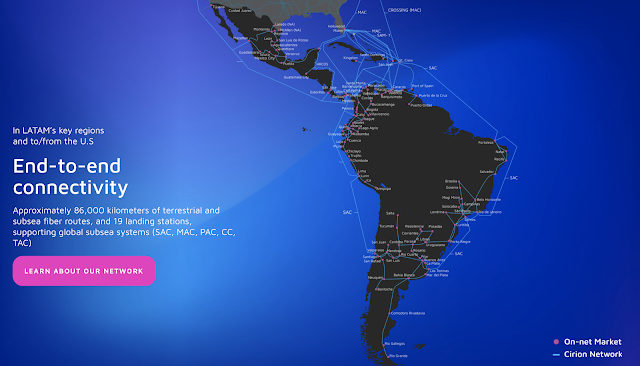
Cirion Technologies is working with Qwilt to bring a more efficient and scalable content delivery network in Latin America. This new partnership, based on Qwilt’s Open Caching technology, allows Cirion to scale up rapidly as market demand increases. It substantially increases Cirion’s ability to reliably deliver high-quality live and VoD streaming throughout the region and becomes one of the largest low-latency CDN service providers across Latin America.

Cirion, previously the Latin American operations of Lumen Technologies, counts over 50,000km of terrestrial long-haul and metropolitan fiber optics, 36,000km of submarine cables and 18 landing stations.

“Our infrastructure adapts dynamically and in real-time to market demands, enabling an efficient management of critical applications and their data. This makes it possible for companies to identify market trends in advance and respond quickly, with solutions that stimulate future growth,” says Girardotti.

“Cirion is an exciting addition to our global ecosystem of service providers, and we are delighted to help power a unique content delivery service offering in Latin America,” said Alon Maor, CEO, Qwilt. “Our all-edge architecture provides a new economic model for streaming delivery, in which Cirion’s network infrastructure and CDN services play a central role in the end-to-end value chain. This announcement underscores the momentum we are gathering as we realize our ambition to build the world’s highest performing edge delivery network.”

Equinix debuts Fabric Cloud Router

Equinix introduced a new virtual routing service to help enterprises easily connect applications and data across multiple clouds and on-premise deployments. 

Equinix Fabric Cloud Router simplifies a complex cloud-to-cloud and hybrid cloud networking challenges by providing an easy-to-configure, enterprise-grade, multicloud routing service that can be deployed in under a minute. By using Equinix's secure private connectivity, customers can connect applications across public clouds in more locations than any other service.

Equinix Fabric Cloud Router is now available in all 58 Equinix Fabric-enabled markets globally with low latency connectivity to all major cloud providers, including Amazon Web Services (AWS), Google Cloud Platform, Microsoft Azure and Oracle Cloud Infrastructure, as well as hundreds of other service providers like Akamai, ServiceNow and Zoom. Delivered as a service on demand and in near real time, Equinix Fabric Cloud Router can remove the costs and complexities of owning and operating a physical router or licensing a virtual router. By removing these limitations, customers can improve application performance, reduce cloud costs and accelerate services to market. Enterprises can also accelerate their multicloud adoption by avoiding vendor lock-in with Equinix's cloud agnostic service, eliminating networking constraints and enabling them to choose the right cloud environment and provider for specific workloads.

"Multicloud networking is hard, but now with the launch of Equinix Fabric Cloud Router we are simplifying it for businesses everywhere by helping users connect different clouds in as little as 45 seconds. This is what you'd expect from Equinix, the leader in multicloud networking," said Arun Dev, Vice President of Digital Interconnection at Equinix. "By combining Equinix's steadfast commitment to cloud and network neutrality that has spanned more than 25 years, our leading access to cloud on-ramps, and the largest selection of cloud providers and services partners, Equinix is uniquely positioned to provide the on-demand digital infrastructure today's enterprises need." 

Highlights:

  • Multicloud Performance – Customers achieve the low latency between all major cloud providers with Equinix's cloud-adjacent locations around the world, eliminating the need to backhaul traffic through a remote location. This superior cloud-to-cloud networking performance enables customers to quickly and easily support evolving infrastructure demands, like cloud migrations.
  • Private Connectivity – By easily deploying private network connections, customers can avoid exposing sensitive data and network infrastructure to the risks of the public internet and support data sovereignty requirements.
  • Enterprise-Grade – Customers can act with confidence knowing they are supported by a 99.999% uptime SLA and can scale bandwidth and connectivity across clouds without constraint using speeds up to 50Gbps, with hundreds of gigabits of aggregate throughput supported per router.
  • Lowering Costs – Enterprises can reduce cloud egress costs by up to 75% using private cloud connections rather than egress over the internet. Built-in Equinix Fabric Cloud Router resilience can save IT teams even more by eliminating the need for expensive redundant routers. Delivered as a service, customers can pay only for what they need without being locked into long-term contracts and have the flexibility to scale up and down as needed.

https://www.equinix.com/newsroom/press-releases/2024/01/equinix-enhances-multicloud-networking-portfolio-enabling-enterprises-to-easily-and-efficiently-connect-applications-across-multiple-clouds

Nokia invests in German R&D

Nokia announced a substantial €360 million investment in software, hardware, and chip design at its Ulm and Nuremberg sites as part of a four-year European IPCEI project. 

The initiative, which is a collaborative effort funded by Nokia, the German Federal Ministry of Economics and Climate Protection (BMWK), and the German states of Baden-Württemberg and Bavaria, is focused on the integrated development of software, hardware, and high-performance systems-on-chips based on a digital twin, with applications in radio and optical products for future mobile communications systems.

Nokia says the investment will have a profound impact on the telecommunications industry in Germany and Europe. It will boost Europe's competitiveness and innovation capacity, particularly in microelectronics for emerging technologies like 6G and artificial intelligence. 

Tommi Uitto, President of Mobile Networks at Nokia, said: “This important funding will support our efforts to advance the telecommunications industry in Germany and in Europe, helping to drive innovation and strengthen competitiveness. In particular, it will help our research into microelectronics that will power future technologies such as 6G, artificial intelligence and the metaverse as well as develop networks that are more energy-efficient and powerful. Germany is an important market for Nokia, and we look forward to working with the government to produce cutting-edge technology that is ‘Made in Germany’.”

Highlights

  • Nokia is investing €360 million in software, hardware, and chip design in Ulm and Nuremberg, as part of a four-year European IPCEI project.
  • The project aims to develop integrated software, hardware, and high-performance chips for 5G-Advanced and 6G standards, with a focus on energy efficiency to support European climate targets.
  • This investment is expected to strengthen Europe's competitiveness in microelectronics, boost innovation for 6G and AI, enable metaverse applications, and enhance network energy efficiency.

https://www.nokia.com/about-us/news/releases/2024/01/17/nokia-plans-eu360-million-investment-in-microelectronics-and-communications-technology-in-germany/

Arelion opens 2nd PoP in Tokyo

Arelion today announced a new Point-of-Presence (PoP) at AT TOKYO's carrier-neutral data center, Chuo Center #1 (CC1). The new PoP is Arelion's second Tokyo PoP and third Japan PoP after its Osaka PoP. 

Chuo Center #1 is one of the largest data centers in Japan with 31 MW capability, gaining popularity as a global connectivity hub for multinational businesses that require high-speed access to Japan's thriving enterprise markets. Japan's financial sector is booming amid national economic growth policies, with Japanese banks holding $17.7 trillion in total financial assets as of 2022. Chuo Center #1 has developed a substantial ecosystem of global Internet carriers, Internet service providers, cloud providers and enterprises, enabling Arelion to support its customers' business expansions through scalable connectivity to cloud, communications, Internet Exchanges and content services.

Chuo Center #1 is designed to mitigate natural disasters, enabling Arelion to provide redundant, resilient connectivity services to wholesale and enterprise customers seeking direct access to APAC markets. Due to its strategic location, Arelion's second Tokyo PoP will provide accessibility to subsea landing stations in the future, with plans to connect Arelion's backbone directly into Chuo Center #1. This will provide fully diverse connectivity out of Japan in addition to Arelion's Osaka PoP, building on Arelion's networking strategy in the APAC region.

Arelion's AS1299 is directly connected to over 70 percent of global Internet routes and has been ranked by Kentik as the #1 backbone in Asia. It is an excellent choice for Japanese businesses requiring world-class customer service and high-capacity, low-latency connectivity to international markets.

"By bringing our #1 ranked Internet backbone to AT TOKYO, we will enhance our presence in Tokyo, extending our reach to Japan's financial center in Tokyo for our enterprise customers," said Wee Kwan, Head of APAC, Arelion. "Chuo Center #1 offers low cross-connect costs, providing our customers with cost-savings as they rely on our high-quality connectivity services to power their global businesses and meet their technological needs."

Seagate ships 30TB drives based on HAMR tech

Seagate introduced its Mozaic 3+ hard drive platform based on its Heat-Assisted Magnetic Recording (HAMR) technology for achieving 3TB+ per platter—and a roadmap that will achieve 4TB+ and 5TB+ per platter in the coming years.

The Mozaic 3+ platform powers Seagate’s flagship Exos product family, with newly announced, industry-leading capacity points of 30TB and up. Exos 30TB+ drives are shipping in volume this quarter to hyperscale cloud customers.

Seagate says that upgrading from a 16TB conventional perpendicular magnetic recording (PMR) drive (the average capacity in large-scale data centers) to an Exos 30TB Mozaic 3+ technology drive effectively doubles capacity in the same footprint.

“Seagate is the world’s only hard drive manufacturer with the areal density capability to get to 3TB per platter and with 5TB on the horizon,” said Dave Mosley, Seagate’s CEO. “As AI use cases put a premium on raw data sets, more companies are going to need to store all the data they can. To accommodate the resulting masses of data, areal density matters more than ever.”

Additional highlights:

  • Superlattice Platinum-Alloy Media. Fundamental physics of higher-density recording requires smaller media grain size at nanoscale. The challenge here is that smaller grains are more unstable. Legacy alloys do not provide sufficient magnetic stability for effective and reliable storage. In Mozaic 3+ hard drives, the media alloy uses a pioneering iron-platinum superlattice structure, which significantly increases the magnetic coercivity of disk media. This allows for precise data writing and unprecedented bit stability.
  • Plasmonic Writer. Since the media are made magnetically “harder” to prevent instability, the design requires a revolutionary writer—a marvel of miniaturization and precision engineering that is Seagate’s unique implementation of HAMR. Anchoring this technology is a nanophotonic laser, which produces an infinitesimal heat spot on the media surface to reliably write the data. Seagate plans to vertically integrate the nanophotonic laser into the plasmonic writer sub-system. “Developing this unique laser technology in-house for Mozaic 3+ will ensure even greater efficiency and yield to support rapid scaling of volume production,” Mosley said.
  • Gen 7 Spintronic Reader. Smaller grains of written data are only useful if they can be read. Integrated along with the sub-components of the plasmonic writer, the reader also needed to evolve. Incorporating quantum technology, Mozaic 3+ includes one of the world's smallest and most sensitive magnetic field reading sensors.
  • 12nm Integrated Controller. Efficiently orchestrating all this technology called for an integrated controller, a system-on-a-chip, developed entirely in house. This sophisticated application-specific integrated circuit delivers up to 3 times the performance compared to prior solutions.

IDC: Telco cloud infrastructure software market forecast

International Data Corporation (IDC) forecasts worldwide revenue for telco cloud infrastructure software, including virtual network functions (VNFs), cloud-native network functions (CNFs), and network functions virtualization infrastructure (NFVI), across four market subsegments (core transport, mobile infrastructure, mobile backhaul, access networks and virtual CPE), will grow from $12.9 billion in 2022 to $27.3 billion in 2027. This represents a compound annual growth rate (CAGR) of 16.1% over the 2022-2027 forecast period.

IDC expects the CNF to grow rapidly in part due to the recent emergence and growing initiative to deploy cloud-native, container-based telco workloads across the telco cloud. Accordingly, the forecast breaks out cloud-native network functions as a separate line item.

In addition, with the inclusion and discrete breakout of cloud-native network functions, IDC recognizes the impact on NFVI and underlying shifts toward container-as-a-service (CaaS) offerings that include container-based infrastructure management such as Kubernetes, or even hybrid deployment models in which containers are deployed on bare metal or virtual machines (VMs). In addition, in a cloud-native world, the impetus is on comms service providers to deploy network functions across edge sites while continuing to manage a mix of core and edge sites on horizontal telco cloud platforms based on a common software foundation.

"Adoption of cloud-native network functions is gaining momentum, with CNFs being deployed alongside virtual network functions across comms service providers' cloud-based digital infrastructure for service agility, lower cost of ownership, and elastic scaling of the network," said Ajeet Das, research director, Telecom Network Infrastructure at IDC. "However, these operators face a range of daunting challenges, including lack of in-house expertise in cloud-native orchestration and infrastructure, difficulty defining and implementing comprehensive security, and operational complexity of managing on-premises, cloud, and multi-cloud networks."

https://www.idc.com/getdoc.jsp?containerId=prUS51778424

LightRiver appoints Brinksma as SVP Software Solutions

LightRiver has appointed Jim Brinksma as Senior Vice President of Software Solutions. Brinksma will be based out of LightRiver's Holmdel Software Development Center in New Jersey.

Brinksma's career spans Department of Defense, SaaS startups, financial services, and telecommunications. His previous roles include Chief Technology Officer (CTO) at Megaport, Co-founder & CTO of InnovoEdge (acquired by Megaport), VP of Strategy & Business Development at Ciena BluePlanet, VP of Sales Engineering & Customer Operations at Ciena, and VP Network Products & Strategy at Goldman Sachs. He also served over seven years in the United States Navy.

"Jim's appointment comes at a crucial time as we expand the delivery of cutting-edge, next-generation optical networking technologies, software-defined networks, and automated wavelength monitoring services," states Mike Jonas, CEO of LightRiver. "I'm thrilled to welcome Jim to our leadership team. His extensive experience in corporate and software development, combined with his visionary approach, aligns perfectly with our efforts to revolutionize network infrastructures and operations for our clients."

https://lightriver.com

Quantinuum raises $300 million

Quantinuum, a quantum computing company formed through the combination of Honeywell Quantum Solutions and Cambridge Quantum, raised , at a pre-money valuation of $5 billion. The round is anchored by Quantinuum’s strategic partner JPMorgan Chase, with additional participation from Mitsui & Co., Amgen and Honeywell, which remains the company’s majority shareholder. This investment brings the total capital raised by Quantinuum since inception to approximately $625 million.

This capital raise represents Quantinuum’s first equity funding round since Cambridge Quantum Computing and Honeywell Quantum Solutions merged in November 2021. The funds will be used to accelerate the path towards achieving the world’s first universal fault-tolerant quantum computers, while also extending Quantinuum’s software offering to enhance commercial applicability.

JPMorgan Chase has one of the world’s most highly regarded specialist teams working on quantum technologies within the financial services industry and has been working with Quantinuum and its predecessor companies since 2020. The company was one of the earliest experimental users of Quantinuum’s H-Series quantum processor and is also one of the most active corporate partners that employs Quantinuum’s software development kit, known as “TKET.”

Lori Beer, Global Chief Information Officer at JPMorgan Chase said: “Financial services has been identified as one of the first industries that will benefit from quantum technologies. As such, we have been investing in quantum research and our team of experts – led by Dr. Marco Pistoia – have made groundbreaking discoveries, partnering with quantum computing leaders like Quantinuum. We look forward to continuing to work together to positively impact our businesses, customers and the industry at large.”

https://www.quantinuum.com/news/honeywell-announces-the-closing-of-300-million-equity-investment-round-for-quantinuum-at-5b-pre-money-valuation

Tuesday, January 16, 2024

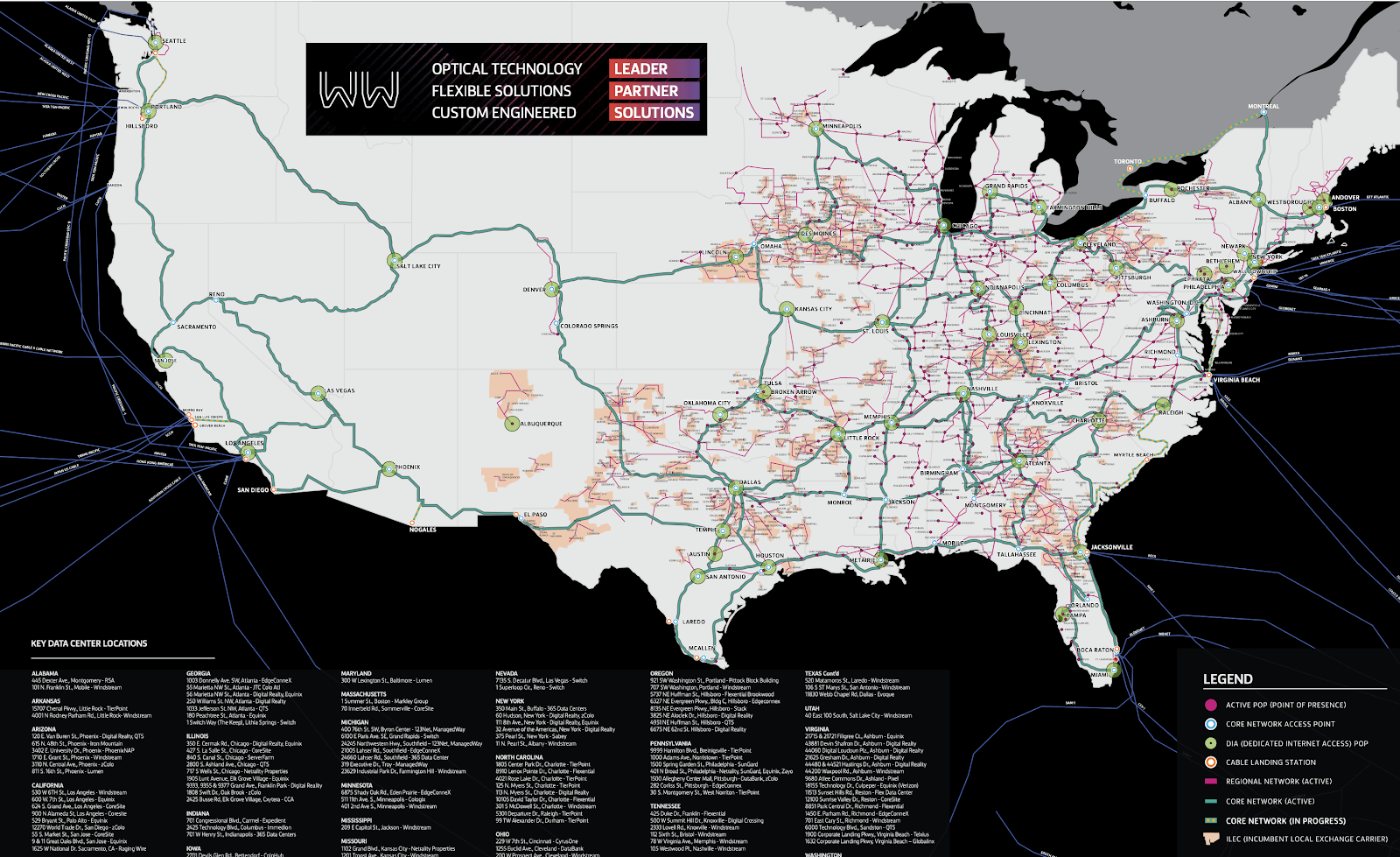
Windstream carries 1 Tbps wavelength over 1,100km with Cisco/Acacia

Windstream Wholesale) transmitted a 1 terabit per second (Tbps) wavelength over a 1,100-kilometer link across multiple routes using the Cisco NCS 1014 C-Band 2.4T WDM Transponder Line Card with Acacia’s Coherent Interconnect Module (CIM) 8, the industry’s first 1.2Tbps faceplate pluggable coherent solution. The transmission was carried over a third-party line system (150Ghz Channel).

The successful trial deployments achieved the following key wavelength transmissions across Windstream ICON routes:

  • Successful roundtrip transport of 1Tbps over 1,100 km from Miami to Jacksonville, Florida
  • Successful transport of 800G over 1,387 km of mixed fiber from Miami through Tallahassee, Florida, to Atlanta, Georgia
  • Successful roundtrip transport of 600G over 2,774 km from Miami, Florida, to Atlanta, Georgia

“This tremendous achievement further proves our commitment to technology leadership and networking expertise,” said John Nishimoto, Windstream Wholesale senior vice president of products, marketing, and strategy. "We developed ICON to provide multi-vendor flexibility and seamlessly integrate the newest optimized technology into our disaggregated network. Achievements like this reinforce our 800G wave strategy and offer improved design and network planning options among our 100G and 400G solutions."

The trial results emphasize that disaggregated networking can be implemented successfully on production networks and demonstrate that interoperability between a vendor's transponder and a third-party line system is achievable. This accomplishment is an industry-first and is another of many successful milestones resulting from the long-term collaboration between Windstream Wholesale, Cisco, and Acacia.

  • March 2023 – Successfully deployed a 1Tbps wave over 541 km between Dallas and Tulsa in a live network trial across Windstream's ICON. The circuit was looped to establish an 800G route over a live network measuring 1,082 km, setting a leading benchmark using digital coherent optics technology.
  • April 2022 – Achieved successful establishment of 400G links in a production environment over a 1,027 km route, pioneering the interoperability of QSFP-DD form factor ZR+ pluggable modules from Cisco and II-VI Incorporated, now Coherent Corp. 
  • February 2021 – Established a 400G ZR+ live network record, successfully deploying a 400G per second single-wavelength transmission over 1,027 km between Phoenix and Los Angeles using ZR+ digital coherent optics technology.

“Collaborating with industry leaders like Windstream, Cisco continues to demonstrate results leveraging our coherent technology innovation from Acacia and the Cisco NCS 1014 platform,” said Bill Gartner, senior vice president of Optical Systems and Optics, Cisco. “This 1Tbps over 1,100km exemplifies how Cisco is providing our customers with disaggregated networking solutions to deliver the capacity and speed for the future of networking.”

https://www.windstreamwholesale.com/january-16-2024-1tbps-wave/

Dell'Oro: InfiniBand vs. Ethernet—the Race is On!

Spending on switches deployed in AI back-end networks is forecast to expand the Data Center Switch Market by 50 percent, according to a new AI Networks for AI Workloads report by Dell'Oro Group.

Current data center switch market spending is on front-end networks used primarily to connect general-purpose servers. AI workloads will require a new back-end infrastructure buildout. The competition intensifies between InfiniBand and Ethernet as manufacturers vie for market dominance in AI back-end networks. While InfiniBand is expected to maintain its lead, Ethernet is forecast to make substantial gains, such as 20 revenue-share points by 2027.

"Generative AI applications usher in a new era in the age of AI, standing out for the sheer number of parameters that they have to deal with," said Sameh Boujelbene, Vice President at Dell'Oro Group. "Several large AI applications currently handle trillions of parameters, with this count increasing tenfold annually. This rapid growth necessitates the deployment of thousands or even hundreds of thousands of accelerated nodes. Connecting these accelerated nodes in large clusters requires a data center-scale fabric, known as the AI back-end network, which differs from the traditional front-end network used mostly to connect general-purpose servers.

"This predicament poses the pivotal question: what is the most suitable fabric that can scale to hundreds of thousands and potentially millions of accelerated nodes while ensuring the lowest Job Completion Time (JCT)? One could argue that Ethernet is one speed generation ahead of InfiniBand. Network speed, however, is not the only factor. Congestion control and adaptive routing mechanisms are also important. We analyzed AI back-end network build-outs by the major Cloud Service Providers (such as Google, Amazon, Microsoft, Meta, Alibaba, Tencent, ByteDance, Baidu, and others) as well as various considerations driving their choices of the back-end fabric to develop our forecast," continued Boujelbene.

Additional highlights from the AI Networks for AI Workloads Report:

  • AI networks will accelerate the transition to higher speeds. For example, 800 Gbps is expected to comprise the majority of the ports in AI back-end networks by 2025, within just two years of the latest 800 Gbps product introduction.
  • While most of the market demand will come from Tier 1 Cloud Service Providers, Tier 2/3 and large enterprises are forecast to be significant, approaching $10 B over the next five years. The latter group will favor Ethernet.

https://www.delloro.com/news/ai-workloads-require-new-network-buildouts-expanding-data-center-switch-market-by-50-percent/


https://youtu.be/3vssaOHFie4

Microsoft inks 10-year AI + Cloud deal with Vodafone

Microsoft announced a 10-year strategic pact under which Vodafone will invest $1.5 billion in its cloud and customer-focused AI services. Additionally, Microsoft will use Vodafone’s fixed and mobile connectivity services.

Microsoft also intends to invest in Vodafone’s managed IoT connectivity platform, which will become a separate, standalone business by April 2024. The new company will attract new partners and customers, driving growth in applications and expanding the platform to connect more devices, vehicles and machines.

The companies said their pact will result in digital services, based on the latest generative AI technology, that provide a highly personalized and differentiated customer experience across multiple channels. There are 5 areas of collaboration:

  • Generative AI: Vodafone will enhance customer experiences using Microsoft Azure OpenAI for real-time, personalized interactions, including through its digital assistant TOBi. Employees will also use Microsoft Copilot to increase productivity and digital efficiency.
  • Scaling IoT: Microsoft will invest in Vodafone's global IoT platform, connecting 175 million devices, and integrate it into the Azure ecosystem, opening it to developers and third-parties through open APIs.
  • Africa Digital Acceleration: Microsoft and Vodafone will expand M-Pesa on Azure, launching new applications and a program to benefit 100 million consumers and 1 million SMEs in Africa. This includes digital literacy, skilling, youth programs, and digital services for SMEs, enhancing financial services innovation.
  • Enterprise Growth: Vodafone commits to distributing Microsoft services, including Azure and Microsoft Teams Phone Mobile, aiding Europe’s businesses with low-cost cloud-based services and supporting 24 million SMEs with a managed growth platform.
  • Cloud Transformation: Vodafone will modernize its data centers using Microsoft Azure, enhancing customer responsiveness, reducing operational costs and energy use, and aligning with its sustainable business strategy by replacing physical data centers with virtual ones in Europe.

Margherita Della Valle, Vodafone Group chief executive, said: “Today, Vodafone has made a bold commitment to the digital future of Europe and Africa. This unique strategic partnership with Microsoft will accelerate the digital transformation of our business customers, particularly small and medium-sized companies, and step up the quality of customer experience for consumers.”

“This new generation of AI will unlock massive new opportunities for every organization and every industry around the world,” said Satya Nadella, chairman and CEO, Microsoft. “We are delighted that together with Vodafone we will apply the latest cloud and AI technology to enhance the customer experience of hundreds of millions of people and businesses across Africa and Europe, build new products and services, and accelerate the company’s transition to the cloud.”

Bleu, the “Cloud de Confiance” from Capgemini and Orange

Bleu, the joint venture cloud company created by Capgemini and Orange, is now engaging with select French public and private organizations. This follows validation from the European Commission in 2023 on the need to establish a "cloud de confiance" for security reasons. The first services are now anticipated to begin from the end of 2024 based on Microsoft technology. 

Capgemini and Orange launched Bleu in a strategic partnership with Microsoft, with the aim of meeting the specific cloud needs of the French State, public agencies, hospitals, regional authorities, Vital Importance Operators (OIVs) and Essential Service Operators (OSEs), enabling them to use Microsoft 365 and Microsoft Azure services. 

In order to meet with strong demand from an array of French organizations, the coming months will be used to prepare their migration, carry out tests and pilots with clients, and to ensure their successful onboarding on Bleu. The Bleu cloud platform will be launched on a set of geographically distributed data centers across France, meeting the necessary high standards of resilience and availability.

"I'm proud of the work done by the Capgemini, Orange and Microsoft teams to realize our shared ambition of being able to offer, through Bleu, a solution that will enable clients to leverage the full power of Microsoft cloud services in a ‘cloud de confiance’," comments Aiman Ezzat, Chief Executive Officer of the Capgemini Group. “Bleu brings a unique combination of security and service benefits, including the widest range of technological innovations, enabling French organizations to accelerate their digital ambitions through the coming years.”

Christel Heydemann, CEO of Orange, commented: “Together with our partner Capgemini, we are very pleased to announce today the launch of activities of our joint venture Bleu. As a leading player in the digital transformation of businesses in France, Orange is aware of the specific challenges in terms of data protection and sovereignty for critical infrastructure operators and public institutions. We are confident that Bleu will meet these needs by providing a cloud solution based on Microsoft services while being fully compliant with the standards set by French authorities in its “trusted cloud” doctrine. Bleu is now fully operational and is actively working with its future customers to prepare for their migration to the platform."

https://www.bleucloud.fr

Cato Networks Un-Predictions: 3 Cyber Events that won't happen in 2024

Etay Maor, Senior Director of Security Strategy from Cato Networks, offers three un-predictions for 2024:

- AI Threats: While AI is increasingly used by cybercriminals for tasks like creating phishing emails, the idea of a catastrophic AI-based attack is unrealistic. Instead, expect to see more AI usage in smaller, more specific tasks within cyber attacks.

- Cyber War: Despite ongoing global conflicts, a full-scale cyber war is unlikely. Cyber tools are used in conjunction with traditional military tactics, not as standalone strategies. However, the alignment of threat actors with different nation states is a trend to watch.

- Breach Time Detection: Contrary to some reports, the average time to detect a breach is not decreasing. This is often due to outdated security solutions. Expect to see a rise in the adoption of Secure Access Service Edge, a cloud-based approach to networking and security, for faster and more effective threat detection.

https://youtu.be/k4KUQdT39Vs

Want to be involved our video series? Contact info@nextgeninfra.io

Spectra7 cites production order for chips for 800G Active Copper Cables

Spectra7 Microsystems announced its first order for production GC1122 chips supporting Active Copper Cables (ACCs) operating at speeds up to 800 Gbps and 1.6 Tbps. The order has come from a major China cable supplier who serves both the North America and China data center markets.

"We are excited to receive the first order for our production GC1122 chips," said Spectra7 CEO Raouf Halim. "Cables using these chips will be used in qualification at major Hyperscalers in both North America and China, and continues our progress with hyperscale data center customers deploying the most advanced implementations, such as artificial intelligence. Hyperscalers are increasingly sensitive to the high power requirements for other cabling options, which can exceed the power required by the switch itself. Spectra7's ACC cables provide a unique solution to this challenge and reduce both the capital cost and operating cost of a hyperscale data center."

"We expect these qualification activities to be complete in Q2 in order to support significant deployments in the second half of 2024 at several Hyperscalers," said Mr. Halim. "We also believe the ACC connectivity market opportunity is estimated to reach $1 billion by 20271."

Spectra7 said its analog based GaugeChanger GC1122 chips are used in Active Copper Cables (ACCs) and offer significant cost, size and energy consumption savings vs. competing Active Electrical Cables (AECs) and Active Optical Cables (AOCs) that use Digital Signal Processing (DSP) technologies.

http://www.spectra7.com/gc1122-order

Monday, January 15, 2024

Telecom Egypt and Zain Omantel plan a new high-capacity route

Telecom Egypt and Zain Omantel International (ZOI)  announced a strategic partnership to establish a  digital corridor connecting the Mediterranean Sea to the Arabian Sea and Arabian Gulf.

The new infrastructure will stretch from Oman's Arabian Sea and Gulf shores to Egypt's Mediterranean coastline, incorporating a high fiber count and a combination of terrestrial and subsea segments. 

The terrestrial segments covering Oman, Saudi Arabia, and Egypt offer  reliability and protection, while the subsea section directly linking Saudi Arabia and Egypt through the Red Sea features a high-capacity, repeaterless cable system. 

This collaboration will not only enhance the resiliency and reliability of end-to-end solutions for Telecom Egypt and ZOI's partners and customers but also extend the infrastructure to Kuwait, Bahrain, Iraq, and Jordan through ZOI's network and collaboration with licensed cable landing parties in each country. Furthermore, it presents an opportunity for subsea cable owners to reduce construction costs and improve latency, resilience, and market response times by connecting to this open access system. 

Mohamed Nasr, Managing Director and CEO at Telecom Egypt, commented: “We are excited to collaborate with ZOI on this strategic project; it’s a game-changer in the Eurasia route connectivity landscape. As we look for innovative ways to better serve our customers, we will consistently strive to provide a seamless international connectivity network and increase our diversity layers, without compromising quality, cost or speed. We will do this by leveraging on both Telecom Egypt’s established history in the subsea cables arena and its experienced and competent team.” 

Sohail Qadir, CEO at ZOI, commented: “We are delighted to partner with Telecom Egypt on such a groundbreaking project. ZOI was created to revolutionize the wholesale telecom scene and this is an example of what the future holds. We are facilitating the landing of subsea connections through our shareholders such as Omantel and Zain KSA being the licensees in those jurisdictions. This one-of-a-kind infrastructure will be expanded to most of ZOI’s network footprint to maximize the benefit to our group operations across the region. The value that this digital corridor will create is enormous and it will be widely realized in the region and beyond not only from a connectivity point of view, but also on technological, commercial and social levels.” END   


https://www.zainomantel.com 

Orange powers AMITIE Subsea Cable with Infinera’s GX

Orange deployed Infinera’s GX Series-based ICE6 coherent solution on its new AMITIE subsea cable, which spans 6,800 km and connects the state of Massachusetts (USA), Le Porge (France) and Bude (UK). 

Orange powers fully resilient global connectivity capability along the world’s busiest route, using two state-of-the-art subsea mega cables, Dunant and AMITIE, to connect France and the U.S. Deploying Infinera’s  ICE6 technology on the GX Series Compact Modular Platform enables Orange to keep pace with future generations of optical transmission technologies while maintaining a high level of performance for the next 20 years. This deployment also significantly reduces Orange’s energy cost per megabit and minimizes its carbon footprint.


“We are pleased to integrate Infinera’s industry-leading technology for the first time on one of our key transatlantic routes and terrestrial backhaul. With this future-proof technology, Orange is well-positioned to continue to be a major player in the global wholesale market, developing our infrastructure to connect continents together and delivering a unique, high-performance, and robust solution to our customers,” said Aurélien Vigano, VP International Transmission Network at Orange.

“Infinera is delighted to partner with Orange to deliver our innovative ICE6 solution across Orange’s critical subsea and terrestrial backhaul routes, offering network operators, wholesale carriers, and enterprise customers resilient and reliable global connectivity capability,” said Nick Walden, Senior Vice President, Worldwide Sales, Infinera.

https://www.infinera.com/press-release/orange-deploys-infinera-gx-series-to-power-amitie-subsea-cable/

  • With a total length of 6,800 km and 16 fiber pairs, and a maximum capacity of 400 Tbps, AMITIE connects Lynn near Boston (USA), Le Porge near Bordeaux (France) and Bude (England). In France, Orange oversees the French part of the cable, and is in charge of operating and maintaining the system's landing station. It provides all AMITIE cable partners with the terrestrial infrastructure required for its smooth operation, from the limit of French territorial waters to the new Equinix datacenter based in Bordeaux.
  • Additional partners on the AMITIE cable include Aqua Comms, Meta, Microsoft, and Vodafone. The cable was built by Alcatel Submarine Networks.
  • In January 2021, Orange announced ready-for-service status on the new Dunant cable system, which is a joint project with Google, and boasts 12 fibre pairs with over 30 Tbps of capacity each.


Broadband Forum intros Automated Intelligence Management framework

The Broadband Forum has introduced two industry standards known as the Automated Intelligence Management (AIM) framework, aimed at leveraging Artificial Intelligence (AI), Machine Learning (ML), and automation to enhance network services' quality and reliability. AIM has the potential to save service providers both costs and effort associated with scaling their networks. By reducing on-site maintenance and human intervention, it can proactively identify and address network faults before they impact the user's experience, ultimately improving operational efficiency. 

The AIM framework is seen as a solution to unlock new revenue streams and optimize network infrastructure, particularly beneficial for service providers that have had to increase their capital expenditure (CapEx) to expand their networks. 


Key points and benefits of the AIM framework:

  • AIM utilizes AI, ML, and automation to enhance network operational efficiency and reduce operational expenditure (OpEx).
  • It can anticipate and resolve network faults before they affect service quality, reducing the need for on-site maintenance.
  • The framework offers potential cost savings and revenue generation for service providers.
  • Two standards, TR-436 and TR-486, define the AIM framework and its interfaces, ensuring vendor interoperability.
  • Use cases include home Wi-Fi network monitoring, network performance optimization, and automated traffic steering.
  • AIM enables automated and intelligent network operations with minimal human intervention, improving user experience.
  • It facilitates end-to-end root cause analysis, path degradation predictions, and customer experience assessments.

The Broadband Forum says its AIM framework represents a significant step forward in network management, providing service providers with the tools needed to deliver high-quality services efficiently and cost-effectively. 

“Service assurance with performance monitoring and automated traffic steering is an attractive proposition as it enables an automated and intelligent way to operate the network with minimal human intervention,” said Mauro Tilocca of TIM - Telecom Italia who also serves as the Broadband Forum Service Provider Action Council Chair. “The new specifications deliver an entire framework to empower network capabilities, via AI/ML-based recommendations. The AIM pipeline components can be implemented as virtualized functions in a cloud-native environment, allowing a high degree of reusability per modern DevOps and GitOps paradigms, as well as flexible and seamless deployments.”

Arrcus Predictions 2024: AI's Impact on Network Infrastructure

For 2024, Shekar Ayyar, CEO from Arrcus, predicts:

- Distributed network infrastructure for effective AI inferencing at the edges. This is where the real value of AI lies, as customers are more interested in the results than the intricacies of model training.

- Multicloud networking with efficient management of egress costs. With more than one hyperscaler highway becoming a requirement, it's time to embrace multicloud networking.

- The need for large-scale data center infrastructure to deploy and train large AI models. Single data centers won't cut it anymore; efficient interconnects between multiple data centers and extending from data centers to the edges are the future.

https://youtu.be/syqxUQOwuiQ

Want to be involved our video series? Contact info@nextgeninfra.io

 Check out all 2024 Predictions from Industry Thought Leaders: https://ngi.fyi/predictions24ytx`

Ericsson, T-Mobile and Qualcomm test 6-component carrier aggregation

Ericsson, T-Mobile and Qualcomm Technologies achieved download speeds beyond 3.6Gbps in a world’s first six-component carrier aggregation (6CC) using sub-6GHz spectrum on a live production 5G network.

5G carrier aggregation allows service providers like T-Mobile to combine multiple 5G channels (or carriers) to deliver greater speed and performance. In this test, the trio merged six 5G channels of mid-band spectrum – two channels of 2.5GHz Ultra Capacity 5G, two channels of Personal Communications Services (PCS) spectrum and two channels of Advanced Wireless Services (AWS) spectrum – creating an effective 245MHz 5G channel. That’s like taking six separate highways and turning them into a massive superhighway where traffic can zoom faster than before.

Fredrik Jejdling, Executive Vice President and Head of Business Area Networks at Ericsson, says: “This latest technology advancement with T-Mobile and Qualcomm Technologies comes as Ericsson continues to go beyond the bounds of its carrier aggregation journey. With this new milestone we have proven once again the versatility of our software innovation and how it helps our customers boost network capacity, coverage and performance.”

Ulf Ewaldsson, President of Technology at T-Mobile, says: “We are pushing the boundaries of wireless technology to offer our customers the best experience possible. With the first and largest 5G standalone network in the country, T-Mobile is the only mobile provider serving 10s of millions of customers to unleash new capabilities like 5G carrier aggregation nationwide, and I am so incredibly proud of our team for leading the way.”  

https://www.t-mobile.com/news/network/t-mobile-delivers-another-worlds-first-with-6-carrier-aggregation