Sunday, July 23, 2023

Amitié transatlantic cable enters service with 16 fiber pairs

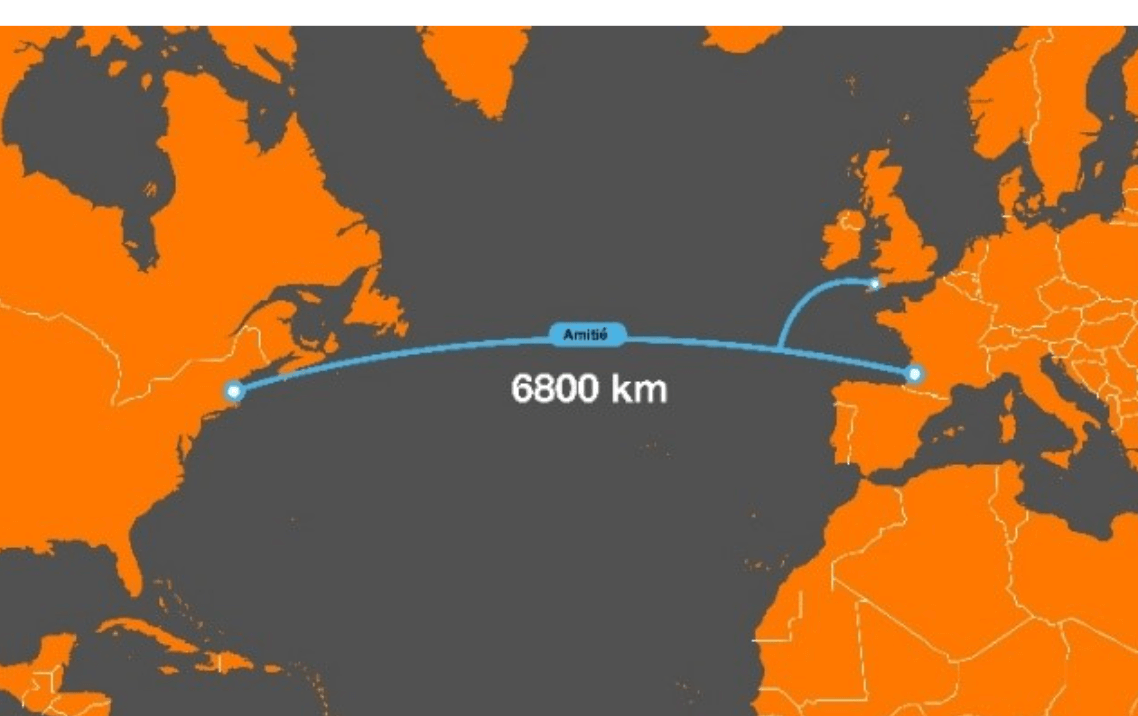
Aqua Comms, Meta, Microsoft, and Vodafone announced the commissioning of the Amitié subsea cable system, a 6,783 km (4,215 miles) trans-Atlantic system connecting North America and Europe and boasting 16 fiber pairs and up to 400 Tbps capacity -- the highest to date.

The Amitié cable, which was built by Alcatel Submarine Networks, has landings in Lynn, Massachusetts; Widemouth Bay, England; and Le Porge, France. 

The design of the system brings all users additional connectivity options in the United States, the UK, and in France. Boston will have direct connection all the way to London and a new Carrier Neutral Data Center constructed in Bordeaux. This delivers improved reliability in terms of protected capacity on multiple diverse routes.

The system includes an innovative branching unit 860 km from France and 650 km from the UK. This device allows the owners to switch either individual optical wavelengths between different landings or the full fiber capacity via two different types of switching technologies.

Andy Hudson, Chief Network Officer, Aqua Comms, said: “Amitié, branded as AEC-3 on Aqua Comms’ network, adds a third high-capacity system to our transatlantic footprint offering enhanced diversity in both the US and Europe and delivering the latest technology to our customers.”

Gary Waterworth, Investment Manager, Meta said: “Amitié will increase telecommunications reliability, speed, and diversity of subsea cable routes between the continents helping to improve transmission capacity in North America and Europe. It’s a great example of tech and telecom companies collaborating to build digital infrastructure to benefit the countless people, businesses, and organizations who rely on global connectivity.”
Frank Rey, General Manager, Azure Networking at Microsoft said: “As public and private sectors deepen their reliance on cloud technologies for economic growth and service improvement, Amitié will advance both resiliency and capacity for customers using our cloud services.”

Fanan Henriques, Director, Vodafone Business International & EU-Cluster, said: “As a significant investor in submarine cables, Vodafone was able to bring its strong heritage and extensive expertise to the partnership. With transatlantic total bandwidth growth forecasted to increase six-fold over the next five years, it is essential that we keep our customers, partners and communities connected to vital services enabling the digital economy. The completion of the Amitié subsea cable will strengthen connectivity and add resilience between the U.S., France and the UK.”

https://aquacomms.com/latest-news/aqua-comms-meta-microsoft-and-vodafone-announce-completion-of-amitie-the-highest-capacity-transatlantic-subsea-cable-system-ever-deployed/

Tech Update: Edge at the Extreme, Connectivity for the Tour de France

Wondering how edge computing is revolutionizing the world of sports?

In this video, Devin Yaung, SVP, Global Enterprise IoT from NTT explains:

  • The importance of *edge computing* in sports events like the *Tour de France* , where real-time data processing is crucial for tracking riders' positions, speed, and other factors.
  • The role of edge computing in creating a *digital twin* of the race, enhancing fan experience by providing accurate predictions and detailed race analytics.
  • The challenges and solutions in ensuring *security and privacy* in edge computing, complying with local regulations, and coordinating with security agencies.

Want to be involved in our video series? Contact info@nextgeninfra.io

Check out latest reports: 
Enterprise edge and cloud networking: https://ngi.fyi/sdwansaseztna23yt 
Telco cloud and edge: https://ngi.fyi/telcocloudyt

IEEE approves 802.11bb LiFi

 The IEEE released 802.11bb, a new standard paving the way for the adoption of LiFi technology and its interoperability with WiFi.

LiFi is a wireless technology that uses light rather than radio frequencies to transmit data.

The standard defines the physical layer specifications and system architectures for wireless communication using light waves.

The IEEE 802.11bb Task Group on Light Communications is focused on introducing necessary changes to the base IEEE 802.11 Stds to enable communications in the light medium - access to the approved Project Authorization Request (PAR) and the Criteria for Standards Development (CSD). The general scope for the TG is limited to:

  • Uplink and downlink operations in 800 nm to 1,000 nm band,
  • All modes of operation achieve minimum single-link throughput of 10 Mb/s as measured at the MAC data service access point (SAP),
  • Interoperability among solid state light sources with different modulation bandwidths.

This amendment specifies changes to the IEEE 802.11 MAC that are limited to the following:

  • Hybrid coordination function (HCF) channel access,
  • Overlapping basic service set (OBSS) detection and coexistance,
  • Existing power management modes of operation (excluding new modes),

The project will also address the security of the transition between the new LC PHY and the existing 802.11 PHYs as well as the security implications in supporting Fast Session Transfer.

"The release of the IEEE 802.11bb standard is a significant milestone for the LiFi market," said Harald Haas, CEO of pureLiFi. "This standard provides a global framework for the deployment of LiFi technology, which will help to accelerate its adoption and interoperability with other wireless technologies."

"The IEEE 802.11bb standard is a major step forward for LiFi," said Dr. Thomas Zwick, Head of the LiFi Research Group at Fraunhofer HHI. "This standard will enable the development of more efficient and interoperable LiFi systems, which will help to make LiFi a more attractive option for businesses and consumers."

pureLiFi, a pioneering company in the development of LiFi technology, has already developed the world's first standards-compliant devices including the recently released Light Antenna ONE.

Analogous to the antenna chain in a radio frequency (RF) system such as WiFi, Light Antenna ONE inherently enables 802.11bb compliance. It can be integrated with existing WiFi chipsets that ship in the billions annually. With Light Antenna ONE, LiFi simply appears to the system as if it were another band of WiFi.

"pureLiFi is delighted to see the release of the IEEE 802.11bb standard," said Alistair Banham, CEO of pureLiFi. "This is a significant moment for the LiFi industry, as it provides a clear framework for the deployment of LiFi technology on a global scale. We are proud to have played a leading role in its creation and to be ready with the world’s first standards-compliant devices. The existence of a global standard gives confidence to device manufacturers who will deploy LiFi at scale.”

“Fraunhofer HHI welcomes the new IEEE 802.11bb.”, says Dominic Schulz, lead of LiFi development at Fraunhofer HHI.“ LiFi offers high-speed mobile connectivity in areas with limited RF, like fixed wireless access, classrooms, medical, and industrial scenarios. It complements or serves as an alternative to WiFi and 5G. 802.11bb integrates easily with existing infrastructures. Operating in an exclusive optical spectrum ensures higher reliability and lower latency and jitter. Light's line-of-sight propagation enhances security by preventing wall penetration, reducing jamming and eavesdropping risks, and enabling centimetre-precision indoor navigation.”

https://www.ieee802.org/11/Reports/tgbb_update.htm

Saturday, July 22, 2023

Ericsson and O2 Telefónica showcase Cloud RAN 5G mmWave

 Ericsson and O2 Telefónica in Germany demonstrate Cloud RAN technology for delivering 5G.

The proof of concept (PoC), which was conducted at O2 Telefónica’s Wayra innovation hub in Munich, utilized a centralized control unit (CU) and mmWave frequency, delivering exceptional performance throughput and validating Cloud RAN for FWA, enterprise and industry-specific use cases.

The companies said the collaboration highlights the efficiency and performance of Ericsson's 5G Cloud RAN solution, enabling faster software capabilities, network automation, and innovation in operational processes.

Daniel Leimbach, Head of Customer Unit Western Europe at Ericsson, says: “The partnership between Ericsson and O2 Telefónica demonstrates our commitment to achieving significant breakthroughs on our path to build the networks of the future. It is a first for both companies in Europe and shows the potential of Cloud RAN for high performance use cases. It builds upon our work with the cloud-native 5G core we have deployed in O2 Telefónica Germany, enabling a full end-to-end cloud native network. We are very proud to be doing this together with O2  Telefónica.”

Friday, July 21, 2023

Lightwave Logic appoints director

Lightwave Logic has appointed Laila Partridge to Lightwave Logic's Board of Directors.

Ms. Partridge currently serves as Founder and Chief Executive Officer of The HardTech Project, a new venture with a novel approach to early-stage hardware investing. Previously, she was Managing Director of the STANLEY + Techstars Accelerator where she directed a global effort for Stanley Black & Decker's Chief Technology Officer to identify and invest in innovative technologies for industrial applications with an emphasis on electrification, sustainability and advanced manufacturing. Prior to that, she began her technology career at Intel Capital, serving as a Director of Strategic Investments. Ms. Partridge began her career at Wells Fargo, where ultimately achieved the role of VP of Corporate Banking.

www.lightwavelogic.com

Australia’s Powerlink deploys Ribbon

Powerlink, the electrical transmission grid operator in the Australian state of Queensland, has selected Ribbon to help modernize its statewide operational network. Part of Australia's National Electricity Market (NEM), Powerlink's network extends 1,700 km (1,055 miles), with 15,000 km (9,300 miles) of transmission lines.

Powerlink is utilizing Ribbon's NPT family of routers to build a robust and protected internal communications network, as well as Ribbon's  LightSoft. Network Management System (NMS), which provides multi-layer, end-to-end network management.

Thursday, July 20, 2023

Fiber Connect 2023 Showcase - August 20-23, 2023

Fiber Connect 2023, which will be held August 20-23, 2023, at the Gaylord Palms in Orlando, will host the following Proof-of-Concept demonstrations:

Digital 3D Georeferenced Fiber Network Roll-Out Management and Documentation - presented by DeepUp

  • This PoC will showcase an augmented reality (AR) solution with which 3D documented subsurface fiber networks can be virtually recovered and digitally seen in 3D to assist fiber network planning.

Enhancing the Customer Experience and Streamlining Operations with Cloud-Based Provisioning, Billing, and Orchestration - presented by Ting Internet and Wavelo

  • This PoC will demonstrate an approach to automate, orchestrate and synchronize disparate systems and processes to provision, install, bill, and manage customers more efficiently, ultimately resulting in higher customer satisfaction and lower operating costs.

Get Ready for The Next Generation of Applications by Deploying A Disruptive Broadband Architecture - presented by Ciena

  • This PoC will show how service providers can rethink their network architectural approach, leveraging disaggregation and virtualization, to push network access closer to the user to deliver and scale capacity where needed.

Leveraging Fiber to Efficiently Capture Small Businesses in Your Markets - presented by Calix

  • This PoC will show how Broadband Service Providers (BSP) can leverage their fiber access network, operations, and processes built around their consumer business to offer managed services purpose-built for small businesses.

Multi-Vendor Middle Mile Use Cases Enhancing PON Infrastructure via Infinera’s XR Optics Point-To-Multipoint, Automated by netFLEX® - presented by Infinera and LightRiver

  • This PoC showcases a multi-vendor FTTX PON network implemented with a 400G DWDM Middle Mile point-to-multipoint solution from the router to the OLT

Enhancing Fiber Reach with Ultra-High Capacity mmW Radios at Network Edge – presented by Ceragon

  • This PoC will show how to enhance fiber reach for operators, filling in where fiber may not reach…yet, allowing operators to better service customers with high-speed connectivity – even in problematic locations.

Superior Network Performance – Every Way You Slice It – presented by Nokia

  • This PoC will show how operators can guarantee quality of service with complete granularity across the network from the IP core to a user appliance in the home. With this level of control, operators can use their fiber network for anything and generate new revenues with guaranteed performance for any service type.

“When fiber leads, the future follows. Our PoC Showcase is a great example of the capabilities that fiber can deliver and the markets that fiber will disrupt next,” said Gary Bolton, President and CEO of the Fiber Broadband Association. “These PoCs are an exciting representation of our members’ ability to redefine what is possible when fiber is the enabling infrastructure that allows any industry, business, or market to go further, faster.”

For more information about Fiber Connect 2023 and to register, visit fiberconnect.fiberbroadband.org

Microsoft previews Azure Boost for offloading virtualized network functions

Microsoft began offering previous of Azure Boost, which offloads virtualization processes traditionally performed by the hypervisor and host OS onto purpose-built hardware and software, such as networking, storage, and host management. 

The idea is to separate hypervisor and host OS functions from the host infrastructure. Microsoft said Azure Boost will deliver greater network and storage performance at scale, improves security by adding another layer of logical isolation, and reduces the maintenance impact for future Azure software and hardware upgrades.

The preview of Azure Boost achieves 200 Gbps networking throughput and remote storage throughput up to 10 GBps and 400K IOPS.

The performance is enabled by a Microsoft Azure Network Adapter (MANA) that is powered by a custom system-on-chip (SoC).  The MANA runs a set of stable forward-compatible device drivers for Linux and Windows operating systems. MANA also supports Data Plane Development Kit (DPDK). In addition, the Azure Boost’s chip features hardware-based secure boot and attestation, while implementing a FIPS 140 certified kernel for its cryptography, providing federal government levels of security.

While the preview is new, Azure Boost has been providing benefits to millions of existing Azure VMs in production today, such as enabling the exceptional remote storage performance of the Ebsv5 VM series and networking throughput and latency improvements for the entire Ev5 and Dv5 VM series.  

https://techcommunity.microsoft.com/t5/azure-infrastructure-blog/introducing-microsoft-azure-boost-preview/ba-p/3876742

650 Group: AI Networking Surges over 100% YoY

The Data Center AI Networking market is expected to grow to over $3 billion in 2023, according to a newly release report by 650 Group, which also reveals that sales of both Infiniband and Ethernet for AI networking applications achieved record levels in 1Q23.

The report indicates that the top two vendors are Arista and NVIDIA. White box switch presence in AI/ML data centers is not as high as the overall market penetration. In addition, the report highlights the difference between Infiniband and Ethernet in vendor shares and market forecasts.

Highlights for 1Q23 include:

  • Arista and NVIDIA are the largest two vendors in this segment
  • By 2027, nearly 1 in 5 Ethernet Switch ports sold into the data center will be related to AI/ML and accelerated computing.
  • AI/ML will drive record levels of 800 Gbps ports and Optics during the first 18 months of adoption.
  • Hyperscaler CAPEX for 2023 will remain robust for AI/ML projects as traditional deployments show weakness in 2023
  • Customers continue to evaluate different networking topologies to address AI/ML networking requirements.

“The first half of 2023 has shown tremendous growth in vendor revenue related to AI/ML networking with 2H 2023 and 2024 set to surge as many customers’ proof of concepts move towards production networks,” said Alan Weckel, Founder and Technology Analyst at 650 Group. “AI/ML puts a tremendous amount of bandwidth performance requirements on the network, and AI/ML is one of the major growth drivers for Data Center switching over the next five years. With bandwidth in AI growing, the portion of Ethernet switching attached to AI/ML and accelerated computing will migrate from a niche today to a significant portion of the market by 2027. We are about to see record shipments in 800Gbps based switches and optics as soon as products can reach scale in production to address AI/ML.”

https://www.650group.com

Nokia posts flat Q2 as mobile sales in N America decline, enterprise up

Nokia reported Q2 net sales of EUR 5.710 billion, flat yoy in constant currency, as gross margin declined to 38.8% due to regional mix in Mobile Networks, partly offset by a strong Network Infrastructure margin and catch-up net sales in Nokia Technologies.

Some highlights:

  • Network Infrastructure business saw a 6% decline in net sales in constant currency as macro uncertainty impacted the business, particularly in IP Networks which declined 11%. 
  • Fixed Networks also declined, driven by Fixed Wireless Access and some modest inventory management, nonetheless fiber demand remains robust. 
  • Optical Networks saw continued strength with 16% growth. 
  • Mobile Networks business continued to benefit from 5G deployments in India offsetting on-going weakness in North America, delivering 5% net sales growth in constant currency. 
  • Cloud and Network Services achieved net sales growth of 2% in constant currency and delivered a 2.2% operating margin in the quarter.
  • Nokia Technologies signed a new long-term patent license agreement with Apple.

Pekka Lundmark, Nokia CEO, writes: “Earlier in the year I highlighted that we were starting to see signs of macroeconomic challenges along with inventory digestion impacting customer spending and this has intensified through the second quarter. In the second half we expect these trends to continue to impact our business, meaning we now see second half net sales broadly similar to the first half in both Network Infrastructure and Mobile Networks with some sequential improvement visible into Q4.

“We have therefore reduced our net sales outlook for 2023 to EUR 23.2 billion to EUR 24.6 billion from the prior EUR 24.6 billion to EUR 26.2 billion. Proactive action by our business groups to manage cost is largely mitigating the impact to our operating margin and hence we only narrow the range to 11.5% to 13.0% from the prior 11.5% to 14.0%.

Looking beyond 2023, in Network Infrastructure we believe these impacts are mostly short-term in nature and that moving forward we see growth opportunities supported by the work we have been doing to diversify our customer base by growing in enterprise and webscale. In Mobile Networks there is still substantial need for operators to invest in 5G globally with only approximately 25% of the potential mid-band 5G base stations so far deployed outside China. We also remain focused on taking the necessary actions to improve our operating margin to double-digit. For the Group we remain committed to achieving at least 14% comparable operating margin longer-term.

Finally, given the strength of our balance sheet and EUR 3.7 billion net cash position I'm confident we have a firm foundation from which to navigate this period of uncertainty. I would like to thank all the Nokia employees for their hard work, cost focus and continued commitment.”


https://www.nokia.com/about-us/investors/results-reports/


Singapore’s Silicon Box targets chiplet fab and packaging

Silicon Box, a start-up based in Singapore, unveiled plans for a $2 billion advanced semiconductor foundry and packaging facility.

The venture, which as founded by Sehat Sutardja, his wife Weili Dai, and BJ Han, says it has developed a chiplet interconnect technology in sub 5 micron for design flexibility, power efficiency, and low manufacturing cost.

The 73,000 sqm facility in the district of Tampines will employ up to 1,200 people when fully developed.

“Silicon Box is well poised to solve the unique challenge for chiplets, which are essential to power emergent technologies. Our team of experts with over 30 years of multi-sectoral experience, critical ecosystem of partners and proprietary interconnection technology will shorten the design cycle of chiplets, lower new device costs, reduce power consumption and enable faster-time-to-market for industry partners involved in areas such as artificial intelligence (AI), data centres, electronic vehicles (EVs), mobile, and wearables, while protecting their intellectual property (IP),” states Dr. Han Byung Joon, CEO of Silicon Box.

https://www.edb.gov.sg/en/about-edb/media-releases-publications/silicon-box-launches-world-most-advanced-semiconductor-interconnection-facility-in-singapore.html

https://www.siliconboxinc.com

Cadence to Acquire Rambus SerDes PHY IP business

Cadence agreed to acquire the Rambus SerDes and memory interface PHY IP business. Financial terms were not disclosed.

Rambus will retain its digital IP business, including memory and interface controllers and security IP. The expected technology asset purchase also brings Cadence proven and experienced PHY engineering teams in the United States, India and Canada, further expanding Cadence’s domain-rich talent base.

“Memory and SerDes IP design and integration continues to be integral to the design of AI, data center and hyperscale applications, CPU architectures and networking devices, and the addition of the Rambus IP and seasoned team further accelerates Cadence’s Intelligent System Design strategy, which drives design excellence,” said Boyd Phelps, senior vice president and general manager of the IP Group at Cadence.

“The acquisition of the Rambus PHY IP broadens Cadence’s well-established enterprise IP portfolio and expands its reach across geographies and vertical markets, such as the aerospace and defense market, providing complete subsystem solutions that meet the demands of our worldwide customers.”

“The accelerating momentum of AI and continued growth in the data center is driving ever-increasing demand for memory and security,” said Sean Fan, senior vice president and chief operating officer at Rambus. “With this transaction, we will increase our focus on market-leading digital IP and chips and expand our roadmap of novel memory solutions to support the continued evolution of the data center and AI.”


Keysight intros handheld spectrum analyzer

Keysight Technologies is expanding its FieldFox portfolio with the new N9912C FieldFox Handheld Analyzer, a software-defined radio frequency (RF) testing platform offering field engineers more than 20 vector network analyzer (VNA), cable and antenna tester (CAT), and spectrum analyzer (SA) options for upgrade and download. 

The unit is designed to help field engineers conduct routine maintenance on and troubleshoot RF, microwave, and millimeter wave (mmWave) systems. 

The Keysight N9912C FieldFox Handheld Analyzer, covering up to 10 GHz, offers a mix of VNA, CAT, and SA tools.


Wednesday, July 19, 2023

Ultra Ethernet Consortium targets networking for AI and HPC

A new Ultra Ethernet Consortium (UEC) has been established with the goal of bringing together leading companies for industry-wide cooperation to build a complete Ethernet-based communication stack architecture for high-performance networking. UEC is 

The aim is to capitalize on Ethernet's ubiquity and flexibility for handling a wide variety of workloads in Artificial Intelligence (AI) and High-Performance Computing (HPC).

Founding members of Ultra Ethernet Consortium, which is a Joint Development Foundation project hosted by The Linux Foundation , include AMD, Arista, Broadcom, Cisco, Eviden (an Atos Business), HPE, Intel, Meta and Microsoft.

The consortium will follow a systematic approach with modular, compatible, interoperable layers with tight integration to provide a holistic improvement for demanding workloads. The founding companies are seeding the consortium with highly valuable contributions in four working groups: Physical Layer, Link Layer, Transport Layer and Software Layer.

The technical goals for the consortium are to develop specifications, APIs, and source code to define:

  1. Protocols, electrical and optical signaling characteristics, application program interfaces and/or data structures for Ethernet communications.
  2. Link-level and end-to-end network transport protocols to extend or replace existing link and transport protocols.
  3. Link-level and end-to-end congestion, telemetry and signaling mechanisms; each of the foregoing suitable for artificial intelligence, machine learning and high-performance computing environments.
  4. Software, storage, management and security constructs to facilitate a variety of workloads and operating environments.

"This isn't about overhauling Ethernet," said Dr. J Metz, Chair of the Ultra Ethernet Consortium. "It's about tuning Ethernet to improve efficiency for workloads with specific performance requirements. We're looking at every layer - from the physical all the way through the software layers - to find the best way to improve efficiency and performance at scale."  

“The next era of computing will be characterized by breakthrough advancements in AI and AI-optimized infrastructure, and Microsoft is committed to empowering organizations to push the bounds of what is possible with the power of Azure. Joining forces to develop a common set of standards to enhance Ethernet for hyperscale AI and high-performance computing workloads will help enable continued innovation now and in the future,” said Steve Scott, Corporate Vice President of Azure Hardware Architecture at Microsoft.

https://ultraethernet.org

Wondering whether to use Infiniband or Ethernet for building large-scale clustered GPU environments?


https://youtu.be/Job_3rlSby0


Juniper powers BT Network Cloud

Juniper is providing the high-performance, high-availability fabric for BT Network Cloud, which is the infrastructure that underpins BT Group's U.K. consumer and business network services.

BT Network Cloud supports diverse network applications across broadband, fixed, mobile and other mission-critical services on a single platform, using Juniper Networks’ high-performance cloud-native solutions and professional services.

BT’s cloud-native platform is deployed at multiple locations across the U.K. to form a distributed architecture designed to scale seamlessly alongside demand and to provide services closer to the end user than with traditional, more centralized deployments. The fabric is now supporting multiple key network-centric applications, such as mobile voice and data, broadband authentication and IP voice calls for tens of millions of customers.

Highlights:

  • Software-defined networking (SDN), switching and firewall solutions for its network cloud. The service provider uses Juniper’s SDN platform to automate the creation and management of its OpenStack-based telco cloud. The platform provides hybrid SDN orchestration and centralized control of virtual switching, routing and security. BT is running cloud-native containerized applications and optimizing costs using OpenStack.
  • Juniper QFX Series Switches provide the high-performance, high-availability fabric needed to support the BT Network Cloud which has rapidly become the largest container-based cloud infrastructure in the world, and is still growing.
  • Juniper collaborated with BT to deliver high-performance, high-availability fabric for BT Network Cloud. BT’s data centers contain over 1,000 Juniper QFX Series Switches and 2,000 Juniper vRouters. The switches connect all mission-critical application servers to the core network. The SDN platform is deployed on the servers to provide virtualized routing capability to connect workloads across BT’s network securely.
  • Juniper vSRX Virtual Firewalls protect and secure the data center traffic. vSRX provides a network address translation capability which was not possible for one of BT’s application providers to deliver in software.

Juniper noted that BT Group leveraged its professional services to complete the project on time and ensure that the challenging service level, availability and performance targets of BT’s applications are met.

“Telecoms services have become central to business and consumer lives and as the U.K.’s national network provider, BT Group has a particular responsibility to lead from the front to deliver the cloud-native, sustainable digital services of the future. Our work with partners such as Juniper is helping to ensure that our critical infrastructure, network and services are agile, secure and resilient for the long term. Our millions of customers can remain confident in the experience-led integrity of the everyday and exceptional digital services on which they rely.,” stated Howard Watson, Chief Security and Networks Officer, BT Group.

“We are delighted that Juniper’s cloud-native networking solutions and comprehensive professional services were selected as the cornerstone of the BT Network Cloud. BT can respond to the demands of the next chapter of digital transformation at scale whilst leveraging the power of the network to enable new digital services for BT’s customers, fully supported by a cloud-native architecture enabling security, automation, scale and agility,”states Raj Yavatkar, Chief Technology Officer, Juniper Networks.


Zayo adds long-haul fiber routes, 400G services, data center PoPs

Zayo announced a series of expansions to its fiber infrastructure, including new long-haul dark fiber routes, increased fiber capacity for existing routes, additional 400 Gbps (400G)-enabled routes and new IP points of presence (PoPs).

New long-haul dark fiber routes include:

  • St. Louis to Indianapolis: Expands connectivity in these growing markets, bypassing the heavily trafficked Chicago metro area with four In-Line Amplification (ILA) sites in key markets along the route.
  • Chicago to Omaha Overbuild: Provides the most direct route between Denver and Chicago, including a new high fiber count cable that connects 11 ILA sites in strategic markets, facilitating seamless network connections for customers. As a heavily used route, this overbuild will allow for more capacity.

New 400G:

Four new 400G-enabled routes were made operational in the second quarter of 2023 and two more slated for completion in Q3

  • Las Vegas to Phoenix
  • Kansas City to Indianapolis
  • Dallas to East St Louis
  • Albany to Boston
  • Denver to Dallas (a direct route scheduled for completion in Q3 2023)
  • Atlanta to DC (scheduled for completion in Q3 2023)

IP PoPs:

Zayo added IP PoPs in 14 neutral data centers in Q1 and nine in Q2 across North America.

https://www.Zayo.com


Enterprise Networking Alphabet Soup: Mastering Multi-Cloud Complexity with IBM

How to efficiently manage the complexities of modern enterprises across multiple environments? 

Murali Gandluru, Vice President of Strategy (Product & GTM), Software Networking Business Unit from IBM explains: 
  • How IBM Hybrid Cloud Mesh simplifies and secures access across various environments 
  • The benefits of Hybrid Cloud Mesh for DevOps organizations 
  • How IBM achieves business outcomes across all applications and domains


Full showcase on #SASE, #SSE, #SDWAN, #ZTNA, #MCN, #NaaS at: https://ngi.fyi/sdwansaseztna23yt

Want to be involved in our video series? Contact info@nextgeninfra.io

Enterprise Networking Alphabet Soup: Building Secure Global Networking at Cato

Wondering how to simplify your network security and management?

Eyal Webber-Zvik, VP Product Marketing from Cato Networks explains:

  • How Cato Networks is the world's first true converged SASE platform, combining networking and security capabilities into one globally available cloud-native platform.
  • Cato's Points of Presence (POPs) around the world, interconnected with a private global backbone (Cato's private highway) that expedites enterprise traffic instead of messy traversal over the public internet.
  • Cato's comprehensive real-time security enforcement that includes firewall as a service (FWaaS), secure web gateway (SWG), intrusion prevention (IPS), anti-malware, zero trust network access (ZTNA), CASB, DLP and remote browser isolation (RBI), with more capabilities coming shortly.


Enterprise Networking Alphabet Soup: Cisco's Cloud Solution

Struggling to simplify networking experience across multiple domains?

Kip Compton, SVP, Strategy & Business Development from Cisco Systems explains:

  • How to unify and manage SD-WAN, data center networking, cloud networking, and wireless technologies
  • How enterprises can deliver seamless and incredible experiences to users with end-to-end solutions
  • Utilizing cross-platform navigation and single sign-on for easy management across domains


https://youtu.be/eMqlrw_uamQ

Full showcase on #SASE, #SSE, #SDWAN, #ZTNA, #MCN, #NaaS at: https://ngi.fyi/sdwansaseztna23yt

Want to be involved in our video series? Contact info@nextgeninfra.io

https://ngi.fyi/sdwansaseztna23-cisco-kip


MACOM wins DoD contract for Gallium Nitride-on-Silicon Carbide R&D

MACOM has been awarded a contract from the United States Air Force Research Laboratory to develop advanced semiconductor process technology related to Gallium Nitride-on-Silicon Carbide (GaN-on-SiC). 

The research will focus on GaN-on-SiC semiconductor process technologies used in millimeter-wave Monolithic Microwave Integrated Circuit (MMIC) products. The contract, valued at approximately $4.0M USD, will have a multi-year period of performance.

“This award supports our strategy to establish leadership in high-frequency and high-power MMIC technologies and products,” said Stephen G. Daly, MACOM’s President and Chief Executive Officer.

In January 2021, MACOM and AFRL entered a Cooperative Research and Development Agreement (CRADA) to transfer AFRL’s production ready 0.14 micron GaN-on-SiC semiconductor process to MACOM’s Massachusetts-based U.S. Trusted Foundry. 

www.macom.com