Tuesday, March 15, 2022

Juniper extends Apstra software to the edge

Juniper Networks is extending its Apstra software platform to edge data centers with collapsed fabric topologies. The latest release of Apstra software also enables tighter Zero Trust security with new policy assurance and Role-Based Access Control (RBAC) capabilities, as well as simplified migration from legacy data centers with new Apstra professional services.

Specifically, the latest version of Apstra provides policy assurance to enable granular enforcement where needed for greater scalability and efficiency, connectivity restrictions for multi-tenant environments and a wide array of RBAC and assurance. Apstra can detect security policy conflicts and duplicated rules, alerting users with actionable suggestions for resolution.

Juniper said Apstra’s edge deployment model supports collapsed fabric topologies, commonly used in smaller, remote edge data centers. With this new model, customers utilize a simple platform to reliably manage intent-based networking and analytics – from small edge data centers to large, centralized sites – using a single source of truth. 

“With the latest enhancements to our Apstra software platform, we are continuing our commitment to putting user and operator experiences at the forefront of everything we do,” said Mike Bushong, VP of Data Center Product Management at Juniper Networks. “Apstra uniquely provides a single solution for the design, deployment and operations of data center networks in multivendor environments, leveraging true intent-based networking to maximize data center reliability with automation and assurance. The newest features enable us to double down on these core architectural differences, bringing reliability, simplicity and security to even more use cases and environments.”


Juniper to acquire Apstra for Intent-Based networking and assurance

Juniper Networks agreed to acquire Apstra, a start-up based in Menlo Park, California offering intent-based networking and automated closed loop assurance solutions. Financial terms were not disclosed.Apstra offers an intent-based network operating system for simplifying the management of data center networks. Intent-Based Networking (IBN) is a closed-loop, continuous validation approach to designing, deploying and managing infrastructure. Apstra...


What's hot at OFC22? Ayar Labs on Optical I/O

There is a lot of discussion about optical I/O and the challenge of getting photonics integrated much closer to compute units, says Mark Wade, co-founder and CTO, Ayar Labs.

Last year, Ayar Labs demonstrated its end-to-end, DWDM micro-ring solution for optical I/O. This year, it's clear that big parts of the industry are heading in this direction.  


Some highlights for the ecosystem include GlobalFoundries newly announced photonics platform, a partnership with Lumentum to build CW-DWM MSA compliant laser modules, an MSA-compliant laser module built with MACOM, and new projects with HPE focused on optical I/O designs.

Lumentum and Ayar Labs target external light sources for CPO

Lumentum and Ayar Labs announced a strategic collaboration agreement to deliver CW-WDM MSA compliant external laser sources in high volume. “Co-packaged optics to replace traditional copper interconnects is a massive new market opportunity broadly recognized by the industry and one that Lumentum is well-positioned to address with our proven laser technologies and manufacturing scale,” said Walter Jankovic, Senior Vice President and General Manager...

What's hot at OFC22? Broadcom on Co-packaged optics

The demonstrations and discussions at OFC22 reveal a significant interest in co-packaging, says Rebecca Schaevitz, Product Line Manager & Principal Engineer, Broadcom. 

We're seeing the first results and now the debate is shifting from whether" co-packaging will to happen" to "when co-packaging will happen."


Intel picks Germany for its next European fab

Intel announced plans to invest an initial 17 billion euros into a leading-edge semiconductor fab mega-site in Magdeburg, Germany, the capital of Saxony-Anhalt.  Construction is expected to begin in the first half of 2023 and production planned to come online in 2027.

The new facility will use Intel’s most advanced, Angstrom-era transistor technologies, serving the needs of both foundry customers and Intel for Europe and globally as part of the company’s IDM (integrated device manufacturer) 2.0 strategy.

Intel also plans to create a new R&D and design hub in France, and to invest in R&D, manufacturing and foundry services in Ireland, Italy, Poland and Spain. 

Intel is also continuing to invest in its Leixlip, Ireland, expansion project, spending an additional 12 billion euros and doubling the manufacturing space to bring Intel 4 process technology to Europe and expand foundry services. Once complete, this expansion will bring Intel’s total investment in Ireland to more than 30 billion euros.

In addition, Intel and Italy have entered into negotiations to enable a state-of-the-art back-end manufacturing facility. With a potential investment of up to 4.5 billion euros, this factory would create approximately 1,500 Intel jobs plus an additional 3,500 jobs across suppliers and partners, with operations to start between 2025 and 2027.

Pat Gelsinger, CEO of Intel, said: “Our planned investments are a major step both for Intel and for Europe. The EU Chips Act will empower private companies and governments to work together to drastically advance Europe’s position in the semiconductor sector. This broad initiative will boost Europe’s R&D innovation and bring leading-edge manufacturing to the region for the benefit of our customers and partners around the world. We are committed to playing an essential role in shaping Europe’s digital future for decades to come.”

Vodafone tests 5G standalone network slicing with Ericsson

Ericsson and Vodafone completed a 5G standalone (SA) network slicing trial in a joint lab demonstration.

The lab trial, which is the first of its kind for a communications service provider in the UK, demonstrated an on-demand premium 5G network slice using Ericsson’s 5G Standalone containerized core architecture and end-to-end automated orchestrated solution, including 5G RAN slicing. The network slice was configured to provide the low latency and high bandwidth experience required for a virtual reality use case.

The process from placing an order to creation of the network slice to carry live network traffic took just 30 minutes, demonstrating the ability for CSPs to deliver new services with faster time to market for automated and customized connectivity.

Andrea Dona, Chief Network Officer, Vodafone UK, says: “Network slicing is an incredibly valuable step forward. By segmenting our network, and customising different slices for different requirements, we can bring to life new ideas that would be impossible otherwise. When we configure our network to empower new services, industries like gaming, entertainment and healthcare can enter a new era. What might seem like science fiction is one step closer thanks to network slicing.”

Andrea Spaccapietra, VP Digital Services, Ericsson UK & Ireland, says: “Network slicing will play a crucial role in enabling new and innovative 5G services for consumers and enterprises. With the tools to efficiently manage network resources and provide differentiated services with dedicated performance, leading network operators like Vodafone can enable new business model innovation and use cases across different sectors and unlock new revenue opportunities to realize the full potential of 5G.”

SiTime samples Elite X Super-TCXO for precise timing at the network edge

SiTime has begun sampling its Elite X Super-TCXO, a precision timing device based on its silicon MEMS technology and designed for edge networks such as data centers, 5G front haul, connected cars and industrial IoT. 

The SiT5501 Elite X Super-TCXO includes the following features and benefits:

  • ±10 ppb frequency stability
  • -40°C to +105°C operating temperature. More applications require 105°C operation.
  • 110 mW typical power consumption
  • Small package, 7.0 mm x 5.0 mm
  • ±0.5 ppb/°C dF/dT (frequency slope), resistant to thermal shock and airflow
  • ±0.5 ppb daily aging

Any frequency from 1 to 60 MHz with up to 6 decimal places of accuracy

The new device fits into SiTime's portfolio of TCXOs and OCXOs: Elite X (±10-20 ppb stability), Emerald (±5 ppb), and Elite (±50-500 ppb).

"Twenty-two million autonomous vehicles on the road by 2025, the rapid adoption of 5G, and the continued growth of data centers will require a large buildout in outdoor, decentralized edge networks,” said Piyush Sevalia, executive vice president of marketing at SiTime. “These new edge devices and their precision timing heartbeat must perform reliably in the presence of extreme temperatures, thermal shock, and vibration. Here, our Elite X Super-TCXO shines by delivering 2x better stability and 30x higher reliability than quartz. Consequently, we believe that Elite X will now be the precision timing device of choice in edge equipment.”


Selector raises $28 million for its AIOps

Selector, a start-up based in Santa Clara, California, announced $28 million in Series A funding for its network-aware AIOps, observability and analytics for multi-cloud environments.

Selector Analytics provides hyper speed-to-value for operations with usable AIOps and zero-touch analytics across any and all data. 

The company was founded in 2019 by former Juniper Networks executives, Kannan Kothandaraman and Nitin Kumar. 

The funding round was led by Two Bear Capital, SineWave Ventures, and Atlantic Bridge. Comcast Ventures and Azure Capital Partners are also investors in the company. This brings total fundng to $33M. 

“At Selector, we have assembled a world-class team looking to transform the AIOps space. By merging networking, AIOps, and observability into a single platform, Selector is approaching the space uniquely. Our mission is to eliminate downtime and empower operations with tools to be more efficient and productive in their jobs,” said Kannan Kothandaraman, Co-Founder and CEO, Selector. “Our customers are having amazing success with the platform and are expanding to new problems they once thought unsolvable.”

“Existing monitoring solutions are single-domain, manual, and complex, making rapid event correlation and analysis tedious, frustrating, and often impossible,” said Nitin Kumar, Co-Founder and CTO of Selector. “Selector abstracts all of that complexity and enables automated remediation using elastic data ingestion, declarative transformations, and data-centric machine learning.”

http://www.selector.ai 

POET Technologies responds to Shenzhen lockdown

POET Technologies, which ffers a platform that allows the seamless integration of electronic and photonic devices into a single multi-chip module, said that it is shifting critical development actitivites to Singapore and other locations as a response to the temporary lockdown resulting from a COVID-19 outbreak in Shenzhen. 

“Over the past two years, we have established redundancy for critical activities in Singapore, Shenzhen and Allentown, Pennsylvania, both to accelerate development and to cope with COVID-19 lockdowns,” reported Dr. Suresh Venkatesan, CEO of POET Technologies. “On Sunday, March 13, 2022, our operation in Shenzhen, China was notified that it would be shut down until at least March 20, 2022, due to a COVID-19 outbreak in that city. We promptly tasked both Singapore and our joint venture, Super Photonics Xiamen, with the task of continuing to build samples for customers. Because we have been well-prepared for such a contingency, we do not believe this temporary lockdown will have any effect on our planned delivery schedule to customers, prospective customers or business partners.”

www.poet-technologies.com

Monday, March 14, 2022

IDC: Ethernet switch market grew 11.8% yoy while router market rises 7.0% yoy

The worldwide Ethernet switch market grew 11.8% year over year in the fourth quarter of 2021 (4Q21) with revenues reaching $8.5 billion, according to IDC's Quarterly Ethernet Switch Tracker and Quarterly Router Tracker.

Some highlights from IDC:

  • For the full year 2021, the Ethernet switch market recorded $30.7 billion in revenues for a year-over-year growth rate of 9.7%. 
  • The total worldwide enterprise and service provider (SP) router market recorded $4.6 billion in revenues in 4Q21, a 7.0% increase year over year. For the full year 2021, the router market finished with revenues of $15.9 billion, a 6.5% increase compared to 2020.
  • The higher-speed segments of the Ethernet switch market continue to see significant growth driven by hyperscalers and cloud providers. Market revenues for 200/400 GbE switches grew 40.4% from the third quarter to the fourth quarter of 2021, with port shipments increasing 22.9% on a sequential basis. 100GbE revenues increased 17.2% year over year in 4Q21, while port shipments rose 17.3%. 100GbE accounts for just under a quarter (24.7%) of the market's total revenues. 25/50 GbE revenues increased 21.8% year over year in 4Q21 while port shipments rose 2.6%.
  • From a geographic perspective, the Ethernet switch market experienced growth in most regions in both the fourth quarter and full year 2021. In the United States, Ethernet switch market revenues rose 12.2% year over year in 4Q21 and increased 7.0% for the full year. The market in Latin America grew 3.4% year over year in the quarter and rose 7.7% for the full year. And Canada's market grew 7.0% in 4Q21 but was down 1.0% for the full year.In Asia/Pacific (excluding Japan and China), the market rose 24.9% year over year in 4Q21 and grew 15.0% annually in 2021. The market in the People's Republic of China (PRC) grew 21.1% in the quarter and rose 17.5% for the full year. Japan's market declined 14.3% in the quarter and fell 0.8% for the full year.

"Organizations of all sizes around the globe are prioritizing connectivity as a critical component of their digital infrastructure strategies, and that's why we’re seeing solid growth in the Ethernet switch market," said Brad Casemore, research vice president, Datacenter and Multicloud Networks. "The Ethernet switch market faces challenges in 2022, most notably from component shortages impacting supply chains, but also from the economic uncertainty associated with geopolitical conflict. These headwinds will be counterbalanced by the continued buildout of high-speed datacenter network capacity at hyperscalers and other major cloud providers in the quarters ahead."

https://www.idc.com/getdoc.jsp?containerId=prUS48943122


What's hot at OFC22? Nokia on IPoDWDM

The arrival of 400ZR and 400ZR+ optics will enable new network architectures, says Heidi Adams, Head of IP/Optical Marketing, Nokia, and the idea of IP-over-DWDM has popped up on the radar again.  

The hyperscalers, in particular, see a pathway for using these new optics to drive greater efficiencies in their networks.

At OFC, Nokia introduced a Coherent Routing solution for service providers that is enabled by 400ZR, 400ZR+, and, in the future, 800GZR.  Here is an overview.

https://youtu.be/HaMiV46o1v8


Nokia shows its next-gen packet optical transport network (P-OTN)

 Nokia announced a series of upgrades for its next-generation packet optical transport network (P-OTN) solutions needed by CSPs offering wholesale services.Upgrades to Nokia’s 1830 PSS-x solutions include a doubling of switching capacity up to a market-leading 48 Tbps, new wavelength division multiplexing (WDM) uplinks based on Nokia’s fifth-generation Photonic Service Engines (PSE-V) and expanding the range of wholesale service options with...


What's hot at OFC22? GlobalFoundries on Co-packaged optics

The proof-point for co-packaged optics are here, says Anthony Yu, VP of Computing and Wired Infrastructure, GlobalFoundries. 

Yu discusses GlobalFoundries' newly unveiled next generation silicon photonics platform and active design wins with major customers, including collaborations with Broadcom, Cisco Systems, Marvell, NVIDIA, Ayar Labs, Lightmatter, PsiQuantum, Ranovus and Xanadu.

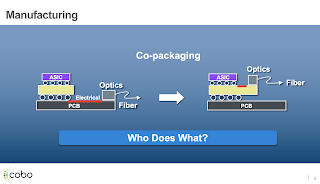
The Consortium for Onboard Optics (COBO) has been instrumental in letting people know the importance of actually placing the photonics chip in proximity of the ASIC. We're also seeing the proof point of putting chipsets of a switch or GPUs.

Lumentum and Ayar Labs target external light sources for CPO

Lumentum and Ayar Labs announced a strategic collaboration agreement to deliver CW-WDM MSA compliant external laser sources in high volume. “Co-packaged optics to replace traditional copper interconnects is a massive new market opportunity broadly recognized by the industry and one that Lumentum is well-positioned to address with our proven laser technologies and manufacturing scale,” said Walter Jankovic, Senior Vice President and General Manager...

GlobalFoundries unveils next gen silicon photonics platform

GlobalFoundries unveiled its next generation silicon photonics platform and active design wins with major customers, including collaborations with Broadcom, Cisco Systems, Marvell, NVIDIA, Ayar Labs, Lightmatter, PsiQuantum, Ranovus and Xanadu. The platform enables a high level of integration onto a photonics integrated circuit (PIC). It also supports innovative packaging solutions, such as the passive attachment for larger fiber arrays, support...


What's hot at OFC22? Lightriver on IPoDWDM

Hot trends at OFC22 include IPoDWDM, 400ZR, disaggregated networking, pluggable, next gen optical line systems, etc., says Travis Ewert, Chief Operating Officer, LightRiver Software.

What's not hot are all of the silos of disaggregated technology. LightRiver steps in with tools for bringing it all together. 

Lightriver supplies multi-vendor, Factory Built Networks and netFLEX vendor neutral, Optical Domain Control Software solutions.

https://youtu.be/gaF84RpQSCE

What's hot at OFC22? Sabic on new resins for optical interconnects

Optical interconnects are hot at OFC, says Shawn Lee, Senior Manager, New Business Development, Sabic.

Key challenges with optical interconnects are efficiency and scalability.  Sabic has introduced a new resin that addresses these challenges thanks to its thermal properties and high refractive index. The resin is suitable for micro molding for optical interconnect components.

https://youtu.be/Djiz__jXhPw

What's hot at OFC22? AOI's David Chen on CPO and NPO

 Two of the hot items at OFC22 were faster pluggable transceivers (800G and even 1.6T in the future) and Co-Packaged Optics (CPO), says David Chen, AVP, Strategic Marketing & Standard Office for Transceivers, AOI. 

There was a lot of activity at the OIF booth regarding CPO, external laser source modules -- all related to COBO's current working groups.  This video includes a diagram showing the evolution of COBO and NPO technologies.

https://youtu.be/nU5VrVblJZ0

Alphawave IP to acquire OpenFive Business Unit from SiFive for $210m

Alphawave IP Group plc agreed to acquire the entire OpenFive business unit from SiFive for US$210 million in cash.

SiFive is the founder and leader of RISC-V computing based in San Mateo, California. 

OpenFive, a SiFive business unit, has a high-speed connectivity system-on-chip (SoC) IP portfolio and a proven team based in India and Silicon Valley that has been delivering custom silicon solutions for over 15 years.  

The acquisition significantly increases Alphawave's customer base globally from 20 currently to over 75, especially in North America, and adds an additional hyperscaler customer based in North America.

This acquisition will nearly double the number of connectivity-focused IPs available to Alphawave customers from 80 to over 155 and will provide customers with a one-stop-shop for their bundled connectivity needs in the most advanced technologies at 5nm, 4nm, 3nm and beyond.  This will include an expanded die-to-die connectivity portfolio that will accelerate chiplet delivery capabilities to customers.  Alphawave has also licensed RISC-V processor IPs from SiFive as part of the transaction. 

Tony Pialis, President and Chief Executive Officer of Alphawave stated: "We have known and worked with the OpenFive team for many years as they have established their credibility in delivering leading-edge SoC IP and custom silicon solutions in the world's most advanced technology, and to the world's most advanced customers.  This acquisition is important for Alphawave, but also for our industry, as we will now be the leading pure-play provider of connectivity solutions in the world in whatever form-factor our customers need it – as silicon IP or in custom silicon solutions like chiplets.  As we look to the future, we expect to develop and acquire additional capabilities to further expand and accelerate our leadership in connectivity.  In our core business, the first quarter of 2022 is very strong and the outlook for 2022 is also strong. We expect this transaction to meaningfully impact revenues in H2 2022, pending regulatory approval of the transaction."

Patrick Little, Chairman and CEO of SiFive stated: "It has been a pleasure working with the Alphawave team on this transaction, and I am sure that we will continue to work together as SiFive focuses on its core RISC-V business.  We were also pleased that Alphawave licensed SiFive's RISC-V processor IP as part of the transaction, which further demonstrates the importance of SiFive RISC-V technology to high-end customers globally in a variety of end markets."

https://www.awaveip.com/en/news-views/alphawave-ip-announces-definitive-agreement-to-acquire-entire-openfive-business-unit-from-sifive-for-us-210m-in-cash/

Gold Data partners with Arelion for Latin American coverage

Gold Data, a leading Latin American network provider, is working with Arelion to expand its reach and service portfolio throughout Latin America including customers in Mexico, Guatemala, Panama, Dominican Republic and Costa Rica.

As a result of collaboration with Gold Data, which will cover both data and Internet services, Arelion will be able to tap further into a rapidly growing market with direct access to 156 key PoPs and 76 data centers throughout the region. The Gold Data Network will facilitate Arelion's reach delivering services including Wavelengths (DWDM), Ethernet, Cloud Connect and IP Transit (AS1299).

"It is a great honor for Gold Data to have been chosen as a LATAM partner by the world's leading Internet backbone provider to empower their growth and success in such a promising, but complex region. This is a testament to the quality of our network and solutions, and our commitment to excellence. We are looking forward to accelerating Arelion's success in the region," said Renato Tradardi, CEO of Gold Data.

"Arelion is dedicated to delivering high-quality, reliable and secure connectivity to address the continued growth of bandwidth demand in the region. We are pleased to include Gold Data as one of our partners in Latin America so we can bring services closer to end-customers in this part of the world. This collaboration is part of our constant growth strategy, as we strive to better serve in-region customers and global partners wanting to address the fast-growing Latin American communication and media markets," said Edison De Leon, Regional Director LATAM & Caribbean, Arelion.


Sunday, March 13, 2022

What's hot at OFC22? Ranovus on Co-Packaged Optics

Co-Packaged Optics are a center point of discussions at #OFC22, says Hamid Arabzadeh, President and CEO of Ranovus.

At the event, Ranovus launched its first generation of co-packaged optics, which monolithically integrates an optical engine into a single die, including drivers, TIAs, photodetectors, modulators, and the laser. Ranovus partnered with AMD-Xiliinx to be able to co-package its chip with the Xilinx Versal compute accelerator.

GlobalFoundries unveils next gen silicon photonics platform

GlobalFoundries unveiled its next generation silicon photonics platform and active design wins with major customers, including collaborations with Broadcom, Cisco Systems, Marvell, NVIDIA, Ayar Labs, Lightmatter, PsiQuantum, Ranovus and Xanadu. The platform enables a high level of integration onto a photonics integrated circuit (PIC). It also supports innovative packaging solutions, such as the passive attachment for larger fiber arrays, support...

Ranovus and Xilinx to demo Co-Packaged Optics integration

 At this week's OFC event in San Diego, Ranovus will demonstrated its Co-Packaged Optics (CPO) 2.0 integration featuing  a Xilinx Versal ACAP its own Ranovus Odin 800Gbps optical engine. The integration eliminates the need for the retimer, resulting in 75% smaller footprint and 40% cost and power consumption savings in the Optical Interconnect.RANOVUS’ Odin is a low latency, high density, and protocol agnostic optical engine that delivers...


What's hot at OFC22? Dan Pitt on Network Disaggregation

Network disaggregation is happening at a rapid pace, but it is having some unintended consequences, says Dan Pitt, President, Palo Alto Innovation Advisors.

One such consequence is that as you disaggregate the hardware, you also disaggregate the software, and means you need CI/CD if there is to be interoperability.

Here’s a look at some disaggregation demos, speaker sessions, and key technology trends at #OFC22.


What's hot at OFC22? Hirose on Multimode Waveguide Interconnects

 The Consortium for Onboard Optics (COBO) recently formed a working group to address Multi-mode Waveguide Interconnect System (MWIS) as an alternative to copper traces in printed circuit boards.  In this video, Joshua Kihong Kim, Principal Engineer, Photonic Signal Integrity, Hirose, discusses the latest developments.


COBO focuses on Multimode Waveguide Interconnects 

 The Consortium for On-Board Optics (COBO) has established a new Multi-Mode Waveguide Interconnect System (MWIS) Working Group to focus specifically on the replacement of copper traces with multi-mode waveguides and adding an extra thin interface for Electrical/Optical and Optical/Electrical conversion within close proximity to the electrical component.

"I am very pleased to have kicked off the new Multimode Waveguide Interconnect System (MWIS) Working Group. Although embedded optical waveguides in printed circuit boards have been researched for decades, now is the time for the industry to work together to address the imminent bandwidth and power issues associated with copper interfaces," said Joshua Kihong Kim, Principal Engineer at Hirose Electric and COBO MWIS Working Group Chair. "In the development of on-board optical systems, this is one of the missing pieces of the puzzle, and COBO is stepping up to develop specifications to enable an industry eco-system."

"The growing diversity of optical applications within the Data Center, including machine learning and resource disaggregation, are driving an increased need to enhance high-speed board level interconnect systems with optical waveguide technology.  COBO members recognize it is critical for companies to collaborate and provide guidance and specifications for design advancement," said Brad Booth, President at COBO and Principal Engineer, Azure Hardware Architecture at Microsoft. "We welcome interested parties to contact us if they would like understand more about our new MWIS Working Group."

http://onboardoptics.org/

What's hot at OFC22? 3M on Expanded Beam Optics

 With all the discussion surrounding silicon photonics and co-packaged optics, and considering the possibility of moving lasers from the faceplate to nearer the switch, it's clear the industry will look for a new generation of reliable connector, says Duane Preiss, Portfolios Marketing Director, 3M. Expanded beam optical is delivering a solution.


Webinar archive: Expanded beam optics

How do you ensure the reliability of a fiber connection to a switch at very high line rates or once co-packaged optics (CPO) solutions come to market? Dust is always a concern, especially at 400G and above, when even a small contamination can lead to magnified disruptions. Reliable optical interconnects are key! The latest OSFP 4.0 spec introduces support for Expanded Beam Optical (EBO) technology, opening up new possibilities.This webinar explores...

3M intros Expanded Beam Ferrule and Connector System

Earlier this month, 3M introduced an Expanded Beam Optical Connector System for single mode and multimode interconnects in next-gen data centers. “We’ve reimagined fiber optic connectors,” said Nick Stacey, Ph.D., global laboratory manager at 3M. “Our ferrule and connector technology is designed to reduce cleaning requirements, to provide design flexibility and to enable the performance necessary for next-generation optical deployment.” The 3M...