Wednesday, February 2, 2022

Intel's Project Circuit Breaker aims to weed out design flaws

Intel announced Project Circuit Breaker, a program to build a community of elite hackers to hunt bugs in firmware, hypervisors, GPUs, and chipsets. 

Project Circuit Breaker builds on Intel’s existing open Bug Bounty program by hosting targeted time-boxed events on specific new platforms and technologies, providing training and creating opportunities for more hands-on collaboration with Intel engineers. 

Project Circuit Breaker’s first event, Camping with Tigers, is already underway with a group of 20 researchers who received systems with Intel Core i7 processors (formerly “Tiger Lake”).

https://www.projectcircuitbreaker.com

  • Intel’s bug bounty awards range from $500 up to $100,000.

Juniper adds Firewall-as-a-Service to its SASE

Juniper Networks is expanding its Secure Access Service Edge (SASE) architecture with the addition of Juniper Secure Edge, a Firewall-as-a-Service (FWaaS) managed by its Security Director Cloud.

Key benefits of Juniper Secure Edge:

Unified policy management from a single UI for all security use cases. Create policies once and apply them anywhere and everywhere with unified policy management, including user- and application-based access, IPS, anti-malware and secure web access within a single policy. 

Secure user access from anywhere. Secure Edge supports the remote workforce whether employees are in the office, at home or on the road with secure user access to the applications and resources needed to do their job effectively. Security policies follow the user wherever they go, protecting the user, device and applications without having to copy over or recreate rule sets.

Dynamic Zero Trust segmentation. Maintain the security of data around identity- and risk-driven policies. Secure Edge delivers consistent security policy framework with policies that automatically adapt based on new risk and attack vectors and follow the user wherever they go, providing automated access controls to employees and third-party contractors through granular policy control.

Investment protection. Juniper customers can use the physical, virtual, containerized – and now cloud-delivered – SRX firewall, completely managed by Security Director Cloud with a single-policy framework, allowing for full visibility and consistent security across both the edge and the data center from one UI.

Integration with any identity provider. Secure Edge allows customers to use the identity provider that works for them by integrating with leading identity providers, such as Azure AD, Okta and others, through SAML 2.0 support.

Validated security effectiveness. Juniper provides cyberattack protection that has been validated by objective, third-party testing to be highly effective against client- and server-side exploits, malware and C2 traffic, regardless of where the users and applications are located. This includes achieving the highest security efficacy rating at 99.5% from CyberRatings.org compared to leading security vendors for Enterprise Firewall, and 100% effectiveness with zero false positives in ICSA Labs’ Advanced Threat Defense test in Q4 of 2021. Secure Edge delivers policies from the cloud, as a service, empowered with these proven threat prevention technologies, ensuring consistent security enforcement.

“We’re excited to take the next big leap in the SASE market with Juniper Secure Edge,” said Samantha Madrid, VP of Security Business & Strategy, Juniper Networks. “First, we empowered our customers to manage security anywhere, all within a single UI with Security Director Cloud. Now, with the introduction of Juniper Secure Edge, Juniper is enabling its customers to seamlessly secure remote workforces with consistent security policies that follow users wherever they go, all while leveraging existing investments as they transition to a cloud-delivered architecture. Secure Edge makes it easy for customers to deploy effective threat protection without breaking visibility.”

https://www.juniper.net/us/en/security.html


Arrcus awarded 10th networking patent for Segment Routing

Privately-held Arrcus, which offers hyperscale networking software for core-to-edge infrastructure, announced continuing momentum and strong business growth, closing 2021 with a tripling of its year-over-year bookings from 2020 to 2021. 

Arrcus also announced its 10th US patent in the area of hyperscale networking, this one for speeding up Segment ID allocation – a critical factor in accelerating internet traffic and content delivery over the web. Segment Routing (SRv6) protocol is getting increasingly popular as telecom carriers look to connect their 5G networks to the IP infrastructure. The distributed allocation of SRv6 Segment IDs helps eliminate latencies and complexities involved in the creation and maintenance of these IDs. This patent adds to others awarded to Arrcus for routing optimization covering topics such as virtualized routing, computational offload, and loop conflict avoidance.

“I am delighted to see us steadily beat our business as well as innovation goals at Arrcus. We are ‘right place, right time’ at the beginning of a massive networking refresh,” said Shekar Ayyar, CEO and Chairman at Arrcus. “As the demand for new network services grows among service providers and enterprises, customers are increasingly opting for the flexibility, security, and economics of Arrcus networking.”

“Arrcus’s ACE platform delivers a network architecture designed for open integration that is secure, scalable and delivers the best routing and switching performance. Our innovative Segment Routing capabilities enable fast rerouting of traffic, helping avoid transient congestion and increase network reliability,” said Keyur Patel, founder, and CTO at Arrcus. “With this, cloud and 5G networks can differentiate the way they deliver applications with unmatched simplicity and scalability.”


Arrcus resets with new CEO, vision, and strategic partners

Arrcus, a hyperscale networking software start-up based in San Jose, California, named Shekar Ayyar as its CEO and chairman of the board. The company also announced a strategic shift toward edge-native, large-scale distributed and disaggregated networking opportunities. In addition, Arrcus announced the infusion of new capital from its strategic partners - Liberty Global, SoftBank Corp and Samsung Next. The new investors join the existing investors,...

Arrcus: Opportunities at the Edge for Network Operating Systems?

In this video, Shekar Ayyar shares his perspective on the need for disaggregated networking solutions at the 5G edge.Ayyarr recently joined Arrcus as CEO and Chairman of the Board. Previously, he was the executive vice president and general manager of VMware's Telco and Edge Cloud business. He also led VMware’s strategy and corporate development efforts in enterprise software and communications while overseeing over 60 M&A transactions and investments...


CommScope joins Meta's Evenstar program for O-RAN

CommScope is joining Meta Connectivity's Evenstar program to help accelerate the adoption of Open RAN by developing open reference designs.

CommScope said tis collaboration will focus on developing a Massive MIMO (mMIMO) reference design based on O-RAN Alliance interoperability specifications. Massive MIMO substantially increases spectral efficiency to deliver more network capacity and wider coverage. The two organizations will cooperate on high-level architectural requirements, open standardized antenna and radio interfaces, and best practice calibration designs.

The mMIMO reference design will provide operators with the option to further disaggregate the filter/antenna elements from the radio unit, supporting flexibility and delivering implementation options to the market.

Meta Connectivity is working with control unit and distribution unit software vendors who will manage interoperability testing, while CommScope will support Over-the-Air (OTA) testing and characterization of the antenna within a laboratory environment.

“We are excited to have CommScope’s expertise in innovative antenna interfaces as part of our Evenstar program,” said Jaydeep Ranade, Director of Wireless Engineering at Meta Connectivity. “This collaboration will help facilitate an ecosystem of high-quality connectivity – something that becomes more important every day as we move to an increasingly digitally connected world.”

“CommScope is thrilled to be joining Meta Connectivity’s global Evenstar ecosystem,” said Farid Firouzbakht, senior vice president of Outdoor Wireless Networks, CommScope. “Open RAN is gaining momentum in the marketplace and mMIMO 5G deployments will require cooperation and collaboration between vendors based on competitive reference models.”

http://www.commscope.com

Saudi Arabia's stc aims to build hub for subsea cables and data centers

Saudi Arabia's stc kicked off an initiative to establish a major digital hub for the Middle East and North Africa with an investment of US$1 billion. The goal is to invest in an advanced fiber optic network linking 3 continents and ensuring continuous availability of services.

The launch came in on the sideline of this week's LEAP International Conference in Riyadh. This comes in cooperation with regional and international partners. The hub will link three continents, benefiting from the strategic location of the Kingdom, and promoting investment in international communication services and data centers. The hub will include the installation of a number of highly efficient cables to meet the future requirements of cloud services, by investing in an 

"stc is committed to be the digital pioneer to achieve KSA Vision 2030 by developing digital business so the Kingdom will be the regional hub and link the three continents. In addition to attracting direct and indirect foreign investments and stimulating more local investments. Hence, our goal is to build this property for the region and turn our goals to reality”, said AlWetaid.

“We are proud to contribute to transforming the digital industry in the Kingdom into a leading industrial power and a global logistics center, and the development of the local industrial sector, which puts Saudi Arabia at the forefront of global countries among data-dependent economies, stressing the transformation of business environments and the local community to be digitally connected in order to achieve an advanced digital economy”, concluded Alwetaid.

https://www.stc.com.sa/wps/wcm/connect/english/stc/NewsItems/stc-launches-mena-hub-1-billion-investment

Telefónica increases its stake in Telxius Telecom to 70%

Telefónica and Pontegadea are increasing their stake in Telxius Telecom, a global telecommunications infrastructure company, by acquiring a 40% stake in Telxius Telecom, previously held by KKR.

With this transaction, Telefónica will increase its stake to 70% and Pontegadea will increase its stake to 30%. The acquisition is carried out for an estimated amount of EUR 215.7 million, pending, among others, the corresponding adjustments derived from the sale of Telxius’ tower business to American Tower in 2021.

Telxius Telecom has one of the largest subsea cable networks in the world, extending 94,000 kilometres via leading subsea systems such as Marea, Brusa and Mistral, as well as SAm-1, the system that connects the United States with Latin America.

Telxius Telecom provides direct connectivity to the internet with a coverage of 93 points of presence and 27 landing stations in 23 countries. In addition, Telxius Telecom offers an extensive range of capacity services, colocation and security services.

Telefónica sells 10% stake in Telxius to long-term partner

Telefónica will sell a 9.99% equity stake in Telxius, its infrastructure arm, to Pontegadea for a total of 378.8 million euros.  This transaction represents a price of 15.2 euro per share of Telxius. Telefónica said the deal incorporates a long-term partner in a holding company that controls its infrastructure arm.  The sale has been structured via Telefónica’s subsidiary, Pontel Participaciones, which owns 60% of Telxius’ capital stock....


T-Mobile US reports higher Q4 revenue and customer additions

T-Mobile US reported service revenues of $15.0 billion for Q4 2021 and $58.4 billion for full-year 2021. Net income amounted to $422 million in Q4 2021 — $3.0 billion in full-year 2021.

“T-Mobile had our strongest year ever. We didn’t just meet the bold goals we set for 2021 around customer growth, profitability, merger synergies and network buildout – we crushed all of them,” said Mike Sievert, T-Mobile CEO. “Our industry-leading year-end results – adding 1.2 million postpaid accounts and 5.5 million postpaid customers, extending Ultra Capacity 5G to 210 million people – show that the Un-carrier is experiencing the greatest growth momentum in wireless. And we’re poised to sustain that position into 2022 and beyond as we continue to execute on our winning playbook and consistently make investments that have enabled our success. With plenty of room to run, we’re in the best-ever position to continue delivering.”

Some highlights:

  • Postpaid net account additions were 315 thousand in Q4 2021, the highest Q4 in four years and reached a record 1.2 million in full-year 2021, more than doubling year-over-year.
  • Postpaid net customer additions were industry-leading with 1.8 million in Q4 2021, the highest Q4, and 5.5 million in full-year 2021, a record-high and above the company’s recent guidance of 5.1 to 5.3 million.
  • Postpaid phone net customer additions were 844 thousand in Q4 2021 and 2.9 million in full-year 2021. Postpaid phone churn was 1.10% in Q4 2021, as the company ramped up its Sprint customer integration, and 0.98% in full-year 2021.
  • Postpaid other net customer additions were 906 thousand in Q4 2021 and 2.6 million in full-year 2021, which included High Speed Internet net customer additions of 224 thousand in Q4 2021 and 546 thousand in full-year 2021. T-Mobile ended the year with 646 thousand High Speed Internet customers, exceeding its year-end goal of 500 thousand customers.
  • Prepaid net customer additions were 49 thousand in Q4 2021 and 342 thousand in full-year 2021, more than doubling year-over-year. Prepaid churn was 3.01% in Q4 2021 and 2.83% in full-year 2021.
  • Total net customer additions were 1.8 million in Q4 2021 and 5.8 million in full-year 2021, the highest annual number in five years. The total customer count increased to a record-high of 108.7 million.

https://investor.t-mobile.com/news-and-events/events-and-presentations/default.aspx

ADTRAN cites record-setting bookings, fiber access up 48% yoy

ADTRAN reported Q4 2021 revenue of $154.2 million. Earnings for the fourth quarter of 2021 were a net loss of $4.2 million and earnings per share was a loss of $0.09. Non-GAAP net income was $4.7 million and non-GAAP earnings per share was $0.10.

ADTRAN Chairman and Chief Executive Officer Tom Stanton stated, “We continue to experience unprecedented demand for our solutions with another record-setting quarter for bookings. These record bookings were combined with record product revenue for both our fiber access platforms, up 48% year-over-year, and residential Wi-Fi platforms, up 72% year-over-year. The growth in these strategic segments was across a diverse mix of large and small service providers in the U.S. and Europe, highlighting the success we have had with customer diversification. Our success in capturing fiber footprint, bundling mesh Wi-Fi platforms and cloud software with fiber access, and the portfolio synergies offered by the announced ADVA combination provide an optimistic outlook for continued growth.”

ADTRAN has declared a quarterly cash dividend of $0.09 per common share to be to stockholders of record as of the close of business on February 17, 2022. 

http://www.investors.adtran.com

NETGEAR posts Q4 revenue of $251 million, down 31.6% yoy

NETGEAR reported Q4 2021 net revenue of $251.2 million, a decrease of 31.6% from the comparable prior year quarter. Q4 2021 GAAP net loss per diluted share was $0.03, as compared to net income per diluted share of $0.99 in the comparable prior year quarter. Fiscal 2021 net revenue was $1.17 billion, a decrease of 6.9% from the prior year.

Patrick Lo, Chairman and Chief Executive Officer of NETGEAR, commented, “Our team continued to execute through a challenging supply environment to deliver fourth quarter revenue of $251.2 million, and non-GAAP operating margin of 2.7%, both within our guidance. The team delivered Q4 year over year revenue growth of 8.6% for SMB products, which contributed to growth of 27% for the full year, despite significant supply challenges that limited our ability to fully meet continued strong SMB demand. On the CHP side of the business, we successfully completed our efforts to optimize channel inventory in the fourth quarter and we are pleased to share that we saw the U.S. consumer WiFi market remain stable at 15% above 2019 levels.”

Mr. Lo continued, “In the fourth quarter, our CHP business took another step forward in our core long-term strategy of focusing on the premium, higher-margin segments of the market, where we demonstrate highly differentiated technology leadership. Our recently released $1,500 Quadband WiFi 6E Orbi has been met with great reception from both customers and industry experts alike. Additionally, accelerated momentum in Pro AV switching and WiFi 6 cloud managed mesh wireless access points fuels our confidence in the long-term growth potential of the SMB business. We also made progress in building out our paid service offerings in the fourth quarter, as consumers increasingly look to secure their home office environments and intelligently manage their devices. I’m pleased to share that we ended the year at 584,000 paid subscribers. We remain confident that we will reach 750,000 paid subscribers by the end of 2022, as our subscriber base grows in tandem with our increased penetration into the premium segment of the market.”

https://investor.netgear.com/events-and-presentations/events-calendar/default.aspx

MaxLinear posts record Q4 revenue of $247.9 million, up 27% yoy

 MaxLinear reported record Q4 2021 net revenue of $247.9 million, up 8% sequentially and up 27% year-over-year. GAAP gross margin was 57.2%, compared to 56.5% in the prior quarter, and 42.7% in the year-ago quarter. Non-GAAP diluted earnings per share was $0.86, compared to diluted earnings per share of $0.75 in the prior quarter, and diluted earnings per share of $0.39 in the year-ago quarter.

“In the fourth quarter, revenue was up 8% sequentially and up 27% year-over-year, driven by strong growth across our connectivity, broadband and infrastructure markets. Wi-Fi grew 40% sequentially and we exited Q4 on a $100 million annualized revenue run rate which we expect to build upon through 2022. Non-GAAP gross margin for Q4 improved to 61.7% driven by product mix shift towards higher value products. We are excited about our prospects for continued future growth driven by our comprehensive product portfolio, and the accelerating pace of new product launches particularly in connectivity, fiber-to-the home broadband, optical, and wireless infrastructure markets,” commented Kishore Seendripu, Ph.D., Chairman and CEO.

https://www.maxlinear.com/

Tuesday, February 1, 2022

Blueprint: An insider’s view on the do’s, don’ts and deal breakers of SaaS

Mark Bunn, Senior Vice President, SaaS Business Operations, Cloud and Network Services, Nokia

Launching a new business model isn’t for the faint of heart, particularly when the change disrupts the status quo. Software-as-a-Service for communication service providers promises to change the very foundation of how our industry does business today. Moving from a legacy of customized, on-premise technology to a cloud native environment where everything is managed by the software vendor, is not only a change in mindset, it also changes the way CSPs have managed their businesses since the industry began in the 1800s.

The tipping point where only the strong survive 

Are CSPs ready to step into another chapter of telecommunications history? It’s only a matter of time before we reach a tipping point. SaaS will transform the way CSPs consume software. 

What’s to gain? Faster time to market, faster deployment of systems and new capabilities. Done right, SaaS eliminates risky, cumbersome upgrades, delivers significant savings on total cost of ownership (TCO) and reduces worry. Adopting SaaS will vastly improve the time-to-value that CSPs can realize by having on-demand access to services. 

Software-as-a-Service for CSPs can usher in a new era, reducing business friction to a level that makes mass adoption and value creation possible. Of course, any major shift brings cultural, operational and technology changes and it’s important to pay attention to lessons we can learn along the way.

Five critical assertions

1. Security and compliance are non-negotiable. 

As security breaches can be devastating. it is critical to take every reasonable action while providing a fully functional and highly available service. Security compliance is table stakes and takes significant time, effort and cost to achieve.

2. Architecture drives profitability.

In a cloud native environment, consider scalability at both ends of the spectrum where cost control becomes most challenging. Keep a rein on technical debt incurred as a byproduct of time-to-market priority decisions. Automate, automate and automate again, relying on infrastructure-as-code instead of manually applying production changes. It keeps the costs of SaaS operations flat while growing the SaaS subscriber base. Finally, and most important, diligently manage the reliability associated related to the deployment architecture with software.  

A key difference between SaaS and other forms of hosted services is that the software, not human beings, is responsible for managing the SaaS services.  For example, if we had production SaaS customers on our SaaS Delivery Framework today, we would have expected little measurable service impact for the AWS outage that occurred the week of December 6. The combination of our SaaS Delivery Framework architecture and Site Reliability Engineering early detection system provides a shield against this type of service disruption. In our future end-state, the SaaS Delivery Framework will enable us to move workloads between hyperscaler platforms to mitigate cloud outages like this one.

3. Embrace the fact that we are the IT department.

The buck stops with the SaaS delivery team, as the responsibility for operations, administration and management moves to the SaaS service provider. The SaaS delivery team provides the equivalent of a public utility service with responsibility for infrastructure, security, patching, updates, and data management including backup, archival and recovery. 

4. The commercial risk is distributed. 

For a mature SaaS service, there is no upfront cost for the buyer and no upfront revenue for the seller. On and off-boarding is expected to be easy. An exceptional offering and ongoing engagement with the customer are critical for retention. 

The SaaS business model is cost-effective. The customer can reduce IT expenses related to the management of personnel, hardware, and software. With a pay-as-you-go, pay-as-you grow subscription, costs for the buyer and recurring revenue for the seller are better managed by providing commercial scaling based on actual need. 

Updates to customers are provided automatically and new features can be accessed immediately. In short, buyer and seller alike reap efficiency and financial benefits from SaaS. 

5. The customer can no longer “always be right”.

With SaaS offerings, we manage customers as a group, not as individuals. SaaS at commercial scale requires the SaaS service provider to maintain full control of the lifecycle of the service. As a result, customers don’t dictate release and upgrade schedules.

Are we there yet?

Now that we’ve laid the foundation with lessons learned, let’s look at clues for SaaS buyers that the service offering has yet to reach a mature state. 

Hosted private cloud versus SaaS

A SaaS buyer would expect that the installation process is fully automated. If professional services with fees are essential to get started or the time between confirming an order and deployment is measured in weeks, it’s likely a hosted private cloud and not SaaS. A SaaS offering includes standard support with the subscription price. Support (or “CARE”) isn’t sold as a separate add-on to the SaaS service. 

Extensibility is measured by the ability to tailor a system and the level of effort needed to implement and maintain the extension. High extensibility leading to extreme customization and, subsequently, increased security vulnerability risk, is inconsistent with a SaaS model. These characteristics are commonplace in hosted private cloud offerings.

Signs it might not be cloud native 

Forced downtime and long, scheduled maintenance windows indicate software that isn’t cloud native. Applications that don’t auto-recover are not mature cloud native applications even though they may have incorporated cloud native elements.

It’s closer to an on-premises model

More than a handful of product codes per service and/or overly complex pricing, indicates an on-premise commercial model. The absence of proactive security penetration testing is also a tell-tale sign. Simplified pricing models and sophisticated security validation are fundamental characteristics of SaaS.

Walk this way to full maturity

Delivering SaaS successfully depends on building a strong foundation for entering the marketplace. While a true SaaS offering needs many ingredients before it’s considered fully mature, that doesn’t mean not being in position and being ready to sell. 

You can offer direction on standard industry security compliances and increasingly provide self-service capabilities to tenants, including ordering, billing care, pay-as-you-go pricing, and service health dashboards. 

There’s a lot more than meets the eye to a true SaaS offering. Getting from where we are today to maturity promises to be the journey of a lifetime. 


O-RAN will be a hot topic at #MWC22

by Benedict Chua


O-RAN is a hot topic on the #MWC22 agenda, says Stephanie Lynch-Habib, CMO of GSMA, speaking at MWC Los Angeles 2021. Stay tuned for more videos with top technology influencers.


Dell'Oro: Hyperscale data center CAPEX to double over next 5 years

Global data center CAPEX is on track to reach $350 billion by 2026. We forecast hyperscale cloud service providers to double their data center spending over the next five years, fueling the market growth, according to a new report from Dell'Oro Group.

“Our outlook for spending on data center infrastructure CAPEX is optimistic, with a five-year projected growth of 10 percent,” said Baron Fung, Research Director at Dell’Oro Group. “The hyperscale cloud service providers will account for an increasing portion of the total market, as they invest to expand their network of data centers, increase cloud capacity, and deploy AI infrastructure to enable new applications such as the metaverse. We also anticipate incremental growth as data center infrastructure become more distributed, as the cloud and telecom service providers and enterprises launch new services at the edge of the network,” explained Fung.

Additional highlights from the January 2022 Data Center IT CAPEX 5-Year Forecast Report:

  • Worldwide data center CAPEX is forecast to grow 10 percent by 2026.
  • CAPEX on servers is expected to outgrow other areas, driven by adoption in new server CPU platforms and accelerated computing.
  • Edge computing is forecast to comprise 8 percent of total data center infrastructure spending by 2026.

https://www.delloro.com/news/global-data-center-capex-to-reach-350-billion-by-2026/

Dell'Oro: Access equipment sales from 2021 to 2026

Sales of PON equipment for fiber to the home deployments, cable broadband access equipment, and fixed wireless CPE will all increase from 2021 to 2026, as service providers look to expand both the reach and rate of their fixed broadband services, according to a newly published report from Dell'Oro Group.

"Between national broadband plans, public subsidization, and private equity, spending on broadband infrastructure will see sustained growth through 2024, and will remain strong through 2026," said Jeff Heynen, Vice President at Dell'Oro Group. "Competition for broadband subscribers is heating up everywhere, fueling the need for operators to invest heavily in their access networks," added Heynen.

Additional highlights from the Broadband Access 5-Year Forecast Report:

  • PON equipment revenue is expected to grow from $8.3 B in 2021 to $9.8 B in 2026, driven largely by XGS-PON deployments in North America, EMEA, and CALA.
  • Revenue for Fixed Wireless CPE is expected to reach $2.8 B by 2026, led by shipments of 5G sub-6GHz and 5G Millimeter Wave units.
  • Revenue for Cable Distributed Access Equipment (Virtual CCAP, Remote PHY Devices, and Remote MACPHY Devices) is expected to reach nearly $900 M by 2024, as operators ramp their DOCSIS 4.0 deployments.

https://www.delloro.com/news/cumulative-spending-on-pon-cable-broadband-equipment-and-fixed-wireless-cpe-to-reach-95-b-between-2021-and-2026/

Starlink Premium promises 150-500 Mbps downlink, latency of 20-40ms

Starlink announced a Premium tier broadband service that promises  download speeds of 150-500 Mbps and latency of 20-40ms, enabling high throughput connectivity for small offices, storefronts, and super users across the globe.

Starlink Premium uses a bigger antenna that is twice the area of Starlink's standard phased array with broader scan angle. There are no long-term contracts, no data caps, and no exclusivity requirements.

Commercial availability for Starlink Premium is expected in Q2.

https://www.starlink.com/premium


Nautilus Floating Data Center connected via fiber

A floating data center deployed on a barge in the San Joaquin River of Central California will use an innovative water cooling system to increase its power efficiency.

Located at the Port of Stockton, the barge-mounted 10,000 square foot carrier-neutral data center is connected to an 18 mile, redundant, high count fiber ring that Utility Telecom built to link the unique facility to a local carrier hotel. 

Clearfield supplied its portfolio of  Clearview cassettes, FieldShield Drop Assemblies, terminals, cabinets, frames and enclosures for connecting the tightly packed spaces of the barge.

The companies said that installing high-speed fiber connectivity from land onto a water-based data center represented the latest, unique fiber deployment challenge for Clearfield’s products to solve. Limited access into the data center and a lack of traditional telecommunication demarc connection points required a creative approach, working with Utility Telecom to deliver and connect the fiber that brought the data center online.

Nautilus Data Technologies’ patented zero-impact water cooling system enables the highest density compute at 1.15 PUE or less with a 30 percent reduction in energy-related CO2 and air pollution. The  system operates without consuming water, producing wastewater, or using refrigerants and chemicals, making it harmless to water and wildlife.

“We are changing the dynamics of the data center industry by factoring sustainability and impact as equal value to the compute environment, resiliency, and scale,” said Ashley Sturm, Vice President of Marketing, Nautilus Data Technologies. “The team at Clearfield and Utility Telecom helped design a network to meet specific needs so we can maximize the opportunity for our company and clients.”

“Providing the right connection options is fundamental to how we approach the market, especially for companies like Nautilus Data Technologies that deliver a unique solution that can change the game for their respective industry,” said Michael Wood, National Market Manager – Utilities, Clearfield. “We believe we can help our operator partners overcome any challenge or obstacle their deployment environment presents as they roll out fiber networks to help take their network and customers further.”

https://ir.seeclearfield.com/news-events/press-releases/detail/270/clearfield-and-utility-telecom-connect-nautilus-floating

Aeva debuts 4D LiDAR on silicon photonics chip

Aeva, a start-up based in Mountain View, California, introduced a "4D LiDAR" sensor based on a unique Frequency Modulated Continuous Wave (FMCW) technology and a LiDAR-on-chip module design. The sensor uniquely detects the fourth dimension of instantaneous velocity for each point in addition to 3D position. 

Aeva’s LiDAR-on-Chip design eliminates all fiber optics and places all key components including transmitters, receivers and optics onto a silicon photonics chip in a compact module.

Aeva's 4D Perception software powers features like 4D Localization and Ultra Resolution, a camera-level image with up to 20 times the resolution of legacy LiDAR sensors. 

Key features :

  • Camera-Level Ultra Resolution: Leverages Aeva’s proprietary raw 4D data to deliver a real-time camera-level image with up to 1000 lines per frame with no motion blur for the static scene
  • Instant Velocity with Ultra Long Range: Aeva’s next-generation 4D LiDAR uniquely measures instantaneous velocity for each pixel in addition to 3D position, allowing automated vehicles and machines to perceive where things are and know precisely how fast they are moving, at distances up to 500 meters
  • LiDAR-on-Chip Technology: A groundbreaking design eliminates all fiber optics and incorporates all key LiDAR elements onto silicon photonics in a single compact module for reliable and scalable production
  • Automotive Grade Reliability: With automotive-grade ratings for ingress, impact, thermal, and shock and vibration to ensure peak performance across a variety of road and environmental conditions
  • Designed for Versatility: At a quarter of the size of the previous generation, the compact design allows for a wide range of integration options, with real-time configurable maximum ranges, field of views and scan patterns to enable a broad range of autonomous applications

“Aeries II is a leap forward for the industry, and we believe it will play a critical role in unlocking the next wave of automation across a variety of applications from automotive, to industrial and beyond,” said Mina Rezk, Co-Founder and CTO at Aeva. “Aeva's unique FMCW technology has inherent advantages like instant velocity detection for each point that allow us to deliver several crucial breakthroughs for our customers such as Ultra Resolution and 4D Localization, which have not been possible until today. Aeries II provides our customers with a new level of perception to help automated vehicles and machines make safer, more intelligent decisions with higher confidence.”

https://www.aeva.com/aeries-ii/

NeoPhotonics shareholders approve acquisition by Lumentum

NeoPhotonics stockholders approved the merger agreement under which Lumentum Holdings will acquire NeoPhotonics. Stockholders also approved other proposals relating to the transaction.

Approximately 99.5% of NeoPhotonics stockholders who voted cast their votes in favor of the proposal to approve the merger agreement. This represented approximately 76.3% of NeoPhotonics’ outstanding common stock as of the record date for the Special Meeting of Stockholders.

The company said the transaction is now expected to close in the second half of calendar year 2022.

http://www.neophotonics.com

Lumentum to acquire NeoPhotonics for $918M amidst strong demand

Lumentum agreed to acquire NeoPhotonics for $16.00 per share in cash, representing a total equity value of approximately $918 million and a premium of approximately 39% to NeoPhotonics' closing stock price on November 3, 2021.

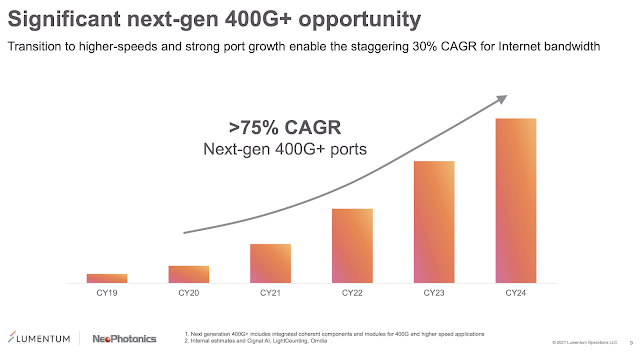
The companies cited significant next-gen 400G+ opportunities as a leading driver for the merger.

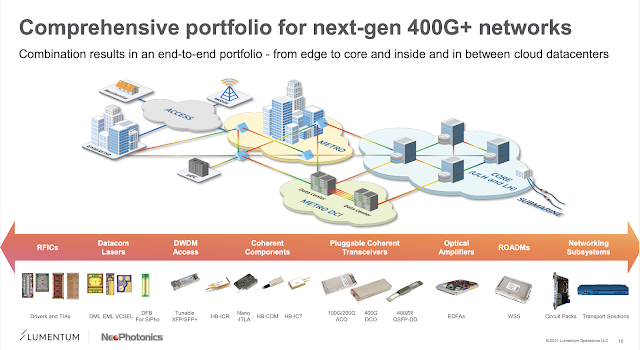
NeoPhotonics, which was founded in 1996 and is based in San Jose, is a leading supplier of tunable lasers and optoelectronic components, including devices manufactured in its own Indium Phosphide fabs and combined with electronics using using Advanced Hybrid Photonic Integration techniques. The product portfolio includes coherent components and tunable lasers, coherent transceivers, wavelength management products, as well as fixed wavelength lasers and high speed driver ICs. The company has engineering and manufacturing facilities in Silicon Valley (USA), Japan and Shenzhen, China.

Lumentum said the acquisition strengthens its position in the more than $10 billion market for optical components used in cloud and telecom network infrastructure. 

"With NeoPhotonics, we're making another important investment in better serving our customers and expanding our photonics capabilities at a time when photonics are at the forefront of favorable long-term market trends," said Alan Lowe, Lumentum President and CEO. "At the center of our strategy is a relentless focus on developing a differentiated portfolio with the most innovative products and technology in our industry so that we can help our customers compete and win in their respective markets. Adding NeoPhotonics' differentiated products and technology and innovative R&D team is consistent with this strategy and together, we will better meet the growing need for next generation optical networking solutions."

"Today's announcement is an exciting milestone for NeoPhotonics," said Tim Jenks, NeoPhotonics President, CEO, and Chairman. "The increasing global demand for our ultra-pure light tunable lasers and photonics technologies for speed over distance applications is more apparent than ever, and Lumentum is the ideal partner to serve our customers on a larger scale. Lumentum recognizes the importance of NeoPhotonics' differentiated photonic technology and products, which are well positioned for accelerated growth in the coming years. "


Lumentum intends to finance the transaction through cash from the combined company's balance sheet. Lumentum also noted that it will provide up to $50 million in term loans to NeoPhotonics to fund anticipated growth, which may require increased working capital and manufacturing capacity.

T–Mobile US extends BSS contract with Netcracker

 T–Mobile US has extended its BSS and managed services partnership for its wholesale business, which includes the MVNO and IoT markets, with Netcracker Technology, a wholly owned subsidiary of NEC. Financial terms were not disclosed.

Netcracker Digital BSS, including Netcracker Partner Management, and Netcracker Managed Services will help T-Mobile continue leveraging best-in-class capabilities for revenue management while optimizing a range of operations, such as reduced bill run times and improved billing accuracy. Netcracker Digital BSS serves as T-Mobile’s billing platform for its wholesale line of business and is used to deliver the best possible offerings and customer experience across its growing subscriber base.


Telefónica’s CEO elected chair of GSMA

José María Álvarez-Pallete, chairman and CEO of Telefónica, has been elected Board Chair of GSMA. He will serve through December 2022. Orange Group’s Stéphane Richard vacates the role after three years’ service.

As Board Chair, Mr Álvarez-Pallete will oversee the strategic direction of the GSMA, with the support of Board Deputy Chair, Rima Qureshi, Executive Vice President and Chief Strategy Officer of Verizon. The GSMA Board comprises the world’s largest operator groups and smaller independent operators with global reach.

“We very much appreciate the support and guidance that Stéphane provided during his term. His leadership was steady and supportive throughout a challenging period,” said Mats Granryd, Director General, GSMA. “As we look forward, we remain committed to our vision to unlock the power of connectivity so that people, industry, and society thrive. It is with great pleasure that we welcome José María as he joins us to support that vision for the coming year.”

“I’m very proud to join the GSMA as Chairman of the Board, representing the global mobile ecosystem. Technologies like 5G, edge computing, cloud, cybersecurity, AI and IoT, have redefined the way society operates and interacts online, paving the way towards metaverse, web3 and a new digital era”, said Telefónica’s Chairman and CEO, José María Álvarez-Pallete. “However, increased digitisation must include responsible leadership to drive growth, job creation, sustainability, and accelerate digital inclusion. I look forward to supporting the GSMA drive these critical issues, and many others, with the GSMA Board.”

https://www.gsma.com/newsroom/press-release/gsma-board-elects-new-chair/