Wednesday, January 10, 2024

Hawaiki activates 400GbE on transpacific cable

Commercial 400GbE services on the Hawaiki Transpacific Cable, which is owned by BW Digital. The 13,540km Hawaiki cable connects Australia, New Zealand, American Samoa, Hawaii, and the U.S. West Coast.

The new capability is powered by Ciena's GeoMesh Extreme submarine network solution. It is supported by the Waveserver 5 compact interconnect platform, powered by WaveLogic 5 Extreme programmable 800G technology, running over the 6500 Packet-Optical Platform Submarine Line Terminal Equipment (SLTE). 

Validation was performed using EXFO’s multi-technology 400G Test Set, which is an Open Transceiver System and Intelligent Pluggable Optics test application. Results demonstrated smooth traffic and no latency impact across the Sydney to Hillsboro segment. BW Digital was supported by WWG Comtest, the EXFO partner in New Zealand, for the loan and technical support on the EXFO Test Set.
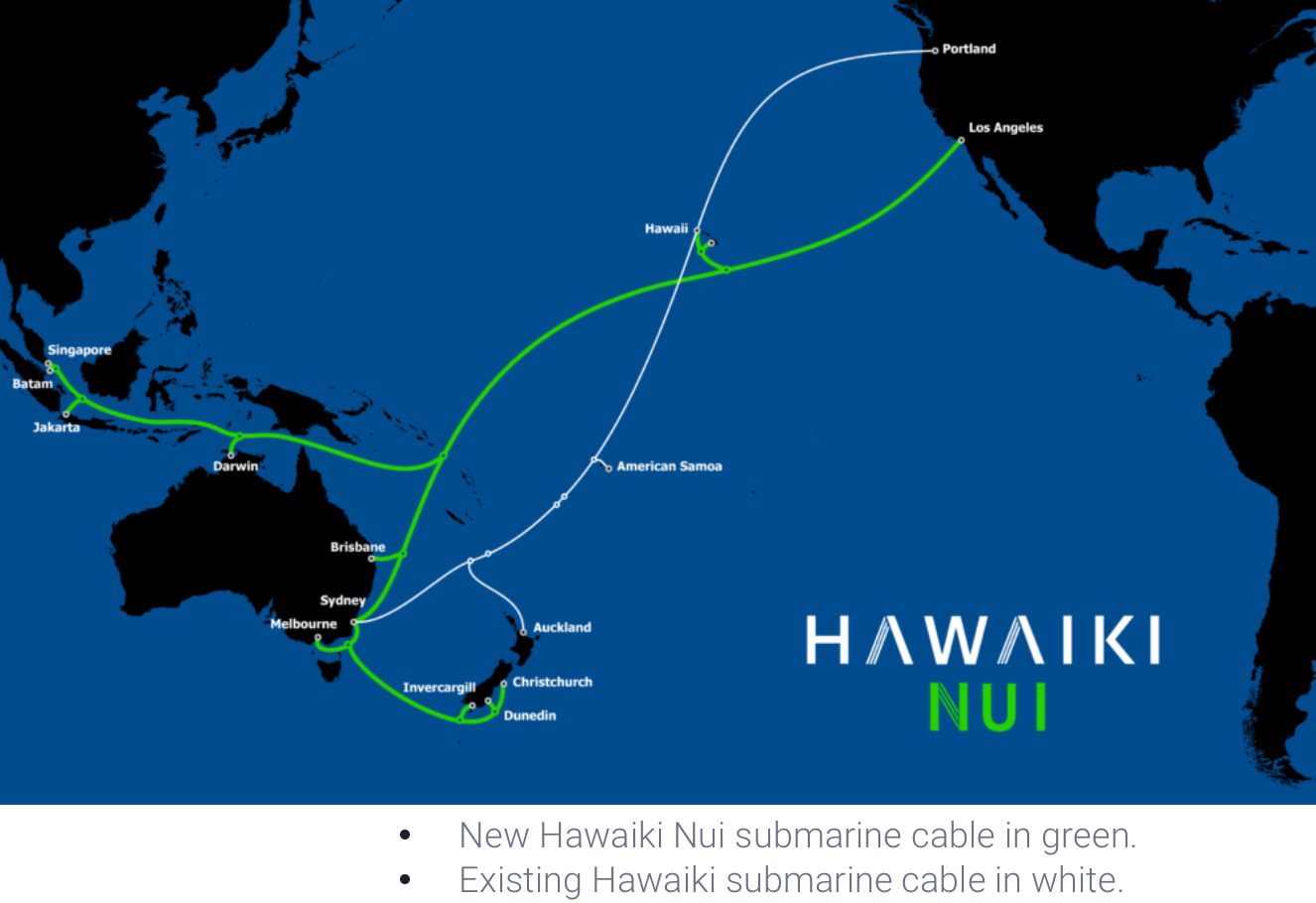

The Hawaiki cable has previously tested and achieved 500Gbps channel wavelengths.

“Our recent upgrades with Ciena’s GeoMesh Extreme put us in good stead to respond to ever-growing market requirements for international connectivity,” said Ludovic Hutier, Chief Executive Officer, BW Digital, which owns the Hawaiki cables. “Ciena and BW Digital have a long-standing relationship, and this is but one of many connectivity highlights that we hope to continue to bring to our customers.”

“Cable operators globally are always looking for ways to upgrade their cables to be faster, smarter, safer, and more open. Our GeoMesh Extreme is providing BW Digital an end-to-end network architecture, enabling the Hawaiki cable to deliver 400GbE services on its network, which is crucial in meeting the needs of today’s digital consumers, enterprises, and content providers,” said Thomas Soerensen, Vice President, Global Submarine Solutions, Ciena.

www.bw-digital.com

www.ciena.com

More notes on HPE + Juniper

On a conference call, executives from HPE and Juniper Networks said the strategic imperative for their proposed merger “will strengthen HPE’s position at the nexus of accelerating macro-AI trends, expand our total addressable market, and drive further innovation for customers as we help bridge the AI-native and cloud-native worlds.”

In particular, the companies see an opportunity to expand their combined Edge and Networking total addressable market by 30% by 2026. They cite:

  • The Juniper integration will make HPE’s portfolio will be even more diversified and more heavily weighted toward its high growth, higher margin businesses.
  • Minimal overlap in product lines and customer segments
  • For Juniper, it grows their footprint in data centers and cloud providers. 

Some slides from the webcast (linked below)


https://investors.hpe.com/~/media/Files/H/HP-Enterprise-IR/documents/hpe-to-acquire-juniper-investor-relations-deck.pdf

DriveNets and Acacia team on 400G ZR/ZR+ cloud

 In response to the requirements of Tier-1 operator customers, DriveNets and Acacia have developed a joint solution that integrates multiple Acacia 400G ZR/ZR+ optical modules with DriveNets' Network Cloud platform.

Last September, DriveNets announced that Network Cloud was the first Disaggregated Distributed Chassis/Backbone Router (DDC/DDBR) to support ZR/ZR+ optics as native transceivers that can be inserted into any Network Cloud-supported white boxes. 

The companies cite several benefits:

  • The joint solution will deliver significant simplicity and cost savings by collapsing Layer-1 to Layer-3 communications into a single platform.
  • The use of 400ZR/ZR+ eliminates the need for standalone optical transponders, lowering the number of boxes in the solution, and reducing operational-overhead, floor-space, and power.
  • DriveNets and Acacia worked together to ensure that the DriveNets NOS (DNOS) supports the 400ZR/ZR+ modules beyond simply plugging them into the box. The collaboration ensures the 400ZR/ZR+ modules can be tunable, configurable, and manageable by DriveNets Network Cloud software.
  • This integration also goes beyond interoperability validation. DriveNets Network Cloud offers full software support for the Acacia modules, including configuration (channel and power), monitoring, and troubleshooting for Acacia Bright 400ZR+ transceivers with transmit power greater than +1dBm.

"Today's announcement is further proof of the growth of disaggregated networking solutions and demonstrates that more operators are looking for open solutions that will allow them to mix elements from multiple vendors and avoid being locked to a specific end-to-end vendor solution," said Nir Gasko, Vice President, Global Strategic Alliances for DriveNets. "By collaborating with Acacia, we enable our joint customers to quickly adopt cutting-edge technologies and evolve their networks faster."

"Partnering with DriveNets on this joint solution will allow network operators to deploy Acacia's high-volume standard-based coherent pluggable portfolio in open disaggregated networks with less effort," said Fenghai Liu, Senior Director of Product Line Management for Acacia. "Through this collaboration customers can achieve significant capex and opex savings with router-based coherent optics."

FCC's Affordable Connectivity Program is running out of funds

 The Federal Communications Commission (FCC) is sounding the alarm that without immediate congressional action the Affordable Connectivity Program (ACP) will begin running out of funds in April 2024 and be completly without money in May. This will result in millions of households losing financial support to afford internet services. Approximately 1,700 internet service providers across the country will be affected by the termination of the ACP and may be forced to disconnect service to households that no longer receive program support.

FCC Chairwoman Jessica Rosenworcel is urgently requesting $6 billion from Congress to keep the program operational.

The urgent need for congressional action stems from the fact that while Congress initially allocated $14.2 billion for the ACP, further funding is essential to sustain the program.

Furthermore, the termination of the ACP could jeopardize the success of the $42.5 billion Broadband Equity, Access, and Deployment Program, for which the ACP provides a stable customer base, incentivizing broadband deployment in rural and underserved areas.

Key facts:

  • Launched on December 31, 2021 under the Bipartisan Infrastructure Law, the Affordable Connectivity Program is the largest internet affordability program in U.S. history.

  • The program has enrolled nearly 23 helping close the digital divide by bringing more households online.

  • Under the current program, eligible low-income households can receive a discount of up to $30 per month toward internet service and up to $75 per month for eligible households on qualifying Tribal lands.

  • Eligible households can also receive a one-time discount of up to $100 to purchase a laptop, desktop computer, or tablet from participating providers if the household contributes more than $10 and less than $50 toward the purchase price.

  • While the program helps connect households in rural and urban communities alike, rural households have enrolled at a higher rate than their urban counterparts.

This week, a bipartisan bill has been introduced in Congress. The Fiber Broadband Association (FBA) published the following statement:

“The Fiber Broadband Association commends Senators Peter Welch (D-VT), J.D. Vance (R-OH), Jacky Rosen (R-NV) and Kevin Cramer (R-N.D.) and Representatives Yvette Clarke (D-NY-9) and Brian Fitzpatrick (R-PA-1) for their bipartisan, bicameral leadership in introducing legislation that will allow the Affordable Connectivity Program to continue into 2024. More than 20 million households are currently benefiting from this important program, allowing them to fully participate in all aspects of the economy and society.” –Gary Bolton, President & CEO, Fiber Broadband Association.


https://docs.fcc.gov/public/attachments/DOC-399616A1.pdf

FBA Predictions2024: Fiber Broadband Deployments in 2024

Gary Bolton, President from Fiber Broadband Association predicts:

- The supply chain for fiber broadband will normalize in the first half of 2024, allowing for new shipments and record deployment.

- Access, affordability, and adoption of fiber broadband will increase, with funding from the Affordable Connectivity Program (ACP) ensuring everyone can participate on the internet.

- 2024 will be the year of workforce development, with over 200,000 fiber optic technicians needed. The Fiber Broadband Association's technician training program will expand across all states and territories, and states will begin to allocate funding for workforce development.


https://youtu.be/hjvZ8oOJIpM


Want to be involved our video series? Contact info@nextgeninfra.io

Global Foundries Predictions 2024: Silicon Photonics & Novel Materials

Vikas Gupta, Senior Director of Product Management from GlobalFoundries, anticipates:

- The growth of the Silicon Photonics ecosystem, with a surge in non-traditional OSATs (Outsourced Semiconductor Assembly and Test ) taking the lead in Silicon Photonics packaging.

- The rise of a cottage industry associated with IP development, fiber supply, laser suppliers, and test equipment, all crucial components in the Silicon Photonics landscape.

- The increasing usage and development of novel materials such as, lithium niobate, barium titanate, and other organic polymers. Gupta emphasizes the importance of these materials over the next four to five years.


https://youtu.be/Zn4Hl6QiEns

Want to be involved our video series? Contact info@nextgeninfra.io

Infinera Predictions 2024: 400G Plugables & Beyond

Check out all 2024 Predictions from Industry Thought Leaders: https://ngi.fyi/predictions24yt

Tim Doiron, VP of Solution Marketing from Infinera, predicts:

- A surge in the adoption of 400G coherent pluggables by traditional network operators. These high-performance pluggables are suitable for longer distances and complex architectures.

- Expanded transmission spectrum on fiber that will enable increased capacity and reduced cost per bit per kilometer.

- The arrival of 800G coherent pluggables based on 5nm DSP technology offering multivendor interoperability, reduced power, and extended reach.


https://youtu.be/ysvItx9gjLI

Want to be involved our video series? Contact info@nextgeninfra.io

Adtran Predictions 2024: Service Provider Networking Trends in 2024

 Ronan Kelly, CTO, EMEA from Adtran, predicts:

- Better inventory alignment at carriers to reduce their high uncertainty buffers of stock. This will free up cash flow, allowing a renewed investment on connecting subscribers.

- A shift towards more efficient solutions, not just for energy, but broader resource consumption, streamlined workflows, and improved operational efficiency.

- A growing need for interoperability, allowing operators to bring disparate networks from different vendors under common control, delivering a homogeneous service offering.


https://youtu.be/DR8p0yLw4JE

Want to be involved our video series? Contact info@nextgeninfra.io

DISH lands $50M NTIA grant for 5G Open RAN center

DISH Wireless has been awarded a  $50 million grant from the U.S. Department of Commerce's National Telecommunications and Information Administration (NTIA) to establish the Open RAN Center for Integration & Deployment (ORCID). 

ORCID, which will be housed in DISH's secure Cheyenne, Wyoming campus, will allow participants to test and validate their hardware and software solutions (RU, DU and CU) against a complete commercial-grade Open RAN network deployed by DISH. The facility will be supported by consortium partners Fujitsu, Mavenir and VMware by Broadcom and technology partners Analog Devices, ARM, Cisco, Dell Technologies, Intel, JMA Wireless, NVIDIA, Qualcomm and Samsung. 

At ORCID, participants will be able to test and evaluate individual or multiple network elements to ensure Open RAN interoperability, performance and security, and contribute to the development, deployment and adoption of open and interoperable standards-based radio access networks. ORCID's "living laboratory" will drive the Open RAN ecosystem — from lab testing to commercial deployment.  

Highlights:

  • ORCID will combine both lab and field testing and evaluation activities. ORCID will be able to test elements brought by any qualified vendor against DISH's live, complete and commercial-grade Open RAN stack. 
  • ORCID will use DISH's spectrum holdings, a combination of low-, mid- and high-band frequencies, enabling field testing and evaluation. 
  • ORCID will evaluate Open RAN elements through mixing and matching with those of other vendors, rather than validating a single vendor's stack. DISH's experience in a multi-vendor environment will give ORCID unique insights about the integration of Open RAN into brownfield networks. 
  • ORCID's multi-tenant lab and field testing will occur in DISH's secure Cheyenne, Wyoming facility, which is already compliant with stringent security protocols in light of its satellite functions.

"The Open RAN Center for Integration and Deployment (ORCID) will serve a critical role in strengthening the global Open RAN ecosystem and building the next generation of wireless networks," said Charlie Ergen, co-founder and chairman, EchoStar. "By leveraging DISH's experience deploying the world's first standalone Open RAN 5G network, ORCID will be uniquely positioned to test and evaluate Open RAN interoperability, performance and security from domestic and international vendors. We appreciate NTIA's recognition of DISH and ORCID's role in driving Open RAN innovation and the Administration's ongoing commitment to U.S. leadership in wireless connectivity."

https://dish.gcs-web.com/news-releases/news-release-details/dish-wireless-awarded-50-million-ntia-grant-5g-open-ran

EKINOPS publishes 2023 financial results

 EKINOPS reported its consolidated revenue figures for the fiscal year ending on December 31, 2023, revealing the following key points:

  • Total Revenue: EKINOPS reported a consolidated revenue of €129.1 million for the year 2023, marking a modest year-over-year increase of +1% compared to the previous fiscal year. When accounting for constant exchange rates, annual revenue showed slightly stronger growth at +2%.
  • Fourth Quarter Growth: In Q4 2023, EKINOPS experienced a sequential revenue growth of +9% compared to the previous quarter, recovering from Q3 2023, which was the low point of the year. However, year-over-year, Q4 2023 revenue decreased slightly to €30.3 million from €31.5 million in Q4 2022, representing a quarterly decline of -4% (-3% at constant exchange rates).
  • Optical Transport Success: EKINOPS saw substantial growth in its Optical Transport business line, with a +27% increase in revenue over the course of 2023. This growth was driven by successful implementations of Wavelength Division Multiplexing (WDM) solutions, particularly in France and EMEA (Europe - excluding France - Middle East and Africa). New customer wins, especially in Eastern Europe, contributed significantly to this success.
  • Access Solutions Decline: In contrast, sales of Access solutions faced challenges in 2023, experiencing a significant decline of -15% over the year. This decline was particularly pronounced in the second half of the year, with a -25% decrease. Factors contributing to this decline included a slowdown in demand, increased caution among clients in making investments, high equipment inventories among major operators, and difficulties in securing financing sources for operators.
  • Software & Services Growth: The share of Software & Services in EKINOPS' revenue increased to 17% of the company's total revenue for FY 2023, compared to 15% in the previous fiscal year. In H2 2023, Software & Services accounted for 20% of the company's revenue. Revenue generated by Software & Services saw an impressive +12% growth over the full year, driven by network virtualization solutions, SD-WAN solutions, and associated services.
  • International Expansion: EKINOPS recorded an +8% growth in international sales for the fiscal year 2023. In North America, revenue increased by +6%, reaching €31.7 million, despite a demanding comparison basis from the previous year. EMEA showed robust growth, with revenue in the region increasing by +23%. In contrast, Asia-Pacific experienced a substantial -63% decline in revenue.
  • Domestic Market Performance: EKINOPS' sales in its domestic market, France, decreased by -11% in 2023. Access equipment, the company's core business in France, saw a -18% drop in sales due to the economic slowdown and high inventory levels at major operator customers. However, Optical Transport continued to perform well, with a significant +57% increase in sales over the year.
  • EBITDA Margin Target: Despite challenging market conditions, EKINOPS confirmed its EBITDA margin target for 2023, aiming for a margin between 13% and 17%. The second half of 2023 was particularly impacted by adverse market conditions in the Access activity.

Didier Brédy, Chairman and CEO of Ekinops, said: "Changes in the economic climate during 2023, affecting company investment policies and health, penalized our Access business in the second half of the year. In contrast, we significantly outperformed the Optical Transport market, both in Europe and the United States. After the low point of Q3, our aim is to generate a higher level of revenue in H1 2024 than that of H2 2023. FY 2024 revenue should be driven by a rebound in Access equipment sales as the economy recovers, and by the launch of a major new optical transport product over the summer.

In terms of acquisitions, Ekinops' management remains fully mobilized, and we aim to complete one or more transactions over the coming months, while favoring non-dilutive financing."

Tuesday, January 9, 2024

HPE + Juniper merger targets AI-native networking

Citing higher growth and higher margin opportunities for modernized networking optimized for hybrid cloud and AI, Hewlett Packard Enterprise (HPE) confirmed plans to acquire Juniper Networks for $40.00 per share in cash, representing an equity value of approximately $14 billion and a 32% premium over the unaffected closing price of Juniper’s common stock on January 8, 2024.

HPE saysJuniper’s complementary portfolios supercharges its own edge-to-cloud strategy with an ability to lead in an AI-native environment based on a foundational cloud-native architecture. 

The combined company will target next-generation AI-native networking and enable new digital experiences through secure, intelligent connectivity. Networking will become the new core business and architecture foundation for HPE’s Hybrid Cloud and AI solutions delivered through our HPE GreenLake hybrid cloud platform. 

“HPE’s acquisition of Juniper represents an important inflection point in the industry and will change the dynamics in the networking market and provide customers and partners with a new alternative that meets their toughest demands,” said Antonio Neri, CEO of HPE. “This transaction will strengthen HPE’s position at the nexus of accelerating macro-AI trends, expand our total addressable market, and drive further innovation for customers as we help bridge the AI-native and cloud-native worlds, while also generating significant value for shareholders. I am excited to welcome Juniper’s talented employees to our team as we bring together two companies with complementary portfolios and proven track records of driving innovation within the industry.”

“Our multi-year focus on innovative, secure AI-native solutions has driven Juniper Networks’ outstanding performance,” said Rami Rahim, CEO of Juniper Networks. “We have successfully delivered exceptional user experiences and simplified operations, and by joining HPE, I believe we can accelerate the next phase of our journey. In addition, this combination maximizes value for our shareholders through a meaningful all-cash premium. We look forward to working with the talented HPE team to drive innovation for enterprise, service provider and cloud customers across all domains, including campus, branch, data center and the wide area network.”

Some highlights:

  • Juniper CEO Rami Rahim will lead the combined HPE networking business, reporting to HPE President and CEO Antonio Neri.
  • On a pro forma basis, the new networking segment will increase from approximately 18% of total HPE revenue as of fiscal year 2023 to approximately 31%[1] and contribute more than 56%1,[2] of HPE’s total operating income.
  • The transaction is expected to be funded based on financing commitments for $14 billion in term loans, which will ultimately be replaced, in part, with a combination of new debt, mandatory convertible preferred securities, and cash on the balance sheet. 
  • The combined company is expected to achieve operating efficiencies and run-rate annual cost synergies of $450 million within 36 months post close. 
  • The acquisition is currently expected to close in late calendar year 2024 or early calendar year 2025.

https://www.hpe.com/us/en/newsroom/press-release/2024/01/hpe-to-acquire-juniper-networks-to-accelerate-ai-driven-innovation.html

From HPE's Q4 2023 financial presentation


From Juniper's Q3 2023 financial presentation


HPE Aruba Networking Predictions 2024: Private 5G, AI & Zero Trust

Check out all 2024 Predictions from Industry Thought Leaders: https://ngi.fyi/predictions24yt

Phil Mottram, EVP and GM from HPE Aruba Networking, predicts:

- Private 5G will become Enterprise ready. Private 5G will coexist with Wi-Fi, particularly benefiting outdoor spaces and areas where speed is crucial.

- AI becomes more mainstream in networking. Network managers will become more efficient, focusing more on strategy rather than individual network issues. 

- Zero trust will be a significant element of security deployments. Zero trust will bridge the gap between network and security departments, providing users with necessary application access while maintaining an organization's security posture. 


https://youtu.be/5ZkpTAK328c

Want to be involved our video series? Contact info@nextgeninfra.io

Juniper Predictions 2024: Sustainability & 800G Networking Shape Future

 How will sustainability, 800G, and AI operations will shape the future of network infrastructure? Sally Bament, VP of Cloud & Service Provider Marketing from Juniper, explains:

- The importance of sustainability in network infrastructure purchasing decisions: Suppliers who can't demonstrate that their products are energy-efficient and recyclable will be at a significant disadvantage. The term "green networking" will become ubiquitous, and businesses will be held accountable to benchmarks aligned with scientific understanding to ensure real contributions to global sustainability efforts.

- The emergence of 800G networking as a hero technology: With the continued growth of data-heavy applications and services demanding ultra-fast experiences, 800G networking will emerge, led by cloud providers, telecom operators, and data center operators. This technology will enable performance without compromise and equip operators to navigate sustainable growth while balancing capacity needs, space efficiencies, and cost management.

- The adoption of on-prem automation and cloud-based AI Ops by operators: Operators will begin experimenting with cloud-based AI operations, influenced by security compliance and data sovereignty needs. By adopting a nuanced strategy, operators will proactively reduce customer-detected issues and improve customer retention to support their broader business goals. Automation will shift focus from cost reduction to enhancing operational efficiencies and user experience. 


https://youtu.be/deoqNO_iOL8

Join Sally as she shares her insightful predictions for 2024 in the world of network infrastructure.

Want to be involved our video series? Contact info@nextgeninfra.io

Juniper Predictions 2024: Shift to On-Premises AI Data Centers

Wondering about the future of AI data centers and how they will evolve in 2024? Ben Baker, Senior Director of Cloud/SP Marketing from Juniper, provides insightful predictions:

- The Shift from Public to Private: Baker discusses the trend of companies moving away from public cloud due to its complexity and cost. He predicts a rise in on-prem AI data centers for better control, tighter security, and lower costs.

- The Importance of Renewable Energy: With data center racks consuming more power, Baker emphasizes the increasing importance of renewable energy. He foresees a rise in 100% renewable powered data centers and innovative cooling methods to minimize power consumption.

- The Role of AI in Network Management: Baker highlights the growing role of AI in network management. He predicts AI Ops will be used for predictive maintenance and troubleshooting, reducing repair time and improving system navigation.


https://youtu.be/0An9_ZnhFnM

Join us as we delve into these predictions and more, exploring the future landscape of AI data centers.

Want to be involved our video series? Contact info@nextgeninfra.io

 Check out all 2024 Predictions from Industry Thought Leaders: https://ngi.fyi/predictions24yt

Juniper Predictions 2024: AI & IoT for Network Security & Scalability

What's next for enterprise networking in 2024? Christian Gilby, Sr. Director of Product Marketing from Juniper, predicts:

- The importance of transitioning to the cloud for integrated network security and management, and how network access control will make a significant comeback in 2024, synergizing with AI Ops and aligning more cohesively with cloud applications.

- How IoT will witness deeper integration into access points and gateways within network infrastructure in 2024, enhancing scalability and making IoT integrations fundamental in leveraging the network to boost outcomes.

- The evolution of client user experience learning in networking, facilitating cross-domain troubleshooting and application integrations, enhancing the overall network application performance and delivering amazing user experiences.


https://youtu.be/TlhpxTEMQ60

Stay ahead of the curve and learn how to harness AI Ops to simplify and optimize Wi-Fi networks, take advantage of the expansion to the 6 GHz Spectrum with Wi-Fi 6E, and prepare for the emergence of Wi-Fi 7. 

Want to be involved our video series? Contact info@nextgeninfra.io

 Check out all 2024 Predictions from Industry Thought Leaders: https://ngi.fyi/predictions24yt

DigitalBridge and Silver Lake invest $6.4B in Vantage Data Centers

Vantage Data Centers announced a $6.4 billion equity investment led by investment vehicles managed by DigitalBridge Group and Silver Lake.

The investment, across North America and EMEA, is incremental to the recently announced €1.5 billion to be invested by AustralianSuper in Vantage EMEA and includes expected investment from DigitalBridge and Silver Lake co-investors. These investments accelerate and extend Vantage’s strategic capabilities across North America and EMEA to partner with global hyperscalers in meeting unprecedented cloud and AI demand.

Vantage owns or controls 25 sites in North America and EMEA totaling more than three gigawatts of expected capacity. As part of the company’s investment plan, Vantage’s strategic land bank is expected to drive an estimated $30 billion of additional development, extending Vantage's track record of bringing market leading capacity and innovative solutions to customers around the world. 

“We are delighted that Silver Lake is joining DigitalBridge to support Vantage’s continued expansion across North America and EMEA,” said Sureel Choksi, president and CEO of Vantage. “Cloud computing, AI and related technologies are driving unprecedented demand for digital infrastructure. The market opportunity in front of us is extraordinary, and we are excited to chart our next phase of growth with two premier investors who have been great partners to us and have an unmatched understanding of our global technology customers and their infrastructure needs.”

“We are excited about supporting the next chapter of Vantage’s growth in partnership with Silver Lake,” said Jon Mauck, senior managing director at DigitalBridge, who leads the company’s data center investment strategy. “We believe the combination of DigitalBridge’s unparalleled insight into the digital infrastructure landscape and Silver Lake’s technology focus creates a unique partnership to further enable Vantage’s strategic expansion and long-term growth plan. Vantage is a critical partner to the leading cloud and technology platforms globally and is well positioned to continue to support accelerating adoption of cloud- and AI-based technologies.”

https://vantage-dc.com

  • Silver Lake launched Vantage in 2010 as a single data center campus in Santa Clara, California, recruited the management team that continues to lead Vantage today, and grew the company to have the then-largest wholesale data center footprint in Silicon Valley focused on serving sophisticated technology companies. 
  • A DigitalBridge-managed vehicle acquired Vantage in 2017 and has been the key strategic partner for nearly seven years, further emphasizing the company’s strategy to support cloud and now AI adoption and scaling Vantage into a global market leader with 32 operational or developing hyperscale data center campuses across five continents.


https://vantage-dc.com

Open XR Optics Forum validates intelligent coherent transceivers

The Open XR Optics Forum recently showcased the effectiveness of their Management Architecture Specification through a demonstration. This initiative, led by Liberty Global, successfully integrated smart transceivers into various network systems and routers. A wide range of currently deployed network configurations was tested using line systems from multiple vendors in point-to-point and point-to-multipoint applications."

Key benefits of Open XR optics include simplification of network architecture enabled by coherent point-to-multipoint connectivity, intergenerational compatibility of high-speed and low-speed transceivers, and software-configurable bandwidth. Realization of these benefits in legacy networks requires compatibility with a diversity of routers and transport host devices as well as coexistence of XR signals in a variety of brownfield DWDM and PON line systems. In many cases, seamless integration with existing network management methods is also needed. Open XR optics advanced management features enable a dual management paradigm that preserves host-independent management of optical functions to maintain the delineation between the IP layer and optical layer management present in many optical transport networks today.

This trial successfully demonstrated the extreme versatility of Open XR transceivers and management methods by operating in 400G routers on 400G line systems in point-to-point connections, 400G to 4 x 100G point-to-multipoint configurations, and 2 x 100G transmission over a 50 GHz line system optimized for only 10G transmission. The trial also demonstrated the ability to transmit 100G full-duplex optical signals over a single-fiber PON infrastructure coexisting with the 10G XGS-PON signal. This PON overlay technique highlights how network operators can leverage XR signals over existing PON infrastructure to deliver new high-speed business services with minimal incremental investment.

Open XR Optics Forum members DriveNets, Infinera, Juniper Networks, Liberty Global, and UfiSpace all participated in this interoperability demonstration. 

The details and results of this demonstration were reported at the European Conference on Optical Communications held in Glasgow, Scotland in October and are now available in the full Open XR Optics Forum report, Dual Management of Open XR pluggable modules in P2MP Applications Hosted in Various Routers with Transmission over Multiple Line Systems Proof of Concept Demonstration. 

Boingo Wireless launches first Wi-Fi 7 Public Venue

Boingo Wireless activated the first Wi-Fi 7 network at a public venue. The network is live at the Las Vegas Monorail Boingo Station at the Las Vegas Convention Center and will be on display during CES at the Boingo Innovation Center.

AI-driven RUCKUS R770 enterprise-class Wi-Fi 7 access points (APs) were utilized for Boingo’s deployment.

“Boingo is proud to lead the charge in launching the world’s first Wi-Fi 7 network at a public venue, unlocking a new era of reliable, secure Wi-Fi connectivity for high-trafficked, diverse enterprise environments including airports, transit stations, hotels, casinos, stadiums, hospitals and military bases,” said Boingo CEO Mike Finley. “CES and Las Vegas have been home to groundbreaking technology unveilings, and Boingo is excited to contribute to that list with this inaugural Wi-Fi 7 deployment.”

Boingo’s Wi-Fi 7 deployment adds to its wireless firsts, including launching the first commercial DAS network, first Passpoint network, first CBRS airport private network and first Wi-Fi 6 network at an airport.


Intel to acquire Silicon Mobility SAS

Intel agreed to acquire Silicon Mobility, a fabless silicon and software company that specializes in SoCs for intelligent electric vehicle (EV) energy management. Financial terms were not dislosed.

 Silicon Mobility’s SoCs feature acceleratorsfor energy delivery and co-designed with highly advanced software algorithms for significant gains in vehicle energy efficiency. The company is headquartered in Sophia Antipolis, France, and has expanded its presence with offices in Silicon Valley, Munich, Japan, and China. Silicon Mobility's technologies focus on controlling key elements of electric powertrains, such as electric motors, battery charging, and power conversion systems, contributing to increased EV range, reduced emissions in hybrid cars, and enhanced passenger safety.

Intel also announced: a new family of AI-enhanced software-defined vehicle system-on-chips (SoCs).

“Intel is taking a ‘whole vehicle’ approach to solving the industry’s biggest challenges. Driving innovative AI solutions across the vehicle platform will help the industry navigate the transformation to EVs,” said Jack Weast, vice president and general manager of Intel Automotive. “The acquisition of Silicon Mobility aligns with our sustainability goals while addressing a critical energy management need for the industry.”

https://www.intc.com/news-events/press-releases/detail/1668/intel-drives-ai-everywhere-into-automotive-market-at

Monday, January 8, 2024

WSJ: HPE nears deal to acquire Juniper for $13B

 The Wall Street Journal reported on Monday afternoon that Hewlett Packard Enterprise (HPE) is nearing a deal to acquire Juniper Networks in a deal valued at approximately $13 billion.  

Neither company has commented publicly on the article as of Monday evening.

As of last Friday, the market capitalization of Juniper Networks was approximately $9.6 billion, so the offer would represent a 35% premium.

https://www.wsj.com/business/deals/hewlett-packard-enterprise-near-deal-to-buy-juniper-networks-6995a464 (paywall)