Tuesday, August 29, 2023

NVIDIA previews AI accelerator

 In a talk at this week’s Hot Chips event at Stanford University, Bill Dally, NVIDIA’s chief scientist and senior vice president of research previewed a deep neural network (DNN) accelerator chip designed for efficient execution of natural language processing tasks.

The 5nm prototype achieves 95.6 TOPS/W in benchmarking and 1711 inferences/s/W with only 0.7% accuracy loss on BERT, demonstrating a practical accelerator design for energy-efficient inference with transformers.

He explored a half dozen other techniques for tailoring hardware to specific AI tasks, often by defining new data types or operations.

Dally described ways to simplify neural networks, pruning synapses and neurons in an approach called structural sparsity, first adopted in NVIDIA A100 Tensor Core GPUs.

“We’re not done with sparsity,” he said. “We need to do something with activations and can have greater sparsity in weights as well.”

In a separate talk, Kevin Deierling, NVIDIA’s vice president of networking, described the unique flexibility of NVIDIA BlueField DPUs and NVIDIA Spectrum networking switches for allocating resources based on changing network traffic or user rules.

“Today with generative AI workloads and cybersecurity, everything is dynamic, things are changing constantly,” Deierling said. “So we’re moving to runtime programmability and resources we can change on the fly.”

https://blogs.nvidia.com/blog/2023/08/29/hot-chips-dally-research/

Google unveils its 5th gen TPU

Google unveiled its 5th generation Tensor Processing Unit (TPU v5e), promising up to 2x higher training performance per dollar and up to 2.5x inference performance per dollar for LLMs and gen AI models compared to Cloud TPU v4.

TPU v5e pods can be interconnected with up to 256 chips, providing aggregate bandwidth of more than 400 Tb/s and 100 petaOps of INT8 performance.

TPU v5e also supports eight different VM configurations, ranging from one chip to more than 250 chips within a single slice. This allows customers to choose the right configurations to serve a wide range of LLM and gen AI model sizes.

Google Cloud also introduced Multislice technology, which allows users to scale AI models beyond the boundaries of physical TPU pods. This means that users can now scale their training jobs up to tens of thousands of Cloud TPU v5e or TPU v4 chips. Previously, training jobs using TPUs were limited to a single slice of TPU chips, capping the size of the largest jobs at a maximum slice size of 3,072 chips for TPU v4.

https://cloud.google.com/blog/products/compute/announcing-cloud-tpu-v5e-and-a3-gpus-in-ga

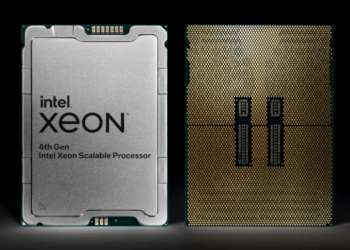
Intel previews 5th Gen Xeons

At this week’s Hot Chips event at Stanford University, Intel presented two sessions revealing technical specifications and features of the Xeon platform architecture and offerings coming in 2024, along with additional information on its forthcoming 5th Gen Intel Xeon® processors launching later this year. A separate session outlined new capabilities related to its Intel Agilex 9 Direct RF-Series FPGAs.
 

The new Intel Xeon platform utilizes modular system-on-chips (SoCs) for increased scalability and flexibility to deliver a range of products that meet the growing scale, processing and power efficiency needs for AI, cloud and enterprise installations.

  • P-core and E-core are delivered with shared intellectual property (IP), firmware and OS software stack.
  • Fastest DDR and new high-bandwidth multiplexed combined rank (MCR) DIMMs.
  • New Intel Flat Memory enables hardware-managed data movement between DDR5 and CXL memory, making total capacity visible to software.
  • CXL 2.0 support for all device types with backward compatibility to CXL 1.1.
  • Advanced I/O with up to 136 lanes PCIe 5.0/CXL 2.0 and up to six UPI links.

Intel Xeon processors with E-cores (Sierra Forest) are enhanced to deliver density-optimized compute in the most power-efficient manner. Xeon processors with E-cores provide best-in-class power-performance density, offering distinct advantages for cloud-native and hyperscale workloads.  

  • 2.5x better rack density and 2.4x higher performance per watt1.
  • Support for 1S and 2S servers, with up to 144c per CPU and TDP as low as 200W.
  • Modern instruction set with robust security, virtualization and AVX with AI extensions.
  • Foundational memory RAS features such as machine check, data cache ECC standard in all Xeon CPUs.

Intel Xeon processors with P-cores (Granite Rapids) are optimized to deliver the lowest total cost of ownership (TCO) for high-core performance-sensitive workloads and general-purpose compute workloads. Today, Xeon enables better AI performance than any other CPU2, and Granite Rapids will further enhance AI performance. Built-in accelerators give an additional boost to targeted workloads for even greater performance and efficiency.

  • 2-3x better performance for mixed AI workloads3.
  • Enhanced Intel AMX with support for new FP16 instructions.
  • Higher memory bandwidth, core count, cache for compute intensive workloads.
  • Socket scalability from one socket to eight sockets.

Intel Agilex 9 Direct RF-Series FPGAs with Integrated 64 Gsps (giga-samples per second) Data Converters and a new wideband agility reference design include both wideband and narrowband receivers within the same multichip package. The wideband receiver provides an unprecedented 32 GHz of RF bandwidth to the FPGA.


Google Cloud and Nvidia Expand Alliance for AI

Google Cloud and NVIDIA are extending their collaboration focuses on AI infrastructure and software.  

Highlights:

  • Google Cloud announced general availability next month of A3 VMs powered by NVIDIA’s H100 GPU for the most demanding gen AI and large language model (LLM) workloads. Google Cloud said theA3 VMs powered by the new H100s will achieve three times better training performance over the prior-generation A2. 
  • NVIDIA H100 GPUs to power Google Cloud’s Vertex AI platform — H100 GPUs are expected to be generally available on VertexAI in the coming weeks, enabling customers to quickly develop generative AI LLMs.
  • Google Cloud to gain access to NVIDIA DGX™ GH200 — Google Cloud will be one of the first companies in the world to have access to the NVIDIA DGX GH200 AI supercomputer — powered by the NVIDIA Grace Hopper™ Superchip — to explore its capabilities for generative AI workloads.
  • NVIDIA DGX Cloud Coming to Google Cloud — NVIDIA DGX Cloud AI supercomputing and software will be available to customers directly from their web browser to provide speed and scale for advanced training workloads.
  • NVIDIA AI Enterprise on Google Cloud Marketplace — Users can access NVIDIA AI Enterprise, a secure, cloud native software platform that simplifies developing and deploying enterprise-ready applications including generative AI, speech AI, computer vision, and more.
  • Google Cloud first to offer NVIDIA L4 GPUs — Earlier this year, Google Cloud became the first cloud provider to offer NVIDIA L4 Tensor Core GPUs with the launch of the G2 VM. NVIDIA customers switching to L4 GPUs from CPUs for AI video workloads can realize up to 120x higher performance with 99% better efficiency. L4 GPUs are used widely for image and text generation, as well as VDI and AI-accelerated audio/video transcoding.

https://nvidianews.nvidia.com/news/google-cloud-and-nvidia-expand-partnership-to-advance-ai-computing-software-and-services


GlobalFoundries unveils its most advanced RF solution

GlobalFoundries (GF) announced its new 9SW RFSOI technology, its most advanced RF solution for use in front-end modules (FEMs) for today's 5G operating frequencies, as well as future 5G mobile and wireless communication applications. The advanced 9SW technology will be manufactured on GF’s 300mm production line at its fabrication site in Singapore.

The 9SW technology improves on the company’s previous 8SW technology with superior switching, low-noise amplifiers (LNA), and logic processing capabilities. The 9SW technology features significant reduction in standby currents for longer battery life, creating products over 10% smaller than previous generations with more than 20% enhancement in efficiency. It is more energy-efficient, lowering power consumption in both inactive and active states.

“Developing high-speed, more reliable connectivity is critical for the key 5G mobile and next-generation applications that we all depend on to live, work and play,” said David Archbold, vice president of product marketing, Wireless Semiconductor Division, Broadcom. “With this new generation of technology, Broadcom will enable our customers to deliver the best possible 5G mobile experience to their end users.”

“Wireless Connectivity comes in many shapes and sizes. GF has long standing leadership, in highly efficient wireless whether it’s short, medium, or long range. The ever-increasing reliance on 5G and smart mobile devices combined with the explosion of data necessitates more connectivity and improved efficiency.  GF’s newest generation of industry-leading RF SOI technologies will allow us to meet the global demand for solutions that deliver more reliable seamless connectivity, while using significantly less power,” said GF President and CEO Dr. Thomas Caulfield.

https://gf.com/gf-press-release/globalfoundries-announces-9sw-rfsoi-technology-for-next-generation-mobile-and-5g-applications/

IONOS interconnects data centers with Infinera’s GX G30

IONOS, the largest web hosting company in Europe, deployed Infinera’s GX Series Compact Modular Platform to expand its network and interconnect data centers across Europe.

IONOS offers small- and medium-sized businesses web hosting and cloud services, managing more than 6 million customers and hosting over 22 million domains in its own regional data centers in Europe and in the U.S. With the 

Infinera GX G30 compact modular solution enables IONOS to scale capacity and deliver 100 GbE and 400 GbE services to meet increased demand for data center connectivity to keep up with its growing cloud business.

“We continue to advance the capabilities of our network infrastructure and invest in best-in-class technologies to meet ever-increasing data center traffic volumes driven by today’s bandwidth-intensive end-user applications,” said Sebastian Hohwieler, IONOS Head of Network Infrastructure. 

“We are constantly improving the energy efficiency of our networks,” said Daniel Heinze, SVP Network at IONOS. “Our target is to lower energy consumption despite traffic growth. Although green electricity is the main source of supply for our data centers in all countries, the best is if energy is not consumed at all.”

https://www.infinera.com


Altafiber raises $600M for fiber rollouts

Cincinnati Bell , which is now doing business as “altafiber” in Ohio, Kentucky, and Indiana, announced $600 million in new funding to support the continued construction of fiber networks throughout incumbent and expansion markets. The equity raise was solely supported by existing investors, funds managed by Macquarie Asset Management, Ares Management, and supporting co-investors.

In addition to continuing to upgrade its current footprint, these new funds will enable altafiber to expand its opportunistic edge-out and community partnership strategy, delivering on its mission to provide individuals and businesses with the fastest, most reliable, future-proof fiber network while maintaining its commitment to the communities it serves.

Since the close of the “take-private” transaction in September 2021, the company has passed ~300,000 addresses with fiber now totaling over 1.1 million homes passed with fiber. The Company expects to complete the construction of fiber to every single-family unit within Greater Cincinnati by the end of 2023. The completion of the construction of Hawaii’s statewide fiber network is expected by the end of 2027.

In combination with previously announced expansion markets, altafiber now has plans to expand its multi-gigabit fiber network to ~400,000 homes outside of its incumbent territories. These new markets include Ohio, Kentucky, and Indiana communities including, but not limited to, Butler, Warren, and Greene Counties in Ohio; Boone, Kenton, and Campbell Counties in Kentucky; and regional cities such as Greater Dayton, Dublin, Middletown, Waynesville, Xenia, Lawrenceburg, and Greendale.

“Gigabit connectivity is essential to access educational, employment, and healthcare opportunities. Robust fiber networks are also powerful economic development tools for business attraction and retention in growing municipalities,” said Leigh Fox, President and CEO of altafiber. “The combination of our operational expertise and this new funding will allow us to continue to invest in fiber, expand our geographic reach, and help to create digital equity in many rural and suburban communities.”


Dell'Oro: Open RAN revenues declined in 2Q2023

Both Open RAN and Virtualized RAN (vRAN) revenues declined in 2Q23, according to a new report from Dell’Oro Group. This marks the first quarter of year-over-year (YoY) contractions since Dell’Oro began tracking these next generation architectures back in 2019. 

“After a couple of years where Open RAN revenues exceeded expectations and advanced at an accelerated pace, the current slowdown doesn't come as a surprise,” said Stefan Pongratz, Vice President with the Dell’Oro Group. “Projections for 2023 were more tempered, considering that it would take time for the early majority operators to balance out the more challenging comparisons with the early adopters who fueled the initial Open RAN wave. This is the trend we are witnessing now – growth decelerated in the first quarter and declined in the second quarter,” continued Pongratz.

Additional Open RAN and vRAN highlights from the 2Q 2023 RAN report:

  • In Europe, Open RAN revenues are on the uptick, but this was insufficient to offset the declines in Asia Pacific and North America.

  • The vendor landscape remains mixed, as many Open RAN-focused suppliers are not thriving as they had hoped. NEC experienced a material improvement in its Open RAN market share between 2022 and 1H23, whereas Mavenir's Open RAN revenue share declined over the same period.

  • The top 4 Open RAN suppliers by revenue for the 1H23 period were Samsung, NEC, Fujitsu, and Rakuten Symphony. 

  • Open RAN revenues are still expected to account for 5 to 10 percent of the 2023 RAN market. 


Monday, August 28, 2023

Arm unveils Neoverse Compute Subsystems for Custom Silicon

Arm has announced a new product offering called Arm Neoverse Compute Subsystems (CSS) that enables Arm partners to build specialized silicon at a lower cost, with less risk and a faster time-to-market.

Neoverse CSS is based on the Arm Neoverse architecture, which is designed for datacenter, edge computing, and high-performance computing use.

The first product in the Neoverse CSS family is Arm Neoverse CSS N2, which is a 5nm-based compute subsystem that can support up to 64 cores and with core frequencies of 2.1GHz up to 3.6Ghz. The design is optimized for cloud computing, AI/ML, and high-performance computing.

Significantly, Arm Neoverse CSS N2 supports high-speed chip-to-chip links, using UCIe or a partner-specific PHY, can link up to 128-cores in a single socket. And two sockets can be coherently connected using CXL PHYs and SMP protocol.

https://community.arm.com/arm-community-blogs/b/infrastructure-solutions-blog/posts/neoverse-compute-subsystems-css-the-fastest-path-to-production-silicon

Intel and Ayar Labs demo 4 Tbps optically-connected FPGA

Intel and Ayar Labs are showcasing a 4 Tbps optical FPGA with Ayar Labs’ in-package optical I/O at this week’s HOT CHIPS 2023 event at Stanford Univertsity.

The demo shows a 4 Tbps bidirectional communication between two optically enabled Intel FPGAs using Ayar Labs TeraPHY optical I/O chiplets. Data generated from each FPGA is optically transmitted from one board and received and verified on the other board.


https://ayarlabs.com/hot-chips/

Cisco and Nutanix Partner to Accelerate Hybrid Multicloud

Cisco and Nutanix announced a global strategic partnership to accelerate hybrid multicloud deployments.

The new offering integrates Cisco's SaaS-managed compute and networking infrastructure with the Nutanix Cloud Platform. The solution will be sold by Cisco using its extensive go-to-market reach. The solution will offer flexible deployment options with support for Cisco UCS rack and blade servers.

The new offering will integrate advanced Cisco servers, networking and security, and management with the Nutanix Cloud Platform software.

The Nutanix Cloud Platform provides a consistent cloud operating model with a single platform for running applications and data across data centers, edges and public clouds.

Solution availability is expected in the next 90 days.

The companies said ustomers will benefit from a fully integrated and validated solution that is sold, built, managed and supported holistically for a seamless end-to-end experience.

https://www.cisco.com

https://www.nutanix.com

Dell'Oro: E-Band Microwave shipments up 77% in 2Q 2023

Shipments of E-band Microwave Transmission equipment grew 77 percent year-over-year in 2Q 2023, according to a new report from Dell'Oro Group. The top two vendors, Huawei and Ericsson, held the vast majority of this market’s share.

 “Demand for E-band microwave equipment really picked up in the past three quarters,” stated Jimmy Yu, Vice President at Dell’Oro Group. “A lot of these systems are being installed in India as the operators in that country quickly ramp up on 5G. Network rollouts and upgrades to 5G are happening at a really fast pace there. On top of this, the use of E-band is steadily moving beyond shorter spans that are under a kilometer to longer spans that are over a couple kilometers. Longer reach is a benefit of the newer radios designed with higher transmit power and active antenna for site-to-site alignment,” added Yu. 

Highlights from the 2Q 2023 Microwave Transmission & Mobile Backhaul Quarterly Report:

  • The Microwave Transmission market grew 5 percent year-over-year in 2Q 2023, driven by both Mobile Backhaul and the Vertical markets. The overall market forecast for 2023 is unchanged at an expected growth rate of 5 percent.
  • The E/V Band market segment reached a new record revenue amount in the quarter. For the trailing four quarter period, the revenue was approximately $600 million.
  • Huawei and Ericsson captured the majority of the E/V Band market in the quarter with a combined market share of more than 70 percent. Other major E/V Band vendors include Nokia, Siklu, and ZTE.


https://www.delloro.com/news/e-band-microwave-transmission-shipments-grew-77-percent-in-2q-2023/ 

Michigan-based US Signal signs with Cato Networks

US Signal is a provider of network connectivity and data center services. It is headquartered in Grand Rapids, Michigan, has entered into a partnership with Cato Networks.

Cato Networks is a leading provider of SASE (Secure Access Service Edge) solutions that converge SD-WAN, network security, and Zero Trust Network Access (ZTNA) into a single cloud-based service.

The collaboration grants US Signal distribution rights for the Cato SASE Cloud throughout North America.

"US Signal is committed to delivering cutting-edge technology solutions that enable our customers to thrive in today's competitive and rapidly changing business landscape," said US Signal CEO, Dan Watts. "Our new SD-WAN offering empowers our customers with unparalleled control over their network infrastructure, enabling their teams to enhance productivity, efficiency, and flexibility."

https://www.catonetworks.com/

Indie launches 240 GHz radar silicon transceiver

Indie Semiconductor has launched the world's first commercial fully integrated 240 GHz radar front-end (RFE) silicon transceiver.

The TRA240091 is a cascadable radar front-end with an operating bandwidth of up to 45 GHz at 240 GHz. It enables extremely high-resolution, which is ideal for applications within the license free 244-246 GHz ISM band and beyond.

The device builds on indie's previously released 120 GHz solution.

Potential automotive and industrial applications, include:

  • * In-cabin driver and occupant monitoring
  • * Vehicle dynamics and monitoring
  • * Material thickness measurement and analysis
  • * End of line product quality
  • * Tank level monitoring
  • * Surface inspection
  • * Security scanners


NY’s Empire Access deploys Ribbon for IP/Optical

Empire Access, a communications service provider in the Northeastern U.S., is leveraging Ribbon's NPT IP Routing and Apollo Optical Transport solutions, part of the company's comprehensive IP Wave portfolio, as well as its MUSE Domain Orchestration application.  

"Empire Access serves a critical need for several rural communities in upstate New York," said Elizabeth Page, Ribbon's Senior Director, National Sales. "We're honored to support its growth and ensure that its customers have access to the communications services today's consumers and businesses require."


Sunday, August 27, 2023

Blueprint: Super-Coherent Optics for the Long-Haul

 By Serge Melle, Leader, Optical Networks Marketing, Nokia

At the heart of the networks that provide today’s telecommunications services are long-haul fiber optic backbone networks, which transmit massive streams of data between cities, across continents and under oceans. These can be operated by wholesale service providers serving a wide range of end-customers, cable operators distributing entertainment and internet content across national footprints, webscale operatorsconnecting data centers and internet exchanges, research and education organizations serving universities and research centers, or governments and defense agencies connecting institutions and bases. In all of these cases, it is a long-haul core network that forms the backbone of their network’s connectivity.

The very distances that define long-haul networks also impose the greatest challenges in terms of supporting the latest high-speed services, scaling network capacity and maximizing transmission distance, while also simultaneously reducing the network power footprint to support environmental and sustainability objectives.

Thankfully, operators of long-haul optical networks will soon be able to benefit from the advancements of sixth-generation coherent optics, which enable operating speeds of 1.2 terabits per second (Tb/s) or more over a single wavelength, to enable transformational benefits compared to the options available today. Sometimes termed “super-coherent” optics, due to their performance, the latest generation of coherent optics increase DSP operating speeds to 130Gbaud or more and are optimized to enable the maximum capacity and the longest reach for these challenging applications.  This will yield three major improvements for operators of long-haul core networks.  

First, sixth-generation coherent solutions increase the transmission reach when operating at wavelength speeds of 800Gb/s by a factor of three times or more, compared to the current generation of coherent optics operating at speeds of 90-100GBaud. This has major implications for network operators migrating their IP core networks to more scalable routers supporting 800 Gigabit Ethernet (800GE) interfaces, and enables them to support 800GE router interconnections between sites over practically all long-haul links.  

Secondly, the improved performance significantly reduces the number of coherent optics needed in the network. While the prior generation of coherent optics supports wavelength speeds up to 800Gb/s, this “headline” capacity is only possible over short distances (up to a few hundred kilometers). After that, wavelength speeds reduce to 600Gb/s or 400Gb/s, for example. In that case 800Gb/s wavelengths cannot span the entirety of a long-haul link, and transporting 800GE services across long-haul core networks requires multiple intermediate sites equipped with back-to-back optics to regenerate the signals. Or,alternatively, a long-haul 800GE service can be split into two data streams transported across two wavelengths — eachoperating at speeds lower than 800Gb/s. 

In contrast, the greater reach (at speeds of 800Gb/s per wavelength to distances of 2000km or more), allows sixth-generation coherent optics to support unrepeated 800GE service transport over practically all long-haul links (see Figure 1). The practical implication of this is that network operators can deploy fewer coherent optics, which helps them reduce network capital costs for new equipment (CapEx). Figure 2 shows examples of savings in the number of optics in typical networks, rangingfrom 22% saving in a regional network spanning Germany, 51% savings in a national Indian long-distance network and up to 53% in pan-European or continental United States networks.  

The third benefit to network operators is the ability to reduce total network power consumption. Sixth-generation optics are implemented using the latest 5nm silicon IC technology, which allows them to leverage Moore’s Law to reduce the power-per-bit by up to 40% versus prior generations. Combined with the reduction in the number of coherent optics needed in the network, network operators can reduce total network power consumption by up to 60% (see figure 3). This significantly reduces the ongoing operating (OpEx) costs related to the electricity fees needed to power the network, while also enablingsignificant progress toward meeting sustainability objectives.  

The latest, sixth generation of performance-optimized coherent optics ushers in a range of transformational benefits that facilitate optical network operators’ evolution requirements, by providing the tools needed to efficiently scale long-haul core backbone service speeds amid unrelenting traffic growth. This innovation and the advances in optical performance they provide will enable the efficient transport of 800GE services over long distances, while also reducing up to 60% of network power consumption, setting new benchmarks in the optical communications industry and lowering network TCO.

About the Author

Serge Melle currently leads the IP-Optical Product Marketing team for Nokia, and previously led the company’s North American sales enablement for IP-optical networks. Prior to joining Nokia, Serge worked at Infinera in product and solutions marketing and business development. Prior to Infinera, Serge worked at Nortel Networks where he was responsible for solutions marketing and business development.

Verizon tests Ericsson's RedCap software

Verizon, Ericsson, and MediaTek successfully completed data and voice (VoNR) sessions over Verizon’s 5G network using Ericsson's new RedCap compatible software (NR light functionality) and MediaTek’s RedCap testing platform. 

RedCap offers similar data rates to LTE enabled devices with improved latency, device energy efficiency and spectrum efficiency. This technology also has the potential to support 5G NR features such as enhanced positioning and network slicing.

Both voice and data sessions were completed using 5G technology over C-band TDD spectrum as well as 5G technology over 850 MHz FDD spectrum, in Verizon’s production network employing Verizon’s 5G standalone core. Once this technology is deployed in the commercial network, Verizon will continue to work with consumer and business solution developers to accelerate 5G device development driving the entire ecosystem forward.

“The network transformation we have undergone the past few years has brought us to this place of having a highly sophisticated and customizable network able to provide a range of capabilities needed for a variety of devices,” said Adam Koeppe, SVP of Network and Technology Planning at Verizon. “The evolution of this new light software coupled with the technologies deployed throughout our 5G network will allow us to provide the best possible experience for our customers in an efficient manner and will drive the 5G ecosystem with low-cost, energy-efficient devices.”


Friday, August 25, 2023

Marvell: Data infrastructure represents 87% of revenue

Marvell reported net revenue for the second quarter of its fiscal 2024 of $1.341 billion, $11 million above the midpoint of the company's prior guidance, but down 12% year-on-year.

GAAP net loss for the second quarter of fiscal 2024 was $(207.5) million, or $(0.24) per diluted share. Non-GAAP net income for the second quarter of fiscal 2024 was $290.2 million, or $0.33 per diluted share.

"Marvell delivered second quarter fiscal 2024 revenue above the midpoint of guidance, and we are forecasting sequential revenue growth to accelerate in the third quarter. This growth is being driven primarily by AI and cloud infrastructure," said Matt Murphy, Marvell's Chairman and CEO. "Demand from AI applications continues to strengthen, driving our overall revenue outlook from AI for this fiscal year even higher than previously outlined. Our strategy to focus on data infrastructure across a diverse set of end markets is serving us well despite the backdrop of a softening macroenvironment."

Some highlights:

  • Data infrastructure revenue represented 87 percent of total revenue.
  • Data center revenue grew 6% QoQ, with cloud growing over 20% QoQ.
  • Enterprise networking revenue declined 10% QoQ, due to inventory corrections.
  • Carrier revenue declined 5% QoQ; wireline decline partially offset by 5G growth.
  • Automotive/industrial revenue grew 23% QoQ; automotive continued strong growth.


Ericsson and Huawei renew global patent license

Ericsson and Huawei have renewed a multi-year global patent cross-licensing agreement that covers patents essential to standards relevant to the products of the parties, including 3G, 4G, and 5G.

The agreement covers the companies’ respective sales of network infrastructure and consumer devices, granting both parties global access to each other's patented, standardized technologies.

"We are pleased to announce our renewal of our global cross-licensing agreement with Huawei," said Christina Petersson, Chief Intellectual Property Officer at Ericsson. "Both companies are major contributors to mobile communication standards and recognize the value of each other's intellectual property. This agreement demonstrates the commitment of both parties that intellectual property should be respected and rewarded, and that leading technological innovations should be shared across the industry. A balanced approach to licensing ensures that the interests of both patent holders and implementers are served fairly, driving healthy, sustainable industry development for the benefit of consumers and enterprises everywhere."

With the current portfolio of IPR licensing contracts, Ericsson estimates the full-year 2023 IPR licensing revenues to be approximately SEK 11 billion.


Jabil looks to sell its Mobility business to BYD for $2.2B

Jabil announced a preliminary agreement to sell its Mobility business to  BYD Electronic (International) for  approximately $2.2 billion.

"This transformational deal would represent the largest transaction in the history of our company, and I am thrilled to be able to work with a reputable company like BYDE to drive this business successfully forward,” said CEO Kenny Wilson.

“If completed, the proceeds from this transaction will enable us to enhance our shareholder-centric capital framework, including incremental share buybacks. Additionally, it will provide opportunities for further investment in electric vehicles, renewable energy, healthcare, AI cloud data centers, and other end-markets," he added.

As part of the agreement, the parties have agreed to endeavor to enter into a definitive agreement. The divestiture will not be completed until the parties have completed due diligence and executed a definitive agreement and closed the transaction, which will be subject to the satisfaction of required regulatory approvals and other customary closing conditions.