Sunday, July 16, 2023

Dell'Oro: RAN market is done expanding

The Radio Access Network (RAN) market is done expanding for now and will enter a period of slow contractions, according to Dell'Oro Group. Following the 40 percent to 50 percent ascent between 2017 and 2021, RAN revenues flattened out in 2022 and these trends extended to 1Q 2023.

“Even if it is early days in the broader 5G journey, the challenge now is the comparisons are becoming more challenging in the more mature 5G markets and the upside with the slower-to-adopt 5G regions is not enough to extend the growth streak,” said Stefan Pongratz, Vice President at Dell’Oro Group. “Meanwhile, growth from new revenue streams including Fixed Wireless Access and enterprise LTE/5G is not ramping fast enough to change the trajectory. With 5G-Advanced not expected to trigger a new capex cycle, the question now is no longer whether RAN will grow. The question now is, rather, how much will the RAN market decline before 6G comes along?” continued Pongratz.

Additional highlights from the Mobile RAN 5-Year July 2023 Forecast Report:

  • Global RAN is projected to decline at a 1 percent CAGR over the next five years.
  • The less advanced 5G regions are expected to perform better while the more developed 5G regions, such as North America and China, are projected to record steeper declines.
  • LTE is still handling the majority of the mobile data traffic, but the focus when it comes to new RAN investments is clearly on 5G. Even with the more challenging comparisons, 5G is projected to grow another 20 percent to 30 percent by 2027, which will not be enough to offset steep declines in LTE.
  • With mmWave comprising a low single-digit share of the RAN market and skepticism growing about the MBB business case, it is worth noting that our position has not changed. We still envision that the mmWave spectrum will play a pivotal role in the long-term capacity roadmap.

https://www.delloro.com/news/ran-market-to-decline-at-a-1-percent-cagr-through-2027/ 

Ericsson and MediaTek hit 565 Mbps with SU-MIMO + Aggregation

Ericsson and MediaTek achieved 565 Mbps performance by combining two Ericsson software features – uplink single user multiple input multiple output (SU-MIMO) and Uplink Carrier Aggregation – on MediaTek T830 CPE platform with three transmit (3Tx) antennas.  The test focused on optimizations for fixed wireless access applications (FWA).

For this demo, a 2.1GHz FDD (frequency division duplex) band was combined with a 3.5GHz TDD (time division duplex) band.

Ericsson said FWA would benefit greatly from combining Uplink SU-MIMO with Uplink Carrier Aggregation in FR1 spectrum, where FR1 stands for Frequency Range 1, the most commonly deployed 5G spectrum globally.

Dr Sibel Tombaz, Head of Product Line 5G RAN, Ericsson, says: “This latest milestone with MediaTek proves that we at Ericsson are continuously innovating and leveraging new technologies to deliver the best possible 5G user experience. With this latest solution offering, fixed wireless access subscribers, consumers and businesses alike, can benefit from higher upload speeds for data-heavy applications such as cloud gaming and extended reality. We are offering high-performing solutions for the evolving fixed wireless access market.”

HC Hwang, General Manager of Wireless Communication System and Partnership at MediaTek, says: “Enhancing uplink performance is an essential advantage for 5G FWA devices used by businesses, and this technology breakthrough will further extend the advantage of 5G CPE versus line-based broadband services.

Ericsson predicts FWA connections will reach 300 million in 2028 from 107 million in 2022. By 2028, 5G is estimated to account for almost 80 percent of all FWA connections.

https://www.ericsson.com/en/news/2023/7/er

BAE Systems tests PHASA-35 drone in the stratosphere

BAE Systems conducted a successful trial of its High Altitude Pseudo Satellite (HAPS) Uncrewed Aerial System (UAS), called PHASA-35, reaching an altitude of over 20,000 meters (66,000 feet) during a 24-hour flight over White Sands, New Mexico.  

Designed by BAE Systems' subsidiary Prismatic Ltd, the PHASA-35 drone operates above weather and air traffic, offering potential applications in intelligence, surveillance, reconnaissance, disaster relief, border protection, and the delivery of communication networks including 4G and 5G. 

With a 35-meter wingspan and a 15kg payload, PHASA-35 utilizes advanced technologies such as solar electric cells, composites, and energy management systems. The recent trial was sponsored by the US Army Space and Missile Defense Command Technical Center.

https://www.baesystems.com/en/article/phasa-35--completes-first-successful-stratospheric-flight

Saturday, July 15, 2023

PAWR testbeds get rolling with O-RAN

The Platforms for Advanced Wireless Research (PAWR) program of large-scale wireless testbeds, which was created and initially funded by the U.S. National Science Foundation, have gained O-RAN ALLIANCE approval as Open Testing and Integration Centers (OTICs). These include: 

  • POWDER at the University of Utah – POWDER supports end-to-end Open RAN testing in lab and field scenarios and has developed a Testing Orchestration and Testing Automation (TOTA) framework to provide streamlined, on-demand testing capabilities. O-RAN ALLIANCE defined OTIC services provided by POWDER will include interoperability and end-to-end testing, badging and certification. POWDER will offer additional Open RAN related services including use case and proof-of-concept development and evaluation, functional testing in lab and field environments, and Open RAN intelligent ecosystem research, testing and development.
  • ARA at Iowa State University – ARA enables research into connectivity solutions for rural environments, including offering a heterogeneous set of access network technologies to support innovative Open RAN testing and development for digital agriculture, rural education, and more. As an OTIC, ARA will support Open RAN R&D, device-level and end-to-end testing of performance, interoperability, and conformance in both sandbox and at-scale field settings.
  • Colosseum as part of the Institute for the WIoT at Northeastern University – The Northeastern team is using the Colosseum infrastructure, which is affiliated with the PAWR program, and other assets of the Institute’s Open 6G Hub to provide testing capabilities for end-to-end AI and ML solutions that will enable new Open RAN use cases. Through its OTIC, Northeastern will provide testing, certification, and badging capabilities.

“By becoming OTICs, the PAWR testbeds are advancing important innovations in wireless research from the academic community and beyond and helping to bridge the gap between government investment and industry-driven change,” said Margaret Martonosi, NSF Assistant Director for Computer and information Science and Engineering. “Wireless communications are vital to both the public and private sectors, and through the services these platforms will provide as OTICs, the PAWR testbeds will accelerate the timeline that begins with cutting-edge research and leads to successful deployment of new wireless technologies.”

Nokia deploys 400GE IP for Budapest Internet Exchange

BIX (Budapest Internet Exchange) has deployed Nokia’s 7750 SR IP edge routing platforms for a spine router network modernization.

The Nokia SR platforms, with FP5 silicon and future-ready 800GE capability, will support the seamless upgrade from 400GE interfaces.

Attila Miszori, President of the Board, Council of Hungarian Internet Providers (owner and operator of BIX), said: “Nokia and its IP solutions were the natural choice to help us modernize our spine router platform, enabling us to address the growing demand for capacity and provide an improved experience to our members in a very sustainable way. BIX members will benefit from significantly higher speed interconnection with low latency and high reliability at the main BIX locations.”

Ivo Lansky, Senior Director for IP Business at Nokia, said: “We are pleased that BIX has chosen Nokia’s IP routing technology to enhance their interconnection capabilities to support the needs of their service provider members in the region. Nokia’s FP5, a key part of BIX’s selection of Nokia, is not only an enabler for building higher-capacity IP networks, but its future-ready 800GE capability will also accelerate BIX’s ability to meet future traffic growth sustainably and at lower cost.”

https://www.Nokia.com

Thursday, July 13, 2023

Panama Digital Gateway opens as a carrier-neutral hub for the Americas

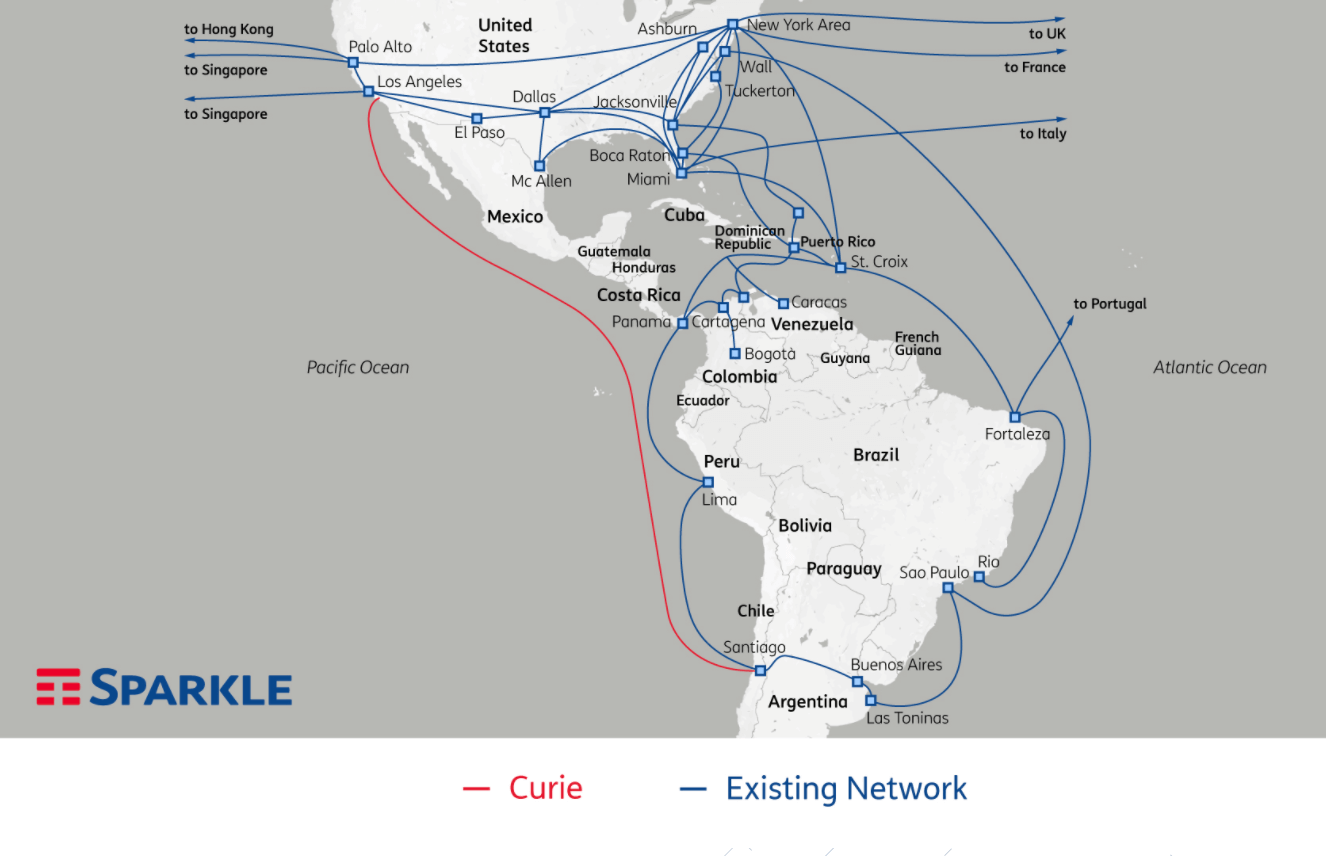
Sparkle, in collaboration with Trans Ocean Network, inaugurated the Panama Digital Gateway (PDG), a next generation, carrier-neutral, open landing station, data center and connectivity hub.

Panama Digital Gateway is the landing point of Curie, the cable system connecting California to Chile with a branching unit into Panama developed by Google and Sparkle, and of new upcoming submarine cables looking for a diversified entry way to Central America.

The new building, which is located in Corazal (Panama City), offers 5,500 square meters of space for up to 650 equivalent racks and 3.5 MW of scalable power.

The gateway is integrated with Sparkle’s global backbone - more than 600,000 km of fiber spanning from Europe to Africa, the Americas and Asia.

Trans Ocean Network is a Panamanian telecommunications operator that owns, operates and maintains a terrestrial network of fiber optic cables in Panama, including rights of way, ducts, beach manholes, bore pipes, and cable landing stations.

The opening ceremony was attended by Laurentino Cortizo Cohen, President of Panama, and attended by Fabrizio Nicoletti, Ambassador of the Italian Republic in Panama, David Gonzalez Solis, CEO and founder of TON, and Enrico Maria Bagnasco, CEO of Sparkle.

Fabrizio Nicoletti, Ambassador of the Republic of Italy in Panama, said: “Panama and Italy have a historic relationship working closely in collaboration and coordination programs of different disciplines, fostering international cooperation between the two countries. We are very proud to have a first level Italian enterprise as Sparkle making possible this data center, a tangible demonstration of Italy's growing interest in Panama and in the Region”.

“Panama Digital Gateway consolidates and positions Panama as the digital hub of the region, strengthening the connectivity of our Country, and becoming a strategic interconnection offer for OTTs, carriers and enterprises”, stated David Gonzalez Solis, CEO of Trans Ocean Network. “We are very pleased to be participating in the construction and operation of this open hub in conjunction with a partner of experience and global scale such as Sparkle.” 

“The development of infrastructures in the Americas represents a pillar of Sparkle's plan to consolidate its positioning in the telecommunications wholesale market while reinforcing its offering of digital solutions”, explained Enrico Maria Bagnasco, CEO of Sparkle. “Panama is a natural crossroad of Central America and a bridge between the Atlantic and the Pacific as well as a strategic cross-point between North and South America, and our Panama Digital Gateway aims to be the reference landing hub of new submarine cables and the centre of choice to develop an ecosystem of interconnected players.”

https://www.tisparkle.com/media/press-release/sparkle-launches-panama-digital-gateway


Microsoft expands SSE platform aiming to replace legacy VPNs

Microsoft expanded its Security Service Edge (SSE) platform with the introduction of two new services:

  • Microsoft Entra Internet Access — an identity-centric Secure Web Gateway that protects access to internet, software as a service (SaaS), and Microsoft 365 apps and resources. It extends Conditional Access policies with network conditions to protect against malicious internet traffic and other threats from the open internet. 
  • Microsoft Entra Private Access — an identity-centric Zero Trust Network Access that secures access to private apps and resources. The service promises to enable users “to quickly and easily connect to private apps—across hybrid and multicloud environments, private networks, and data centers—from any device and any network.” The service, which is now in preview, aims to replace legacy VPNs.  Users can apply Conditional Access to individual applications, and enforce multifactor authentication, device compliance, and other controls to any legacy application without changing those applications.

Microsoft Entra suite, which was introduced in May 2022, initially included three products: Microsoft Azure Active Directory (Azure AD), Microsoft Entra Permissions Management, and Microsoft Entra Verified ID. The suite was later expanded with Microsoft Entra ID Governance and Microsoft Entra Workload ID. To simplify its marketing, the company is now changing the name of Azure AD to Microsoft Intra ID.

https://www.microsoft.com/en-us/security/blog/2023/07/11/microsoft-entra-expands-into-security-service-edge-and-azure-ad-becomes-microsoft-entra-id/


UPN expands fiber infrastructure in Arizona

Unite Private Networks (UPN) announced a network expansion into Yuma, Arizona, adding 70 miles of new, high-count fiber-optic infrastructure.

The company estimates over 2,450 serviceable buildings in Yuma, which is located on the border with California, overlooking the Colorado river, and which has a population of about 97,000.

UPN will also establish a network hub in Yuma and deploy diverse connectivity to UPN's network in Denver for enhanced network resiliency. Carrier customers in the area will now have access to Optical Ethernet and Internet Access powered by a low-latency, carrier-grade, 100 percent fiber-optic network.

Jeremy Andrews, Group Vice President of Strategic Networks, states: “We are delighted to introduce our high-capacity fiber-optic network to Yuma. Our goal is to provide local carriers with reliable and efficient high-speed fiber services, and we look forward to partnering with the community to ensure their connectivity needs are met with utmost satisfaction."


TELUS trims outlook citing reduced service demand and global pressure

Citing unexpected reductions in service demand, TELUS International released a preliminary summary of financial results for the quarter ended June 30, 2023, and revised downward its full-year 2023 outlook.

TELUS now expects revenue in the range of $660 to $668 million, reflecting year-over-year growth of 6% to 7% on a reported basis and 6% to 7% on a constant currency basis, and a decline of approximately 1% when excluding revenue earned from WillowTree. These year-over-year revenue growth rates are lower due to lower than expected business volumes primarily within its technology vertical. Net loss is now expected to be in the range of $7 to 10 million, reflecting a year-over-year decline of 113% to 118%, and net loss margin in the range of 1.0% to 1.5%. 

During the second quarter, as a result of persistent global macroeconomic pressures, TELUS International experienced more pronounced and unexpected reductions in service demand from some of our larger clients, particularly within the technology vertical. We also experienced delays and lower than expected activity in converting opportunities into spend commitments, as clients continue to address their own cost structures, including successive employee downsizing. These issues have in turn impacted TELUS International’s overall revenue and profitability to a larger extent than previously anticipated, contributing to a more cautious outlook for the balance of 2023,” said Jeff Puritt, President and CEO of TELUS International.

Vanessa Kanu, CFO said, “The magnitude of the headwinds we’re experiencing and our preview of second quarter performance data prompted a revision to the full-year outlook for 2023 to better reflect our updated expectations for the remainder of the year. We’ve actioned significant cost efficiency programs, including staff reductions to address lower service volumes in the technology vertical. Additionally, we are driving further automation and generative AI enabled solutions to further optimize our cost structure."

https://www.telusinternational.com/investors/news-events

Dell’Oro: Mobile core network market growth slows

Dell’Oro Group trimmed its forecast for the mobile core network (MCN) market, citing slower subscriber growth. Worldwide MCN 5-year growth is now forecasted at a 1 percent compounded annual growth rate (CAGR), compared to our January 2023 forecast of 2 percent CAGR.

“We have reduced our forecast for the third consecutive time, primarily caused, this time, by an expected slowdown in subscriber growth,” said Dave Bolan, Research Director at Dell’Oro Group. “Also, we reduced our projections for the Multi-Access Edge Computing (MEC) market to a 31 percent CAGR as commercially viable enterprise applications are taking much longer to realize than earlier hoped.

“Mobile Network Operators (MNOs) are concerned about inflation, a possible recession, and political conflicts. They are therefore being restrained in their capital expenditures, another factor weighing in on a more conservative forecast. As we continue refining our count of MNOs that have launched 5G Standalone (5G SA) eMMB networks, we note that only 4 MNOs have commercially deployed new 5G SA networks compared to six in the first half of 2022,” Bolan added.

Additional highlights from the Mobile Core Network & Multi-Access Edge Computing 5-Year July 2023 Forecast Report:

* Year-over-year MCN revenue growth rates are projected to be flat in 2026 and turn negative in 2027.

* The North America and China regions are expected to have negative CAGRs, while Europe, Middle East, and Africa (EMEA), and Asia Pacific excluding China regions are expected to have the highest positive CAGRs.

https://www.delloro.com/news/slower-subscriber-growth-to-cut-mobile-core-network-market-growth/

Render and VEA Connect deliver visibility and automation for FTTX

VEA Connect selected Render’s network construction technology for OpenFiber FTTX project in North Carolina, South Carolina, and Georgia. 

The fiber network will be built and managed for VEA’s customer OpenFiber and will serve the suburbs of Charlotte–N.C.’s largest city. 

Render’s solution will enable VEA to drive efficiency across the planned 321,000-premise network build and connect locations faster with end-to-end automation from construction to operations.

VEA Connect is a subsidiary of the VEA Group, a global investment company with a diversified portfolio of independently-managed telecommunications businesses and operations across South Africa, the UK, and the U.S. 

“We’re growing quickly. In our first six months of operations in the U.S., we passed 22,000 homes with fiber. We plan to increase another 443,000 homes passed over the next three years, and Render will allow us to accomplish–even exceed–that goal,” said Louis Bester, CTO at VEA. “Render can streamline our tools and processes with automated work scope creation, real-time performance insights across the portfolio, and change management functionality. We now have unmatched visibility, improved productivity, and aligned stakeholders.”

https://www.rendernetworks.com 


Former president of AT&T Networks Eng and Ops joins Fortress’ board

Fortress Solutions, a provider of critical infrastructure management and support services, announced the appointment Scott Mair to its Board of Directors.

Recently retiring after a 37-year career at telecom giant AT&T, most notably as the President of AT&T Networks Engineering and Operations, Mr. Mair was responsible for launching the first standards-based mobile 5G network, running AT&T’s next-generation wireless and wireless networks, as well as launching the first secure communications platform used nationwide for U.S. Public Safety workers, including EMS, police, firefighters and first responders. Mr. Mair is an established figure in this field and an extremely well-respected industry professional.

https://www.fortsol.com 

Casa appoints Michael Glickman as CEO

Casa Systems named Michael Glickman as its new President and Chief Executive Officer, succeeding interim CEO and current CFO Ed Durkin, and former CEO and company founder Jerry Guo, who retired earlier this year.

Glickman most recently served as the President of PacketFabric, where he scaled Operations and drove double digit growth through innovative joint ventures. Prior to that, Glickman held senior executive positions at Cisco, including Senior Vice President for the Global Service Provider unit, where he led sustainable growth in a multi-billion-dollar business. Glickman’s tenure at Cisco also included leadership roles in its Cloud & Managed Services and Channels businesses worldwide. He has also held executive positions at Fujitsu Americas and Amdahl Corporation. 

"Casa Systems has a very strong heritage and cutting-edge technologies. I look forward to building upon what Jerry Guo, visionary founder and former CEO and this talented team have created over the past twenty years, and I am committed to our collective vision of re-establishing Casa Systems as an industry disruptor for the benefit of our global customers. I am excited and committed to moving the Company forward with the speed required to capitalize on the significant opportunities in front of us. We will work together to deliver our innovative solutions to the market, address the evolving needs of our global customers, and achieve sustainable growth and profitability.”

https://www.casa-systems.com

Wednesday, July 12, 2023

Broadcom gains European Commission clearance for VMware deal

Broadcom received conditional approval from the European Commission to complete its acquisition of VMware.

The $61 billion deal was first announced on May 26, 2022.

To ensure competition and innovation in cloud computingBroadcom said it provided the European Commission with a technology access remedy that preserves interoperability, a core principle that would not have changed as a result of this transaction.

Broadcom has already received regulatory clearance from Australia, Brazil, Canada, South Africa, and Taiwan.

https://investors.broadcom.com/news-releases/news-release-details/european-commission-approves-broadcoms-acquisition-vmware

ViaSat-3 Americas satellite fails to deploy reflector

The recently launched ViaSat-3 Americas satellite encountered a malfunction in the deployment of its reflector, potentially limiting the usefulness of the satellite.

In a press statement, ViaSat said it is conducting a rigorous review of the development and deployment of the affected reflector. It is also working on potential remedial measures and contingency plans.

“We’re disappointed by the recent developments,” said Mark Dankberg, Chairman and CEO, Viasat. “We’re working closely with the reflector’s manufacturer to try to resolve the issue. We sincerely appreciate their focused efforts and commitment.”

Contingency plans are currently being refined to minimize the economic effect to the company. Potential options include redeploying satellites from Viasat’s extensive fleet to optimize global coverage, and/or reallocating a subsequent ViaSat-3 class satellite to provide additional Americas bandwidth. The initial service priority for ViaSat-3 Americas has been to facilitate growth in the company’s North American fixed broadband business.”

https://news.viasat.com/newsroom/press-releases/viasat-provides-status-update-on-viasat-3-americas-satellite

  • In April, SpaceX successfully launched the ViaSat-3 Americas satellite to geostationary orbit aboard a Falcon Heavy rocket from Kennedy Space Center in Florida. Also on board this mission was Astranis’s first MicroGEO satellite and Gravity Space’s GS-1 satellite. 
  • ViaSat-3 Americas is the first of three geostationary satellites that will form a new constellation. Each of the satellites offers over 1 Tbps of onboard switching capacity with the ability to redirect bandwidth as needed. Each of the satellites in the upcoming ViaSat-3 global constellation is expected to be able to temporarily concentrate capacity at geographic points of demand, reducing coverage to places that need less capacity. Enormous solar panels will offer 25 kilowatts of power.
  • ViaSat-3 also features anti-jamming capabilities for government and defense applications.
  • ViaSat-3’s ground network will be composed of hundreds of Satellite Access Nodes (SANS), ensuring redundancy.


Akamai opens sites in Paris, Wash DC, Chicago, Seattle, Chennai

Marking the first major step in its push to put compute, storage, database, and other services on top of the same underlying backbone that powers its edge network, Akamai Technologies inaugurated three cloud computing sites in Paris, Washington, D.C., and Chicago. Akamai plans to open similar sites in Seattle and Chennai later this quarter.

“Distributed workloads require distributed infrastructure,” said Adam Karon, chief operating officer and general manager, Cloud Technology Group, Akamai Technologies. “Legacy, centralized cloud architecture was not designed for the demands of developers and companies challenged with delivering better user experiences that increasingly require putting applications and data closer to the customer.”

“Next generation applications demand cloud infrastructure that provides dramatically lower latency and better egress than what’s currently possible from today’s legacy cloud providers,” said Karon. “What we’re building is designed for that new world.”

The company also announced new premium instances that deliver consistent performance, predictable resource and budget allocation, and simpler SKU management for larger commercial workloads. The new instance types guarantee assignment to the best performing processor and hardware combination available. They can also make it easier to manage multiple deployments and upgrades without complicated SKU matching which can often see in excess of 100,000 changes a month across the top three legacy hyperscale providers. The new premium service, available across each of the company’s newly launched sites, adds to Akamai’s existing shared and dedicated offerings.

Additionally, Akamai announced it doubled the capacity of its object storage product to one petabyte and one billion objects per bucket. The upgrade allows businesses to access higher data volumes to build scalable, performant, and low-latency cloud-native applications and analytics solutions. Clusters with the increased limits will be available in the new sites announced today.

Lastly, the company announced plans to launch Akamai Global Load Balancer later this quarter, the first of several planned integrated services following Akamai’s acquisition of Linode. The new global load balancing capabilities ensure no single point of failure, routing traffic requests to the optimal data center to minimize latency. 

Adtran expands fiber monitoring for deep PON assurance

Adtran has expanded of ALM fiber monitoring platform with PON assurance features for granular and actionable insights. The new capabilities enable communication service providers (CSPs) to monitor their entire PON infrastructure for any faults or degradation. 

Adtran says the non-intrusive, service-agnostic deep PON assurance solution eliminates the need for demarcation reflectors in the field, ensuring compatibility with any existing PON network while reducing operational complexity. 

Offering valuable insights into passive network quality, it acts like a radar to pinpoint the location of issues. Featuring fanless operation and low-power consumption, the ultra-compact ALM enhances operational efficiency and sustainability.

Until today, assuring PON networks was challenging and expensive. Now there’s a simple and cost-efficient way to leverage real-time insight so that maintenance teams can quickly locate and resolve issues before they affect customers. 

https://www.adtran.com/en/newsroom/press-releases/20230712-adtran-expands-alm-with-deep-pon-assurance-for-fttx-network-monitoring


Optus partners with SpaceX for mobile coverage across Australia

Optus signs with SpaceX for 100% mobile coverage across Australia, excluding the Australian Radio Quiet Zone in Western Australia and Remote Offshore Territories and Islands.

Optus announced an agreement with SpaceX for mobile connectivity covering 100% of Australia using the Starlink satellite constellation. This new satellite-to-phone coverage will be extensively tested before launch, with further information on its characteristics and accessibility provided closer to availability.

The companies will work to expand the reach of customers’ mobile connectivity to include the 60% of Australia’s land mass that currently has no mobile coverage. This will be achieved through a phased rollout of SpaceX’s satellite capability, starting with SMS in late 2024, with voice and data to follow in late 2025.

Optus’ Managing Director, Marketing and Revenue, Matt Williams, said, “Optus has always thought differently about what it means to deliver connectivity to our customers, and today we proudly provide mobile coverage to 98.5% of Australia’s population through our existing network. However, Australia’s vastness and terrain can make it difficult for any operator to provide mobile coverage everywhere it is needed – especially in remote or hard-to-reach locations.”

This new satellite-to-phone coverage will be extensively tested before launch, with further information on its characteristics and accessibility provided closer to availability.

Ekinops reports Q2 revenue of € 39.2 million, up 10%

Ekinops reported consolidated revenue of €39.2m in Q2 2023, up +10% Y-o-Y. As a reminder, Q2 2022 recorded strong growth of +29%. This year's quarterly growth at constant exchange rates was 11%. Compared to Q1 2023 (€31.9m), Q2 sales were up +23%, reflecting buoyant activity.

Over H1 2023, revenue amounted to €71.0m, representing overall growth of +12% vs. H1 2022, which was a particularly challenging basis for comparison (+25% growth last year).  

Didier Brédy, Chairman and CEO of Ekinops said: "Ekinops delivered a good H1 2023, fully in line with our expectations. This robust H1 performance, achieved despite the very challenging comparative figures after an exceptional 2022, comes in an overall less buoyant market context and a weaker economic environment. Despite this, we expect H1 sales to show good profitability in terms of gross margin."

"Visibility is weaker for H2 given the economic environment, and Ekinops is making it a priority to ramp up its commercial activity across all its geographies."

Some highlights

  • In continuity with FY 2022, Optical Transport activity continued its strong growth trajectory, achieving a further jump of +41% in H1 2023 compared to the same period last year (vs. +32% in Q1 2023 and +49% in Q2 2023), thanks to the success of WDM solutions and the appeal of OTN technology both in the US and Europe.
  • Access solutions were down by -5% over H1 2023 (vs. +21% in H1 2022), mainly due to lower sales in Asia-Pacific. Access sales were virtually flat in France (-1%), but up +7% in EMEA.
  • Software & Services revenue, which accounted for 14% of Group revenues in H1 2023 (vs. 15% over full year 2022), showed slight growth over the period (+1%).
  • International growth came in at +14% in H1 2023. Sales outside France represented 66% of the Group's total revenue, compared with 65% a year earlier.
  • North America reported revenues of €18.2m up by a robust +42% year-on-year (identical in US dollar terms), driven by strong demand for Optical Transport solutions. This key strategic region represented 26% of Group revenue in H1 (vs. 20% a year earlier).
  • After a dip at the start of the year (-7% over Q1 2023), the EMEA region (Europe - excluding France - Middle East & Africa) has returned to growth, posting a +13% increase over H1 2023. This recovery was mainly driven by solid growth in sales of Optical Transport solutions in the region, which account for 39% of sales.
  • Business in Asia-Pacific was down -65% at mid-year, following a +80% growth in H1 2022. Ekinops generated 2% of its revenue in Asia-Pacific in H1 this year.
  • Lastly, in its domestic market, Ekinops posted H1 revenue growth of +9% vs. the year-earlier period, particularly driven by a doubling in sales of Optical Transport solutions. Ekinops generated 34% of its H1 revenue in France.


DZS adds to its team

DZS has appointed Daniel Won Chief Operating Officer for Asia and Gunter Reiss Chief Customer Officer for the Americas, Europe, Middle East and Africa (AEMEA) regions. 

Prior to his current role, Won was Chief Customer Officer for Asia and Chief Product Officer at DZS and previously served as President of DASAN Networks Solutions prior to the merger in 2016 creating current DZS.  Prior to DZS, he held various executive positions at LG and Cisco Systems.

Reiss joined DZS in February 2022 as Chief Marketing Officer. Prior to DZS, Reiss was a member of the executive leadership team at A10 and before that, he was an integral part of the leadership team at Ericsson leading global strategy and business development for IP, broadband access, 4G/5G packet core, optical transport and microwave.

https://www.dzsi.com