Monday, November 27, 2023

Telespazio's Space Centre Signs on with Sparkle's Sicily Hub

Telespazio, a joint venture between Leonardo, 67%, and Thales, 33%,  and one of the world’s leading operators in satellite services, signed an agreement with Spakle for fibre-optic access to the Sparkle Sicily Hub in Palermo. 

The Scanzano Space Centre - operational since 1989 and located near the artificial lake of the same name about 47 kilometres away from Palermo - is specialized in providing hosting and housing services for large international satellite operators using low earth (LEO), medium earth (MEO) and geostationary (GEO) orbit constellations. These services require resilient and stable connections with a high level of performance.

Under the agreement, the Scanzano Space Centre is connected via its own fibre optic ring to Sparkle's Sicily Hub in Palermo - a state-of-the-art neutral data center and key Internet hub in the Mediterranean thanks to the presence of content platforms and cloud applications of the world's major players and the connection of all international cables landing in Sicily - with the consequent opportunity of offering its customers high-speed and reliable connections worldwide.

In addition, with the activation of Sparkle's new BlueMed submarine cable - connecting Italy with France, Greece and several countries bordering the Mediterranean all the way to Aqaba in Jordan - the Scanzano Space Centre will be able to count on connections at multiples of 100 or 400 Gbps to Europe, Asia and the Middle East. In Italy, where the cable is active since September, BlueMed increases the resilience of Sparkle’s network by offering a safe and diverse route between Sicily and Milan, with a latency reduced by 50% compared to the terrestrial backbones connecting the two capitals.

“With access to Sparkle's Sicily Hub, the Scanzano Space Centre consolidates and expands its capacity to connect to the global network, enabling Telespazio to offer its customers connectivity services with increasing speeds and high reliability. This is essential to promote the Scanzano centre as a Mediterranean satellite hub, enhancing its geographical position,” said Alessandra Farese, SVP Satellite Systems and Operations of Telespazio.

https://www.tisparkle.com/media/press-release/telespazios-space-centre-scanzano-connected-sparkles-sicily-hub-palermo


Safaricom Kenya deploys Nokia AVA Energy Efficiency

Safaricom Kenya has deployed Nokia’s AVA Energy Efficiency software to achieve lower power consumption and costs over its 5G, 4G, and 3G networks.

The rollout, covering approximately 30,000 5G, 4G, and 3G cells, is expected to lead to planned network energy cost savings of 8-10%, and follows the recent successful completion of a pilot program with Safaricom Kenya. 

Nokia AVA for Energy uses artificial intelligence and machine learning algorithms to shut idle and unused equipment automatically during low usage periods whilst maintaining customer experience; this is done in conjunction with Nokia Radio Energy Efficiency features. 

Nokia says it is engaged or completed more than 50 energy saving projects with CSPs.

https://www.nokia.com/about-us/news/releases/2023/11/27/nokia-deploys-ava-energy-efficiency-for-safaricom-kenya-to-drive-network-energy-savings/

Ooredoo Qatar brings 4G to Offshore Oil and Gas Platforms

Ooredoo Qatar is working with Ericsson to install a 4G network on offshore oil and gas platforms. The network will connect the oil and gas enterprise customer’s facilities with arriving ships.

Ericsson is Ooredoo Qatar’s radio access network (RAN) supplier.

Thani Al Malki, Chief Business Officer of Ooredoo Qatar, says: “Ooredoo Qatar is committed to providing our enterprise customers with the best possible connectivity solutions. Our collaboration with Ericsson on this project allows us to leverage our extensive network infrastructure, modernized with Ericsson's technology and expertise as our RAN supplier, to provide our oil and gas enterprise customers with a cutting-edge offshore 4G network. We are proud to be a part of this innovative project and look forward to its successful implementation."

https://www.ericsson.com/en/press-releases/5/2023/ericsson-and-ooredoo-qatar-partner-to-enhance-offshore-cellular-network-for-oil-and-gas-platforms

Sunday, November 26, 2023

CHIPS for America allocates $3 billion for National Advanced Packaging

As part of the Chips for America program to drive U.S. leadership in semiconductors, $3 billion will be allocated to a new National Advanced Packaging Manufacturing Program.  The funding targets advanced packaging technology in the United States that can be deployed to manufacturing facilities, including recipients of CHIPS manufacturing incentives. 

An initial funding opportunity for this program is expected to be announced in early 2024.  

This initiative is outlined in the “Vision for the National Advanced Packaging Manufacturing Program” (NAPMP), published by CHIPS for America.

The approximately $3 billion program will be dedicated to activities that include an advanced packaging piloting facility for validating and transitioning new technologies to U.S. manufacturers; workforce training programs to ensure that new processes and tools are capably staffed; and funding for projects that focus on:  

  • materials and substrates,
  • equipment, tools and processes,
  • power delivery and thermal management,
  • photonics and connectors,
  • a chiplet ecosystem, and
  • co-design for test, repair, security, interoperability and reliability. 

“Within a decade, we envision that America will both manufacture and package the world’s most sophisticated chips,” said NIST Director Laurie E. Locascio. “This means both onshoring a high-volume advanced packaging industry that is self-sustaining, profitable and environmentally sound, and conducting the research to accelerate new packaging approaches to market.” 

The four R&D programs under the CHIPS for America initiative are:

  1. National Semiconductor Technology Center: This public-private consortium is aimed at being the central point for semiconductor research across the nation.
  2. National Advanced Packaging Manufacturing Program: Focused on developing the capability to package chips in multiple dimensions with various functions, known as advanced packaging, to maintain leadership in semiconductor manufacturing.
  3. Manufacturing USA Institute(s): Funded by CHIPS for America, these institutes will advance research and commercialization of semiconductor manufacturing technologies, with a focus on virtualization, simulation, automation, and workforce training.
  4. CHIPS R&D Metrology: Managed by NIST, this program involves the measurement science critical for developing new materials, packaging, and production methods for semiconductors. It includes working on reference materials, data, and calibrations for chip manufacturing equipment and advising on standards development for processes and cybersecurity 

https://www.nist.gov/system/files/documents/2023/11/19/NAPMP-Vision-Paper-20231120.pdf

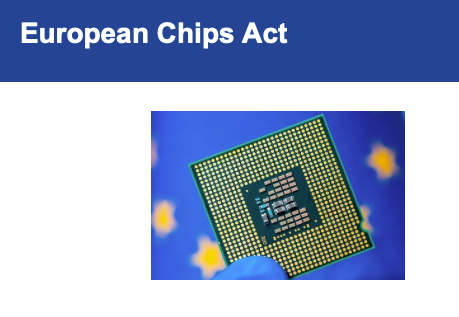
European Chips Act promises billions for semiconductor fabs

The European Parliament and the Council reached agreement to proceed with a European Chips Act aimed at strengthening European competitiveness and resilience in this strategic sector.

The European Union aims to to double its current global market share of semiconductor manufacturing to 20% in 2030.

There are three pillars to the European Chips Act.

  1. Chips for Europe Initiative will combine investments from the Union, Member States and the private sector. The Initiative will be supported by €6.2 billion of public funds, of which €3.3 billion from the EU budget agreed today for the period until 2027, the end of the current multi-annual financial framework. This support will come in addition to €2.6 billion public funding already foreseen for semiconductor technologies. The €6.2 billion will support activities, such as the development of a design platform and setting up of pilot lines to accelerate innovation and production. The Initiative will also help the establishment of competence centres, located across Europe, which will provide access to technical expertise and experimentation, helping companies, SMEs in particular, to improve design capabilities and developing skills.
  2. Spur an estimated €43 billion in public and private investments in manufacturing facilities for chipmakers and their suppliers. European Chips Act createsframework for Integrated Production Facilities and Open EU Foundries that are “first-of-a-kind” in the Union and contribute to the security of supply and to a resilient ecosystem in the Union interest.
  3. Establish a coordination mechanism between the Member States and the Commission for strengthening collaboration with and across Member States, monitoring the supply of semiconductors, estimating demand, anticipating shortages, and, if necessary, triggering the activation of a crisis stage. To address such situations, the European Chips Act establishes a dedicated toolbox of measures that can be undertaken.


VMware is now part of Broadcom

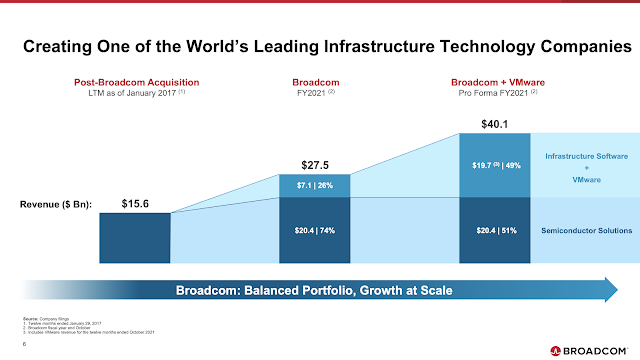
In a strategic move, Broadcom completed its acquisition of VMware, combining its deep portfolio of networking semiconductors with VMware's leading position in networking virtualization software and services. 

VMware, which was founded in 1998 and is based in Palo Alto, California,  pioneered the development of virtualization technology, which allows multiple operating systems to run on a single physical server, thereby improving efficiency, scalability, and resource utilization in computing environments. VMware's revenue for the fiscal year 2022 was approximately $12.851 billion, marking a 9.21% increase from the previous year. 

Hock Tan, President and Chief Executive Officer of Broadcom, writes: "While an important moment for Broadcom, it’s also an exciting milestone for our customers around the world. And as I said when we first announced the acquisition, we can now come together and have the scale to help global enterprises address their complex IT infrastructure challenges by enabling private and hybrid cloud environments and helping them deploy an 'apps anywhere' strategy. Our goal is to help customers optimize their private, hybrid and multi-cloud environments, allowing them to run applications and services anywhere."

The deal was first announced on 22-May-2022 as a cash-and-stock transaction that values VMware at approximately $61 billion, based on the closing price of Broadcom common stock on May 25, 2022. In addition, Broadcom was to assume $8 billion of VMware net debt. The deal had the support of VMware's Board of Directors, along with Michael Dell and Silver Lake, which own 40.2% and 10% of VMware shares outstanding.

What happens next

Broadcom is committed to VMware Cloud Foundation as the software stack that serves as the foundation of private and hybrid clouds.

The vision is to convert the typically heterogeneous enterprise IT infrastructure into a virtualized and containerized environment, enabling private and hybrid clouds. VMware will offer a rich catalog of services on top of VMware Cloud Foundation to modernize and optimize cloud environments, including the following.

  • Application networking and security - the focus is to deliver lateral protection that can be implemented in a simpler and more agile manner for VMware virtualized infrastructure. Emerging AI/GenAI techniques are leveraged to counter the evolving threat landscape.
  • Modern applications - VMware Tanzu is designed to accelerate application development, delivery and management on any cloud – on VMware Cloud Foundation as well as across all major hyperscalers. Specifically optimized for app-dev frameworks such as Spring, the leading enterprise Java application framework, Tanzu drives significant developer productivity while enabling platform teams to enforce application standards, maintain security and compliance and track app performance. 
  • Software-enabled innovations from data center to the edge - Private and hybrid cloud ambitions are gaining velocity just as modular, platform-based technologies enable agility. This is true in the data center and also becoming true at the Software-Defined Edge. 
There are no plans to tie VMware software to run specifically on Broadcom silicon, according to media interviews with Hock Tan.

https://www.broadcom.com/blog/broadcom-announces-successful-acquisition-of-vmware

Significant Milestones for VMware

1998: VMware founded by Diane Greene (president and CEO), Mendel Rosenblum (Chief Scientist), Scott Devine, Ellen Wang, and Edouard Bugnion. 

1999: VMware introduced its first product, VMware Workstation, and entered the server market in 2001 with VMware GSX Server and VMware ESX Server.

2003-2004: The company launched VMware Virtual Center, vMotion, and Virtual SMP technology and introduced 64-bit support.

2004: EMC Corporation acquired VMware for $625 million. This was followed by VMware going public in 2007, with EMC selling 15% of its shares.

2008: VMware collaborated with Cisco Systems, leading to the creation of the Cisco Nexus 1000V, a distributed virtual software switch.

2011: Introduction of Cloud Foundry, an open-source platform-as-a-service system, and transfer of Mozy backup service from EMC to VMware.

2012-2013: Pat Gelsinger was appointed CEO, and VMware spun off Pivotal Software with investment from General Electric.

2013: Launch of vCloud Hybrid Service and acquisition of Desktone.

2016: Dell's acquisition of EMC, leading to significant changes within VMware, including restructuring and executive departures.

2017: VMware was ranked 3rd in the list of highest-paying companies in the U.S. and sold vCloud Air to French cloud service provider OVH.

2021: Pat Gelsinger left VMware to join Intel; VMware announced Raghu Raghuram as the new CEO and spun off from Dell.

2022: Broadcom announced its intention to acquire VMware, a transaction valued at approximately $61 billion, including debt assumption.

Significant milestones for Broadcom


Broadcom, originally known as HP Associates, was established in 1961 as a semiconductor products division of Hewlett-Packard. The division became part of Agilent Technologies in 1999, which was later acquired by KKR and Silver Lake Partners in 2005 to form Avago Technologies. 

1961: Establishment as HP Associates, a semiconductor division of Hewlett-Packard.

1999: Became part of Agilent Technologies spinoff from Hewlett-Packard.

2005: Formation of Avago Technologies by KKR and Silver Lake Partners, acquiring Agilent's Semiconductor Products Group.

2006: Hock Tan appointed CEO of Avago Technologies

2009: Avago Technologies went public on NASDAQ.

2013: Acquisition of CyOptics for $400 million to expand fiber optics portfolio.

2013: Avago Technologies acquired LSI Corporation for $6.6 billion.

2014: Sale of SSD controller business to Seagate Technology.

2015: Avago acquired Broadcom Corporation for $37 billion, renaming the combined company Broadcom Ltd.  The original Broadcom, which was based in Irvine, California, was founded in 1991 by Henry Samueli and Henry T. Nicholas III , two professors from UCLA. It grew to about 10,000 employees worldwide, with more than 10,700 U.S. and 3,700 foreign patents. 2014 revenue was $8.43 billion. In 2014, Broadcom exited the cellular baseband business.

2018: Acquisition of CA Technologies for $18.9 billion, moving into infrastructure software.

2019: Acquisition of Symantec's enterprise security business for $10.7 billion.

Telstra biggest spender in Australia's 3.4/3.7 GHz auction

The Australian Communications and Media Authority’s (ACMA) announced the following results in its 3.4/3.7 GHz bands spectrum allocation process:

Of 588 lots available, 574 were allocated to bidders. The allocation realised total revenue to the Commonwealth of $721,766,300.

  • Mobile JV Pty Ltd won 44 lots of spectrum for $128,194,100.
  • NBN Co Pty Ltd won 200 lots of spectrum for $14,384,600.  
  • Optus Mobile Pty Ltd won 4 lots of spectrum for $33,539,600. 
  • Telstra Ltd won 326 lots of spectrum for $545,648,000. 

“The outcomes of the allocation process align strongly with our objectives," said ACMA Chair Nerida O’Loughlin. 

“The allocation of this spectrum will support digital connectivity, promote competition and facilitate investment in new services for Australian consumers and businesses across metropolitan and regional areas of Australia. 

The licences issued will come into force shortly, with the 3.4 GHz band licences expiring in December 2030 and the 3.7 GHz band licences expiring in January 2044.


https://www.acma.gov.au/articles/2023-11/outcome-3437-ghz-bands-spectrum-allocation-process

China Telecom and China Unicom employ digital twin for shared net

Working with ZTE, China Telecom and China Unicom used a digital twin to plan and managed shared network infrastructure during the recent 19th Asian Games, which were held in Hangzhou, China, from 23 September to 8 October 2023.

The companies built a unified DTN (Digital Twin Network) featuring  centralized, transparent and proactive operation mode that assured performance to an audience of 600,000 visitors attending 48 matches held in 21 venues during the Asian Games.

Using AI and knowledge-driven digital twin modeling, the platform dynamically predicted the peak traffic and user experience. It achieved 90% accuracy in problem detection, resulting in an optimal network tuning strategy.

https://www.zte.com.cn/global/about/news/china-telecom-china-unicom-and-zte-unveil-digital-twin-based-smart-operation-for-co-construction-and-sharing-network.html

MediaTek tests RedCap interoperability with Keysight

MediaTek completed 5G New Radio (NR) and 5G reduced capability (RedCap) interoperability development testing (IODT) of its 5G modem based on the 3GPP Release 17 (Rel-17) standard using Keysight’s 5G Network Emulation Solutions.

The testing verified early identification, bandwidth part (BWP) definition, user equipment (UE) capability, radio resource management (RRM) relaxation, network control device-synchronization signal block (NCD-SSB), sounding reference signal (SRS) enhancement, extended discontinuous reception (eDRX), and physical uplink control channel (PUCCH) for frequency hopping. The 5G NR IODT validated the chipset supported Rel-17 features including power saving, small data transmission, and NR coverage enhancement.


Dr. Ho-Chi Hwang, General Manager of Wireless Communication System and Partnerships at MediaTek, said: “MediaTek is committed to driving market advancements in 5G NR Rel-17 and RedCap technology. We collaborate with Keysight to develop state-of-the-art 5G modem platforms, fostering a growing ecosystem of 5G device innovators.”

Prisma Photonics opens in Austin

Prisma Photonics, an Israeli startup which utilizes advanced optical fiber technology to monitor large scale power utility infrastructure,  opened its first US office in Austin, Texas. 

Founded in 2017, Prisma Photonics works with leading power utilities in the United States and Europe to deploy solutions that identify threats to transmission assets in real time while offering hyper-accurate line ratings to help utilities comply with US FERC regulations and increase capacity on congested networks.

  • Earlier in 2023, Prisma Photonics, which has been using optical fibers to monitor Israel’s national transmission electrical grid since 2020, was awarded a contract by Israel Electric Corporation (IEC) to extend coverage to 1,000 km (over 620 miles), which is 20% of the transmission grid.


Tuesday, November 21, 2023

NVIDIA's data center revenue soars 279% yoy to $14.51 billion

NVIDIA reported revenue of $18.12 billion for its third quarter ended October 29, 2023, up 206% from a year ago and up 34% from the previous quarter.  Non-GAAP earnings per diluted share were $4.02, up nearly 6x from a year ago and up 49% from the previous quarter.

“Our strong growth reflects the broad industry platform transition from general-purpose to accelerated computing and generative AI,” said Jensen Huang, founder and CEO of NVIDIA.

“Large language model startups, consumer internet companies and global cloud service providers were the first movers, and the next waves are starting to build. Nations and regional CSPs are investing in AI clouds to serve local demand, enterprise software companies are adding AI copilots and assistants to their platforms, and enterprises are creating custom AI to automate the world’s largest industries.

“NVIDIA GPUs, CPUs, networking, AI foundry services and NVIDIA AI Enterprise software are all growth engines in full throttle. The era of generative AI is taking off,” he said.

Some highlights

  • Data Center revenue was a record $14.51 billion, up 41% from the previous quarter and up 279% from a year ago.
  • Gaming revenue was $2.86 billion, up 15% from the previous quarter and up 81% from a year ago. 
  • Professional Visualization revenue was $416 million, up 10% from the previous quarter and up 108% from a year ago.
  • Automotive revenue was $261 million, up 3% from the previous quarter and up 4% from a year ago.


Colt builds 3rd Frankfurt hyperscale data centre

Colt Data Centre Services (DCS) commenced the construction of its third state-of-the-art data centre in Frankfurt, Germany. 

The new facility is strategically situated in close proximity to Colt DCS's existing Frankfurt  Data Centre, offering seamless connectivity to the Rhine-Main region and convenient access to Frankfurt's major financial district. Designed for a leading Cloud Service Provider, this facility will provide 32.4MW of IT power capacity, ensuring exceptional data storage capabilities and scalability for the tenant's IT infrastructure.

The facility boasts direct access to DE-CIX, one of the world's largest internet exchange points, as well as multiple dark fibre providers.

https://www.coltdatacentres.net

Bharti Airtel picks Nokia for optical transport

Bharti Airtel will deploy Nokia’s Optical Transport Network (OTN) technology across its nationwide footprint. The upgrade will enable Bharti Airtel to provide massive capacity to enterprises, operators and hyperscalers.

As part of the agreement, Airtel will utilize Nokia’s 1830 PSS-x OTN switches in its National Long-Distance Network connecting major cities across India.

Chandan Kumar, Head of Optical Network Business Centre for Nokia India , said: “As a world leader in OTN, our technology will help Airtel to increase the capacity and features of Bharti’s optical transport network to meet growing bandwidth demand driven by the enterprise and hyperscaler segments. It will also provide the service level performance to meet the strict SLAs from Airtel customers”.

https://www.nokia.com/about-us/news/releases/2023/11/21/nokia-builds-multi-terabit-pan-indian-optical-network-for-bharti-airtel/


Infinera awarded $14m California Competes Grant for next-gen semiconductors

Infinera has been awarded a California Competes (CalCompetes) grant valued at up to $14 million over five years by the California Governor’s Office of Business and Economic Development (GO-Biz). 

This is a first step to expand and modernize Infinera’s U.S.-based domestic production of next-generation semiconductors and continue to support innovation and economic development in the United States in future years.

The CalCompetes grant will enable Infinera, a domestic optical compound semiconductor manufacturer with in-house fab operations and advanced test and packaging capabilities in multiple states, to build upon its 20+ year history in the United States and continue to drive innovation in indium phosphide-based compound semiconductor and monolithic photonic integrated circuit (PIC) technologies. 

The CalCompetes Grant Program is one of California’s main incentive programs to leverage tens of billions of dollars of federal funds available under the Creating Helpful Incentives to Produce Semiconductors (CHIPS) Act. 

“We are grateful and honored to receive this grant award, which represents an important step in helping to boost America’s domestic production of semiconductor technologies,” said David Heard, Chief Executive Officer, Infinera. “Since our founding, we chose to keep our optical compound semiconductor fab and advanced packaging operations in the United States. We remain committed to leveraging our unique expertise, talent, and capabilities to support the goals of U.S. federal and state initiatives focused on economic development and national security.”

https://www.infinera.com/press-release/infinera-awarded-california-competes-grant/


Telstra Broadcast Services and BT enter alliance

 Telstra Broadcast Services (TBS) and BT entered into an initial five-year strategic alliance to bring together each company's global media network teams, pooling their vast network infrastructure and localised expertise.  

The deal will increase TBS' global footprint by 50% and expand its customer-base to more than 170 broadcast and media organisations worldwide.    

As part of the deal, customers will have access to a product offering headed up by Telstra, including key Asia-Pacific regions with India, Malaysia, and Hong Kong, and other countries.   This will be supported by an increased local team in APAC and access to the broader suite of TBS products and services, including field services, special events teams, and broadcast operations centers in Sydney, Melbourne, Hong Kong, London, and Pittsburgh.   

"Our priority at TBS is to offer a world-class global content delivery service for our customers, including the largest distribution network with the most flexibility and options for organisations to connect to the world," said Karen Clark, Head of APAC at Telstra Broadcast Services.   


STL develops optical connectivity business

STL announced the appointment of two executives to its optical connectivity business:

  • David De Craemer brings over 25 years of industry experience working with the likes of TE Connectivity and CommScope. Discussing his vision for STL, David said: "I am excited about the opportunity and look forward to leveraging my strength and capabilities to co-create sustainable growth for the company, creating superior value for our customers."
  • Tomasz Bednarczyk has worked for 18 years at Corning in various R&D, Finance and PLM domains. Excited at this opportunity, Tomasz said: "I have the privilege of leading an agile, motivated and customer-oriented team that is relentlessly working towards providing its customers with best-in-class technology. We commit to investing in the innovation process while keeping environmental sustainability as a top priority."

This follows STL’s acquisition of Optotec in Italy in 2020.  STL has now fully integrated optical connectivity products and design engineering capabilities into its optical business. 

 STL notes that it is one of the very few players to have end-to-end capability across the fibre value chain, starting with glass preform, fibre, cables and finally, Optical Connectivity solutions. 

Paul Atkinson, CEO of Optical Networking Business, STL, warmly welcomed David and Tomasz, acknowledging their invaluable expertise and experience. He said: "Their arrival is sure to enhance our Connectivity business, fostering innovation and growth  and creating impact for our customers."


DriveNets Joins Ultra Ethernet Consortium

DriveNets has joined the Ultra Ethernet Consortium, an organization aimed at building an open, interoperable, Ethernet-based architecture for high-performance networking serving AI and HPC workloads. 

DriveNets Network Cloud-AI – introduced in May and now available for order with Broadcom Jericho 3-AI based white boxes – offers the highest-performance AI networking solution available today, based on trials with leading hyperscalers and independent testing by Scala Computing. It improves the performance of large-scale AI workloads regardless of GPU or AI accelerator used, enabling users to build open, multi-vendor AI infrastructures.

DriveNets is part of the first group of companies to join the UEC after its founding by members including Microsoft, Meta, Broadcom, AMD, Arista, Cisco, Oracle, HPE, Intel and Eviden. 

"AI is going to be ubiquitous in cloud and data center infrastructure and will require technology that can effectively minimize GPU idle cycles in high-performance AI workloads," said Ido Susan, founder and CEO of DriveNets. "Solving for that calls for Ethernet-based fabric that supports open, standards-based architectures that eliminate vendor lock-in. The Ultra Ethernet Consortium is committed to advancing open, interoperable Ethernet-based solutions, and DriveNets is proud to support its efforts to evolve the Ethernet standard."

Nokia backs Ultra Ethernet Consortium

Nokia announced its support for the Ultra Ethernet Consortium (UEC), a group that brings together companies for industry-wide cooperation to develop Ethernet specifications and software APIs that empower AI and HPC environments. 

Vach Kompella, Head of Nokia’s IP business, said: “Generative AI and ML are revolutionizing every aspect of our customers’ businesses. Our networking solutions advance their ability to deploy AI quickly and pursue exciting new use cases and applications. With our extensive footprint in communications, enterprise and webscale networks, we are focused on making Ultra Ethernet a highly compatible, low cost and interoperable part of future AI and HPC application stacks.”

https://www.nokia.com/about-us/news/releases/2023/11/21/nokia-supercharges-ai-with-ultra-ethernet/

Monday, November 20, 2023

NVIDIA advances its Spectrum-X Ethernet switching, Bluefield-3 SuperNIC

Dell Technologies, Hewlett Packard Enterprise and Lenovo will be the first to integrate NVIDIA Spectrum-X Ethernet networking technologies for AI into their server lineups

Spectrum-X combines the extreme performance of the Spectrum-4 Ethernet switch; the NVIDIA BlueField-3 SuperNIC, a new class of network accelerators for supercharging hyperscale AI workloads; as well as acceleration software. Spectrum-X complements BlueField-3 DPU.

NVIDIA describes Spectrum-X as a new class of Ethernet networking that can achieve 1.6x higher networking performance for AI communication versus traditional Ethernet offerings.

“Generative AI and accelerated computing are driving a generational transition as enterprises upgrade their data centers to serve these workloads,” said Jensen Huang, founder and CEO of NVIDIA. “Accelerated networking is the catalyst for a new wave of systems from NVIDIA’s leading server manufacturer partners to speed the shift to the era of generative AI.”

NVIDIA’s Spectrum-4 is a 51 Tbps Ethernet switch featuring adaptive routing and enhanced congestion control mechanisms for multi-tenant, AI cloud workloads.  The NVIDIA Spectrum-4 uses a custom ASIC with a 51.2 terabits per second switching capacity, supporting up 128 ports of 400G or 64 ports of 800G, and based on 100 Gbps PAM4 SerDes technology. It integrates a 12.8 Tb/s crypto engine wtih support for MACsec and VXLANsec. It also support secure boot as default via hardware root of trust . It is based on 4nm process technologies.

BlueField-3 SuperNICs are designed for network-intensive, massively parallel computing, offering up to 400 Gbps RDMA over Converged Ethernet (RoCE) network connectivity between GPU servers and boosting performance for AI training and inference traffic on the east-west network inside the cluster. They also enable secure, multi-tenant data center environments, ensuring deterministic and isolated performance between tenant jobs. 

Highlights of NVIDIA’s SuperNICs: 

  • High-speed packet reordering to ensure that data packets are received and processed in the same order they were originally transmitted. This maintains the sequential integrity of the data flow. 
  • Advanced congestion control using real-time telemetry data and network-aware algorithms to manage and prevent congestion in AI networks. 
  • Programmable compute on the input/output (I/O) path to enable customization and extensibility of network infrastructure in AI cloud data centers. 
  • Power-efficient, low-profile design to efficiently accommodate AI workloads within constrained power budgets. 
  • Full-stack AI optimization, including compute, networking, storage, system software


https://nvidianews.nvidia.com/news/nvidias-new-ethernet-networking-platform-for-ai-available-soon-from-dell-technologies-hewlett-packard-enterprise-lenovo


Zayo to acquire Globalways GmbH

Zayo agreed to acquire Globalways GmbH, a Stuttgart-based fibre infrastructure and network services company. 

Globalways operates approximately 360km of owned fibre infrastructure across the Stuttgart metropolitan area and surrounding regions, with more than 700 on-net buildings.

Yannick Leboyer, Managing Director at Zayo Europe, said: “Globalways has established itself as a key player in the Stuttgart and wider German market, offering high-quality communication infrastructure and network solutions via a comprehensive owned network. Globalways’ local expertise is the perfect complement to our European footprint. 

“This acquisition will enable Zayo to offer an extended range of services to our European clients and provide Globalways’ customers with access to Zayo’s extensive international network. This is a testament to our commitment to delivering unparalleled connectivity solutions and further building our presence in Germany. We are excited about the opportunity this creates for our European customers, employees, and stakeholders.”

Moritz Frenzel, Managing Director at Globalways, said: “After successfully growing Globalways to a strong and successful national internet service provider under the ownership of Relined GmbH, we’re now looking forward to enabling our customers and partners to connect international markets and expanding our product portfolio with Zayo as an ideal strategic partner that shares our vision and values.”


www.zayo.com 

Ericsson: Consumers will pay for superior 5G experience

A new study by Ericsson ConsumerLab reveals over one-in-five Canadian 5G smartphone users are willing to pay a premium for a 5G plan that ensures elevated network performance, particularly in areas of quality of experience and network performance, that caters to high-performing video streaming, gaming, and other popular apps to boost user satisfaction.

Head of Ericsson ConsumerLab, Jasmeet Singh Sethi, says: "Canadian 5G users have high expectations for their service; they're seeking not just connectivity but rather differentiated connectivity where it matters most like crowded arenas or public indoor locations, the value-added experience that enhances daily activities,” says Sethi. "Our findings reveal that if these expectations aren't met, consumers are three times more inclined to switch to a provider that can deliver a superior 5G experience, with twenty two percent of users willing to pay nine per cent more for a service that offers differentiated quality of experience over 5G."

The Ericsson report offers  four priorities for service providers:

  • 5G network satisfaction drivers are evolving beyond coverage. Post 5G buildout, service providers would benefit from prioritizing network optimizations that cater to high-performing video streaming, gaming, and other popular applications to boost user satisfaction.
  • 5G is reshaping video streaming and augmented reality (AR) usage. On average, Canadian 5G users report a 28 per cent increase in time spent streaming video in HD/4K format per day and a 59 per cent increase in time spent on watching multi-view video streaming compared to 2022. Service providers looking to increase customer engagement should offer innovative service bundles to leverage the rising demand for new video formats and AR, driven by 5G.
  • 5G performance at key locations influences consumer loyalty. Since the launch of 5G in Canada, a substantial 20 per cent of consumers have changed their service provider, and the primary driving factor behind this shift is 5G network performance. Remarkably, nearly 46 per cent of those who've made the switch did so due to the quality of their 5G network. Service providers should prioritize enhancing 5G performance in key locations to boost consumer loyalty and minimize churn rates.
  • 5G consumers will pay premiums for differentiated quality of experience . Forty-one per cent of users demand more data to justify a price increase, and 17 per cent are looking for bundles with innovative services, while 22 per cent expect superior performance and prioritize connectivity. Service providers should explore differentiated 5G monetization strategies with speed tiers, content bundles, and QoS-based pricing, leveraging 5G SA capabilities and targeted segmentation.

https://www.ericsson.com/en/press-releases/6/2023/users-willing-to-pay-more-for-best-quality-5g