Monday, January 16, 2023

Zayo adds fiber routes connecting Paris and Marseille

Zayo has activated a new 400G enabled fiber route connecting Paris and Marseille.

The new Paris-to-Marseille route 24 Tbps of expected capacity per fiber pair and offers critical path diversity options.

Zayo notes that its new route will also provide direct access to Bordeaux—the landing city for Amitié, a new private transatlantic cable that will connect the U.S. with the UK and France. Once ready for service, the connection will enable direct access to Asia, Africa, and the Middle East.

“We are continuously expanding, improving and diversifying our network in order to support our customers with their increasing bandwidth,” said Yannick Leboyer, Europe Chief Operating Officer at Zayo. “With several new subsea cable projects set to deploy in the coming years, Marseille is on its way to becoming one of the top five internet connectivity hubs globally, and Zayo is uniquely positioned to provide the necessary infrastructure to support this growth. The Paris-to-Marseille route is built to support and transport the fast-paced bandwidth growth and increasingly high demand for connectivity in these markets, giving customers a more reliable, scalable and secure way to share data to the rest of Europe and the U.S.”

https://www.zayo.com/newsroom/zayo-boosts-infrastructure-leadership-in-europe-with-pivotal-fiber-expansion/

SES demos satellite-enabled 5G backhaul

SES demonstrated its current generation O3b Medium Earth Orbit (MEO) satellites for 5G backhaul .

The proof-of-concept, which was held with du from Emirates Integrated Telecommunications Company (EITC), saw numerous tests conducted over an SES’s O3b satellite, including voice and data scenarios to measure quality of service performance and stress test load capacity. The low latency and high throughput 5G backhaul link showed O3b is an ideal solution for 5G satellite-enabled networks with Quality of Experience (QoE) at par with terrestrial backhauling technologies.

“du has vast experience using satellites for its own cellular backhaul, as well as for delivering satellite-enabled data communications services to our enterprise customers, but we need much better throughputs and low-latency performance to support our enterprise, cloud, and data growth applications. O3b mPOWER promises to provide the dedicated multi-gigabit per connection scale with cloud-optimised and low-latency performance to provide the required Quality of Experience (QoE) with the flexibility of satellite,” said Saleem AlBlooshi, Chief Technology Officer, du.

John-Paul Hemingway, Chief Strategy & Product Officer of SES, said, “We appreciate the opportunity to collaborate with du on this demonstration of high-performance MEO services and how we can jointly deploy the Middle East’s first satellite-enabled 5G backhaul network. du can leverage more guaranteed-SLA bandwidth, with greater flexibility, via O3b mPOWER to rapidly generate new revenue streams by expanding high-quality 4G/5G to remote areas and by cost effectively connecting its enterprise customers.”

SES opens new era with O3b mPOWER MEO constellation

SES heralded the first launch for O3b mPOWER, its second-generation medium earth orbit (MEO) constellation poised to enable tens of thousands of multi-gigabit class spotbeams across the planet. 

SpaceX succesfully orbited the first two satellites, which a software-defined capability to deliver more than 5,000 steerable beams that can be repositioned based on real-time data from SES customers’ terminals. The satellites were launched aboard a Falcon 9 rocket from Space Launch Complex 40 (SLC-40) at Cape Canaveral Space Force Station in Florida. 

The satellites are based on Boeing’s 702 platform use Spectrolab’s custom-designed solar arrays built to withstand harsh MEO radiation.

SES contracted with Boeing to deliver 11 O3b mPOWER satellites to SES, Boeing continues production, integration and testing of the remaining nine spacecraft. The O3b mPOWER satellites are also flexible in their launch configuration, with the ability to launch two or three satellites at a time.

SES said its new MEO satellites will be able to deliver roundtrip latency of less than 150 milliseconds. The company is also partnering with Microsoft to bring one-hop connectivity from the satellites into Microsoft Azure data centers. The terabit-scale capacity of the new O3b mPOWER constellation, the automated and software-defined steerable beams of the satellites, upgraded customer terminals and telco/cloud partnerships are expected many new use cases and deployment sites.

“Much more than just another launch, today marks the next milestone of our MEO journey. Since starting this journey, we have gone on to positively impact millions around the world. Today, with our second-generation O3b mPOWER, we are bringing game-changing technology that delivers a unique combination of multiple gigabits per second of throughput at any location, guaranteed reliability and service flexibility that is a first in the industry,” said Steve Collar, CEO of SES. “Whether we are enabling governments to carry out critical missions securely, cruise operators to provide high-speed broadband access to passengers at all times, or mobile network operators to deploy 4G/5G networks in underconnected areas or restore communications networks in down time, O3b mPOWER is the satellite system of choice for applications where performance matters most.”

Transpacific “Unity” cable doubles capacity with Infinera’s ICE6

The transpacific Unity Submarine Cable System, which spans 9,620 kilometers between Japan and the U.S., will double its capacity by upgrading to Infinera’s ICE6 solution. The upgrade is expected to increase the life span of the cable by nearly 25% and deliver up to 7.4 Tbps per fiber pair.

The Unity Submarine Cable System is a subsea consortium representing Bharti Airtel Limited, Global Transit Limited (a wholly-owned subsidiary of TIME), Google, KDDI Corp., Telstra and Singtel.

“Infinera’s innovative ICE6 technology was selected to upgrade our system because it enables us to extend the life of the Unity Submarine Cable System while providing the highest level of quality for our customers,” said the Unity consortium. “The Unity Submarine Cable System is a critical connection between two continents with the fastest growing bandwidth needs. We needed an industry-leading solution that would enable us to be competitive now and in the future.” 

“The Unity Submarine Cable System is one of the highest capacity underwater fiber optic cables ever built between Asia and North America, and Infinera is proud to power it with our latest optical engine technology,” said Nick Walden, Senior Vice President of Worldwide Sales at Infinera. “The increased capacity will help operators in Asia and the U.S. meet the increasing bandwidth demands on both sides of the Pacific.”

https://www.infinera.com/press-release/unity-submarine-cable-system-leverages-infinera-ice6-800g-solution


IDC: Spending continues at fast clip for cloud infrastructure

 Spending on compute and storage infrastructure products for cloud deployments, including dedicated and shared IT environments, increased 24.7% year over year in the third quarter of 2022 (3Q22) to $23.9 billion, according to IDC's Worldwide Quarterly Enterprise Infrastructure Tracker: Buyer and Cloud Deployment report.

Some highlights from IDC:

Spending on cloud infrastructure continues to outgrow the non-cloud segment although the latter had strong growth in 3Q22 as well, increasing at 16.5% year over year to $16.8 billion. The market continues to benefit from high demand and large backlogs, coupled with an improving infrastructure supply chain.

Spending on shared cloud infrastructure reached $16.8 billion in the quarter, increasing 24.4% compared to a year ago. IDC expects to see continuous strong demand for shared cloud infrastructure with spending expected to surpass non-cloud infrastructure spending in 2023. The dedicated cloud infrastructure segment grew 25.3% year over year in 3Q22 to $7.1 billion. Of the total dedicated cloud infrastructure, 45.2% was deployed on customer premises.

For the full year 2022, IDC is forecasting cloud infrastructure spending to grow 19.6% year over year to $88.1 billion – a noticeable increase from 8.6% annual growth in 2021. 


Non-cloud infrastructure is expected to grow 10.7% to $64.7 billion. Shared cloud infrastructure is expected to grow 19.0% year over year to $60.9 billion for the full year while spending on dedicated cloud infrastructure is expected to grow 21.2% to $27.3 billion for the full year.

IDC tracks various categories of service providers and how much compute and storage infrastructure these service providers purchase, including both cloud and non-cloud infrastructure. The service provider category includes cloud service providers, digital service providers, communications service providers, and managed service providers. In 3Q22, service providers as a group spent $23.9 billion on compute and storage infrastructure, up 22.5% from the prior year. This spending accounted for 58.7% of the total market. Non-service providers (e.g., enterprises, government, etc.) increased their spending at a similarly high rate, 19.3% year over year. IDC expects compute and storage spending by service providers to reach $87.8 billion in 2022, growing at 17.5% year over year.

On a geographic basis, year-over-year spending on cloud infrastructure in 3Q22 increased in all regions except Central and Eastern Europe (CEE), which is impacted by the Russia-Ukraine war. Spending in CEE declined 35.1% year over year in the quarter. The Middle East and Africa (MEA), the United States, and Western Europe grew the most at 65.8%, 32.1%, and 31.3% year over year, respectively. All other regions demonstrated growth in the teens and twenties percentage range. 

For the full year 2022, cloud infrastructure spending is expected to grow in all regions except CEE, with four regions – Asia/Pacific (excluding Japan and China), MEA, USA, and Western Europe – expecting to post annual growth in the 20-35% range.

Long term, IDC predicts spending on cloud infrastructure to have a compound annual growth rate (CAGR) of 12.9% over the 2021-2026 forecast period, reaching $135.1 billion in 2026 and accounting for 67.3% of total compute and storage infrastructure spend. Shared cloud infrastructure will account for 72.3% of the total cloud amount, growing at a 13.8% CAGR. Spending on dedicated cloud infrastructure will grow at a CAGR of 10.7% to $37.4 billion. Spending on non-cloud infrastructure will have a CAGR of 2.3%, reaching $65.6 billion in 2026. 

Spending by service providers on compute and storage infrastructure is expected to grow at a CAGR of 12.1%, reaching $131.9 billion in 2026.

https://www.idc.com/getdoc.jsp?containerId=prUS50037523

What's next for data center technology in 2023?

 Will 800G pluggables arrive for data center switches in 2023? 

 Here are 3 predictions from Credo’s Scott Feller.

https://youtu.be/DoPY_UOqtJQ

Check out other 2023 Predictions

See what other experts have to say on NextGenInfra.io  - https://nextgeninfra.io/2023-predictions/

Amplify your MWC 2023 presence

Looking to record your video for our channel for our MWC 2023 Showcase in Barcelona? We will be there! Book your session now. https://ngi.fyi/mwc2023yt

PacketFabric and Unitas Global to merge

PacketFabric and Unitas Global have agreed to merge to become a larger Network as a Service (NaaS) platform. 

PacketFabric helps businesses build new secure, private network fabrics to connect their core sites, cloud assets and manage shifts in data gravity with their unique fabric integrated storage. PacketFabric Converge orchestrates on-demand connectivity across colocation facilities, cloud providers, and private network interconnection across the globe.

Unitas Global offers intelligent automation for business internet connectivity, providing end-to-end network design, pricing, ordering and visibility across more than one thousand first/middle/last mile networks, accessing more than 50 million fiber lit buildings.

The companies said their merger will create a company that is changing the business internet architecture to one that is finally software-defined and fully programmable, versus legacy systems that are rigid and struggle to meet the price, performance, and flexibility needs of today’s enterprise customers. The combined platform assets and automation capabilities of the two companies will deliver real-time, on-demand control to our customers from The Edge to Everywhere.

“We are the only company that helps businesses shift from being reactive to proactive when it comes to the constant change of digitized operations,” said PacketFabric CEO Dave Ward. “Our platforms enable a fundamental shift in the way to architect and operationalize a modern business. We enable a reimagination of simplified operations with real-time, on-demand automation, self-service, complete telemetry and flexible consumption, applied to every aspect of business connectivity. We do this by fulfilling the promise of software-defined-networking and AIOps via our cloud native platforms. Not one other NaaS offer enables Edge to Everywhere through their platform, we believe this makes us the one true NaaS.”

https://packetfabric.com/press-releases/packetfabric-and-unitas-global-announce-merger

Deutsche Telekom cloudifies its Next Gen IMS platform

Deutsche Telekom announced some major deployment milestones with its NIMS (Next Generation IP Multimedia Subsystem) project to ‘cloudify’ and automate the core of its IP-based voice telephony platform. 

More than ten million voice subscribers have successfully been migrated. 

In addition, billions of interconnect voice minutes with approximately 100 Interconnect partners are now completely processed via NIMS.

“With the launch of our NIMS platform, we have implemented a game-changing level of lifecycle automation for all telco cloud and payload components. This enables Deutsche Telekom to validate and deploy new software for our customers in a few days, or soon even minutes, instead of weeks – thanks to our great team and ambitious partners,” says Abdu Mudesir, CTO of Telekom Deutschland.

DT said the most fundamental innovation is the automation of the platform from end-to-end. 

In addition, Telekom has created an innovative and highly-collaborative multi-vendor ecosystem to deliver on the vision of this highly-automated, cloud-based architecture. Current partners are Juniper Networks (Cloud Infrastructure & Prime Integrator), Mavenir, Metaswitch, Hewlett Packard Enterprise, Lenovo und Red Hat. Due to the high level of disaggregation and the horizontal cloud approach, more technology partners can easily be added as the demand for services grows.

https://www.telekom.com/en/media/media-information/archive/voice-subscribers-cloudified-voice-production-1023708

What's next for edge services in 2023?

What are the prospects for virtualized services at edge locations in 2023? 

Here are 3 predictions from Zededa's Said Ouissal .

https://youtu.be/x7iOEKlExts

Check out other 2023 Predictions

See what other experts have to say on NextGenInfra.io  - https://nextgeninfra.io/2023-predictions/

Amplify your MWC 2023 presence

Looking to record your video for our channel for our MWC 2023 Showcase in Barcelona? We will be there! Book your session now. https://ngi.fyi/mwc2023yt

Sunday, January 15, 2023

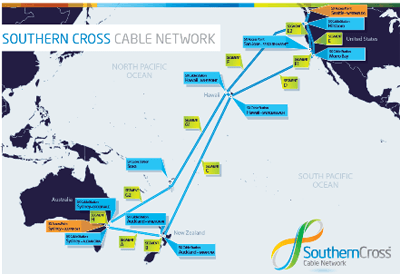
Southern Cross NEXT activates 400GbE services

Southern Cross Cables Limited has activated commercial 400GbE services on its Southern Cross NEXT cable, which links Australia, New Zealand and the United States.

“With the Southern Cross NEXT cable system, the new technology and capability has been designed to support the rising demand for bandwidth driven by cloud adoption and digitisation. We are now thrilled to be able to offer 400GbE Layer 1 services as the first of several planned innovations taking advantage of the Southern Cross eco-system, and the new NEXT cable,” stated Mr Laurie Miller, CEO of Southern Cross.

“The availability of 400GbE services will allow customers hyper-scale low-latency connectivity directly between data-centres in Sydney and Los Angeles, and with a new Auckland DC PoP due for implementation in 2023. Demand for 100G+ high-capacity links has been booming in recent years particularly for data-centre to data-centre GCN connectivity, where extremely large and resilient volumes of data are required to traverse core network infrastructure for data replication, data storage connectivity and disaster recovery. An application where the Southern Cross multi-path eco-system excels.”

Southern Cross’ 400GbE service runs on Ciena’s 6500 Packet-Optical Platform powered by WaveLogic 5 Extreme coherent optics and is managed by the Manage, Control and Plan (MCP) domain controller. To accommodate increasing and changing network traffic demands, Southern Cross’s eco-system also incorporates Ciena’s 5400 and 8700 platforms, providing the ability to deploy services from 100Mbs now up to 400GbE connectivity over applicable wavelengths.

Mr Ivan Polizzi, Regional Managing Director, Australia, New Zealand and the Pacific Islands for Ciena, said: “With such a flexible and scalable network foundation from Ciena, Southern Cross is able to target the growing demands of today’s networks and provide customers with unrivalled connectivity by way of applications such as 400GbE services. This is important as Ciena and Southern Cross continue to collaborate on future opportunities and innovations to meet changing customer and industry demands”.

What’s next for Cloud and Service Provider infrastructure in 2023?

Has sustainability really become a key factor shaping the market for carrier network infrastructure? What is happening in metro access and aggregation?

Here are 3 predictions from Juniper Networks’ Sally Bament.

https://www.youtube.com/watch?v=JNfSc2Lydzw

Check out other 2023 Predictions

See what other experts have to say on NextGenInfra.io  - https://nextgeninfra.io/2023-predictions/

Amplify your MWC 2023 presence

Looking to record your video for our channel for our MWC 2023 Showcase in Barcelona? We will be there! Book your session now. https://ngi.fyi/mwc2023yt

What's next for optical transmission in 2023?

How will the subsea sector evolve? 

Will 800G rollouts accelerate? 

Here are 3 predictions from Infinera’s Tim Dorion.

https://youtu.be/9nYupHd0B0U

Check out other 2023 Predictions

See what other experts have to say on NextGenInfra.io  - https://nextgeninfra.io/2023-predictions/

Amplify your MWC 2023 presence

Looking to record your video for our channel for our MWC 2023 Showcase in Barcelona? We will be there! Book your session now. https://ngi.fyi/mwc2023yt

What’s next for multi-cloud routing and switching in 2023?

 As we look ahead to the future of routing and switching in 2023, how will telcos and cloud operators integrate their infrastructure? Are we headed to a big mash-up? 

Here are 3 predictions from Arrcus’ Shekar Ayyar .

https://youtu.be/E7GEIQzLQVY

Check out other 2023 Predictions

See what other experts have to say on NextGenInfra.io  - https://nextgeninfra.io/2023-predictions/

Amplify your MWC 2023 presence

Looking to record your video for our channel for our MWC 2023 Showcase in Barcelona? We will be there! Book your session now. https://ngi.fyi/mwc2023yt

Saturday, January 14, 2023

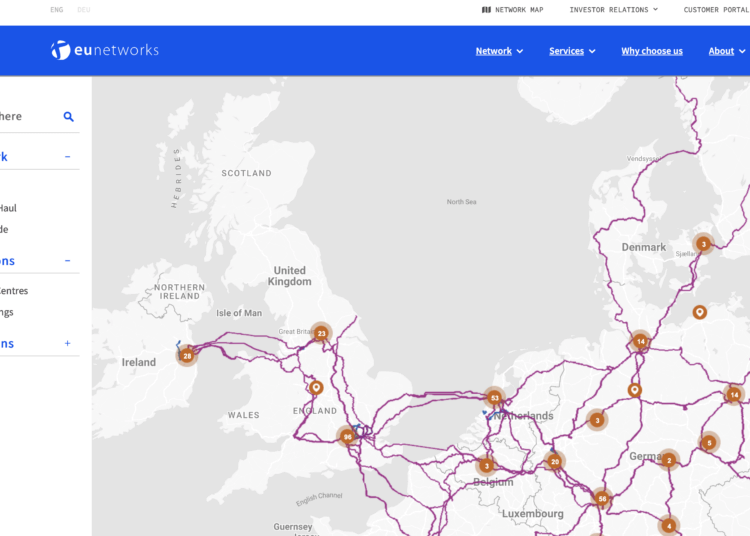
euNetworks deploys 40km hollowcore fibre system

euNetworks has deployed an additional 26km of hollowcore fibre cable between Basildon and London. This is connected to the 14km of hollowcore fibre cable deployed in September 2022. 

euNetworks now offers an end-to-end hollowcore fibre route from Basildon to The London Stock Exchange in London, delivering another global first with a 40km total system distance with no mid-span amplification. 

euNetworks has already successfully deployed three hollowcore fibre-based routes and is committed to augmenting its leading position across major trading routes, delivering the best available latencies in the market. Future deployments will target further ultra low latency metropolitan and long haul routes across Europe to support euNetworks’ high frequency trading (HFT) customers.

“We continue to be focused on delivering the best possible bandwidth solutions for our customers and look forward to deploying longer routes of hollowcore fibre in the coming quarters,” said Paula Cogan, Chief Executive Officer of euNetworks. “We have great teams focused on deploying this product on our network to maintain market-leading latency margins in our euTrade services.”

https://eunetworks.com/news/eunetworks-deploys-a-40km-hollowcore-fibre-system-with-no-mid-span-amplification/

Researchers develop photonic circuit in lithium niobate

Researchers led by Cristina Benea-Chelmus in the Laboratory of Hybrid Photonics (HYLAB) in EPFL’s School of Engineering, ETH Zurich and Harvard University are testing a new thin-film circuit that, when connected to a laser beam, produces finely tailorable terahertz-frequency waves.

The integrated photonic circuit chip is made of lithium niobate.


https://actu.epfl.ch/news/integrated-photonic-circuits-could-help-close-the-/

NTIA to allocate BEAD funding by June 30

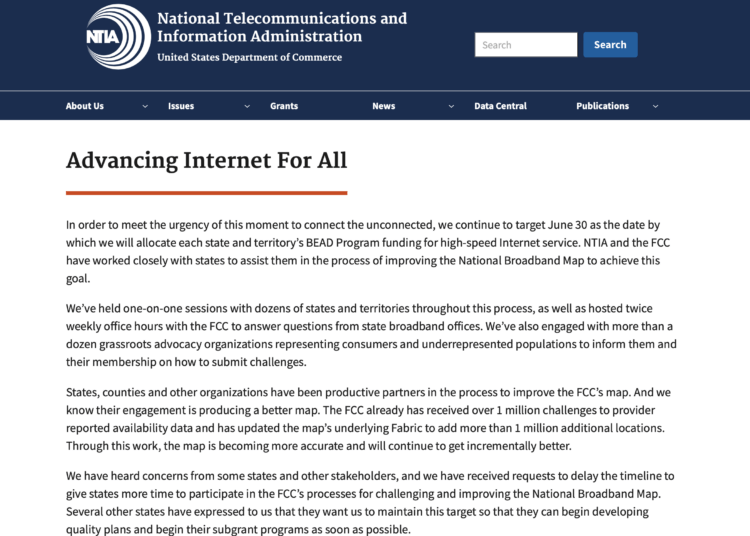
The National Telecommunications and Information Administration (NTIA) has set June 30 as the date by which it will allocate each state and territory’s BEAD Program funding for high-speed Internet service. 

NTIA said it has engaged with dozens of states and territories to assist them in the process of improving the FCC's National Broadband Map. 

The FCC already has received over 1 million challenges to provider reported availability data and has updated the map’s underlying Fabric to add more than 1 million additional locations. 

"We have heard concerns from some states and other stakeholders, and we have received requests to delay the timeline to give states more time to participate in the FCC’s processes for challenging and improving the National Broadband Map. Several other states have expressed to us that they want us to maintain this target so that they can begin developing quality plans and begin their subgrant programs as soon as possible.

Unfortunately, a delay in the timeline would mean a delay in providing funding to communities who desperately need it, and it will not address many of the process concerns we have heard."

https://ntia.gov/blog/2023/advancing-internet-all

Taiwan's Far EasTone delivers 5G slice to police cars

Far EasTone, a mobile operator in Taiwan, has delivered a 5G Smart Patrol Car solution for the Kaohsiung City police department to support license plate recognition for tracking stolen cars.

The solution leverages Ericsson’s end-to-end 5G network slicing technology, including 5G Core and RAN Slicing utilizing Dynamic Radio Resource Partitioning in a live 5G Standalone (SA) network. The pioneering use case demonstrates advanced 5G capability to enable mission-critical applications for the public sector, marking another milestone in the two companies’ 20 years of strategic partnership.

With high data throughput and low latency guaranteed by Ericsson’s end-to-end 5G network slicing technology, the data from moving patrol cars can be transmitted in real-time, allowing for the immediate recognition of these license plates being sighted by the device. 

As police patrol cars will be constantly on the move, Ericsson’s Dynamic Radio Resource Partitioning, a feature of 5G RAN Slicing, plays an essential role in the solution by optimizing radio resources, strengthening end-to-end slicing capabilities for dynamic resource management, and orchestration while securing required performance level for multiple services.

In addition, the 5G Smart Patrol Car solution uses Ericsson Local Packet Gateway, an edge user plane with small footprint, to connect each equipped car to a regional site for each city for data processing without installing a system on every single car. 

Chee Ching, President of Far EasTone Telecommunications, says: “We are thrilled to achieve another 5G milestone with Ericsson by creating the very first network slicing use case in a live 5G standalone network in Taiwan. The 5G Smart Patrol Car is made possible by our continuous investment in big data, AI and IoT, combining with Ericsson top-notch 5G technology and the great support from Kaohsiung City Police Department. ”

David Chou, President of Ericsson Taiwan, says: “Network slicing enables communications service providers to offer innovative services to enter new markets. By creating and operating end-to-end logical networks on top of a shared infrastructure, network slicing can provide tailored services with different requirements on speed, latency and reliability for various use cases, with its full potential only made possible through 5G Standalone. We expect this collaboration will simplify the 5G Smart Patrol Car setup and provide ease of maintenance and operations. Ericsson’s network slicing technology addresses further 5G business opportunities with full flexibility.”

https://www.ericsson.com/en/press-releases/2/2023/1/fet-5g-smart-patrol-in-kaohsiung

Tech Mahindra open delivery center in Mexico for Google Cloud

Tech Mahindra has opened a delivery center for Google Cloud in Guadalajara, Mexico. The center will be dedicated to Google Cloud-centric solutions that enable customers to modernize infrastructure and manage workloads with differentiated accelerators, Cloud Native and Open-Source technologies.

The partnership will leverage the expertise of both organizations in the domains, including the Google Cloud Platform on Anthos, Data and Analytics, Artificial Intelligence (AI), Machine Learning (ML), and more. The center will empower customers across the Americas to accelerate cloud adoption by leveraging hundreds of Google Cloud Certified engineers. 

Sudhir Nair, Chief Delivery Officer & Global Head – Infra & Cloud Business at Tech Mahindra, said, “Guadalajara has a booming technology ecosystem and produces most of the IT engineers in Mexico. Therefore, it is ideal for us to open our innovative delivery center for Google Cloud in the region. The new center is a strategic step forward in our partnership with Google to further enable our customers accelerate their digital transformation journey with faster migration, and optimized business outcomes. As part of Tech Mahindra’s CLOUDNXT.NOW™ framework, we are committed to providing our customers with modern IT infrastructure to adopt a ‘business first’ approach and be future ready.”

Victor Morales, Vice President, Global System Integrators Partnerships, Google Cloud, said, “We're proud to work in partnership with Tech Mahindra and help enable more customers with access to the technologies and expertise needed to simplify their migration to the cloud and unlock new opportunities for growth as they digitally transform for the future.”

http://www.techmahindra.com

Friday, January 13, 2023

Megaport demos quantum-secure transmission with Qrypt

Megaport has demonstrated the  ability to transmit data using quantum-secure methods powered by quantum key generation technology from Qrypt, a start-up based in New York City.

In the demo file-sharing applications were launched across several global data centers, including AWS in San Francisco, Azure US East in Virginia, and Google Cloud in Tokyo, using Megaport's Network-as-a-Service platform. 

“Demonstrating quantum-secure connectivity across regions and services is just another example of how Megaport is the best place to network for the most sensitive workloads in the cloud,” said Jim Brinksma, CTO of Megaport. “Megaport is always deepening its understanding of the cybersecurity challenges institutions will face for their most demanding, mission-critical applications.”

“Qrypt is dedicated to securing the world’s data and privacy,” said Denis Mandich, CTO of Qrypt. “With this deployment we demonstrate that you can not only gain quantum security fast, but you can start today and eliminate risk now.”

https://www.qrypt.com/about-us/

https://www.megaport.com


Coherent hires Dr. Beck Mason to head telecom business unit

Coherent Corp. appointed Dr. Beck Mason as Executive Vice President, Telecommunications. 

Dr. Mason will lead the Telecommunications Business Unit within the Networking Segment. He will have oversight of Coherent’s broad technology and product portfolio for optical communications in transport and access networks, from components to integrated modules and disaggregated subsystems.

Dr. Mason joins Coherent from Lumentum, where he was Senior Vice President and General Manager of the Telecom Transmission business and helped to guide their technology strategy for the past four years. He joined Lumentum in 2018 through the acquisition of Oclaro, where he was president of the Integrated Photonics business. Prior to Oclaro, Dr. Mason held leadership positions at JDSU, Collinear, Finisar, Agere Systems, and Lucent Technologies Bell Labs. He holds a bachelor’s degree in Engineering from the University of Waterloo in Canada, a master’s in Aerospace Engineering from the University of Toronto, and a Ph.D. in Electrical and Computer Engineering from the University of California at Santa Barbara.

Coherent's telecom product portfolio includes its wavelength-tunable pluggable transceivers, high-speed coherent pluggable transceivers, wavelength selective switch (WSS) modules, pump lasers, optical amplifiers, optical monitoring, and ROADM solutions.

“We are excited to welcome Dr. Mason to Coherent,” said Dr. Vincent D. Mattera, Jr., Chair and CEO. “In this position, Dr. Mason will identify the technology vision for Coherent’s telecom product offerings, play an integral role in defining the company’s technology platforms and strategic investments, and drive the profitable growth of the telecom business in the communications markets that we serve.”


Thursday, January 12, 2023

Asia Direct Cable lands in Hong Kong

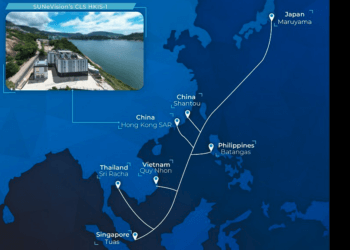
China Telecom Global Limited (CTG)confirmed that the Asia Direct Cable (ADC) has officially landed its Hong Kong segment at SUNeVision's HKIS-1 located at Chung Hom Kok. SUNeVision is the number one data centre provider and connectivity hub in Hong Kong.

With multiple fiber pairs, the ADC subsea cable system has a design capacity of over 140 Tbps. The  system serves as a significant infrastructure linkage for Hong Kong, mainland China to/from key information hubs along the East and Southeast Asia. 

SUNeVision's carrier-neutral cable landing station HKIS-1 was built with data centre capabilities certified by ANSI/TIA-942 and direct backhaul access to MEGA Campus including MEGA-i. Interconnecting with MEGA-i, which is home to around 15,000 cross-connects and 9 out of 11 City PoPs of international subsea cables in Hong Kong, users of ADC Hong Kong segment either via CLS or City PoP at MEGA Plus can enjoy one-stop-shop connectivity and interconnect with hundreds of providers through SUNeVision's rich data centre ecosystem with high reliability and efficiency. 

Xiaolei Wu, Executive Vice President of CTG said, "In a rising era of digital business, we are witnessing exponential urgency from organisations in Asia-Pacific looking to proactively fast-track their journey of digital transformation to ensure leading positions in their respective industries. This has led to a massive flow of new data that has been generated across the region as a direct result of a rapid race towards digitalisation. "

Raymond Tong, Chief Executive Officer of SUNeVision said, "Hong Kong maintains as a strategic connectivity hub intersecting with international submarine cable system and domestic land cables in mainland China. Landing ADC Hong Kong segment at the only carrier and cloud-neutral cable landing station in Hong Kong, SUNeVisions's HKIS-1, plus a new City PoP at MEGA Plus, would provide unique neutrality and true connectivity advantages that no other facilities in the region can. We are glad to jointly announce this with CTG and look forward to more win-win collaboration to foster digital business for joint customers in Hong Kong, mainland China to other markets rapidly growing in Asia and the globe."

Asia Direct Cable Consortium plans 140 Tbps system

The Asia Direct Cable (ADC) Consortium has selected NEC to build a submarine cable connecting China (Hong Kong SAR and Guangdong Province), Japan, the Philippines, Singapore, Thailand and Vietnam. The 9,400-kilometer long ADC cable, which is expected to be completed by the fourth quarter of 2022, will offer multiple pairs of high capacity optical fibers and is designed to carry more than 140 Tbps of traffic, enabling high capacity transmission of...