Thursday, June 27, 2024

Nokia to acquire Infinera for $2.3 billion

Nokia has agreed to acquire Infinera for $6.65 per share, representing an enterprise value of US$ 2.3 billion and a premium of 28% to Infinera’s share price at the close of 26 June 2024.

The combined entity will benefit from substantial in-house capabilities, including an expanded digital signal processor (DSP) development team and expertise in silicon photonics and indium phosphide-based semiconductor material sciences. Additionally, the merger will deepen Nokia’s competency in photonic integrated circuit (PIC) technology.

The merger will also strengthen Nokia’s presence in the North American optical market, an area where the two companies have minimal customer overlap. Infinera, which has established a solid foothold in North America with approximately 60% of its sales, will enhance Nokia’s optical scale in the region. This complements Nokia’s strong market positions in APAC, EMEA, and Latin America. The combination builds on Nokia’s commitment to US-based manufacturing and advanced testing and packaging capabilities.

The companies cited increased scale and profitability as driving factors for the merger.

Key benefits listed by Nokia

  • Enhanced Global Scale: Increases Nokia’s Optical Networks business by 75%.
  • Advanced Capabilities: Expanded DSP development, silicon photonics expertise, and PIC technology.
  • North American Market Growth: Strengthens position with Infinera’s established presence.
  • Enterprise and Webscale Expansion: Accelerates growth in the enterprise sector and webscale market, leveraging Infinera’s 30% sales in this segment and recent advancements in high-speed, low-power optical components.

Nokia said the deal will strengthen its leadership in optical and increase exposure to webscale customers, the fastest growing segment of the market. The combination with Infinera is projected to accelerate Nokia’s journey to a double-digit operating margin in its Optical Networks business. Nokia targets to achieve EUR 200 million of net comparable operating profit synergies by 2027. This transaction along with the recently announced sale of Submarine Networks will create a reshaped Network Infrastructure built on three strong pillars of Fixed Networks, IP Networks and Optical Networks. Nokia targets mid-single digit organic growth for the overall Network Infrastructure business and to improve its operating margin to mid-to-high teens level.

Under the deal, for each Infinera share, Infinera shareholders will be able to elect to receive either: 1) $6.65 cash, 2) 1.7896 Nokia shares, or 3) a combination of $4.66 in cash and 0.5355 Nokia shares for each Infinera share. All Nokia shares will be issued in the form of American Depositary Shares. The definitive agreement includes a proration mechanism so that the Nokia shares issued in the transaction do not exceed an amount equal to approximately 30% of the aggregate consideration that may be paid to Infinera shareholders.

Pekka Lundmark, President and CEO of Nokia, said: “In 2021 we increased our organic investment in Optical Networks with a view to improving our competitiveness. That decision has paid off and has delivered improved customer recognition, strong sales growth and increased profitability. We believe now is the right time to take a compelling inorganic step to further expand Nokia’s scale in optical networks. The combined businesses have a strong strategic fit given their highly complementary customer, geographic and technology profiles. With the opportunity to deliver over 10% comparable EPS accretion, we believe this will create significant value for shareholders.”

Federico Guillén, President of Network Infrastructure at Nokia, said: “Today, Network Infrastructure offers a unique portfolio across the fixed access, optical and IP networks domains built on leading technology innovation and a strong customer focus. This acquisition will further strengthen the optical pillar of our business, expand our growth opportunities across all our target customer segments and improve our operating margin. I am extremely pleased that we are bringing together these two talented and dedicated teams. Separately, we have long respected each other as competitors. Together, we find the logic of combination irresistible.”

David Heard, CEO of Infinera, said: “We are really excited about the value this combination will bring to our global customers. We believe Nokia is an excellent partner and together we will have greater scale and deeper resources to set the pace of innovation and address rapidly changing customer needs at a time when optics are more important than ever – across telecom networks, inter-data center applications, and now inside the data center. This combination will further leverage our vertically integrated optical semiconductor technologies. Furthermore, our stakeholders will have the opportunity to participate in the upside of a global leader in optical networking solutions.”


https://www.nokia.com/about-us/news/releases/2024/06/27/inside-information-nokia-to-acquire-infinera-to-increase-scale-in-optical-networks-and-accelerate-product-roadmap/

Nokia to sell Submarine Networks business to French State

In a strategic move to streamline its portfolio, Nokia has announced plans to sell Alcatel Submarine Networks (ASN) to the French government. The telecommunications giant will initially retain a 20% stake in the company, with the intention of a full exit in the future. This decision aligns with Nokia's focus on core markets and its goal to improve profitability in its Network Infrastructure business group.

The proposed sale, which is subject to employee consultation and regulatory approvals, is expected to close by late 2024 or early 2025. The French State, represented by the Agence des participations de l'Etat (APE), has been deemed the most suitable custodian for ASN, given its long-term interest in critical infrastructure operations and maintenance. This move is anticipated to ensure continuity for ASN's customers, employees, and partners.

Following the divestment, Nokia's Network Infrastructure Business Group will be restructured to comprise three units: Fixed Networks, IP Networks, and Optical Networks. While this reorganization is projected to reduce the group's net sales by approximately €1 billion, it is expected to boost its operating profit margin by 100-150 basis points. Nokia has stated that this transaction will not affect its previously announced financial outlook for 2024.

Key points:

  • Nokia to sell ASN to the French government, retaining a 20% stake initially
  • Sale aligns with Nokia's strategy to focus on core markets and improve profitability
  • Transaction expected to close by late 2024 or early 2025, subject to approvals
  • Nokia's Network Infrastructure group to be restructured into three units
  • Deal expected to reduce net sales but increase operating profit margin

Pekka Lundmark, President and CEO of Nokia, said: “This is a good step forward in our strategy of actively managing our portfolio. ASN has been a standalone part of our Network Infrastructure business and through the divestment, Network Infrastructure will benefit from a streamlined portfolio with a focus on growth and strengthening its technology leadership. ASN has gone through a significant transformation in recent years and has a strong market position. I am pleased we have found a natural owner for the business. The French State will ensure continued investment in ASN and protection of critical industry know-how.” 

 Alain Biston, President and CEO of ASN, said: “This is an incredibly exciting moment for ASN as we undertake the next phase of our development. The French State’s ownership gives us a stable platform to further develop our vertically integrated technology offering. This, combined with Nokia’s retained stake, underscores all parties’ aligned interests in delivering a smooth transition for the benefit of our customers, suppliers and other stakeholders.” 

 Bruno Le Maire, French Minister of Economy, said: “The French State, represented by the Agence des Participations de l’Etat (French shareholding Agency), is thrilled to announce its willingness to acquire 80% shareholding of ASN. The Company is one of the world leaders in the submarine cable market, and the only company of its kind in Europe.”

https://www.nokia.com/about-us/news/releases/2024/06/27/nokia-enters-into-an-agreement-with-the-french-state-regarding-the-sale-of-leading-submarine-networks-business-asn/


  • Alcatel Submarine Networks (ASN) has a rich history dating back to the first submarine cables for telegraphs in the 1860s and 1870s. 
  • Over the decades, through various mergers and acquisitions, ASN has evolved into a global leader in undersea communication networks.
  • In recent years, ASN has been at the forefront of major submarine cable projects worldwide. One of its most notable achievements is the SEA-ME-WE 5 (South East Asia-Middle East-Western Europe 5) cable system, completed in 2016. This 20,000-kilometer cable connects Southeast Asia to Europe, enhancing connectivity across 17 countries. Another significant project is the Dunant cable, a joint venture with Google, stretching 6,600 kilometers across the Atlantic Ocean between Virginia Beach in the United States and Saint-Hilaire-de-Riez in France.
  • ASN has also been instrumental in developing innovative technologies for the submarine cable industry. The company has pioneered advancements in fiber optic technology, amplification systems, and cable protection methods. Its contributions have been crucial in meeting the ever-increasing demand for global data transmission capacity, supporting the growth of internet usage, cloud computing, and international telecommunications.
Timeline
  • 1923: Submarine Telegraph Company (STC) is founded in Paris, France, to lay underwater cables for telecommunications.

  • 1954: STC merges with Compagnie Française de Télécommunications (CFT) to form Compagnie Générale de Télécommunications (CGT).
  • 1969: CGT creates a dedicated submarine cable manufacturing division, which becomes known as Submarine Systems (SS).
  • 1985: Alcatel is formed through the merger of CGT and ITT Corporation's European telecom activities.
  • 1987: Alcatel acquires Submarine Systems (SS) and renames it Alcatel Submarine Networks (ASN).
  • 1990s: ASN becomes a leading player in the submarine cable industry, providing turnkey solutions for fiber-optic cable systems.
  • 1998: Alcatel acquires Vitrove, a French fiber-optic component manufacturer, and incorporates its technology into ASN's products.
  • Early 2000s: ASN faces increased competition from other telecom equipment manufacturers, including Huawei.
  • 2006: Alcatel merges with Lucent Technologies to form Alcatel-Lucent.
  • 2013: Nokia acquires Alcatel-Lucent, including ASN, and merges it with its own submarine cable business.

Marvell debuts 1.6T PAM4 DSP for active electrical cables

Marvell introduced a high-performance, 1.6T PAM4 DSP for active electrical cables (AECs) designed for the greater connectivity bandwidth requirements between AI accelerators, server to top-of-rack links and switch-to-switch interconnects within data center racks..s

The new Marvell Alaska A 1.6T DSP, which leverages 5nm process technology and over a decade of Marvell PAM4 leadershio, features eight 200 Gbps SerDes lanes to the host device and eight 200 Gbps SerDes lanes to the copper cable. The industry-leading equalization engine built into the Alaska A 1.6T DSP enables cable reaches of greater than three meters, addressing the reach requirements for inside-the-rack copper connections. The Alaska A 1.6T DSP is designed for next-generation accelerated infrastructure with 200 Gbps I/O interfaces on AI accelerators, GPUs, NICs and switches.

Key features of the Alaska A 1.6T AEC DSP include:

  • Proven DSP-based 200G PAM4 SerDes
  • Advanced digital equalizer with Feed Forward (FFE), Decision Feedback (DFE) and Maximum Likelihood Sequence Detection (MLSD)
  • Greater than 3-meter reach at 200G/lane
  • 200 Gbps per lane electrical line-side interface
  • Optimized for QSFP-DD and OSFP form factors
  • Retiming and gearboxing support
  • Cable reference design for 1.6T AECs
  • SDK support for advanced telemetry and diagnostics


The new device has gained support from leading copper cable manufacturers, including Amphenol, Molex, and TE Connectivity.

Marvell says the traditional method of using direct attached cable (DAC) for short-reach copper connections between AI accelerators and other components in server racks is facing limitations as data speeds increase to 200G/lane. The use of passive DACs is becoming less viable due to the declining distance over which they can effectively operate. To address this, Active Electrical Cables (AECs) are emerging as a critical solution. AECs leverage PAM4 DSPs to retime signals, thereby extending the reach of copper interconnects and allowing for the use of thinner cables in high-density data center environments.

“The next wave of AI clusters will need 200 Gbps signaling to handle the bandwidth requirements of generative AI and large language models,” said Venu Balasubramonian, vice president of product marketing, Connectivity Business Unit, at Marvell. “The newest addition to our Alaska A product line extends our leadership in delivering PAM4 DSP technology for short-reach copper connectivity for cloud AI clusters.”

https://www.marvell.com/company/newsroom/marvell-extends-connectivity-leadership-industry-first-1-6t-pam4-dsp-active-electrical-cables.html

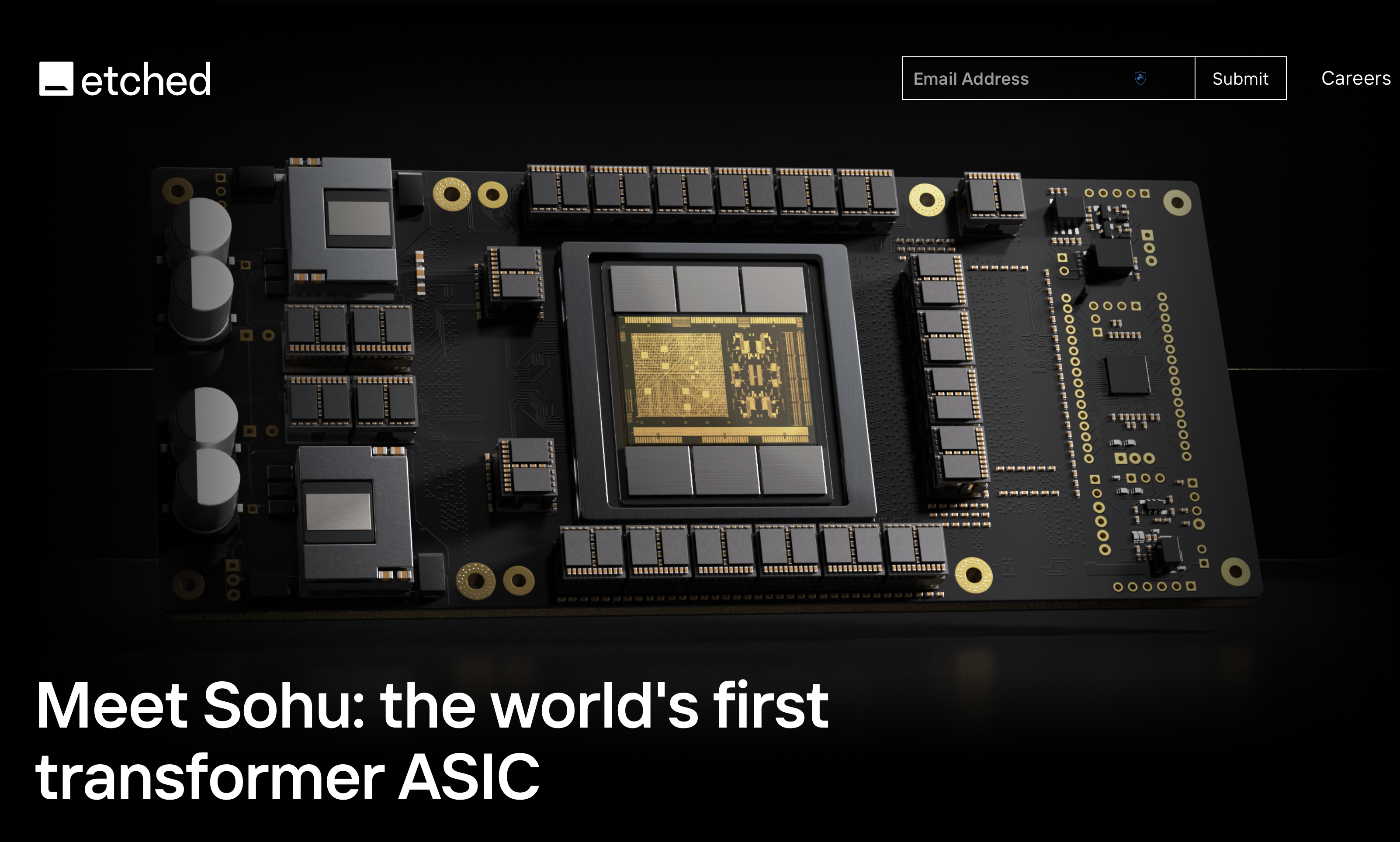
Etched.ai targets highest performance ASIC for AI transformers

Etched.ai, a start-up based in Cupertino, California, has introduced its Sohu ASIC, a specialized chip designed specifically for transformer architecture-based artificial intelligence models. According to the company, Sohu is capable of processing over 500,000 tokens per second in Llama 70B throughput, surpassing the performance of leading AI chips from Nvidia and other major players.

Key Points:

  • Sohu ASIC claims to be the fastest AI chip of all time
  • Processes over 500,000 tokens per second in Llama 70B throughput
  • Designed specifically for transformer architecture-based AI models, such as ChatGPT, SD3, and Sora
  • Partners with TSMC on 4nm process and secured HBM and server supply from top vendors
  • Raised $120M in funding from multiple investors, including Primary Venture Partners and Positive Sum
https://etched.ai

Google Cloud and Gulf Edge to offer sovereign cloud in Thailand

Google Cloud has entered a multi-year agreement with Gulf Edge Company to provide sovereign cloud services in Thailand. This partnership aims to support organizations in critical industries with their digital transformation efforts by leveraging advanced AI and analytics capabilities. The services will adhere to Thailand’s stringent data residency, security, and privacy requirements, ensuring data, operational, and software sovereignty for customers.

Key details of the collaboration include Gulf Edge’s authorization to operate Google Distributed Cloud (GDC) as a Managed GDC Provider (MGP), focusing on air-gapped configurations for Thai organisations. Deployment options will include GDC air-gapped on-premises or within Gulf Group data centers, offering flexible hardware choices to meet specific workload needs while ensuring compliance with local legal frameworks, such as the Personal Data Protection Act. Through GDC, organizations will access core features of Google Cloud’s Vertex AI, enabling the development and deployment of advanced ML and AI applications within Thailand. Additionally, customers can utilize Google Cloud’s hardware and software resources, including Google Kubernetes Engine (GKE), NVIDIA Tensor Core GPUs, AlloyDB Omni database engine, and Dataproc, in a secure, air-gapped environment.

Key Points:

  • Strategic Partnership: Google Cloud and Gulf Edge team up to deliver sovereign cloud services in Thailand.
  • Managed GDC Provider: Gulf Edge authorised to operate Google Distributed Cloud with a focus on air-gapped configurations.
  • Local Compliance: Solutions adhere to Thailand’s data residency, security, and privacy requirements, including the Personal Data Protection Act.
  • Advanced AI Capabilities: Access to Google Cloud’s Vertex AI for developing ML and AI applications.
  • Comprehensive Resources: Includes GKE, NVIDIA Tensor Core GPUs, AlloyDB Omni, and Dataproc in a secure environment.

Gulf Edge Company Limited is a subsidiary of Gulf Energy Development Public Company Limited, a prominent energy and infrastructure company based in Bangkok, Thailand. Gulf Energy Development is known for its extensive investments in power generation and infrastructure projects. 

Singtel and Hitachi Digital collaborate to 5G + AI

Singtel announced a new collaboration with Hitachi Digital, a provider of comprehensive digital transformation services and technologies. This partnership will combine Hitachi’s advanced AI expertise with Singtel’s Paragon platform, an integrated orchestration solution for 5G, edge computing, and cloud services.

In the initial phase, Hitachi Digital will deploy the Paragon platform at Hitachi Americas’ Santa Clara R&D Labs. This will be followed by a pilot project at a U.S. factory to explore Industry 4.0 use cases. The pilot aims to validate the interoperability of Hitachi’s AI applications, focusing on quality assurance, workplace safety, immersive training, and pre-emptive maintenance using the Paragon platform. Additionally, this trial will facilitate the integration of Paragon with Hitachi’s industry cloud applications and digital services, addressing the challenges of complex, low-latency connectivity and enhancing productivity.

Hitachi’s pre-built Industrial AI applications, combined with the Paragon platform’s network and multi-cloud orchestration capabilities, will enable the creation of various Paragon-related offerings. These solutions are designed to help clients improve and accelerate their cloud operations. Moving forward, Hitachi Digital Services will market these offerings as a Singtel Paragon authorized System Integrator, providing a unique value proposition to enterprise customers seeking to leverage multiple network protocols for digital transformation in industrial environments.

Key Points:

  • Strategic Collaboration: Singtel and Hitachi Digital join forces to integrate AI with 5G, edge computing, and cloud.
  • Pilot Project: Initial deployment at Hitachi’s Santa Clara R&D Labs, followed by a U.S. factory trial for Industry 4.0 applications.
  • Interoperability Testing: Focus on validating AI applications for quality assurance, safety, training, and maintenance.
  • Enhanced Offerings: Creation of new solutions to improve cloud operations and digital transformation in industrial settings.


América Móvil consolidates its share in Chile's ClaroVTR

América Móvil and Liberty Latin America confirmed that América Móvil will be consolidating ClaroVTR into its ongoing operations. 

ClaroVTR is a Chilean telecommunications company that operates under a joint venture of the Mexican telecommunications giant América Móvil and Liberty Latin America.

ClaroVTR was formed in 2000 through the merger of Chile's fourth and fifth largest telecommunications companies, VTR (owned by Telefónica) and Claro (owned by América Móvil).

In 2004, América Móvil acquired a majority stake in ClaroVTR, and since then, the company has expanded its services and network coverage across Chile.

In 2016, Liberty Latin America Limited, a publicly traded company listed on the NASDAQ stock exchange, acquired a 20% stake in ClaroVTR from América Móvil for approximately $800 million. As of 2022, ClaroVTR has around 1.3 million subscribers across Chile.

In a press release, América Móvil said it has been providing fundingto ClaroVTR through convertible notes to support the execution of its business plan and for the refinancing of certain bank debt existing at the formation of the JV. Liberty Latin America had the right to catch-up its respective portion of such funding commitments by the middle of this year for ClaroVTR to continue as a 50:50 joint venture.

On June 23, 2024, Liberty Latin America informed América Móvil it would not be exercising such right. As a result, AMX will convert its outstanding notes held in ClaroVTR into equity resulting (subject to adjustments at closing) in a controlling interest of approximately 91%. LLA will continue to own approximately 9% of the equity of ClaroVTR (subject to final adjustments at closing). 


Wednesday, June 26, 2024

Intel highlights 4 Tbps optical compute interconnect chiplet

Intel announced an integrated optical compute interconnect (OCI) chiplet co-packaged with an Intel CPU, representing a leap forward in high-bandwidth interconnect by enabling co-packaged optical input/output (I/O) in emerging AI infrastructure. 

The prototype chiplet was demonstrated earlier this year at OFC 2024 (see video below).

The fully Integrated OCI chiplet leverages Intel’s field-proven silicon photonics technology and integrates a silicon photonics integrated circuit (PIC), which includes on-chip lasers and optical amplifiers, with an electrical IC. The OCI chiplet demonstrated at OFC was co-packaged with an Intel CPU but can also be integrated with next-generation CPUs, GPUs, IPUs and other system-on-chips (SoCs).

This first OCI implementation supports up to 4 terabits per second (Tbps) bidirectional data transfer, compatible with peripheral component interconnect express (PCIe) Gen5. The live optical link demonstration showcases a transmitter (Tx) and receiver (Rx) connection between two CPU platforms over a single-mode fiber (SMF) patch cord. The CPUs generated and measured the optical Bit Error Rate (BER), and the demo showcases the Tx optical spectrum with 8 wavelengths at 200 gigahertz (GHz) spacing on a single fiber, along with a 32 Gbps Tx eye diagram illustrating strong signal quality.

The current chiplet supports 64 channels of 32 Gbps data in each direction up to 100 meters (though practical applications may be limited to tens of meters due to time-of-flight latency), utilizing eight fiber pairs, each carrying eight DWDM wavelengths. In terms of energy efficiency, the co-packaged solution consumes only 5 pico-Joules (pJ) per bit compared to pluggable optical transceiver modules at about 15 pJ/bit. 

Key features of Intel's OCI chiplet include:

  • Fully integrated die stack, consisting of a single Intel® Silicon Photonics Integrated Circuit (PIC) with on-chip DWDM lasers and SOAs, and an advanced node CMOS electrical integrated circuit (EIC) with all the electronic devices required to form a complete optical I/O subsystem. No external laser source or optical amplification is required.
  • The first-generation chiplet supports 4 Tbps bidirectionally, with a roadmap to tens of Terabits per second per device.
  • Works over standard single-mode fiber (SMF-28). No polarization-maintaining fiber (PMF) is required.
  • A path to incorporate a detachable optical connector.
  • Designed to be co-packaged with next-generation CPU, GPU, IPU, and other SOCs. Stand-alone on-board implementations can also be supported.
  • Chiplet-level evaluation platforms to be available.
  • Based on the field-proven Intel Silicon Photonics platform, which has already shipped more than 8 million PICs with over 32 million on-chip lasers embedded in pluggable optical transceivers for data center networking, with industry-leading reliability.

“The ever-increasing movement of data from server to server is straining the capabilities of today’s data center infrastructure, and current solutions are rapidly approaching the practical limits of electrical I/O performance. However, Intel’s groundbreaking achievement empowers customers to seamlessly integrate co-packaged silicon photonics interconnect solutions into next-generation compute systems. Our OCI chiplet boosts bandwidth, reduces power consumption and increases reach, enabling ML workload acceleration that promises to revolutionize high-performance AI infrastructure,” stated Thomas Liljeberg, senior director, Product Management and Strategy, Integrated Photonics Solutions (IPS) Group.

https://www.intel.com/content/www/us/en/products/details/network-io/silicon-photonics.html

#OFC24: Intel's Optical I/O Chiplet Co-Packaged with Server CPU

At #OFC24, Intel demonstrated an advanced Optical Compute Interconnect (OCI) chiplet co-packaged with a prototype of a next-generation Intel CPU.

The OCI chiplet contains a single Silicon Photonics Integrated Circuit (PIC) with integrated lasers, an electrical IC with RF Through-Silicon-Vias (TSV), and a path to incorporate a detachable/re-usable optical connector.  The 4 Tbps bidirectional chiplet is compatible with PCIe Gen5, supporting 64 lanes of 32 Gbps data in each direction over 10’s of meters, realized as eight fiber pairs each carrying eight DWDM wavelengths.

Christian Urricariet, Senior Director of Product Marketing, from Intel's Silicon Photonics Products Division explains:

- Intel demoed its first Optical Compute Interconnect(OCI) chiplet, a high-density optical interconnect solution for compute elements like CPU or GPU clusters.

- The capabilities of the OCI chiplet, which can support up to 4 terabits per second bi-directionally, and its integration with next-generation Intel CPUs.

- The performance of the OCI technology, showcasing its ability to run over standard, widely deployed single-mode fiber (SMF-28), without requiring Polarization Maintaining Fiber (PMF) like other technical approaches in the market.

https://youtu.be/xYmiAS5zoFE

See Intel's blog on this topic:


undefined

Zayo selected for Nevada's Middle Mile project

The State of Nevada has awarded $153 million grant to Zayo to build, operate, maintain, and commercialize the state’s new Middle Mile Network project. 

Zayo will construct over 800 miles of the open-access, fiber optic network backed by funding from the National Telecommunications and Information Administration (NTIA) and the Office of Science, Innovation, and Technology (OSIT) to provide robust broadband access to unserved and underserved communities with routes through Reno and Las Vegas.

Project overview: 

The project encompasses two major routes:

  • The US 93 Route through Las Vegas with an investment of $43.5 million from the NTIA Middle Mile Grant Program and $43.5 million funded by the Nevada Department of Transportation. 
  • The I-80 Route through Reno with an investment of over $66 million funded by the Department of Treasury Capital Project Funds and the State of Nevada. 

The routes will connect over 40,000 unserved or underserved locations, including households, schools, libraries, community buildings and more. 

Zayo said the new routes will be built with its new Digital Equity Access Network (DEAN) architecture which enhances rural connectivity by lowering the barrier to entry for rural ISPs to build last-mile infrastructure by providing pre-provisioned, dedicated fiber backhaul and competitive IP pricing that matches metro market rates. The new architecture includes multiple interconnection points pre-built into the network, making connecting to our middle-mile more affordable for ISPs.  

Zayo also notes that this public-private partnership with the State of Nevada enables unique revenue-sharing opportunities that would not otherwise be available, enabling Zayo to operate, maintain, and commercialize the route to ensure the long-term sustainability and economic viability of the project. 

“Lack of reliable internet access puts communities and businesses at a severe disadvantage when it comes to entrepreneurship, employment, healthcare and education. Zayo’s work in the Nevada Middle-Mile project will help bridge the digital divide in these underserved areas,” said Bill Long, Chief Product & Strategy Officer at Zayo. “In addition, as Reno and Las Vegas emerge as major data center hubs, these two new routes will also enhance connectivity in these areas to support increased bandwidth needs. Together, the project will support profound societal and economic transformation for the State of Nevada.”

undefined

Türk Telekom carries 800Gbps over 2300km with Nokia

Türk Telekom International (TTI) used Nokia’s sixth generation of super-coherent Photonic Service Engine (PSE-6s) technology to transmit an 800 Gbps single wavelength over 2,300 km -- a new distance record according to the companies.

The real-world field trial took place on a highly loaded commercial network with no regeneration on C+L band WDM infrastructure.

The two companies also conducted real-world demonstrations on similarly highly-loaded links delivering 700 Gbps single wavelength transmission over 2500km and 600 Gbps over 4100km. They were performed with no regeneration and with traffic loads near 95% of the maximum WDM capacity of the network, further highlighting the scale and performance of Nokia’s optical network solutions.

The companies said the field trial successfully achieved its main target: avoiding regeneration on routes between Turkey and Frankfurt with significantly higher line rates than 200Gbps and 300Gbps that are used today.

Zekeriya Erkan, Chief Technology Officer at TTI, said: “Our main target was to avoid regeneration between Turkey and Frankfurt with highly efficient lambdas for transporting aggregated 100GE and 400GE services. We were pleased to validate that the capabilities of the PSE-6S-based transponder on our existing C+L infrastructure allowed us to go beyond our goal and grow the wavelengths from 200/300Gbps to 600/700/800Gbps, thus scaling the overall bandwidth on a brownfield network. These are truly groundbreaking results that will allow us to offer more efficient services, reduced cost and greener transport to our customers.”

James Watt, Senior Vice President and General Manager of Optical at Nokia, said: “Faster, greener, more efficient.  This new industry benchmark of 800Gbps over 2,300 kilometers ticks all the boxes for organizations needing to transmit data at immense scale, over long distances, fast and with the minimum energy use.  In Türk Telekom, we have a partner who is ready to set the bar extremely high and help us push the limits of optical technology.  It’s gratifying to reach this important milestone together.”

https://www.nokia.com/about-us/news/releases/2024/06/26/nokia-and-turk-telekom-international-smash-800gbps-transmission-world-record-on-long-haul-commercial-network/

undefined

Nokia teams with Google Cloud on telco APIs

Nokia is collaborating with Google Cloud to enhance 5G enterprise and consumer applications through telco infrastructure. This partnership will leverage Nokia's Network as Code platform, which will run on Google Cloud, integrating Google Cloud's data and generative AI solutions, including Vertex AI and Gemini 1.5 Pro. This integration aims to improve the developer experience by providing AI capabilities and coding assistance tools, thereby boosting productivity.

The collaboration will initially focus on healthcare, aiming to deliver better and safer customer experiences. Google Cloud’s extensive developer community, spanning various industries and geographies, will gain access to standardized 5G network capabilities worldwide through Nokia's platform. This will equip developers with the necessary tools to swiftly create new applications for their customers. Since its launch in September 2023, Nokia's Network as Code platform has signed collaboration agreements with 13 network operators and ecosystem partners across Europe, North America, and South America.

Key Points:

  • Nokia and Google Cloud partner to enhance 5G applications via telco infrastructure.
  • Nokia's Network as Code platform integrates Google Cloud's AI solutions to improve developer productivity.
  • Initial focus on healthcare to enhance customer experiences.
  • Google Cloud’s developer community will access global standardized 5G network capabilities.
  • Nokia's platform has secured 13 collaboration agreements since its launch in September 2023.

undefined

Dell'Oro: campus Ethernet switch revenues dropped in Q1

Worldwide Campus Switch revenues dropped by 23 percent year-over-year (Y/Y) during the first quarter of 2024, according to a new report from Dell'Oro Group.  The only two vendors that grew Campus Switch revenues Y/Y in 1Q 2024 were Arista and Ubiquiti.

“Vendor backlogs of campus switch orders have now been completely run down, and the market is in a multi-quarter digestion cycle,” said Siân Morgan, Research Director at Dell’Oro Group. “The shipments of most port speeds declined, and the Average Sales Price (ASP) also dropped on a Y/Y basis.

“However, in 1Q 2024, Arista had its third sequential quarter of share gain, growing Campus Switch sales to large enterprises. Meanwhile, Cisco’s Campus Switch shipments contracted sharply.  This reduction contrasts with their shipments in 2023, when Cisco opened the “floodgate” for Catalyst and Meraki port shipments which had been on backorder,” added Morgan.

Additional highlights from the 1Q 2024 Ethernet Switch – Campus Report:

  • The contraction in campus switch sales was broad-based across all regions, with the exception of CALA.
  • Some vendors bucked the price trend and were able to grow port ASPs thanks to richer product mixes.
  • 5/5.0 Gbps switch ports are expected to return to growth as shipments of Wi-Fi 7 Access Points accelerate.

https://www.delloro.com/news/campus-ethernet-switch-revenues-crash-to-a-two-year-low-in-1q-2024/

NTT DATA and Zebra partner on 5G device ecosystem

NTT DATA has announced a strategic partnership with Zebra Technologies aimed at accelerating innovation within the 5G device ecosystem. The collaboration focuses on the development of devices designed for intelligent asset tracking and real-time monitoring in industrial and enterprise environments. These advancements are expected to significantly improve visibility, efficiency, and security in Industry 4.0 supply chain management.

A key aspect of this partnership addresses the limited availability of 5G devices for enterprises, which has been a barrier to the adoption of Private 5G networks. By combining their expertise, NTT DATA and Zebra Technologies plan to bridge this gap, with market analysts from Omdia predicting a 35% global growth in the enterprise Private 5G market, reaching nearly $10 billion by 2028. This partnership also establishes Zebra Technologies as a strategic partner in NTT DATA’s Device as a Service practice, facilitating easier access to 5G device lifecycle management and support for customers worldwide.

Key Points:

  • NTT DATA and Zebra Technologies partner to enhance the 5G device ecosystem.
  • The collaboration aims to improve asset tracking and real-time monitoring in industrial settings.
  • The partnership addresses the shortage of 5G devices for enterprises, critical for Private 5G adoption.
  • The enterprise Private 5G market is projected to grow by 35% globally, reaching nearly $10 billion by 2028.
  • Zebra Technologies joins NTT DATA’s Device as a Service practice, simplifying 5G device management for customers.


undefined

Tuesday, June 25, 2024

Cadence previews Janus Network-on-Chip interconnect tool

Cadence Design Systems introduced its Janus Network-on-Chip (NoC) technology for managing data delivery between silicon components in complex SoCs and disaggregated multi-chip systems. The Cadence Janus NoC manages these simultaneous high-speed communications efficiently with minimal latency, enabling customers to achieve their PPA targets faster and with lower risk.

The Cadence Janus NoC leverages Cadence's trusted Tensilica RTL generation tools and extensive software and hardware portfolio for simulation, emulation, and performance analysis. This flow enables architectural exploration, resulting in the best NoC design for product needs.

The Cadence Janus NoC addresses the routing congestion and timing issues common in complex SoC interconnects, often only apparent during physical implementation. As a first-generation NoC, it provides a platform for future innovations, including support for industry-standard memory and I/O coherence protocols.

Highlights

  • Easy to use: Cadence’s GUI enables easy NoC configuration ranging from small subsystems to full SoCs and future multi-chip systems.
  • Accelerated time to market: PPA-optimized RTL enables SoC designers to achieve their bandwidth and latency goals. Packetized messages enable higher utilization of wires, reducing wire count and timing closure challenges.
  • Lower risk: The NoC’s built-in power management, clock domain crossing and width matching reduce design complexity.
  • Quick turnaround: Cadence’s extensive simulation and emulation capabilities enable early architectural exploration, allowing quick validation of PPA results to ensure the configuration meets design requirements.
  • Scalable architecture: Customers can design a subsystem and reuse it in a full SoC context of the NoC, allowing future reuse in a multi-chip system.
  • Flexible: The NoC is compatible with any IP with an industry-standard interface, including AXI4 and AHB.

“Cadence is an established leader in IP and design quality, and we continue to invest in our foundational interface and processor IP, system IP, software and design services capabilities to enable our customers to develop differentiated and disaggregated designs,” said Boyd Phelps, senior vice president and general manager of the Silicon Solutions Group at Cadence. “The addition of the Cadence Janus NoC to our growing system IP portfolio is a key milestone in this strategy. Our evolution from an IP provider to an SoC design partner delivers greater value to our customers, empowering them to focus valuable engineering resources on differentiating their silicon.”


undefined

Telefónica and Nokia collaborate on 5G Standalone Network APIs

Telefónica and Nokia have announced an agreement to explore new opportunities for 5G Standalone (SA) network APIs, aimed at supporting developers in creating innovative use cases for consumer, enterprise, and industrial customers. As part of this collaboration, Telefónica will utilize Nokia's NEF (Network Exposure Function) solution to provide developers with access to its 5G network capabilities.

Nokia's NEF solution, based on 3GPP specifications, enables developers to interface with well-defined functions in the core network, combining multiple APIs from different core functions into a new customized API. This simplified approach allows developers to create new applications that leverage the operator's 5G network capabilities, such as precise device location, enhanced notifications, and edge discovery.

The collaboration also leverages Nokia's Network as Code platform, a unified ecosystem that connects networks, systems integrators, and software developers. This platform allows developers to easily integrate advanced 5G capabilities into their applications, without requiring in-depth knowledge of underlying network technologies. Since its launch in September 2023, Nokia has signed collaboration agreements with 14 network operators and ecosystem partners worldwide.

Highlights

  • Telefónica and Nokia are exploring the use of 5G Standalone (SA) network APIs to support developers in creating new use cases.
  • Nokia's NEF solution enables developers to access Telefónica's 5G network capabilities, such as precise device location and enhanced notifications.
  • The collaboration leverages Nokia's Network as Code platform, which provides a unified ecosystem for developers to integrate advanced 5G capabilities into their applications.
  • Nokia has signed agreements with 14 network operators and ecosystem partners worldwide since the launch of its Network as Code platform in September 2023.

Cayetano Carbajo Martin, Core & Transport Director, Global CTIO at Telefónica said: “We are pleased to take this step with Nokia in recognition of the tremendous opportunity we have to further empower developers with the tools they require to deliver new use cases and experiences for their customers and beyond. This partnering agreement is about steering the industry in building new APIs and more use cases over 5G SA capabilities that have been launched across Telefonica’s main operations.”

Shkumbin Hamiti, Head of Network Monetization Platform, Cloud and Network Services at Nokia said: “There continues to be a rising recognition that sustaining closed networks is a thing of the past and that embracing ecosystems is the way forward for deepening collaboration and creating new use cases; delivering better customer experiences; and generating new revenue opportunities. Our agreement with Telefónica is added proof of the much greater telco ecosystem openness that we are now seeing today and we look forward to jointly working to support developers in harnessing a broader array of network capabilities.” 

https://www.nokia.com/about-us/news/releases/2024/06/25/telefonica-and-nokia-sign-agreement-to-boost-adoption-of-network-apis-leveraging-5g-sa-capabilities/

  • The network API landscape is witnessing significant advancements, with major players like the Linux Foundation, GSMA, TM Forum, and MEF driving innovation and standardization. 
  • Recently, the Linux Foundation announced the availability of its LF Network API, a unified API framework that enables developers to access and manage network resources across different providers. TM Forum, a global industry organization, launched its APIs for Digital Services (DSS) initiative, focusing on creating standards-based APIs for service providers to expose their digital services to developers and businesses. Meanwhile, MEF is pushing forward with its LSO (Lifecycle Service Orchestration) initiative, aiming to create a standardized framework for network APIs that enables seamless service orchestration across different networks.
  • The GSMA is also actively involved in shaping the future of network APIs through its CAMARA (Common API for Mobile Applications and Services) project. CAMARA aims to define a set of common APIs that enable mobile operators to expose their network capabilities and services to third-party application developers, accelerating the development of innovative mobile services.The GSMA Open Gateway initiative launched with eight network APIs in 2023 and has since continued to expand. 

MEF State of the Industry Report: SASE

MEF published a report that explores multiple factors dramatically increasing the risk of major cyberattacks worldwide. 

“State of the Industry Report: SASE – Validating Cyber Defense in an Era of Unprecedented Threats” explains how enterprise networking and cybersecurity decisionmakers can utilize MEF standards-based SASE certification to choose the best solutions with validated cyber defense effectiveness and application performance. 

According to the report, many organizations are responding to today’s high-risk threat environment by prioritizing investment in SASE, a cloud-based cybersecurity model, to advance secure digital transformation. SASE solutions protect users, devices, and applications at scale regardless of their location, combining network connectivity via SD-WAN, cloud-based security including Zero Trust (ZT) and Security Service Edge (SSE), and subscriber policies, to provide a high level of application performance and a tightly integrated set of security capabilities.  

Key findings include: 

  • Industry Collaboration Essential: Stronger collaboration to develop effective, standardized and scalable cybersecurity solutions to protect critical infrastructure is essential. The SASE market is a logical focal point for collaboration. 
  • Increased Investments: Global spending on cybersecurity, the top area of technology investment in 2024, is expected to increase at double-digit rates. According to Gartner, nearly 40% of CIO’s will or plan to deploy SASE solutions by mid-2025. 
  • MEF Standards and Certification Drive Adoption: SASE industry standards and certification programs like MEF’s are crucial for ensuring consistent terminology, interoperability, and validated security effectiveness of SASE solutions, building trust, and accelerating adoption. 
  • Benefits of Standards-Based SASE Certification 

https://www.mef.net/news/mef-state-of-the-industry-report-highlights-critical-need-for-certified-sase-solutions-to-combat-rising-cyber-threats/

undefined

Windstream expands Beach Route dark fiber to Miami

Windstream Wholesale has expanded its Beach Route Dark Fiber Alliance to include South Reach Networks (SRN). This extends Windstream Wholesale’s reach by adding a new segment from the Jacksonville, Fla., Cable Landing Station to Miami. This extension adds 360 miles of dark fiber, bringing the total alliance route mile count to 1,400.

The new expansion passes through key locations in South Florida, enhancing connectivity options for international data traffic. Miami's strategic position as a major gateway for communication between North America, Latin America, and Europe makes it a Tier 1 access hub for data exchange between continents. The 100% underground fiber optic network from Miami to Jacksonville provides customers with a seamless, high-performing solution. Meanwhile, Windstream Wholesale's Beach Route spans 690 miles from Jacksonville to Raleigh, North Carolina, offering low-latency connections crucial for cloud services and content delivery providers. The route has been extended north by 315 miles through the Beach Route Dark Fiber Alliance, which includes Mid-Atlantic Broadband, Tilson Infrastructure, and SummitIG, linking key hubs along the East Coast.

Windstream Wholesale now offers a one-stop fiber solution between Miami and Ashburn, managing all aspects of the network transaction under one contract and one dedicated account team while the customer enjoys the benefits of more fiber, more miles, and more diversity and connectivity options along the coast.

Joe Scattareggia, president of Windstream Wholesale, expressed his enthusiasm for the expanded alliance, stating, “Extending the Beach Route to Miami marks a pivotal milestone in our mission to deliver unparalleled connectivity solutions and maintain our commitment to flexible partnerships. Including South Reach Networks in our alliance allows us to offer our customers even greater reach and performance, further cementing our position as a market leader.”


undefined

Ciena supplies XGS-PON to Georgia's Seimitsu

Seimitsu, a Savannah-based service provider, is launching residential broadband services in the Isle of Hope, Dutch Island, and Sandfly neighborhoods, utilizing Ciena's XGS-PON solution. The communities, nestled along Georgia's coast, have been lacking in reliable high-speed fiber internet service, a issue community leaders sought to address.

The TrueConnX Home service, powered by Ciena's technology, will deliver broadband speeds of up to 10Gb/s over fiber, ending slow connections, buffering, and lag for residents. The service will be accessed through an all-underground fiber network that stretches across Chatham County and up to Atlanta.

Highlights

  • Seimitsu's TrueConnX Home service will be available in late summer 2024, passing around 2,300 homes in the initial stage.
  • The service will be powered by Ciena's 5164 Routers, XGS-PON uOLTs, and 3802 ONUs.
  • Seimitsu plans to pass 24,000 homes in Chatham County as it expands throughout the Low Country, aiming to bring the same reliability and velocity it has provided to business customers since its inception.

Dell'Oro: Insatiable Demand for GPUs and Accelerators

 The server and storage component market grew 152 percent in 1Q 2024, reaching a new record, according to a new report from Dell'Oro Group. This rapid growth is primarily the result of high demand for GPUs and custom accelerators for the hyperscale cloud market. General-purpose server and storage components also experienced double-digit revenue growth following an inventory correction cycle in 2023.

“While accelerators continue to set record shipments quarter after quarter, the unit growth of the traditional server and storage component market returned to positive year-over-year growth for the first time in eight quarters as vendors and the Cloud service providers resume purchases in anticipation of higher system demand later this year,” stated Baron Fung, Senior Research Director at Dell’Oro Group. “Average selling price (ASP) of components has increased significantly from a year ago adding to topline growth. For CPUs, an increasing mix toward fourth- and fifth-generation CPUs, which have more cores and feature sets compared to their predecessors, have commanded higher ASPs. Storage drives and memory have seen a significant increase in pricing as vendors ensure supply does not exceed demand. In the case of memory, the three major suppliers have shifted production capacity from DRAM to AI-focused HBM products,” explained Fung.

Additional highlights from the 1Q 2024 Data Center IT Semiconductors and Components Quarterly Report:

  • In 1Q 2024, NVIDIA led all vendors in component revenues, followed by Samsung and Intel. NVIDIA accounted for nearly half of the reported component revenues as H100 GPU supplies improved for both the Cloud and Enterprise markets.
  • Strong growth for accelerators is expected to continue into 2024. GPUs will remain the primary choice for training and inference, with NVIDIA’s upcoming Blackwell platform strengthening the firm’s leadership. Dell'Oro also anticipates that custom accelerators and other vendors will gain some share with competitive offerings such as the AMD MI300X/MI325X Instinct and Intel Gaudi3.
  • Smart NIC and DPU revenues grew more than 50 percent in 1Q 2024, driven by strong hyperscale adoption for both AI and non-AI use cases.

https://www.delloro.com/news/insatiable-demand-for-gpus-and-accelerators-pushed-data-center-semiconductor-and-component-market-up-152-percent-in-1q-2024/

Broadcom updates VMware Cloud Foundation, its private cloud platform

Broadcom announced the latest updates to VMware Cloud Foundation (VCF), its flagship private cloud platform. The new release includes several key advancements designed to modernize infrastructure, accelerate innovation, and simplify cloud operations.

VCF now includes a new VCF Import capability, which enables customers to integrate existing vSphere and vSAN environments into the platform, centralizing management and optimizing resources. The platform also provides full support for vSAN Max and vSAN ESA stretched clusters, offering petabyte-scale disaggregated storage and active-active availability.

The new VCF Edge configuration is optimized for edge use cases, providing scalable, cost-efficient, and flexible management. VCF also simplifies application deployment and management with quick start templates, easy network integration, and advanced performance insights.

In addition, the platform offers Tanzu Kubernetes Grid (TKG) as an independent service, delivering asynchronous TKG releases to align with upstream Kubernetes. VCF networking enables developers to focus on coding and testing, facilitates better collaboration, and supports more efficient CI/CD pipelines.

The new release also includes several security and resilience enhancements, including ESXi Live Patching, Flexible VCF Component upgrade, and dual DPU support with vSphere Distributed Services Engine. vSAN Data Protection enables administrators to more easily protect and recover VMs from accidental deletions and ransomware attacks.

“VMware Cloud Foundation is the industry’s first private-cloud platform to offer the combined power of public and private clouds with unmatched operational simplicity and proven total cost of ownership value,” said Paul Turner, Vice President of Products, VMware Cloud Foundation Division, Broadcom. “With our latest release, VCF is delivering on key requirements driven by customer input. The new VCF Import functionality will be a game changer in accelerating VCF adoption and improving time to value. We are also delivering a set of new capabilities that helps IT more quickly meet the needs of developers without increasing business risk. This latest release of VCF puts us squarely on the path to delivering on the full promise of VCF for our customers.”


undefined