Monday, March 18, 2024

NVIDIA launches 6G Research Cloud AI platform

NVIDIA unveiled its 6G Research Cloud platform, which aims to advance AI in radio access networks.

The NVIDIA 6G Research Cloud platform consists of three foundational elements:

  • NVIDIA Aerial Omniverse Digital Twin for 6G: A reference application and developer sample that enables physically accurate simulations of complete 6G systems, from a single tower to city scale. It incorporates software-defined RAN and user-equipment simulators, along with realistic terrain and object properties. Using the Omniverse Aerial Digital Twin, researchers will be able to simulate and build base-station algorithms based on site-specific data and to train models in real time to improve transmission efficiency.
  • NVIDIA Aerial CUDA-Accelerated RAN: A software-defined, full-RAN stack that offers significant flexibility for researchers to customize, program and test 6G networks in real time.
  • NVIDIA Sionna Neural Radio Framework: A framework that provides seamless integration with popular frameworks like PyTorch and TensorFlow, leveraging NVIDIA GPUs for generating and capturing data and training AI and machine learning models at scale. This also includes NVIDIA Sionna, the leading link-level research tool for AI/ML-based wireless simulations.

Key adopters and ecosystem partners of this platform include industry leaders like Ansys, Arm, ETH Zurich, Fujitsu, Keysight, Nokia, Northeastern University, Rohde & Schwarz, Samsung, SoftBank Corp., and Viavi, showcasing broad support for NVIDIA's vision.

https://nvidianews.nvidia.com/news/nvidia-unveils-6g-research-cloud-platform-to-advance-wireless-communications-with-ai

Orange picks Infinera’s GX Series for international network

Orange has selected Infinera’s GX Series compact modular networking platform to optimize its network infrastructure across Europe.

The network deployment project will leverage Infinera’s latest generation of coherent engines and optical line system. Orange and Infinera recently completed a network in the U.S., and will now connect Paris, Marseille, and Bordeaux in France. Spanning 3,000 kilometers (km), this network includes multiple hub cities for international connectivity via submarine landing stations on France’s Atlantic and Mediterranean coasts and connection points for European data centers and additional Orange affiliates.

“We are excited about this new partnership with Infinera,” said Aurélien Vigano, VP of International Transmission Networks at Orange. “By partnering with Infinera, we are glad to add another key supplier to our network in order to reinforce our core backbone infrastructure across France to double our route between three strategic connectivity hubs, adding resilience and capacity to our network. With Infinera’s flexible GX platform, we will be able to seamlessly reinforce our network as new technologies become available, enabling us to keep pace with rapidly growing customer demands, while providing the best customer experience.”

“Infinera looks forward to our long-term partnership with Orange to deliver our GX Series solution on Orange’s new and existing optical transport routes, expanding Orange’s offerings to network operators and wholesale carriers, with resilient and reliable global connectivity capability,” said Nick Walden, Senior Vice President, Worldwide Sales, Infinera.

https://www.infinera.com/press-release/infinera-and-orange-establish-long-term-partnership/

Windstream Wholesale upgrades key routes in Virginia

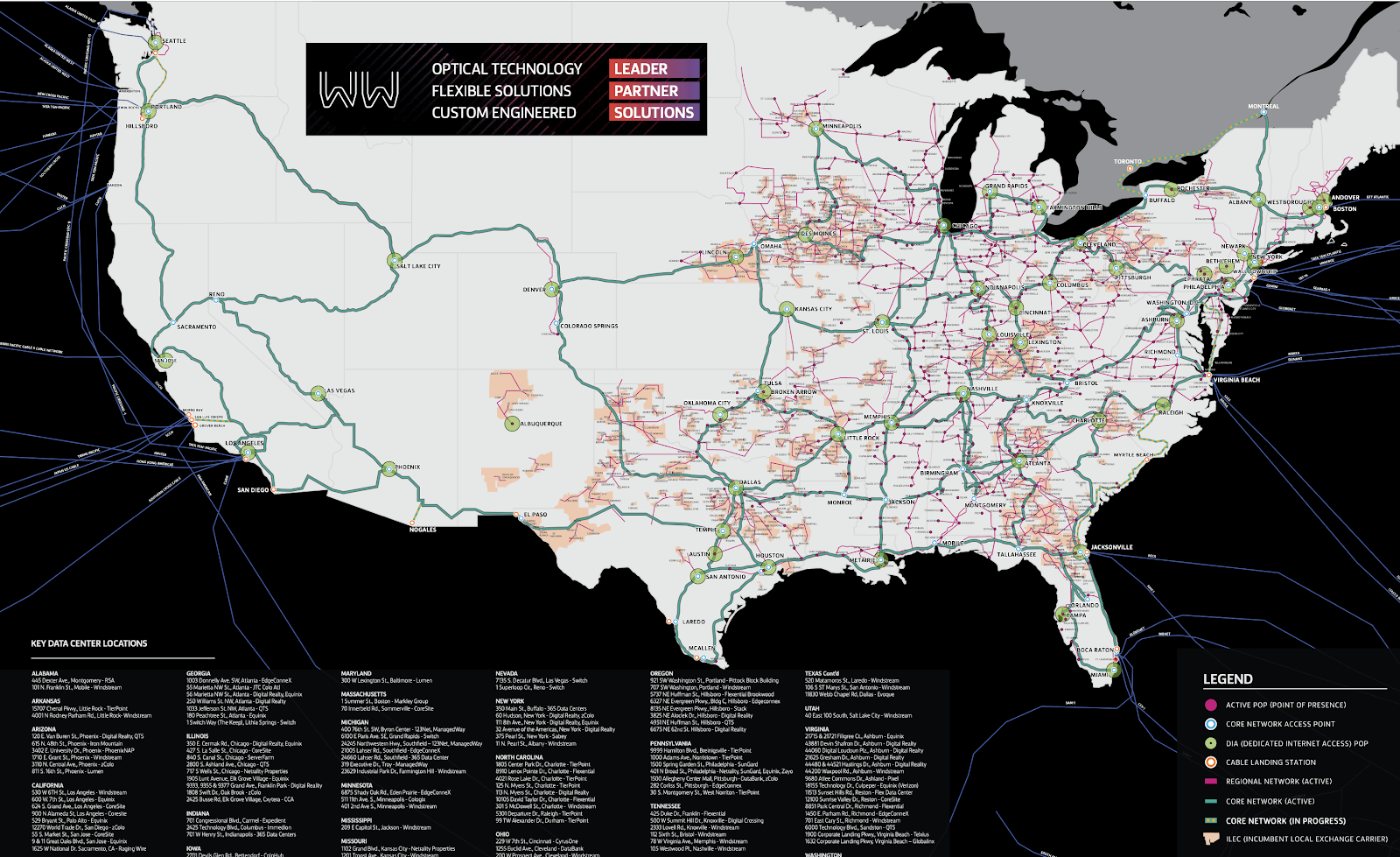
Windstream Wholesale completed two pivotal route enhancement projects across Virginia using FLEX DWDM (FLEX) technology.

The FLEX upgrade extends across Windstream’s ICON network from Ashburn through Richmond, Virginia, and into the Virginia Beach cable landing station (CLS).  The route segment from Ashburn to Richmond serves as a vital connection between key data centers while the extension from Richmond to the Virginia Beach subsea CLS opens new avenues for international connectivity.

The upgrades leverage Ciena’s 6500 Reconfigurable Line System (RLS).

Windstream Wholesale’s FLEX/ICON upgrades and expansions enable 400G wave service, Managed Spectrum service, and greater visibility into network health and performance with technologies like inline optical time-domain reflectometer (OTDR) engineered into the route. Inline OTDR dramatically reduces mean time to repair (MTTR) in the event of a network interference or fiber cut, providing the ability to locate the interference without physically deploying resources. FLEX also provides cost benefits, enabling the direct connection of key data centers to core long-haul network nodes and eliminating the need to bookend equipment to jump between long-haul and regional networks.

“We are proud to announce the completion of these two crucial route initiatives,” said John Nishimoto, Windstream Wholesale senior vice president of product, marketing, and strategy. “These enhancements represent our steadfast commitment to technology leadership and exceeding customer expectations as we continue to drive innovation to meet today’s connectivity demands.”

Windstream Wholesale understands the critical role connectivity plays in today’s digital landscape. By investing in infrastructure expansion and leveraging state-of-the-art technologies like FLEX, the company remains at the forefront of delivering reliable, high-performance network solutions.

https://www.windstreamwholesale.com/network-map/

Dell'Oro: Broadband Access Equipment Sales Dipped 9% in 2023

The total global revenue for the Broadband Access equipment market decreased to $17.5 B in 2023, down 9 percent year-over-year (Y/Y), according to a new report from Dell'Oro Group. Spending on Cable equipment dropped 3 percent overall, though spending on Remote PHY Devices (RPDs) jumped 21 percent, following a 99 percent Y/Y increase in 2022.

"Cable operators continue to modernize their networks through the deployment of Distributed Access Architectures," said Jeff Heynen, Vice President with Dell'Oro Group. "Though macroeconomic and supply chain issues continue to cloud the short-term horizon, there is no question that the goals of delivering more bandwidth and pushing edge processing and automation closer to subscribers are driving cable operator spending," explained Heynen.

Additional highlights from the 4Q 2023 Broadband Access and Home Networking quarterly report:

  • Total PON equipment spending was down 7 percent from 2022, driven by a 10 percent decline in spending on PON OLTs.
  • Spending on Fixed Wireless CPE increased 7 percent in 2023, driven once again by 5G Sub-6 GHz unit shipments in North America.
  • Total Wi-Fi 6E and Wi-Fi 7 Router and Broadband CPE unit shipments reached 10 M in 2023, with a significant ramp expected for Wi-Fi 7 units in 2024.

https://www.delloro.com/news/broadband-equipment-spending-drops-9-percent-in-2023/

Sunday, March 17, 2024

FCC advances Mobile- Satellite collaboration

 The FCC adopted a new regulatory framework that aims to advance collaborations between satellite operators and terrestrial service providers to offer ubiquitous connectivity directly to consumer handsets using spectrum previously allocated only to terrestrial service. The new regulations bolster supplemental coverage from space, or SCS, which will enable consumers in areas not covered by terrestrial networks to be connected using their existing devices via satellite-based communications. 

Specifically, the FCC has updated the United States Table of Frequency Allocations to enable satellite communications in frequencies previously dedicated solely to terrestrial services. This change permits two-way, secondary mobile-satellite service operations in specific spectrum bands lacking primary, rigid-use legacy holders, whether federal or non-federal. For these selected bands, satellite communication services (SCS) are approved only in instances where all terrestrial license holders within a distinct geographical area collectively agree to lease their spectrum rights to a satellite operator. This operator's part 25 license will then include these frequencies and outline the specific geographical area where the SCS will be provided.

The FCC also highlighted the importance of the work carried out by the 3rd Generation Partnership Project (3GPP) in developing wireless standards, especially concerning the partnership between satellite operators and terrestrial service providers. While earlier solutions adhered to 3GPP standards from before Release 17, it was Release 17 that first introduced features aimed at efficiently facilitating operations of non-terrestrial networks (NTN), incorporating feedback from industry stakeholders. This was a significant step in incorporating satellite technology into the global development of 5G systems. These standards provided for satellite access via New Radio (NR) in Frequency Range 1, targeting handsets and Very Small Aperture Terminals, alongside access for the narrowband Internet of Things and Long-Term Evolution Machine-Type Communication for satellite-based enhanced machine-type communication. Furthermore, 3GPP Release 18 expanded NTN support into Frequency Range 2, including operations in the Ku-band and introducing improvements for better coverage, seamless service continuity, and smoother mobility between non-terrestrial and terrestrial networks. More recently, 3GPP has decided to propose a 5G NR satellite access Radio Interface Terminal to the International Mobile Telecommunications-2020 (IMT-2020), marking another advance in integrating satellite capabilities into next-generation wireless systems.

FCC Chairwoman Jessica Rosenworcel writes: "We are fast heading to a world where next-generation wireless networks will connect everyone and everything around us. They will open up possibilities for communications that we cannot even fully imagine today. But we will not be successful in our effort to make this always-on connectivity available everywhere if we limit ourselves to using only one technology. We are going to need it all—fiber networks, licensed terrestrial wireless systems, next-generation unlicensed technology, and satellite broadband. But if we do this right, these networks will seamlessly interact in a way that is invisible to the user. We won’t need to think about what network, where, and what services are available. Connections will just work everywhere, all the time."


https://www.fcc.gov/document/fcc-advances-supplemental-coverage-space-framework-0

Dell'Oro: AI Investments to Lift Hyperscale Cloud Capex

Accelerated computing is forecast to lift hyperscale cloud capex to 17 percent growth in 2024, according to a new report from Dell'Oro Group, which also found that AI infrastructure investments in the enterprise are also gaining momentum.

“After growing just 4 percent in 2023, worldwide data center capex is projected to rebound to double-digit growth this year,” said Baron Fung, Sr. Research Director at Dell’Oro Group. “While accelerated computing for generative AI applications will be the front-runner in data center investments, we expect a modest recovery in general-purpose servers and storage demand following a period of steep correction. Until last year, the hyperscalers led the way for AI-related investments. This year, we expect accelerated systems to account for an increasing part of server OEM sales and carry a significant backlog as enterprise customers deploy AI workloads,” explained Fung.

Additional highlights from the 4Q 2023 Data Center IT Capex Quarterly Report:

  • Dell led all OEMs in server revenue in 2023, followed by HPE and IEIT Systems. The revenue share of the white box server vendors surpassed that of the top 3 server OEMs in 2023.
  • Server and storage systems revenue is forecast to grow by 18 percent in 2024, as the product mix shifts to AI-optimized servers and to server platforms with the latest x86 CPUs from Intel and AMD, as well as ARM CPUs.
  • Dell'Oro projects that the top 4 US hyperscalers—Amazon, Google, Meta, and Microsoft—will each increase their data center capex by double digits in 2024.

https://www.delloro.com/news/ai-investments-to-lift-hyperscale-cloud-capex17-percent-in-2024/

Swisscom to acquire Vodafone Italia, creating nation's 2nd competitor

In a significant move to bolster its presence in the Italian telecommunications market, Swisscom has announced the acquisition of Vodafone Italia for EUR 8 billion, aiming to merge it with its Italian subsidiary, Fastweb. This strategic merger is expected to create a powerful converged operator in Italy, enhancing both mobile and fixed connectivity services across the country. Here are the key points related to the network operations, size, and footprint of this merger:

Combined Strengths and Synergies:

The merger brings together Vodafone Italia's premium mobile network with Fastweb's robust fixed connectivity infrastructure.

Expected annual synergies of approximately EUR 600 million will improve cost efficiency and scale, facilitating significant investments in Italy's telecommunication sector.

This convergence aims to deliver innovative, competitively priced services, enhancing user experience for both private and business customers across all market segments.

Enhanced Customer Benefits:

Mobile users will enjoy improved connectivity and service quality through a fully controlled end-to-end managed wireless network.

Broadband customers will benefit from enhanced service quality, leveraging Fastweb’s wireline network and Vodafone’s 5G Fixed Wireless Access (FWA).

The merger promises high-performance combined fibre and mobile solutions, offering greater service convergence at competitive prices.

Business and Public Administration Value:

Access to complementary assets such as Fastweb's cloud infrastructure and Vodafone Italia's mobile assets will offer a broader range of IT and communication services.

The merger facilitates a one-stop-shop experience for B2B customers, promoting faster digitalization for enterprises and public administrations in Italy.

National Impact and Competitive Landscape:

By creating a commercially resilient entity, the merger aims to ensure sustained investment in top-tier network infrastructure and innovation.

The combined operation will help close the digital divide and accelerate Italy's digital transformation, increasing competition in the telecommunications market.

Financial and Strategic Benefits:

The transaction, valued at attractive multiples, is expected to be cash flow neutral to Swisscom in the first year and accretive from the second year onwards.

Swisscom plans to increase its dividend post-merger, supported by synergy realization and free cash flow growth, while retaining its strong corporate credit rating.

Regulatory Approvals and Closing Timeline:

Subject to regulatory and customary approvals, the transaction is expected to close in Q1 2025.

Post-closing, the combined entity and Vodafone Group will enter into transitional and long-term service agreements, including a brand license agreement.

Swisscom CEO, Christoph Aeschlimann, and Vodafone Group CEO, Margherita Della Valle, have both highlighted the merger's strategic rationale, emphasizing the enhanced value proposition for customers and the strengthened competitive position in the Italian market. This move underscores Swisscom's commitment to growth and investment in both the Swiss and Italian telecommunication sectors, promising a new era of connectivity and digital services in Italy.


https://www.swisscom.ch/en/about/investors/acquisitionvodafoneitalia.html

  • In November 2023. KKR and TIM reached a €22 billion agreement for KKR to acquire a key part of TIM's infrastructure: its fixed-line network. This network forms the backbone of TIM's landline and internet services in Italy. By acquiring this asset, KKR gains a foothold in the Italian telecom market and the potential to reshape the industry. The deal received a critical boost in January 2024 when the Italian government approved it under its "golden power rule," granting oversight but also requiring a security task force to monitor the network's operations. However, a potential roadblock remains. 
  • Vivendi, the largest shareholder in TIM, is unhappy with the sale price and has challenged the deal in court. This legal battle could delay or even prevent the acquisition from finalizing. 
  • It's important to note that this deal excludes Sparkle, TIM's undersea cable unit, which boasts a vast network of fiber optic cables that connect Italy to other parts of the world. TIM received a separate non-binding offer for Sparkle, but it was ultimately rejected. For TIM, the sale of the fixed-line network would provide significant funds to invest in the business and reduce its debt burden. It would also allow them to focus on their mobile network operations and potentially their remaining international assets like Sparkle.

Private investors acquire Verne data centers in UK, Iceland, Finland

Ardian, a private investment house, has acquired Verne (formerly Verne Global), a leading data center platform headquartered in the UK and diversified across Northern Europe, from Digital 9 Infrastructure plc (D9). Financial terms were not disclosed.

Verne, established in 2012, operates data centers in central London, Iceland and Finland. The company specializes in high-performance computing (HPC) workloads, including AI, Machine Learning, and Large Language Models (LLM), providing a competitive total cost of ownership, strong green credentials, and exceptional availability. Sustainability is central to Verne's mission, operating with 100% renewable energy in Iceland and 100% decarbonized energy in Finland and the UK.

“Having identified the company through our systemic matrix sourcing approach, looking through both a digital infrastructure and country specific lens, we identified Verne as a truly green data center compared with its peers globally. 
This investment is fully aligned with our approach at Ardian of investing into platforms and delivering strong returns through major industrial strategy backed by an accelerated capex plan.  Ardian will support Verne’s top tier management team to match the incredible and fascinating customer AI-driven demand. With this investment, Ardian Infrastructure is now exposed to the whole digital infrastructure value chain capitalizing on global digitalization trends.” Gonzague Boutry, Managing Director - Digital Infrastructure, Ardian.

“This is an exciting day for Verne as we become part of the Ardian platform. We have ambitious plans to continue growing the company and delivering sustainable data center solutions. We want to enable organizations to cost-effectively scale their digital infrastructure while reducing their environmental impact. We are hugely excited to be working with Ardian to help power our future.” Dominic Ward, CEO, Verne.

https://verneglobal.com/


IP Infusion reports 61% growth spurt in 2023

IP Infusion, a privately-held supplier of carrier-grade networking software systems, reported a significant 61% year-over-year sales jump in 2023, marking the highest revenue in the company’s history.

  • Ninety-five new customers turned to IP Infusion’s  solutions in 2023, and 41 new partners joined the company’s extensively curated open networking ecosystem that now boasts 127 partners. 

  • IP Infusion had 351 repeat orders from existing OcNOS customer orders, solidifying the company’s role as the leading disaggregated alternative to legacy vendors such as Cisco, Juniper, and Arista.
  • To date, more than 42,000 total OcNOS licenses have been sold and two million ports shipped globally. IP Infusion’s reputation for carrier-grade products that provide flexibility, reliability, and low Total Cost of Ownership undergird its growing market position.
  • IP Infusion publicly announced 15 new OcNOS customer wins for 2023, including Africell Sierra Leone, Amplex Internet, BroadStar, DojoNetworks, EXATEL, Haefele Connect, Kinetix Networks, MetaLINK Technologies, Multinet, Netplus, Pine Networks, Scott Data, Telcom, Targo, and Vyve Broadband. As customers expand their networks and move toward open network deployments, the OcNOS Aggregation Router, Data Center, and Cell Site Router use cases continue to lead overall sales.
  • A key industry event in 2023 was IP Infusion’s strategic partnership with NTT DATA (part of NTT Group) in which NTT DATA and IP Infusion announced collaboration for go-to-market open networking solutions. IP Infusion also announced that it had provided technical support for the development of Beluganos — a new network operating system (NOS) for white box solutions to realize NTT Corporation (NTT)’s IOWN concept — and is providing sales and support for global markets with NTT and NTT Advanced Technology Corporation (NTT-AT), the core technology company of NTT Group.

“We are extremely gratified to see IP Infusion’s momentum continue to increase substantially throughout 2023 due to robust demand for our software and open, disaggregated network solutions,” said Atsushi Ogata, President and CEO of IP Infusion. “Today’s volatile global economy requires mature, cost-effective end-to-end open solutions for secure, reliable networks. We are confident that our OcNOS-based products offer the highest-rated solutions that meet complex use cases.”

Quintessent raises $11.5M for quantum dot lasers

Quintessent, a start-up based in Santa Barbara, California, closed $11.5 million in venture funding for its workin in heterogeneous silicon photonics and quantum dot laser technology.

The seed round was oversubscribed and included was led by Osage University Partners (OUP) with new investors including M Ventures, and joining existing investors Sierra Ventures, Foothill Ventures, and Entrada Ventures.

“We are grateful for the support from our new and existing investors who all recognize the need for foundational innovations to catalyze sustainable and reliable interconnect scaling for the era of accelerated computing,” said Alan Liu, CEO and co-founder of Quintessent. 

Liu was previously an Associate at Booz Allen Hamilton and advised on various photonics R&D programs for clients at DARPA and ARPA-E. Alan obtained his PhD from Professor John Bowers’ group at UCSB where he performed research that is now part of Quintessent’s core technology.  

https://www.quintessent.com/post/quintessent-raises-11-5m-in-seed-funding-to-future-proof-optical-connectivity

  • Last year, Quintessent and  Tower Semiconductor demonstrated a world first in heterogeneously integrating O-band GaAs quantum dot (QD) lasers with a commercial foundry silicon photonics process. Tower's PH18DB platform is targeted for optical transceiver modules in datacenters and telecom networks, as well as new emerging applications in artificial intelligence (AI), machine learning, LiDAR and other sensors. 
  • The companies, which are collaborating under the DARPA LUMOS program, cited benefits of semiconductor quantum dot lasers and amplifiers over traditional quantum well materials:
  • Lower relative intensity noise (RIN) in multiwavelength lasers
  • Optical amplifiers with near ideal noise figure
  • Improved optical feedback tolerance for isolator-free, on chip lasers
  • The ability to operate efficiently at high ambient temperatures
  • Significantly improved component reliability and lifetimes 

  • Heterogeneous integration of lasers/amplifier functionality and other silicon photonic elements on common substrate presents significant benefits such as: 
  • New product architectures and functionalities otherwise not achievable using external lasers, for example complete self-test at the chip level, or on-chip amplification
  • Reduced cost
  • Reduced power consumption and improved link margin
  • Improved system reliability


Thursday, March 14, 2024

Broadcom shows 200-Gbps per lane optical interconnects

Ahead of this month's #OFC24 in San Diego, Broadcom is announcing an expanded portfolio of optical interconnect solutions, including:

  • Production release of 200-Gbps per lane (200G/lane) electro-absorption modulated laser (EML) to pair with next generation GPUs
  • Demonstration of the industry’s first 200G/lane vertical-cavity surface-emitting laser (VCSEL) 
  • Demonstration of continuous wave (CW) laser with high efficiency and high linearity for silicon photonics (SiPh) modulation at 200G
  • Shipment of more than 20 million channels of 100G/lane high speed optical components used in AI/ML systems

The demand for AI clusters is expected to drive rapid adoption of 200G/lane optics in 800G and 1.6T transceivers. Broadcom’s 200G VCSEL and EML products follow up on successful deployment of 100G/lane VCSEL and EML chips into first-generation generative AI networks.

At OFC24, Broadcom will showcase the following products and technologies:

  • 200G VCSEL technology demonstration
  • 200G EML product demonstration
  • 200G SiPh modulation with CW lasers
  • 100G VCSELs for emerging applications including server interconnect, PCIe interconnect and next generation Fibre Channel

“Generative AI has unleashed a network transformation necessitating an order of magnitude increase in high-speed optical links compared to standard network requirements,” said Near Margalit, Ph. D., vice president and general manager of the Optical Systems Division at Broadcom. “We will continue to invest in VCSEL, EML and CW laser technologies to deliver disruptive innovation in bandwidth, power and latency for optical interconnects in next generation AI links.”

https://www.broadcom.com/company/news/product-releases/61941

#OFC24 preview: Ushering in Terabit Transceivers

What's next for optical interconnects needed for next-gen AI clusters? Manish Mehta, VP Marketing from Broadcom's Optical Systems Division, provides an insightful look into the advancements in this field:

- Manish discusses the progress in optical components, particularly the development of the terabit transceiver. He highlights Broadcom's ongoing production of 100G vertical-cavity surface-emitting laser (VCSEL) and 100G electro-absorption modulated lasers (EMLs), and the upcoming showcase of 200G EMLs and 200 VCSELs that can be used in 1.6 terabit transceivers. This is a significant step forward for the next generation of AI networks.

- He also delves into the company's investment in co-packaged optics, revealing the next phase of their 51.2 T co-packaged Ethernet switch product.

- Lastly, Manish touches on the ongoing debates and efforts in the industry to reduce the power of the optical interconnect, a goal targeted by both LPO and CPO. This is a crucial aspect of the industry's evolution and one that Broadcom is keenly focused on.


https://youtu.be/V7ghZj72sSE

Want to be involved our video series? Going to OFC? Contact info@nextgeninfra.io

Broadcom ships its 51.2 Gbps CPO switch

Broadcom confirmed commercial deliveries of Bailly, the industry’s first 51.2 Tbps co-packaged optics (CPO) Ethernet switch. The product integrates eight silicon photonics based 6.4-Tbps optical engines with Broadcom’s StrataXGS Tomahawk 5 switch chip. 

Compared to conventiOnal switches with pluggable transceivers, Bailly's CPO interconnect promises 70% lower power consumption and delivers an 8x improvement in silicon area efficiencY. 

Bailly integrates hundreds of optical components and hundreds of millions of transistors in a single optical engine. The high degree of integration enables the placement of the optical engines on a common substrate with complex logic ASICs minimizing the need for signal conditioning circuitry.

51.2-Tbps CPO Switch Product Highlights:

  • Broadcom 51.2-Tbps StrataXGS Tomahawk 5 switch silicon
  • Broadcom 6.4T-FR4 Bailly SCIP optical engines with Broadcom Fiber Connector (BFC) for CPO systems
  • 4RU system design with high-efficiency air cooling to deliver 128 ports of 400G FR4 connectivity externally fiber-coupled with 128 duplex LC optical connectors
  • CPO engine to front-panel routing supports traditional single-mode fiber 
  • System design compatible to support multiple remote laser modules (RLM) for field replaceability
  • More than 70% optical interconnect power consumption savings compared to standard pluggable optics solutions

Broadcom notes that conventional pluggable optical transceivers consume approximately 50% of system power and constitute more than 50% of the cost of a traditional switch system. Bailly's high degree of integration provides the lowest latency, highest bandwidth density, lowest power, and lowest cost solution for building large-scale, power-efficient AI clusters.

“As AI clusters demand higher bandwidth density, lower power consumption and lower latency, we are pleased to announce delivery of the industry’s first 51.2-Tbps CPO switch,” said Near Margalit, Ph. D., vice president and general manager of the Optical Systems Division at Broadcom. “Bailly will enable hyperscalers to deploy lower-power, cost-efficient, large-scale AI and compute clusters. Broadcom’s technology leadership and manufacturing innovations help Bailly deliver 70% better power efficiency and ensure an optical I/O roadmap that can walk in tandem with the future bandwidth and power needs of AI infrastructure.”


https://www.broadcom.com/company/news/product-releases/61946


https://youtu.be/KsiHanEPkT8

Want to be involved our video series? Contact info@nextgeninfra.io


https://youtu.be/E4gE8XEoGrQ

Filmed at OCP Summit 2023 (#OCPSummit23) in San Jose.


Infinera intros InP-based terabit optics

At #OFC24, Infinera is introducing a new line of high-speed intra-data center optics based on monolithic indium phosphide (InP) photonic integrated circuit (PIC) technology. 

The new ICE-D optics are designed to dramatically lower cost and power per bit while providing intra-data center connectivity at speeds of 1.6 terabits per second (Tb/s) and greater. Infinera’s flexible ICE-D intra-data center optics are designed to support integration into a variety of different intra- and campus data center optical solutions. These solutions include digital signal processor (DSP)-based retimed optics, linear-drive pluggable optics (LPO), and co-packaged optics (CPO) for both serial and parallel fiber applications and distances ranging from 100 meters up to 10 kilometers. ICE-D test chips are currently available and have demonstrated a reduction in power per bit by as much as 75 percent while simultaneously increasing connectivity speed.

Infinera said the new InP optics will leverage the unique capabilities of its U.S.-based optical semiconductor fab. Infinera’s intra-data center optical connectivity technology enables highly integrated solutions that combine multiple optical functions onto a single monolithic chip, resulting in industry-leading density, low latency, and power efficiency. 

“Infinera is excited to apply our 20+ years of pioneering innovation in optical connectivity solutions to solve the challenge of economically scaling intra-data center connectivity to support the deluge of bandwidth stemming from AI applications,” said Ron Johnson, SVP and General Manager of Optical Systems and Global Engineering at Infinera. “Our unique monolithic InP PIC technology puts us in an ideal position to develop innovative technologies to provide cost- and power-efficient, high-capacity intra-data center connectivity solutions.”

#OFC24 preview: Optical Innovation for the Terabit Age

How will optical transport keep up with the relentless pace of bandwidth growth in the AI era?  Robert Shore, SVP, Marketing from Infinera highlights innovations at #OFC24:

- The enhancements made to Infinera's GX platform, designed to support all applications across the network, from Metro Edge to subsea. This platform can scale to meet growing bandwidth demands and easily integrate new technologies as they become available.

- The introduction of new aggregation cards, the recently released ICE 7 1.2 Terabit Optical engine, and new Optical line system functionality on the GX. These innovations can increase capacity per fiber by nearly 40%, reducing cost, power per bit, and overall total cost of ownership.

- The launch of a suite of intelligent coherent pluggable Optics (ICE-X) and new applications for the Open Wave suite of network automation solutions. These are designed to make multi-vendor and multi-layer networks easier to manage, enabling more efficient network design.


https://youtu.be/zMp9ndecSyU

Join us at this year's OFC in San Diego.

Want to be involved our video series? Contact info@nextgeninfra.io

Australia’s NBN picks Infinera’s GX and ICE-X coherent pluggables

NBN Co (nbn), Australia’s wholesale open-access broadband provider, has selected Infinera’s GX Series platform and ICE-X intelligent coherent pluggables to help upgrade its nationwide optical network.

The Infinera GX and ICE-X solution, which will be deployed across nbn’s 60,000-kilometer fiber optic transport network, will increase traffic aggregation efficiencies and overall network capacity, while enabling significant power and cost per bit savings.

“The need for broadband in Australia is expected to reach levels never seen before over the next decade, and we continue to upgrade and modernise our national network to stay ahead of the evolving needs of our customers,” said Andrew Leong, nbn Chief Technology Officer – Fixed Networks. “By enhancing the performance of our fibre optic backbone by using Infinera’s GX platform and ICE-X pluggable optics, we expect to be able to cost-efficiently scale capacity while delivering a great customer experience.”

https://www.infinera.com/press-release/nbn-selects-infinera-gx-and-ice-x-to-upgrade-national-broadband-network/

Arrcus runs SRv6 Mobile User Plane on NVIDIA's Bluefield DPUs

Arrcus is demonstrating a secure 5G network slice using SRv6 Mobile User Plane (MUP), led by SoftBank Corp, and implemented on the NVIDIA BlueField-3 DPU.

The proof-of-concept will be shown at the NVIDIA GTC global AI developer conference, scheduled from March 18th to 21st in San Jose, California. The demonstrations leverage BlueField DPUs and Arrcus' ArcOS network operating system (NOS) solution, aiming to deliver end-to-end network slicing and offer simplicity, high performance, and a lower total cost of ownership.

Network slicing, facilitated by Arrcus' SRv6 MUP implementation, offers automated end-to-end segmentation of network resources, enabling the delivery of advanced applications and services. Additionally, security is paramount in the delivery of network slices, particularly for tasks like secure data transportation for enterprise AI inference and training. IPSec adds end-to-end encryption and authentication to secure the traffic on the network slices.

One of the critical challenges in delivering network slicing with IPSec encryption lies in the attainable network throughput, as it is constrained by the limitations of standard compute processors. BlueField DPUs offload the compute-intensive encrypted data path from CPUs, accelerating it with dedicated hardware. This frees up CPU resources for critical applications while ensuring high-performance data delivery.

"We are thrilled to work with NVIDIA and SoftBank to accelerate the deployment of secure 5G network slices," said Shekar Ayyar, Chairman, and CEO of Arrcus. "SRv6 MUP technology, developed in collaboration with SoftBank, combined with NVIDIA BlueField DPUs, offers a powerful solution that helps address the evolving needs of modern networks, providing advanced security and efficiency while unlocking new revenue opportunities for service providers."

"NVIDIA BlueField DPUs are purpose-built to offload, accelerate, and isolate data center workloads, making them ideal for secure and power efficient 5G network slices,” said Ronnie Vasishta, Senior Vice President of Telecom at NVIDIA. "The integration of BlueField DPUs with Arrcus’ SRv6 technology will help make the deployment of a secure 5G network possible."

"SoftBank is committed to delivering the most advanced and secure 5G network to our customers," said Keiichi Makizono, Executive Vice President & Chief Information Officer (CIO) at SoftBank Corp. "These demonstrations of SRv6 MUP using Arrcus’ ArcOS NOS running on NVIDIA BlueField DPUs are a major step forward in achieving this goal."


https://youtu.be/4sbjBVrRlLA

https://arrcus.com/news/arrcus-to-demonstrate-secure-5g-networking-on-nvidia-bluefield-3-dpus/

CANARIE, ESnet, GÉANT, and Internet2 expand transatlantic bandwidth

Internet2, CANARIE, the Energy Sciences Network (ESnet), and GÉANT, have added three 400 Gbps circuits to boost transoceanic capacity for data-intensive science.

The Advanced North Atlantic (ANA) collaboration supports multinational, data-intensive science collaborations, including the Large Hadron Collider (LHC), the world’s largest and most powerful particle accelerator, and the Square Kilometer Array (SKA), the ongoing effort to build the world's largest radio astronomy observatory.

The joint effort adds three 400 Gbps spectrum circuits between exchange points in the U.S., U.K., and France using the new  Amitié subsea cable system, which was completed in July 2023 and spans 6,783 kilometers (4,215 miles).

With the addition of the new circuits, the combined capacity of the ANA collaboration’s trans-Atlantic network is now 2.4 Tbps

Key points:

  • ESnet will operate two of the 400 Gbps transoceanic circuits in support of U.S. Department of Energy national laboratories, supercomputing facilities, major scientific instruments, and global collaborators, bringing its total 400 Gbps transoceanic circuits to three. 
  • Internet2 will operate one circuit for members of the U.S. R&E community, as well as its North American partner CANARIE.
  •  Internet2 recently added a new 400 Gbps exchange point in Boston. 
  • Internet2 also augmented two existing exchange points with 400 Gbps switching capacity: the Manhattan Landing (MAN-LAN) in New York, NY, and the Washington International Exchange (WIX) in McLean, VA.
  • From the endpoints of the Amitié cable systems in the U.K. and France, GÉANT is providing the connectivity to deliver the trans-Atlantic traffic to the London, Geneva, and Paris points of presence on its pan-European network backbone. 
  •  GÉANT is also planning to further reinforce the ANA collaboration's capacity by upgrading its trans-Atlantic connectivity via the GN5-IC1 project.

“We are thrilled to be part of this momentous undertaking alongside our partners Internet2, ESnet, and GÉANT,” said Mark Wolff, chief technology officer at CANARIE. “This advancement in trans-Atlantic high-speed connectivity will enable researchers and students in Canada to contribute to and benefit from global scientific discoveries and is truly a testament to the collaborative ethos of the global research and education networking community.”

“ESnet is excited to be working with the R&E networking community to fulfill our goal of building the necessary bandwidth to support the expanding data-intensive needs of global scientific research collaborations, such as the high-luminosity upgrade of the LHC,” said Jon-Paul Herron, head of ESnet Network Services.

https://www.es.net/news-and-publications/esnet-news/2024/ana-transatlantic-400g-circuits/

Meter rolls out new switches with digital twin capabilities

 Meter, a start-up offering Network as a Service (NaaS) delivered as a fullstack solution, is rolling out brand new switch hardware, firmware, and virtualization features, all built from the ground up to work seamlessly with the rest of the Meter Network Operating System (NOS).

The new switches, which are available in 24-port and 48-port models, offer a digital twin capability for better planning, visibility, configurability, and reliability.

https://www.meter.com/product-newsletter/meter-switch-platform

Meter attracts Silicon Valley investors for its NaaS

Meter, a start-up based in San Francisco, announced a $35 million round of funding, for its Network as a Service (NaaS).Meter's Network as a Service offering is delivered as a full stack solution, including its own hardware, software, and operations. Using its cloud-managed dashboard, which serves as a digital counterpart for routing, switching, wireless, security, DNS security, VPN, and SD-WAN, customers can easily schedule maintenance, adjust configurations...


FCC increases broadband speed benchmark to 100/20 Mbps

 The FCC is increasing the minimum benchmark speed to classify as "high-speed fixed broadband" to download speeds of 100 Mbps and upload speeds of 20 Mbps – a four-fold increase from the 25/3 Mbps benchmark set by the Commission in 2015. A newly-issued FCC report also sets a 1 Gbps/500 Mbps long-term goal for broadband speeds.

The increase in the Commission’s fixed speed benchmark for advanced telecommunications capability is based on the standards now used in multiple federal and state programs (such as NTIA’s BEAD Program and multiple USF programs), consumer usage patterns, and what is actually available from and marketed by internet service providers.

The Report concludes that advanced telecommunications capability is not being deployed in a reasonable and timely fashion based on the total number of Americans, Americans in rural areas, and people living on Tribal lands who lack access to such capability, and the fact that these gaps in deployment are not closing rapidly enough.

Using the agency’s Broadband Data Collection deployment data for the first time rather than FCC Form 477 data, the Report shows that, as of December 2022:

  • Fixed terrestrial broadband service (excluding satellite) has not been physically deployed to approximately 24 million Americans, including almost 28% of Americans in rural areas, and more than 23% of people living on Tribal lands;
  • Mobile 5G-NR coverage has not been physically deployed at minimum speeds of 35/3 Mbps to roughly 9% of all Americans, to almost 36% of Americans in rural areas, and to more than 20% of people living on Tribal lands;
  • 45 million Americans lack access to both 100/20 Mbps fixed service and 35/3 Mbps mobile 5G-NR service; and
  • Based on the new 1 Gbps per 1,000 students and staff short-term benchmark for schools and classrooms, 74% of school districts meet this goal.

https://docs.fcc.gov/public/attachments/DOC-401205A1.pdf