Tuesday, March 14, 2023

Amazon provides a look at Project Kuiper

Amazon’s Project Kuiper is promising to low-cost connectivity at rates from 100 Mbps for consumers to up to 1 Gbps for enterprise, government, and telecom applications when its constellation of LEO satellites enter service.

Project Kuiper’s ground infrastructure will include gateway antennas that securely send and receive customer data to and from satellites, along with telemetry, tracking, and control (TT&C) antennas. A global network will connect those gateway antennas to the internet, public cloud, or private networks.

Some highlights detailed in an Amazon blog:

  • Project Kuiper’s initial satellite constellation design includes 3,236 satellites at an orbit between 590 and 630 kilometers.
  • More than 1,000 engineers, programmers, and support personnel are currently working on Project Kuiper
  • Development work on Project Kuiper is currently be carried out at a facility in Redmond, Washington. 
  • In 2023, Project Kuiper will open a dedicated satellite production facility in Kirkland, Washington with the capacity to build up to four satellites per day. 
  • Amazon has announced contracts for up to 92 heavy-lift rocket launches,
  • The smallest terminal will measure 7" and each side and be capable of 100 Mbps downlinks. The expected cost is under $500.
  • Amazon built its own baseband chip, coded name Prometheus, to power all of its customer terminals. The Prometheus chip combines the processing power of a 5G smartphone modem chip, the capability of a cellular base station to handle traffic from thousands of customers at once, and the ability of a microwave backhaul antenna to support powerful point-to-point connections.
  • The Prometheus chips will also be used in Project Kuiper’s satellites and ground gateway antennas. Each satellite will be able to process up to 1 terabit per second (Tbps) of traffic on board.
  • The first two prototype Kuiper satellites are expected to launch on the first flight of United Launch Alliance’s (ULA) Vulcan Centaur rocket.

https://www.aboutamazon.com/news/innovation-at-amazon/what-is-amazon-project-kuiper


Telefónica offers access to its Open Gateway’s pre-commercial APIs

Telefónica has begun offering free access to its Open Gateway’s pre-commercial APIs. Three such APIs are currently available:

  • Connectivity: enable control of service quality on mobile and Wi-Fi networks (throughput, latency, congestion).
  • Fraud control: enable the obtaining of information for devices such as roaming status, approximate location, change of SIM and phone number verification.
  • Payments: enable the ability to make payments charged to the carrier’s invoice.

Telefónica said developers will be able to test and validate selected use cases to generate end-to-end services for end customers (B2B and B2C). They will be able to experiment with high-performance network capabilities, including high-response and low-latency computing, to create applications of use to end users.


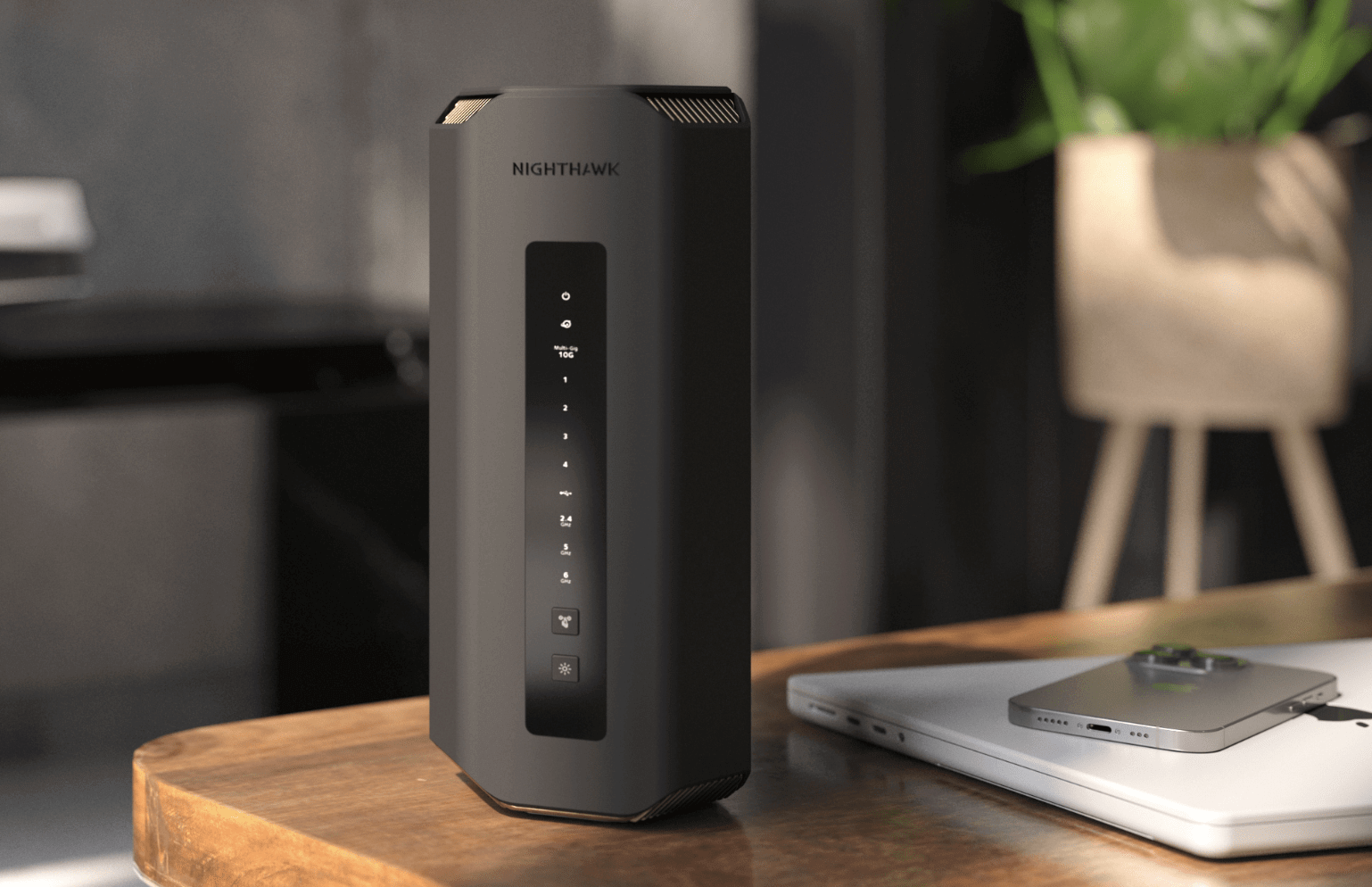
NETGEAR intros first WiFi 7 router

NETGEAR launched the first WiFi 7 router.

Highlights of the NETGEAR Nighthawk RS700 Router.

  • 320MHz high-capacity channels & 4K QAM – WiFi 7 smartphones and laptops can get speeds up to 5Gbps.
  • Uses multiple WiFi bands at once to improve network reliability, reduce latency, and ensure data is delivered with maximum speed.
  • Supports up to 200 devices, such as security cameras, smart home devices, and speakers, while enjoying 4K/8K video streaming, online gaming and HD video conferencing.
  • Multi-Gig Speeds with 10GbE Internet Port – 10 Gig internet port for cable and fiber plans up to 10Gbps.
  • One wired 10Gbps and four 1Gbps LAN ports.
  • Powered by Broadcom’s BCM6726/3 WiFi 7 system on a chip (SOC)
  • US  MSRP is $699.99

"With the launch of our Nighthawk RS700 Router, we’re setting the pace for adoption of the next generation WiFi,” said David Henry, president & GM of Connected Home Products and Services at NETGEAR. “The RS700 is purposefully constructed for the highest possible performance. We’ve deployed our decades of RF expertise to maximize antenna range within a compact design that minimizes interference while fitting flawlessly into any home environment.”

https://convergedigest.com/netgear-unveils-first-wi-fi-7-router/

Adtran and Satelles partner to deliver Satellite Time and Location

Adtran has formed a partnership with Satelles, a supplier of secure time and location technology using low-earth orbit (LEO) satellites, to enable operators of critical infrastructure to safeguard their timing networks with Satellite Time and Location (STL) technology. 

Adtran will integrate Satelles’ STL into its Oscilloquartz network synchronization products. This can serve as an alternative to GNSS systems or a way to augment them with enhanced reliability and security.

STL provides augmented and secure backup for GPS or other GNSS by harnessing encrypted signals transmitted via LEO satellites. It ensures timing and location information that is highly precise, robustly secure, and accessible worldwide. STL is effectively impervious to cyberattacks and is far less susceptible to GNSS vulnerabilities such as signal disruption and manipulation. And because STL signals are up to 1,000 times stronger than GNSS, they can easily reach into buildings and other hard-to-reach locations. Through its partnership with Satelles, Adtran’s Oscilloquartz division will incorporate these benefits into its end-to-end timing toolkit. What’s more, as well as integrating STL into its grandmaster clocks, it will develop miniature M.2 form factor STL receiver modules for third-party product integration.

“We’re pleased to be working with Adtran’s Oscilloquartz division to integrate STL into its portfolio of PTP network timing devices. Together, we’re enabling even more customers to benefit from their game-changing aPNT+™ technology,” said Christina Riley, VP and GM of commercial enterprise solutions at Satelles. “Leveraging LEO signals that are 1,000 times stronger than GNSS, our STL solution is transforming the PNT industry. It’s ideal for providing accurate, reliable timing where GNSS can’t reach, such as indoor locations. "

“We’re excited to offer Satelles’ innovative STL technology as the perfect addition to our portfolio. Reliable, precise and secure, STL is an excellent source of alternative PNT services that’s ideal for use in situations where distributed PTP is unavailable. It also creates new market opportunities for indoor 5G and data center use cases. By incorporating it into our solutions, we’ll empower operators of mission-critical networks to bring robust timing to the most challenging environments and remove the expense of installing outdoor antennas and coring through concrete,” commented Gil Biran, GM of Oscilloquartz, Adtran. 

https://www.adtran.com/en/newsroom/press-releases/20230313-adtran-and-satelles-partner-to-deliver-satellite-time-and-location

Colt upgrades LH network in Japan with Ciena 6500 RLS

Colt Technology Services has more than doubled its long-haul network capacity in Japan using Ciena's 6500 Reconfigurable Line System, Waveserver 5 compact interconnect platform and Manage, Control and Plan domain controller.

Ciena notes that its 6500 RLS offers built-in tools like Zero-Touch Provisioning (ZTP), network auto-discovery, and real-time network monitoring and visibility. Network adaptability is also enhanced with automated calibration. Additionally, with RLS’s integrated L-band amplification and ASE noise loading, the upgrade has no impact to existing C-band traffic and does not require any visits or changes to line amplifier sites, enabling stable and uninterrupted service launches.

“Throughout Japan, there is a growing ask to support the connectivity needs required to run cloud-based applications and bandwidth-heavy video content. Designed with programmability, performance, and scalability in mind, Ciena’s 6500 RLS enables Colt to deploy C&L-band optimized equipment with no service interruptions, empowering Colt to bring the digital universe to its customers faster than ever before despite the distance,” said Kazuyasu Takahashi, Vice President and General Manager, Ciena Japan.

https://www.ciena.com/about/newsroom/press-releases/ciena-supports-colts-launch-of-long-haul-networking-services-in-japan

AST SpaceMobile signs MoU with stc for satellite-to-mobile

AST SpaceMobile, which is planning to deploy a space-based cellular broadband network accessible directly by standard mobile phones, signed a non-binding memorandum of understanding with Saudi Arabia's stc.

"We are thrilled to announce our commitment to expanding our digital services and communications, with a goal to provide a truly inclusive ecosystem that connects every corner of Saudi Arabia with unparalleled service quality and reliability,” said stc VP of Products & Solutions, Saud Alsheraihi. “As we forge ahead in our quest for a more connected and sustainable world, we are excited to collaborate with AST SpaceMobile to potentially revolutionize the telecom industry through Space in the Kingdom.”

“Our collaboration with AST SpaceMobile aims to help us achieve our goal of providing the highest quality and reliable communication services in Saudi Arabia. Our commitment to expanding our digital services and communications is unwavering, and this relationship is a testament to our dedication to innovation and excellence.'”

AST SpaceMobile’s mission is to eliminate the connectivity gaps faced by today’s five billion mobile subscribers and finally bring broadband to the billions who remain unconnected. The company has entered into agreements and understandings with mobile network operators, who collectively have over 2 billion mobile subscribers.

https://ast-science.com/

Monday, March 13, 2023

Microsoft deploys NVIDIA's H100 Tensor Core GPUs + Quantum-2 InfiniBand

Microsoft announced new massively scalable virtual machines that integrate the latest NVIDIA H100 Tensor Core GPUs and NVIDIA Quantum-2 InfiniBand networking. Azure’s new ND H100 v5 virtual machine for AI developers can scale across thousands of GPUs.

The ND H100 v5 VMservice is supported by:

  • 8x NVIDIA H100 Tensor Core GPUs interconnected via next gen NVSwitch and NVLink 4.0
  • 400 Gb/s NVIDIA Quantum-2 CX7 InfiniBand per GPU with 3.2Tb/s per VM in a non-blocking fat-tree network
  • NVSwitch and NVLink 4.0 with 3.6TB/s bisectional bandwidth between 8 local GPUs within each VM
  • 4th Gen Intel Xeon Scalable processors
  • PCIE Gen5 host to GPU interconnect with 64GB/s bandwidth per GPU
  • 16 Channels of 4800MHz DDR5 DIMMs

“Co-designing supercomputers with Azure has been crucial for scaling our demanding AI training needs, making our research and alignment work on systems like ChatGPT possible.”—Greg Brockman, President and Co-Founder of OpenAI. 

In a blog post, Microsoft's John Roach disclosed that since 2019, Microsoft and OpenAI have been working working in close collaboration to build supercomputing resources for training increasingly powerful AI models. The Azure infrastructure used included thousands of NVIDIA AI-optimized GPUs linked together in a high-throughput, low-latency network based on NVIDIA Quantum InfiniBand.

https://news.microsoft.com/source/features/ai/how-microsofts-bet-on-azure-unlocked-an-ai-revolution/

https://azure.microsoft.com/en-us/blog/azure-previews-powerful-and-scalable-virtual-machine-to-help-customers-accelerate-ai/


Coherent shows CPO 800G multimode optical engine

Coherent demonstrated a co-packaged (CPO) 800G multimode optical engine for use in cost-, power-, and latency-sensitive applications such as artificial intelligence and machine learning computer clusters. 

The module that features 16 channels of 50G NRZ transmitters and receivers in a 15 mm x 15 mm x 4 mm multimode CPO 800G VCSEL-based engine. 

The entire analog front end, including the driver, VCSEL, photodiode, and transimpedance amplifier, consumes less than 4 pJ/bit. 

Each VCSEL is paired with another unpowered device to enable 100% cold sparing for extremely high reliability.

Prototypes of this multimode CPO engine, which are jointly developed with IBM under the sponsorship of ARPA-E, are available for immediate evaluation.


https://www.coherent.com/news/press-releases/coherent-demos-optical-transciever-module-operating-at-200g

Rivada to leverage Aalyria's Spacetime orchestration

Rivada Space Networks (RSN) will use Aalyria’s Spacetime platform to orchestrate the network for its planned LEO constellation.

Aalyria, which is based in Livermore, California, is a spin-out from Google. Aalyria's Spacetime software was used internally at Google and Alphabet for nearly a decade, and most recently powered the communications network for Project Loon’s various deployments in Peru, Puerto Rico, and Kenya. The technology already has millions of flight hours orchestrating and managing airborne communications systems around the world. Spacetime is also being used by the Defense Innovation Unit (DIU) to help develop secure internet connectivity throughout the space domain for both private and public sector customers.

Rivada’s constellation will consist of 600 satellites interconnected via laser links. The solution will offer integrated core and edge connectivity over a single, global private network in space. The first satellite launch is set for 2025, with global service starting in 2026.

Aalyria said its Spacetime solution will ensure robust and reliable means of communications between any two user terminals in the world through real-time analysis of millions of possible paths. Spacetime is an advanced software platform designed for orchestrating and managing networks of satellites, ground stations, aircraft, ships, urban meshes, and more. Spacetime optimizes and continually evolves the antenna link scheduling, network traffic routing, and spectrum resources -- responding in real time to changing network requirements. Spacetime operates networks across land, sea, air, and space, at any altitude or orbit type, supports all radio frequency bands and optical wavelengths, and is designed for interoperability with legacy, hybrid space, 5G NTN and FutureG network architectures.

“Rivada’s first-of-its-kind constellation is exactly the type of next generation connectivity system Spacetime was designed to advance,” said Chris Taylor, CEO of Aalyria. “We built Spacetime to dynamically route communications across anything that flies or moves, on Earth or in space, to expand connectivity to people, places, and things that were previously thought unconnectable. We’re excited to add Rivada to our roster of world-class partners and look forward to working with them in the coming years.”

Clemens Kaiser, Chief Program Officer at RSN commented: "With our manufacturing and launch services contracts in place we are now moving at full speed on defining the optimal systems solutions to deliver our ground-breaking constellation. We are delighted to be integrating Aalyria’s Spacetime solution and look forward to demonstrating that our fully meshed laser space network, regenerative payload and beam hopping solution can be very efficiently orchestrated to provide unparalleled service performance for our customers."

Keysight provides O-RAN testing for NTIA's 5G Challenge

The 2023 5G Challenge, which is led by the NTIA’s Institute for Telecommunication Sciences and hosted by CableLabs and its subsidiary, Kyrio, aims to accelerate the adoption of 5G open interfaces, interoperable subsystems, and modular, multi-vendor solutions by fostering a large, vibrant, and growing vendor community.

Keysight announced that its Open RAN Architect (KORA) solutions have been added to CableLabs’ 5G Lab to validate the interoperability of open radio access network (O-RAN) components during the event.

Specifically, Keysight’s KORA solutions will be used in the CableLabs 5G Lab to test edge-to-core O-RAN subcomponents, verifying interoperability and measuring performance. The Keysight P8800S UeSIM and P8822S RuSIM solutions will be used to emulate a baseline system with the P8850S CoreSIM O-RAN core emulator. This will enable the test lab to validate O-RAN radio units, distributed units, and central units, allowing contestants to optimize products and designs for the latest O-RAN specifications.

Keysight offers a comprehensive test portfolio that verifies end-to-end performance of 5G network elements and enables conformance, interoperability, performance, and security testing across the entire O-RAN lifecycle for Open Testing & Integration Centers (OTIC) such as Kyrio.

Jason Lauer, Vice President for Kyrio’s Engineering and Operations Group, said: “Expanding the capabilities of the 5G Lab and OTIC by adding the Keysight Wireless test solutions will provide 5G Challenge contestants and future OTIC testing vendors the opportunity to test end-to-end with multiple test platforms.”

Peng Cao, Vice President and General Manager for Keysight's Wireless Test Group, said: “We are delighted to support CableLabs’ 5G Lab with expanded testing capabilities with Keysight's complete interoperability and conformance solutions portfolio. Our equipment will allow 5G Challenge contestants to confirm that their subcomponents are interoperable with the subcomponents of other vendors.”

2023 5G Challenge for O-RAN solutions offers $6M in prizes

The National Telecommunications and Information Administration (NTIA), in partnership with the Department of Defense (DoD), is kicking off a 2023 5G Challenge that aims to accelerate the adoption of 5G open interfaces, interoperable subsystems, secure networks and multi-vendor solutions by advancing towards true plug-and-play 5G interoperability.The 5G Challenge offers over $6 million in prize money. Contestants will create 5G equipment prototypes...


ZTE's revenues rose 7.4% in 2022 to RMB 122.95 billion

ZTE reported 2022 revenue of RMB 122.95 billion (approximately US$17.9 billtion), 7.4% higher than a year earlier. The company's profit hit RMB 8.08 billion (approximately US$1.2 billion) in 2022, up 18.6% compared to 2021.

Some additional highlights from ZTE:

In 2022, operating revenue in both the domestic and international markets, and operating revenue in the Company's three major businesses including carriers' networks, government and enterprise business, as well as consumer business, all achieved a year-on-year growth. Operating revenue of domestic market reaching RMB 85.24 billion, 69.3% of its overall operating revenue while the operating revenue from international market hitting RMB 37.71 billion, covering 30.7% of its overall operating revenue.

For its carriers networks business, ZTE achieved an annual operating revenue of RMB 80.04 billion, a year-over-year rise of 5.7%. ZTE claims the No.2 market share position for annual shipments of 5G base stations, 5G core networks and 200G coherent ports.

For its government and corporate business, ZTE achieved an operating revenue of RMB 14.63 billion, a year-on-year growth 11.8%. ZTE's core products such as server and storage, GoldenDB distributed databases, and cloud computers, have achieved rapid growth in the number of top customers across the industries including finance and Internet.

In its consumer business, ZTE generated an operating revenue of RMB 28.28 billion, a year-on-year increase 9.9% during the period. The company has gradually integrated mobile phones, mobile Internet products, home information terminals, and ecological capabilities to provide individuals and families with a rich selection of smart products. 


India's Netplus Broadband picks Nokia for big rollout

Netplus Broadband, an Internet Service Provider (ISP) in India, has selected Nokia's Multi-Access Gateway Broadband Network Gateway (BNG) application for access management and 7750 S and 7250 IXR aggregation routers for a major rollout in northern India.

Netplus has operations spread across 400 plus cities and towns in several states in Northern India, with the biggest in Punjab.  

In addition, Netplus will also deploy Nokia’s 7750 SR Extended Services Appliance (ESA) to scale support of Carrier Grade Network Address Translation (CGNAT), helping it solve the challenges faced by increasing demand for connected endpoints.

Netplus will be partnering with Nokia’s IP Networks services team to support the deployment of the Nokia products and applications to deliver the new, quad-play residential broadband services to its subscriber base of one million plus across the state of Punjab. 

Arshdeep Singh Mundi, Executive Director at Netplus, said: “Our partnership with Nokia will help us achieve our goals of a world-class broadband experience for our customers and last-mile broadband expansion with the benefit of added capacity. The expanded coverage will leverage Nokia’s state of the art broadband access infrastructure and help Netplus cater to our customers’ increasing demand, helping drive the Digital India vision.”

https://www.nokia.com/about-us/news/releases/2023/03/13/nokia-partners-with-netplus-to-deliver-future-proof-and-world-class-broadband-services-in-india/

Telekom Malaysia builds 5G Core with ZTE

Telekom Malaysia (TM) has selected ZTE to build a hybrid cloud 5G core network that is designed for future technologies and applications.

Over the next three years, this strategic partnership will foster innovation and advancement of state-of-the-art technologies for TM's 5G Core project, which includes bare metal containers, SDN-based architecture, hardware acceleration, CUPS, and 3-layer decoupling. Advancements in these technologies will propel the development of a converged, open, reliable, trusted and efficient 5G core network.

Jasmine Lee Sze Inn, TM's Executive Vice President for Mobile, said: "TM is pleased to partner ZTE in building a hybrid cloud 5G core network that is designed to meet the rising needs for future technologies. This strategic partnership will transform 5G-enabled networks to deliver innovative solutions and services through our state-of-the-art network and infrastructure, and enable seamless connectivity and exceptional network performance."

Sunday, March 12, 2023

IDC: Worldwide Ethernet switch market continues strong growth

Worldwide Ethernet switch revenues grew 22.0% year over year in the fourth quarter of 2022 (4Q22) to $10.3 billion and grew 18.7% for the full year 2022 to $36.5 billion, according to the recently published International Data Corporation (IDC) Worldwide Quarterly Ethernet Switch Tracker and Worldwide Quarterly Router Tracker.

The total worldwide enterprise and service provider (SP) router market recorded $4.6 billion in revenue in 4Q22, a 0.7% year-over-year increase. For the full year, router market revenues increased 3.9% to $16.5 billion. Worldwide Ethernet switch revenues 18.7% for the full year 2022 to $36.5 billion while the service provider router market grew 3.9% to $16.5 billion

Ethernet Switch Market Highlights

  • The Ethernet switch market's growth of 22.0% year over year in 4Q22 builds on growth of 23.9% in the third quarter of 2022. 
  • Annual growth of 18.7% for the full year builds on the market growing 9.7% in 2021 compared to 2020. In the fourth quarter, the Ethernet switch market showed strength across both the datacenter and non-datacenter segments of the market. 
  • Revenues in the non-datacenter/enterprise campus and branch segment grew 22.6% year over year in 4Q22, while port shipments rose 18.0% year over year. 
  • For the full year, non-datacenter Ethernet switch revenues rose 15.7% while port shipments grew 12.2%. 
  • Revenues in the datacenter portion of the market rose 21.2% year over year in 4Q22, while port shipments increased 17.3%. 
  • For the full year, datacenter ethernet switch revenues rose 22.6% year over year and port shipments increased 12.2%.
  • Market revenues for 200/400 GbE switches rose more than 300% for the full year in 2022 but were flat at 0.7% sequential growth from 3Q22 to 4Q22. 
  • 100GbE revenues increased 18.7% year over year in 4Q22 and rose 22.0% for the full year. 25/50 GbE revenues increased 30.1% year over year in 4Q22 and rose 29.8% for the full year.
  • Revenues for 1GbE switches rose 21.4% year over year in 4Q22 and grew 12.6% for the full year. 10GbE switches rose 1.0% year over year in the quarter but were flat at 0.4% for the full year.
  • 2.5/5GbE switch revenue – also known as multi-gigabit Ethernet switches – rose 122.1% year over year in 4Q22, with 53.1% sequential growth from 3Q22 to 4Q22.

"Strong growth in the Ethernet switch market continued in the fourth quarter of 2022, driven by a variety of trends, but the most significant factor was the continued easing of component shortages and a reduction in supply chain disruptions," said Brad Casemore, research vice president, Cloud and Datacenter Networks, IDC. "Meanwhile, enterprises, service providers, and hyperscalers continue to build out Ethernet switching capacity, reinforcing the importance of connectivity and network infrastructure in today's digital-first business world."

Router Market Highlights

  • The service provider segment, which includes both communications SPs and cloud SPs, accounted for 73.7% of the market's total revenues. 
  • The service provider segment of the market decreased 4.0% year over year in 4Q22 and finished the full year up 1.3%. 
  • Revenues in the enterprise segment account for the remaining share of the market and rose 17.1% year over year in the quarter and increased 12.9% for the full year.
  • From a regional perspective, the combined service provider and enterprise router market in the U.S. rose 18.5% year over year in 4Q22 and was up 17.0% for the full year. 
  • In Canada ,the router market increased 12.3% in the quarter and rose 1.4% for the full year, while in Latin America the market rose 5.2% in 4Q22 and was up 16.7% for the full year. 
  • In the Asia/Pacific region (excluding Japan & China), the market increased 0.7% in the quarter, but fell 3.9% for the full year. 
  • Japan's market was up with 5.6% growth in 4Q22 and a 0.3% increase for the full year. 
  • The People's Republic of China market decreased 18.9% in the quarter and 6.7% for the full year. 
  • Revenues in Western Europe decreased 1.0% in 4Q22 but rose 5.2% for the full year, while the Central and Eastern Europe market was down 17.1% in the quarter and 21.2% for the full year. 
  • The Middle East & Africa region was up 5.2% in the quarter and grew 3.7% for the full year.


https://www.idc.com/getdoc.jsp?containerId=prUS50475923

2022 Global Provider Carrier Ethernet LEADERBOARD

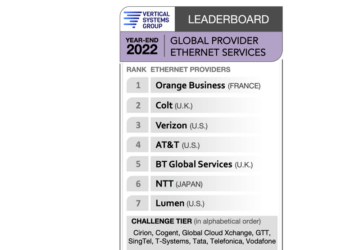
Vertical Systems Group announced that seven companies achieved a rank on the 2022 Global Provider Ethernet LEADERBOARD as follows (in order based on retail port share as of year-end 2022): Orange Business (France), Colt (U.K.), Verizon (U.S.), AT&T (U.S.), BT Global Services (U.K.), NTT (Japan) and Lumen (U.S.). This industry benchmark for multinational Ethernet network market presence ranks companies that hold a 4% or higher share of billable retail ports at sites outside of their respective home countries.

The following nine companies attained a 2022 Challenge Tier citation (in alphabetical order): Cirion (Argentina), Cogent (U.S.), Global Cloud Xchange (India), GTT (U.S.), SingTel (Singapore), T-Systems (Germany), Tata Communications (India), Telefonica (Spain) and Vodafone (U.K.). The Challenge Tier includes companies with share between 2% and 4% of this defined market.

“The market for global Ethernet ports expanded as enterprises continue to add sites to their existing networks,” said Rick Malone, principal of Vertical Systems Group. “DIA additions outpaced other Ethernet services, as enterprises transition to hybrid SD-WAN architectures worldwide.” 

Some highlights

  • Rank positions are unchanged for the top four Global Ethernet Providers on the 2022 LEADERBOARD – Orange Business, Colt, Verizon and AT&T. Share differentials remain slim between these leading providers based on latest port share results.
  • The next three LEADERBOARD positions have shifted due to Lumen’s divestiture of Latin American assets, which included a sizable Ethernet base.
  • As a result, Lumen drops from rank position #5 to the #7 position. BT Global Services advances to the #5 position from #6, and NTT moves up to the #6 position from #7.
  • The 2022 Challenge Tier expands from eight to nine companies with the addition of Cirion, which acquired global Ethernet ports from Lumen.
  • Our research shows a steady uptick in the number of net new Global Provider Ethernet ports installed during 2022.
  • Global Ethernet providers cite geopolitical disruptions, supply chain concerns, and increased competition as growth inhibitors for this segment.
  • Five of the seven Global Provider Ethernet LEADERBOARD companies have attained MEF 3.0 Carrier Ethernet certification as follows (in rank order): Orange Business, Colt, Verizon, BT Global Services, and Lumen.

https://www.verticalsystems.com/2023/03/06/ye2022-global-ethernet-leaderboard/


Dell'Oro: Ethernet adapter market rose 40% in 2022

The Ethernet Adapter market grew 40 percent in 2022. However, we expect the market to moderate in 2023, as server vendors lower their inventory levels in anticipation of lower enterprise demand, and the major cloud service providers undergo a capex digestion cycle, according to a new report from Dell'Oro Group.

“The Ethernet Adapter market achieved record revenue growth in 2022, primarily from the shift of product mix to higher speed ports and higher prices,” said Baron Fung, Research Director at Dell’Oro Group. “However, the market is changing rapidly, as the market shifted from a supply-constrained environment to one that is oversupplied with vendors reducing inventory levels. Enterprise demand is expected to slow this year, and we anticipate some major cloud service providers will undergo a server digestion cycle. However, there are opportunities in the market, as server access speeds continue to increase, and broader Smart NIC adoption is expected in 2023,” added Fung.

Additional highlights from the 4Q 2022 Ethernet Adapter and Smart NIC report include:

  • The Ethernet Adapter market is forecast for 13 percent revenue growth in 2023.
  • 100 Gbps and higher speed ports could account for nearly half the market in 2023.
  • Smart NIC open vendors such as AMD, Intel, and NVIDIA in a position to capture opportunities in the Cloud and Enterprise markets this year.

OFC attracted 11,500 participants and 515 exhibiting companies

Last week's OFC 2023 in San Diego attracted over 11,500 participants and 515 exhibiting companies.

"One of OFC's highlights was live interoperability demonstrations from leading optics companies running over OFCnet," said OFC chairs Chris Cole, Coherent Corporation; Ramon Casellas, Centre Tecnològic de Telecomunicacions de Catalunya; and Ming-Jun Li, Corning Incorporated. "Another was the Plenary Session with inspiring talks by three leading executives, including two females, who shared insights into how technology is transforming our industry and reshaping the world." 

"The optical sector is currently in an exciting period," said Woo Jin Ho, Analyst - Hardware and Communications Equipment, Bloomberg Intelligence. "Companies continued to introduce and launch new innovations at OFC 2023, such as 1.2T and 1.6T coherent optics and Co-Packaged Optics. But it was really refreshing to hear the ramp up and monetization of the innovations that were introduced at OFC two, three years ago."

"What an amazing week with so many innovations in one place," said Jelena Pesic, Ph.D., Nokia. "Nothing can replace face-to-face meetings with colleagues and researchers around the world. For Nokia, it was an opportunity to show our cutting-edge innovation with new PSE-6s, Coherent Routing, network automation, integrated C+L band line systems and 25G PON. Looking forward to seeing the boundaries being pushed even further at OFC 2024!"

OFC 2024 is scheduled for 24-28 March at the San Diego Convention Center.


OFC video: First 200G PAM4 Mach-Zehnder modulated laser

What's hot at #OFC23? 

Sanjai Parthasarathi discusses the live demonstration of a 200G four-level pulse amplitude modulation (PAM4) Mach-Zehnder modulated laser. 

The demo featured a distributed feedback laser (DFB) and Mach-Zehnder modulator combined monolithically in a photonic integrated circuit (PIC) that enables 200G PAM4 for 1.6T transceivers with up to 10 km reach.

https://youtu.be/Ka9K23rL-TI

OFC video: Nokia’s Super Coherent Photonics Service Engine

What’s hot at #OFC23?

Nokia’s Serge Melle discusses the latest generation super-coherent Photonic Service Engine, capable of 1.2 Tb/s over metro distances (118km) and 800 Gb/s over long haul distances (2,019 km), using a single wavelength.

https://youtu.be/LK6VZvKFuys

OFC video: 400ZR for Cloud Metro

What’s hot at #OFC23? 

Juniper is bringing to market new 400ZR and 400ZR+ optics to power its Cloud Metro architecture. 

Juniper's Irene Zheng provides an overview.

https://youtu.be/HbJURV1eYH0