Tuesday, July 21, 2015

Cloud Native Computing Foundation Seeks Alignment Among Container Technologies

A new Cloud Native Computing Foundation is being launched to drive the alignment of container technologies.  Founding organizations include AT&T, Box, Cisco, Cloud Foundry Foundation, CoreOS, Cycle Computing, Docker, eBay, Goldman Sachs, Google, Huawei, IBM, Intel, Joyent, Kismatic, Mesosphere, Red Hat, Switch SUPERNAP, Twitter, Univa, VMware and Weaveworks.

The Cloud Native Computing Foundation, which is a project managed by The Linux Foundation, aims to advance the state-of-the-art for building cloud native applications and services, allowing developers to take full advantage of existing and to-be-developed open source technologies. Cloud native refers to applications or services that are container-packaged, dynamically scheduled and micro services-oriented.

Specifically, he Foundation will look at open source at the orchestration level, followed by the integration of hosts and services by defining API's and standards through a code first approach to advance the state-of-art of container-packaged application infrastructure. The organization will also work with the recently announced Open Container Initiative on its container image specification. Beyond orchestration and the image specification, the Cloud Native Computing Foundation aims to assemble components to address a comprehensive set of container application infrastructure needs.

“The Cloud Native Computing Foundation will help facilitate collaboration among developers and operators on common technologies for deploying cloud native applications and services,” said Jim Zemlin, executive director at The Linux Foundation. “By bringing together the open source community’s very best talent and code in a neutral and collaborative forum, the Cloud Native Computing Foundation aims to advance the state of the art of application development at Internet scale.”

https://cncf.io

“AT&T sees tremendous value in these initiatives,” said Toby Ford, assistant vice president of Cloud Technology, Architecture and Planning at AT&T. “We are very interested in helping to shape the container standards and architecture of the next-generation ecosystem that will deliver on the promise of cloud-enabled software. We are fully committed to this technology direction, as demonstrated by our Domain 2.0 initiative to migrate 75% of our targeted network onto a software defined network directed cloud.”

"Cloud native applications are critical for companies that want to scale their business quickly and successfully,” said Dave Ward, CTO and Chief Architect, Cisco. “Efforts designed to simplify and improve the overall developer experience, such as the Cloud Native Computing Foundation, are a great step forward. We’re excited to be a part of this community initiative to enable new technologies and innovation for developers, as well as our continued commitment to enable users by Open Source.”

http://collabprojects.linuxfoundation.org

Kubernetes V1 Released on Github

Kubernetes, the open source container orchestration system, has reached the v1 milestone (GitHub), indicating that it is now ready for commercial use.

Google noted that Kubernetes was built by over 400 contributors with 14,000 commits. The list of set of features in this release includes:

App Services, Network, Storage 

  • Includes core functionality critical for deploying and managing workloads in production, including DNS, load balancing, scaling, application-level health checking, and service accounts
  • Stateful application support with a wide variety of local and network based volumes, such as Google Compute Engine persistent disk, AWS Elastic Block Store, and NFS
  • Deploy your containers in pods, a grouping of closely related containers, which allow for easy updates and rollback
  • Inspect and debug your application with command execution, port forwarding, log collection, and resource monitoring via CLI and UI.   
Cluster Management
  • Upgrade and dynamically scale a live cluster
  • Partition a cluster via namespaces for deeper control over resources.  For example, you can segment a cluster into different applications, or test and production environments.
Performance and Stability
  • Fast API responses, with containers scheduled < 5s on average
  • Scale tested to 1000s of containers per cluster, and 100s of nodes
  • A stable API with a formal deprecation policy
http://googlecloudplatform.blogspot.com/2015/07/Kubernetes-V1-Released.html

Gigamon Launches Security Visibility Platform for Advanced Persistent Threats

Gigamon introduced its "GigaSECURE" Security Delivery Platform for providing pervasive visibility of network traffic, users, applications and suspicious activity, and then delivering it to multiple security devices simultaneously without impacting network availability.

The idea is to counter Advanced Persistent Threats (APTs) by leveraging a traffic visibility fabric to extract scalable metadata across a network, including cloud and virtual environments, and thereby empower third party security applications. This enables improved forensics and the isolation of applications for targeted inspection. The company also said its solution is also able to deliver visibility to encrypted traffic for threat detection.  The architecture supports inline and out-of-band security device deployments.

Gigamon's GigaSECURE is comprised of scalable hardware and software elements:

  • Infrastructure-wide reach via GigaVUE-VM and GigaVUE nodes;
  • High-fidelity, un-sampled Netflow/IPFIX generation;
  • Application Session Filtering;
  • SSL decryption; and
  • Inline bypass capabilities.

Gigamon also highlighted its Application Session Filtering (ASF), a new, patent-pending GigaSMART application that can identifies applications based on signature or patterns that appear within a packet or packets. Once positively identified, ASF extracts the entire session corresponding to the matched application flow from the initial packet to the last packet of the flow, even if the match occurs well after the first packet. This allows an administrator to forward specific “traffic of interest” to security appliances thereby optimizing their operational efficiency and improving overall performance.

The GigaSECURE platform already supports a broad ecosystem of security partners and their respective security functions, including:

Advanced Malware Protection: Check Point, Cisco, Cyphort, FireEye and Lastline;
Behavior Analytics: Damballa, Lancope, LightCyber and Niara;
Forensics/Analytics: ExtraHop, PinDrop, RSA and Savvius;
IPS: Check Point and Cisco;
NGFW: Check Point, Cisco, Fortinet and Palo Alto Networks;
Secure Email Gateways: Cisco;
SIEMs: LogRythm and RSA;
WAFs: Imperva.

https://www.gigamon.com/

Gigamon's Shehzad Merchant: Intersection of Open and Security


The open networking movement is here to stay. It's not just about open source software, says Shehzad Merchant, CTO of Gigamon, but really about taking a vertically-integrated networking stack and disaggregating it. With various components of the networking stack supplied by different vendors, maintaining visibility across every layer of that stack becomes critical.

By disaggregating the networking stack, you are, in principle, opening up new attack vectors across multiple surfaces. On the other hand, there will be a much broader ecosystem moving much quicker to address vulnerabilities.

This 9-minute sponsored video covers (1) whether the many open networking projects help or hurt the case for better network security (2) the overlapping trands of virtualization and higher networking speeds (3) security as the use case for SDN (4) redefining security boundaries with SDN

http://open.convergedigest.com/2015/05/gigamon.html

Automating Visibility inside the Cisco Live Network with Gigamon and JDSU

The Cisco Live Network and its state-of-the-art network operations center serve all of the attendees of Cisco's big annual event. Equipment must be deployed rapidly. As soon as the show begins, the network supports tens of thousands of clients and pushes terabytes of data to the Internet.

This video takes a look at the Cisco Live Network and the use of Gigamon's new software-defined visibility,  which leverages APIs to make real-times changes in the types of data under analysis. Software-defined visibility allows the NOC to change the nature of the visibility fabric to provide only the type data needed by the testing tools in real-time.  In addition, the video features a live use-case presented by JDSU covering software-defined visibility and their tools.

Presented by Andy Huckridge, Director of Service Provider Solutions at Gigamon; Joe Clarke, Distinguished Engineer at Cisco; and Charles Thompson, Senior Director, Product Line Management, at JDSU.

See video:  https://youtu.be/giYXwy2thlQ

Cavium's 100G NITROX V Security Processor Packs 288 Cores

Cavium unveiled its new family of NITROX V security processors & adapters aimed at enterprise networking equipment and virtualized cloud data centers, where increasing east-west traffic flows are driving high performance, symmetric encrypted bandwidth requirements. In addition, SaaS providers such as search engines, email services and social networking services are now encrypting customer data they receive over the Internet using SSL and new crypto schemes such as Perfect Forward Secrecy (PFS). Another major trend is the need for high performance data compression with excellent compression ratios for data center traffic, driving the need for better security processors.

The NITROX V security processors integrate up to 288 purpose-built security cores with high performance compression engines and virtualization hardware with PCI-Express Gen 3 and Interlaken interfaces. The company says this delivers 3 to 10 times greater performance than alternative solutions within the same power envelope.

Some highlights

  • Up to 288 RISC Security Cores – Support up to 100Gbps of security performance simultaneously with 120K RSA Ops/sec for 2048 bit keys or 300K P256 ECC Multiply Ops/sec.
  • Compression Engines - Enhanced Compression/decompression acceleration – 100 Gbps. Support for GZIP, PKZIP, Inflate and Deflate algorithms. Also includes support for LZS Compression that is widely used for Storage applications.
  • High bandwidth IO – Supports 100 Gbps of traffic.  PCI-Express Gen3 x8 and Interlaken x8 interfaces.
  • Virtualization support – Single Root IO Virtualization (SR-IOV) feature with up to 256 Virtual Function support.
  • Latest security features – Supports a wide variety of protocols including IPsec, SSL, TLS 1.x, DTLS and ECC Suite B. Also supports a wide variety of algorithms including several variants of AES, 3DES, SHA-2, SHA-3, RSA 2048, RSA 4096, RSA 8192, ECC p256/p384/p521, Kasumi, ZUC and SNOW 3G.
  • SSL performance with 120K RSA Ops/Sec and 300K P256 ECC Ops/sec and bulk encryption performance of 100 Gbps for a variety of different protocols, 
  • Flexibility to support emerging algorithms and protocols.
  • The single-chip NITROX V processors do not require external memory enabling lower cost, power and real-estate.

http://www.cavium.com/processor_security_NITROX-V.html

Arbor: DDos Attacks Continue to Grow in Ferocity

The average size of distributed denial-of-service (DDoS) attacks, from both a bits-per-second and packets-per-second perspective, continues to grow, according to new tracking data released by Arbor Networks.

Arbor’s data is gathered through ATLAS, a collaborative partnership with more than 330 service provider customers who share anonymous traffic data with Arbor in order to deliver a comprehensive, aggregated view of global traffic and threats. ATLAS collects 120TB/sec of Internet traffic and is the source of data for the Digital Attack Map, a visualization of global DDoS attacks created in collaboration with Google Ideas.

The largest attack monitored in Q2 was a 196GB/sec UDP flood, a large, but no longer uncommon attack size. Of most concern to enterprise networks is the growth in the average attack size. In Q2, 21 percent of all attacks topped 1GB/sec, while the most growth was seen in the 2-10GB/sec range. However, there was also a significant spike in the number of attacks in the 50-100GB/sec range in June, mainly SYN Floods targeting destinations in the US and Canada.

“Extremely large attacks grab the headlines, but it is the increasing size of the average DDoS attack that is causing headaches for enterprise around the world,” said Arbor Networks Chief Security Technologist Darren Anstee. “Companies need to clearly define their business risk when it comes to DDoS. With average attacks capable of congesting the Internet connectivity of many businesses, it is essential that the risks and costs of an attack are understood, and appropriate plans, services and solutions put in place. ”

http://www.slideshare.net/Arbor_Networks/atlas-q2-2015final

Microsoft's Commercial Cloud Revenues on $8B Annual Run Rate

Microsoft reported revenues for the quarter ended June 30, 2015 of $22.2 billion.  Gross margin, operating loss, and loss per share for the quarter were $14.7 billion, $(2.1) billion, and $(0.40) per share, respectively.

These results include the impact of a $7.5 billion non-cash impairment charge related to assets associated with the acquisition of the Nokia Devices and Services (NDS) business, in addition to a restructuring charge of $780 million, along with other charges.

Some highlights:

  • Devices and Consumer revenue declined 13% (down 10% in constant currency) to $8.7 billion, with the following business highlights:
  • Windows OEM revenue decreased 22% as revenue was impacted by PC market declines following the XP end-of-support refresh cycle
  • Surface revenue grew 117% to $888 million, driven by Surface Pro 3 and launch of the Surface 3
  • Total Xbox revenue grew 27% based on strong growth in consoles, Xbox Live transactions and first party games
  • Search advertising revenue grew 21% with Bing U.S. market share at 20.3%, up 110 basis points over the prior year
  • Office 365 Consumer subscribers increased to 15.2 million, with nearly 3 million subscribers added in the quarter.
  • Officer Consumer revenue declined 42%
  • Windows Phone revenue declined 68%

Commercial revenue increased slightly (up 4% in constant currency) to $13.5 billion, with the following business highlights:


  • Commercial cloud revenue grew 88% (up 96% in constant currency) driven by Office 365, Azure and Dynamics CRM Online and is now on an annualized revenue run rate of over $8 billion
  • Server products and services revenue grew 4% (up 9% in constant currency), with stable annuity performance offsetting declines in transactional revenue
  • Dynamics revenue grew 6% (up 15% in constant currency), with the Dynamics CRM Online install base growing almost 2.5x
  • Office Commercial products and services revenue declined 4% (up 1% in constant currency), with continued transition to Office 365 and lower transactional revenue due to declining business PCs following the XP end-of-support refresh cycle
  • Windows volume licensing revenue declined 8% (down 4% in constant currency), driven primarily by transactional revenue declining following the XP end-of-support refresh cycle with annuity growth on a constant currency basis


“In our commercial business we continue to transform the product mix to annuity cloud solutions and now have 75,000 partners transacting in our cloud,” said Kevin Turner, chief operating officer at Microsoft. “We are also expanding the opportunity for more partners to sell Surface, and in the coming months will go from over 150 to more than 4,500 resellers globally.”

http://www.microsoft.com
http://www.microsoft.com/investor/EarningsAndFinancials/Earnings/PressReleaseAndWebcast/FY15/Q4/default.aspx

Verizon Reports Steady Trends with LTE and FiOS

Verizon Communications reported Q2 revenue of $32.2 billion, a 2.4 percent increase compared with second-quarter 2014, and EPS of $1.04, compared with $1.01 per share in second-quarter 2014. The company cited top-line revenue growth driven by wireless and FiOS, with emerging revenue streams from the Internet of Things (IoT) and telematics, and continued strong cash flow.

“Verizon has delivered another quarter of strong financial and operational results, based on consistent network reliability and superior value that continues to attract new customers,” said Chairman and CEO Lowell McAdam. “In the second quarter, we again balanced quality Verizon Wireless connections growth with low churn and profitability, and we announced and completed our acquisition of AOL. We’re now poised to offer customers exciting new over-the-top (OTT) mobile video services, and we look forward to a very positive second half of 2015.”

Wireless Highlights

  • Total revenues were $22.6 billion in second-quarter 2015, up 5.3 percent year over year. Service revenues totaled $17.7 billion, down 2.2 percent year over year, while equipment revenues increased to $3.9 billion in second-quarter 2015 from $2.4 billion in second-quarter 2014 as more customers chose to buy new devices with installment pricing.
  • In second-quarter 2015, wireless operating income margin was 34.0 percent, up from 32.5 percent in second-quarter 2014. Segment EBITDA margin on service revenues was 56.1 percent, compared with 50.3 percent in second-quarter 2014. Segment EBITDA margin on total revenues was 43.9 percent, compared with 42.3 percent in second-quarter 2014.
  • Verizon Wireless had 1.1 million retail postpaid net additions in second-quarter 2015, nearly twice the net additions in first-quarter 2015. At the end of second-quarter 2015, the company had 109.5 million retail connections, a 4.7 percent year-over-year increase, and 103.7 million retail postpaid connections, a 5.2 percent year-over-year increase. These totals do not include wholesale or IoT connections.
  • Verizon added 842,000 4G smartphones to its postpaid customer base in second-quarter 2015. Postpaid phone net adds totaled 321,000 as net smartphone adds of 588,000 were partially offset by a net decline of 266,000 basic phones. Tablet net adds totaled 852,000 in the quarter, and net prepaid devices declined by 126,000.
  • 4G devices now constitute approximately 73 percent of the retail postpaid connections base, with the LTE network handling about 87 percent of total wireless data traffic in second-quarter 2015. Overall traffic on LTE has essentially doubled in the past year.
  • About 7.2 percent of Verizon’s retail postpaid base upgraded to a new device in second-quarter 2015. In the past year, the number of 4G smartphones in Verizon’s customer base has increased by 17.8 million, to 61.6 million, an increase of about 40 percent. The company continues to see opportunities to upgrade its base of about 16 million basic phone and 9 million 3G smartphone customers to 4G devices.
  • At 0.90 percent in second-quarter 2015, retail postpaid churn improved both sequentially and year over year. Low churn is an indicator of high customer loyalty, and this was Verizon’s lowest churn rate in three years.
  • Verizon’s network densification plans are on schedule. These plans include deployment of small cells, DAS (distributed antenna system) nodes and in-building solutions.

Wireline Highlights

  • In second-quarter 2015, consumer revenues were $4.0 billion, an increase of 4.5 percent compared with second-quarter 2014. Consumer revenues have now grown by at least 4 percent for 12 consecutive quarters, with FiOS revenues representing 79 percent of the total.
  • Total FiOS revenues grew 10.0 percent, to $3.4 billion, comparing second-quarter 2015 with second-quarter 2014.
  • Wireline operating income margin was 5.3 percent in second-quarter 2015, up from 2.6 percent in second-quarter 2014. Segment EBITDA margin (non-GAAP) was 23.5 percent in second-quarter 2015, compared with 23.4 percent in second-quarter 2014.
  • In second-quarter 2015, Verizon added 72,000 net new FiOS Internet connections and 26,000 net new FiOS Video connections. Verizon had totals of 6.8 million FiOS Internet and 5.8 million FiOS Video connections at the end of the second quarter, representing year-over-year increases of 8.1 percent and 6.4 percent, respectively.
  • FiOS Internet penetration (subscribers as a percentage of potential subscribers) was 41.4 percent at the end of second-quarter 2015, compared with 40.1 percent at the end of second-quarter 2014. In the same periods, FiOS Video penetration was 35.7 percent, compared with 35.3 percent.
  • Verizon saw higher-than-anticipated demand for its new Custom TV packages, with more than one-third of FiOS Video gross customer additions opting for Custom TV and migration demand from existing customers. While Custom TV adoption has an initial negative impact on revenue growth, it is expected to improve profitability.
  • By the end of second-quarter 2015, 64 percent of consumer FiOS Internet customers subscribed to FiOS Quantum, which provides speeds ranging from 50 to 500 megabits per second. The highest rate of growth is in the 75-megabit-per-second tier, to which 23 percent of FiOS customers subscribe.
  • In second-quarter 2015, Verizon migrated 51,000 customers who had been using copper connections, toward a full-year goal of 200,000.
  • Wireline results include operations being sold to Frontier Communications Corp. in the non-contiguous states of California, Florida and Texas. 


http://www.verizon.com/about/news/verizon-delivers-double-digit-adjusted-earnings-growth-strong-cash-flows-2q-2015

DOCOMO Expands 5G Collaboration Program

NTT DOCOMO is expanding its industry collaboration program for 5G.  The company announced individual collaborations with five additional vendors: Intel, Keysight Technologies, Panasonic Corporation, Qualcomm Technologies, and Rohde & Schwarz GmbH & Co.

DOCOMO and its vendor-partners expect to begin technical discussions and various indoor trials at the DOCOMO R&D Center in Yokosuka, Kanagawa Prefecture within the current fiscal year ending in March 2016. The trials will expand to outdoor settings thereafter. Key findings and achievements will be shared with global research bodies and at international conferences. Through the collaborations, DOCOMO expects to evaluate and verify its proprietary 5G technologies and thereby accelerate 5G standardization.

Since May 2014, DOCOMO has been working with a number of other vendors, including Alcatel-Lucent, Ericsson, Fujitsu, Huawei, Mitsubishi Electric, NEC, Nokia and Samsung.

DOCOMO said it aims to introduce 5G on a commercial basis in 2020. 5G is being developed for ultra-high-speed data transmissions of over 10Gbps and 1,000 times the capacity of LTE, which will help address the proliferation of connected items in the emerging Internet of Things (IoT), as well as to support the increasingly diverse range of mobile services.

"Global expectations for 5G are growing as we approach the start of the standardization phase," said Seizo Onoe, Executive Vice President and Chief Technology Officer at DOCOMO. "We are delighted to form these new collaborations on 5G experimental trials for wider technical areas to establish the 5G ecosystem with additional world-leading global vendors to promote R&D targeted at 5G deployment in 2020."

https://www.nttdocomo.co.jp/english/info/media_center/pr/2015/0722_00.html


Monday, July 20, 2015

Video: Building Interconnects to the Big Cloud Providers

The cloud ecosystem is expanding at an astonishing pace and  Tata Communications is right in the middle it, says Mike Galvin, Vice President, Next Gen.

Tata Communications is focusing on the building blocks for hybrid clouds, including direct connectivity via MPLS or Ethernet to the major public cloud providers. The carrier is also enhancing its global IP backbone to make it fit for business with better predictability and reduced latency.

This video interview also highlights Tata's new partnership with Salesforce and existing interconnects with AWS, Microsoft and Google.

See 3-minute video: https://youtu.be/chTg3v09MR8


Tata Communications Provides Interconnect to Salesforce

Tata Communications, which operates one of the most advanced and largest submarine cable networks and a Tier-1 IP network, announced plans to provide direct MPLS and Ethernet connections to Salesforce's cloud CRM solutions.

Through this global partner interconnect agreement, Tata Communications’ IZO Private platform will connect businesses to Salesforce’s Customer Success Platform, giving customers access to a one-stop-shop for end-to-end management that offers exceptional network performance and end-user experience. The carrier said its private network connections will deliver fast provisioning, increased productivity, and better privacy and data protection.

Denzil Samuels, Senior Vice President of Alliances, Salesforce, says, “Companies are transforming the way they connect with customers, partners and employees to thrive in today’s connected world. Tata Communications is accelerating this shift for its customers with the addition of Salesforce to the IZO™ network platform.”

Julie Woods-Moss, CMO and CEO of NextGen Business at Tata Communications, says, “Tata Communications’ partnership with Salesforce represents another milestone around our IZO™ cloud enablement platform. Our recent, independent research confirms that organisations are experiencing benefits they didn’t expect from cloud services and realizing competitive advantages from cloud deployments. We are committed to creating a global ecosystem that harnesses our extensive global network and enables global organisations to meet the needs of their businesses and drive customer success by adopting the cloud confidently and securely.”

Tata Communications' IZO ecosystem currently consists of over 20 network providers covering 34 countries and serving 85% of the world's GDP. It connects four of the largest cloud platforms, including Salesforce, Amazon Web Services, Microsoft Azure and Google Cloud Platform, and over 50 data centers across the globe.

http://www.tatacommunications.com/izo


OpenStack Marks its Fifth Anniversary

The OpenStack Foundation marks the fifth anniversary of this initiative of open source software for building clouds.

OpenStack was launched in 2010 as a joint project between Rackspace and NASA to orchestrate virtual machines and object storage. It has evolved into dozens of projects tackling a broad range of use cases, from accelerating software development to reducing the cost of big data analytics to helping large telco providers roll out Network Functions Virtualization (NFV) and next generation network services. The community of OpenStack supporters has grown to include more than 500 organizations and 30,000 individual members across 166 countries. There have been 4,000 contributors to date producing nearly 4 million lines of code.

“Five years ago, the idea that massively scalable cloud infrastructure should be open and driven by a community of developers and users was a vision hindered by the reality of the engineering hurdles in the way. Today, hundreds of companies rely on OpenStack to deliver a stable core of cloud services to their app developers, surrounded by a vibrant ecosystem for technology innovation. The OpenStack community is powering the software-defined economy,” stated Jonathan Bryce, chief executive officer, OpenStack Foundation.

The next release of the software, codenamed Liberty, will be available on October 15, 2015.

The next OpenStack Summit will be held in Tokyo, Japan, October 27 - 30.

https://www.openstack.org/


IBM Cites $8.7 billion in Annual Cloud Revenue

IBM reported declines in core services, software and hardware businesses, offset somewhat by growth in cloud services, big data analytics and its legacy mainframe business.

For the second-quarter of 2015, IBM reported consolidated net income of $3.4 billion or $3.50 of diluted earnings per share, including operating net losses in discontinued operations related to the Microelectronics business. Second-quarter net income from continuing operations was $3.5 billion compared with $4.3 billion in the second quarter of 2014, a decrease of 17 percent.

"Our results for the first half of 2015 demonstrate that we continue to transform our business to higher value and return value to shareholders. We expanded margins, continued to innovate across our portfolio and delivered strong growth in our strategic imperatives of cloud, analytics and engagement, which are becoming a significant part of our business," said Ginni Rometty, IBM chairman, president and chief executive officer.

Revenues from the company’s strategic imperatives --- cloud, analytics, and engagement --- increased more than 20 percent year-to-date (more than 30 percent adjusting for currency and the divested System x business). Total cloud revenues increased more than 50 percent (more than 70 percent adjusting for currency and the divested System x business) year-to-date, and is $8.7 billion over the last 12 months, adjusted for the divested System x business. The annual run rate for cloud delivered as a service -- a subset of the total cloud revenue -- increased to $4.5 billion from $2.8 billion in the second quarter of 2014. Revenues from business analytics increased more than 10 percent (more than 20 percent adjusting for currency) year-to-date. Revenues from mobile more than quadrupled, and social revenues increased more than 30 percent (more than 40 percent adjusting for currency), both year-to-date.

Global Technology Services segment revenues were down 10 percent (up 1 percent adjusting for currency and the divested System x business) to $8.1 billion. Global Business Services segment revenues were down 12 percent (down 3 percent adjusting for currency) to $4.3 billion.

Revenues from the Software segment were down 10 percent to $5.8 billion (down 3 percent adjusting for currency) compared with the second quarter of 2014. Revenues from IBM’s key middleware products, which include WebSphere, Information Management, Tivoli, Workforce Solutions and Rational products, were $4.0 billion, down 7 percent (flat adjusting for currency) year-to-year. Operating systems revenues of $0.4 billion were down 17 percent (down 9 percent adjusting for currency) year-to-year.

Revenues from the Systems Hardware segment totaled $2.1 billion for the quarter, down 32 percent (up 5 percent adjusting for currency and the impact of the divested System x business) year-to-year. Revenues from z Systems mainframe server products increased 9 percent compared with the year-ago period (up 15 percent adjusting for currency). Total delivery of z Systems computing power, as measured in MIPS (millions of instructions per second), increased 24 percent. Revenues from Power Systems were down 1 percent compared with the 2014 period (up 5 percent adjusting for currency). Revenues from System Storage decreased 10 percent (down 4 percent adjusting for currency).

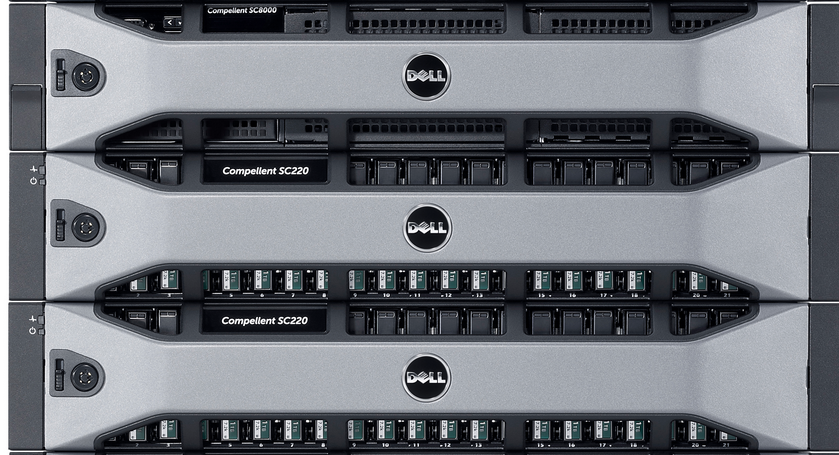
Dell Packs 90 TB of 3D NAND SSDs in 2U Array

Dell Storage introduced new Mainstream Read-Intensive (RI) SSDs, based on Triple Level Cell (TLC) 3D NAND technology, boasting up to 24x performance improvement at the same price for capacity as 15K hard disk drives. This enables Dell SC Series storage arrays to pack up to 90 terabytes of raw flash capacity in a 2U shelf -- twice the data density as before.

In terms of pricing, the company said it now can offer Dell Storage SC4020 enterprise-class all-flash solutions for as low as $1.66 (US) per gigabyte street price and as low as 58 cents (US) per gigabyte for typical hybrid flash configurations.

“As the first array vendor to announce support for this latest flash technology, Dell continues to redefine the economics of enterprise storage and tear down cost barriers to flash adoption,” said Alan Atkinson, vice president and general manager, Dell Storage.

http://www.dell.com/learn/us/en/uscorp1/press-releases/2015-07-20-dell-flash-drive-storage-tchnology

Wind River Joins KDDI R&D Lab Tests

Wind River will participate in a proof-of-concept (PoC) led by KDDI R&D Laboratories for automated operation for Network Functions Virtualization (NFV) test beds. The PoC will utilize Wind River Titanium Server as its foundation for demonstrating the deployment of virtual network function. Titanium Server is a carrier grade NFV infrastructure software solution that meets the stringent requirements of the telecom industry.

"Delivering virtualized services at carrier grade levels of reliability and performance is essential as the industry is transitioning to NFV infrastructures,” said Paul Senyshyn, vice president and general manager of networking solutions at Wind River. “Wind River Titanium Server provides a NFV infrastructure that delivers the carrier grade reliability that meets strict telecom requirements and enables service providers to more easily and quickly find NFV success.”

http://www.windriver.com/markets/networking

Open Networking User Group Adds to Board

The Open Networking User Group (ONUG) has added Morgan Stanley, Intuit, and Yahoo to its Board.

Pablo Espinosa, formerly Director of Network Infrastructure at Gap, moves to Intuit as Director of Network Engineering to oversee strategy, architecture, engineering, and operations. Despite Pablo’s new affiliation, Gap will retain a seat on the board, with a new representative to be appointed by Pablo and approved by the ONUG Board.

Meanwhile, Lane Patterson has recently transitioned out of his role as Vice President of Global Network at Symantec into the same role at Yahoo, where he is responsible for overall architecture and DevOps and reports to Yahoo Co-Founder and Chief Yahoo, David Filo.

“We are excited to welcome Intuit and Yahoo to the ONUG Board,” said Nick Lippis, Chairman and Co-Founder of ONUG. “We look forward to expanding our reach and gaining new insight from a wider variety of industry sectors.”

Moreover, the ONUG Board has appointed John Storm, Executive Director within Morgan Stanley’s Institutional Securities division, as its newest member. John Storm joins other IT leaders in overseeing the strategy and direction of ONUG to assist IT executives as they transition toward open cloud infrastructure. In addition to being represented on the ONUG Board, Morgan Stanley will co-host ONUG Fall 2015 with NYU, and a representative from the company will deliver a keynote address at the fall event.

ONUG Fall 2015, hosted by Morgan Stanley and NYU, will be held at the NYU Kimmel Center. The event will begin with ONUG Academy on November 3rd, followed by the two-day ONUG Conference, November 4th and 5th. Early bird registration will run through September 4th.

htttp://www.OpenNetworkingUserGroup.com

Sunday, July 19, 2015

Video: Open Source Drives Today's IT Services


In today's IT services, "open" is hitting on both sides of the wire -- the mobile side, where employees are seeking a more consumer-like experience on the job, and in the backend data center, says Robin Purohit, President, Service Support, BMC.

There is an increased blending of private cloud and public cloud IT environments.

BMC is reinventing its entire technology stack to fulfill the vision of digital service management.

https://youtu.be/Q4JYj8HHIso


Friday, July 17, 2015

NEC to Offer VNFs on HP OpenNFV Platform

Last week, HP and NEC Corporation agreed to collaborate to accelerate the market for network functions virtualization (NFV) by integrating their solutions.

NFV offers a new way for CSPs to design, deploy, and manage networking services. By decoupling the network functions from proprietary hardware appliances, CSPs can accelerate the introduction of new, compelling services quickly and cost-effectively.

When fully integrated, NEC will be able to offer its virtual network functions on the HP OpenNFV Platform, including HP Helion OpenStack Carrier Grade, providing a pre-validated solution that will deliver the reliability, scalability and performance CSPs require. The integrated offering will encompass HP hardware, including HP servers, networking and storage products. Availability is targeted for later this year. Additionally, the companies plan to develop a joint NFV reference platform to demonstrate NEC virtual network functions and management software on HP OpenNFV infrastructure in OpenStack and Linux KVM environments.

"NFV technologies enable flexible, scalable, and operationally efficient service deployment that will transform conventional network operations," said Atsuo Kawamura, senior vice president, NEC Corporation. "NEC has a track record of expertise in commercially delivering SDN/NFV solutions for mobile and fixed networks. This collaboration with HP will help us further strengthen our NFV solutions portfolio to help CSPs bring new innovative services to market more quickly and efficiently."

"CSPs are looking for ways to easily implement NFV technology," said Werner Schaefer, vice president, Network Functions Virtualization, HP. "Our collaboration with NEC is intended to create more open environments for customers, meeting their desire for faster deployment at a lower cost, continuing our commitment to enabling increased adoption of NFV technology."

http://www.nec.com/en/press/201507/global_20150715_01.html
http://www.hp.com

Alcatel-Lucent Demos 8 Tbps per Fiber Pair on Transatlantic Cable

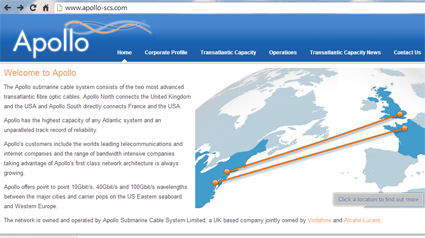
Alcatel-Lucent Submarine Networks (ASN) demonstrated an optical transmission capacity of 8 Tbps per fiber pair on the Apollo South transatlantic system, which connects France to the United States.

The test used ASN's current generation 1620 Light Manager submarine line terminal, equipped with the latest 100 Gbps technology and made use of innovative detection techniques and advanced error correction coding. ASN said it employed proprietary modulation and pulse shaping schemes to counteract the signal distortions and noise that impact high speed, long-distance transmission performance.

Richard Elliott, Managing Director of Apollo said: “This new demonstration further proves the technological lead of the Apollo system in offering capacity increases. The achievable capacity of 8Tbit/s per fiber pair has confirmed once again our expectation; that Apollo could carry around four times the current entire Atlantic traffic in use today.”

Philippe Dumont, President of Alcatel-Lucent Submarine Networks said: “This field trial is another proof point of the adaptability of ASN technology that continues to offer carriers a smart evolution path for tuning capacity and performance throughout the life of a system. As capacity and connectivity needs continue to increase, the high resiliency to potential degradation at higher speeds combined with the reliability of our technology offer a cost-effective and flexible networking model to cope with content providers and their end-users’ service demands.”

https://www.alcatel-lucent.com

Alcatel-Lucent Upgrades Transatlantic Apollo Cable to 100G

Alcatel-Lucent completed an upgrade of the Apollo undersea cable system which links the UK and France to the United States for 100G channels and over 25 Tbps of total capacity.

The Apollo system consists of two of the most advanced fiber optic cables: Apollo North connects the UK to the US, and Apollo South connects France directly to the US, collectively spanning a total of 13,000 km.

Alcatel-Lucent deployed its 1620 Light Manager (LM) submarine line terminal equipment using coherent technology at 100G to provide the most efficient use of the available optical spectrum. The 1620 LM leverages Alcatel-Lucent’s advanced coherent technology, which also incorporates the latest Soft Decision Forward Error Correction (SDFEC) technology to provide highest ultimate capacity at the same time as lowest cost per bit.

Rapid7 Pops in IPO

Rapid7, which provides security data and analytics solutions, completed an initial public offering of 6,450,000 shares of common stock at a price to the public of $16.00 per share.

On the first day of trading, shares of Nasdaq: RPD closed at $25.28, up 58% for the day.

http://www.rapid7.com/

Cinarra Raises $20 Million for Deep Mobile Data + Advertising

Cinarra Systems, a start-up based in Santa Clara, California announced $20 million in Series B funding for its analytics ecosystem for mobile operators and advertisers.

The funding was led by Japan's SoftBank Corp., in participation with Alma Capital and Cisco Systems. In addition, Cinarra has begun joint business operations in Japan with SoftBank, offering new opportunities for Japanese advertisers to engage with consumers. SoftBank has introduced the service to its network in Japan, operating a targeted advertising platform.

Cinarra said its mediation platform eliminates the complexities of integrating operator and advertising platforms, while addressing head-on the issue of consumer data privacy.

“Our relationship with SoftBank signifies a fundamentally new phase for Cinarra,” said Alex Zinin, co-founder and CEO of Cinarra. “With SoftBank’s investment and partnership, we are in an excellent position to be the first to establish a global platform that is open for mobile operators and advertising platforms in Japan and around the world, enabling them to participate in a new business model that will drive the next phase of growth for the mobile Internet economy. With this foundation, the opportunities created by the platform will expand beyond the telecom and advertising industries.”

“Growing needs in mobile communication have propelled us into a new mobile Internet economy,” said Ken Miyauchi, President & CEO of SoftBank. “The next phase of the industry evolution requires a new technology to leverage the ‘always on’ consumer lifestyle. Partnering with Cinarra, whose technology and direction align with our vision of a new Internet economy, is strategic to our business. We are confident that our investment and partnership will further enhance our services for customers.”

http://www.cinarra.com