Showing posts with label Storage. Show all posts

Monday, November 28, 2022

Lightbits demos NVMe over TCP block storage for AWS

Lightbits Labs, which offers high-performance Cloud Data Platform based on NVMe over TCP (NVMe/TCP) protocol, will be demonstrating its next-generation block storage for AWS at the AWS re:Invent Marketplace Pavilion that will run from November 28 to December 2.

Lightbits will demonstrate how its technology, accelerated by Intel-based storage-optimized EC2 instances can accelerate analytics, high-performance databases, and transactional workloads on the public cloud for half the cost of alternative solutions. 

Lightbits, an AWS APN partner, said its NVMe/TCP architecture delivers high-performance at consistent low-latencies, making it ideal for database workloads like Oracle and PostgreSQL.

Monday, October 24, 2022

OCP: Massive power efficiency gains for tape vs HDDs

https://youtu.be/5NAr3YPilM8

IBM unveiled its Diamondback Tape Library, a high-density archival storage solution that is physically air-gapped to help protect against ransomware and other cyber threats in hybrid cloud environments.

IBM Diamondback, which can store hundreds of petabytes of data, is designed for both traditional and "new wave" hyperscalers – global enterprises aggregating massive customer data sets. 

In this video, Shawn Brume highlights the platform, including its power efficiency advantage over HDDs in OCP data centers.


Monday, October 17, 2022

Samsung's latest LPDDR DRAM clocks in at 8.5 Gbps

Samsung Electronics introduced its latest and fastest LPDDR DRAM to date: LPDDR5X DRAM boasts the industry’s fastest speed of 8.5 Gbps as validated for use on Snapdragon mobile platforms. 

By optimizing a high-speed signal environment between application processor and memory, Samsung has surpassed the previous maximum speed of 7.5Gbps achieved in March, reaffirming its leadership in the memory market.

For data centers and edge servers, LPDDR DRAM’s low-power characteristics can help reduce power consumption levels, resulting in an improved total cost of ownership (TCO) for data center managers, while cutting down on heat and carbon emissions to ultimately lower their impact on climate change.

“The joint validation of 8.5Gbps LPDDR5X DRAM has enabled us to accelerate market-wide availability of this high-speed memory interface by more than a year, which is a tremendous accomplishment made possible through our long-standing collaboration with Qualcomm Technologies,” said Daniel Lee, Executive Vice President of the Memory Product Planning Team at Samsung Electronics. “As LPDDR memory continues to broaden its usage beyond smartphones into AI and data center applications, strong collaboration between memory and SoC vendors is becoming all the more important. Samsung will continue to actively engage with innovators like Qualcomm Technologies to enhance ecosystem readiness for future LPDDR standards.”

“At Qualcomm Technologies, we strive to be at the forefront of enabling and adopting the latest memory specifications on our Snapdragon mobile platforms. We’re the first in the mobile industry to enable the latest LPDDR5X at 8.5Gbps on Snapdragon mobile platforms, which will enhance user experiences with new features and improved performance for mobile, gaming, camera and AI applications,” said Ziad Asghar, Vice President of Product Management, Qualcomm Technologies, Inc.

Tuesday, October 4, 2022

Micron to build megafab in New York

Micron will build a "megafab" in Clay, New York (near Syracuse) to produce lead-edge memory chips in high volume using the most advanced semiconductor manufacturing processes and tools, including extreme ultraviolet (EUV) lithography

Micron said it will invest $20 billion in the project by 2030 and up to $100 billion over the next 20-plus years. The company is looking to secure support from the recently-passed CHiPS legislation.

Micron’s central New York site could eventually include four 600,000 square foot cleanrooms, accounting for a total of 2.4 million square feet of cleanroom space – the size of approximately 40 U.S. football fields. Site preparation work will start in 2023 with construction beginning in 2024.

https://investors.micron.com/news-releases/news-release-details/micron-announces-historic-investment-100-billion-build-megafab

Tuesday, September 27, 2022

Kioxia announces first 2TB microSDXC card

Kioxia announced the industry's first 2 TB microSDXC memory card working prototypes. 

The KIOXIA 2TB microSDXC UHS-I memory card is based on the company's BiCS FLASHTM 3D flash memory and an in-house designed controller.

The SD Association’s SDXC specification has supported memory cards up to 2TB for more than a decade – but 2TB cards have not been successfully manufactured until now.

Mass production of the KIOXIA 2TB microSDXC memory cards is scheduled to begin in 2023.


Sunday, August 7, 2022

Western Digital sees growth in HDDs for cloud players

Western Digital reported revenue of $4.53 billion for the fourth quarter of its fiscal 2022, down 8% year-over-year (YoY). Fourth quarter GAAP earnings per share (EPS) was $0.95 and Non-GAAP EPS was $1.78. 

Fiscal year 2022 revenue was $18.79 billion, up 11% YoY. Fiscal year 2022 GAAP EPS was $4.75 and non-GAAP EPS was $8.22.

For Q4:

  • Cloud revenue increased 5%. Cloud represented 46% of total revenue. Within Cloud, the continued ramp of 18-terabyte and 20-terabyte drives drove a 7% year-over-year increase in nearline HDD revenue. In Flash, enterprise SSD revenue more than doubled sequentially and was up 38% year-over-year. There was strong demand from  cloud customers for the latest generation energy assisted drives driving a near record nearline shipment of 111 exabytes.
  • Client revenue declined 14%. Client represented 36% of total revenue. On both a sequential and year-over-year basis, client HDD led the revenue decline while Flash was roughly flat.
  • Consumer revenue declined 23% YoY. Consumer represented 18% of revenue. On a sequential basis, the revenue decline was primarily due to lower retail HDD shipments. The year-over-year decrease was due to broad-based decline in retail products across HDD and Flash.

"I am proud of our team for driving strong fiscal year 2022 performance, during which revenue grew 11% and non-GAAP EPS increased 81%, demonstrating progress in unlocking the earnings potential of our business,” said David Goeckeler, Western Digital CEO. “In addition to strong financial performance, fiscal year 2022 was a hallmark year for Western Digital from an innovation, product development and execution perspective. The combination of our innovation engine and the multiple channels to deliver our products to the market puts Western Digital in a great position to capitalize on the large and growing opportunities in storage ahead even in the midst of macro dynamics weighing on near-term demand.”


https://investor.wdc.com/static-files/7a02a646-b769-442b-885c-c62cf97ced6e

Thursday, August 4, 2022

NEO Semiconductor unveils its X-DRAM

NEO Semiconductor introducted its X-DRAM, a new class of memory promising improvements over conventional DRAM by lowering the power consumption and increasing the performance. Specifically, the X-DRAM architecture lowers refresh power by 85% and activation latency by 50%.

The company says its X-DRAM is compatible with current DRAM manufacturing technologies, processes, structures, and dies. X-DRAM has a wide range of use cases, from cloud servers to mobile devices to IoT objects. 

"Not only is X-DRAM expected to have a significant impact on the global DRAM market, but it will also serve environmental, social, and corporate governance (ESG) goals," says Andy Hsu, Founder and CEO of NEO Semiconductor and an accomplished technology inventor with more than 120 granted U.S. patents. "X-DRAM can lower refresh power by more than 80% through a combination of 50% refresh frequency and 25% refresh time. It also lowers main memory latency and narrows the processor-to-memory performance gap. As a result, it dramatically reduces the power consumption of IT infrastructure and consumer products, leading to much lower greenhouse gas (GHG) emissions."

Power consumption and latency performance have led to alarming environmental and economic concerns. Products incorporating X-DRAM will be able to address these "DRAM fab manufacturers have been innovative in utilizing new materials, developing new processes, increasing memory density, and achieving reduced cost," said Jay Kramer, President of Network Storage Advisors. "Even with all the success with each generation of DRAM technology, X-DRAM enables DRAM manufacturers to implement a new architecture to achieve considerably lower power for environmental sustainability and improved latency for higher system and device performance."

https://neosemic.com

Monday, July 25, 2022

Kioxia intros enterprise NVMe SSDs with PCIe 5.0

Kioxia is now shipping new CM7 series NVMe SSDs designed with PCIe 5.0 technology in Enterprise and Datacenter Standard Form Factor (EDSFF) E3.S and 2.5-inch form factors.

The EDSFF E3 family enables the next generation of SSDs with PCIe 5.0 technology and beyond to address future data center architectures, while supporting a variety of new devices and applications. It provides improved airflow and thermals, signal integrity benefits, eliminates the need for LEDs on the drive carriers, and gives options for larger SSD capacity points.

KIOXIA CM7 Series highlights include:

  • EDSFF E3.S and 2.5-inch 15mm Z-height form factors
  • Designed to the NVMe 2.0 and PCIe 5.0 specifications
  • SFF-TA-1001 capable to support Universal Backplane Management enabled systems (also known as U.3)
  • Read-intensive (1 DWPD) capacities up to 30.72 TB
  • Mixed-use (3 DWPD) capacities up to 12.80 TB
  • Dual-port design for high availability applications
  • Flash Die Failure Protection maintains full reliability in case of a die failure
  • Support for SR-IOV, CMB, Multistream writes

https://www.kioxia.com/en-jp/top.html

Thursday, July 21, 2022

Samsung's 2nd gen SmartSSD computational drive offloads CPU

Samsung Electronics introduced a second generation of its pioneering SmartSSD computational storage drive that uses a Xilinx Versal Adaptive chip to offload certain data processing functionality from the host CPU.

Unlike existing SSDs, Samsung’s SmartSSD can process data directly, thereby minimizing data transfers between the CPU, GPU and RAM. This technology can avoid the bottlenecks that often occur when moving data between storage devices and CPUs, resulting in markedly improved system performance and much higher energy efficiency.

 Samsung says that compared to conventional data center solid-state drives, processing time for scan-heavy database queries can be slashed by over 50%, energy consumption by up to 70% and CPU utilization by up to 97%.

Since its development in 2020 through the joint efforts of Samsung and AMD, the first-generation SmartSSD is being supplied to global IT companies including video communications platform providers. The first-generation SmartSSD was recognized as an Innovation Awards Honoree at CES 2021 for its outstanding performance and energy efficiency.

 “Commercialization of the first-generation SmartSSD, in collaboration with AMD, established that the computational storage market has great potential,” said Jin-Hyeok Choi, Executive Vice President and Head of Memory Solution Product & Development at Samsung Electronics. “With the upgraded processing functionality of the second-generation SmartSSD, Samsung will be able to easily address increasing customer needs in the database and video transcoding sectors, as we expand the boundaries of the next-generation storage market.”

 “Powered by Xilinx Versal Adaptive SoCs from AMD, second-generation Samsung SmartSSDs enable improved CPU efficiency and greatly reduced energy consumption by efficiently integrating the computing and storage functions in data centers,” said Sina Soltani, Corporate Vice President of Sales, AECG, Data Center and Communication Group at AMD. “As data-intensive applications continue to grow, second-generation Samsung SmartSSDs will deliver the superior performance and efficiency required for this expanding market.”

 https://news.samsung.com/global/samsung-electronics-develops-second-generation-smartssd-computational-storage-drive-with-upgraded-processing-functionality

Saturday, June 25, 2022

ITRI cites advancements in magnetic memory technology

Taiwan's government-backed Industrial Technology Research Institute (ITRI), in collaboration with TSMC and academic partners, announced the development of Spin Orbit Torque Magnetoresistive Random Access Memory (SOT-MRAM) array chips.

Dr. Shih-Chieh Chang, General Director of ITRI's Electronic and Optoelectronic System Research Laboratories, pointed out that the use of lower voltage and current in the memory can lead to higher efficiency. Therefore, ITRI and TSMC developed SOT-MRAM technology that incorporates high write efficiency and low write voltage, achieving a writing speed of 0.4 nanoseconds and a high endurance of 7 trillion reads and writes. The memory also offers a data storage lifespan of over 10 years. In the future, it can potentially be integrated into the advanced processes of embedded memory, which has outstanding prospects in applications such as AI, automotive electronics, and high-performance computing chips.

ITRI has also collaborated with National Yang Ming Chiao Tung University (NYCU) to develop magnetic memory technology that can perform across a wide operating temperature range of nearly 400°C. Both developments are pivotal for industries to move towards next-generation memory technology.

In the ITRI-NYCU collaboration, both parties have worked to develop high-efficiency operating technology for MRAM and jointly presented the R&D results at this year's IEEE Symposium on VLSI Technology and Circuits, one of the leading events in the global semiconductor industry. The newly developed Spin-Transfer-Torque MRAM (STT-MRAM) adopts ultrathin composite films and magnesium spacers to boost writing speed, reduce latency, minimize writing current, and improve endurance. The multi-functional magnetic memory has optimal data access performance and stability across a wide operating temperature range between 127°C and -269°C. This is the first of its kind to pass verification tests and will offer enormous potential for applications such as quantum computers and aerospace.

https://www.itri.org.tw/english/ListStyle.aspx?DisplayStyle=01_content&SiteID=1&MmmID=617731531241750114&MGID=111062708280270049


Monday, June 13, 2022

Kioxia samples first PCIe/NVMe removable storage device

Kioxia announced sampling of the first XFM DEVICE Ver.1.0-compliant removable PCIe attached, NVMe storage device.

Kioxia's XFMEXPRESS XT2 will be available in in 256GB and 512GB models and is designed for ultra-mobile PCs, IoT devices and various embedded applications.

First introduced in August of 2019, and then presented as a proposal to the JEDEC Subcommittee for Electrical Specifications and Command Protocols, KIOXIA XFMEXPRESS is a new form factor for PCIe/NVMe devices. 

https://www.kioxia.com

Thursday, June 9, 2022

SK hynix to supply first HBM3 DRAM to NVIDIA

SK hynix confirmed the initiation of mass production of HBM3 high bandwidth memory (HBM), which vertically interconnects multiple DRAM chips and dramatically increases data processing speed in comparison to traditional DRAM products. 

HBM3 DRAM is the 4th generation HBM product, succeeding HBM (1st generation), HBM2 (2nd generation) and HBM2E (3rd generation).60

NVIDIA has recently completed its performance evaluation of SK hynix's HBM3 samples. SK hynix will provide HBM3 for NVIDIA systems expected to ship starting in the third quarter of this year. SK hynix will expand HBM3 volume in the first half in accordance with NVIDIA's schedule.

The highly anticipated NVIDIA H100 is the world's largest and most powerful accelerator. SK hynix's HBM3 is expected to enhance accelerated computing performance with up to 819GB/s of memory bandwidth, equivalent to the transmission of 163 FHD (Full-HD) movies (5GB standard) every second.


Tuesday, June 7, 2022

WD considers its strategic options

Responding to input from Elliott Investment Management and other investors, Western Digital announced that it is reviewing potential strategic alternatives aimed at further optimizing long-term value for its shareholders. The Executive Committee of the Western Digital Board, chaired by Western Digital CEO, David Goeckeler, will oversee the assessment process and fully evaluate a comprehensive range of alternatives, including options for separating its market-leading Flash and HDD franchises. 

“The Board is aligned in the belief that maximizing value creation warrants a comprehensive assessment of strategic alternatives focused on structural options for the company’s Flash and HDD businesses,” said Goeckeler. “Through this process, we are actively engaging in a broad range of strategic and financial alternatives that will help further optimize the value of Western Digital, including Elliott’s offer to invest incremental equity capital in our Flash Business. We look forward to continuing our constructive dialogue with Elliott as this process unfolds.”

Elliott Managing Partner Jesse Cohn and Senior Portfolio Manager Jason Genrich said, “Western Digital is strongly positioned in an industry that represents a compelling growth opportunity, and we have confidence in David and his management team’s execution, strategic vision and focus on shareholder value. We’re encouraged by the positive direction of our discussions so far, and by Western Digital’s openness to considering a full separation of its Flash business. We are pleased that Western Digital’s Board is conducting this review, and Elliott is prepared to provide strategic resources and additional capital to help the company realize the full value of both of its businesses.”

https://www.westerndigital.com/company/newsroom/press-releases/2022/2022-06-07-western-digital-announces-review-of-strategic-alternatives

Thursday, April 14, 2022

Kioxia and Western Digital invest in new flash memory plant

Kioxia and Western Digital agreed to jointly invest in the first phase of the Fab7 (Y7) manufacturing facility at Kioxia’s Yokkaichi Plant in the Mie Prefecture of Japan. 

This joint-venture investment adds a sixth flash memory manufacturing facility to the Yokkaichi Plant, enhancing its position as the world's largest flash memory manufacturing site. The first phase of the Y7 facility will produce 3D flash memory including 112- and 162-layer and future nodes.

“We are very pleased to further deepen our strategic partnership with Western Digital through this joint investment in Y7,” said Nobuo Hayasaka, President and CEO of Kioxia. “The rapid digitization of societies underpins accelerating use of memory products. We will continue to leverage our technological partnership and economies of scale to develop and produce cutting-edge semiconductor products and achieve organic corporate growth.”

“This joint investment in Y7 accentuates our productive and positive relationship with Kioxia, underscoring our substantial global share in memory, the ongoing importance of memory and storage and our multi-faceted commitment to Japan,” said Dr. Siva Sivaram, President, Technology & Strategy, Western Digital. “Our strategic partnership with Kioxia has led to the introduction of leading-edge technology while increasing the scale of manufacturing and R&D capabilities. We look forward to continuing to drive long-term success together.”


Tuesday, April 5, 2022

Kioxia builds new fab for its 3D flash memory

 Kioxia held a groundbreaking ceremony for a state-of-the-art semiconductor fabrication facility (Fab2) at its Kitakami Plant in Iwate Prefecture, Japan. 

The new facility will contribute towards possible expansion of production of its proprietary 3D flash memory BiCS FLASHTM at the Kitakami Plant. Construction of the Fab2 facility is scheduled to be completed in 2023.

The Fab2 facility will have an earthquake-absorbing structure and environmentally friendly design that utilizes advanced energy saving manufacturing equipment and renewable energy sources. In addition, an administration building will be constructed to accommodate the control management and technical departments in response to the increased staff.

“As a leader in memory, this Fab2 facility will become Kioxia’s key manufacturing hub to produce our memory products at scale. We are planning to introduce automated in-facility transfers and advanced production control to make Fab2 a truly world-class smart fabrication facility,” said Nobuo Hayasaka, President and CEO, Kioxia. 

https://about.kioxia.com/en-jp/news/2022/20220323-1.html 

Tuesday, March 22, 2022

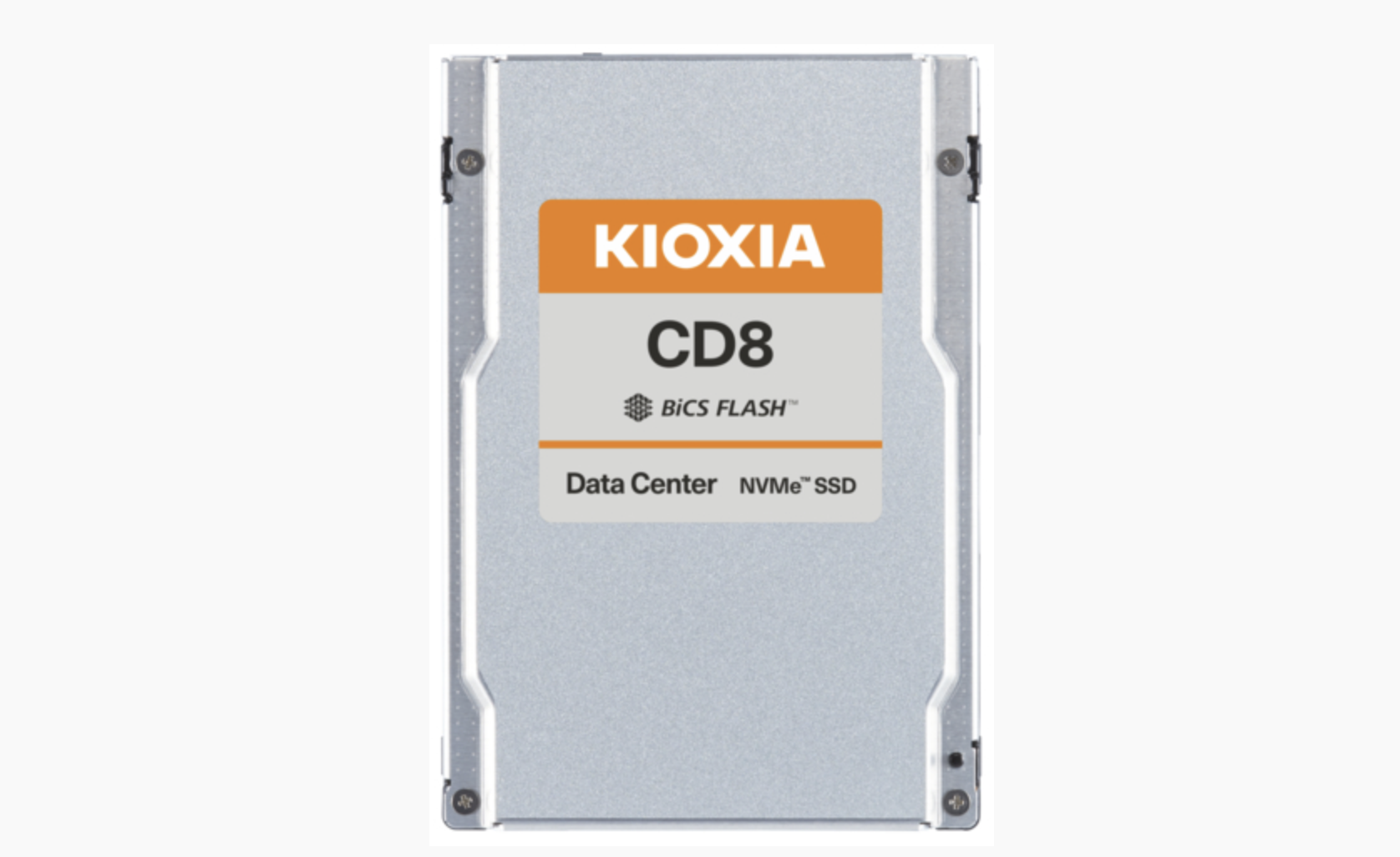
Kioxia intros data center SSDs with PCIe 5.0 -- 14% performance boost

Kioxia is the first to introduce a data center SSD with a PCIe 5.0 interface, which doubles the bandwidth over PCIe 4.0 from 16 gigatransfers per second (GT/s) to 32GT/s. The CD8 Series is now available for customer evaluation.

Based on Kioxia’s 5th generation BiCS FLASH 3D flash memory technology, the CD8 Series utilizes a proprietary Kioxia controller and firmware, which can be customized to customer needs, and is housed in a 2.5-inch[2], 15mm Z-height form factor. The new drives are designed to the PCIe 5.0, Open Compute Project (OCP) Datacenter NVMe SSD 2.0 and NVMe 1.4 specifications.

Additional features include:

  • Read-intensive 1DWPD (Drive Write Per Day) endurance models targeted for hyperscale and server-centric workloads, in capacities from 960GB to 15.36TB
  • Mixed-used 3DWPD endurance targeted models are available, in capacities from 800GB to 12.8TB
  • Delivers up to 1.25M random read IOPS and 7.2GB/s sequential read throughput, an improvement of approximately 14% over the previous generation version
  • Security options include sanitize instant erase (SIE) and self-encrypted drive (SED) 


Wednesday, February 9, 2022

WD and Kioxia suffer disruption at flash memory fab

Western Digital and Kioxia, its joint venture partner, announced that contamination of certain material used in its manufacturing processes has occurred and is affecting production operations at both its Yokkaichi and Kitakami flash fabrication facilities in Japan.

The anomoly concerns production of  three-dimensional (3D) flash memory BiCS FLASH at both plants. Kioxia does not anticipate that shipment of its conventional 2D NAND flash memory will be affected. 

Western Digital said its current assessment of the impact is a reduction of its flash availability of at least 6.5 exabytes. 


https://about.kioxia.com/en-jp/news/2022/20220210-1.html

Western Digital investor presentation


Tuesday, February 8, 2022

Toshiba aims for HDDs with 30TB by 2023, 40TB by 2026

Toshiba published the following roadmap for its next-generation Nearline HDDs. 

Toshiba plans to leverage its proprietary recording technologies, FC-MAMR (Flux-Controlled - Microwave-Assisted Magnetic Recording), MAS-MAMR (Microwave Assisted Switching – Microwave-Assisted Magnetic Recording), and Disk Stacking technology to lift Nearline HDD capacities to 30TB by FY2023, and greater capacities beyond.

“Toshiba continues to work closely with the cloud companies to understand their exact capacity and performance requirements, and the ability to utilize our next-generation technologies will be key to meeting our customers’ needs,” said Raghu Gururangan, Toshiba America Electronic Components, Inc. Vice President, Engineering & Product Marketing. “Many years of close collaboration work with our key component suppliers is leading to impactful technology breakthroughs to achieve higher capacities, which ultimately reduces TCO (total cost of ownership) of our Nearline HDDs.”

http://toshiba.semicon-storage.com/us/product/storage-products.html

Wednesday, December 29, 2021

Intel completes sale of its NAND and SSD business to SK hynix

Intel completed the first closing of the sale of its NAND and SSD business, selling its SSD business (including the transfer of certain NAND SSD-associated intellectual properties (IP) and employees) and the Dalian NAND memory manufacturing facility in China to Seoul-based SK hynix. In exchange, SK hynix will pay Intel US$7 billion in consideration. 

The deal was first announced October 19, 2020.

Intel said it plans to continue to manufacture NAND wafers at SK hynix’s Dalian memory manufacturing facility and retain certain IP related to the manufacture and design of NAND flash wafers until the final closing of the transaction, which is expected in March 2025, when SK hynix will acquire from Intel the remaining NAND business assets, including certain IP related to the manufacture and design of NAND flash wafers, R&D employees and the Dalian fab workforce, for US$2 billion.

The SSD business will transition to a newly formed company called Solidigm, a subsidiary of SK hynix. The company will be based in San Jose, California. It will be headed by Rob Crooke as CEO. Crooke was previously senior vice president and general manager of Intel’s Non-Volatile Memory Solutions Group. Lee Seok-hee, president and co-CEO of SK hynix, will be appointed executive chairman of Solidigm and will lead the post-merger integration processes after the first closing. 

Solidigm said its name reflects a new paradigm in solid-state storage. 

https://www.solidigmtechnology.com

Thursday, December 23, 2021

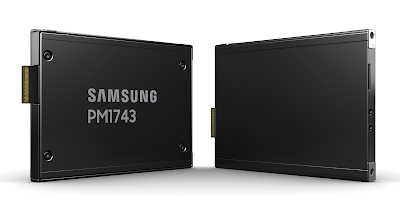
Samsung's new enterprise PCIe 5.0 SSD reads at up to 13,000 MB/sec

Samsung Electronics introduced its next-gen, enterprise SSDs integrating the PCIe 5.0 interface with its own sixth-generation V-NAND.

Samsung said its new PM1743 will feature a sequential read speed of up to 13,000 megabytes per second (MB/s) and a random read speed of 2,500K input/output operations per second (IOPS), offering 1.9x and 1.7x faster speeds over the previous PCIe 4.0-based products. Moreover, write speeds have been elevated significantly, with a sequential write speed of 6,600 MB/s and a random write speed of 250K IOPS, also delivering 1.7x and 1.9x faster speeds, respectively.  In addition, the new SSD can provide improved power efficiency of up to 608 MB/s per watt, which represents about a 30% boost over the previous generation. 

Samsung will offer a variety of capacities from 1.92 terabytes (TB) to 15.36TB in the conventional 2.5-inch form factor, as well as in a 3-inch EDSFF (E3.S) — an increasingly popular SSD form factor designed specifically for next-generation enterprise servers and data centers. 

Samsung also projects that customers deploying 7.5mm EDSFF SSDs will be able to double the storage density in their systems, compared to when the 15mm 2.5-inch form factor is used.

The new SSDs are also expected to be the industry's first PCIe 5.0 SSD with dual-port support.

"For over a decade, Samsung has been delivering SATA, SAS and PCIe-based SSDs that have been recognized for outstanding performance and reliability by leading enterprise server customers including corporations, governments and financial institutions," said Yong Ho Song, Executive Vice President and Head of the Memory Controller Development Team at Samsung Electronics. "The introduction of our PCIe 5.0 SSD, along with PCIe 6.0-based product developments that are underway, will further solidify our technological leadership in the enterprise server market."

"Intel has been working with Samsung to test Samsung's newest PCIe NVMe SSD, the PM1743. Together, we have jointly resolved complicated technical issues encountered with PCIe 5.0 during this initial evaluation period. The performance potential of Gen5 is truly impressive. In the near future, we strongly believe that PCIe Gen5 systems with high-speed NVMe SSDs will have the ability to transform applications such as AI/ML and high-performance databases," said Jim Pappas, Director, Technology Initiatives, Intel Corporation. "Looking ahead, we are confident that Intel and Samsung's continued commitment in industry leadership will provide these and other benefits to our mutual customers."

Mass production is expected in Q1 2022.

https://news.samsung.com/us/samsung-develops-high-performance-pcie-5-ssd-enterprise-servers/